
Research article · 2025 · Full text
International Journal of Agriculture and Food ScienceRecent trends in farm machineries for horticulture
Volume 7(9) · Pages 909–911 · DOI: 10.33545/2664844x.2025.v7.i9l.843 ↗
Research areasCrop Yield and Soil Fertility
Abstract
Author-writtenHorticultural mechanization has emerged as a crucial driver of productivity, quality enhancement, and sustainability. Unlike broadacre agriculture, horticultural crops require highly specialized machinery due to smaller plot sizes, intensive cultural operations, and delicate produce. Over the last decade, but especially in the period 2020-2025, significant technological progress has been recorded in precision farming, automation, robotics, electrification, protected cultivation machinery, and post-harvest processing. Digital tools such as artificial intelligence (AI), Internet of Things (IoT), and cloud-based decision support systems are accelerating adoption. This review synthesizes recent trends, examines adoption constraints, identifies research gaps, and proposes future directions to foster wider use of modern farm machineries in horticulture.
Summary
Source-checkedPlain-language reading of the full paper, prepared with AI and checked against the text. Each point links to the authors' own words.
Why it matters
- Horticultural crops, including fruits, vegetables, and plantation crops, are vital for generating income and ensuring nutritional security. View evidence ↗
- India is a global leader in fruit and vegetable production, producing over 355 million tonnes in 2022-23. View evidence ↗
- The need for mechanization is increasing due to rising labor costs, seasonal labor shortages, and a demand for high-quality, uniform produce. View evidence ↗
The question
- The paper aims to review recent trends in horticultural mechanization, specifically focusing on robotics, precision agriculture, electrification, and digital integration, while identifying research gaps. View evidence ↗
What they did
- The authors conducted a review to synthesize technological trends, examine barriers to adoption, and propose future research directions. View evidence ↗
What they found
- Precision spraying systems utilizing ultrasonic sensors have reduced pesticide use by up to 30% in vineyards. View evidence ↗
- Robotic harvesters for citrus, tomatoes, strawberries, and apples are being developed using soft grippers, depth cameras, and machine vision. View evidence ↗
- For small-scale machinery, electric motors are reported to be 30-40% more energy-efficient than diesel engines. View evidence ↗
- The area dedicated to protected cultivation in India is more than 1.5 lakh hectares. View evidence ↗
- In India, post-harvest losses for vegetables and fruits are estimated to be between 15% and 25%. View evidence ↗
What it means
- The adoption of robotics is limited by high initial costs, energy constraints, fruit maturity variability, and the complexity of crop canopies. View evidence ↗
Visual summary
1 visualsIllustrations explain the paper; they do not show study data.
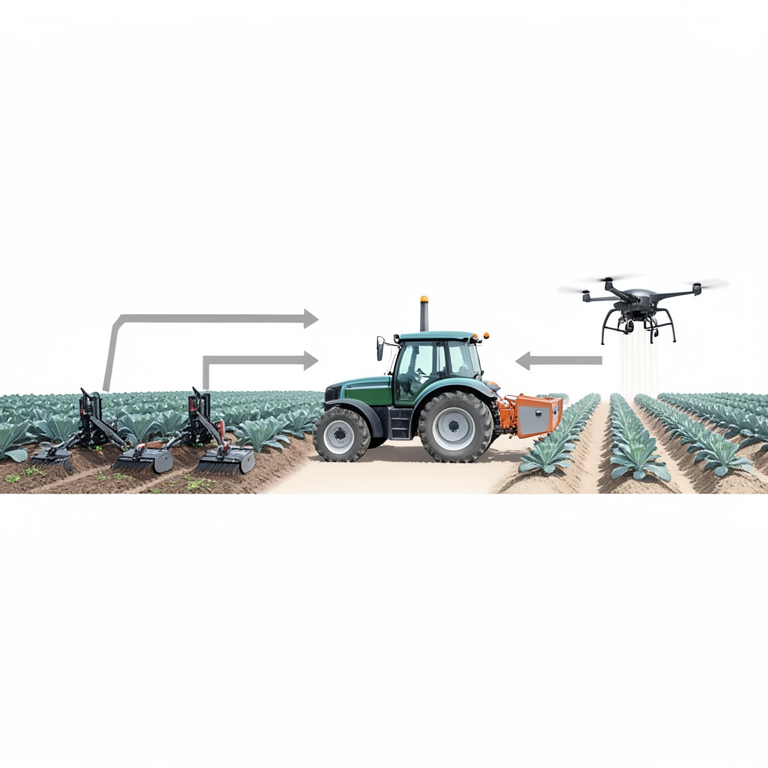
Study overview
AI-generated conceptual illustration (modern horticultural farm machinery in a vegetable field). It explains the idea and does not show study data.
View source evidence ↗Introduction
Horticultural cropsfruits, vegetables, floricultural and plantation cropscontribute substantially to nutritional security and income generation. India is the second largest producer of fruits and vegetables globally, with production exceeding 355 million tonnes in 2022-23 (NHB, 2023). However, production is highly labour-intensive; operations such as planting, weeding, pruning, spraying, harvesting, grading and packaging demand precision and skill. Rising labour costs, seasonal shortages, and consumer demand for uniform, highquality produce are intensifying the need for mechanization. In contrast to field crops, horticultural mechanization faces unique challenges: smaller farm holdings, high-value but delicate produce, diverse crop morphology, and the need for gentle handling. Recent years have witnessed rapid advances in robotics, sensor-based systems, renewable-energy-powered equipment, and post-harvest machines. Integration of digital technologies such as IoT and AI further strengthens mechanization outcomes. This article reviews recent trends in horticultural mechanization with focus on precision agriculture, automation and robotics, electrification, machines for protected cultivation, postharvest innovations, and digital integration, followed by identification of research gaps and policy priorities.
Precision Agriculture in Horticulture
Precision farming technologies are being increasingly customized for horticulture. Sensors and monitoring devices: Soil moisture sensors, canopy reflectance sensors, and low-cost IoT-enabled devices help optimize irrigation and fertigation. Variable rate application (VRA): Nutrients and pesticides are delivered based on crop and canopy variability, reducing wastage. GNSS/RTK-based systems: These allow accurate row planting, orchard mapping, and autonomous navigation in narrow inter-row spaces. Decision support systems (DSS): Integrated platforms now combine weather forecasts, soil data, and plant growth models to guide orchard management.
For example, precision spraying systems using ultrasonic sensors achieved up to 30% reduction in pesticide use in vineyards (Pallottino et al., 2021) [4] . Similar studies in apple and citrus orchards confirm higher input efficiency.
Automation and Robotics Robotic harvesters
Fruit harvesting is labour-intensive and time-sensitive. Robotic harvesters equipped with machine vision, depth cameras, and soft grippers are being developed for apples, strawberries, tomatoes, and citrus. Commercial prototypes like the strawberry harvester (Belgium) and FFRobotics apple picker (USA) demonstrate progress, although speed and cost remain bottlenecks.
Unmanned Ground Vehicles (UGVs)
Small-scale UGVs fitted with weeding tools, sprayers, or load carriers are increasingly used in high-value crops.
Researchers at Wageningen University developed a robotic lettuce harvester, while Indian prototypes of robotic weeders for vegetables show promise in labour substitution.
Drones in horticulture
Drones are applied for Aerial spraying of micronutrients and pesticides in vineyards and mango orchards. Remote sensing for canopy stress detection. Pollination support in greenhouse crops.
Challenges
Robotic adoption is slowed by canopy complexity, variability in fruit maturity, energy constraints, and high initial investment.
Electrification and Renewable Energy Integration
Electrification is a major trend across agriculture, with horticulture as an early adopter due to smaller machines and confined operations. Battery-powered sprayers and weeders are widely available for small farmers. Electric tractors (e.g., Monarch Tractor, Sonalika Tiger Electric) are being trialed in orchards. Solar-powered cold rooms and dryers help reduce postharvest losses in perishable horticultural crops.
Studies suggest that electric motors are 30-40% more energy-efficient compared to diesel counterparts for smallscale machinery (Mohanraj et al., 2022) [2] . Challenges include battery replacement costs and charging infrastructure.
Mechanization for Protected Cultivation and High-Density Orchards
Protected cultivation area in India exceeds 1.5 lakh hectares. Mechanization within greenhouses and polyhouses requires compact, modular equipment. Mobile platforms for spraying, harvesting, and pruning are now used in cucumber and capsicum cultivation. Robotic pruners in apple and grapevine systems increase uniformity and reduce labour cost. Automated fertigation units with pH and EC sensors deliver precise nutrient solutions.
High-density orchards (apple, guava, mango) are benefiting from compact tractors, mechanical pruners, and platform harvesters designed for narrow alleys.
Post-Harvest Mechanization
Post-harvest losses in fruits and vegetables in India are estimated at 15-25% (FAO, 2021). Mechanization is critical to reducing this loss. Grading and sorting machines use vision sensors to classify fruits by size, colour, and quality. On-farm pack houses with conveyor belts, washing, waxing, and packaging lines are expanding under government schemes. Solar-powered cold storage units improve shelf life for smallholders. Mechanical dryers enhance processing for chilies, ginger, and onion.
Research is now focusing on affordable and modular postharvest units for small-scale farmers (Subash Sunar et al, 2022) [8] .
Digitalization and AI Integration
Digitalization and AI Integration
Conclusion
Farm mechanization in horticulture is at a transformative stage. Precision agriculture, automation, electrification, and post-harvest innovations hold immense promise. However, adoption hinges on affordability, service ecosystems, and context-specific design. Future research must focus on developing scalable, cost-effective, and sustainable technologies that suit small and medium horticultural holdings while integrating digital tools for efficiency.
References
9 in the original paper- Food and Agriculture Organization (FAO). Food Loss and Waste Database. Rome: FAO; 2021.
- K, Senthilkumar S, Kumar V. Electrification of farm machinery: Opportunities and challenges for Indian horticulture. Journal of Agricultural Engineering. 2022;59(4):45-53.
- National Horticulture Board (NHB). Horticultural Statistics at a Glance 2023. Ministry of Agriculture and Farmers Welfare, Government of India; 2023.
- Pallottino F, Figorilli S, Menesatti P, Antonucci F, Costa C. Advances in precision spraying for orchard crops: A review. Biosyst Eng. 2021;202:39-54.
- Rathore DS, Singh K, Pandey R. Robotics in horticultural production systems: Current status and future prospects. Indian J Hortic. 2023;80(2):155-166.
- Singh G, Kumar P. Recent mechanization trends in protected cultivation and high-density orchards. J Hortic Sci. 2022;17(1):23-31.
- Tiwari SP, Mishra R, Jha K. IoT-enabled smart horticulture: Emerging opportunities for India. Journal of Agricultural Engineering. 2023;60(2):65-74.
- Sunar S, Sapkota D, Dumre A, Bhattarai I, Sharma DR, Sapakota MM. Status of farm mechanization on rice production: A case study of Banganga Municipality, Kapilvastu, Nepal. Int J Agric Extension Social Dev. 2022;5(1):28-31. DOI:10.33545/26180723.2022.v5.i1a.120
- Zhang Y, Chen H, Li B. Robotic harvesting technologies for fruits: A review of recent progress. Comput Electron Agric. 2022;197:106933.
Cited by 4
From OpenAlex, OpenCitations and reference lists read by Scinovex
- Designing climate-resilient farm machinery: A review on adaptive technologies for heat, drought, and soil conservation challenges
Yuvraj Gopinath Kasal, Satyapal Singh, Shahroon Khan · International Journal of Horticulture and Food Science · 2025
Climate change has intensified abiotic stresses such as heat, drought, and soil degradation, directly impacting the performance, durability, and efficiency of agricultural machinery. Designing climate-resilient farm machinery (CRFM) is therefore essential to maintain productivity under variable weather and resource constraints. This review synthesizes global progress in adaptive machinery design focusing on thermal management, material innovation, soil-conserving implements, and smart control systems that respond dynamically to climatic conditions. The integration of renewable energy, automati
- Hybrid Power Systems in Farm Machinery: A Review of Solar, Biofuel, and Hydrogen-Assisted Agricultural Mechanization
Yuvraj Gopinath Kasal, Shahroon Khan, Satyapal Singh · International Journal of Agriculture and Food Science · 2025
Hybrid power solutions that combine solar electricity, biofuels, and hydrogen (fuel-cell or dual-fuel) with conventional engines are emerging as practical pathways to decarbonize agricultural mechanization while maintaining operational flexibility. This review synthesizes recent advances in solar-assisted charging and agrivoltaic concepts, biofuel (biodiesel/ethanol/biomethane) utilisation in off-road engines, and hydrogen fuel-cell or hydrogen-assisted hybrid drivetrains for tractors and implements. We compare technical architectures (series hybrids, parallel hybrids, range-extenders, and mod
- Scale-appropriate mechanization: A review of low-cost, energy-efficient farm machinery solutions for smallholder farmers
Yuvraj Gopinath Kasal, Satyapal Singh, Shahroon Khan · International Journal of Agriculture and Nutrition · 2025
Agricultural mechanization has long been associated with increased productivity, yet conventional large-scale machinery often remains inaccessible to smallholder farmers due to high costs, inappropriate scale, and limited technical support. This review focuses on scale-appropriate mechanization (SAM) a sustainable approach emphasizing low-cost, energy-efficient, and locally adaptable technologies designed for small farms, typically below two hectares. It synthesizes technological, economic, and institutional dimensions of SAM, including innovations in lightweight materials, renewable-powered i
- Emerging Trends in Agricultural Robotics: Integration of Artificial Intelligence, Machine Vision, and IoT in Farm Machinery
Yuvraj Gopinath Kasal, Satyapal Singh, Shahroon Khan · International Journal of Agriculture and Nutrition · 2025
Agricultural robotics is rapidly maturing from isolated prototypes to integrated systems that combine artificial intelligence (AI), machine vision, and the Internet of Things (IoT). This review synthesizes recent advances, practical deployments, and research challenges at the intersection of robotics, perception, and connectivity in farm machinery. We examine design paradigms for autonomous platforms, sensor suites and vision pipelines for crop/weed/fruit tasks, edge and cloud AI for perception and planning, IoT architectures for fleet and energy management, human-robot interaction and safety,