
Research article · 2025 · Full text
International Journal of Agriculture and Food ScienceHybrid Power Systems in Farm Machinery: A Review of Solar, Biofuel, and Hydrogen-Assisted Agricultural Mechanization
Volume 7(11) · Pages 14–17 · DOI: 10.33545/2664844x.2025.v7.i11a.935 ↗
Research areasElectric and Hybrid Vehicle TechnologiesBiodiesel Production and ApplicationsHybrid Renewable Energy Systems
Abstract
Author-writtenHybrid power solutions that combine solar electricity, biofuels, and hydrogen (fuel-cell or dual-fuel) with conventional engines are emerging as practical pathways to decarbonize agricultural mechanization while maintaining operational flexibility. This review synthesizes recent advances in solar-assisted charging and agrivoltaic concepts, biofuel (biodiesel/ethanol/biomethane) utilisation in off-road engines, and hydrogen fuel-cell or hydrogen-assisted hybrid drivetrains for tractors and implements. We compare technical architectures (series hybrids, parallel hybrids, range-extenders, and modular solar-battery stations), energy-management strategies, system integration challenges (weight, ruggedisation, refuelling/recharging logistics), life-cycle environmental implications, and economics. Representative field demonstrations and modelling studies indicate that solar-assisted micro-tractors and hybrid tractors are already viable for low-range specialty tasks, while fuel flexibility with advanced biofuels and hydrogen shows promise for heavier, continuous work as infrastructure matures. Major barriers include energy density limits, capital cost, rural hydrogen and charging infrastructure, feedstock sustainability for biofuels, and standards/regulation gaps. We close with a research and pilot-deployment roadmap that prioritises duty-cycle measurement, modular hybrid demonstrators, on-farm energy integration, and circular-economy pathways for fuels and batteries.
Summary
Source-checkedPlain-language reading of the full paper, prepared with AI and checked against the text. Each point links to the authors' own words.
Why it matters
- Agricultural mechanization is currently dependent on internal-combustion engines for power and implement operation. View evidence ↗
- Reducing carbon emissions in farming is difficult due to high energy needs, harsh environments, and the requirement for long autonomy during peak periods. View evidence ↗
- Hybrid systems using solar, biofuels, and hydrogen can lower greenhouse gas emissions without sacrificing the reliability or range of traditional engines. View evidence ↗
The question
- The paper aims to synthesize recent progress in solar-assisted charging, biofuel use in off-road engines, and hydrogen-assisted hybrid drivetrains for agricultural machinery. View evidence ↗
What they did
- The review compares various technical architectures, including series and parallel hybrids, alongside energy management, integration challenges, and economic impacts. View evidence ↗
- The analysis is based on representative modelling studies and field demonstrations of hybrid and solar-assisted tractors. View evidence ↗
What they found
- Micro-tractors with 5-15 kWh battery packs and solar stations are feasible for specific tasks like weeding and seeding if charging is managed intelligently. View evidence ↗
- Renewable diesel (HVO) is generally a drop-in replacement for fossil diesel and lowers lifecycle emissions. View evidence ↗
- Hydrogen fuel cells are better suited for heavy, continuous work than batteries because they offer higher energy density per mass and faster refueling. View evidence ↗
- Pure battery-electric vehicles (BEVs) are currently impractical for large-scale tillage because of the high cost and weight of the batteries. View evidence ↗
- Using batteries large enough for long fieldwork increases the weight of the machinery, which leads to higher soil compaction and lower payload capacity. View evidence ↗
- Hybrid power systems currently have higher initial capital costs compared to conventional tractors. View evidence ↗
What it means
- The authors conclude that the best hybrid technology depends on the specific region, the task's duty cycle, available local feedstocks, and financial access. View evidence ↗
- The authors recommend prioritizing field measurements, modular hybrid demonstrators, on-farm energy pilots, and sustainable policy frameworks. View evidence ↗
- Key limitations to adoption include energy density constraints, high costs, lack of rural infrastructure for charging and hydrogen, and gaps in regulation. View evidence ↗
Visual summary
1 visualsIllustrations explain the paper; they do not show study data.
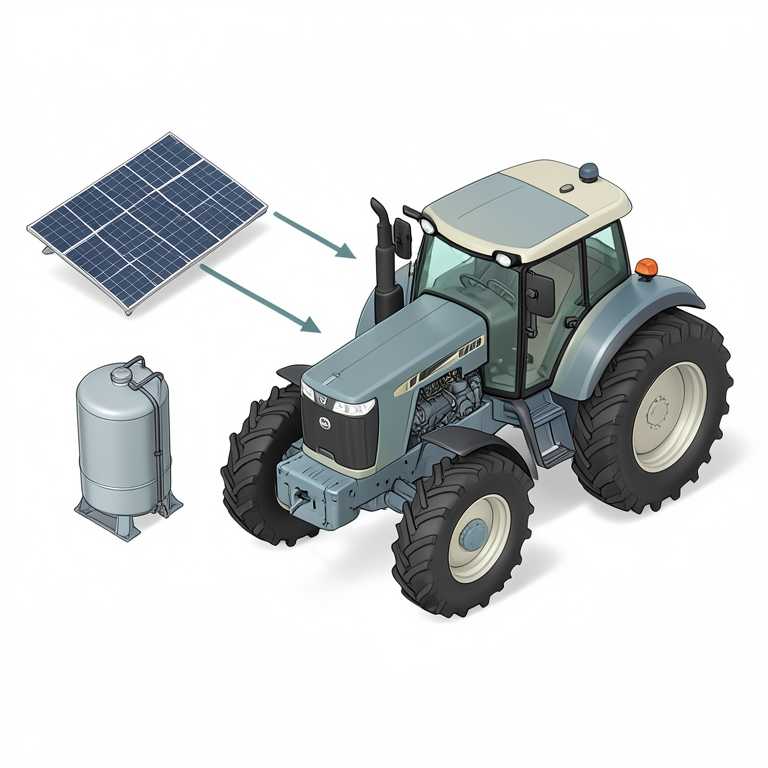
Hybrid Power Ecosystem
AI-generated conceptual illustration (modern agricultural tractor). It explains the idea and does not show study data.
View source evidence ↗Figures & tables
From the original paper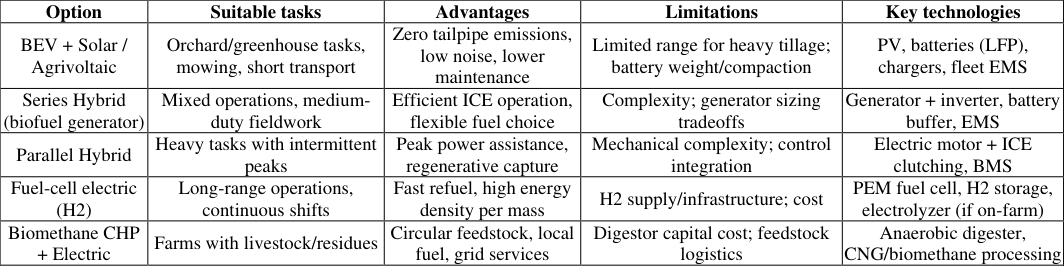 Table 1
Introduction
Mechanized agriculture relies heavily on internal-combustion engines (ICEs) for traction power, PTO, and implement actuation. Decarbonizing farm power is challenging because of the high energy demands, variable duty cycles, rough operating environments, and the need for long operational autonomy during peak seasons. Hybrid power systemscombining electrical storage or generation (solar PV + batteries), renewable liquid/ gaseous fuels (biodiesel, bioethanol, biomethane), and hydrogen (fuel cells or hydrogen-assisted engines) offer multiple pathways to reduce greenhouse-gas (GHG) emissions while retaining the reliability and range of conventional powerplants. This review focuses on three complementary approaches: solar-assisted electrification and agrivoltaics, biofuel integration (including drop-in and advanced biofuels), and hydrogen-assisted powertrains (fuel-cells, hydrogen-diesel dual-fuel). We synthesize the state of technology, real-world pilots, energymanagement options, lifecycle and economic considerations, and research needs. Recent reviews and field projects provide a foundation for the techno-economic and policy perspectives discussed here.
Architectural options for hybrid farm power
Farm hybrid power systems are implemented using several drivetrain and energy-supply topologies. The major classes are: 1. Battery-Electric with Solar Assist (BEV + Solar): Onboard battery supplies traction and PTO power; charging occurs overnight or via on-farm PV (stationary array or agrivoltaic panels). For extended operations, stationary storage can buffer PV generation. This is ideal for short-range, repetitive tasks (orchard, greenhouse, mowing).
Use cases in farm hybrid systems
Biofuels are attractive as range-extender fuels in series hybrids (generator operation), or as the main fuel in dualfuel engines that blend hydrogen or pilot fuel with biofuel to improve combustion and emissions. On mixed farms with livestock, biomethane produced from anaerobic digestion can be a locally available low-carbon fuel for stationary gensets or modified vehicles.
Hydrogen and fuel-cell assisted powertrains Fuel-cell tractors and hydrogen hybrids: tech status
Hydrogen fuel cells for heavy duty and off-highway applications, including prototypes of fuel-cell tractors and hydrogen-hybrid systems, have advanced through demonstration projects and R&D consortia. Fuel-cell systems offer high energy density per mass compared to batteries and the possibility of fast refuelling, making them appealing for long-range or continuous heavy work. Recent work on hydrogen-hybrid or fuel-cell tractors shows promising efficiency and range projections but highlights infrastructure and cost barriers.
Integration patterns and energy management
Common patterns include: (a) fuel-cell + battery hybrid, where the fuel cell provides sustained power and the battery handles transients and regenerative capture; (b) hydrogen-diesel dual-fuel engines where hydrogen reduces diesel consumption and emissions; and (c) electrolyzer + hydrogen storage on farm integrated with PV to produce and store seasonal hydrogen for peak demand. Effective energy management manages hydrogen flow, battery SOC, and generator/fuel-cell operation to optimize system efficiency and hydrogen consumption. Simulation studies and early field trials underscore the importance of duty-cycle tuned sizing to avoid excessive hydrogen consumption.
Barriers and enablers
Barriers: Hydrogen production (green hydrogen cost), distribution/refuelling infrastructure in rural areas, safety and storage challenges, and system capital cost. Enablers: Development of regional hydrogen hubs, colocation of electrolyzers with high-solar sites or biogas reformers, policy support and industrial partnerships for heavy machinery applications (e.g., OEM trials).
Comparative assessmentperformance, lifecycle, and economics Field performance indicators
Key metrics for comparing hybrid options include: energy or fuel consumed per hectare (kWh/ha or L/ha), effective drawbar/ PTO power delivered, duty-cycle matching (fraction of operations within battery or hydrogen range), soil compaction impacts (mass distribution), noise and operator comfort, and system availability/downtime. Recent modelling indicates BEV and solar-assisted micro-tractors can reduce operational emissions markedly for short-range tasks; large-scale tillage remains challenging for pure BEV due to battery weight and cost unless hybridization is used.
Lifecycle and emissions (LCA) considerations
LCA outcomes depend strongly on electricity carbon intensity (for BEV and electrolysis hydrogen), feedstock sourcing for biofuels, and the embodied carbon of battery and fuel-cell manufacturing. When powered by low-carbon electricity or renewable fuels (biomethane, sustainably produced biofuels, or green hydrogen), hybrid systems can achieve significant GHG reductions versus fossil diesel. However, battery production and end-of-life recycling, as well as the potential for indirect land-use change from feedstocks, must be accounted for.
Economic tradeoffs and business models
Capital costs for hybrid systems remain higher than conventional tractors; operating cost savings (fuel, maintenance) and incentives (grants, carbon credits) influence payback. Business models that reduce upfront burdenleasing, battery/fuel-as-a-service, and Custom Hiring Centers (CHCs) sharing equipped machinesimprove accessibility for smallholders. On-farm generation (PV + storage + biofuel production) can improve economics in high-tariff or remote grid contexts. Sensitivity analyses show break-even is sensitive to diesel price, PV costs, hydrogen price, and utilization rate.
Conclusions
Hybrid power systems combining solar, biofuels, and hydrogen represent pragmatic, complementary paths to decarbonize agricultural mechanization. Solar-assisted electrification is close to viability for many low-range tasks and benefits from falling PV and battery costs; biofuels (especially renewable diesel/HVO and biomethane) offer immediate drop-in potential that leverages existing fleets and distribution channels; hydrogen and fuel-cell hybrids show promise for high-duty, long-range farm work but require substantial infrastructure and cost reductions to scale. The optimal technological mix will be region-and task-dependent determined by duty cycle, local feedstocks, electricity carbon intensity, and access to capital. Priority actions include robust field measurement campaigns, modular demonstrators for series/parallel hybrids and fuelcell systems, on-farm integrated energy pilots, and policy frameworks that ensure sustainable feedstock sourcing and infrastructure development. Close collaboration between OEMs, utilities, agro-enterprises, and policymakers will be essential to translate technical advances into resilient, lowcarbon farm power systems.
Figures and tables from the paper
References
9 in the original paper- Yang Y, et al. A review of green agriculture and energy management strategies for hybrid tractors. Energies. 2025.
- Zhang M, et al. Energy management strategy for fuel cell hybrid tractor. Sci Rep. 2024.
- Obalalu AM, et al. Improving agricultural efficiency with solar-powered electric micro-tractors. Renew Energy. 2023.
- Osman WNAW, et al. Comparative review of biodiesel production and purification. Fuel Process Rev. 2024.
- Kivekäs K, et al. Energy efficiency and CO₂ emissions of battery electric tractors: modelling and field study. 2025.
- Kasal YG, Singh S, Khan S. Recent trends in farm machineries for horticulture. Int J Agric Food Sci. 2025;7(9):909-11. doi:10.33545/2664844X.2025.v7.i9l.843
- Kasal YG, Singh S, Khan S. Electrification of agricultural machinery: advances in battery technology, powertrain design, and field performance for sustainable farming. Int J Agric Food Sci. 2025;7(10):252-6. doi:10.33545/2664844X.2025.v7.i10d.881
- Kasal YG, Singh S, Khan S. Innovations in farm machinery for sustainable horticultural production: an Indian perspective. Int J Hortic Food Sci. 2025;7(10):86-9. doi:10.33545/26631067.2025.v7.i10b.407
- Kasal YG, Singh S, Khan S. Emerging trends in agricultural robotics: integration of artificial intelligence, machine vision, and IoT in farm machinery. Int J Agric Nutr. 2025;7(10):70-4. doi:10.33545/26646064.2025.v7.i10b.303