
Research article · 2025 · Full text
International Journal of Agriculture and NutritionScale-appropriate mechanization: A review of low-cost, energy-efficient farm machinery solutions for smallholder farmers
Volume 7(11) · Pages 22–23 · DOI: 10.33545/26646064.2025.v7.i11a.309 ↗
Research areasSmart Agriculture and AIAgricultural Engineering and MechanizationInnovation and Socioeconomic Development
Abstract
Author-writtenAgricultural mechanization has long been associated with increased productivity, yet conventional large-scale machinery often remains inaccessible to smallholder farmers due to high costs, inappropriate scale, and limited technical support. This review focuses on scale-appropriate mechanization (SAM) a sustainable approach emphasizing low-cost, energy-efficient, and locally adaptable technologies designed for small farms, typically below two hectares. It synthesizes technological, economic, and institutional dimensions of SAM, including innovations in lightweight materials, renewable-powered implements, modular design, and service-based access models. Case studies from Asia and sub-Saharan Africa demonstrate how inclusive mechanization enhances labor efficiency, crop yields, and environmental sustainability. Challenges such as affordability, standardization, and after-sales services are discussed, along with emerging opportunities involving digital tools, 3D printing, and AI-driven machinery optimization. The paper concludes that scaling SAM through decentralized innovation hubs and cooperative service platforms can accelerate agricultural modernization without marginalizing smallholders.
Summary
Source-checkedPlain-language reading of the full paper, prepared with AI and checked against the text. Each point links to the authors' own words.
Why it matters
- Agricultural mechanization is a key factor in improving food security, crop yields, and labor efficiency. View evidence ↗
- Standard large-scale farm machinery is often unsuitable for smallholder farmers because it is too expensive, too large, and lacks technical support. View evidence ↗
- In India, 85% of farms are smaller than 2 hectares, but most available tractors are over 35 horsepower, which is technically and economically inappropriate for such small plots. View evidence ↗
The question
- The review examines Scale-Appropriate Mechanization (SAM), which focuses on low-cost, energy-efficient technologies for farms typically under two hectares. View evidence ↗
What they did
- The authors synthesized information regarding the technological, economic, and institutional aspects of SAM, including modular designs and renewable energy. View evidence ↗
- The review utilizes case studies from sub-Saharan Africa and Asia to evaluate the impact of inclusive mechanization. View evidence ↗
What they found
- Hybrid diesel-battery systems and electric drives can increase energy efficiency by 15-25% and lower emissions. View evidence ↗
- In India, solar-powered sprayers have demonstrated a 40% reduction in energy costs when compared to petrol-powered units. View evidence ↗
- Custom Hiring Centers (CHCs) increase the utilization of machinery by 60% and lower costs per acre by 25%. View evidence ↗
- Programs for inclusive mechanization have achieved labor savings of up to 50% in the cultivation of vegetables. View evidence ↗
- Electric and hybrid systems reduce CO2 emissions by nearly 30% compared to small diesel engines. View evidence ↗
- Institutional support exists through the Sub-Mission on Agricultural Mechanization (SMAM) for distribution and the Africa Mechanization Framework for local manufacturing. View evidence ↗
What it means
- The authors conclude that using cooperative service platforms and decentralized innovation hubs to scale SAM can modernize agriculture without excluding smallholder farmers. View evidence ↗
- Obstacles to the adoption of SAM include limited financing options, weak service networks, and fragmented supply chains. View evidence ↗
Visual summary
1 visualsIllustrations explain the paper; they do not show study data.
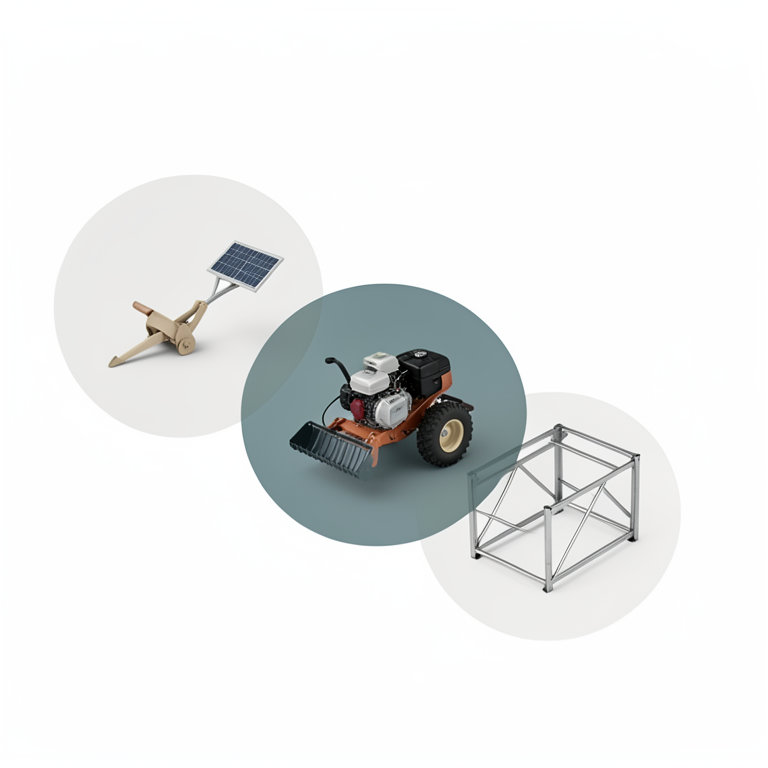
SAM Framework Overview
AI-generated conceptual illustration (smallholder farm machinery). It explains the idea and does not show study data.
View source evidence ↗Figures & tables
From the original paper Table 1
Introduction
Mechanization remains a fundamental driver of agricultural productivity, influencing labor efficiency, crop yields, and food security. However, the mechanization process has historically favored large-scale operations, leaving smallholders who constitute over 80% of global farmers dependent on manual or animal power. In India, for instance, 85% of farms are below 2 hectares (FAO, 2022) [4], yet most available tractors exceed 35 horsepower, making them economically and technically unsuitable. Scale-Appropriate Mechanization (SAM) is an emerging paradigm that tailors mechanization solutions to the constraints and capacities of smallholders.
It focuses on minimizing power requirements, ensuring affordability, and adapting implements for diversified cropping systems and fragmented landholdings. Recent advances in energy-efficient power units, modular implements, and digital platforms are transforming how smallholders access and utilize machinery. Evolution of Scale-Appropriate Mechanization Historically, mechanization was linear progressing from human labor to animal traction, then to fossil-fuel-based tractors. However, small-scale farmers often faced “mechanization traps”: inappropriate machine size, high maintenance cost, and poor service support.
The modern SAM framework promotes appropriate technology design, energy optimization, and inclusive access through custom hiring centers and cooperative ownership. Technological Components of Scale-Appropriate Mechanization Power Units Mini-tractors (8-20 HP), two-wheel tractors, and solar-powered power tillers form the backbone of SAM. Advances in electric drives and hybrid diesel-battery systems enhance energy efficiency by 15-25% while reducing emissions. NAAS Rating (2025): 4.69 IJAN 2025; 7(11): 22-23 Yuvraj Gopinath Kasal Deptt.
Of Farm Power and Machinery, Maharana Pratap Horticultural University, Karnal, Haryana, India Satyapal Singh Deptt. Of Vegetable Science, Maharana Pratap Horticultural University, Karnal, Haryana, India Shahroon Khan Deptt. Of Fruit Sciecne, Maharana Pratap Horticultural University, Karnal, Haryana, India Yuvraj Gopinath Kasal Deptt. Of Farm Power and Machinery, Maharana Pratap Horticultural University, Karnal, Haryana, India https://www.agriculturejournal.net Implements and Attachments Modular implements such as adjustable seed drills, multi- crop planters, and reversible ploughs allow flexibility across crops.
The design emphasis is on weight reduction, multi- functionality, and easy coupling. Renewable-Powered Machinery Solar energy integration in water pumps, sprayers, and threshers is increasingly viable due to declining PV costs. Field demonstrations in India (ICAR, 2021) [5] show solar sprayers achieving 40% energy cost reduction compared with petrol units. Digital and IoT Integration Low-cost Bluetooth and GSM modules enable farmers to track operational data, fuel consumption, and service alerts.
Start-ups such as Trringo and KhetiGaadi have digitized machinery rentals for smallholder clusters. Table 1: Representative Scale-Appropriate Machinery Options design, digital tools, and cooperative business models to democratize technology for millions of smallholders.
| Machine Type | Power Source | Major Applications | Advantages | Constraints |
|---|---|---|---|---|
| Two-wheel tractor | Diesel/electric hybrid | Ploughing, hauling, tillage | Multipurpose, affordable | Limited traction |
| Mini power tiller | Battery-assisted | Intercultural operations | Compact, low maintenance | Limited runtime |
| Solar sprayer | PV + Li-ion battery | Crop protection | No fuel dependency | Limited autonomy |
| Manually operated planter | Mechanical | Seeding, weeding | Very low cost | Labor intensive |
| IoT-enabled irrigation unit | Solar + GSM | Water control | Remote automation | Network dependence |
Table text extracted from the original PDF; superscript letters are shown inline. The original table image is below.
View original table image
Conclusion
Scale-appropriate mechanization provides a pragmatic approach to sustainable intensification of smallholder agriculture. Innovations in compact power sources, modular implements, and renewable energy integration have demonstrated tangible gains in efficiency and affordability. The future of SAM lies in convergence blending mechanical
References
13 in the original paper- Sims B, Kienzle J. Sustainable agricultural mechanization: A framework for Africa. Agric Mech Asia Afr Lat Am. 2017;48(1):20-26.
- Biggs S, Justice S. Rural mechanization: The roles of policy and the private sector in South Asia. Food Policy. 2015;41:31-38.
- Singh G, Chandel NS. Mechanization trends in Indian agriculture: Energy and economics. Curr Sci. 2020;118(10):1573-1581.
- Food and Agriculture Organization (FAO). Smallholder mechanization strategies for sustainable intensification. Rome: FAO; 2022.
- Indian Council of Agricultural Research (ICAR). Annual Report on Farm Machinery Development. New Delhi: ICAR; 2021.
- Kasal YG, Singh S, Khan S. Recent trends in farm machineries for horticulture. Int J Agric Food Sci. 2025;7(9):909-911. doi:10.33545/2664844X.2025.v7.i9l.843.
- Kasal YG, Singh S, Khan S. Electrification of agricultural machinery: Advances in battery technology, powertrain design, and field performance for sustainable farming. Int J Agric Food Sci. 2025;7(10):252-256. doi:10.33545/2664844X.2025.v7.i10d.881.
- Kasal YG, Singh S, Khan S. Innovations in farm machinery for sustainable horticultural production: An Indian perspective. Int J Hortic Food Sci. 2025;7(10):86-89. doi:10.33545/26631067.2025.v7.i10b.407.
- Kasal YG, Singh S, Khan S. Emerging trends in agricultural robotics: Integration of artificial intelligence, machine vision, and IoT in farm machinery. Int J Agric Nutr. 2025;7(10):70-74. doi:10.33545/26646064.2025.v7.i10b.303. Machine Type Power Source Major Applications Advantages Constraints Two-wheel tractor Diesel/electric hybrid Ploughing, hauling, tillage Multipurpose, affordable Limited traction Mini power tiller Battery-assisted Intercultural operations Compact, low maintenance Limited runtime Solar sprayer PV + Li-ion battery Crop protection No fuel dependency Limited autonomy Manually operated planter Mechanical Seeding, weeding Very low cost Labor intensive IoT-enabled irrigation unit Solar + GSM Water control Remote automation Network dependence Economic and Social Dimensions Cost and Access Models For smallholders, machinery ownership is often unfeasible. Custom Hiring Centers (CHCs) and Farmer Producer Organizations (FPOs) allow pay-per-use access. Studies show CHCs improve machinery utilization by 60% while reducing per-acre costs by 25%. Gender and Labor Impacts SAM technologies such as ergonomic weeders and lightweight harvesters reduce drudgery for women farmers. Inclusive mechanization programs (FAO, 2022) [4] have shown labor savings up to 50% in vegetable cultivation. Environmental Benefits Reduced fuel use and soil-friendly implements lower carbon emissions and preserve soil structure. Hybrid and electric systems cut CO₂ emissions by nearly 30% compared with small diesel engines. Policy and Institutional Framework Countries such as India, Bangladesh, and Kenya have launched targeted SAM initiatives. The Sub-Mission on Agricultural Mechanization (SMAM) promotes small machinery distribution, while Africa Mechanization Framework supports local manufacturing clusters. However, fragmented supply chains, weak service networks, and limited finance options remain obstacles. Future Directions
- Digital Integration: Linking machinery with farm management systems.
- Local Manufacturing: Promoting fabrication hubs and repair networks.
- AI Optimization: Intelligent scheduling and usage analytics for shared equipment.
- Circular Economy: Recycling machine components and extending lifespan.