
Research article · 2025 · Full text
International Journal of Horticulture and Food ScienceDesigning climate-resilient farm machinery: A review on adaptive technologies for heat, drought, and soil conservation challenges
Volume 7(10) · Pages 174–176 · DOI: 10.33545/26631067.2025.v7.i10c.420 ↗
Research areasSoil Mechanics and Vehicle DynamicsAgriculture and Farm SafetyAgricultural Engineering and Mechanization
Abstract
Author-writtenClimate change has intensified abiotic stresses such as heat, drought, and soil degradation, directly impacting the performance, durability, and efficiency of agricultural machinery. Designing climate-resilient farm machinery (CRFM) is therefore essential to maintain productivity under variable weather and resource constraints. This review synthesizes global progress in adaptive machinery design focusing on thermal management, material innovation, soil-conserving implements, and smart control systems that respond dynamically to climatic conditions. The integration of renewable energy, automation, and precision agriculture further enhances resilience and sustainability. Case studies from semi-arid regions of India, Africa, and Australia highlight how design adaptations-ranging from solar-powered tractors to low-ground-pressure tillage tools-improve operational reliability and environmental compatibility. The review concludes by emphasizing the need for localized design standards, farmer co-design participation, and cross-disciplinary R&D to achieve climate-resilient mechanization.
Summary
Source-checkedPlain-language reading of the full paper, prepared with AI and checked against the text. Each point links to the authors' own words.
Why it matters
- Climate change increases abiotic stresses like heat and drought, which negatively affect how agricultural machinery performs and how long it lasts. View evidence ↗
- Prolonged heat and drought lead to more frequent issues such as engine overheating, the breakdown of lubricants, and increased soil compaction. View evidence ↗
- Developing climate-resilient farm machinery (CRFM) is necessary to keep agricultural productivity stable despite unpredictable weather and limited resources. View evidence ↗
The question
- The review aims to synthesize global progress in designing adaptive machinery, specifically focusing on smart control systems, material innovation, thermal management, and soil-conserving tools. View evidence ↗
What they did
- The review utilizes case studies from Australia, Africa, and semi-arid regions of India to examine adaptations like low-ground-pressure tools and solar-powered tractors. View evidence ↗
What they found
- The use of nano-ceramic coatings on exhaust manifolds and pistons can lower heat transfer by 15-20%. View evidence ↗
- In arid zones of India, solar-electric tractors reduced fuel costs by 50% and provided 6-8 hours of operation on a single charge. View evidence ↗
- Controlled traffic farming (CTF), which limits machinery to specific paths, reduces soil compaction by 40%. View evidence ↗
- The use of strip-till and zero-till implements can result in up to 60% energy savings and better retention of soil organic carbon. View evidence ↗
- Automatic optimization of machinery settings via sensors for temperature, traction, and soil moisture results in 10-15% fuel savings. View evidence ↗
- In Rajasthan, India, the use of solar-hybrid tillers reduced fuel consumption by 60% without affecting tillage depth. View evidence ↗
- The use of low-compaction planters in Kenya increased maize yields by 18% when used on degraded soils. View evidence ↗
- AI-controlled irrigation tractors in Australia reduced water use by 25% and decreased equipment overheating by 40%. View evidence ↗
What it means
- To make these technologies scalable across different environments, the authors recommend supportive policy frameworks, farmer-centric innovation, and interdisciplinary collaboration. View evidence ↗
- The authors identify a need for the development of climate testing facilities to validate machinery under simulated stress. View evidence ↗
- Future development requires localized co-design processes that include climate scientists, engineers, and farmers. View evidence ↗
Visual summary
1 visualsIllustrations explain the paper; they do not show study data.
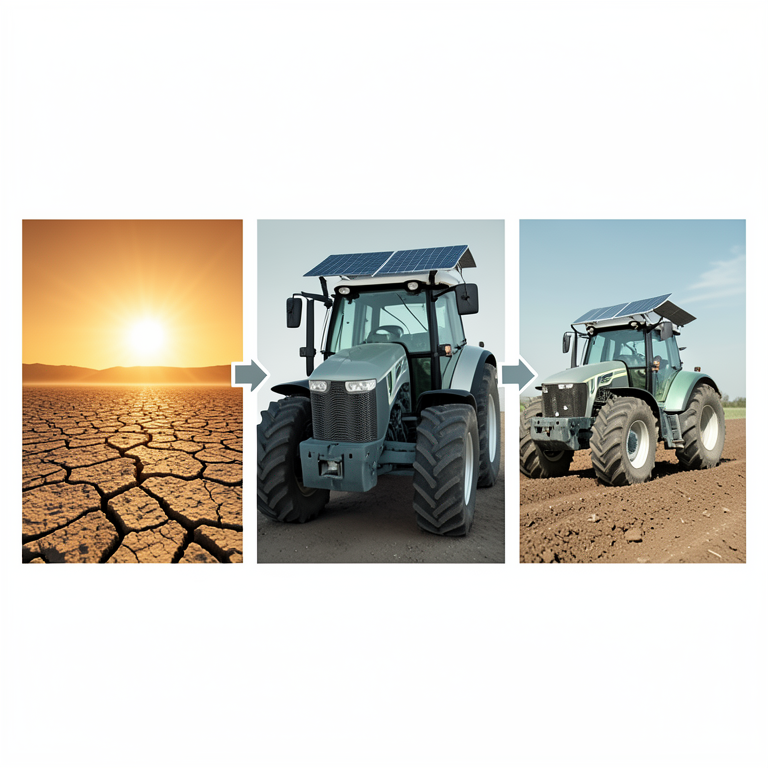
Climate Stressors and Machinery Adaptation
AI-generated conceptual illustration (modern agricultural tractor on a field). It explains the idea and does not show study data.
View source evidence ↗Figures & tables
From the original paper Table 1
 Table 2
Introduction
Climate variability is emerging as a major constraint to mechanized agriculture. Rising temperatures, erratic rainfall, and declining soil fertility compromise the efficiency and lifespan of conventional farm machinery. For instance, engine overheating, lubricant degradation, and soil compaction have become more frequent under prolonged heat and drought conditions. Climate-Resilient Farm Machinery (CRFM) seeks to address these constraints through engineering and design innovations that ensure reliability, energy efficiency, and soil protection across diverse environments.
This involves using heat-resistant materials, adaptive cooling systems, renewable-powered drives, and intelligent soil-machine interfaces. Climate Stressors and Their Impact on Machinery Performance Stress Type Effect on Machinery Engineering Challenge Heat Engine overheating, faster lubricant oxidation, reduced tire pressure Thermal management, material fatigue Drought Dust ingress, soil hardness, high traction load Improved filtration, adaptive tillage systems Floods & Humidity Corrosion, electrical failures Protective coatings, sealed enclosures Soil Degradation Reduced traction, compaction Soil-friendly implements, low-pressure tires Thermal and Structural Adaptation Strategies Heat-Resistant Power Units Diesel and hybrid engines operating above 45°C require improved thermal management. Incorporating liquid cooling systems, heat exchangers, and phase-change materials (PCM) enhances efficiency and engine longevity. NAAS Rating (2025): 4.74 IJHFS 2025; 7(10): 174-176 Yuvraj Gopinath Kasal Department of Farm Power and Machinery, Maharana Pratap Horticultural University, Karnal, Haryana, India Satyapal Singh Department of Vegetable Science, Maharana Pratap Horticultural University, Karnal, Haryana, India Shahroon Khan Department of Fruit Science, Maharana Pratap Horticultural University, Karnal, Haryana, India Yuvraj Gopinath Kasal Department of Farm Power and Machinery, Maharana Pratap Horticultural University, Karnal, Haryana, India https://www.hortijournal.com Material Innovation Advancements in composite materials (fiber-reinforced polymers, aluminum alloys) reduce weight and enhance heat tolerance.
Nano-ceramic coatings on pistons and exhaust manifolds reduce heat transfer by 15-20%. Cooling and Ventilation Systems Solar-assisted ventilation systems are being adopted in combine harvesters and tractors to maintain cabin comfort and electronic reliability. Adaptive Machinery for Drought-Prone Regions Water-Efficient Implements: Conservation tillage tools such as ripper-planters, mulch spreaders, and sub-surface seeders improve soil moisture retention and reduce runoff. Solar-Powered Machinery Solar power reduces dependency on scarce diesel supplies.
Trials in India’s arid zones show solar-electric tractors delivering 6-8 hours of operation per charge, cutting fuel costs by 50%. Dust-Resilient Systems Enhanced air filtration, sealed bearings, and smart diagnostics prevent machinery wear during dry and dusty conditions. Table 1: Drought-Adaptive Farm Machinery Technologies Machine/Component Adaptation Feature Benefit Solar-electric tractor PV-based drive system Fuel independence Ripper-planter Sub-surface tillage Reduced moisture loss Smart irrigation pump IoT-based scheduling Efficient water use Dust-sealed bearings Advanced sealing Lower maintenance cost Soil-Conserving Mechanization Approaches Soil erosion and compaction have long-term consequences for productivity and carbon sequestration. Mechanization must thus balance productivity with soil health.
| Machine/Component | Adaptation Feature | Benefit |
|---|---|---|
| Solar-electric tractor | PV-based drive system | Fuel independence |
| Ripper-planter | Sub-surface tillage | Reduced moisture loss |
| Smart irrigation pump | IoT-based scheduling | Efficient water use |
| Dust-sealed bearings | Advanced sealing | Lower maintenance cost |
Table text extracted from the original PDF; superscript letters are shown inline. The original table image is below.
View original table image
Low-Compaction Mobility Tracks, wide tires, and reduced ballast designs distribute load evenly. Controlled traffic farming (CTF) ensures machinery travels only on designated paths, cutting soil compaction by 40%. Conservation Tillage Zero-till and strip-till implements reduce fuel use and soil disturbance. Field studies show up to 60% energy savings and higher soil organic carbon retention.
Residue Management: Residue shredders and reversible rotary tillers integrate crop residues into the soil, improving fertility and water retention. Digital and Intelligent Control Systems Smart sensors and AI-based control systems enable real- time adaptation to changing field conditions. Precision Data Integration Sensors measuring soil moisture, traction, and temperature optimize machinery settings automatically. This leads to 10- 15% fuel savings and reduced mechanical stress.
Predictive Maintenance Machine learning models predict component wear based on operating conditions, minimizing downtime in extreme climates. Fleet Coordination IoT platforms (e.g., LoRa, NB-IoT) coordinate multiple machines, balancing workloads according to microclimatic variations. Renewable Energy and Hybridization in Climate- Resilient Machinery Hybrid tractors combining battery-electric and hydrogen fuel cells are emerging as clean and efficient solutions for diverse climates. Table 2: Comparison of Emerging Power Technologies Smart Mechanization Initiative encourage R&D and local manufacturing of adaptive machinery.
| Power System | Energy Source | Advantages | Challenges |
|---|---|---|---|
| Battery-electric | Solar grid | Zero emissions, low noise | Limited runtime |
| Hydrogen fuel cell | Green H₂ | High energy density | High cost |
| Biofuel hybrid | Ethanol/biodiesel | Uses local feedstock | Variable efficiency |
Table text extracted from the original PDF; superscript letters are shown inline. The original table image is below.
View original table image
Incentives for renewable integration, machinery retrofits, and resilience testing facilities are crucial to mainstream CRFM. Future Research and Development Directions 1. Development of climate testing facilities for machinery validation under simulated stress. 2. Localized co-design involving farmers, engineers, and climate scientists. 3.
Digital twin technologies for predictive performance Power System Energy Source Advantages Challenges Battery-electric Solar grid Zero emissions, low noise Limited runtime Hydrogen fuel cell Green H₂ High energy density High cost Biofuel hybrid Ethanol/biodiesel Uses local feedstock Variable efficiency Case Studies and Global Insights India (ICAR, 2023): Adoption of solar-hybrid tillers in Rajasthan reduced fuel use by 60% while maintaining tillage depth. Kenya: Low-compaction planters improved maize yield by 18% on degraded soils. Australia: AI-controlled irrigation tractors saved 25% water and reduced equipment overheating incidents by 40%. Policy and Institutional Interventions National programs such as India’s National Mission on Sustainable Agriculture (NMSA) and the FAO’s Climate- modelling. 4. Circular economy models for recycling and remanufacturing components. https://www.hortijournal.com 5. Material genomics for developing heat-tolerant composites.
Conclusion
Designing climate-resilient farm machinery is a cornerstone of sustainable agricultural transformation. Through integration of adaptive materials, renewable power systems, and precision technologies, CRFM enhances reliability, reduces environmental footprint, and ensures long-term productivity. Interdisciplinary collaboration, farmer-centric innovation, and supportive policy frameworks are essential to translate these technologies into scalable field applications across diverse agro-ecologies.
References
12 in the original paper- Singh S, Kasal YG. Innovations in farm machinery for sustainable horticultural production. J Agric Eng Res. 2023;17(2):145-162.
- FAO. Climate-smart mechanization strategy for smallholder farmers. Rome: Food and Agriculture Organization of the United Nations; 2021.
- ICAR. Annual report on climate-resilient mechanization. New Delhi: Indian Council of Agricultural Research; 2023.
- Sharma P, Mehta CR. Soil compaction and conservation tillage technologies in India. Agric Mech Asia Afr Lat Am. 2022;53(1):25-34.
- UNIDO. Designing sustainable agricultural machinery for low-carbon economies. Vienna: United Nations Industrial Development Organization; 2020.
- Mukherjee S, Pramanik P, Chatterjee D, Pradhan S. Application of solar energy in food processing: An update. J Curr Res Food Sci. 2023;4(2):49–51.
- Lal R. Soil health and climate-resilient agriculture. J Soil Water Conserv. 2020;75(2):35-42.
- Kasal YG, Singh S, Khan S. Recent trends in farm machineries for horticulture. Int J Agric Food Sci. 2025;7(9):909-911. DOI: 10.33545/2664844X.2025.v7.i9l.843.
- Kasal YG, Singh S, Khan S. Electrification of agricultural machinery: Advances in battery technology, powertrain design, and field performance for sustainable farming. Int J Agric Food Sci. 2025;7(10):252-256. doi:10.33545/2664844X.2025.v7.i10d.881.
- Gaike AR, Baisane V. A geographical study of changing trends of agriculture efficiency of Parbhani District, Maharashtra. Int J Geogr Geol Environ 2024;6(2):151-155.
- Kasal YG, Singh S, Khan S. Innovations in farm machinery for sustainable horticultural production: An Indian perspective. Int J Hortic Food Sci. 2025;7(10):86-89. DOI: 10.33545/26631067.2025.v7.i10b.407.
- Kasal YG, Singh S, Khan S. Emerging trends in agricultural robotics: Integration of artificial intelligence, machine vision, and IoT in farm machinery. Int J Agric Nutr. 2025;7(10):70-74. DOI: 10.33545/26646064.2025.v7.i10b.303.