
Research article · 2025 · Full text
International Journal of Agriculture and NutritionEmerging Trends in Agricultural Robotics: Integration of Artificial Intelligence, Machine Vision, and IoT in Farm Machinery
Volume 7(10) · Pages 70–74 · DOI: 10.33545/26646064.2025.v7.i10b.303 ↗
Research areasBuilding materials and conservationGeological Modeling and AnalysisMineralogy and Gemology Studies
Abstract
Author-writtenAgricultural robotics is rapidly maturing from isolated prototypes to integrated systems that combine artificial intelligence (AI), machine vision, and the Internet of Things (IoT). This review synthesizes recent advances, practical deployments, and research challenges at the intersection of robotics, perception, and connectivity in farm machinery. We examine design paradigms for autonomous platforms, sensor suites and vision pipelines for crop/weed/fruit tasks, edge and cloud AI for perception and planning, IoT architectures for fleet and energy management, human-robot interaction and safety, and socio-economic aspects including business models and policy. Representative industrial examples and high-impact demonstrations are discussed to highlight real-world readiness and remaining gaps. Finally, we propose a research agenda—covering duty-cycle datasets, standardized benchmarks, robust perception under agricultural conditions, low-power edge AI, and interoperable IoT standards—that aims to accelerate responsible deployment of robotic systems in diverse farm contexts.
Summary
Source-checkedPlain-language reading of the full paper, prepared with AI and checked against the text. Each point links to the authors' own words.
Why it matters
- Agricultural robotics is being developed to solve critical issues such as labor shortages, the need for higher resource efficiency, and the reduction of agrochemical use through precision. View evidence ↗
- Advances in AI, computing power (like edge GPUs), and high-resolution sensing over the last ten years have allowed robots to handle complex tasks like autonomous tillage and fruit picking. View evidence ↗
- The integration of IoT has transformed agricultural robots from standalone tools into coordinated, data-driven platforms capable of sharing telemetry and schedules. View evidence ↗
What they did
- The authors conducted a review covering autonomous platform design, sensor suites, AI for perception, IoT architectures, safety, and socio-economic factors. View evidence ↗
- The review analyzes industrial examples and high-impact demonstrations to assess the readiness of these technologies for real-world use. View evidence ↗
What they found
- RGB cameras are a low-cost option (100-500 USD) suitable for weed mapping and fruit detection, though they are sensitive to shadows and lighting variations. View evidence ↗
- Hyperspectral sensors allow for early disease and nutrient stress detection but are expensive (10,000-50,000 USD) and data-intensive. View evidence ↗
- LiDAR provides accurate 3D canopy mapping and works well in low light, but it is costly (5,000-25,000 USD) and has a heavy payload. View evidence ↗
- The Carbon Robotics LaserWeeder is a commercial system using deep learning and CO2 lasers for precision weeding, though it faces challenges with high capital costs and safety regulations. View evidence ↗
- The FarmDroid FD20 is a commercial solar-powered robot for seeding and weeding, but it is limited by its payload capacity and dependence on solar energy. View evidence ↗
- AI performance in the field is still hindered by variable lighting and occlusions, such as leaves hiding fruit, which necessitates research into synthetic data and robust training. View evidence ↗
- Harvesting robots generally still lag behind human pickers in terms of speed (cycle times) and the rate of crop damage. View evidence ↗
What it means
- The authors conclude that the integration of AI, IoT, and machine vision is successfully moving agricultural robotics from the demonstration phase to real-world field impact. View evidence ↗
- The authors recommend multidisciplinary collaboration between policy makers, agronomists, and robotics experts to overcome remaining technical and regulatory hurdles. View evidence ↗
- A significant limitation to commercial adoption is the lack of clear regulatory standards for farm robots in many jurisdictions. View evidence ↗
Figures & tables
From the original paper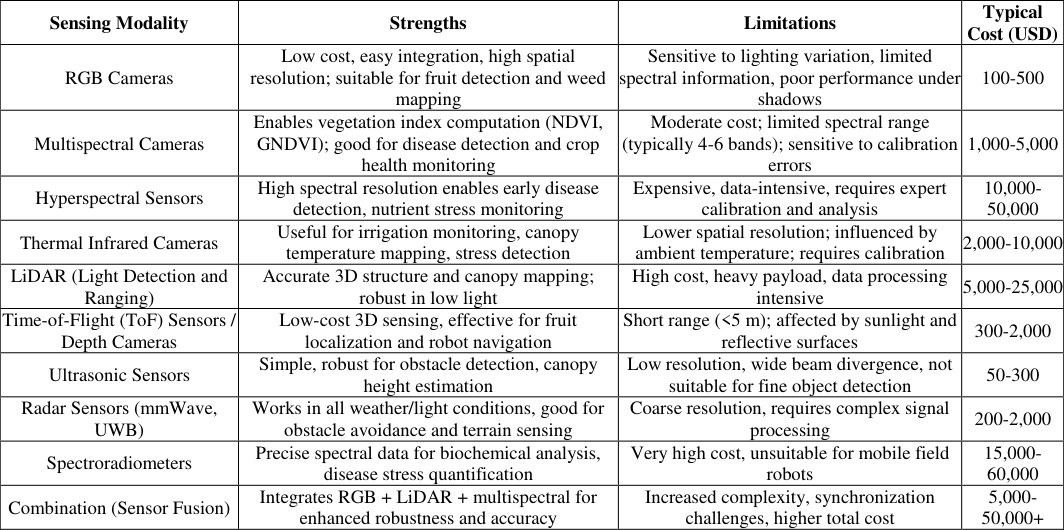 Table 1
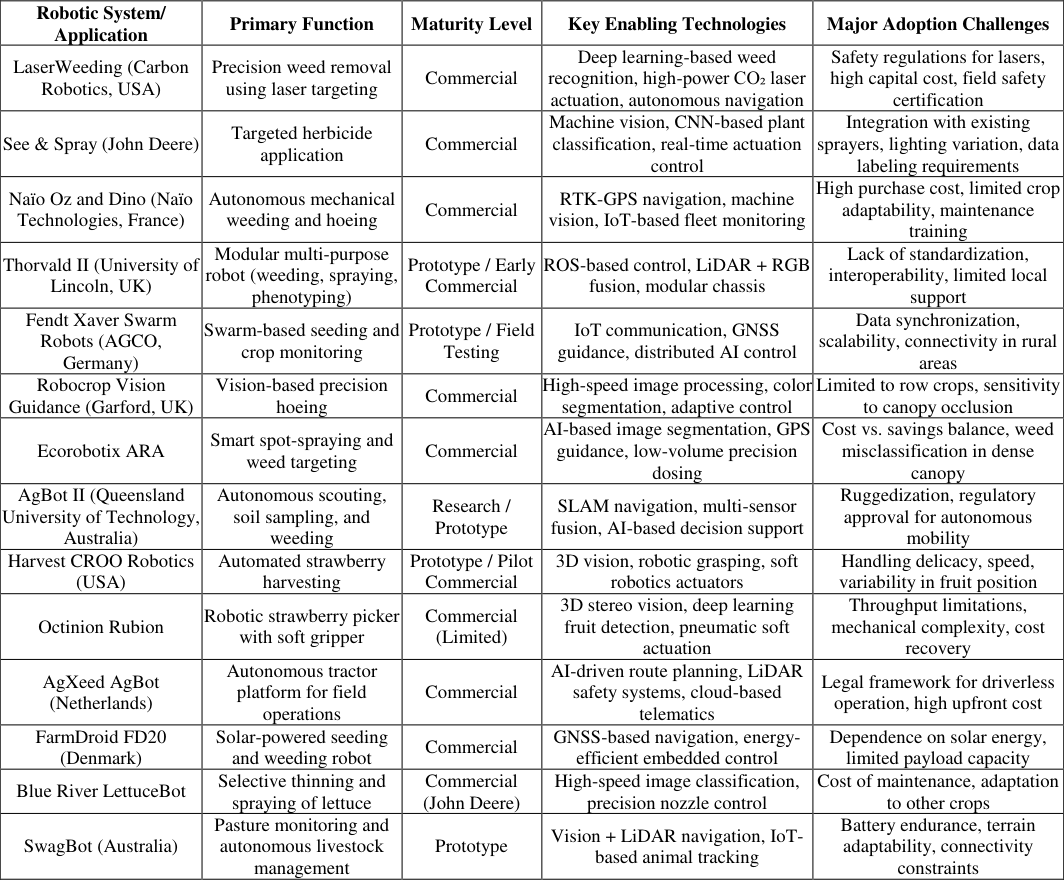 Table 2
Introduction
Automation and robotics in agriculture aim to address pressing challenges: labor shortages, the need for precision to reduce agrochemical use, and sustainability goals requiring higher resource-use efficiency. Over the last decade, improvements in sensing (high-resolution RGB, multispectral, hyperspectral cameras), compute (edge GPUs, NPUs), and AI (deep learning for detection, segmentation, and control) have enabled robots to perform complex field tasks such as targeted weeding, fruit picking, and autonomous tillage. At the same time, IoT connectivity allows distributed fleets and implements to share state, telemetry, and task schedules—shifting systems from single-robot tools to orchestrated, data-driven platforms. Recent reviews summarize the rapid technology diffusion and identify an industry moving from lab prototypes to commercial deployments.
This review focuses on the integration of AI, machine vision, and IoT in farm machinery— how these components are combined, what capabilities they unlock, and what technical and non-technical constraints remain. We consider both stationary (sorting lines, packhouses) and mobile systems (ground robots, UAVs), giving emphasis to mobile field robotics where perception, control, and connectivity interplay strongly. Architectural paradigms for agricultural robotic systems Robotic farm systems broadly implement one of three architectural paradigms: 1. Monolithic autonomous machines: single platforms with onboard sensing, perception, planning, and actuation (e.g., autonomous mowers, laser weeders).
These systems minimize dependency on external connectivity but must carry more compute and energy resources. Examples include the Carbon Robotics Laser Weeder and OEM autonomous tractors. 2. Edge-cloud hybrid systems: perception and low-latency control run on edge compute while higher-level planning, fleet coordination, and model updates are handled in the cloud. This balances real-time responsiveness with centralized optimization and learning.
NAAS Rating (2025): 4.69 IJAN 2025; 7(10): 70-74 Yuvraj Gopinath Kasal Dept. of Farm Power and Machinery, Maharana Pratap Horticultural University, Karnal, Haryana, India Satyapal Singh Dept. of Vegetable Science, Maharana Pratap Horticultural University, Karnal, Haryana, India Shahroon Khan Dept. of Fruit Science, Maharana Pratap Horticultural University, Karnal, Haryana, India Yuvraj Gopinath Kasal Dept. of Farm Power and Machinery, Maharana Pratap Horticultural University, Karnal, Haryana, India https://www.agriculturejournal.net 3. Distributed multi-agent systems: swarms or cooperative fleets (tractor + implements + small robots + drones) that divide labor and communicate via IoT middleware to optimize coverage and energy usage. Cooperative multi-machine operations are attracting research interest and early pilots. Key architectural design decisions depend on task latency, bandwidth availability in rural areas, energy budgets, and safety/regulatory constraints.
Perception: machine vision systems and AI pipelines Sensors and modalities Machine vision in agriculture uses a mix of sensors: RGB cameras for color and texture cues (fruit detection, weed/plant boundaries). Multispectral/hyperspectral sensors for physiological and stress detection (NDVI, disease signatures). Thermal imagers for water stress or animal detection. LiDAR and stereo vision for 3-D shape, obstacle avoidance and canopy structure estimation. Time-of-flight/ultrasonic sensors for short-range range finding and collision avoidance. Practical deployments often fuse modalities—e.g., RGB + NIR + depth—to improve robustness under variable illumination and occlusion. Sensor selection balances information needs, weight, power, and cost. AI for detection, segmentation, and pose estimation Deep learning has become the dominant approach for object detection and segmentation in agriculture.
Key capabilities include: Object detection (Faster-RCNN, YOLO families) for fruits, weeds, pests, and machinery parts. Instance and semantic segmentation (Mask R-CNN, DeepLab) for precise localization required in harvesting and selective spraying. Pose estimation and grasp planning for manipulators (keypoint-based or end-to-end grasp networks), crucial for reliable harvesting. Domain adaptation and few-shot learning to handle varying cultivars, lighting, and growth stages; these reduce the need for prohibitive labeled datasets. Performance remains sensitive to occlusions (leaves obscuring fruit), variable lighting, and high intra-class visual variation, motivating research into robust training, synthetic data augmentation, and active learning approaches. Recent surveys document strong progress but emphasize the gap between lab accuracy and field robustness. Real-time constraints and edge AI Field robots often require real-time perception on power- and space-constrained platforms.
Edge AI strategies include: Model compression (pruning, quantization) to reduce model size and inference latency. Efficient architectures (Mobile Net, Efficient Det, Tiny- YOLO) tailored to embedded GPUs/NPUs. Pipeline optimization—frame skipping, region-of- interest cropping, and sensor-triggered capture—to trade off fidelity for compute savings. Advances in low-power accelerators (embedded GPUs, dedicated NPUs) make higher-accuracy models viable on- field; yet there is a continuous need to balance accuracy, latency, and energy. Control, planning, and manipulation Motion planning and navigation Autonomous navigation combines GNSS (RTK for cm-level accuracy in many precision tasks), visual odometry, LiDAR SLAM, and IMU fusion. Agricultural fields present unique challenges: repetitive textures, featureless bare soil, dynamic obstacles (workers, animals), and challenging GNSS conditions under tree canopies.
Robust systems therefore fuse multiple modalities and incorporate field-aware path planners that respect crop geometry and minimize soil compaction. Manipulation for harvesting and precision tasks Manipulation tasks require gentle, adaptable grippers and compliant control to avoid crop damage. Control approaches include: Impedance and force control for safe interaction with fruit/plant tissue. Visual servoing—closing the perception-to-actuation loop with image feedback—to correct for perception and actuation errors. Learning-based controllers that map vision to end- effector commands (end-to-end or hybrid), particularly for variable fruit poses. Despite progress, harvest robotics still suffer from cycle times and damage rates that lag human pickers in many crops; success has been strongest in high-value, uniform crops (e.g., strawberries under controlled environments) and for mechanical thinning/targeted pruning tasks.
IoT and systems integration: connectivity, data, and fleet management IoT architectures for farm machinery IoT enables telemetry, remote monitoring, OTA model updates, and fleet orchestration. Architectures typically include: Device layer: sensors and actuators with local controllers and edge compute. Communication layer: LoRaWAN, NB-IoT, LTE/4G/5G, or Wi-Fi depending on bandwidth and latency needs. Low-bandwidth options suit periodic telemetry; higher bandwidth links or mobile gateways support offloading of rich sensor data (e.g., images) to the cloud. Cloud services: data lakes, model training, fleet dashboards, and command-and-control APIs. Orchestration layer: scheduling, task assignment, and energy-aware routing for multiple machines. Challenges include rural connectivity gaps, heterogeneous device ecosystems, and cybersecurity/safety concerns.
Edge-cloud co-design (local autonomy with cloud coordination) mitigates bandwidth limits while enabling centralized optimization. Data pipelines, digital twins and predictive maintenance IoT telemetry enables digital twins—virtual models of machines and fields—that support simulation, what-if https://www.agriculturejournal.net planning, and predictive maintenance (anomaly detection on vibration, motor current, battery metrics). Predictive models reduce downtime and optimize service scheduling, which is especially important where service centers are distant. Standards, interoperability and data governance Interoperability standards (similar to ISOBUS for implements) are emerging as critical for multi-vendor fleets.
Data ownership, privacy, and policies around agricultural data sharing remain active topics—particularly given value in crop yield forecasting, input optimization, and traceability. Recent reviews emphasize the need for open interfaces and clear governance mechanisms to foster trust and wider adoption. Real-world deployments and industrial examples Several high-impact commercial demonstrations in recent years illustrate technological maturity and practical tradeoffs: Laser Weeder (Carbon Robotics): An AI-driven, GPU-backed tractor-pulled unit that identifies and removes weeds at scale using lasers—demonstrates extreme processing needs and safety concerns associated with high-power actuation in the field. This system highlights the role of cloud/edge GPU farms for model training and high throughput inference. OEM autonomy and retrofit kits (e.g., Deere): Major manufacturers are introducing autonomous tractors and retrofit autonomy kits that combine multi-camera sensing, RTK GNSS, and centralized fleet management—showing that large-scale industry is embracing autonomy for commercial operations. Startups & diversified platforms: From small weeding robots to multi-purpose platforms for mowing, spraying, and surveillance, a vibrant startup ecosystem reveals varied business models—robot-as-a-service, implement retrofit, and licensed autonomy stacks.
Industry reports note continued investment growth despite macroeconomic headwinds. These deployments underscore practical constraints—capital expense, safety/regulatory compliance (e.g., lasers, failsafe autonomy levels), and the need for reliable service/support models. Human-robot interaction, safety, and socio-economic considerations Safety and regulatory frameworks Field robots operate near humans and livestock; safety requires redundant sensing, predictable behavior, emergency stop mechanisms, and rigorous validation. Regulatory frameworks for autonomous vehicles have begun to extend into off-road domains, but many jurisdictions lack clear standards for farm robots; this creates uncertainty for commercial adoption.
Labor, skills, and adoption pathways While robotics can alleviate labor shortages, adoption pathways must consider worker reskilling—farm technicians will need skills in robotics maintenance, data management, and safety protocols. Business models such as Custom Hiring Centers (CHCs), robot-as-a-service, or cooperatives can lower farmer capital barriers and improve utilization rates for expensive robotic assets. Ethical and environmental concerns Automation decisions affect rural employment and land management. Careful evaluation of social impact, equitable access to technology, and environmental tradeoffs (e.g., energy use, embodied emissions) must accompany technical development.
Key technical challenges and research opportunities We identify major areas where research would yield high impact: 1. Robust perception under real-world agricultural conditions: long-tail cases (dense occlusion, rain/dust, lighting extremes) remain a major failure mode. Research in sensor fusion, domain adaptation, and self- supervised learning can reduce labeling needs and increase robustness. 2. Standardized datasets and benchmarks: the community needs representative, annotated datasets covering multiple crops, growth stages, and environmental conditions to benchmark detection, segmentation, and manipulation.
Public benchmarks will drive reproducibility and accelerate progress. 3. Low-power, low-latency edge AI: optimized model architectures, compiler toolchains, and hardware- software co-design for embedded platforms that balance inference accuracy with energy and thermal budgets. 4. Multi-agent coordination and task allocation: scalable algorithms for heterogeneous fleets that can share perception, coordinate coverage, and dynamically reassign tasks considering energy and operational constraints. 5. Interoperable IoT and data governance: open APIs and standardized telemetry schemas to enable third- party tools, avoid vendor lock-in, and enable secure, privacy-preserving data sharing. 6.
Field-ready manipulation and soft robotics: compliant, adaptive end-effectors and tactile sensing for delicate harvesting tasks, with control strategies that generalize across fruit geometries and attachment modes. 7. Validation frameworks and safety cases: standardized testbeds and simulation-to-real validation pipelines for proving safety in mixed human-robot workspaces. Roadmap and recommendations For researchers, industry, and policymakers we recommend: Short term (1-2 years): Establish open datasets and shared evaluation protocols; pilot edge-cloud setups in cooperative farms; fund workforce training programs for robot maintenance. Medium term (3-5 years): Develop fleet orchestration tools and interoperable IoT standards; deploy predictive maintenance and digital-twin pilots in commercial settings; support regulatory clarity around safety and certification. Long term (>5 years): Mature modular robotic platforms with swappable payloads; mainstream robotic services via CHCs and coop models; integrate robotics outcomes into sustainability policy (reduced agrochemical use, improved yields, traceability). https://www.agriculturejournal.net Table 1: Comparison of sensing modalities for common agricultural perception tasks Sensing Modality Strengths Limitations Typical Cost (USD) RGB Cameras 100-500 Low cost, easy integration, high spatial resolution; suitable for fruit detection and weed mapping Sensitive to lighting variation, limited spectral information, poor performance under shadows Multispectral Cameras 1,000-5,000 Enables vegetation index computation (NDVI, GNDVI); good for disease detection and crop health monitoring Moderate cost; limited spectral range (typically 4-6 bands); sensitive to calibration errors Hyperspectral Sensors High spectral resolution enables early disease detection, nutrient stress monitoring Expensive, data-intensive, requires expert calibration and analysis 10,000- 50,000 Thermal Infrared Cameras Useful for irrigation monitoring, canopy temperature mapping, stress detection Lower spatial resolution; influenced by ambient temperature; requires calibration 2,000-10,000 LiDAR (Light Detection and Ranging) Accurate 3D structure and canopy mapping; robust in low light High cost, heavy payload, data processing intensive 5,000-25,000 Time-of-Flight (ToF) Sensors / Depth Cameras Low-cost 3D sensing, effective for fruit localization and robot navigation Short range (<5 m); affected by sunlight and reflective surfaces 300-2,000 Ultrasonic Sensors Simple, robust for obstacle detection, canopy height estimation Low resolution, wide beam divergence, not suitable for fine object detection 50-300 Radar Sensors (mmWave, UWB) Works in all weather/light conditions, good for obstacle avoidance and terrain sensing Coarse resolution, requires complex signal processing 200-2,000 Spectroradiometers Precise spectral data for biochemical analysis, disease stress quantification Very high cost, unsuitable for mobile field robots 15,000- 60,000 Combination (Sensor Fusion) Integrates RGB + LiDAR + multispectral for enhanced robustness and accuracy Increased complexity, synchronization challenges, higher total cost 5,000- 50,000+ Table 2: Representative robotic applications, maturity level, key enabling technologies, and adoption challenges Robotic System/ Application Primary Function Maturity Level Key Enabling Technologies Major Adoption Challenges LaserWeeding (Carbon Robotics, USA) Precision weed removal using laser targeting Commercial Deep learning-based weed recognition, high-power CO₂ laser actuation, autonomous navigation Safety regulations for lasers, high capital cost, field safety certification See & Spray (John Deere) Targeted herbicide application Commercial Machine vision, CNN-based plant classification, real-time actuation control Integration with existing sprayers, lighting variation, data labeling requirements Naïo Oz and Dino (Naïo Technologies, France) Autonomous mechanical weeding and hoeing Commercial RTK-GPS navigation, machine vision, IoT-based fleet monitoring High purchase cost, limited crop adaptability, maintenance training Thorvald II (University of Lincoln, UK) Prototype / Early Commercial ROS-based control, LiDAR + RGB fusion, modular chassis Modular multi-purpose robot (weeding, spraying, phenotyping) Swarm-based seeding and crop monitoring Prototype / Field Testing IoT communication, GNSS guidance, distributed AI control Lack of standardization, interoperability, limited local support Fendt Xaver Swarm Robots (AGCO, Germany) Data synchronization, scalability, connectivity in rural areas Robocrop Vision Guidance (Garford, UK) Vision-based precision hoeing Commercial High-speed image processing, color segmentation, adaptive control Limited to row crops, sensitivity to canopy occlusion Ecorobotix ARA Smart spot-spraying and weed targeting Commercial AI-based image segmentation, GPS guidance, low-volume precision dosing Research / Prototype SLAM navigation, multi-sensor fusion, AI-based decision support Cost vs. savings balance, weed misclassification in dense canopy AgBot II (Queensland University of Technology, Australia) Autonomous scouting, soil sampling, and weeding Ruggedization, regulatory approval for autonomous mobility Harvest CROO Robotics (USA) Automated strawberry harvesting Prototype / Pilot Commercial 3D vision, robotic grasping, soft robotics actuators Handling delicacy, speed, variability in fruit position Octinion Rubion Robotic strawberry picker with soft gripper Commercial (Limited) 3D stereo vision, deep learning fruit detection, pneumatic soft actuation Throughput limitations, mechanical complexity, cost recovery Commercial AgXeed AgBot (Netherlands) Legal framework for driverless operation, high upfront cost Autonomous tractor platform for field operations AI-driven route planning, LiDAR safety systems, cloud-based telematics FarmDroid FD20 (Denmark) Solar-powered seeding and weeding robot Commercial GNSS-based navigation, energy- efficient embedded control Dependence on solar energy, limited payload capacity Blue River LettuceBot Selective thinning and spraying of lettuce Commercial (John Deere) High-speed image classification, precision nozzle control Cost of maintenance, adaptation to other crops SwagBot (Australia) Prototype Vision + LiDAR navigation, IoT- based animal tracking Pasture monitoring and autonomous livestock management Battery endurance, terrain adaptability, connectivity constraints https://www.agriculturejournal.net
| Robotic System/ Application | Primary Function | Maturity Level | Key Enabling Technologies | Major Adoption Challenges |
|---|---|---|---|---|
| LaserWeeding (Carbon Robotics, USA) | Precision weed removal using laser targeting | Commercial | Deep learning-based weed recognition, high-power CO₂ laser actuation, autonomous navigation | Safety regulations for lasers, high capital cost, field safety certification |
| See & Spray (John Deere) | Targeted herbicide application | Commercial | Machine vision, CNN-based plant classification, real-time actuation control | Integration with existing sprayers, lighting variation, data labeling requirements |
| Naïo Oz and Dino (Naïo Technologies, France) | Autonomous mechanical weeding and hoeing | Commercial | RTK-GPS navigation, machine vision, IoT-based fleet monitoring | High purchase cost, limited crop adaptability, maintenance training |
| Thorvald II (University of Lincoln, UK) | Modular multi-purpose robot (weeding, spraying, phenotyping) | Prototype / Early Commercial | ROS-based control, LiDAR + RGB fusion, modular chassis | Lack of standardization, interoperability, limited local support |
| Fendt Xaver Swarm Robots (AGCO, Germany) | Swarm-based seeding and crop monitoring | Prototype / Field Testing | IoT communication, GNSS guidance, distributed AI control | Data synchronization, scalability, connectivity in rural areas |
| Robocrop Vision Guidance (Garford, UK) | Vision-based precision hoeing | Commercial | High-speed image processing, color segmentation, adaptive control | Limited to row crops, sensitivity to canopy occlusion |
| Ecorobotix ARA | Smart spot-spraying and weed targeting | Commercial | AI-based image segmentation, GPS guidance, low-volume precision dosing | Cost vs. savings balance, weed misclassification in dense canopy |
| AgBot II (Queensland University of Technology, Australia) | Autonomous scouting, soil sampling, and weeding | Research / Prototype | SLAM navigation, multi-sensor fusion, AI-based decision support | Ruggedization, regulatory approval for autonomous mobility |
| Harvest CROO Robotics (USA) | Automated strawberry harvesting | Prototype / Pilot Commercial | 3D vision, robotic grasping, soft robotics actuators | Handling delicacy, speed, variability in fruit position |
| Octinion Rubion | Robotic strawberry picker with soft gripper | Commercial (Limited) | 3D stereo vision, deep learning fruit detection, pneumatic soft actuation | Throughput limitations, mechanical complexity, cost recovery |
| AgXeed AgBot (Netherlands) | Autonomous tractor platform for field operations | Commercial | AI-driven route planning, LiDAR safety systems, cloud-based telematics | Legal framework for driverless operation, high upfront cost |
| FarmDroid FD20 (Denmark) | Solar-powered seeding and weeding robot | Commercial | GNSS-based navigation, energy- efficient embedded control | Dependence on solar energy, limited payload capacity |
| Blue River LettuceBot | Selective thinning and spraying of lettuce | Commercial (John Deere) | High-speed image classification, precision nozzle control | Cost of maintenance, adaptation to other crops |
| SwagBot (Australia) | Pasture monitoring and autonomous livestock management | Prototype | Vision + LiDAR navigation, IoT- based animal tracking | Battery endurance, terrain adaptability, connectivity constraints |
Table text extracted from the original PDF; superscript letters are shown inline. The original table image is below.
View original table image
| Sensing Modality | Strengths | Limitations | Typical Cost (USD) |
|---|---|---|---|
| RGB Cameras | Low cost, easy integration, high spatial resolution; suitable for fruit detection and weed mapping | Sensitive to lighting variation, limited spectral information, poor performance under shadows | 100-500 |
| Multispectral Cameras | Enables vegetation index computation (NDVI, GNDVI); good for disease detection and crop health monitoring | Moderate cost; limited spectral range (typically 4-6 bands); sensitive to calibration errors | 1,000-5,000 |
| Hyperspectral Sensors | High spectral resolution enables early disease detection, nutrient stress monitoring | Expensive, data-intensive, requires expert calibration and analysis | 10,000- 50,000 |
| Thermal Infrared Cameras | Useful for irrigation monitoring, canopy temperature mapping, stress detection | Lower spatial resolution; influenced by ambient temperature; requires calibration | 2,000-10,000 |
| LiDAR (Light Detection and Ranging) | Accurate 3D structure and canopy mapping; robust in low light | High cost, heavy payload, data processing intensive | 5,000-25,000 |
| Time-of-Flight (ToF) Sensors / Depth Cameras | Low-cost 3D sensing, effective for fruit localization and robot navigation | Short range (<5 m); affected by sunlight and reflective surfaces | 300-2,000 |
| Ultrasonic Sensors | Simple, robust for obstacle detection, canopy height estimation | Low resolution, wide beam divergence, not suitable for fine object detection | 50-300 |
| Radar Sensors (mmWave, UWB) | Works in all weather/light conditions, good for obstacle avoidance and terrain sensing | Coarse resolution, requires complex signal processing | 200-2,000 |
| Spectroradiometers | Precise spectral data for biochemical analysis, disease stress quantification | Very high cost, unsuitable for mobile field robots | 15,000- 60,000 |
| Combination (Sensor Fusion) | Integrates RGB + LiDAR + multispectral for enhanced robustness and accuracy | Increased complexity, synchronization challenges, higher total cost | 5,000- 50,000+ |
Table text extracted from the original PDF; superscript letters are shown inline. The original table image is below.
View original table image
Conclusions
Integration of AI, machine vision, and IoT is propelling agricultural robotics from demonstrations to real impact in the field. Technical advances across perception, planning, manipulation, and systems integration have enabled novel capabilities—precision weeding, autonomous harvesting, and fleet orchestration—while also exposing challenges in robustness, energy, connectivity, and safety. Addressing these challenges will require multidisciplinary collaboration across robotics, agronomy, data governance, and policy. With careful attention to social and environmental tradeoffs and by building interoperable, resilient systems, agricultural.
Acknowledgments
The author thanks colleagues at the College of Horticulture, M.P.H.U., Karnal, and the broader agricultural robotics community for discussions and inputs.
References
10 in the original paper- Spagnuolo M, et al. Agricultural robotics: A technical review addressing applications and market trends. Robotics (MDPI). 2025;14(2):9.
- Thakur A, et al. An extensive review on agricultural robots with focus on machine vision techniques. Comput Electron Agric. 2023.
- Sharma K, et al. Integrating artificial intelligence and Internet of Things in modern agriculture. Elsevier Rev. 2024.
- Miller T, et al. The IoT and AI in agriculture: The time is now. Front Syst (Open Access Rev). 2025.
- Carbon Robotics (LaserWeeder) demonstration coverage. Tom’s Hardware; 2025.
- Reuters. Deere boosts bet on autonomous tractors with new machines. Reuters News Report. 2025.
- Prabin Kumar Sahoo, Deoraj Sharma. Economic impact of artificial intelligence in the field of agriculture. Int J Hortic Food Sci 2023;5(1):29-34. DOI: 10.33545/26631067.2023.v5.i1a.152
- Kumar V, et al. A comprehensive review on smart and sustainable IoT for agriculture; 2024.
- Kasal YG, Singh S, Khan S. Recent trends in farm machineries for horticulture. Int J Agric Food Sci. 2025;7(9):909- 11. https://doi.org/10.33545/2664844X.2025.v7.i9l.843
- Liu L, et al. Smart sensors and IoT solutions for precision agriculture; 2025.
Cited by 6
From OpenAlex, OpenCitations and reference lists read by Scinovex
- Research Progress on Key Technologies, Restrictive Factors and Optimization Strategies of Detasseling for Maize Seed Production ↗
Yang LI, Yiteng Lei, Zhen Ma, Cundeng Wang · Agriculture · 2026
Maize hybrid seed production is a core factor in increasing maize yield. It is the key to ensure seed purity to remove tassels from female plants. This paper analyzes the inherent connections between seed production agronomy, biomechanics, computer vision, and intelligent devices at the system engineering level. The paper first elaborates on the role of crop growth models and genetic…
❝ 0PDF - MECHANIZED DETASSELING TECHNOLOGY FOR CORN SEED PRODUCTION: GLOBAL PROGRESS, KEY CHALLENGES, AND OPTIMIZATION STRATEGIES ↗
Yang LI, Yiteng Lei, Luochuan Xu, Wei DONG · INMATEH Agricultural Engineering · 2026
Detasseling the female parent plants is a critical operation in hybrid corn seed production. This article systematically reviews global developments in mechanized detasseling technology for corn seed production. First, it provides an in-depth analysis of two key technologies supporting mechanized detasseling: the biomechanical characteristics of corn tassels and intelligent tassel-detection technologies based on machine vision and photoelectric sensing. Second, the…
❝ 0PDF - Trustworthy agricultural autonomy integrates robot learning safe control and human robot interaction ↗
Muhammad Khizar Hayat, Rahime Cengiz, Muhammad Arif, Umair Gull, Mehmet Öten · Discover Robotics · 2026
The future of modern farming is intelligent, autonomous and data-driven farming operations. This will help to address the increasing labor shortage, resource constraints and climate variability. But for deployment in unstructured agricultural settings, high-performance automation is needed, as well as trustworthy systems that can make safe decisions, have the ability to learn adaptively and collaborate effectively with human operators. In…
❝ 0PDF - Designing climate-resilient farm machinery: A review on adaptive technologies for heat, drought, and soil conservation challenges
Yuvraj Gopinath Kasal, Satyapal Singh, Shahroon Khan · International Journal of Horticulture and Food Science · 2025
Climate change has intensified abiotic stresses such as heat, drought, and soil degradation, directly impacting the performance, durability, and efficiency of agricultural machinery. Designing climate-resilient farm machinery (CRFM) is therefore essential to maintain productivity under variable weather and resource constraints. This review synthesizes global progress in adaptive machinery design focusing on thermal management, material innovation, soil-conserving implements, and smart control systems that respond dynamically to climatic conditions. The integration of renewable energy, automati
- Hybrid Power Systems in Farm Machinery: A Review of Solar, Biofuel, and Hydrogen-Assisted Agricultural Mechanization
Yuvraj Gopinath Kasal, Shahroon Khan, Satyapal Singh · International Journal of Agriculture and Food Science · 2025
Hybrid power solutions that combine solar electricity, biofuels, and hydrogen (fuel-cell or dual-fuel) with conventional engines are emerging as practical pathways to decarbonize agricultural mechanization while maintaining operational flexibility. This review synthesizes recent advances in solar-assisted charging and agrivoltaic concepts, biofuel (biodiesel/ethanol/biomethane) utilisation in off-road engines, and hydrogen fuel-cell or hydrogen-assisted hybrid drivetrains for tractors and implements. We compare technical architectures (series hybrids, parallel hybrids, range-extenders, and mod
- Scale-appropriate mechanization: A review of low-cost, energy-efficient farm machinery solutions for smallholder farmers
Yuvraj Gopinath Kasal, Satyapal Singh, Shahroon Khan · International Journal of Agriculture and Nutrition · 2025
Agricultural mechanization has long been associated with increased productivity, yet conventional large-scale machinery often remains inaccessible to smallholder farmers due to high costs, inappropriate scale, and limited technical support. This review focuses on scale-appropriate mechanization (SAM) a sustainable approach emphasizing low-cost, energy-efficient, and locally adaptable technologies designed for small farms, typically below two hectares. It synthesizes technological, economic, and institutional dimensions of SAM, including innovations in lightweight materials, renewable-powered i