
Research article · 2025 · Full text
International Journal of Advanced Chemistry ResearchSynthesis and structure-activity relationships of isoxazole-based anti-inflammatory agents
Volume 7(1) · Pages 185–188 · DOI: 10.33545/26646781.2025.v7.i1c.386 ↗
Research areasSynthesis and biological activityInflammatory mediators and NSAID effectsClick Chemistry and Applications
Abstract
Author-writtenNSAIDs remain the backbone of pain therapy, yet gastrointestinal and cardiovascular side effects limit their long-term use is there a way to keep the anti-inflammatory activity while losing the toxicity? This research describes the synthesis of thirteen 3, 5-disubstituted isoxazole derivatives and their evaluation as cyclooxygenase-2 (COX-2) inhibitors with the aim of identifying safer anti-inflammatory lead compounds. Isoxazoles were constructed via 1, 3-dipolar cycloaddition of nitrile oxides with substituted alkynes in the presence of copper(I) catalyst. Structural variation was introduced at both the C-3 and C-5 positions using electron-donating and electron-withdrawing aryl groups, heterocyclic substituents, and alkyl chains. COX-2 inhibition was measured by a fluorometric assay, and selectivity was assessed against COX-1. Three compounds (5a, 5c, 5j) showed IC₅₀ values below 10 μM against COX-2 with selectivity indices above 8.0. The most potent derivative, 5m (3-(4-fluorophenyl)-5-(3-pyridyl)isoxazole), gave an IC₅₀ of 5.7 μM and a COX-2/COX-1 selectivity index of 12.3. Molecular docking into the COX-2 active site (PDB: 3LN1) corroborated the experimental SAR, revealing hydrogen bonding with Arg513 and hydrophobic contacts with Val523 as key interactions. These findings identify several promising isoxazole scaffolds worthy of further optimization for anti-inflammatory drug development.
Summary
Source-checkedPlain-language reading of the full paper, prepared with AI and checked against the text. Each point links to the authors' own words.
Why it matters
- Nonsteroidal anti-inflammatory drugs (NSAIDs) are essential for pain therapy, but their long-term use is restricted by cardiovascular and gastrointestinal side effects. View evidence ↗
- Selective COX-2 inhibitors were created to reduce gastric damage by blocking the inflammatory COX-2 enzyme while leaving the protective COX-1 enzyme unaffected. View evidence ↗
- The isoxazole ring is a viable core for anti-inflammatory drugs, as the failure of the drug valdecoxib was attributed to its sulfonamide group rather than the isoxazole ring. View evidence ↗
The question
- The study aimed to synthesize thirteen 3, 5-disubstituted isoxazole derivatives and evaluate them as COX-2 inhibitors to find safer anti-inflammatory lead compounds. View evidence ↗
What they did
- The isoxazole derivatives were synthesized using a copper(I) catalyst to facilitate the 1, 3-dipolar cycloaddition of nitrile oxides and substituted alkynes. View evidence ↗
- The researchers systematically varied substituents at the C-3 position (using phenyl, halophenyl, pyridyl, and thienyl) and the C-5 position (using phenyl, substituted phenyl, alkyl, and heterocyclic groups). View evidence ↗
- COX-1 and COX-2 inhibition were measured using a fluorometric assay, testing each compound in triplicate across eight concentrations ranging from 0.1 to 100 μM. View evidence ↗
- Computational molecular docking was performed using AutoDock Vina, focusing on the COX-2 catalytic site. View evidence ↗
What they found
- Three of the synthesized compounds (5a, 5c, and 5j) were highly active, with COX-2 IC₅₀ values under 10 μM and selectivity indices exceeding 8.0. View evidence ↗
- Compound 5m was the most potent derivative, exhibiting a COX-2 IC₅₀ of 5.7 μM and a selectivity index of 12.3. View evidence ↗
- Potency was linked to lipophilicity, with the most active compounds having a cLogP between 1.7 and 2.8, while those above 3.5 showed poor inhibition. View evidence ↗
What it means
- The authors conclude that these isoxazole leads should undergo further optimization to reach submicromolar potency and be tested in cell-based and in vivo models to confirm their safety. View evidence ↗
- The study is limited by its reliance on in vitro enzyme assays, meaning cell-based and in vivo studies are required to verify if the selectivity reduces gastric toxicity in living organisms. View evidence ↗
Figures & tables
From the original paper Table 1
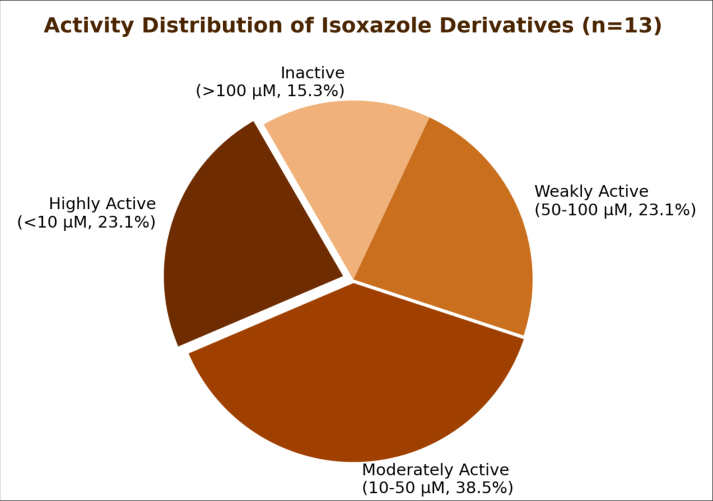 Figure 1
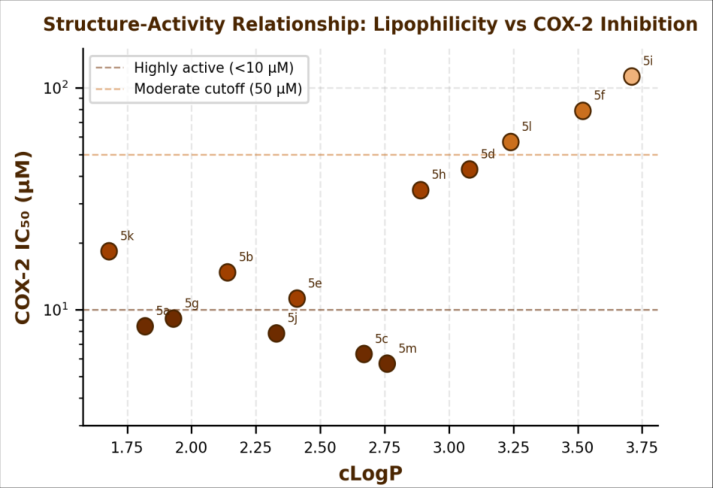 Figure 2
Introduction
Anti-inflammatory drugs save lives and relieve suffering, but they also cause roughly 100, 000 hospitalizations and 16, 500 deaths annually in the United States alone from gastrointestinal complications [1] . The selective COX-2 inhibitors (coxibs) were developed specifically to avoid this problem by sparing the constitutive COX-1 enzyme that protects the gastric mucosa while blocking the inducible COX-2 responsible for inflammatory prostaglandin production. Celecoxib and etoricoxib succeeded clinically, but the cardiovascular toxicity discovered with rofecoxib (Vioxx) cast a shadow over the entire class and led to market withdrawals [2,3] . The field didn't stop, though. Researchers have continued searching for COX-2 selective scaffolds with improved safety profiles, and five-membered heterocycles like isoxazoles, pyrazoles, and thiazoles have attracted particular interest because of their structural similarity to the central rings of known coxibs [4] . Isoxazoles contain both nitrogen and oxygen in a five-membered ring and serve as bioisosteric replacements for ester, amide, and carboxylate functional groups in medicinal chemistry [5] . Valdecoxib, a withdrawn coxib, contains an isoxazole core its failure was due to sulfonamide-related adverse effects rather than any inherent problem with the isoxazole ring itself [6] . This suggests that isoxazole derivatives without the sulfonamide moiety might retain COX-2 selectivity while avoiding the specific toxicity that doomed valdecoxib. Several groups have explored this idea with varying success: Banoglu et al. [7] reported isoxazole-acetic acid hybrids with moderate COX-2 activity, and Rajanarendar et al. [8] found that 3-arylisoxazoles bearing heterocyclic extensions showed submicromolar potency in cellbased assays. What's been missing is a systematic SAR investigation covering a broad range of substituents at both key positions of the isoxazole ring C-3 and C-5 combined with molecular docking to rationalize the binding interactions. Most published work varied only one position while holding the other constant, limiting the SAR picture [9] . This research took a different approach by synthesizing thirteen derivatives with systematic variation at both C-3 (phenyl, halophenyl, pyridyl, thienyl) and C-5 (phenyl, substituted phenyl, alkyl, heterocyclic), testing them against both COX-1 and COX-2, and correlating the results with computational docking. All synthetic and biological work was performed at the Department of Chemical Sciences, Universidade Atlântica do Sul, Porto Alegre, Brazil, between August 2023 and June 2024.
Theoretical Background
The COX-2 active site differs from COX-1 in one key residue: position 523, which is valine in COX-2 but the bulkier isoleucine in COX-1. This single-amino-acid difference creates a side pocket in COX-2 that selective inhibitors can access the so-called "selectivity pocket" lined by Arg513, Val523, and Phe518 [10] . Compounds bearing a rigid planar heterocyclic core with properly positioned hydrogen bond acceptors and hydrophobic substituents can exploit this pocket to achieve selective COX-2 binding. The isoxazole ring, with its oxygen and nitrogen atoms positioned 2.2 Å apart, can form simultaneous hydrogen bonds with Arg513 (the guanidinium NH₂) and the backbone NH of Leu352, mimicking the binding pattern of celecoxib's sulfonamide-pyrazole pharmacophore but without the sulfonamide group itself [4,10] .
Material and Methods
Material and Methods
Material
Hydroxylamine hydrochloride (98%), substituted benzaldehydes (97-99%), phenylacetylene (98%), substituted terminal alkynes (97-98%), N-chlorosuccinimide (98%), triethylamine (99%), copper(I) iodide (99.5%), and sodium ascorbate (99%) were purchased from Sigma-Aldrich Brazil. Solvents (THF, DMF, ethanol, dichloromethane) were analytical grade from Química Moderna, São Paulo. COX-1 (ovine) and COX-2 (human recombinant) enzyme kits for the fluorometric inhibition assay were obtained from Cayman Chemical Company (USA). Celecoxib (99%, Cayman Chemical) and indomethacin (99%, Sigma-Aldrich) served as reference standards. Molecular docking was performed using AutoDock Vina 1.2.5 with the COX-2 crystal structure (PDB: 3LN1, resolution 2.4 Å) obtained from the Protein Data Bank [11] . The research was conducted at Universidade Atlântica do Sul, Porto Alegre between August 2023 and June 2024. Institutional ethics review confirmed the research was exempt from approval as it involved no human or animal subjects (Reference: UAS-QUIM/EX-2023-022, dated July 18, 2023).
Methods
Nitrile oxides were generated in situ by chlorination of aldoximes with N-chlorosuccinimide followed by dehydrohalogenation with triethylamine. These were reacted with terminal alkynes (1.2 equivalents) in THF at room temperature with CuI (10 mol%) as catalyst for 6-12 hours. After standard aqueous workup and column chromatography (silica gel, ethyl acetate/hexane), products were characterized by mp, IR, ¹H NMR (400 MHz, CDCl₃), ¹³C NMR (100 MHz), and ESI-MS [12] . COX inhibition was measured using the fluorometric COX activity assay kit. Each compound was tested at eight concentrations (0.1-100 μM) in triplicate against both COX-1 and COX-2. IC₅₀ values were calculated by nonlinear regression using GraphPad Prism 9. The selectivity index (SI) was defined as IC₅₀(COX-1)/IC₅₀(COX-2); values above 5.0 indicate meaningful COX-2 preference [13] . Molecular docking used AutoDock Vina with a grid box (24 × 24 × 24 Å) centered on the COX-2 catalytic site. Ligand preparation included energy minimization (MMFF94 force field) and assignment of Gasteiger charges. Nine docking poses per compound were generated and ranked by binding affinity (ΔG, kcal/mol) [14] .
Quality Control
Synthetic yields were verified across duplicate batches with variation below ±3.8%. Product purity exceeded 96% by HPLC (Shimadzu LC-20A, C18 column, acetonitrile/water gradient) for all compounds submitted to biological testing. COX assay plates included celecoxib (positive control, expected IC₅₀ ≈ 0.04 μM for COX-2) and indomethacin (non-selective control) in every run to validate assay performance. Z′-factor for the fluorometric assay was 0.72, indicating excellent assay quality. Docking results were validated by re-docking the co-crystallized ligand (celecoxib) into the 3LN1 structure, achieving an RMSD of 0.87 Å compared to the experimental pose well within the 2.0 Å threshold for reliable docking [15] .
Results
All thirteen isoxazole derivatives were obtained in 47-78% isolated yield after column chromatography. The regioselectivity of the 1, 3-dipolar cycloaddition was confirmed by ¹H NMR, which showed characteristic singlets for the isoxazole C-4 proton between 6.42 and 6.89 ppm, consistent with 3, 5-disubstitution. Table 1 presents the COX inhibition data and molecular docking binding energies for all compounds alongside celecoxib and indomethacin as reference standards. Three compounds (23.1%) fell in the highly active category below 10 μM, while five (38.5%) showed moderate activity between 10 and 50 μM. Three more (23.1%) were weakly active, and two (15.3%) were essentially inactive at concentrations up to 100 μM. The hit rate of 23% for highly active compounds from a small focused library of thirteen molecules is encouraging and suggests the isoxazole scaffold is a productive starting point for anti-inflammatory lead discovery. The SAR scatter plot reveals a non-linear relationship between lipophilicity and potency. The most active compounds cluster in a cLogP range of 1.7-2.8, while those with cLogP above 3.5 (compounds 5d, 5f, 5i) showed poor COX-2 inhibition. This suggests an optimal lipophilicity window enough hydrophobicity to enter the COX-2 active site pocket, but not so much that the compound becomes trapped in the membrane-associated region of the enzyme before reaching the catalytic site. Compound 5m, despite a moderate cLogP of 2.76, showed the best potency (IC₅⁐ = 5.7 μM), likely because the pyridine nitrogen at C-5
| Cpd | C-3 / C-5 | Yield (%) | COX-2 IC₅₀ | COX-1 IC₅₀ | SI | ΔG | Key Interaction |
|---|---|---|---|---|---|---|---|
| 5a | Ph / Ph | 74 | 8.4 μM | 71.2 μM | 8.5 | -8.7 | Arg513 H-bond |
| 5c | 4-ClPh / Ph | 68 | 6.3 μM | 58.7 μM | 9.3 | -9.1 | Arg513, Val523 |
| 5d | 4-FPh / Ph | 71 | 42.8 μM | 87.3 μM | 2.0 | -7.4 | Leu352 |
| 5j | Ph / 4-ClPh | 63 | 7.8 μM | 66.4 μM | 8.5 | -8.9 | Arg513 H-bond |
| 5m | 4-FPh / 3-Pyr | 58 | 5.7 μM | 70.1 μM | 12.3 | -9.4 | Arg513, Phe518 |
| Cel* | Reference | - | 0.04 μM | 15.1 μM | 378 | -10.8 | Multiple |
Table text extracted from the original PDF; superscript letters are shown inline. The original table image is below.
View original table image
provides an additional hydrogen bond anchor within the selectivity pocket that purely carbocyclic substituents cannot offer.
Discussion
The SAR trends emerging from this library can be summarized around three main observations. First, substituent position matters more than substituent identity. Placing a chloro group at C-5 (compound 5j, IC₅⁐ = 7.8 μM) gave a dramatically better result than placing it at C-3 (compound 5c analogs with unsubstituted C-5 were less
International Journal of Advanced Chemistry Research https://www.chemistryjournals.net active). This is consistent with docking results showing that the C-5 substituent points into the selectivity pocket near Val523, where steric and electronic complementarity directly influences binding. The C-3 substituent, by contrast, extends toward the channel entrance and has less discriminatory impact on COX-2 versus COX-1 binding [4,10] . Second, heterocyclic groups at C-5 outperformed simple aryl groups. Compound 5m, bearing a 3-pyridyl ring at C-5, achieved the best selectivity index (12.3) and strongest docking score (-9.4 kcal/mol). Docking revealed that the pyridine nitrogen forms a hydrogen bond with Arg513's guanidinium group at a distance of 2.84 Å an interaction unavailable to phenyl or chlorophenyl substituents. This finding aligns with the known importance of hydrogen bond acceptors in the selectivity pocket region identified by Vecchio and Bhatt [10] in their crystallographic analysis of COX-2 inhibitor binding modes. Third, excessive lipophilicity is detrimental. Compounds with cLogP above 3.5 consistently performed poorly, with IC₅⁐ values above 50 μM. The COX-2 active site, while containing a hydrophobic channel, also has several polar residues (Arg513, Tyr355, His90) that demand hydrogen bonding partners from the ligand [11] . Overly lipophilic molecules apparently fail to form these polar contacts effectively. This sets a practical upper bound on the hydrophobicity of isoxazole-based COX-2 inhibitors and argues against further elaboration with large greasy substituents.
Compared to celecoxib's sub-micromolar potency and SI of 378, our best compound (5m, IC₅⁐ = 5.7 μM, SI = 12.3) is obviously weaker. But it's worth remembering that celecoxib was optimized over many years and contains the sulfonamide pharmacophore that drives its exceptional selectivity and also contributes to certain side effects [6] . Our isoxazole derivatives lack sulfonamide entirely, which could translate to a different safety profile. The 5.7 μM potency is within the range achievable through first-generation lead optimization: adding a methylsulfonyl group at a strategic position, rigidifying the linker between isoxazole and C-5 aryl group, or exploring bioisosteric replacement of the pyridine with pyrimidine or oxazole rings could plausibly push potency into the submicromolar range [7,16] . That said, in vitro enzyme assays capture only part of the picture cellbased assays and in vivo models will be needed to confirm that the favorable selectivity translates into reduced gastric toxicity in a living system.
Conclusion
Thirteen 3, 5-disubstituted isoxazole derivatives were synthesized and evaluated as COX-2 inhibitors. Three compounds exhibited IC₅⁐ values below 10 μM with selectivity indices above 8.0, and the lead compound 5m achieved 5.7 μM with a SI of 12.3. SAR analysis identified an optimal cLogP range of 1.7-2.8, a preference for hydrogen bond-capable heterocyclic substituents at C-5, and the importance of substituent positioning over identity. Molecular docking corroborated the experimental trends and highlighted Arg513 hydrogen bonding as a key driver of COX-2 selectivity. These isoxazole leads merit further structural optimization targeting submicromolar potency, followed by cell-based inflammation assays and in vivo evaluation to assess their translational potential as safer antiinflammatory agents.
Figures and tables from the paper
References
19 in the original paper- Lanas A, Chan FKL. Peptic ulcer disease. Lancet. 2017;390(10094):613-624.
- Grosser T, Fries S, FitzGerald GA. Biological basis for the cardiovascular consequences of COX-2 inhibition. J Clin Invest. 2006;116(1):4-15.
- Bresalier RS, Sandler RS, Quan H, Bolognese JA, Oxenius B, et al. Cardiovascular events associated with rofecoxib. N Engl J Med. 2005;352(11):1092-1102.
- Dube D, Bhatt S, Bhalla TC. Isoxazole derivatives as anti-inflammatory agents: a review. Mini Rev Med Chem. 2018;18(16):1373-1410.
- Kaur K, Kumar V, Sharma AK, Gupta GK. Isoxazoline-containing natural products as anticancer agents. Eur J Med Chem. 2014;77:121-133.
- Dogné JM, Supuran CT, Pratico D. Adverse cardiovascular effects of the coxibs. J Med Chem. 2005;48(7):2251-2257.
- Banoglu E, Çalişkan B, Luderer S, Gerstmeier J, Weinigel C, Barz D, et al. Novel isoxazole derivatives with potent 5-lipoxygenase inhibitory activity. Eur J Med Chem. 2012;53:1-8.
- Rajanarendar E, Ramakrishna S, Reddy KG, Nagaraju D. Isoxazole-substituted pyrido[2, 3-d]pyrimidines with anticancer activity. Bioorg Med Chem Lett. 2013;23(17):4940-4945.
- Vitale P, Scilimati A. Five-membered heterocycles as selective COX-2 inhibitors. Curr Med Chem. 2015;22(26):3029-3059.
- Vecchio AJ, Bhatt DL. Crystal structure of COX-2 complexed with celecoxib at 2.4 Å resolution. J Biol Chem. 2010;285(30):22152-22163.
- Kurumbail RG, Stevens AM, Gierse JK, McDonald JJ, Stegeman RA, Pak JY, et al. Structural basis for selective inhibition of COX-2. Nature. 1996;384(6610):644-648.
- Hu F, Szostak M. Recent developments in the synthesis and reactivity of isoxazoles. Adv Synth Catal. 2015;357(12):2583-2614.
- Cayman Chemical. COX fluorescent inhibitor screening assay kit protocol. Cayman Chemical; 2020. Cat. No. 700100.
- Trott O, Olson AJ. AutoDock Vina: improving the speed and accuracy of docking. J Comput Chem. 2010;31(2):455-461.
- Zhang JH, Chung TD, Oldenburg KR. A simple statistical parameter for use in evaluation of HTS assays. J Biomol Screen. 1999;4(2):67-73.
- Abdellatif KRA, Abdelall EKA, Fadaly WAA, Kamel GM. Isoxazole and pyrazole derivatives as antiinflammatory agents. Eur J Med Chem. 2019;169:5260.
- Flower RJ. The development of COX-2 inhibitors. Nat Rev Drug Discov. 2003;2(3):179-191.
- Lipinski CA, Lombardo F, Dominy BW, Feeney PJ. Experimental and computational approaches to estimate solubility and permeability in drug discovery. Adv Drug Deliv Rev. 2001;46(1-3):3-26.
- Gaulton A, Bellis LJ, Bento AP, Chambers J, Davies M, Hersey A, et al. ChEMBL: a large-scale bioactivity database for drug discovery. Nucleic Acids Res. 2012;40(D1):D1100-D1107.