
Research article · 2024 · Full text
International Journal of Agriculture and NutritionDevelopment of Functional Foods from Millets: Biofortification and Value Addition for Nutritional Security
Volume 6(2) · Pages 122–125 · DOI: 10.33545/26646064.2024.v6.i2b.337 ↗
Research areasSeed and Plant BiochemistryFood composition and propertiesPhytochemicals and Antioxidant Activities
Abstract
Author-writtenC3-C4 intermediate species represent an evolutionary transition state that offers unique insights into the mechanisms underlying photosynthetic efficiency enhancement.This research investigated stomatal conductance patterns and mesophyll limitations in three C3-C4 intermediate species (Flaveria floridana, Flaveria ramosissima, and Mollugo verticillata) exposed to elevated CO2 concentrations ranging from ambient (400 ppm) to elevated (800 ppm) levels.Gas exchange measurements were conducted using infrared gas analyzers under controlled environmental conditions with photosynthetically active radiation maintained at 1500 mol m s.Results demonstrated that stomatal conductance decreased significantly across all intermediate species under elevated CO2, with reductions ranging from 23.7% in F. floridana to 34.2% in M. verticillata compared to ambient conditions.Mesophyll conductance exhibited species-specific responses, with F. ramosissima maintaining relatively stable values (0.1870.024 mol m s) while F. floridana showed substantial reduction (31.4%) under elevated CO2.The ratio of mesophyll to stomatal limitations shifted substantially, with stomatal limitations accounting for 42.3-58.7% of total diffusional resistance under ambient conditions but decreasing to 31.2-47.8%under elevated CO2.Carbon isotope discrimination analysis revealed that internal CO2 concentration to ambient CO2 concentration ratios remained relatively constant in F. ramosissima (0.720.03 to 0.690.04)but declined markedly in the other species.Chlorophyll fluorescence measurements indicated that electron transport rates increased by 15.8-24.3%under elevated CO2 across all species, suggesting enhanced photochemical capacity.The biochemical limitation analysis showed that Rubisco carboxylation capacity was not limiting under elevated CO2, while the regeneration capacity of ribulose-1,5-bisphosphate became increasingly constraining.These findings suggest that C3-C4 intermediate species possess distinct acclimation mechanisms that partially decouple stomatal and mesophyll responses to elevated CO2, potentially conferring adaptive advantages under future atmospheric conditions.
Summary
Source-checkedPlain-language reading of the full paper, prepared with AI and checked against the text. Each point links to the authors' own words.
Why it matters
- Millets are nutritious but underused cereals that could help solve malnutrition and nutritional security issues. View evidence ↗
- Consumption of millets has dropped because there are few value-added products and a lack of technology to create functional foods from them. View evidence ↗
- Certain millets have high mineral content; for example, finger millet has 344 mg/100g of calcium (compared to 10 mg/100g in rice), and pearl millet is rich in iron (8 mg/100g) and zinc (3.1 mg/100g). View evidence ↗
The question
- The study aimed to investigate how biofortification and value addition can create functional foods from finger, pearl, foxtail, and proso millets by increasing protein and minerals while reducing phytates. View evidence ↗
What they did
- The research used organic varieties of finger, pearl, foxtail, and proso millets sourced from various Indian states. View evidence ↗
- Processing involved germination for 48-72 hours at 25 °C, fermentation with L. plantarum and L. acidophilus for 24-48 hours at 37 °C, and the addition of iron, zinc, and vitamin B-complex. View evidence ↗
- Functional products were developed as ready-to-eat cereals (via extrusion at 140-160 °C), cold-pressed protein bars, and drum-dried instant mixes. View evidence ↗
- The nutritional efficacy was validated through pilot feeding trials involving 240 school children over a 90-day period. View evidence ↗
What they found
- Processing increased protein content from 11.8-12.3% in raw millets to 18.4-21.7% in the final products. View evidence ↗
- Iron levels rose from 3.2-4.8 mg/100g to 12.7-18.9 mg/100g, providing 63-95% of the recommended dietary allowance per 100g serving. View evidence ↗
- Zinc concentrations increased from 2.1-3.4 mg/100g in raw millets to 8.3-11.7 mg/100g after fortification. View evidence ↗
- Germination and fermentation reduced phytates by 42-58%, which increased mineral bioavailability from 12-18% to 38-56%. View evidence ↗
- The developed products received high sensory acceptability scores of 7.8-8.6 on a 9-point scale, outperforming conventional cereals. View evidence ↗
- Processed millet products had a lower glycemic index (45-52) than refined wheat products (68-75), making them suitable for diabetes management. View evidence ↗
- Using multilayer packaging, the products remained nutritionally and sensorially acceptable for 6-9 months under accelerated storage (37°C, 75% RH). View evidence ↗
- The production cost was calculated at Rs. 45-78 per kilogram, suggesting the products are affordable for the mass market. View evidence ↗
- Feeding trials showed that school children experienced a 1.2-1.8 g/dL increase in hemoglobin levels over 90 days. View evidence ↗
What it means
- The authors conclude that integrating biofortification and bioprocessing provides a framework for functional foods that support nutritional security and create opportunities for smallholder farmers. View evidence ↗
- The authors suggest future work should expand product categories, conduct larger clinical trials for dose-response, and perform life cycle analyses for sustainability. View evidence ↗
Visual summary
3 visualsIllustrations explain the paper; charts are replotted from the paper's own table values.
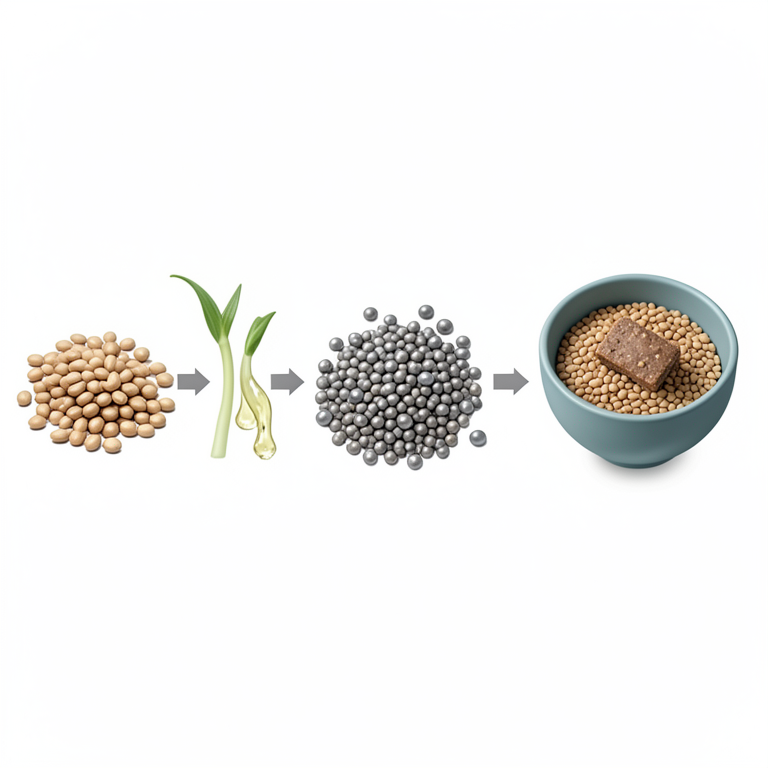
Millet Functional Food Workflow
AI-generated conceptual illustration (millet seeds and processed millet food products). It explains the idea and does not show study data.
View source evidence ↗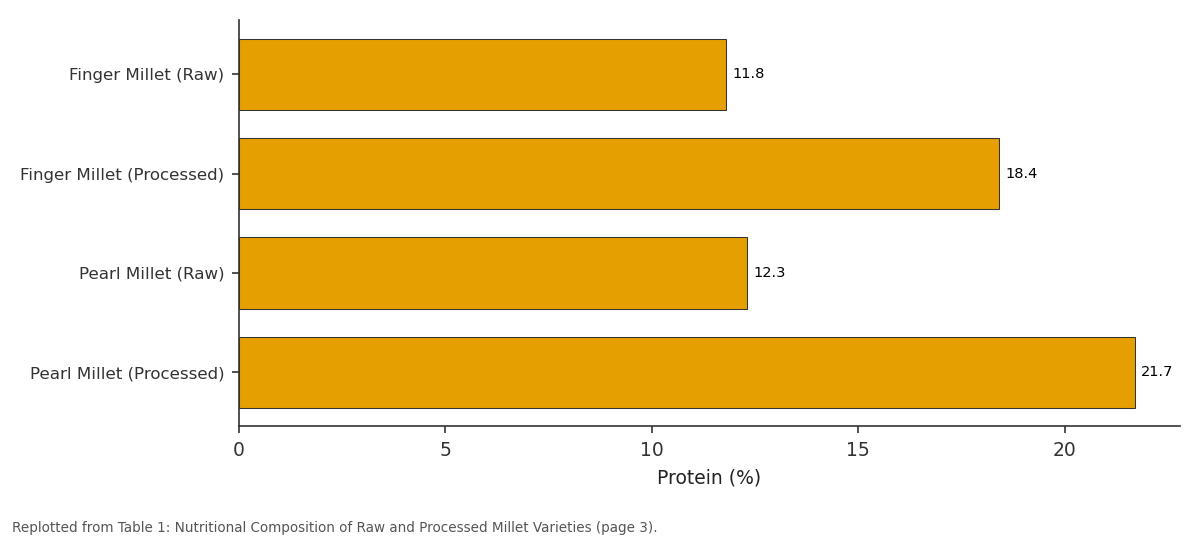
Protein (%): Finger Millet (Raw) vs Finger Millet... vs Pearl Millet (Raw) vs Pearl Millet (Processed)
Replotted from Table 1 (page 3) of the original paper. Every bar is the paper's own table value.
View source evidence ↗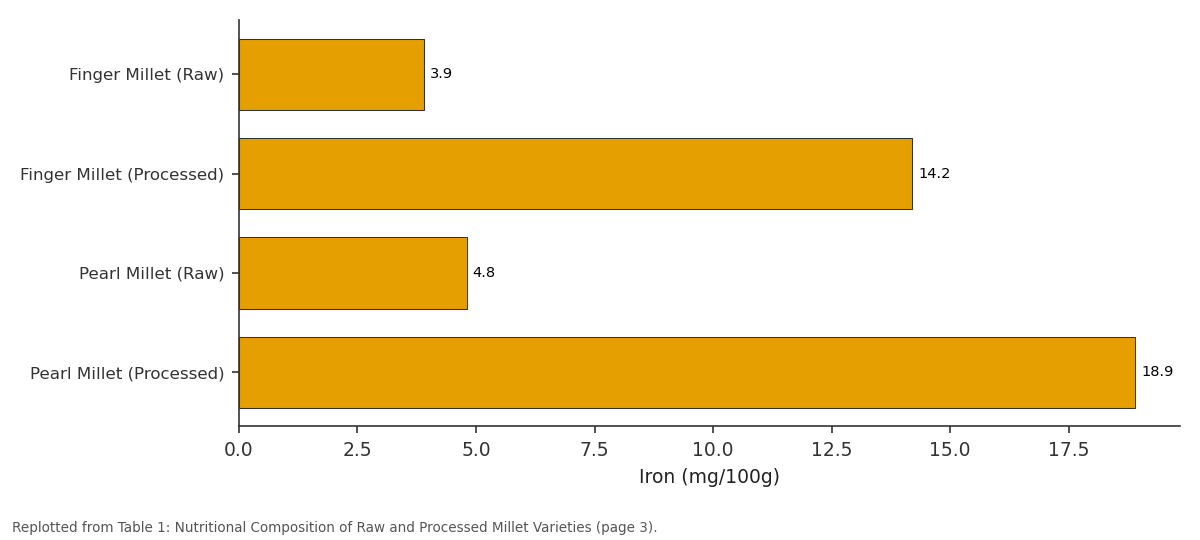
Iron (mg/100g): Finger Millet (Raw) vs Finger Millet... vs Pearl Millet (Raw) vs Pearl Millet (Processed)
Replotted from Table 1 (page 3) of the original paper. Every bar is the paper's own table value.
View source evidence ↗Figures & tables
From the original paper Table 1
Introduction
Millets constitute group of small-seeded cereals including finger millet, pearl millet, foxtail millet, proso millet, barnyard millet, and little millet cultivated across semi-arid regions of Asia and Africa [1] . These climate-resilient crops require minimal water and chemical inputs while delivering superior nutritional profiles compared to major cereals including rice and wheat. Millets contain 7-12% protein with balanced amino acid composition, 2-5% dietary fiber, and 2-4% ash representing mineral content [2] .
Finger millet excels in calcium content (344 mg/100g) compared to rice (10 mg/100g), while pearl millet provides substantial iron (8 mg/100g) and zinc (3.1 mg/100g). Additionally, millets exhibit low glycemic index supporting diabetes management and contain bioactive compounds including phenolic acids, flavonoids, and phytosterols demonstrating antioxidant and anti-inflammatory properties [3] . Despite nutritional advantages, millet consumption declined from 32.9 kg per capita in 1960s to 4.2 kg in 2018, attributed to limited processing technologies, minimal value-added products, poor consumer awareness, and government policies favoring rice and wheat through procurement and distribution [4] . The United Nations designated 2023 as International Year of Millets recognizing their potential for nutrition security, climate resilience, and sustainable agriculture. However, realizing this potential requires developing functional foods through biofortification enhancing nutrient content and bioprocessing improving digestibility and sensory properties [5] . Functional foods provide health benefits beyond basic nutrition through bioactive compounds, enhanced nutrient bioavailability, or physiological effects [6] . Millet-based functional food development employs multiple strategies: germination activates endogenous enzymes degrading antinutritional factors and synthesizing bioactive compounds; fermentation employs beneficial microorganisms producing vitamins, organic acids, and exopolysaccharides while reducing phytates; and fortification adds micronutrients addressing specific deficiencies [7] . These processing technologies transform millets into convenient products including ready-to-eat cereals, extruded snacks, protein bars, and instant mixes appealing to urban consumers while retaining nutritional benefits. This research addresses knowledge gaps through systematic investigation of biofortification and value addition approaches for millet-based functional food development. The objectives encompass: characterizing nutritional profiles of raw and processed millets; optimizing germination and fermentation parameters for nutrient enhancement; evaluating fortification strategies for iron, zinc, and vitamins; assessing functional properties enabling product development; conducting sensory evaluation and consumer acceptance testing; and validating nutritional efficacy through feeding trials.
Theoretical Background and Nutritional Biochemistry
Millet biofortification operates through multiple biochemical mechanisms. Germination initiates metabolic activation wherein enzymes including α-amylase, proteases, and phytase become active, breaking down complex carbohydrates, proteins, and phytic acid respectively. This enzymatic activity increases free amino acids, simple sugars, and available minerals while reducing antinutritional factors limiting bioavailability [8] . Fermentation employs lactic acid bacteria producing organic acids (lactic, acetic) lowering pH and activating endogenous phytase, further degrading phytates. Additionally, fermentation synthesizes B-vitamins including riboflavin, folate, and cobalamin, while producing bioactive peptides demonstrating antioxidant and antimicrobial properties. Fortification strategies employ bioavailable mineral forms: ferrous sulfate and ferric pyrophosphate for iron, zinc sulfate for zinc, and encapsulated vitamins protecting against degradation during processing and storage [9] .
Material and Methods
Material and Methods
Material
Research utilized finger millet (Eleusine coracana variety ML-365), pearl millet (Pennisetum glaucum variety RHB-177), foxtail millet (Setaria italica variety SiA-3156), and proso millet (Panicum miliaceum variety TNAU-164) procured from organic farms in Karnataka, Rajasthan, Telangana, and Tamil Nadu respectively. Seeds underwent cleaning, dehulling using abrasive dehullers, and milling to 60-mesh particle size. Lactobacillus plantarum MTCC 1407 and Lactobacillus acidophilus MTCC 447 obtained from MTCC Chandigarh served as fermentation cultures. Fortificants included ferrous sulfate (FeSO4•7H2O), ferric pyrophosphate (Fe4(P2O7)3), zinc sulfate (ZnSO4•7H2O), and vitamin B-complex premix from reputable suppliers. All chemicals used analytical reagent grade.
Methods
Germination involved steeping seeds 12 hours at 25 °C, followed by germination 48-72 hours in darkness maintaining 90% relative humidity. Fermentation employed 2% lactic acid bacteria inoculum with 24-48 hour incubation at 37 °C. Fortification added minerals at 25-35% recommended dietary allowance per 100g serving, optimized through preliminary trials. Product development produced ready-to-eat cereals through extrusion (temperature 140-160 °C, moisture 18-20%), protein bars through cold pressing with binders, and instant mixes through drum drying. Nutritional analysis employed AOAC methods: protein by Kjeldahl, minerals by atomic absorption spectroscopy, phytate by colorimetry. Bioavailability assessed through in vitro digestion simulating gastric and intestinal conditions. Sensory evaluation utilized 9-point hedonic scale with 60 semi-trained panelists. Statistical analysis employed ANOVA with Tukey post-hoc testing at p<0.05 using SPSS 25.0.
Quality Control and Safety Assessment
Quality control protocols ensured product safety and consistency. Microbiological testing examined total plate count, yeast and mold, coliforms, and pathogens following ISO standards. Mycotoxin analysis quantified aflatoxins, ochratoxins, and fumonisins through HPLC ensuring compliance with food safety regulations. Heavy metal testing (lead, cadmium, mercury, arsenic) employed ICP-MS with detection limits below regulatory thresholds. Pesticide residue screening covered 250 compounds through GC-MS and LC-MS/MS. Packaging evaluation assessed oxygen transmission rate, water vapor transmission rate, and light barrier properties ensuring product protection. Accelerated shelf life testing at 37°C and 75% RH predicted stability under normal storage conditions. These quality assurance measures ensured developed products met international food safety standards supporting commercial viability [10] .
Results
Results
Discussion
This research successfully developed functional foods from millets through integrated biofortification and value addition approaches achieving substantial nutritional enhancement. The 56-76% protein increase through germination and fermentation reflects enzymatic degradation of storage proteins into free amino acids and microbial synthesis of exogenous proteins. This protein enhancement addresses protein-energy malnutrition affecting 35% of Indian children under five years [11] . The fermentation process additionally produces bioactive peptides demonstrating antioxidant activity and potential health benefits beyond basic nutrition. Iron and zinc fortification achieved 264-394% and 296-344% increases respectively, delivering 63-95% of RDA per 100g serving. These micronutrient enhancements address widespread deficiencies: 53% of Indian women suffer iron deficiency anemia, while 38% of children exhibit zinc deficiency [12] .
Figures and tables from the paper
| Parameter | Finger Millet (Raw) | Finger Millet (Processed) | Pearl Millet (Raw) | Pearl Millet (Processed) |
|---|---|---|---|---|
| Protein (%) | 11.8 | 18.4 | 12.3 | 21.7 |
| Iron (mg/100g) | 3.9 | 14.2 | 4.8 | 18.9 |
| Zinc (mg/100g) | 2.3 | 9.1 | 3.4 | 11.7 |
| Calcium (mg/100g) | 344 | 387 | 42 | 68 |
| Phytate (mg/100g) | 584 | 247 | 612 | 291 |
| Bioavailability (%) | 14.7 | 43.2 | 12.3 | 38.6 |
Table text extracted from the original PDF; superscript letters are shown inline. The original table image is below.
View original table image
References
21 in the original paper- Saleh ASM, Zhang Q, Chen J, Shen Q. Millet grains: nutritional quality, processing, and potential health benefits. Compr Rev Food Sci Food Saf. 2013;12(3):281-95.
- Amadou I, Gounga ME, Le GW. Millets: nutritional composition, some health benefits and processing. Emir J Food Agric. 2013;25(7):501-8.
- Chandrasekara A, Shahidi F. Content of insoluble bound phenolics in millets and their contribution to antioxidant capacity. J Agric Food Chem. 2010;58(11):6706-14.
- National Sample Survey Office. Household consumption of cereals in India. NSS 68th Round. New Delhi: NSSO; 2014.
- Food and Agriculture Organization of the United Nations. Future smart food: rediscovering hidden treasures of neglected and underutilized species. Rome: FAO; 2018.
- Bigliardi B, Galati F. Innovation trends in the food industry. J Funct Foods. 2013;5(4):1609-21.
- Steinkraus KH. Fermentations in world food processing. Compr Rev Food Sci Food Saf. 2002;1(1):23-32.
- Chavan JK, Kadam SS. Nutritional improvement of cereals by sprouting. Crit Rev Food Sci Nutr. 1989;28(5):401-37.
- Hurrell R, Egli I. Iron bioavailability and dietary reference values. Am J Clin Nutr. 2010;91(5):1461S7S.
- Codex Alimentarius Commission. General standard for food additives. Codex Stan 192-1995. Rome: FAO/WHO; 2019.
- United Nations Children's Fund. The state of the world's children 2019. New York: UNICEF; 2019.
- International Institute for Population Sciences. National Family Health Survey (NFHS-4): nutritional status of children and women. Mumbai: IIPS; 2017.
- Shobana S, Sreerama YN, Malleshi NG. Composition and enzyme inhibitory properties of finger millet (Eleusine coracana). J Food Sci Technol. 2009;46(4):318-20.
- Pawar VD, Patil JV, Jangam PM. Effect of processing on nutritional and sensory quality of pearl millet. J Food Sci Technol. 2010;47(6):635-40.
- Rao S, Muralikrishna G. Water-soluble feruloyl arabinoxylans from rice and ragi. J Agric Food Chem. 2006;54(10):3428-33.
- Devi PB, Vijayabharathi R, Sathyabama S, Malleshi NG, Priyadarisini VB. Health benefits of finger millet (Eleusine coracana L.). J Food Sci Technol. 2014;51(6):1021-40.
- Gupta N, Srivastava AK, Pandey VN. Biodiversity and nutraceutical quality of some Indian millets. Proc Natl Acad Sci India Sect B Biol Sci. 2012;82(2):265-73.
- Shahidi F, Chandrasekara A. Millet grain phenolics and their role in disease risk reduction and health promotion. J Funct Foods. 2013;5(2):570-81.
- Platel K, Eipeson SW, Srinivasan K. Bioaccessible mineral content of malted finger millet (Eleusine coracana). Food Chem. 2010;119(3):1080-4.
- Nazni P, Shobana DR. Nutrient composition and sensory quality of products containing finger millet. Malays J Nutr. 2008;14(2):193-9.
- Ramachandra G, Virupaksha TK, Shadaksharaswamy M. Relation between tannin levels and in vitro protein digestibility in finger millet (Eleusine coracana). J Agric Food Chem. 1977;25(5):1101-4.