
Research article · 2025 · Full text
International Journal of Horticulture and Food ScienceInnovations in farm machinery for sustainable horticultural production: An Indian perspective
Volume 7(10) · Pages 86–89 · DOI: 10.33545/26631067.2025.v7.i10b.407 ↗
Research areasParticle physics theoretical and experimental studiesComputational Physics and Python ApplicationsHigh-Energy Particle Collisions Research
Abstract
Author-writtenHorticulture is central to India’s food security, nutrition and farm incomes. However, the sector is constrained by labour shortages, high post-harvest losses and limited access to appropriate machinery. Recent innovations — precision sensors and decision support, robotics and automation, electrified powertrains, protected-cultivation machinery and modular post-harvest units — can increase productivity, reduce resource use and lower losses. This review synthesizes technological advances applicable to Indian horticulture, quantifies current system metrics (production, losses, infrastructure), evaluates adoption drivers and barriers, and delineates priority R&D and policy actions to achieve sustainable mechanization. Key figures: horticultural production in 2022-23 ≈ 355.48 million tonnes; fruit production 2022-23 ≈ 110.21 million tonnes; India’s cold-storage capacity ≈ 39.4 million MT in ~8,600 facilities; post-harvest losses remain high (variously estimated at ~15-30% for horticultural produce).
Summary
Source-checkedPlain-language reading of the full paper, prepared with AI and checked against the text. Each point links to the authors' own words.
Why it matters
- Horticulture plays a critical role in maintaining food security, nutrition, and farm-level income in India. View evidence ↗
- The Indian horticultural sector faces significant challenges, including a lack of appropriate machinery, labor shortages, and high levels of post-harvest losses. View evidence ↗
- Because horticultural crops are labor-intensive, perishable, and high-value, they require specialized mechanization different from that used in broadacre farming. View evidence ↗
The question
- The authors aim to synthesize technological advances for Indian horticulture, quantify current system metrics, and identify the R&D and policy actions needed for sustainable mechanization. View evidence ↗
What they did
- The study is a review that synthesizes existing technological advances and quantifies current production, loss, and infrastructure metrics in India. View evidence ↗
What they found
- In 2022-23, India's total horticultural production was approximately 355.48 million tonnes, with fruit production accounting for about 110.21 million tonnes. View evidence ↗
- India possesses approximately 8,600 cold storage facilities with a total capacity of about 39.4 million metric tonnes. View evidence ↗
- Post-harvest losses for horticulture in India are typically estimated between 15% and 25%, though some crops reach up to 30%. View evidence ↗
- Global case studies of sensor-based micro-irrigation in orchards and polyhouses show water savings of 20% to 40%. View evidence ↗
- The use of canopy-sensing sprayers and spot-spraying in orchard crops has resulted in pesticide savings of 20% to 50%. View evidence ↗
- Targeted unmanned ground vehicle (UGV) systems for weeding in high-value vegetables can potentially reduce herbicide use by 50% to 90%. View evidence ↗
- Access to basic cold storage and pack-houses can reduce losses related to perishability by approximately 10 to 20 percentage points. View evidence ↗
- Estimates for the area under protected cultivation in India vary significantly, ranging from approximately 11,000 to 30,000 hectares. View evidence ↗
What it means
- The authors conclude that translating prototypes into wide-scale impact requires a combination of coordinated R&D, policy support, and innovative business models like equipment leasing and Custom Hiring Centres (CHCs). View evidence ↗
- The authors state that the sector will benefit significantly from machinery that is designed with a focus on maintainability, affordability, and sustainability. View evidence ↗
- Technical limitations for robotics include energy autonomy, cost parity with manual labor, gripper adaptability, and perception reliability under varying light. View evidence ↗
Visual summary
1 visualsIllustrations explain the paper; they do not show study data.
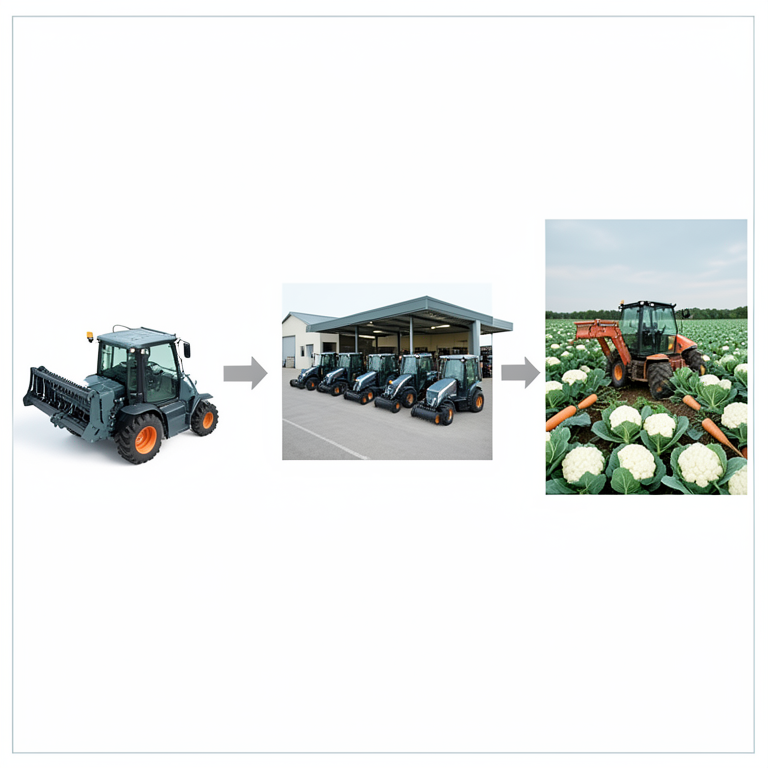
Sustainable Mechanization Ecosystem
AI-generated conceptual illustration (Indian horticultural farm machinery and vegetable crops). It explains the idea and does not show study data.
View source evidence ↗Introduction
Horticulture in India is highly diverse and a major contributor to agricultural GDP and household nutrition. Final estimates for 2022-23 place total horticulture production at ~355.48 million tonnes, with fruit production alone ~110.21 million tonnes. Annual changes in area and production reflect both expansion and intensification of horticultural enterprises. The sector's value density, perishability and labor intensity make it a priority for targeted mechanization approaches that differ from broadacre solutions. Sustainable mechanization must meet four concurrent goals: (1) increase labor productivity and reduce seasonal labor constraints; (2) reduce resource intensity (water, energy, agrochemicals); (3) minimize product damage and losses; and (4) be economically accessible for small and marginal farmers who predominate in India. This review examines technological trends and quantifies the current system status, highlighting opportunities for rapid, equitable impact.
Facts & figurescurrent infrastructure and losses (India)
Providing baseline metrics helps frame where machinery innovation can deliver the most benefit. Total horticulture production (2022-23): ~355.48 million tonnes (Final Estimates).
Fruit production was ~110.21 million tonnes for 2022-23. These figures represent yearon-year increases and substantial national output. Protected cultivation area: Estimates vary by sourcesome surveys report ~11,000 hectares, while other compiled assessments indicate up to ~30,000 hectares under some forms of protected cultivation (polyhouse/greenhouse) depending on definitions and datasets. The divergence underscores differences in data collection (small tunnels vs commercial greenhouses) and rapid expansion in recent years. Cold-storage capacity: India has approximately 8,600 cold storage facilities with a combined capacity of ~39.4 million metric tonnes (as of recent analyses), but utilization, geographic distribution and suitability for fruits & vegetables remain uneven. Investment programs are underway to modernize and add solar and grid-hybrid cold rooms.
Post-harvest losses: Estimates differ by methodology. FAO and policy briefs suggest that ~13-30% of food produced is lost from harvest to retail in developing contexts; India-specific estimates often place horticultural post-harvest losses in the range ~15-25%, with some aggregated studies noting up to ~30% for certain crops and value chains. Reducing these losses is a large lever for increasing food availability and farmer incomes (Subash Sunar et al, 2022) [7] .
Lifecycle and circularity concerns
Battery raw materials, recycling and end-of-life management must be integrated into electrification plans.
Lifecycle analyses comparing small electric tractors vs diesel for Indian tasks show promising energy and emissions benefits but depend on grid carbon intensity and battery lifecycle management.
Protected cultivation & mechanization in intensive systems
Machines tailored to greenhouse/polyhouse environments Compact mobile platforms, trolley-mounted manipulators and modular pruning/harvesting attachments support intensive vegetable and floriculture systems. Automation of microclimate control (sensor-feedback loops controlling ventilation, shade nets and misting) improves uniformity in protected environments and reduces inputs.
High-density orchard mechanization
Mechanized platforms for pruning, thinning and harvesting in high-density plantings increase throughput. These include worker platforms (lifted) and mechanical pruners adapted to tree architecture.
Area under protected cultivation: Data shows rapid expansion but estimates vary (range cited above); this expansion increases the market for compact and modular mechanization solutions.
Post-harvest mechanization & cold-chainpractical units and cost metrics Village/FPO level modular pack-houses
Modular units (grading, washing, conveyor sorters, small cold rooms) deployed at FPO levels reduce losses and increase value capture. Evidence from government schemes indicates high demand for such investments; subsidies for cold chain components are available (e.g., NHB cold chain schemes).
Grading & sorting with machine vision
Affordable vision systems now perform size, colour and defect sorting at modest throughputs suitable for small packhouses. These systems reduce manual sorting time and improve market compliance for export and institutional buyers.
Quantified impact on losses and revenue
Field demonstrations indicate that access to basic packhouse and cold-storage can reduce perishability-related losses by ~10-20 percentage points and enable better market timing, improving farmgate prices. However, capital costs, power supply and maintenance are constraints.
Business models, financing and service delivery
Business models, financing and service delivery
Conclusion
India's horticulture sector stands to gain substantially from thoughtfully designed farm machinery that prioritizes sustainability, affordability and maintainability. The scale of production (hundreds of millions of tonnes annually) and persistent post-harvest losses indicate large potential returns on investments in machinery, cold-chain, and service delivery. Coordinated R&D, policy support and businessmodel innovation (CHCs, FPOs, equipment leasing) will be pivotal to translating prototypes into widescale impact.
References
9 in the original paper- Government of India. Final estimates of 2022-23 & first advance estimates 2023-24 of horticulture production. Press Information Bureau, Ministry of Agriculture & Farmers Welfare; 2024 Mar 7. Available from: https://pib.gov.in
- Indian Council for Research on International Economic Relations (ICRIER). Reducing post-harvest losses in Indian agriculture: Policy brief. New Delhi: ICRIER; 2024.
- Kumar R, Singh A. Protected cultivation of horticultural crops: A sustainable approach. Biochem J Agric Environ. 2025;14(2):115-128.
- Singh P, Sharma V, Kaur G. Prospects and challenges of protected cultivation in India. Int J Hortic Sci. 2023;29(1):45-52.
- Rao S, Meena K. Transforming India's legacy cold storage infrastructure: Challenges and opportunities. J Food Supply Chain Manag. 2025;7(1):33-47.
- Department of Agriculture & Farmers Welfare. District-wise targets and achievements of custom hiring centres. AgriMachinery Portal; 2023. Available from: https://agrimachinery.nic.in
- Sunar S, Sapkota D, Dumre A, Bhattarai I, Sharma DR, Sapakota MM. Status of farm mechanization on rice production: A case study of Banganga Municipality, Kapilvastu, Nepal. Int J Agric Extension Social Dev. 2022;5(1):28-31. DOI:10.33545/26180723.2022.v5.i1a.120
- Sharma R, Patel D. Emerging trends in electric tractors for Indian agriculture. J Agric Eng. 2023;60(3):112-20.
- Zhang Y, Chen H, Li B. Robotic harvesting technologies for fruits: A review of recent progress. Comput Electron Agric. 2022;197:106933. DOI:10.1016/j.compag.2022.106933
Cited by 3
From OpenAlex, OpenCitations and reference lists read by Scinovex
- Designing climate-resilient farm machinery: A review on adaptive technologies for heat, drought, and soil conservation challenges
Yuvraj Gopinath Kasal, Satyapal Singh, Shahroon Khan · International Journal of Horticulture and Food Science · 2025
Climate change has intensified abiotic stresses such as heat, drought, and soil degradation, directly impacting the performance, durability, and efficiency of agricultural machinery. Designing climate-resilient farm machinery (CRFM) is therefore essential to maintain productivity under variable weather and resource constraints. This review synthesizes global progress in adaptive machinery design focusing on thermal management, material innovation, soil-conserving implements, and smart control systems that respond dynamically to climatic conditions. The integration of renewable energy, automati
- Hybrid Power Systems in Farm Machinery: A Review of Solar, Biofuel, and Hydrogen-Assisted Agricultural Mechanization
Yuvraj Gopinath Kasal, Shahroon Khan, Satyapal Singh · International Journal of Agriculture and Food Science · 2025
Hybrid power solutions that combine solar electricity, biofuels, and hydrogen (fuel-cell or dual-fuel) with conventional engines are emerging as practical pathways to decarbonize agricultural mechanization while maintaining operational flexibility. This review synthesizes recent advances in solar-assisted charging and agrivoltaic concepts, biofuel (biodiesel/ethanol/biomethane) utilisation in off-road engines, and hydrogen fuel-cell or hydrogen-assisted hybrid drivetrains for tractors and implements. We compare technical architectures (series hybrids, parallel hybrids, range-extenders, and mod
- Scale-appropriate mechanization: A review of low-cost, energy-efficient farm machinery solutions for smallholder farmers
Yuvraj Gopinath Kasal, Satyapal Singh, Shahroon Khan · International Journal of Agriculture and Nutrition · 2025
Agricultural mechanization has long been associated with increased productivity, yet conventional large-scale machinery often remains inaccessible to smallholder farmers due to high costs, inappropriate scale, and limited technical support. This review focuses on scale-appropriate mechanization (SAM) a sustainable approach emphasizing low-cost, energy-efficient, and locally adaptable technologies designed for small farms, typically below two hectares. It synthesizes technological, economic, and institutional dimensions of SAM, including innovations in lightweight materials, renewable-powered i