
Research article · 2025 · Full text
International Journal of Agriculture and Food ScienceElectrification of Agricultural Machinery: Advances in Battery Technology, Powertrain Design, and Field Performance for Sustainable Farming
Volume 7(10) · Pages 252–256 · DOI: 10.33545/2664844x.2025.v7.i10d.881 ↗
Research areasElectric and Hybrid Vehicle TechnologiesBiodiesel Production and ApplicationsAgricultural Engineering and Mechanization
Abstract
Author-writtenThe electrification of agricultural machinery represents a transformative shift toward sustainable, efficient, and intelligent farming systems. This review synthesizes recent advancements in battery technologies, powertrain architectures, and energy management strategies that enable the replacement or hybridization of conventional diesel-based systems. Lithium Iron Phosphate (LFP) and Nickel-Manganese-Cobalt (NMC) chemistries currently dominate applications, while emerging solid-state and sodium-ion batteries show long-term promise. The paper examines design challenges related to thermal management, vibration resistance, soil compaction, and battery modularity for field operations. Comparative analyses of battery-electric, hybrid, and fuel-cell powertrains highlight tradeoffs in efficiency, emissions, and total cost of ownership under diverse agricultural duty cycles. Field trials indicate up to 23% improvement in energy efficiency and complete elimination of tailpipe emissions. Integration of renewable energy, on-farm microgrids, and intelligent energy management systems enhances operational resilience and sustainability. Finally, the paper identifies policy interventions, financing mechanisms, and research priorities—including second-life battery use, standardization, and circular economy models—to accelerate large-scale adoption of electrified farm machinery, particularly in developing regions.
Summary
Source-checkedPlain-language reading of the full paper, prepared with AI and checked against the text. Each point links to the authors' own words.
Why it matters
- The shift toward electrifying agricultural machinery is driven by the need to reduce greenhouse gases, mitigate fossil fuel price volatility, and improve occupational health by reducing noise and particulates. View evidence ↗
- Adoption is limited by the energy density of current batteries, the need for equipment to be rugged enough for off-road use, and the highly variable power demands of seasonal farm work. View evidence ↗
The question
- The review aims to define engineering tradeoffs, synthesize technological advances in powertrains and batteries, identify performance metrics, and propose policy and research agendas for agricultural electrification. View evidence ↗
What they did
- The authors conducted a synthesis of recent advancements in battery technology, powertrain design, and energy management to evaluate the replacement or hybridization of diesel systems. View evidence ↗
- The paper proposes standardized metrics for comparing powertrains, including energy consumption per hectare (kWh/ha), CO2-equivalent emissions, and Total Cost of Ownership (TCO). View evidence ↗
What they found
- Electric tractors showed a 23.2% improvement in energy efficiency compared to diesel tractors, reducing consumption from 18.5 to 14.2 kWh/ha. View evidence ↗
- Operating costs for electric tractors were lower at 300 ₹/hr compared to 450 ₹/hr for diesel tractors, representing a 33.3% improvement. View evidence ↗
- Electric tractors completely eliminated tailpipe emissions, reducing them from 7.5 kg of CO2-eq/hr in diesel tractors to 0. View evidence ↗
- Maintenance costs for electric tractors are reported as low compared to high costs for diesel, with an improvement of 40-50%. View evidence ↗
- Lithium Iron Phosphate (LFP) batteries offer high safety and a long lifespan of 4,000-5,000 cycles, with costs between 90-110 $/kWh. View evidence ↗
- Nickel-Manganese-Cobalt (NMC) batteries provide higher energy density (180-250 Wh/kg) than LFP, but have a shorter lifespan of 2,000-3,000 cycles. View evidence ↗
- Battery-Electric Vehicles (BEVs) are limited in heavy continuous tillage due to battery weight and cost, making hybrids or range extenders more suitable for arable farming. View evidence ↗
What it means
- The authors conclude that scaling the adoption of electric farm machinery, especially in developing regions like India, requires integrating renewable energy, policy incentives, and local innovation. View evidence ↗
- A significant technical challenge is that heavier battery packs increase soil compaction, and current mitigation strategies like wider tires involve cost and performance tradeoffs. View evidence ↗
- The high upfront cost of electrified machinery remains the primary socio-economic barrier for smallholder farmers. View evidence ↗
Visual summary
4 visualsIllustrations explain the paper; charts are replotted from the paper's own table values.
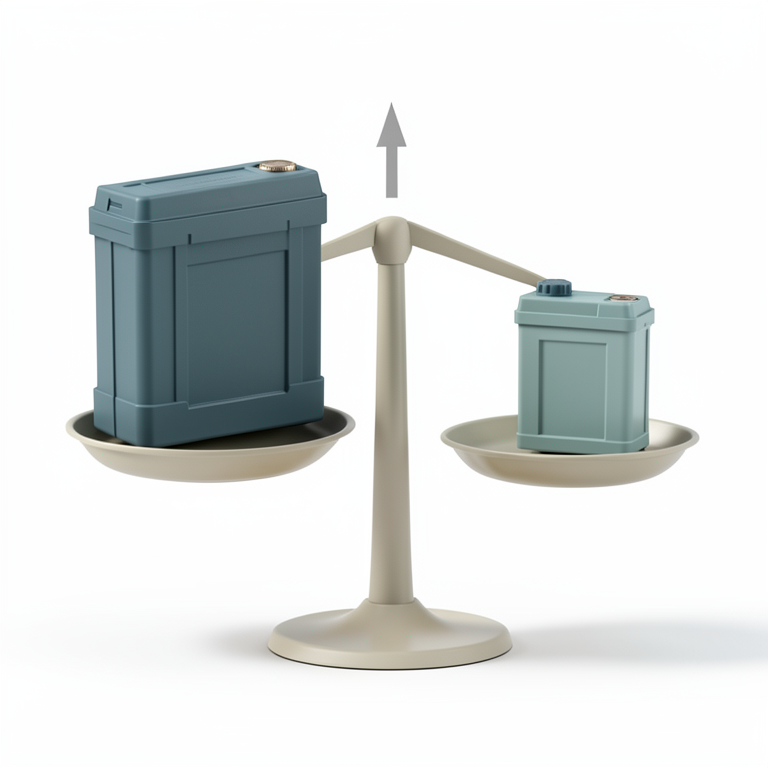
Battery Chemistry Trade-offs
AI-generated conceptual illustration (electric tractor batteries). It explains the idea and does not show study data.
View source evidence ↗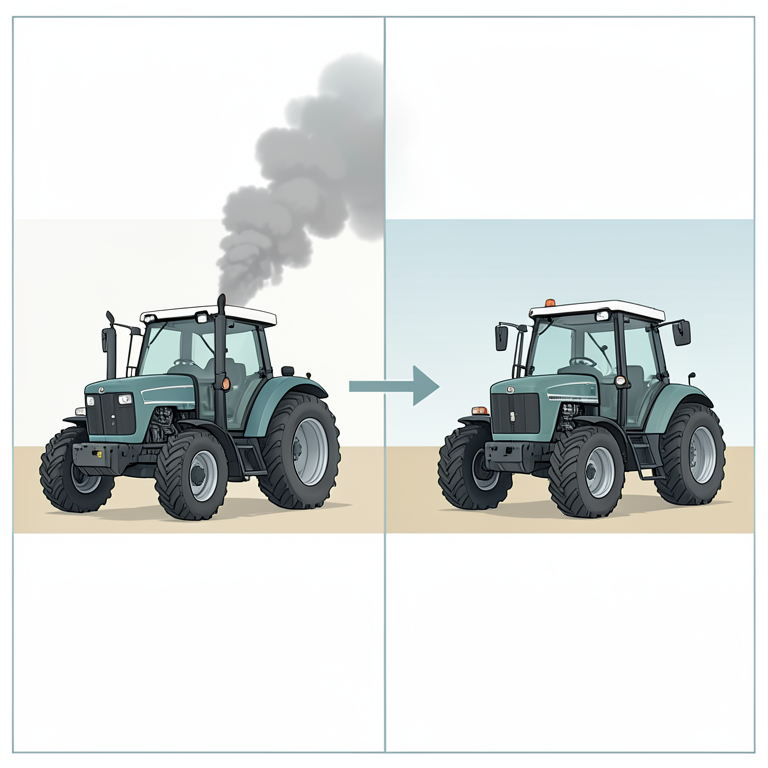
Diesel vs Electric Impact
AI-generated conceptual illustration (Agricultural tractors). It explains the idea and does not show study data.
View source evidence ↗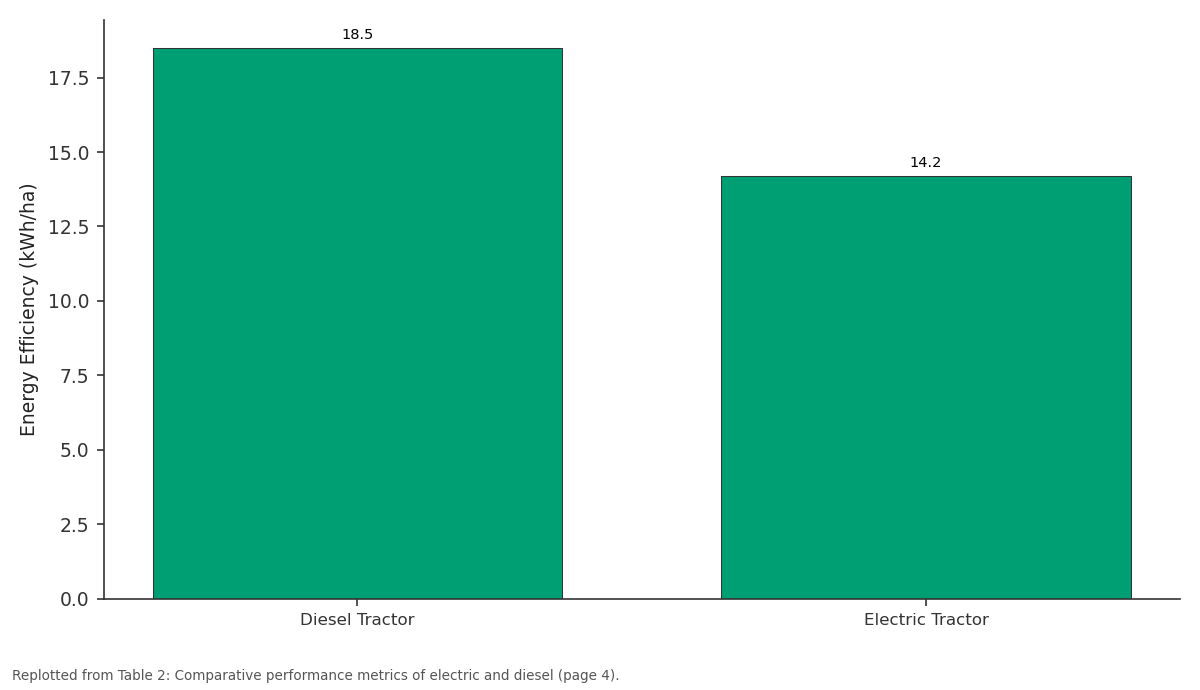
Energy Efficiency (kWh/ha): Diesel Tractor vs Electric Tractor
Replotted from Table 2 (page 4) of the original paper. Every bar is the paper's own table value.
View source evidence ↗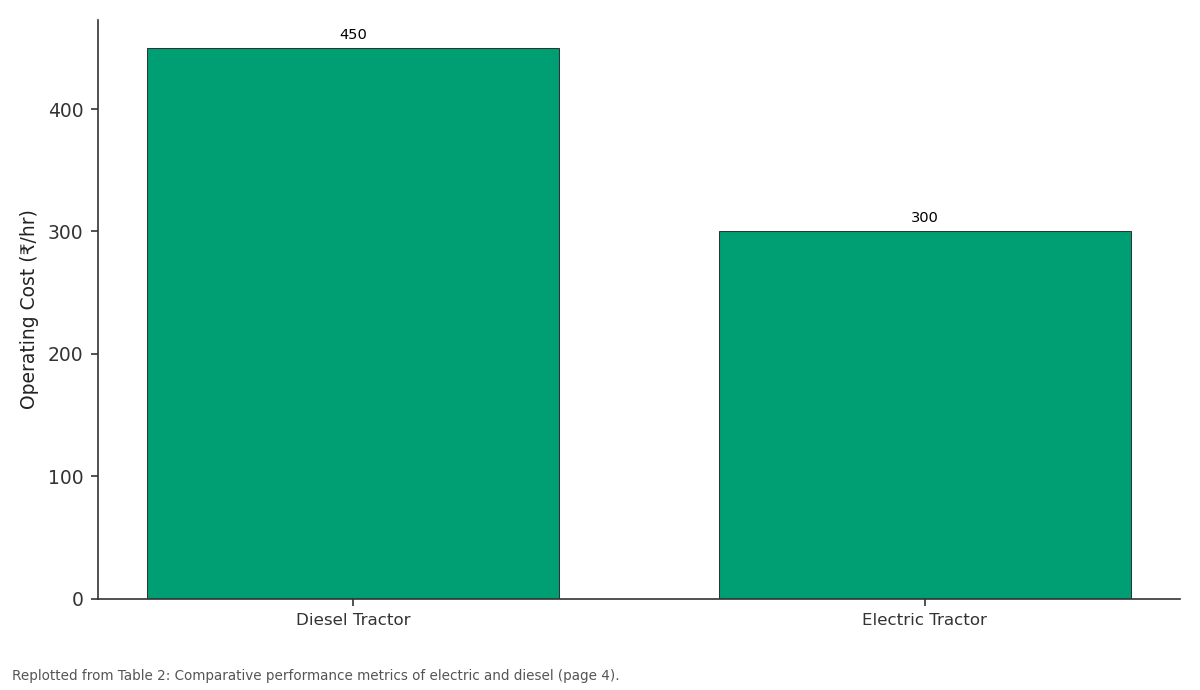
Operating Cost (₹/hr): Diesel Tractor vs Electric Tractor
Replotted from Table 2 (page 4) of the original paper. Every bar is the paper's own table value.
View source evidence ↗Figures & tables
From the original paper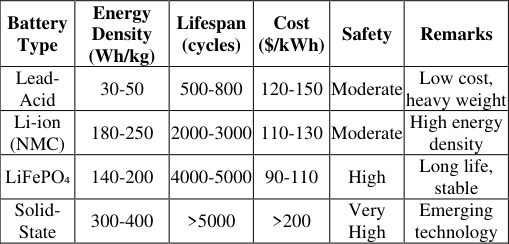 Table 1
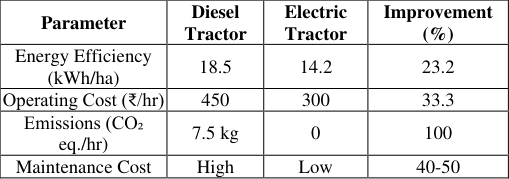 Table 2
Introduction
Electrifying agricultural machinery is not a single technology shift but a systems transition: it touches vehicle and implement design, energy supply (grids, on-farm renewables), operations planning, maintenance ecosystems, and farmer economics. Key drivers are: greenhouse-gas reduction targets, fossil fuel price volatility, occupational health (reduced particulates and noise), and the availability of high-power electric components developed for EV and industrial markets. Key constraints are energy density of batteries, ruggedness requirements for off-road duty, and the seasonal, highly variable power profiles of farm work. Purpose of an expanded review a) define the engineering constraints and tradeoffs for electrified farm power. b) synthesize recent advances in batteries, BMS, motors, transmissions, and charging/infrastructure c) identify metrics and experimental methods for fair performance comparison; (d) highlight socio-economic and policy levers d) propose concrete research agendas (measurement campaigns, pilot designs, techno- economic analysis frameworks).
Battery Technologies for Agricultural Applications — elaborated Battery chemistries: characteristics and implications for farm use When choosing a battery chemistry for agricultural vehicles, engineers must map chemistry properties to farm requirements. Below are common and emerging chemistries with practical implications. NAAS Rating (2025): 4.97 IJAFS 2025; 7(10): 252-256 Yuvraj Gopinath Kasal Dept. of Farm Power and Machinery, Maharana Pratap Horticultural University, Karnal, Haryana, India Satyapal Singh Dept. of Vegetable Science, Maharana Pratap Horticultural University, Karnal, Haryana, India Shahroon Khan Dept. of Fruit Sciecne, Maharana Pratap Horticultural University, Karnal, Haryana, India Yuvraj Gopinath Kasal Dept. of Farm Power and Machinery, Maharana Pratap Horticultural University, Karnal, Haryana, India https://www.agriculturaljournals.com Cost-constrained, emerging markets: Consider lower-energy chemistries with battery-as-service models. Battery pack design, mechanical integration, and ruggedization Key design areas for farm battery packs: 1.
Mechanical mounting & shock isolation: Packs must survive high vibration, shock from uneven ground, and implement-induced forces. Use vibration-resistant trays, elastomeric mounts, and structural integration to distribute loads. 2. Ingress protection & sealing: IP65/IP67 levels are Lithium Iron Phosphate (LFP / LiFePO₄) Strengths: Excellent cycle life (often >3000 cycles in real use), high thermal stability, lower cost (no cobalt), safer under abuse, tolerant of high charge/discharge currents. Weaknesses: Lower gravimetric energy density versus NMC; larger pack mass/volume for equivalent range.
Implications: LFP is well suited for duty cycles with frequent shallow cycles and where safety and longevity matter—e.g., orchard tractors, utility vehicles, and battery packs that may be repurposed as stationary storage later. Nickel-Manganese-Cobalt (NMC) / Nickel-Cobalt- Aluminium (NCA) Strengths: Higher energy density (better range for a given weight), well established in automotive industry. Weaknesses: Higher cost, reliance on critical metals, slightly more sensitive to abuse and thermal runaway risk. Implications: Where range or compactness is critical (larger arable tractors or situations with limited charging), NMC packs can reduce pack weight—but may require more robust thermal management. Sodium-Ion Strengths: Uses abundant sodium (lower raw material cost), improving low-temperature performance in some formulations. Weaknesses: Lower energy density; still early commercial scale. Implications: Potential future option for cost-sensitive markets when cycle life improves. Lithium-Sulfur, Solid-State, and Other Emerging Chemistries Promise: Higher theoretical specific energy (Li-S) and improved safety/energy density (solid-state). Reality: Technology readiness varies; lifecycle issues and manufacturing scale remain barriers. Implications: Good to follow for medium-term prospects (5-10 years), but not yet broadly deployable for rugged farm use.
Table 1: Comparative characteristics of battery types for electric farm machinery Battery Lifespan Type (cycles) Cost ($/kWh) Safety Remarks Energy Density (Wh/kg) Lead- Acid 30-50 500-800 120-150 Moderate Low cost, heavy weight Li-ion (NMC) 180-250 2000-3000 110-130 Moderate High energy density LiFePO₄ 140-200 4000-5000 90-110 High Long life, stable Solid- State 300-400 >5000 >200 Very High Emerging technology Practical design implication: choose chemistry based on operational case Short-range, high-cycle (orchards, greenhouse): LFP, prioritizing safety and cycle life. Long-range, heavy load (large arable): NMC/NCA or hybrid architectures to avoid excessive pack weight. common targets; dust infiltration and moisture from irrigation or muddy environments must be prevented. 3. Thermal management Passive cooling may suffice for low-power duty, but long high-power operations (ploughing, heavy tillage) require active liquid cooling or forced air. Thermal design must also consider cold start: battery performance falls at low temperatures, so thermal pre- conditioning can be necessary. 4. Modularity & swappability Modular packs permit seasonal scaling (add modules during harvest) or battery swapping approaches for continuous operations. Design tradeoffs include mechanical/electrical connector robustness and safety interlocks. 5. Mechanical placement & soil compaction Low center of gravity and even weight distribution are desirable, but heavier packs increase axle loads and soil compaction.
| Battery Type | Energy Density (Wh/kg) | Lifespan (cycles) | Cost ($/kWh) | Safety | Remarks |
|---|---|---|---|---|---|
| Lead- Acid | 30-50 | 500-800 | 120-150 | Moderate | Low cost, heavy weight |
| Li-ion (NMC) | 180-250 | 2000-3000 | 110-130 | Moderate | High energy density |
| LiFePO₄ | 140-200 | 4000-5000 | 90-110 | High | Long life, stable |
| Solid- State | 300-400 | >5000 | >200 | Very High | Emerging technology |
Table text extracted from the original PDF; superscript letters are shown inline. The original table image is below.
View original table image
Consider placement over axles and implement design changes (wider tires, tracks) to mitigate compaction. Battery Management Systems (BMS), diagnostics and second life State-of-Charge (SOC) and State-of-Health (SOH): Adaptive algorithms that handle non-ideal conditions (variable temperature, irregular loads) are necessary. Off-road vibrations and intermittent high current demands complicate coulomb-counting—Kalman filters and machine-learning SOC estimators have been investigated. Cell balancing and fault detection: Passive and active balancing strategies prolong pack life. Early fault detection for cell mismatches is critical in remote farm settings. Prognostics & lifecycle management: BMS should support predictive maintenance: reporting SOH trends and advising on replacement or repurposing of battery modules. Second-life applications: Used packs can be repurposed as stationary farm storage to store PV energy, extending economic life and supporting the farm energy ecosystem.
Powertrain Architectures and Energy Management — detailed analysis Comparative architectures: pros, cons, and mapping to farm tasks https://www.agriculturaljournals.com An EMS coordinates battery SOC, ICE/generator outputs (if hybrid), regenerative braking/recapture strategies (relevant for loaders, transport), and charge scheduling. Important EMS features: Duty-cycle aware control: Predictive EMS using historical/real-time task scheduling to allocate energy and minimize fuel/electricity cost. Regenerative capture policies: For operations with deceleration/relief (transport between fields), recuperation helps recover energy. Peak shaving & grid interaction: EMS can manage charging to avoid peak tariffs or align charging with PV generation. Safety & fail-safe modes: Always specify fail-safe state (e.g., limp-home mode) if battery falls below minimum SOC. Field Performance: methods, metrics, and evidence
Experimental Design
and standard metrics To compare conventional and electrified powertrains, studies should use standardized metrics and protocols: 1. Metrics: Energy consumed per hectare (kWh/ha), fuel energy equivalent, effective drawbar power, implement field capacity (ha/h), soil compaction indices (kPa or axle load per contact area), noise levels (dB(A)), CO₂- eq emissions per operation, TCO over defined ownership period, operator comfort scores. 2. Protocols Define test tasks (ploughing at X depth on soil type Y, transport loaded on R km on road). Log high-resolution time series of power, torque, vehicle speed, battery SOC, ambient conditions. Use instrumented tractors or test rigs to reproduce conditions. Include lifecycle boundary definitions for LCA (manufacturing, operation, EOL). Simulation tools and modeling approaches Vehicle dynamic models: Simulate tractive force, rolling resistance, drawbar pull under varying soil conditions to predict energy demands. Cycle simulation: Use duty cycle traces from real operations to drive battery discharge models; include thermal models and BMS behavior. LCA tools: Integrate embodied emissions (battery manufacture) with operational emissions; sensitivity runs for grid carbon intensity and battery recycling rates.
Prototypes, demonstrations, and case studies — practical lessons Small electric tractors: Demonstrated advantages in orchards, vineyards, and greenhouses: quiet operation, instant torque for precise low-speed tasks, and lowered air pollution in enclosed environments. Users appreciate improved operator comfort and simpler maintenance. Large BEV limitations: For heavy continuous tillage, BEV requires either very large battery packs (weight and cost problems) or operational changes (shorter shifts, battery swap), so many projects target hybrids or range extenders for arable contexts. Battery-Electric Vehicle (BEV) Pros: Highest drivetrain efficiency (electric motors ~90%+ efficiency), simpler drivetrain (no multi-gear mechanical transmission in many designs), lower operational maintenance. Cons: Requires sufficient battery energy for mission; recharge time or swapping logistics needed for continuous operations. Best uses: Greenhouse tractors, orchard/row-crop operations, mowers, loaders with defined, short duty cycles. Parallel Hybrid Pros: Combines ICE for continuous energy and motor assistance for peak power; smaller battery required than BEV; familiar maintenance paradigms. Cons: More mechanically complex (couplings, clutches), still emits tailpipe emissions (albeit reduced), requires integration of control between ICE and motor. Best uses: Large tractors doing long continuous fieldwork but with periodic high power needs.
Series Hybrid / Range Extender Pros: ICE/generator operates at an efficient fixed operating point to charge batteries; electric motors handle traction—simpler transmission needs and potentially lower fuel consumption than conventional tractors under certain duty cycles. Cons: Added generator weight, system integration complexity; if generator is undersized it limits available power. Best uses: Situations where fuel supply is easier than electricity infrastructure; fleets requiring predictable operation durations with less downtime. Fuel Cell-Electric Pros: Fast refuelling potential (H₂), higher gravimetric energy potential than batteries for long-range; zero tailpipe CO₂ (if H₂ is green). Cons: H₂ production and logistics are currently expensive; infrastructure sparse; PEM fuel cells sensitive to particulate and require maintenance. Motors, control and PTO electrification Motor types: Permanent magnet synchronous motors (PMSM) provide high power density and efficiency; induction motors are robust and lower cost but may be slightly less efficient. Motor selection must consider duty cycle, peak torque needs, and thermal management. Power electronics: Inverters must be ruggedized to handle dust, thermal extremes, and shock.
Silicon carbide (SiC) devices offer efficiency improvements at high voltages and temperatures but cost more. Electric PTO (ePTO): Electrifying PTOs enables implements to be powered independently of engine RPM, offering optimized implement control, variable speeds, and potential energy-saving strategies (e.g., adaptive RPM based on load). ePTO architectures also enable implement electrification (e.g., e-driven seeders or sprayers). Energy Management Strategies (EMS) https://www.agriculturaljournals.com Implementation lessons: User acceptance increases when electrified machines: (a) match or improve task productivity, (b) reduce operating complexity (no constant gear changes), and (c) have predictable maintenance and service plans. Training of operators and technicians is essential. Table 2: Comparative performance metrics of electric and diesel tractors Improvement Parameter Diesel Tractor Electric Tractor (%) Energy Efficiency (kWh/ha) 18.5 14.2 23.2 Operating Cost (₹/hr) 450 300 33.3 Emissions (CO₂ eq./hr) 7.5 kg 0 100 Total Cost of Ownership (TCO) modeling TCO should include Capital costs: Machine purchase price premium, charger/install cost, battery replacement cost over ownership period. Operating costs: Electricity price (or diesel cost), maintenance labor and parts, tires (weight impacts), downtime cost. Residual values: Uncertainty in battery residual value and market adoption affects resale price. Incentives: Grants, tax credits, or concessional financing change payback times. Case analysis: Provide break-even analysis under scenarios (e.g., diesel price at X, electricity price at Y, subsidy Z).
| Parameter | Diesel Tractor | Electric Tractor | Improvement (%) |
|---|---|---|---|
| Energy Efficiency (kWh/ha) | 18.5 | 14.2 | 23.2 |
| Operating Cost (₹/hr) | 450 | 300 | 33.3 |
| Emissions (CO₂ eq./hr) | 7.5 kg | 0 | 100 |
| Maintenance Cost | High | Low | 40-50 |
Table text extracted from the original PDF; superscript letters are shown inline. The original table image is below.
View original table image
Environmental accounting: Life Cycle Assessment (LCA) LCA for electrified farm machinery should include: Cradle-to-grave boundaries: Raw material extraction (battery production footprint), manufacturing, operation (electricity or diesel), maintenance, EOL recycling. Sensitivity analysis: Electricity grid carbon intensity, battery recycling rate, battery lifetime cycles, and second-life application drastically alter outcomes. Soil health & ecosystem services: Consider indirect effects: heavier batteries increasing compaction can reduce yields and soil carbon sequestration—include these in extended LCA or consequential LCA when data exists. Policy levers and financing models Direct subsidies and grants for electrified farm equipment accelerate early adoption. Low-interest loans or leasing reduce upfront barriers for smallholders—leasing battery packs or offering "tractor-as-a-service" can lower adoption friction. Carbon credits or payments for ecosystem services could create additional revenue streams for low- emission farming. Standards & certification: Standardized battery modules and charging interfaces promote interoperability and reduce costs. Technical and Socio-Economic Challenges — expanded Technical 1. Battery mass and soil compaction: Heavier packs increase ground pressure; mitigation includes wider tires, tracks, or lighter chassis designs—but these have cost and performance tradeoffs. 2.
Thermal & environmental extremes: High summer temperatures and dusty environments accelerate degradation; design must include robust filtration and climate management. 3. Durability & serviceability: Component selection, protection for connectors, and field repairability (replaceable modules) are crucial for rural applicability. 4. Standardization: Lack of standard battery form factors and charging connectors complicates scale and swapping solutions. Socio-economi Maintenance Cost High Low 40-50 Charging, Energy Integration, and On-farm Infrastructure — in depth Charging options and operational strategies Slow charging (Level 1/2 style): Lower cost, suitable when machines idle overnight and grid capacity is limited.
Practical for small fleets with long nightly downtime. Fast charging / DC charging: Enables shorter turnarounds but demands heavy grid capacity and more sophisticated chargers; useful for larger fleets or when continuous operations are needed. Battery swapping: Reduces downtime by swapping depleted modules for charged ones. Requires standardized modular packs, handling equipment, and safe swap protocols. Good for operations with predictable energy use and enough capital to invest in extra packs. Mobile charging units & generator chargers: Trailer- mounted chargers or mobile gensets can support remote fields but add logistics and cost. Integrating on-farm renewables and storage PV + battery storage: Charging profiles should be co- optimized—daytime operations aligned with solar generation reduce grid draw and operational emissions.
Storage smooths mismatch between PV generation and energy demand peaks during harvest. Sizing: Sizing must consider peak instantaneous power (to charge quickly) and energy (kWh needed per day). Use measured duty cycles to size both the machine battery and stationary storage. Microgrid considerations: Farms with limited grid support can implement microgrids with PV, storage, and intelligent EMS to manage charging schedules. Regulatory aspects (net metering, grid codes) and interconnection costs must be considered. Rural grid and policy practicalities Many rural grids have limited transformer capacity; large simultaneous charging events can impose costly upgrades.
Staggered charging schedules, on-site generation, or load management via EMS can mitigate the need for infrastructure upgrades. Economics, Policy, and Environmental Impacts — detailed treatment https://www.agriculturaljournals.com 1. Capital access for smallholders: Upfront cost remains the largest barrier—leasing, cooperatives, and CHCs (Custom Hiring Centers) can spread access. 2. Skill shortages & safety: High-voltage systems require new safety protocols and trained technicians—invest in rural training programs. 3.
Behavioral & operational changes: Farmers may need to change scheduling to match charging windows; acceptability depends on clear productivity benefits. 4. Supply chain & recyclability: Establishing local or
Conclusion
Electrification of agricultural machinery marks a major advancement toward sustainable and intelligent farming. With progress in high-performance batteries, efficient powertrains, and digital control systems, electric farm machinery can significantly reduce carbon footprint while improving operational efficiency. The integration of renewable energy, policy incentives, and localized innovation ecosystems will be critical for scaling adoption in developing regions like India. Continued research, supported by academia-industry collaboration, can accelerate the realization of a fully electrified, smart agricultural landscape.
Acknowledgments
The author acknowledges Maharana Pratap Horticultural University, Karnal, for institutional support and access to resources related to agricultural mechanization studies.
References
10 in the original paper- Baliyan S, Singh R, Yadav P. Electrification pathways for farm machinery: challenges and opportunities. Renew Energy Agric. 2024;18(4):112-28.
- FAO. Mechanization and sustainable agriculture: global trends and prospects. Rome: Food and Agriculture Organization; 2023.
- Kumar A, Gupta R, Sharma S. Design of hybrid solar charging systems for rural mechanization. Energy Rep. 2024;12(3):221-37.
- Mishra D, Verma K. Smart control architecture for electric tractors using machine learning. Comput Electron Agric. 2023;213:108276.
- NITI Aayog. Policy roadmap for electrification of agricultural machinery in India. New Delhi: Government of India; 2024.
- Patel J, Meena RS, Singh R. Powertrain optimization in electric agricultural machinery. J Agric Eng Res. 2023;187:45-62.
- Wang Y, Zhao L, Chen J. Thermal management of Li- ion batteries in agricultural machinery. Appl Therm Eng. 2023;237:120941.
- Yoon S, Lee D, Park J. Regenerative braking strategies in electric field machinery. Energy Convers Manag. 2024;307:118732.
- Zhao Q, Lin H, Wang X. Recent progress in solid-state batteries for off-road electrification. J Energy Storage. 2024;78:109956.
- Singh A, Ranjan V. Adoption trends and barriers to electric farm machinery in India. Agric Syst. 2023;224:103479. regional battery recycling and remanufacturing ecosystems are necessary for circularity. Research Gaps and Future Directions — specific suggestions & methods Below are tangible research items and suggested methods. Duty-cycle measurement campaigns (short term) What: Instrument a representative sample of tractors (different sizes and crops) to record power, torque, speed, implement load, and GPS traces for 12 months. Why: Generates realistic duty cycles per crop/region to size batteries and choose architectures. How: Use data loggers with CAN/OBD interfaces or add retrofit sensors; anonymize and aggregate. Soil-friendly electrified vehicle design (medium term) What: Study battery placement, track vs tire impacts, and lightweight chassis materials (high-strength steels, composites). Metrics: Soil bulk density, penetration resistance, yield impacts, machine productivity. 8.3 Second-life batteries & circular pathways (medium term) What: Test repurposed tractor batteries as stationary storage for PV; evaluate capacity fade, economics, and operational limits. Outcome: Lifecycle economic models and recycling business cases. Robust BMS and prognostics (short-medium) What: Develop ML-assisted SOC/SOH estimators resilient to vibration and variable loads. Test: Hardware-in-the-loop simulation and field validation under real operations. Integrated farm energy pilots (applied) What: Set up pilot farms coupling PV, battery storage, and a small electrified fleet with data logging to quantify emissions, costs, and operational impacts over 2-3 years. Deliverable: Real-world TCO numbers, grid impacts, and farmer feedback. Standards and interoperability research (policy/product) What: Propose standard pack mechanical/electrical interfaces and safety protocols for swapping and chargers. Why: Facilitates battery-as-service business models and reduces vendor lock-in.
Cited by 4
From OpenAlex, OpenCitations and reference lists read by Scinovex
- Hybrid Electric Rice–Wheat Combine Harvesters for Low-Carbon and Intelligent Harvesting: A Review ↗
Xiaoxue Du, Zhihao Zhu, Lizhang Xu · Agriculture · 2026
Rice–wheat combine harvesters face coupled traction and material-processing loads whose variability complicates energy saving without reducing throughput or harvest quality. This review connects five perspectives: intelligent sensing, electrified actuation, hybrid powertrain architecture, field-condition prediction, and energy management. It examines interfaces under common quality and battery energy boundaries. Forward crop sensing, feed-rate monitoring, and component-load observation provide complementary information, while independent…
❝ 0PDF - Designing climate-resilient farm machinery: A review on adaptive technologies for heat, drought, and soil conservation challenges
Yuvraj Gopinath Kasal, Satyapal Singh, Shahroon Khan · International Journal of Horticulture and Food Science · 2025
Climate change has intensified abiotic stresses such as heat, drought, and soil degradation, directly impacting the performance, durability, and efficiency of agricultural machinery. Designing climate-resilient farm machinery (CRFM) is therefore essential to maintain productivity under variable weather and resource constraints. This review synthesizes global progress in adaptive machinery design focusing on thermal management, material innovation, soil-conserving implements, and smart control systems that respond dynamically to climatic conditions. The integration of renewable energy, automati
- Hybrid Power Systems in Farm Machinery: A Review of Solar, Biofuel, and Hydrogen-Assisted Agricultural Mechanization
Yuvraj Gopinath Kasal, Shahroon Khan, Satyapal Singh · International Journal of Agriculture and Food Science · 2025
Hybrid power solutions that combine solar electricity, biofuels, and hydrogen (fuel-cell or dual-fuel) with conventional engines are emerging as practical pathways to decarbonize agricultural mechanization while maintaining operational flexibility. This review synthesizes recent advances in solar-assisted charging and agrivoltaic concepts, biofuel (biodiesel/ethanol/biomethane) utilisation in off-road engines, and hydrogen fuel-cell or hydrogen-assisted hybrid drivetrains for tractors and implements. We compare technical architectures (series hybrids, parallel hybrids, range-extenders, and mod
- Scale-appropriate mechanization: A review of low-cost, energy-efficient farm machinery solutions for smallholder farmers
Yuvraj Gopinath Kasal, Satyapal Singh, Shahroon Khan · International Journal of Agriculture and Nutrition · 2025
Agricultural mechanization has long been associated with increased productivity, yet conventional large-scale machinery often remains inaccessible to smallholder farmers due to high costs, inappropriate scale, and limited technical support. This review focuses on scale-appropriate mechanization (SAM) a sustainable approach emphasizing low-cost, energy-efficient, and locally adaptable technologies designed for small farms, typically below two hectares. It synthesizes technological, economic, and institutional dimensions of SAM, including innovations in lightweight materials, renewable-powered i