
Research article · 2021 · Full text
International Journal of Horticulture and Food ScienceReview of garlic cultivation under zero tillage in rice straw mulch (Allium sativum)
Volume 3(2) · Pages 01–03 · DOI: 10.33545/26631067.2021.v3.i2a.65 ↗
Research areasShallot Cultivation and AnalysisGarlic and Onion StudiesPlant Growth and Agriculture Techniques
Abstract
Author-writtenGarlic botanically known as Allium sativum is the second most widely used crop of genus Allium after onion (Allium cepa). It belongs to family Alliaceae. It is used as spice and condiments. The edible part of the garlic is its underground stem, which is composed of number of smaller bulbs which is known as cloves. It is a cool season crop. Cool and humid climate is required for vegetative growth and relatively dry period for bulb formation. It can be grown in variety of soil pH ranging 5-7. Garlic has been being cultivated from long time ago but the productivity is very low due to lack of better cultivation practices. So, the cultivation of Garlic under zero tillage in rice straw mulch can be one of the economical and productive method to increase the productivity and quality of garlic. The main objectives of this research was to: review the method of Garlic Cultivation under Zero Tillage in Rice Straw Mulch.
Summary
Source-checkedPlain-language reading of the full paper, prepared with AI and checked against the text. Each point links to the authors' own words.
Why it matters
- Garlic (Allium sativum) is a highly utilized crop, ranking second in the Allium genus after onion. View evidence ↗
- Despite its long history of cultivation, garlic productivity remains low because of a lack of improved cultivation practices. View evidence ↗
- Conventional heavy tillage can be detrimental to garlic production by destroying soil structure, causing moisture loss, and killing beneficial soil microorganisms. View evidence ↗
The question
- The primary objective of this review was to examine the method of cultivating garlic using zero tillage combined with rice straw mulch. View evidence ↗
What they did
- Zero-tillage is defined as a minimum tillage approach that removes both primary and secondary tillage, with cloves sown via dibbling or broadcasting without soil disturbance. View evidence ↗
- In this system, land preparation involves leaving a 3-5 cm thick layer of rice paddy residue on the soil surface after the rice harvest. View evidence ↗
- Standard practices include using 500 kg of 8-10 mm diameter cloves per hectare, with spacing of 15cm x 15cm or 20cm x 20cm. View evidence ↗
- The recommended fertilizer application for this method is 120:80:80 kg of NPK per hectare. View evidence ↗
What they found
- Rice straw mulch is identified as the most effective mulching material, resulting in better plant emergence and higher leaf area, bulb weight, diameter, and cloves per bulb compared to water hyacinth or sooty leaf mulch. View evidence ↗
- One cited study reported an emergence percentage of 3% in zero tillage compared to conventional tillage methods. View evidence ↗
- Zero tillage is associated with higher leaf area, fresh weight of the bulb, roots per plant, bulb diameter, and cloves per bulb. View evidence ↗
- Productivity can increase from 6 tonnes per hectare under conventional tillage to up to 10 tonnes per hectare using zero tillage practices. View evidence ↗
What it means
- The authors conclude that zero tillage is only beneficial when combined with mulch, as the absence of mulch leads to high soil moisture loss and reduced crop production. View evidence ↗
- The authors highly recommend the cultivation of garlic under zero tillage specifically using rice straw mulch. View evidence ↗
Visual summary
1 visualsIllustrations explain the paper; they do not show study data.
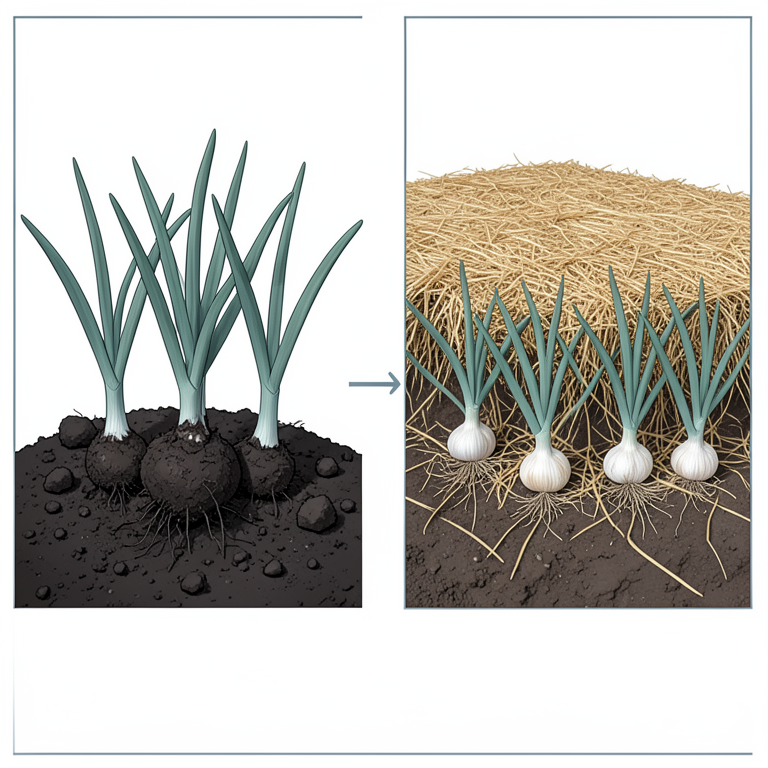
Zero Tillage vs Conventional Tillage Concept
AI-generated conceptual illustration (garlic plants (Allium sativum) in soil with rice straw mulch). It explains the idea and does not show study data.
View source evidence ↗Introduction
Garlic (Allium sativum) is one of the important spices and condiment. Generally, garlic is cultivated under conventional tillage methods throughout the world. This method includes combination of primary tillage (first deep soil ploughing of soil after harvest of previous crop) and secondary tillage (breaking of clods, leveling land, etc. (Karaye, A.K., Yakubu, A.I., 2006) [4] . The cloves of garlic which is used as propagating or planting materials is either dibbled or broadcasted in the prepared field, maintaining proper distance. This method is time consuming, as it takes a significant amount of time that increases the cost of production. The excessive tillage operation with heavy equipment may destroy the soil structure and may result heavy loss of moisture. The manipulation of soil can also kill the important microorganisms of soil (Aliudding T 1986) [1] . To overcome such problems, researchers and scientists have come with new cultivation technique for garlic cultivation, Zero Tillage Garlic Cultivation. Zero-tillage is a form of minimum tillage that omits the primary as well as secondary tillage operations. The seeds (cloves in case of garlic) are shown without disturbing the soil either by dibbling or broadcasting. This method has been proven to be beneficial for utilization of residual moisture and nutrient from previous crops (Kwon, K.S., Azad, O.K., Hwang, J.M., 2011) [3] . It also helps in maintaining the soil fertility. But it is recommended for shallow rooted crops only. (Note: Garlic is a shallow rooted crop).
Objectives
To review the garlic cultivation under zero tillage in rice straw mulch To review cultivation practices and field requirements To review the advantage of garlic cultivation under zero tillage in rice straw mulch over traditional method
Literature review 2.1 Garlic under Zero Tillage
No till garlic or zero tillage garlic cultivation is practiced in the region of tropical low land. Plain paddy fields are suitable for this technique (also can be done in others lowland area of world). Garlic is sown directly in the soil after rice is harvested. China is the major adopting regions of this method (en.wikipedia). It is widely adopted by a large percentage of households.
It is being popular in the south Asian countries as well. It is said to be local initiative started about 20 years ago.
Cultivation methods of Garlic under Zero-Tillage 2.2.1 Land Preparation
For the cultivation of garlic, land is prepared after harvesting the rice, by leaving 3-5 cm thick layer of rice paddy crop residue on the soil surface (Aliudding T 1986) [1] . (Note: No tillage operation is done in this technique.)
Seed rate and sowing method
Seed rate differs according to planting distance and method of sowing. In normal case, 500 kg of cloves of diameter 8-10 mm is enough for 1 hector of land (Karaye, A.K., Yakubu, A.I., 2006) [4] . In order to maintain proper spacing, rice should be planted at spacing of 15cm×15cm or 20cm×20cm (since the cloves are shown in the remain residual part of the rice). The spacing also depends on rice to be cultivated and garlic to be sown after harvesting of rice. The cloves are dibbled directly in the remain of the rice after harvest, making a hole in between with rod or sickle. Each residual part is dibbled with a single clove.
Fertilizer management
The surface application of the fertilizer causes great loss of fertilizers by volatilization as fertilizers are not incorporated in the soil. This may increase the fertilizers amount to be used. In order to prevent that, mulching of the field after fertilizer application is most. Organic fertilizers should be incorporated during the land preparation prior to planting rice, that also benefits the garlic. The recommended dose of fertilizers is 120:80:80 kg NPK per hector of land. Phosphorous and Potassium should be applied as basal dose. Nitrogen can be also applied as basal as well as split dose.
Mulching Technique
This method requires mulching. It is most important part of the cultivation. A significant difference is seen between mulched and open cultivation of garlic under zero tillage condition. It reduces the nutrient loss and also preserve the residual moisture required for garlic.
What sort of mulch is required?
As mentioned above, mulching is most under zero tillage. It increases the productivity of the crop. It decreases the soil temperature (Garlic is cold season crop). The efficient conservation of water and uses of water can be achieved. High temperature may suppress the rate of root elongation decreasing the root density that decreases the water uptake. Different material can be used as mulch. However, rice straw mulching is seen to be the best one. Water hyacinth, Sotty leaf of ginger can also be used. Researches done to find out the best mulching materials have shown that better emergence of plant is seen in rice straw mulch (M B Mahdie, Najafabadi Gh, MH Asil and Jamal-Ali Olfati 2012) [11] . Other parameters like leaf area, leaves per plants, bulb weight, diameter, cloves per bulb, etc. was also high in case of rice straw mulched, followed by water hyacinth and sooty leaf mulch. No mulching at all has major reduction in production and productivity of garlic. So, rice straw mulch is most important and is necessary of high yield.
Irrigation
Irrigation is important factor for crop cultivation. The productivity is directly related with the amount of water available when needed by the plant. The residual moisture preserved by mulching plays initial role in germination of cloves. So, irrigation may not be required. However, in later phase of growth, water may be required based on the soil moisture content. Irrigation should be provided once a week after monitoring the soil moisture level. Irrigation should be stopped a week before harvesting. Excess water (flooding) may cause rooting of the root. So, it should be avoided.
Conclusion
The technique has become popular these days throughout the world. Many researches have been carried out to find out its practical significances on production. Researches have shown a remarkable result in this method. Comparing the pattern of growth and development, studies have shown that the emergence rate is highest in case of zero tillage. Compared with the conventional tillage method, the emergence percentage is 3% in zero tillage (Halim A 2000) [2] . Similarly leaf area, fresh weight and roots per plant is higher in this technique. The other measuring index like leaf area, fresh weight of bulb was also high. Similarly, the clove per unit bulb and diameter of the bulb were also high in zero tillage.
Recommendations
One of the major reasons for innovations of new ideas is to improve the performance of the crop, using locally available resources and increasing its productivity. In normal condition of conventional tillage, the productivity is 6 tones per hector. But with the practices of zero tillage in the same condition, the productivity can be increased up to 10 tones per hector. The increment in productivity is directly linked with the method of cultivation. But it is to be noted that zero tillage is only beneficial if it is provided by mulch. In absence of mulch, the soil moisture loss is high as mentioned above, increases the soil temperature and loss of nutrient is seen. This causes the reduction of the production of the crop. Zero tillage of garlic is seen to have the least emergence, least height, diameter, cloves per bulb, in comparison to the mulch (either rice straw or water hyacinth or sotty leaves). This ultimately reduces the production. So, The Garlic Cultivation under Zero Tillage in Rice Straw Mulch is highly recommended.
References
10 in the original paper- Aliudding T. Effect of soil tillage and application of mulch on yield of field grown garlic. Bull. Poenelitian Hortikultura 1986;4:23-37.
- Halim A. Efects of mulches on the growth and yield of some garlic germplasms. M.S. Thesis, Department of Horticulture, BAU, Mymensingh 2000, p. 103.
- Kwon KS, Azad OK, Hwang JM. Mulching methods and removing dates of mulch affects growth and postharvest quality of garlic (Allium sativum L) cv. Uiseong. Korean Journal of Horticultural Science and Technology 2011;29(4):293-297.
- Karaye AK, Yakubu AI. Influence of intra-row spacing and mulching on weed growth and bulb yield of garlic (Allium sativum L.) in Sokoto, Nigeria. African Journal of Biotechnology 2006;5(3):260-264.
- Islam MJ, Hossain AKMM, Khanam F, Majumder UK, Rahman MM, Saifur Rahman M. Effect of mulching and fertilization on growth and yield of garlic at Dinajpur in Bangladesh. Asian Journal of Plant Sciences 2007;6(1):98-101.
- Dasharathbhai Chaudhari, Patel VJ, Patel BD, Hiren Patel. Integrated weed management in garlic with and without rice straw mulch 2019, 7-8.
- Jaishi Ajay, Marahatta Santosh, Jha Ritesh Kumar. Production economics and technology adoption of spring rice at Eastern Chitwan of Nepal. Int. J Res. Agron. 2020;3(1):13-18.
- Baten MA, Nahar BS, Sarker SC, Khan MAH. Effect of different mulches on the growth and yield of late planted garlic (Allium sativum L.). Pakistan Journal of Scientific and Industrial research 1995;38(3-4):138141.
- Bhuiya MAK, Rahim MA, Chowdhury MNA. Effect of Planting Time, Mulch and Irrigation on the Growth and Yield of Garlic. Asian Journal of Plant Sciences 2003;2:639-643.
- Mahdie MB, Najafabadi GH, Asil MH, Jamal-Ali Olfati. Mulching effects on the yield and quality of garlic as second crop in rice fields 2012, 18.
Cited by 5
From OpenAlex, OpenCitations and reference lists read by Scinovex
- Phytonutrient screening and evaluation of in-vitro antibacterial activity of onion and garlic peels: A comparative study with the prospects of waste to wealth ↗
Moumita Saha, Shirsha Mukherjee, Shouvik Das, Mahima Chowdhury, Madhurima Das, Souhardya Sarkar et al. · International Journal of Herbal Medicine · 2022
The current world survey states that it has become a major issue of huge wastage of fruits and vegetables in our ecology and economy. The by-products of these vegetables can be a major source of nutrients with having potential phytochemical, antioxidant, and antimicrobial potential. Hence, the significance of our study is to do the comparative analysis of phytonutrients and in-vitro
- Effect of dietary supplementation of garlic (Allium sativum) powder on performance of broiler chicken
G. G. Sewatkar, AP Dhok, AD Deshmukh, SR Lende · International Journal of Veterinary Sciences and Animal Husbandry · 2024
One hundred and thirty-five broilers in three replications were offered standard diet (SD); standard diet plus garlic powder @ 2 percent (G2) and standard diet plus garlic @ 3 percent (G3). The BW gain and FCR was significantly affected due to supplementation of 3 percent garlic powder. The muscle and total cholesterol, LDL and triglycerides were significantly reduced due to supplementation of either levels of garlic. The increased lymphoid organ weights in treatment groups indicated the effect of garlic on immunity. It was concluded that the supplementation of 3 percent as well as 2 percent g
- Inhibitory effect of spice extracts on seed germination of Parthenium hysterophorus L.
Sanghmitra, Kavita Singh Chaudhary · International Journal of Advanced Biochemistry Research · 2024
Laboratory based experiments were conducted to evaluate inhibitory effect of different spice extracts (2, 5, 10, 20% concentration) on seed germination of Parthenium hysterophorus L. Among the five spice extracts Syzigium aromaticum was found to be most effective in inhibiting the germination of parthenium seed, it caused 100% inhibition even in 2% concentration. Piper nigrum and Cinnamomum tamala completely restricted the germination of parthenium seed in 10 and 20% concentration. Inhibitory effect of 10 and 20% concentration of Allium sativum and Zingiber officinalis was more than that of 2
- Effect of garlic (Allium sativum) and Ginger (Zingiber officinale) on the microbial and sensorial quality of smoked mackerel fish (Scomber scombrus)
Kutte MM · International Journal of Biology Sciences · 2022
This study examined the effect of garlic (Allium sativum) and ginger (Zingiber officinale) on the microbial and sensorial quality of smoked mackerel fish (Scomber scombrus). Thirty six (36) pieces of fresh frozen Mackerel fish of 1.09kg average weight were purchased, dressed, dipped in a solution of 0% garlic or ginger (T0), 10% garlic (T1), 10% Ginger (T2) and 5% garlic and 5% ginger (T3) solution for 30 min, smoked dried and stored at 28±2 °C over the period of 60 days. Microbiological and sensory analyses were performed on the smoked fish samples. The result revealed that the garlic and gin
- Potential of plants to treat argulosis disease in fresh water fish ↗
Rosidah Rosidah Rosidah, Fittrie Meyllianawaty Pratiwy · International Journal of Fisheries and Aquatic Studies · 2023
Fresh water fish, such as carp (Cyprinus carpio), koi (Cyprinus carpio), koki (Carassius auratus) and comet (Carassius auratus auratus) have great opportunities for developing aquaculture in Indonesia. However, the presence of argulosis disease caused by ectoparasites Argulus sp. be one of the obstacles. This parasitic infestation can cause fish to experience a decrease in body weight, weakness, bleeding, secondary infection,