
Research article · 2024 · Full text
International Journal of Advanced Biochemistry ResearchInhibitory effect of spice extracts on seed germination of Parthenium hysterophorus L.
Volume 8(3S) · Pages 341–344 · DOI: 10.33545/26174693.2024.v8.i3se.762 ↗
Research areasAllelopathy and phytotoxic interactionsMedicinal Plants and NeuroprotectionGABA and Rice Research
Abstract
Author-writtenLaboratory based experiments were conducted to evaluate inhibitory effect of different spice extracts (2, 5, 10, 20% concentration) on seed germination of Parthenium hysterophorus L. Among the five spice extracts Syzigium aromaticum was found to be most effective in inhibiting the germination of parthenium seed, it caused 100% inhibition even in 2% concentration. Piper nigrum and Cinnamomum tamala completely restricted the germination of parthenium seed in 10 and 20% concentration. Inhibitory effect of 10 and 20% concentration of Allium sativum and Zingiber officinalis was more than that of 2 and 5%. Thus with increasing the concentration of spice extract inhibition in germination was also increased. Effectiveness of different spice extract on inhibition of seed germination of parthenium are as Syzigium aromaticum > Piper nigrum > Cinnamomum tamala > Zingiber officinalis > Allium sativum.
Summary
Source-checkedPlain-language reading of the full paper, prepared with AI and checked against the text. Each point links to the authors' own words.
Why it matters
- Parthenium hysterophorus L. is a highly invasive and obnoxious weed that has spread across the Indian Subcontinent and is considered a primary terrestrial weed in India. View evidence ↗
- The weed is problematic because it is highly allergenic, causing conditions like asthma and dermatitis, and it negatively impacts agriculture, horticulture, and silviculture. View evidence ↗
- Using natural products from allelopathic plants for weed control is an alternative to synthetic herbicides, potentially avoiding the problems associated with chemical treatments. View evidence ↗
The question
- The study aimed to evaluate whether extracts from five specific spices, garlic, cinnamon, black pepper, cloves, and ginger, could inhibit the seed germination of Parthenium hysterophorus. View evidence ↗
What they did
- Spice extracts were prepared using a Soxhlet apparatus at 60-75 degrees Celsius with a 1:5 w/v ratio of powder to distilled water, then prepared in concentrations of 2%, 5%, 10%, and 20%. View evidence ↗
- The experiment used three replicates for each set, and the percentage of germination inhibition was calculated after 15 days. View evidence ↗
What they found
- Syzigium aromaticum (cloves) was the most effective extract, causing 100% inhibition of seed germination at all tested concentrations (2%, 5%, 10%, and 20%). View evidence ↗
- Piper nigrum (black pepper) and Cinnamomum tamala (cinnamon) both achieved 100% inhibition of seed germination at concentrations of 10% and 20%. View evidence ↗
- Allium sativum (garlic) showed the lowest inhibitory effect, with 42.85% inhibition at 2% concentration, increasing to 83.14% at 20% concentration. View evidence ↗
- Zingiber officinalis (ginger) inhibited germination by 58.93% at 2% concentration and up to 92.86% at 20% concentration. View evidence ↗
- The study found a direct correlation where increasing the concentration of the spice extracts led to an increase in the percentage of seed germination inhibition. View evidence ↗
- The overall effectiveness of the spices in inhibiting germination followed the order: Syzigium aromaticum > Piper nigrum > Cinnamomum tamala > Zingiber officinalis > Allium sativum. View evidence ↗
What it means
- The authors conclude that extracts from all five tested spices at all concentrations can serve as 'green herbicides' for controlling Parthenium hysterophorus. View evidence ↗
- The authors state that further research is needed to isolate and identify the specific herbicidal chemical constituents within these spice extracts. View evidence ↗
Visual summary
2 visualsIllustrations explain the paper; charts are replotted from the paper's own table values.
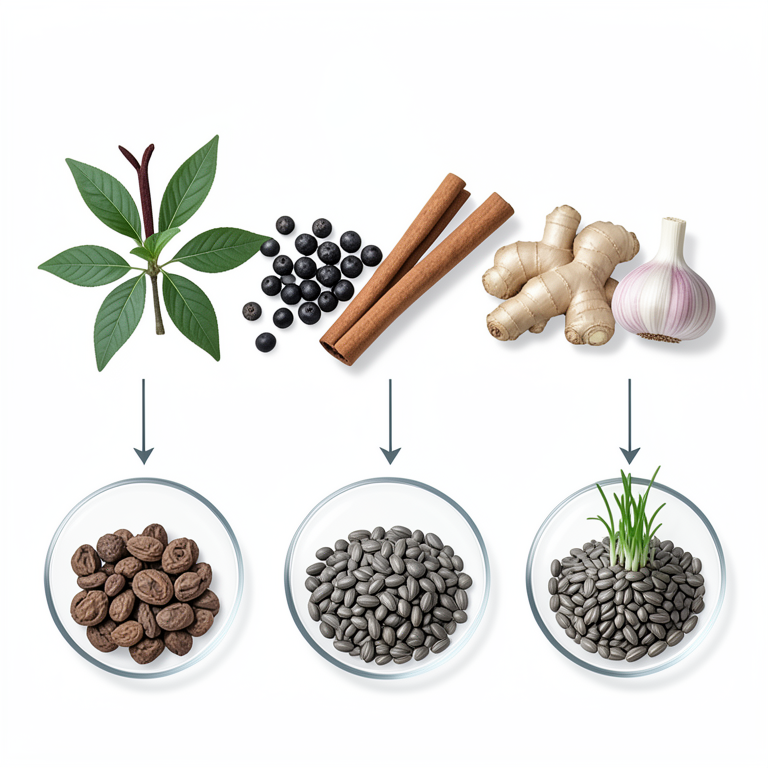
Relative Effectiveness of Spice Extracts
AI-generated conceptual illustration (Parthenium hysterophorus seeds and spice plants (cloves, black pepper, cinnamon, ginger, garlic)). It explains the idea and does not show study data.
View source evidence ↗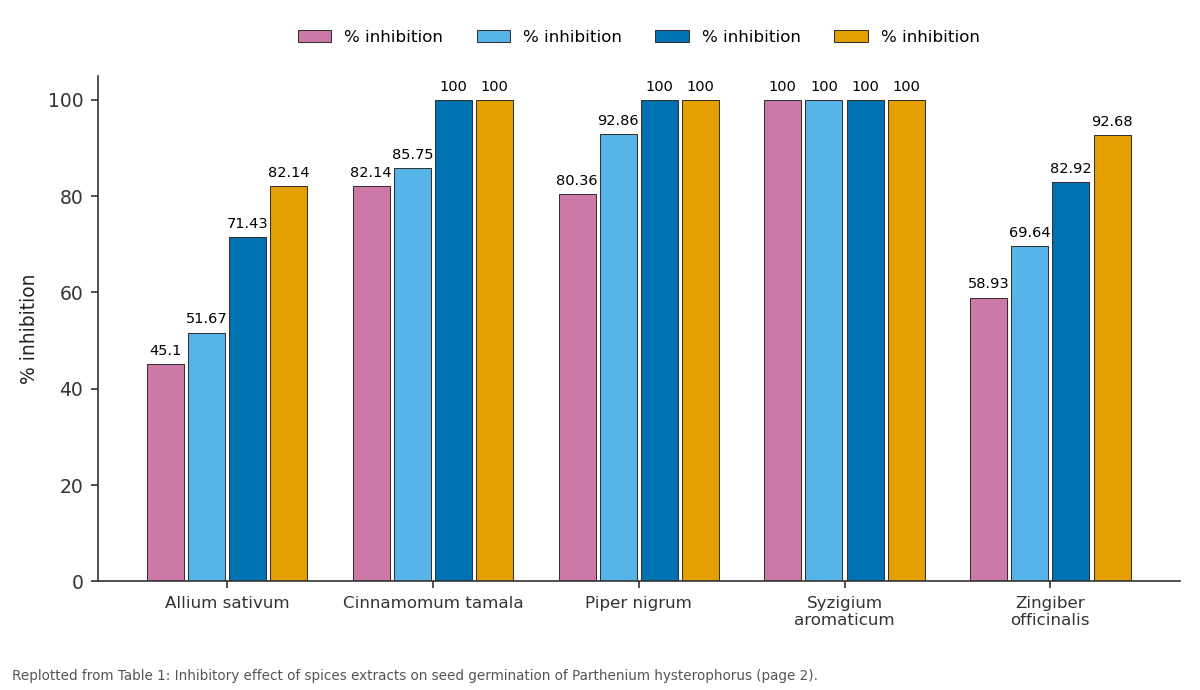
% inhibition and % inhibition and more: Allium sativum vs Cinnamomum tamala vs Piper nigrum vs Syzigium aromaticum vs Zingiber officinalis
Replotted from Table 1 (page 2) of the original paper. Every bar is the paper's own table value.
View source evidence ↗Figures & tables
From the original paper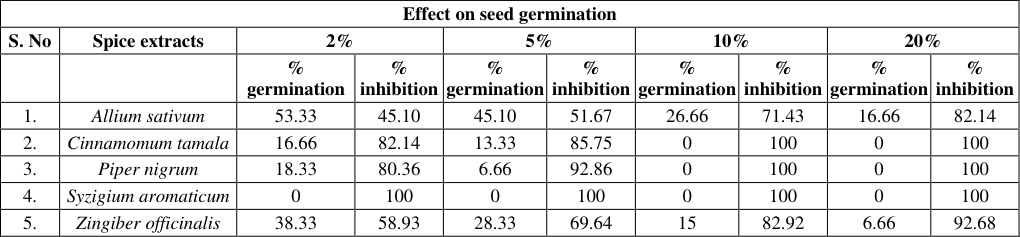 Table 1
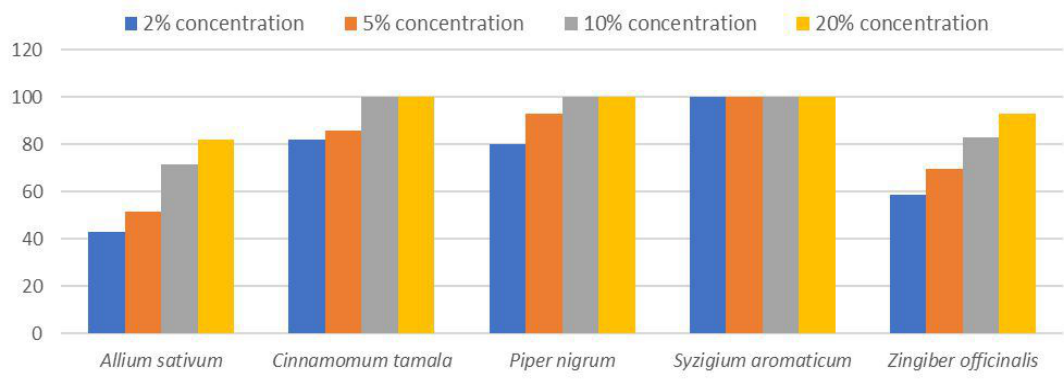 Figure 1
Introduction
Parthenium hysterophorus L, is an obnoxious weed, indigenous to North and Central America, Mexico and West Indies. In India it was first reported from Pune. It has now spread throughout most of the Indian Subcontinent (Aneja et al. 1991) [5] and considered to be principal terrestrial weed in India (Dhawan et el. 1993) [10] . It has spread to more than 40 Countries (Bajwa et al. 2018) [7] . The successful establishment of parthenium weed in fields is supported by several factors, such as its numerous seed production, genetic diversity, tolerance to stresses, and its allelopathic potential (Bajwa et al 2016) [6] . It is an aggressive coloniser of grassland, open woodland, road sides, vacant land and disturbed ground, and possessing allelopathic properties, parthenium effectively displaces native flora and forms dense monospecific stands (Qureshi et al. 2018; Adkins et al. 2019) [23,1] . Parthenium is considered highly allergenic and causes dermatitis, eczema, hay fever, asthma, allergic rhinitis (Evans, 1997) [13] . Harmful effects of Parthenium in agriculture, horticulture, and silviculture is well documented (Agarwal and Anand, 1992, Agrawal and Kohli, 1994) [3,2] . There are several methods available for controlling Parthenium weed such as Physical, Chemical, Biological, Competitive replacement, Utilization and integrated approach etc. In the recent years, creating competition between native and alien species has gain momentum. Numerous plants are reported to possess allelopathic potential and effort has been made to use them in weed control. Natural products release from allelopathic plants may help to reduce the use of synthetic herbicides for weed management as they are free from problems associated with present herbicides. Allelopathy as a component of biological control and allelochemicals as biological herbicides have been a challenge to current synthetic chemical approaches (El-Rokiek et al 2006) [11] . Numerous allelochemicals are involved in the allelopathic activities of the allelopathic plants; such as phenolics, terpenoids, alkaloids, coumarins, tannins, flavonoids, steroids and quinines (Xuan et al. 2005) [27] . Various plants are proposed to have allelopathic prospective and struggles are being made to practice them in weed control. Planting plants such as Cassia sericea, C. tora, and C. auriculata can help to replace parthenium in a competitive manner (Javaid and Anjam, 2006; Wahab, 2005) [14,26] , Amaranthus spinosus, Tephrosia purpurea, Croton bonplandianum, Sida spinosa, and Mirabilis jalapa, Hyptis suaveolens (Knox et al. 2010) [19] which are able in suppressing Parthenium effectively in natural habitats (Wahab 2005) [26] . According to one study, Cassia sericea diminishes parthenium accumulation by 70% and parthenium population by 52.5 percent (Javaid et al 2005) [15] . The deleterious effect of eucalyptus oils extracted from Eucalyptus glohulus and Eucalptus citriodora on P. hysterophorus was reported by (Dhakad et al 2018) [9] . Shafique, et al. 2005 [24] assessed the herbicidal activity of aqueous extracts (2, 4, 6, 8, and 10%) of dry leaves of Ficus bengalensis, Azadirachta indica, Melia azadarach, Mangifera indica and Syzygium cumini against parthenium seeds germination in lab bioassays. The 8% and 10% extracts of these tree species significantly suppressed the germination of parthenium seeds. Allelopathy is a natural and an environment-friendly technique which may prove to be a unique tool for weed control, increase crop yields, decrease our reliance on both synthetic pesticides and improve the ecological environment. The objective the present study was to assess the potential of spice extract of five plant species viz., Allium sativum, Cinnamum tamala, Piper nigrum, Syzygium aromaticum and Zingiber officinalis to control the germination of Parthenium hysterophorus seed.
Materials and Methods
Spices which were used in extraction were dipped in 0.2% Sodium hypochloride solution for one minute and washed with sterilized distilled water. After air drying, macerated with the aid of grinder and blender and extraction was done with the process evolved by Ahmad and Prasad (1995) [4] . Powder of spices were mixed with distilled water (1:5 w/v). These mixtures were placed in Soxhlet bottle of extraction apparatus for the extraction purpose. Temperature was adjusted for 60-75 degrees Celsius. Extracts were collected in a bottle, desired concentration (2, 5, 10, 20%) were prepared and autoclaved at 15 psi for about 15 minutes. Spices which were used are as follows-Piper nigrum, Allium sativum, Cinnamomum tamala, Syzygium aromaticum, and Zingiber officinalis.
Seed Germination Bioassay
Seeds of Parthenium hysterophorous were collected, air dried and stored in sterilized bottles. Healthy seeds were dipped in 0.2% Sodium Hypochloride solution for 1 minute and washed with sterilized and distilled water. Seeds were soaked in 10 ml of each spice extracts of different concentration (2, 5, 10, 20%) for 24 hrs. 20 seeds of each were arranged equidistantly in sterilized petridishes containing sterilized moist sand and incubated at 25 ± 2 degrees Celsius. Three replicates of each set were used. After 15 days germinated normal seedlings were counted and % germination inhibition was calculated by the following formula.
% inhibition=
% of germination in control -% of germination treated % of germination in control X 100
Result
In the present study effect of different concentration (2%, 5%, 10% and 20%) of spices extracts on seed germination of Parthenium hysterophorus was evaluated and observation was recorded after 15 days. Effect of spice extracts on seed of Parthenium hysterophorus is presented in table (1 Fig. 1). From the table (1, Fig. 1), it is evident that all the 5 test spices significantly affected the germination of parthenium seed. Effect of extract concentration was also significant. Extract of Syzigium aromaticum proved to be the most effective where 2% 5%, 10% and 20% extract completely affected the germination of parthenium and caused 100% inhibition in germination. In case of Piper nigrum and Cinnamomum tamala also 10% and 20% concentration completely check the germination of Parthenium hysterophorus seed and cause 100% inhibition of seed germination. Minimum 42.85% inhibition was recorded in 2% concentration of Allium sativum while the rest of the concentration 5%, 10% and 20% caused 51.67%, 71-43% and 83.14% inhibition of seed germination respectively. 2% and 5% concentration of Cinnamomum tamala and Piper nigrum were also effective in inhibiting the seed germination, while former caused 82.14% and 85.75% inhibition of seed germination and later caused 80.63% and 92.86% inhibition of seed germination respectively. 10 and 20% concentration of Zingiber officinalis were also effective and caused 82.92% and 92.86% inhibition of seed germination respectively. In case of 2% and 5% concentration of Z. officinalis 58.93% and 69.64% Inhibition of germination was recorded. From the table it is also clear that with the increase in the concentration of spice extract inhibition percentage of seed germination of parthenium is also increased. Effectiveness of different spice extract on inhibition of seed germination of parthenium are as follows: Syzigium aromaticum > Piper nigrum > Cinnamomum tamala > Zingiber officinalis > Allium sativum.
Discussion and Conclusion
Among the extracts of all the spices, 2, 5, 10, and 20% concentration of Syzygium aromaticum caused 100% inhibition of seed germination. This might be due to the presence of highly potential allelochemicals. 10 and 20% concentration of Piper nigrum and Cinnamomum tamala completely restricted the germination of parthenium seed. 2% 5% concentration will also effective inhibiting the seed but less in comparison to 10% and 20%. 10 and 20% concentration of Allium sativum and Zingiber officinalis were more inhibitory as compared to 2% on 5%. More inhibition at higher concentration maybe due to the presence of higher amount of Allelochemicals. The effect of allelochemicals was concentration dependent (Lehman et al., 1994; Karthiyayini et al., 2003) [21,16] . Inhibition of germination was directly dependent on concentration of extracts (Evanari, 1949; Kato-Noguchi, 2003) [12,17] . At higher concentration of extract/leachate, the seed germination was adversely affected due to the imbalance in metabolism and metabolic pathways regulated by various hydrolysing enzymes (Kaul and Bedi, 1995; Dhawan, 1997; Tiwari et al., 1998; Oudhia and Tripathi, 2000; Batish et al., 2002) [18,10,25,22,8] . The present study, thus concludes that all the concentrations of extract of Piper nigrum, Allium sativum, Cinnamomum tamala, Syzygium aromaticum, and Zingiber officinalis can be used as a green herbicides. Further studies are required to isolate and identify their herbicidal constituents, especially from these spices. These natural compounds may be used for the synthesis of natural product-based herbicides for the control of one of the world's worst hazardous weed Parthenium hysterophorus.
Figures and tables from the paper
| Effect on seed germination | — | — | — | — | — | — | — | — | — |
|---|---|---|---|---|---|---|---|---|---|
| S. No | Spice extracts | 2% | 5% | 10% | 20% | ||||
| % germination | % inhibition | % germination | % inhibition | % germination | % inhibition | % germination | % inhibition | ||
| 1. | Allium sativum | 53.33 | 45.10 | 45.10 | 51.67 | 26.66 | 71.43 | 16.66 | 82.14 |
| 2. | Cinnamomum tamala | 16.66 | 82.14 | 13.33 | 85.75 | 0 | 100 | 0 | 100 |
| 3. | Piper nigrum | 18.33 | 80.36 | 6.66 | 92.86 | 0 | 100 | 0 | 100 |
| 4. | Syzigium aromaticum | 0 | 100 | 0 | 100 | 0 | 100 | 0 | 100 |
| 5. | Zingiber officinalis | 38.33 | 58.93 | 28.33 | 69.64 | 15 | 82.92 | 6.66 | 92.68 |
Table text extracted from the original PDF; superscript letters are shown inline. The original table image is below.
View original table image
References
23 in the original paper- Ahmad SK, Prasad JS. Efficacy of foliar extracts against pre and post-harvest disease of sponge guard fruits. Lett Apple Microbiol. 1995;21:373-375.
- Aneja KR, Dhawan SR, Sharma AB. Deadly weed Parthenium hysterophorus L. And its distribution. Indian Journal of Weed Science. 1991;23:14-18.
- Bajwa A, Chauhan B, Farooq M, Shabbir A, Adkins S. What do we really know about alien plant invasion? A review of the invasion mechanism of one of the world's worst weeds An International Journal of Plant Biology. 2016;244(1):39-57.
- Bajwa A, Nguyen T, Navie S, Apos, Donnell C, Adkins S. Weed seed spread and its prevention: The role of roadside wash down Journal of Environmental Management. 2018;208:8-14.
- Batish DR, Singh HP, Kohli RK, Saxena DB, Kaur S. Allelopathic effects of Parthenium against 2 weed species, Avena fatua and Bidens pilosa. Environmental and Experimental Botany. 2002;47:149-155.
- Dhakad AK, et al. Biological, medicinal and toxicological significance of Eucalyptus leaf essential oil: a review. 2018;98(3):833-848.
- Dhawan SR, Aneja KR, Dhawan P. Parthenium hysterophorus Linn. The Danger weed and its control. Biome. 1993;6:117-122.
- El-Rokiek KG, El-Sahahawy TA, Sharara FA. New approach to use rice straw waste for weed control. II: The effect of rice straw extract and fusillade on some weeds infesting soybean. Int J Agric Biol. 2006;8:269275.
- Evanari M. Germination inhibitors. The Botanical Review. 1949;15:153-194.
- Evans HC. Parthenium hysterophorus: A Review of its weed status and possibilities for biological control. Bio control News Inf. 1997;18:389-398.
- Javaid A, Anjum TJPJB. Control of Parthenium hysterophorus L., by aqueous extracts of allelopathic grasses. 2006;38(1):139.
- Javaid A, et al. Biological control of Parthenium II: Allelopathic effect of Desmostachya bipinnata on distribution and early seedling growth of Parthenium hysterophorus L. 2005;2(2):459-463.
- Karthiyayini R, Ponnammal NR, Rajesh B. Effects of Digera muricata L. Mart on germination and seedling growth of Sorghum bicolor L. Varitis. Allelopathy Journal. 2003.
- Kato -Noguchi H. Assessment of Allelopathic potential extracts of Evolvulus alsinoides. Weed Research. 2000;40:343-350.
- Kaul K, Bedi YS. Allelopathic influence of Tagetus erecta on germination and seedling growth of radish (Raphanus sativus) and lettuce (Lactuca sativa). Indian Journal of Agriculture Science. 1995;65(8):599-601.
- Bipin Koirala, Raja Babu Chaudhary. Review of garlic cultivation under zero tillage in rice straw mulch (Allium sativum). Int. J Hortic. Food Sci. 2021;3(2):0103.
- Lehman ME, Blum U, Greg TM. Simultaneous effect of ferulic acid and P. coumaric acids on cucumber leaf expansion in split-root experiment. Journal of Chemical Ecology. 1994;20:1773-1782.
- Oudhia P, Tripathi RS. Allelopathic effects of an obnoxious weed Parthenium hyterophorus L. on germination and seedling vigour of rice var. Mahamaya. Research on Crops. 2002;1:111-115.
- Qureshi H, et al. Multivariate impact analysis of Parthenium hysterophorus invasion on above-ground plant diversity in Pothwar region of Pakistan. Applied Ecology and Environmental Research. 2018;16:57995813.
- Shafique S, et al. Biological control of Parthenium IV: suppressive ability of aqueous leaf extracts of some allelopathic trees against germination and early seedling growth of Parthenium hysterophorus L. 2005;11(12):75-79.
- Tiwari JP, et al. Studies on allelopathic effect of Cassia tora on Parthenium hysterophorus, Indian journal of weed Science. 1998.
- Wahab S. Management of Parthenium through an integrated approach initiatives, achievements and research opportunities in India. In Proceedings of the 2nd International Conference on Parthenium Management. 2005. University of Agricultural Sciences.
- Xuan TD, Tawata S, Khanh TD, Chung IM. Biological control of weeds and plants pathogens in paddy rice by exploiting plant allelopathy: an overview. Crop Prot. 2005;24:197-206.
Cited by 1
From OpenAlex, OpenCitations and reference lists read by Scinovex
- Allelopathic Effect of Aqueous Leaves Extract of Some Plants on Seed Germination of Parthenium hysterophorus L. ↗
Sanghmitra · Journal for Research in Applied Sciences and Biotechnology · 2025
The weed Parthenium hysterophorus is an invasive, ubiquitous and significantly threatens agricultural productivity and biodiversity. This study explored the potential of allelopathy for its impact by investigating the effects of aqueous extracts from 31 plant species on seed germination of parthenium. The study revealed that all the 31 plant species adversely affected the germination of Parthenium seed. Leaf extract of…
❝ 0PDF