
Research article · 2022 · Full text
International Journal of Agriculture Extension and Social DevelopmentStatus of farm mechanization on rice production: A case study of Banganga municipality, Kapilvastu, Nepal
Volume 5(1) · Pages 28–31 · DOI: 10.33545/26180723.2022.v5.i1a.120 ↗
Research areasRice Cultivation and Yield ImprovementAgricultural Systems and Practices
Abstract
Author-writtenEscalating outmigration of youths for foreign employment has created shortage of labor in agriculture. This situation demands the mechanized agricultural practices. To assess the status of adoption of farm machineries in rice production, a study was carried out in Banganga Municipality of Kapilvastu district in 2018. 70 rice growing households from purposively selected rice zone of this district were randomly surveyed to collect information regarding adoption of farm machinery in different stages of rice production. Household survey, focus group discussion and key informant interview were major primary sources of data collection while secondary data were collected through published reports, books and research papers. It was found from this study that majority of the farmers used rotavator, cultivator, tractor, thresher and combine harvester during cultivation of rice. There is no use of machinery at the stage of nursery preparation, rice transplantation, weeding, and fertilizer application. Farmers use thresher and tractor for threshing purpose. Most of the farmers (65.7 percent) get information related to farm machinery through DADO. Majority of the farmers (52.9 percent) has easy access to farm machinery. Most of the farmers (84.3 percent) are satisfied with the performance of mechanization. 81.4 percent, 15.7 percent and 2.9 percent of farmers asserted loss of time, loss in time, increase in cost of production and lower production in the absence of farm mechanization. PMAMP rice zone and other stakeholders should bring new farm machineries for rice transplanting, weeding and fertilizer application and develop the package of practices of mechanized rice production to increase its productivity, profitability and efficiency.
Summary
Source-checkedPlain-language reading of the full paper, prepared with AI and checked against the text. Each point links to the authors' own words.
Why it matters
- Agriculture is a critical part of Nepal's economy, employing 60% of the population and contributing approximately 29.4% to the GDP. View evidence ↗
- Rice is the primary staple food in Nepal, accounting for nearly 20% of the Agriculture Gross Domestic Product and 7% of the overall GDP. View evidence ↗
- The migration of youth for foreign employment has led to a significant shortage of agricultural labor in rural areas. View evidence ↗
The question
- The study aimed to assess the adoption status of farm machinery for rice production in the Banganga Municipality of the Kapilvastu district in 2018. View evidence ↗
What they did
- The researchers used non-replacement simple random sampling to select 70 households from a total population of 500 commercial rice-growing households. View evidence ↗
- Data collection involved primary sources such as household surveys, focus group discussions, and key informant interviews, supplemented by secondary reports and publications. View evidence ↗
- The study used SPSS version 16.0 and Microsoft Excel for data entry and applied descriptive statistics to analyze the results. View evidence ↗
What they found
- All surveyed farmers (100%) utilized rotavators and cultivators for land preparation. View evidence ↗
- No machinery was used for nursery preparation, rice transplantation, or fertilizer application, as these tasks were performed manually by all farmers. View evidence ↗
- For threshing, 82.85% of respondents used a thresher, while 17.14% used a tractor. View evidence ↗
- The District Agriculture Development Office (DADO) was the primary source of information on mechanization for 65.7% of farmers. View evidence ↗
- In the absence of mechanization, the most significant problem was increased production time (81.4%), followed by increased costs (15.7%) and field dryness (2.9%). View evidence ↗
- While 52.9% of respondents reported easy access to machinery, 47.1% experienced shortages during the production period. View evidence ↗
- A large majority of farmers (84.3%) were satisfied with the performance of the farm machinery they used. View evidence ↗
What it means
- The authors recommend that stakeholders and the PMAMP rice zone introduce new machinery for weeding, fertilizer application, and transplanting to improve productivity and efficiency. View evidence ↗
Visual summary
3 visualsIllustrations explain the paper; charts are replotted from the paper's own table values.
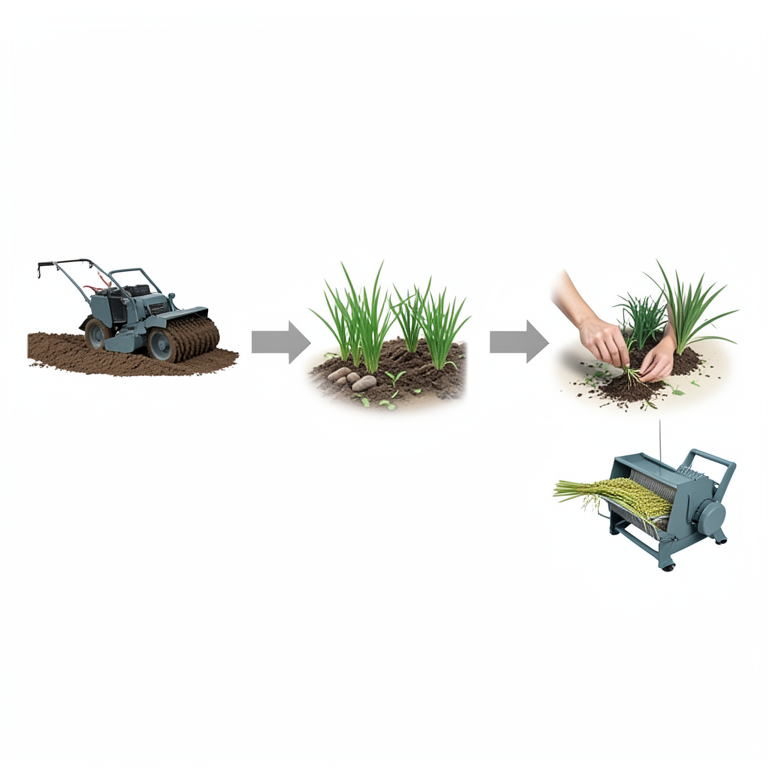
Rice Production Mechanization Gap
AI-generated conceptual illustration (rice plants in a paddy field). It explains the idea and does not show study data.
View source evidence ↗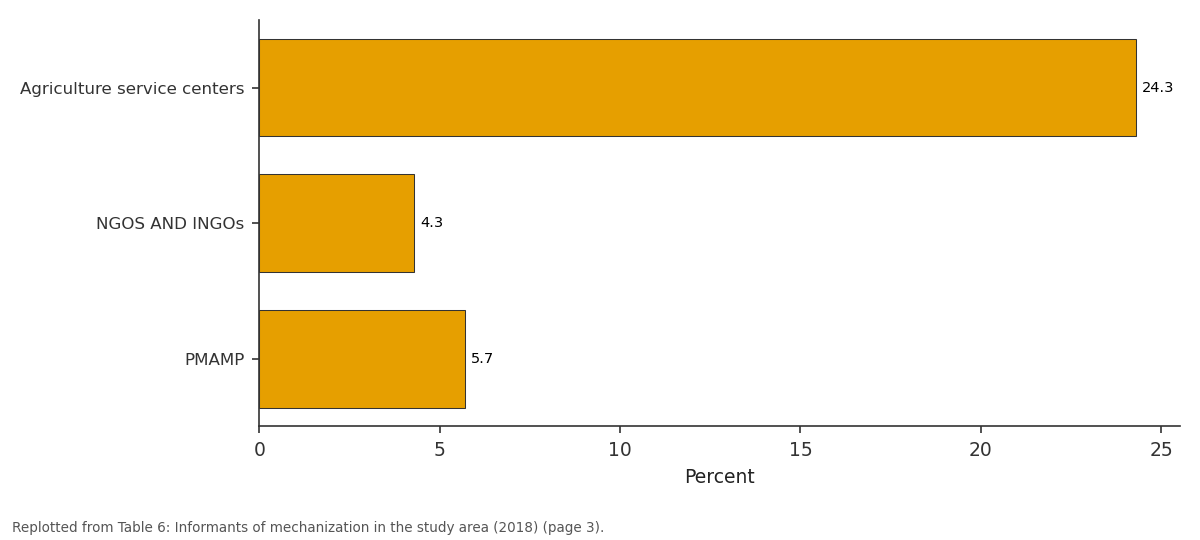
Percent: Agriculture service... vs NGOS AND INGOs vs PMAMP
Replotted from Table 6 (page 3) of the original paper. Every bar is the paper's own table value.
View source evidence ↗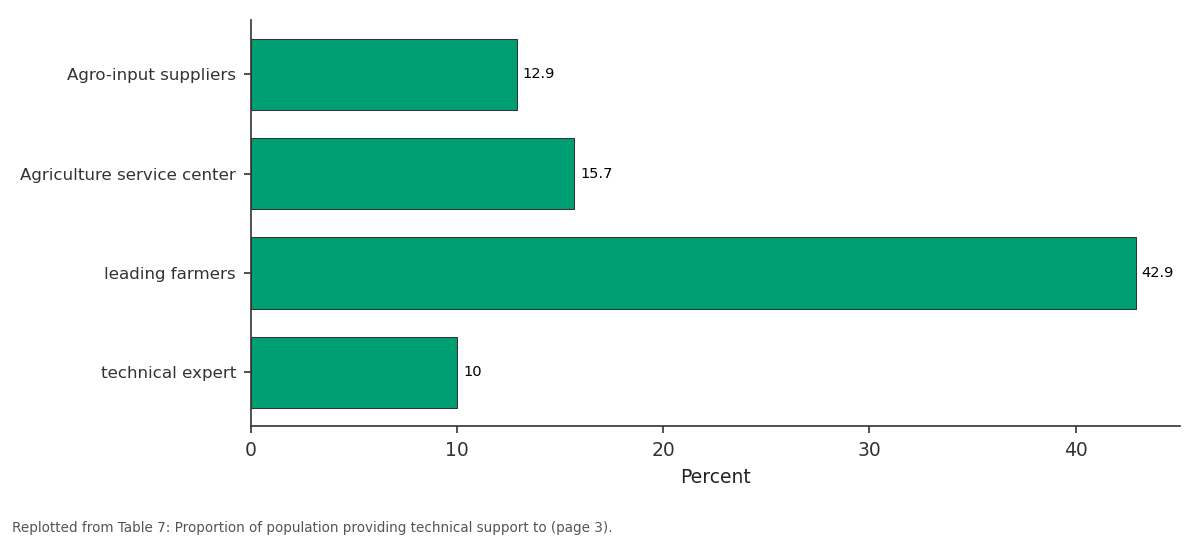
Percent: Agro-input suppliers vs Agriculture service... vs leading farmers vs technical expert
Replotted from Table 7 (page 3) of the original paper. Every bar is the paper's own table value.
View source evidence ↗Figures & tables
From the original paper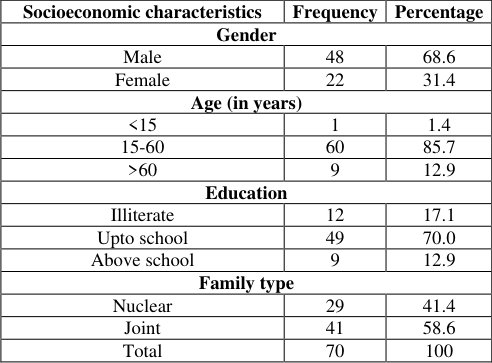 Table 1
 Table 2
 Table 3
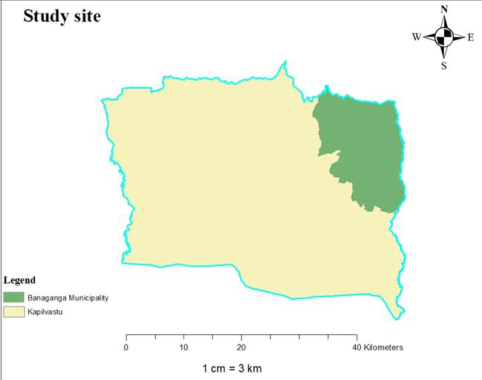 Figure 1
 Table 4
 Table 5
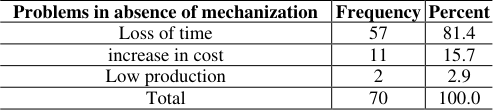 Table 8
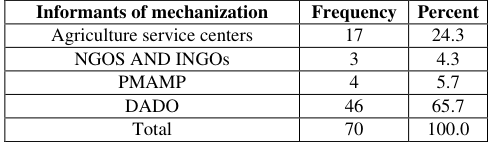 Table 6
 Table 9
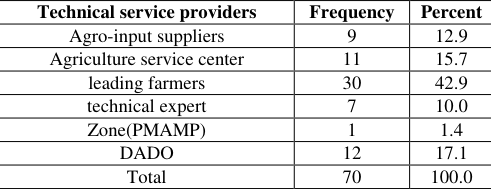 Table 7
 Table 10
Introduction
Agriculture is the pillar of Nepalese economy. It provides employment opportunities to 60% of the total population and contributes about 29.4% in the GDP (MOF, 2018). Rice is the most important staple food of Nepalese people that contributes nearly 20% to the Agriculture Gross Domestic Product (AGDP) and 7% to the GDP (MoAD, 2016) [5] . Kapilvastu is the leading producer of rice in Nepal. In 2017/73, 158230 Mt rice was produced in 70560 ha in Kapilvastu (DADO, 2017) [2] . Rice production involves the physical force requiring activities from land preparation to harvesting. Labor scarcity is one of the serious problems impeding the productivity of rice. Heavy outmigration for foreign employment has almost evacuated the youth forces in rural agricultural settings. On the other hand, employment of labor in rice production is both cost and time ineffective. This situation demands the mechanization of rice production to increase production, profitability and efficiency in of this enterprise. Mechanization is the process of using machinery to simplify the work of agriculture. The proper utilization of time by the farm mechanization prevents the grain loss as well as the farmers with small landholding can use the farm equipment from the custom hiring center (Verma & Tripathi, 2015) [7] . Beside increasing the production, mechanization also encourages the large scale production and sometimes also increases the quality of farm produce (LU, 2009) [4] . Tractor is used for farm operations for the purpose of land preparations, cultivation and harvesting of crops. Rotary power tiller is light duty agricultural equipment used for tilling operation. It is affordable in price when compared with the four wheeled tractors, for the small and medium www.extensionjournal.com scale farmers. Other farm equipments used are crop thresher, combine harvester, disc plough, harrow, fertilizer sprayer, Sheller mill etc. Tillage operation is first to be carried which is efficiently carried with disc plough. Disc harrower is used to break the soil into small fine particles. The use of combine harvester and tractor mounted harvester makes agricultural food production easier, economical and faster. Combined harvester for grain crops is used in three operations-harvesting, threshing or shelling (depending on the type of crop)-winnowing (blowing) and extension bagging of the crops (Folaranmi, 2014) [3] . This study is designed to assess the status of adoption of farm machineries in rice production in rice zone Kapilvastu district. The results of this study are helpful to the policy makers to know the situation of adoption and formulate the policies to increase adoption of farm machineries in different stage of rice production to increase productivity, profitability and efficiency in rice production.
Methodology
The study was conducted in purposively selected Banganga Municipality which is located at northern part from Taulihawa (headquarter of Kapilvastu). According to zone profile, there were 2000 HHs member are involved in rice farming. The commercial farmers were categorized as the farmers who grew rice on the landholdings of greater than a bigha and these farmers were taken as the sampling frame. Total population commercial rice growing farmers were 500 HHs. Out of 500HHs, 70 households were selected with non-replacement simple random sampling techniques. Primary data were obtained through household survey, focus group discussion and key informant interview. Secondary information were obtained by reviewing reports from different government and non-government organization, university publication, journals and theses. Information collected from household survey, key informants interview and FGD was coded first and entered in Ms-Excel. Data entry was done by using statistical package for social science (SPSS, version 16.0) and Microsoft Excel. Descriptive statistics was used to explain the results.
Results and Discussion Socioeconomic characteristics
Table 1. represents the socio-economic characteristics of the respondents surveyed. Majority of the respondents (68.6 percent) were male. 85.7 percent of them were of economically active age group. Majority of the respondents (70 percent) had attained school level education, few had higher level education (12.9 percent) and 17.1 percent of the respondents were illiterate. Most of the respondents (58.6 percent) live in joint family.
| Socioeconomic characteristics | Frequency | Percentage |
|---|---|---|
| Gender | ||
| Male | 48 | 68.6 |
| Female | 22 | 31.4 |
| Age (in years) | ||
| <15 | 1 | 1.4 |
| 15-60 | 60 | 85.7 |
| >60 | 9 | 12.9 |
| Education | ||
| Illiterate | 12 | 17.1 |
| Upto school | 49 | 70.0 |
| Above school | 9 | 12.9 |
| Family type | ||
| Nuclear | 29 | 41.4 |
| Joint | 41 | 58.6 |
| Total | 70 | 100 |
Table text extracted from the original PDF; superscript letters are shown inline. The original table image is below.
View original table image
Status of farm mechanization Method of tillage
It was found from the study that 72.9 per cent of the respondent use modern method of tillage and rest of the farmers used both the traditional and modern methods of tillage (Table 2).
| Method of tillage | Frequency | Percent |
|---|---|---|
| Modern | 51 | 72.9 |
| Modern and traditional | 19 | 27.1 |
| Total | 70 | 100.0 |
Table text extracted from the original PDF; superscript letters are shown inline. The original table image is below.
View original table image
Activities
Activities
Machinaries used
Nursery preparation 100% of the farmers use labor for the nursery bed preparation. There is no use of machinery at this stage of cultivation practices.
Transplantation
All the respondents transplant the rice manually. There is no use of machinery at this stage. Weeding Majority of the respondents (77.1 percent) did weeding manually while the remaining 22.9 percent used pesticide.
Fertilizer application
All the farmers apply the fertilizer manually. Irrigation 67.1 percent of respondents irrigate the field by canal while 32.9 percent of respondents use boring for irrigation.
Rice processing
All the farmers use seller mill for the processing of rice at the study area.
Informants of mechanization
Most of the farmers got the information regarding mechanization from DADO (65.7 percent) followed by agriculture service centers (24.3 percent), PMAMP (5.7 percent) and NGOs and INGOs (4.3 percent).This is supported by Carkle (2000) [1] that the essential material and equipment needed in the hill region of Nepal are promoted by government organizations, INGOs and NGOs of Nepal that help to boost the commercial agriculture through the implementation of mechanization in proper way.
Problems faced in the absence of mechanization
Increase in the time during the production practices was the major problem (81.4 percent) followed by increase in cost of production (15.7 percent). The result showed that 2.9 percent of the farmers faced the problems of field dryness due to the lack of mechanization.
Access to machinery
Majority of the respondents (52.9 percent) had easy access to machinery while other (47.1 percent) had the problem of machinery shortage in the production period. Satisfaction with the performance of mechanization Majority (84.3 percent) of the farmers were satisfied with the performance of different farm machinery during production practices while 15.7 percent of respondents were unsatisfied with these machineries.
Conclusion
It can be concluded from the findings of the study that mechanization has played the great role in rice farming in the context of labor shortage. Majority of the farmers used rotavator, cultivator, tractor, thresher and combine harvester during cultivation of rice. Thresher and tractor are used for threshing purpose. However, there is no use of machinery at the stage of nursery preparation, rice transplantation, weeding, and fertilizer application. Some of the machineries like seed driller, trans-planter reaper, mini tiller, power tiller were not introduced in Banganga municipality. Most of the farmers are satisfied with the performance of mechanization and most of the population are moderately satisfied with rice production. PMAMP rice zone and other stakeholders should bring new farm machineries for rice transplanting, weeding and fertilizer application and develop the package of practices of mechanized rice production to increase its productivity, profitability and efficiency.
Figures and tables from the paper
| Equipment in tillage | Number of farmers | Percentage |
|---|---|---|
| Spade | 21 | 30.0 |
| MB plough | 15 | 21.4 |
| Rotavator | 70 | 100.0 |
| Tractor drawn MB plough | 8 | 11.4 |
| Cultivator | 70 | 100.0 |
| Leveler | 3 | 4.3 |
| Total | 70 | 100.00 |
Table text extracted from the original PDF; superscript letters are shown inline. The original table image is below.
View original table image
| Activities | Machinaries used |
|---|---|
| Nursery preparation | 100% of the farmers use labor for the nursery bed preparation. There is no use of machinery at this stage of cultivation practices. |
| Transplantation | All the respondents transplant the rice manually. There is no use of machinery at this stage. |
| Weeding | Majority of the respondents (77.1 percent) did weeding manually while the remaining 22.9 percent used pesticide. |
| Fertilizer application | All the farmers apply the fertilizer manually. |
| Irrigation | 67.1 percent of respondents irrigate the field by canal while 32.9 percent of respondents use boring for irrigation. |
| Rice processing | All the farmers use seller mill for the processing of rice at the study area. |
| Threshing | Majority of respondents use thresher (82.85 percent) for threshing while some of them use tractor (17.14%). Thresher is efficient and faster than that of tractor |
Table text extracted from the original PDF; superscript letters are shown inline. The original table image is below.
View original table image
| Facilitators of farm mechanization | Frequency | Percentage |
|---|---|---|
| DADO | 17 | 24.3 |
| NGOS AND INGOs | 3 | 4.3 |
| PMAMP | 4 | 5.7 |
| Neighbor | 46 | 65.7 |
| Total | 70 | 100.0 |
Table text extracted from the original PDF; superscript letters are shown inline. The original table image is below.
View original table image
| Problems in absence of mechanization | Frequency | Percent |
|---|---|---|
| Loss of time | 57 | 81.4 |
| increase in cost | 11 | 15.7 |
| Low production | 2 | 2.9 |
| Total | 70 | 100.0 |
Table text extracted from the original PDF; superscript letters are shown inline. The original table image is below.
View original table image
| Informants of mechanization | Frequency | Percent |
|---|---|---|
| Agriculture service centers | 17 | 24.3 |
| NGOS AND INGOs | 3 | 4.3 |
| PMAMP | 4 | 5.7 |
| DADO | 46 | 65.7 |
| Total | 70 | 100.0 |
Table text extracted from the original PDF; superscript letters are shown inline. The original table image is below.
View original table image
| Availability of machineries | Frequency | Percent |
|---|---|---|
| Easy access | 37 | 52.9 |
| Difficult access | 33 | 47.1 |
| Total | 70 | 100.0 |
Table text extracted from the original PDF; superscript letters are shown inline. The original table image is below.
View original table image
| Technical service providers | Frequency | Percent |
|---|---|---|
| Agro-input suppliers | 9 | 12.9 |
| Agriculture service center | 11 | 15.7 |
| leading farmers | 30 | 42.9 |
| technical expert | 7 | 10.0 |
| Zone(PMAMP) | 1 | 1.4 |
| DADO | 12 | 17.1 |
| Total | 70 | 100.0 |
Table text extracted from the original PDF; superscript letters are shown inline. The original table image is below.
View original table image
| Satisfaction from mechanization | Frequency | Percent |
|---|---|---|
| Yes | 59 | 84.3 |
| No | 11 | 15.7 |
| Total | 70 | 100.0 |
Table text extracted from the original PDF; superscript letters are shown inline. The original table image is below.
View original table image
References
3 in the original paper- Lu FM. The role of agricultural mechanization in the modernization of Asian agriculture: Taiwan's experience. Engineering in Agriculture, Environment and Food. 2009;2(4):124-131.
- MoAD. Statistical information on Nepalese agriculture, 2015/16. Ministry of Agricultural Development (MoAD), Agri-business Promotion and Statistics Division (ABPSD), Singhadurbar, Kathmandu, Nepal; c2016.
- Verma M, Tripathi A. Perspective of agricultural mechanization in supaul district of North Bihar-A research. Journal of Agriculture and Veterinary Science. 2015;8(8):04-12.
Cited by 9
From OpenAlex, OpenCitations and reference lists read by Scinovex
- Performance testing of developed small tractor operated raising platform (Elevator) for mango harvesting
Shirsat NA, Shahare PU, Dhande KG, Aware VV, Khandetod YP, Dhekale JS · International Journal of Advanced Biochemistry Research · 2025
Konkan region of Maharashtra is one of the largest mango growing belts in the country and Alphonso is highly demanded fruit in the region, which has got lot of export value as well as potential of export. There are several limitations for farm mechanization in Konkan region. Therefore, tractor (above 35 hp) operated machines and related technologies have got very limited scope for farm mechanization in the region. Considering the problems of Konkan region, a small tractor operated raising platform was developed for harvesting, spraying and pruning operations. The basic components on machine co
- Drought responses and its management in rice: A review
S Aswani, S. Anitha, P. Prameela, Parameswaran G. Sreekumar, P Prashanthi, Santhoshkumar AV · International Journal of Research in Agronomy · 2025
Rice (Oryza sativa L.) is one of the oldest crops cultivated over 117 countries and it is staple food for about half of the world's population. But rice production is severely affected by drought and other climate change threats. Drought affects yield as well as biochemical, physiological and morphological functioning of plant. Drought will affect not only rice yield but also will shift cropping systems away from rice cultivation towards more cultivable crops with adequate temperature range. Therefore managing drought for sustaining rice cultivation and yield is very important. Application of
- Carbon sequestration in agricultural soils: Practices and policies
N. Satheeshkumar, Chuncha Laxmi Prasanna, Rajeeb Lochan Moharana, Ashutosh Srivastava, Kumari Sunita, Chau Chiktiya Mounglang · International Journal of Research in Agronomy · 2025
Carbon sequestration in agricultural soils has emerged as a promising strategy to mitigate climate change while enhancing soil health and agricultural productivity. This paper provides a comprehensive review of the practices and policies that promote soil carbon sequestration, focusing on their potential to reduce atmospheric carbon dioxide (CO₂) levels and contribute to sustainable agriculture. The paper covers key practices such as conservation tillage, cover cropping, agroforestry, organic amendments, and crop rotation, as well as the role of policy frameworks in incentivizing carbon seques
- A study on consumer behaviour analysis for agro implements ↗
N Ilango, S Gopinath, BS Shiyam Chandar · International Journal of Research in Management · 2025
This study examines consumer behavior in the adoption of agro implements, focusing on factors such as pricing, brand loyalty, government incentives, and technological awareness. Through statistical analyses, the research highlights key influences on farmers' purchasing decisions, revealing that while price significantly impacts satisfaction, demographic factors like age and gender show minimal influence. Findings indicate a growing interest in advanced agricultural
- Recent trends in farm machineries for horticulture
Yuvraj Gopinath Kasal, Satyapal Singh, Shahroon Khan · International Journal of Agriculture and Food Science · 2025
Horticultural mechanization has emerged as a crucial driver of productivity, quality enhancement, and sustainability. Unlike broadacre agriculture, horticultural crops require highly specialized machinery due to smaller plot sizes, intensive cultural operations, and delicate produce. Over the last decade, but especially in the period 2020-2025, significant technological progress has been recorded in precision farming, automation, robotics, electrification, protected cultivation machinery, and post-harvest processing. Digital tools such as artificial intelligence (AI), Internet of Things (IoT),
- A study on the ecological impact of farm tourism in rural areas of kerala - with special reference to Wayanad district ↗
Vinod Thomas, Malliga Marimuthu · International Journal of Tourism and Hotel Management · 2025
Farm tourism, a growing niche within the tourism industry, involving visitors participate with agricultural activities and experiencing rural life. Tourism on farms a progressive approach in tourism industry for the sustainable development of the state. Mass tourism contributes the economy but it suffers certain ecological issues that are not easily manageable. The study examines both positives and negatives of the
- Innovations in farm machinery for sustainable horticultural production: An Indian perspective
Yuvraj Gopinath Kasal, Satyapal Singh, Shahroon Khan · International Journal of Horticulture and Food Science · 2025
Horticulture is central to India’s food security, nutrition and farm incomes. However, the sector is constrained by labour shortages, high post-harvest losses and limited access to appropriate machinery. Recent innovations — precision sensors and decision support, robotics and automation, electrified powertrains, protected-cultivation machinery and modular post-harvest units — can increase productivity, reduce resource use and lower losses. This review synthesizes technological advances applicable to Indian horticulture, quantifies current system metrics (production, losses, infrastructure), e
- Atmanirbhar Bharat @ 2047: Vision for a self-reliant India through higher education ↗
R. Pavithra Devi · International Journal of Financial Management and Economics · 2024
This paper explores the role of higher education in realizing the vision of Atmanirbhar Bharat @ 2047, a long-term developmental roadmap aimed at making India self-reliant in every critical sector. As India celebrates 100 years of independence in 2047, higher education is expected to play a catalytic role in nurturing innovation, entrepreneurship, global competitiveness, and human capital development. The paper
- General health, psychological well-being and need for guidance in physical ↗
Kandarpa Nath · International Journal of Advanced Academic Studies · 2024
Agricultural mechanization, defined as the replacement of human and animal labor with modern machinery and tools, plays a pivotal role in enhancing productivity, reducing drudgery, and ensuring food security. This study investigates the status, prospects, and challenges of mechanization in rice cultivation in the Rangjuli Tribal Development Block, Goalpara district, Assam. The primary objectives were to outline the general mechanization