
Research article · 2023 · Full text
International Journal of Veterinary Sciences and Animal HusbandryMicrobiological evaluation of raw dog foods underwent HPP (high pressure processing) treatment
Volume 8(3) · Pages 229–233 · DOI: 10.22271/veterinary.2023.v8.i3d.549 ↗
Research areasMicrobial Inactivation MethodsMeat and Animal Product QualityIdentification and Quantification in Food
Abstract
Author-writtenThe study includes three raw dog foods (diets) consisting of different types of meat. After production, each of them underwent additional high-pressure processing (HPP). The aim of the study is to perform a microbiological analysis of raw food known as „Raw meat-based diets” (RMBDs) and “Biologically Appropriate Raw Food” or “Bones and Raw Food” (BARF) that has undergone HPP treatment. The diets were tested for pathogenic microorganisms - Salmonella enterica., E. Coli, L. monocytogenes and Total Plate Count (TPC). Microbiological analysis indicates that the three types of diets that have undergone HPP treatment are edible up to the 30th day of storage up to 0-4 °C. Our results showed that there is a significant increase in shelf life without the use of preservatives or other additives. The end product is safe, not only for the dog but also eliminates the risk of asymptomatic carriage of some zoonoses, which can infect the owners.
Summary
Source-checkedPlain-language reading of the full paper, prepared with AI and checked against the text. Each point links to the authors' own words.
Why it matters
- Feeding dogs and cats raw foods has grown in popularity among pet owners. View evidence ↗
- The primary risk to human health from raw pet food is the excretion of pathogens in animal feces. View evidence ↗
- Pathogens like Salmonella enterica, E. coli, and Listeria are of particular concern because they are often linked to the farm animals used in raw food production. View evidence ↗
The question
- The study aims to microbiologically evaluate three different raw dog diets both before and after high-pressure processing (HPP) treatment. View evidence ↗
What they did
- The research utilized 210 samples across three different raw dog food diets. View evidence ↗
- HPP-treated samples (30 per diet) were processed for 3 minutes at 6000 bar and stored at 0-4°C. View evidence ↗
- Diets were tested for Total Plate Count (TPC), Salmonella enterica, E. coli, and L. monocytogenes. View evidence ↗
What they found
- Untreated raw food became unfit for consumption by the 10th and 15th days due to TPC levels exceeding permissible values. View evidence ↗
- HPP-treated Diet No 1 (beef) remained suitable for consumption for up to 30 days when refrigerated at 0-4°C. View evidence ↗
- All three HPP-treated diets met Regulation 142/2011 requirements, showing zero tolerance for salmonellosis bacteria. View evidence ↗
What it means
- The authors conclude that HPP treatment combined with storage at 0-4°C extends the shelf life of BARF diets up to 30 days. View evidence ↗
- The authors recommend implementing HPP technology in BARF manufacturing to ensure safety for both pets and owners. View evidence ↗
Visual summary
3 visualsIllustrations explain the paper; charts are replotted from the paper's own table values.
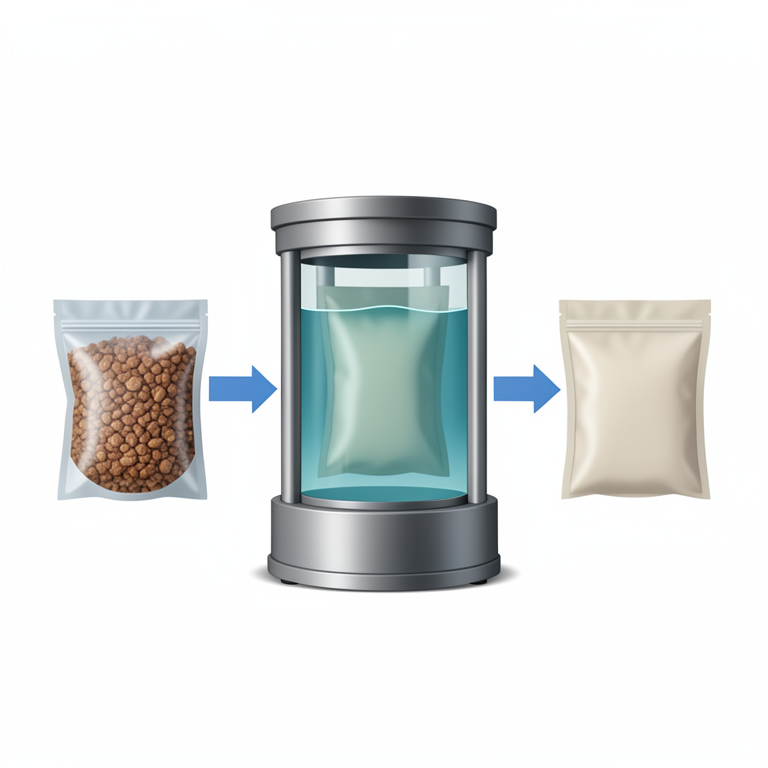
HPP Process Concept
AI-generated conceptual illustration (raw dog food in vacuum-sealed plastic packaging inside a high-pressure processing chamber). It explains the idea and does not show study data.
View source evidence ↗
Shelf Life Comparison
AI-generated conceptual illustration (raw dog food (BARF diet) in vacuum-sealed packaging). It explains the idea and does not show study data.
View source evidence ↗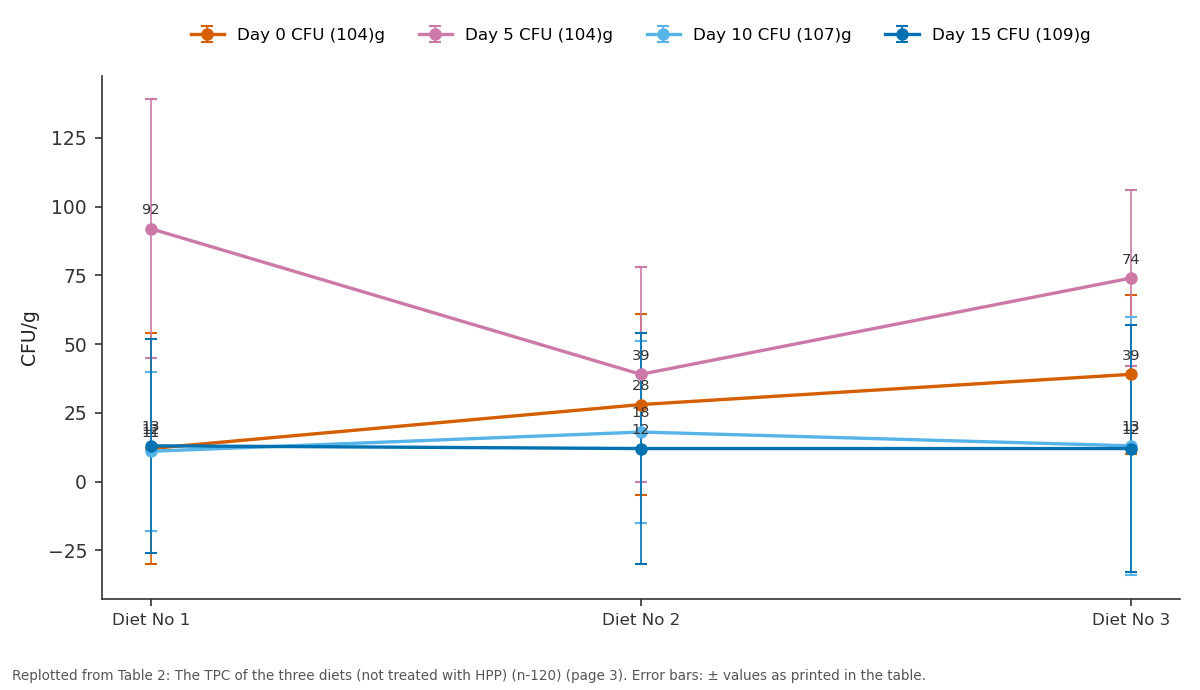
Day 0 CFU (104)g and Day 5 CFU (104)g and more: Diet No 1 vs Diet No 2 vs Diet No 3
Replotted from Table 2 (page 3) of the original paper. Every bar is the paper's own table value.
View source evidence ↗Figures & tables
From the original paper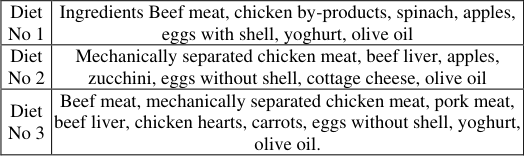 Table 1
 Table 2
 Table 3
 Table 4
 Table 5
Introduction
Introduction
Dog and BARF
In recent years, the dogs and cats feeding with raw foods has become increasingly popular among the pet owners (Freeman and Michel 2001) [38] . According to (Freeman et al., 2013) [14] , this practice presents a potential risk for the human and animal health. The most studies on the raw food use are associated with the risk of microbial contamination (Lenz et al., 2009) [23] . The manifestation of the clinical symptoms in healthy animals in the presence of microbial contamination of raw foods is not the main problem. The excretion of pathogens by their faeces is the real risk for human health (Carter and Quinn 2000; Lenz et al., 2009) [7,23] . Particular attention is paid to Salmonella enterica., Escherichia coli, Listeria, Clostridium and Campylobacter spp., as these microorganisms can be linked to the farm animals that may be used as source of raw materials for this type of food (Jenkins et al., 2016) [18] . Dogs, as generation of predators, have many physiological and anatomical adaptive mechanisms that allow them to tolerate relatively high levels of microorganisms in their diet. As a consequence, usually they do not have clinical symptoms, when they consume the food with the high number of bacterial contaminants (Lenz et al., 2009) [23] . When these microorganisms are excreted with the dog's faeces, there is a real risk to human health, because these pathogens can cause various diseases in humans (Lenz et al., 2009) [23] . The presence of Salmonella enterica. in the faeces of clinically healthy dogs, regardless of their diet, varies between 1.0 and 18.0%, but it is suggested that much higher levels of Salmonella enterica,. are required to spread the infection (Sanchez et al., 2002) [27] . There is evidence in the scientific literature of clinical cases of salmonellosis in domestic animals caused directly or indirectly by feeding them with raw food (Striver et al., 2003; Morley et al., 2006) [34,25] . The results of a survey by Joffe and Schlesinger (2002) [19] with a group of dogs showed that not a small percentage of dogs fed BARF, gave a positive fecal sample for Salmonella enterica., аnd nearly 80% of the raw foods tested contained Salmonella enterica.
HPP and BARF
Various processing technologies are available to reduce meat products contamination with microorganisms (Delmore et al., 1998) [11] . These treatments include hot water, organic acids, chlorine, steam, pasteurization and high pressure treatment (HPP) (Belk 2005; Sofos 2005; Skandamis et al., 2008) [5,32,30] . Inactivation of the vegetative bacteria in the food, using a high-pressure treatment, has been proven by various authors (Cheftel 1995; Smelt 1998, Farkas and Hoover 2000; Yuste et al., 2001, Adamcova et al. 2019) [9,31,13,37,1] . HPP is a type of preserving technology for different types of foods, which uses high pressure without heat treatment (Hugas et al. 2002) [17] During the HPP, the food is treated with a high hydrostatic pressure of 100-1000 MPa. The product temperature and exposure time can be adjusted by varying in temperature from 0°C to 100 °C and the time can be last from a few seconds to 20 minutes (Yaldagard et al., 2008) [36] . The survey of other authors also noted that the use of HPP decreases a microbial load and this technology is widely used in the production of meat products (Hugas et al. 2002 and Simonin et al. 2012) [17,29] A study by Argyri et al. (2019) [4] on the raw chicken meat, confirms that the HPP -treated product has a significantly longer shelf life and minimal number microorganisms. The same author, but in another team, proves again the effectiveness of the technology by examining chicken inoculated with Salmonella enterica. Their results show that HPP technology deactivates salmonellosis bacteria regardless of their amount in the product (Argyri et al. 2018) [3] . Similar are Garriga et al. (2004) [15] results who research meat and meat products in vacuum packs after high pressure treatment (600 MPa for 6 min). They proved that HPP processing is an effective method of slowing down the growth of microorganisms involved in meat degradation and reducing the safety risks associated with Salmonella enterica and L. Monocytogenes. Ananth et al. (1998) [2] conduct a similar survey with raw pork meat. The authors find that a pressure of 414 MPa for 13 minutes at 25°C inactivates the most common pathogens in foods such as Listeria, Salmonella and Coli bacteria. In addition to the deactivation of the bacteria, this treatment of the product extends the shelf life of the HPP treated meat. Kruk et al. (2011) [21] also trace the effect of HPP processing on E. coli, Listeria monocytogenes and Salmonella typhimurium, in chicken meat. Using different pressures, the authors prove that the microorganisms present in the meat are eliminated, the shelf life is prolonged and the meat is safe for consumption. The aim of this study is to evaluate microbiologically three raw diets for dogs, before and after technological treatment with HPP
Materials and Methods
The research was conducted with 210 samples of three different dog raw foods. The ingredients of the diets are presented in Table No 1. Our raw food is produced under the same conditions and packaged in special vacuum packs (withstanding high pressure). In addition, all production safety requirements are kept. All raw materials used are fit for human consumption.
After the raw food production, control samples 40 of each diet were left and the remaining amount of samples was treated with HPP. The three diets were tested on the day of production (day 0) for Salmonella enterica, E. coli, L. monocytogenes and Total Plate Count, then cooled at 0-4°C and stored at these temperature conditions throughout the experiment. Samples (40 controls of 40 each diet ) were taken from each diet that had not undergone HPP treatment and were tested for Total Plate Count on days 0, 5, 10, and 15. Also, 30 samples were taken from each diet that were treated by HPP for 3 minutes at 6000 bar and then stored at 0-4°C throughout the experiment. The microbiological tests were performed on days 0, 15 and 30 of the date of production for Salmonella enterica, Listeria monocytogenes, Escherichia coli and Total plate count. The microbiological studies have been carried out in an accredited laboratory in accordance with ISO / IEC 17025: 2017 using the following test methods for each microorganism: HPP treatment is carried out with "AVURE AV-20M highpressure treatment equipment" for storage microbiological reduction. The machine is capable of adjusting the pressure up to 660 MPa and with an operating temperature of 0-29 °C. The food was packed in individual high-pressure vacuum packs. The packaging used meets the requirements of Regulation (EC) No. 1935/2004. The food is packed in highbarrier polypropylene films meeting the criteria "Oxygen Transmission Rate" (OTR) < 5 and "Water Vapor Transmission Rate" (WVTR) < 5. The parameters during the HPP treatment of all samples are as follows: All samples were in the cooled state, duration of 3 minutes at a pressure of 6000 bar., also described by Yaldagard et al. (2008) [36] .
Statistical analysis
Аll results were processed statistically using Microsoft Excel for Windows. The obtained results are presented as mean value with standard deviation (X±SD), after applying statistical analysis with Student T-test. We considered statistically significant differences at p<0.05.
Results and Discussion
To survey the impact of technology on food shelf life, we conducted microbiological analyzes in dynamics before HPP treatment. Table No. 2 presents the results obtained for the total plate count (TPC) for all three raw food diets before HPP treatment. The data showed that for the period from day 0 to day 5, all diets had low microbial counts, indicating that the number of microorganisms was below acceptable levels and the food was safe and fit for consumption by dogs. After the 10th and 15th day of the production of the raw food, the total number of microorganisms increases and is above the permissible values and the food is not fit for consumption. In general, it is clear that after the 5th day of production, the food cannot be used, because the TPC is significantly increased, and in addition, visible signs of spoilage and a significant change in all organoleptic indicators began to be observed. The remaining samples of the diets have been treated by HPP for 3 min at 6000 bar, and then stored in at 0-4 °C throughout the test period. Each diet was examined on day 0, day 15, and day 30 of production date for Salmonella enterica, L. monocytogenes, E. coli and Total Plate Count. Table No. 3 presents the results of the microbiological studies of diet No 1 before and after the HPP processing in dynamics.
On the day before HPP treatment (day 0), Salmonella enterica and L. monocytogenes were not detected in the food, which is normal considering that we are using raw materials suitable for human consumption. The amount of E. coli is below the permissible value as well as the TPC -2.8.104±0.33 CFU/g. The results showed the absence of Salmonella enterica and L. monocytogenes until the end of the experiment (lasting 30 days). On day 15, the TPC decreased to <1.103 CFU/g as a result of HPP treatment, compared to day 0 (2.8.104±0.33 CFU/g). The HPP treatment significantly reduces the TPC, and on the 30th day, it is 4.9.104±0.46, which is below the permissible limit (of < 5.106 CFU /g). The results of microbiological tests showed that diet No 1 (beef) is suitable for consumption until the 30th day when stored in refrigerated conditions (0-4 °C). Bermudez-Aguirre and Barbosa-Canovas (2011) [6] reported an increase in shelf life after HPP treatment which our data confirm. Researchers also have discovered that HPP processing is an effective technology for reducing bacterial contamination and ensuring the microbiological safety of foods (Cheftel and Culioli, 1997; Huang et al., 2014; Sheen et al., 2015) [8,16,28] . The microbiological studies of diet No. 2 (chicken), which underwent HPP processing, are presented in Table No 4. On the day before processing (day 0), Salmonella enterica and L. monocytogenes were not detected, as in the first diet. Until the end of the experiment /day 30/, the presence of Salmonella enterica and L. monocytogenes was also not detected. On the 15th day of storage, E.coli values were < 1 CFU/g in the HPP-treated food compared to the beginning of the experiment (<10 CFU/g) before treatment. HPP also called cold pasteurization, reduces E. coli levels. On the 30th day, the values for E. coli were 3.6.101±0.21, which is below the acceptable level (of <500 CFU/g). On day 15, the TPC decreased to <1.103 CFU/g compared to the day 0 -1.2.104±0.42 CFU/g before HPP treatment. The results showed a significant reduce the TPC, which on the 30th day is 1.5.105±0.38 CFU/g at a limit of < 5.106 CFU/g. It confirms Hugas et al. (2002) [17] and Simonin et al. (2012) [29] statements that HPP reduces the microbial load of food and extends shelf life. The obtained results correspond with those of Argyri et al. (2019) [4] , who prove that raw chicken meat treated with HPP has a significantly longer shelf life and minimal amounts of microorganisms. . We observed again that the TPC did not exceed the initial amounts of < 10 CFU/g. A reduced microbial count on day 15 (<1.103 CFU/g) due to HPP treatment, compared to day 0, which again confirms the claim that the technology used significantly reduces the amount of microorganisms. On the 30th day of food storage, the TPC was 6.4.105±0.43, which is below the permissible limit (< 5.106 CFU/g). Our results are similar to those documented by other authors (Bermúdez-Aguirre and Barbosa-Cánovas, 2011) [6] . The HPP significantly increases the period of reliability, achieving significant decontamination of the product. Our study sustains Stewart and Cole's (2001) [33] claim that HPP technology not only extends shelf life but also improves food safety. Our research data on raw dog food also confirm the thesis of Koutchma (2014), for a safe end product with a longer shelf life, without the use of preservatives and without significant change in the nutritional and organoleptic characteristics after HPP treatment.
Conclusions
The data of the current study demonstrate that HPP treatment for 3 min at 6000 bar of BARF, significantly reduced the presence of E. coli and delay the increase of the TPC and the risk of food spoilage. After the HPP treatment of the BARF and storage at a temperature of 0-4 °C we can achieve a shelf life of up to 30 days. Last but not least we have decontamination of raw food without heat treatment or the use of various types of preserving products and additives. Our results suggest that the technology could be successfully implemented in BARF manufacturing, producing a safe product for the health of both pets and their owners.
Acknowledgement
AcknowledgementThe authors are grateful to AquaBar LTD for the financial support
Figures and tables from the paper
| Day Diet | Day 0 CFU (104)g | Day 5 CFU (104)g | Day 10 CFU (107)g | Day 15 CFU (109)g | Limits |
|---|---|---|---|---|---|
| Diet No 1 | 1,2±0,42 | 9,2±0,47 | 1,1±0,29 | 1,3±0,39 | < 5.106 |
| Diet No 2 | 2,8±0,33 | 3,9±0,39 | 1,8±0,33 | 1,2±0,42 | < 5.106 |
| Diet No 3 | 3,9±0,29 | 7,4±0,32 | 1,3±0,47 | 1,2±0,45 | < 5.106 |
Table text extracted from the original PDF; superscript letters are shown inline. The original table image is below.
View original table image
| Microorganisms | Before treatment with HPP | After treatment with HPP | — | Limits | Test conditions |
|---|---|---|---|---|---|
| Day 0 | Day 15 | Day 30 | |||
| Salmonella enterica cfu/10g | Absence | Absence | Absence | Absence | T=(37,0±1,0) °C, T=(41,5±0,5) oC |
| Listeria monocytogenes cfu/25g | Absence | Absence | Absence | Absence | T=(37,0±1,0) °C, T=(41,5±0,5) °C |
| Escherichia coli cfu/g | < 10 | < 1 | 3,6.101±0,21 | < 500 | T=(37,0±1,0) °C, T=(44,0±1,0) °C |
| Aerobic colony count cfu/g | 1,2.104±0,42 | < 1.103 | 1,5.105±0,38 | < 5.106 | t=(30,0±1,0)°C |
Table text extracted from the original PDF; superscript letters are shown inline. The original table image is below.
View original table image
| Microorganisms | Before treatment with HPP | After treatment with HPP | — | Limits | Test conditions |
|---|---|---|---|---|---|
| Day 0 | Day 15 | Day 30 | |||
| Salmonella enterica cfu/10g | Absence | Absence | Absence | Absence | T=(37,0±1,0) °C, T=(41,5±0,5) oC |
| Listeria monocytogenes cfu/25g | Absence | Absence | Absence | Absence | T=(37,0±1,0) °C, T=(41,5±0,5) °C |
| Escherichia coli cfu/g | < 10 | < 10 | < 10 | < 500 | T=(37,0±1,0) °C, T=(44,0±1,0) °C |
| Aerobic colony count cfu/g | 2,8.104±0,33 | <1.103 | 4,9.104±0,46 | < 5.106 | T=(30,0±1,0) °C |
Table text extracted from the original PDF; superscript letters are shown inline. The original table image is below.
View original table image
| Microorganisms | Before treatment with HPP | After treatment with HPP | — | Limits | Test conditions |
|---|---|---|---|---|---|
| Day 0 | Day 15 | Day 30 | |||
| Salmonella enterica cfu/10g | Absence | Absence | Absence | Absence | T=(37,0±1,0) °C, T=(41,5±0,5) oC |
| Listeria monocytogenes cfu/25g | Absence | Absence | Absence | Absence | T=(37,0±1,0) °C, T=(41,5±0,5) °C |
| Escherichia coli cfu/g | < 10 | < 10 | < 10 | < 500 | T=(37,0±1,0) °C, T=(44,0±1,0) °C |
| Aerobic colony count cfu/g | 3,9.104±0,29 | < 1.103 | 6,4.105±0,43 | < 5.106 | T=(30,0±1,0) °C |
Table text extracted from the original PDF; superscript letters are shown inline. The original table image is below.
View original table image
References
31 in the original paper- Adamcova M, van Andel V, Strohalm J, Houska M, Sevcik R. Effect of high-pressure processing and natural antimicrobials on the shelf-life of cooked ham. Czech Journal Food Sciences. 2019;37(1):57-61. https://doi.org/10.17221/204/2018-CJFS;
- Ananth V, Dickson JS, Olson DG, Murano EA. Shelf Life Extension, Safety, and Quality of Fresh Pork Loin Treated with High Hydrostatic Pressure. Journal of Food Protection. 1998;61(12):1649-1656. DOI: 10.4315/0362-028x-61.12.1649
- Argyri AA, Papadopoulou OS, Nisiotou A, Tassou ChC, Chorianopoulos N. Effect of high pressure processing on the survival of Salmonella enteritidis and shelf-life of chicken fillets. Food Microbiology. 2018;70:55-64.
- Argyri AA, Papadopoulou OS, Sourri P, Chorianopoulos N, Tassou C. Quality and Safety of Fresh Chicken Fillets after High Pressure Processing: Survival of Indigenous Brochothrix thermosphacta and Inoculated Listeria monocytogenes. Microorganisms. 2019;7(1):520. DOI: 10.3390/microorganisms7110520;
- Bermudez-Aguirre D, Barbosa-Canovas GV. An update on high hydrostatic pressure, from the laboratory to industrial applications. Food Engineering Reviews. 2011;3:44-61. https://doi.org/10.1007/s12393-010-90304
- Cheftel JC. Review: High-pressure, microbial inactivation and food preservation. Food Science and Technology International. 1995;1(2/3):75-90. https://doi.org/10.1177/108201329500100203
- Commission Regulation (EU) No 142/2011 of 25 February 2011 implementing Regulation (EC) No 1069/2009 of the European Parliament and of the Council laying down health rules as regards animal by-products and derived products not intended for human consumption and implementing Council Directive 97/78/EC as regards certain samples and items exempt from veterinary checks at the border under that Directive. Official Journal of the European Union; c2009. p. 01-54
- Delmore LG, Sofos J, Smith G. Decontamination of inoculated beef with sequential spraying treatments. Journal of Food Science. 1998;63(5):890-900. https://doi.org/10.1111/j.1365-2621.1998.tb17921.x
- Escherichia coli -Microbiology of food and animal feeding stuffs -Horizontal method for the enumeration of beta-glucuronidase-positive Escherichia coli -Part 2: Colony-count technique at 44 degrees C using 5-bromo4-chloro-3-indolyl beta-D-glucuronide (ISO 166492:2014); c2019. p. 01-08.
- Farkas D, Hoover D. High pressure processing in IFT. Special supplement: Kinetics of microbial inactivation for alternative processing technologies. Inst. of Food Technologists. Journal of Food Science. 2000;65(8):S1S108.
- Freeman LM, Chandler ML, Hamper BA, et al. Current knowledge about the risks and benefits of raw meat based diets for dogs and cats. Journal of the American Veterinary Medical Association. 2013;243(11):15491558. DOI: 10.2460/javma.243.11.1549
- Hugasb M. Microbial inactivation after high-pressure processing at 600 MPa in commercial meat products over its shelf life. Innovative Food Science and Emerging Technologies. 2004;5(4):451-457. DOI: 10.1016/j.ifset.2004.07.001
- Huang HW, Lung HM, Yang BB, Wang CY. Responses of microorganisms to high hydrostatic pressure processing. Food Control. 2014;40:250-259. https://doi.org/10.1016/j.foodcont.2013.12.007;
- Hugas M, Garriga M, Monfort JM. New mild technologies in meat processing: High pressure as a model technology. Meat Science. 2002;62(3):359-371. DOI: 10.1016/s0309-1740(02)00122-5
- Joffe DJ, Schlesinger DP. Preliminary assessment of the risk of Salmonella infection in dogs fed raw chicken diets. Canadian Veterinary Journal. 2002;43(6):441-442.
- Kruk Z, Yun H, Rutley D, Lee E, Kim Y, Jo C, et al. The effect of high pressure on microbial population, meat quality and sensory characteristics of chicken breast fillet. Food Control. 2011;22(1):6-12. DOI: 10.1016/j.foodcont.2010.06.003
- Listeria monocytogenes -Microbiology of the food chain -Horizontal method for the detection and enumeration of Listeria monocytogenes and of Listeria spp. -Part 1: Detection method (ISO 11290-1:2017).
- Lenz JD, Joffe D, Kauffman M, Zhang Y, LeJeune J. Perceptions, practices, and consequences associated with foodborne pathogens and the feeding of raw meat to dogs. Canadian Veterinary Journal. 2009;50(6):637-643.
- Michel KE. Unconventional diets for dogs and cats. Veterinary Clinics of North America: Small Animal Practice. 2006;36(36):1269-1281. DOI: 10.1016/j.cvsm.2006.08.003
- Morley PS, Strohmeyer RA, Tankson JD, Hyatt DR, Dargatz DA, Fedorka-cray PJ. Evaluation of the association between feeding raw meat and Salmonella enteric infections at a Greyhound breeding facility. Journal of the American Veterinary Medical Association. 2006;228(10):1524-1532. DOI: 10.2460/javma.228.10.1524
- Salmonella enterica -Microbiology of the food chain - Horizontal method for the detection, enumeration and serotyping of Salmonella-Part 1: Detection of Salmonella spp. (ISO 6579-1:2017).
- Sanchez S, Hofacre CL, Lee MD, Maurer JJ, Doyle MP. Animal sources of salmonellosis in humans. Journal of the American Veterinary Medical Association. 2002;221(4):492-497. DOI: 10.2 460/javma.2002.221.492
- Sheen S, Cassidy J, Scullen B, Uknalis J, Sommers C. Inactivation of Salmonella spp. in ground chicken using high pressure processing. Food Control. 2015;57:41-47. DOI: 10.1016/j.foodcont.2015.04.005.
- Simonin H, Duranton F, De Lamballerie M. New insights into the high-pressure processing of meat and meat products. Comprehensive Reviews in Food Science and Food Safety. 2012;11(3):285-306. DOI: https://doi.org/10.1111/j.1541-4337.2012.00184.x
- Skandamis PN, Yoon Y, Stopforth JD, Kendall PA, Sofos JN. Heat and acid tolerance of Listeria monocytogenes after exposure to single and multiple sublethal stresses. Food Microbiology. 2008;25(2):294303. DOI: 10.1016/j.fm.2007.10.008
- Smelt JPPM. Recent advances in the microbiology of high pressure processing. Trends in Food Science and Technology. 1998;9(4):152-158. DOI: https://doi.org/10.1016/S0924-2244(98)00030-2
- Striver SL, Frazier KS, Mauel MJ, Styer EL. Septicemic salmonellosis in two cats fed a raw-meat diet. Journal of the American Animal Hospital Association. 2003;39(6):538-542. DOI: 10.5326/0390538
- Total Plate Count -Microbiology of the food chain - Horizontal method for the enumeration of microorganisms -Part 1: Colony count at 30 degrees C by the pour plate technique (ISO 4833-1:2013).
- Yaldagard M, Mortazavi SA, Tabatabaie F. The principles of ultra high pressure Technology and its application in food processing/preservation: A review of microbiological and quality aspects. African Journal of biotechnology. 2008;7(16):2739-2767.
- Yuste J, Pla R, Capellas M, Sendra E, Beltran E, MorMur M. Oscillatory high pressure processing applied to mechanically recovered poultry meat for bacterial inactivation. Journal of Food Science. 2001;66(3):482484. DOI: 10.1111/j.1365-2621.2001.tb16135.x
- Freeman LM, Michel KE. Evaluation of raw food diets for dogs. Journal of the American Veterinary Medical Association. 2001;218(5):705-709.
Cited by 2
From OpenAlex, OpenCitations and reference lists read by Scinovex
- Salmonella Presence and Risk Mitigation in Pet Foods: A Growing Challenge with Implications for Human Health ↗
Janak Dhakal, Leslie Pearl M. Cancio, Aiswariya Deliephan, Byron D. Chaves, Stephan L. Tubene · Comprehensive Reviews in Food Science and Food Safety · 2024
Pet food is increasingly recognized as a significant vehicle for the transmission of foodborne pathogens to humans. The intimate association between pets and their owners, coupled with the rising trend of feeding pets raw and unprocessed foods, contributes substantially to this issue. Salmonella contamination in pet food can originate from raw materials and feed ingredients, the processing environment, and postprocessing…
❝ 25PDF - Current Status of Non-Thermal Sterilization by Pet Food Raw Ingredients ↗
Ui-Bin Baek, Hack-Youn Kim · Food Science of Animal Resources · 2024
Recently, as the concept of pet food that satisfies both nutritional needs and the five senses has evolved, so too has the demand for effective pet food non-thermal sterilization methods. Prominent non-thermal technologies include high-pressure processing, plasma, and radiation, which are favored for their ability to preserve nutrients, avoid residues, and minimize compositional changes, thereby maintaining quality and sensory properties.…
❝ 6PDF