
Research article · 2022 · Full text
International Journal of Advanced Chemistry ResearchEffect of weed management on weed dynamics, crop growth, fodder yield and economics of fodder maize (Zea mays L.) African tall under Chhattisgarh condition
Volume 4(2) · Pages 235–241 · DOI: 10.33545/26646781.2022.v4.i2d.104 ↗
Research areasCrop Yield and Soil FertilityAgronomic Practices and Intercropping SystemsAgricultural Science and Fertilization
Abstract
Author-writtenFodder maize is palatable and nutritious which can be fed as green or dry and makes excellent silage. But it is heavily infested with weeds which often inflicts huge yield and quality losses. A field experiment was conducted at Indira Gandhi Krishi Vishwavidyalaya, Raipur during Kharif 2017. Results showed that the lowest weed density and dry weight was recorded in tank mix application of atrazine 750 g + pendimethalin 750 g ha-1 as pre emergence followed by hand weeding twice at 20 and 40 days after sowing and topramezone 35 g + atrazine 250 g ha-1 as post emergence. These herbicides also recorded higher weed control efficiency (93-95%) and the lowest weed index (1-2%). Highest green and dry fodder yield were also obtained with the tank mix application of atrazine 750 g + pendimethalin 750 g ha-1 as pre emergence followed by hand weeding twice at 20 and 40 days after sowing and topramezone 35 g + atrazine 250 g ha-1 as post emergence. Similarly, crude protein yield was also highest under these combinations. Among herbicides, the highest net returns (Rs 41768 ha-1) and benefit: cost ratio (2.68) were also highest with tank mix application of atrazine 750 g + pendimethalin 750 g ha-1 as pre emergence followed by hand weeding twice at 20 and 40 days after sowing and topramezone 35 g + atrazine 250 g ha-1 as post emergence. Thus, this study suggests tank-mixed herbicide application for better weed control in fodder maize rather than their sole application. These combinations of herbicides may be the alternative of manual weeding.
Summary
Source-checkedPlain-language reading of the full paper, prepared with AI and checked against the text. Each point links to the authors' own words.
Why it matters
- Fodder maize is a highly nutritious and palatable forage crop that can be used as green fodder, dry feed, or silage. View evidence ↗
- Weed infestation is a major problem for fodder maize, potentially reducing crop yields by 25% to 80% or causing total crop failure. View evidence ↗
- Because the efficacy of standard pre-emergence herbicides is often reduced by environmental factors, there is a need to explore post-emergence herbicides and their mixtures. View evidence ↗
The question
- The study aimed to identify the most appropriate weed management strategy for fodder maize. View evidence ↗
What they did
- The research was conducted as a field experiment during the Kharif 2017 season at the Research Farm of Indira Gandhi Krishi Vishwavidyalaya in Raipur. View evidence ↗
- The study used a randomized block design consisting of ten different weed management treatments, each replicated three times. View evidence ↗
- Researchers measured weed density using 1 m² quadrats at 30 and 60 days after sowing, and determined weed dry weight by oven-drying samples at 60 °C for 48 hours. View evidence ↗
- Crude protein yield was determined by measuring nitrogen content via the micro-Kjeldahl method and multiplying by a factor of 6.25 and the dry matter yield. View evidence ↗
What they found
- The lowest weed dry weight at 60 days after sowing was achieved using a tank mix of atrazine (750 g a.i.) and pendimethalin (750 g a.i.) as pre-emergence, combined with hand weeding at 20 and 40 days. View evidence ↗
- The tank mix of atrazine (750 g a.i.) and pendimethalin (750 g a.i.) as pre-emergence showed the highest weed control efficiency, reaching 95% at 30 days and 93% at 60 days after sowing. View evidence ↗
- The tank mix of atrazine (750 g a.i.) and pendimethalin (750 g a.i.) as pre-emergence produced the maximum plant height (252 cm) and the highest number of green leaves (11.52). View evidence ↗
- The tank mix of atrazine and pendimethalin (T7) resulted in a green fodder yield of 422 q ha-1, a dry matter yield of 94.15 q ha-1, and a crude protein yield of 7.66 q ha-1. View evidence ↗
- Economically, the atrazine and pendimethalin tank mix (T7) provided the highest net return of Rs 39,766 ha-1 and the highest benefit-cost ratio of 2.69. View evidence ↗
What it means
- The authors conclude that tank mixes of atrazine with pendimethalin (pre-emergence) or topramezone (post-emergence) are superior to no control and comparable to manual hand weeding. View evidence ↗
- The study recommends these two tank-mix herbicide applications as the best alternatives to labor-intensive hand weeding. View evidence ↗
Visual summary
2 visualsIllustrations explain the paper; charts are replotted from the paper's own table values.
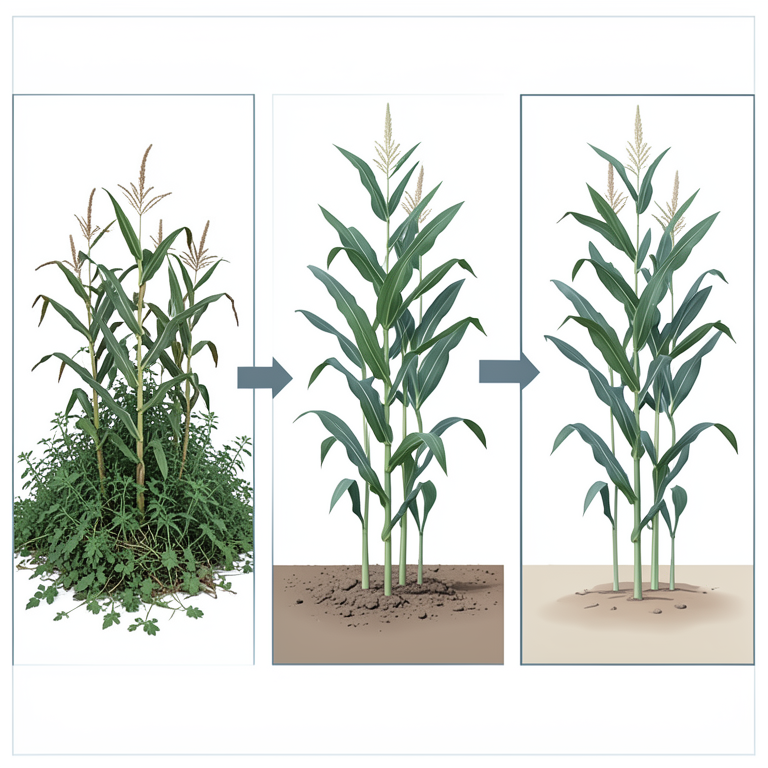
Comparison of Weed Management Strategies
AI-generated conceptual illustration (fodder maize (Zea mays L.) plants). It explains the idea and does not show study data.
View source evidence ↗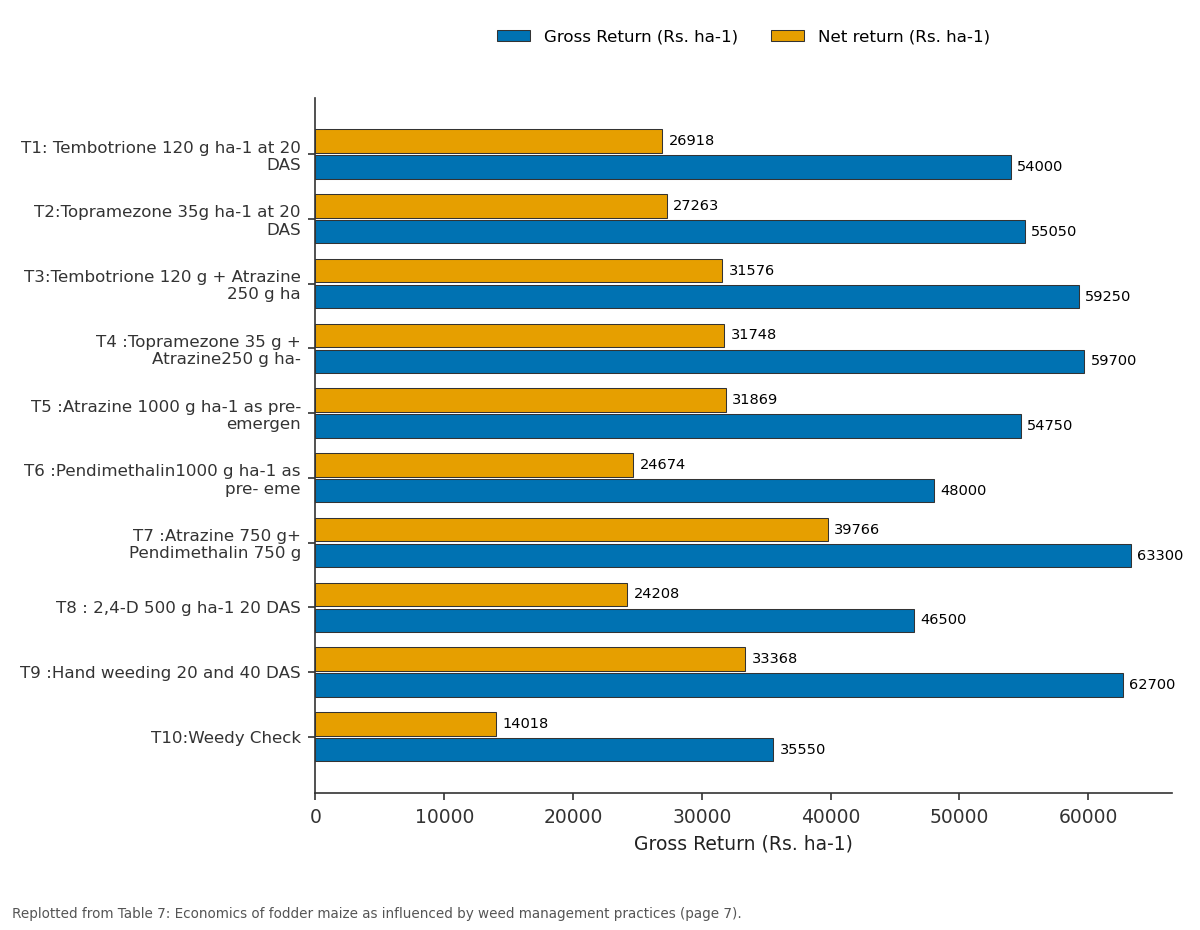
Gross Return (Rs. ha-1) and Net return (Rs. ha-1): T1: Tembotrione 120 g... vs T2:Topramezone 35g ha-1... vs T3:Tembotrione 120 g +... vs T4 :Topramezone 35 g +... vs T5 :Atrazine 1000 g...
Replotted from Table 7 (page 7) of the original paper. Every bar is the paper's own table value.
View source evidence ↗Figures & tables
From the original paper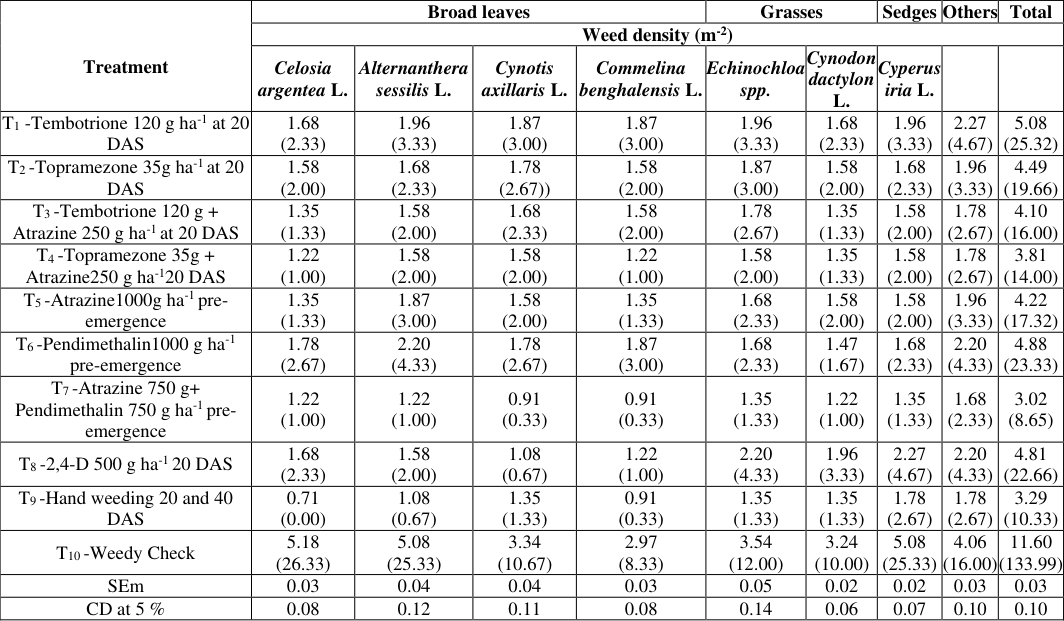 Table 1
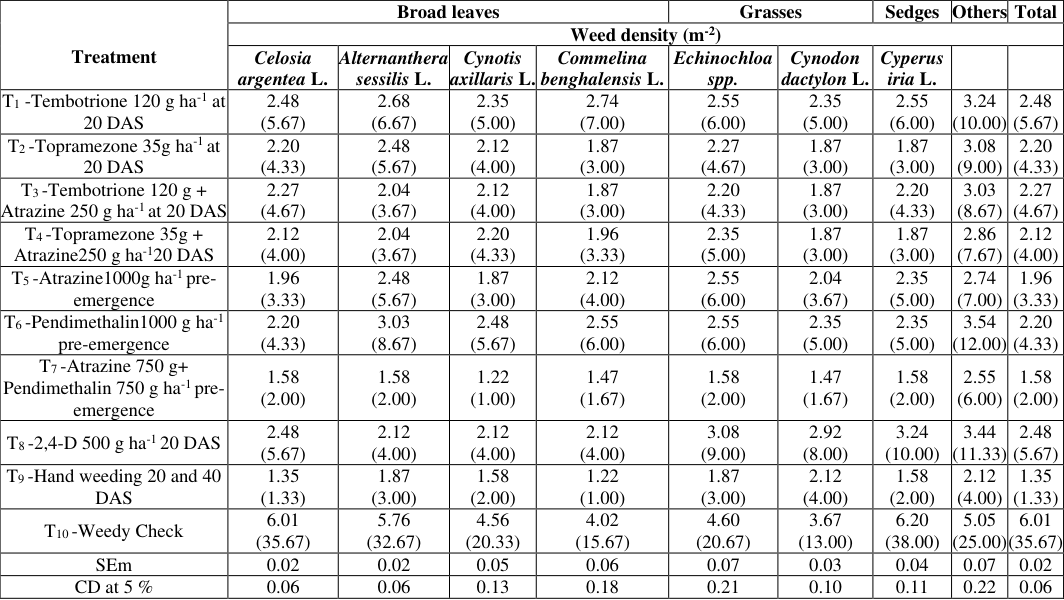 Table 2
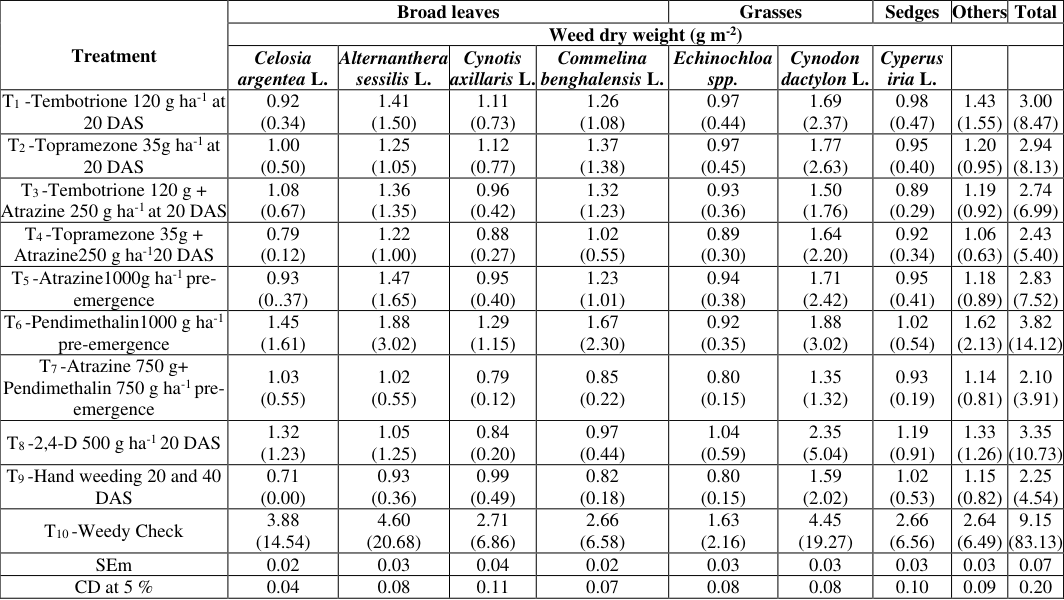 Table 3
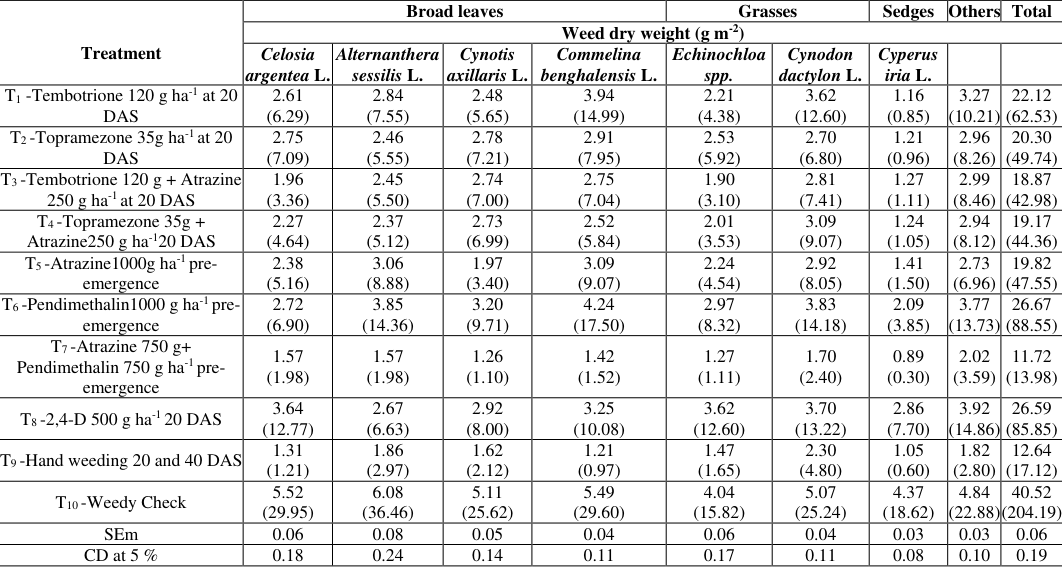 Table 4
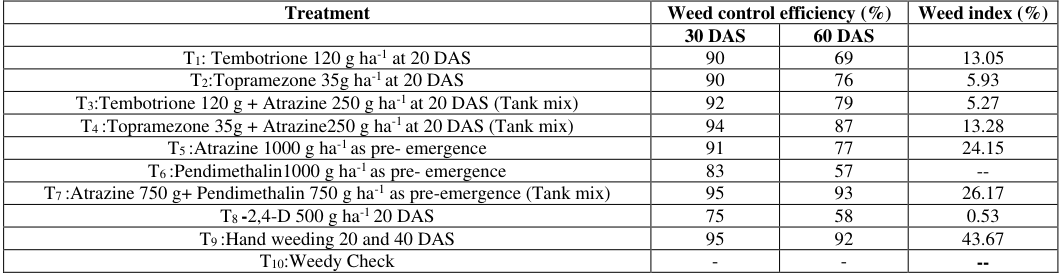 Table 5
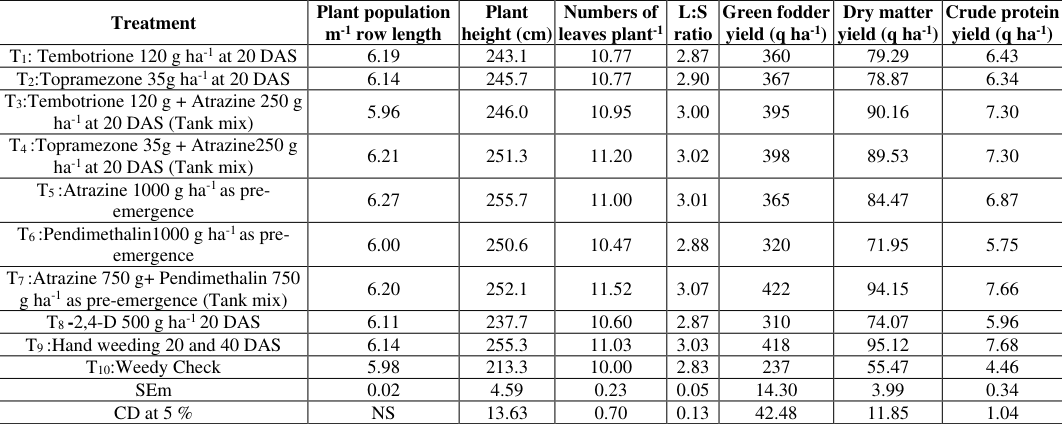 Table 6
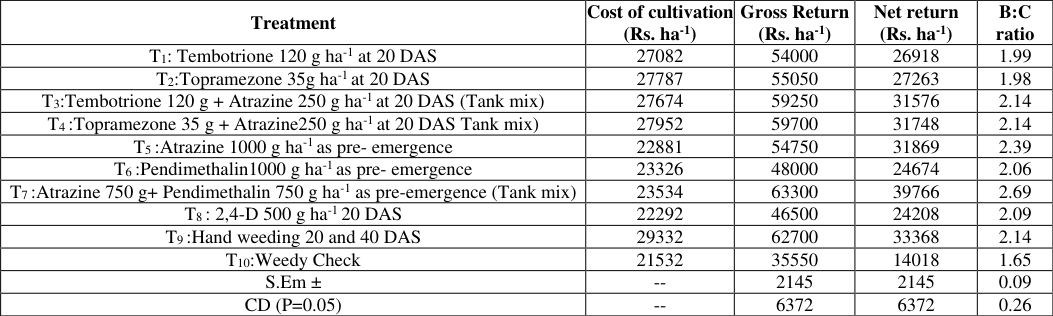 Table 7
Introduction
Maize (Zea mays L.) is an ideal forage crop grown throughout the country. It is quick growing high yielding and supplies palatable and nutritious forage which can be feed at any stage of growth without any risk to animals. It can be feed as green or dry and makes excellent silage. Maize produces good quality herbaceous fodder with high palatability. On average, it contains 9-10 % crude protein (CP), 60-64% neutral detergent fiber (NDF), 38-41% acid detergent fibre (ADF), 23-25 % hemicellulose, and 28-30% cellulose on dry matter basis when harvested at milk to early-dough stage. The nutritious green fodder maize is relished by all livestock, especially milch animals due to its succulent and palatable taste. Maize is a short-duration crop grown for green fodder and becomes ready for harvesting in about 8-10 weeks after sowing. In Chhattisgarh about 80 percent of the population lives in rural areas, largely dependent on agriculture and allied activities for livelihood. Livestock production is the backbone of Indian agriculture contributing 7% to National GDP and a source of employment and ultimate livelihood for 70% of the population in rural areas. Total livestock population in the state consisting of cattle, buffalo, sheep, goat, pig, horses & ponies, mules, donkeys and camels, was 150.40 lakhs in 2012. The total bovine population (Cattle and Buffalo) was 112.03 lakhs and milch animals (in-milk and dry together) in cows and buffaloes are 27.34 lakhs and 29.02 lakhs respectively present in the state. During last census (2012) total number of sheep, goat and pigs in the state was 1.68 lakh, 32.25 lakh and 4.39 thousand respectively. The milk production in India is 94.5 million tones, the highest in the world. The Indian cow produces less than 1000 kg per year. Although we stand high in case of total milk production, the productivity is quite low.
Although the genetic potential contributes significantly towards higher milk production but the genetic potential of high yielding animals can be realized only if they are fed well with quality fodder. Among the factors accountable for the low yield, weed infestation is the major cause. Excessive growth of weeds in maize field leads to 25 to 80% reduction in crop yield or sometimes to a complete crop failure if weeds are left uncontrolled (Karlen et al., 2002; Chikoye & Ekeleme, 2003). Therefore, the full expression of the production potential of forage crops depends on the degree of weed infestation (Kostov, 2006). Sharma and Nayital (1993) reported that unchecked weed growth in sandy loam soils of Punjab reduced maize yield by 61.3 % compared to weed free check. Weed infestation is a major constraint in maize cultivation that can cause 33 to 72 % of yield loss (Thakur and Sharma, 1996). Reduction in grain yield of maize due to weed infestation ranged from 40 to 60 % depending upon the intensity and types of weed flora (Mishra, 1997) Mostly farmers are using pre-emergence herbicides for weed control in maize, but their efficacy is reduced by various climatic and edaphic factors. Therefore, the only alternative that needs to be explored is the use of postemergence herbicides alone and in mixture and the new generation herbicides can control the weed efficiency.
Materials and Methods
A field experiment was carried out at Research Farm of Indira Gandhi Krishi Vishwavidyalaya, Raipur during Kharif 2017. The experimental farm is located between 21°49 N Latitude and 81°39´ E Longitude at an altitude of 298 meters above the mean sea level. The soil of the experimental field was vertisol clayey in texture locally named as Kanhar, neutral in pH (7.09), medium in organic carbon (0.60%), low in available nitrogen (237 kg ha -1 ), medium in available phosphorus (14.3 kg ha -1 ) and high in available potassium (361 kg ha -1 ). The experiment was carried out in a randomized block design with ten treatments replicated thrice viz. T 1 : tembotrione 120 g ha -1 at 20 DAS, T 2 : topramezone 35 g ha -1 at 20 DAS, T3: tembotrione 120 g + atrazine 250 g ha -1 at 20 DAS, T 4 : topramezone 35 g + atrazine 250 g ha -1 20 DAS, T 5 : atrazine 1000 g ha -1 pre-emergence, T 6 : pendimethalin 1000 g ha -1 pre-emergence, T 7 : atrazine 750 g + pendimethalin 750 g ha -1 preemergence, T 8 : 2,4-D 500 g ha -1 20 DAS, T 9 : hand weeding 20 and 40 DAS and T 10 : weedy check with the objective to find out appropriate weed management in fodder maize. Sowing of fodder maize (African Tall) was done in the mid-July in kharif 2017 of investigation with 30 cm row spacing. Before sowing, the field was thoroughly ploughed and levelled. The recommended doses of fertilizer for fodder maize 80:40:20 N:P 2 O 5 :K 2 O kg ha -1 was applied. The full dose of phosphorus, potassium and half dose of the nitrogen through diammonium phosphate, muriate of potash and urea were applied at the time of sowing and remaining quantity of nitrogen was applied at 30 days after sowing. All the recommended package of practices was adopted to raise the crop. All the herbicides were applied as pre and postemergence using knapsack sprayer fitted with a flat fan nozzle attached by mixing in 500 L of water ha -1 as per treatment. Tank mix solution was prepared by mixing the appropriate dose and applied in the field as per treatment. Weed density was counted at 30 and 60 days after sowing by using a quadrate of 1 m 2 size randomly in the net plot. Weeds were uprooted and cut close to the transition of root and shoot in each plot and collected for dry matter accumulation. The samples were first dried in the sun and then kept in an oven at 60 °C for 48 hours till constant weight was obtained. Species wise dry weight was recorded and total dry weight of weeds was expressed in gm -2 . Weed control efficiency (WCE) and weed index (WI) were calculated using formulae as suggested by Kumar and Gill (1969) [11] . The weed density and dry weight data were subjected to square-root transformation [√(x + 0.5)] before statistical analysis. Green fodder yield was recorded in each net plot immediately after harvest. Samples were weighed fresh and oven dried at 60 °C for 48 hr till constant weight for dry matter (DM) determination. Dried samples were ground using a grinder fitted with stainless steel blades. Crude protein content in plant samples was computed by multiplying the N content (micro-Kjeldahl method) with the factor 6.25 (AOAC, 1980) [1] . Crude protein yield (kg ha -1 ) was calculated by multiplying the protein content with dry matter yield. Cost of cultivation, gross returns, net returns and benefit-cost ratio for each treatment were calculated by taking into consideration of total costs incurred and returns obtained. The results were analysed using the standard statistical procedure given by Gomez and Gomez (1984) [6] .
Result and Discussion
Result and Discussion
Weed flora
The major weed flora observed in the experimental field were Cyperus iria L. (sedge), Cynodon dactylon L, Echinochloa spp. among grasseses; while among broad leaf weeds Celosia argentea L., Alternanthra sessilis L., Cynotis axilllaris L., Commelina benghalensis L. Other weeds noticed in lower densities were Malva perviflora L., Euphorbia hirta L., and Parthenium hysterophorus L. among broad leaf weeds.
Different weed management treatments significantly influenced weed density at 30 and 60 days after sowing (Table 1 and2). At 30 days after sowing, data indicate that weed density of Cynotis axillaris L., (0.91 m -2 ), Commelina benghalensis L., (0.91 m -2 ), Echinochloa spp. (1.35 m -2 ), Cynodon dactilon L., (1.22 m -2 ) and Cyperus iria L., (1.35 m -2 ) was significantly lowest in tank mix application of atrazine 750 g a.i. + pendimethalin 750 a.i. g ha -1 as pre emergence, this may be due to effect of pre emergence application of herbicide followed by two hand weeding and tank mix application of topramezone 35 g + atrazine 250 g ha -1 as post emergence application. Lowest weed density of Alternanthera sessilis L., (1.08 m -2 ) Commelina benghalensis (1.08 m -2 ) and Echinochloa spp. (1.35 m -2 ) was recorded in hand weeding, in this treatment may be due to hand weeding done at 20 and 40 days after sowing. Significantly maximum weed density of all the species was recoded in weedy check treatment. It clearly indicated that up to 30 days, application of pre-emergence tank mixture of atrazine + pendimethalin or topramezone + atrazine controls the first flush of weed similarly as hand weeding. At 60 days after sowing, data indicate that weed density of Celosia argentea L., (1.35 m -2 ), Commelina benghalensis L., (1.22 m -2 ) and Cyperus iria L. (1.58 m -2 ) was recorded in hand weeding at 20 and 40 days after sowing followed by tank mix application of tembotrione 120 g + atrazine 250 g ha -1 as post emergence and tank mix application of topramezone 35 g + atrazine 250 g ha -1 as post emergence except Celosia argentea L. Tank mix application of atrazine 750 g a.i.+ pendimethalin 750 a.i. g ha -1 as pre emergence was recoded lowest weed density of Alternanthera sessilis L., (1.58 m -2 ), Cynotis axillaris L., (1.22 m -2 ), Echinochloa spp. (1.58 m -2 ) and Cynodon dactilon L., (1.47 m -2 ) followed by tank mix application of tembotrione 120 g + atrazine 250 g ha -1 as post emergence and tank mix application of topramezone 35 g + atrazine 250 g ha -1 as post emergence. Significantly higher weed density of all species was recorded in weedy check treatment. This might have been due to the uninterrupted growth of weeds by utilizing the growth resource like moisture, nutrient, sunlight to the full extent and offering stiff competition to the crop. The lower number of weed density under tank-mix application of pre and early post-emergence herbicides as effective as twice manual weeding in forage maize and this combination might be the alternative of hand weeding which is time-consuming, costly and labour dependent operation. The lower number of weeds in the field offer better growth condition for forage maize and it is in agreement with Sanodiya et al. (2013) [17] and Madhavi et al. (2014) [12] .
| Treatment | Broad leaves | — | — | — | Grasses | — | Sedges | Others | Total |
|---|---|---|---|---|---|---|---|---|---|
| Weed density (m-2) | |||||||||
| Celosia argentea L. | Alternanthera sessilis L. | Cynotis axillaris L. | Commelina benghalensis L. | Echinochloa spp. | Cynodon dactylon L. | Cyperus iria L. | |||
| T1 -Tembotrione 120 g ha-1 at 20 DAS | 1.68 (2.33) | 1.96 (3.33) | 1.87 (3.00) | 1.87 (3.00) | 1.96 (3.33) | 1.68 (2.33) | 1.96 (3.33) | 2.27 (4.67) | 5.08 (25.32) |
| T2 -Topramezone 35g ha-1 at 20 DAS | 1.58 (2.00) | 1.68 (2.33) | 1.78 (2.67)) | 1.58 (2.00) | 1.87 (3.00) | 1.58 (2.00) | 1.68 (2.33) | 1.96 (3.33) | 4.49 (19.66) |
| T3 -Tembotrione 120 g + Atrazine 250 g ha-1 at 20 DAS | 1.35 (1.33) | 1.58 (2.00) | 1.68 (2.33) | 1.58 (2.00) | 1.78 (2.67) | 1.35 (1.33) | 1.58 (2.00) | 1.78 (2.67) | 4.10 (16.00) |
| T4 -Topramezone 35g + Atrazine250 g ha-120 DAS | 1.22 (1.00) | 1.58 (2.00) | 1.58 (2.00) | 1.22 (1.00) | 1.58 (2.00) | 1.35 (1.33) | 1.58 (2.00) | 1.78 (2.67) | 3.81 (14.00) |
| T5 -Atrazine1000g ha-1 pre- emergence | 1.35 (1.33) | 1.87 (3.00) | 1.58 (2.00) | 1.35 (1.33) | 1.68 (2.33) | 1.58 (2.00) | 1.58 (2.00) | 1.96 (3.33) | 4.22 (17.32) |
| T6 -Pendimethalin1000 g ha-1 pre-emergence | 1.78 (2.67) | 2.20 (4.33) | 1.78 (2.67) | 1.87 (3.00) | 1.68 (2.33) | 1.47 (1.67) | 1.68 (2.33) | 2.20 (4.33) | 4.88 (23.33) |
| T7 -Atrazine 750 g+ Pendimethalin 750 g ha-1 pre- emergence | 1.22 (1.00) | 1.22 (1.00) | 0.91 (0.33) | 0.91 (0.33) | 1.35 (1.33) | 1.22 (1.00) | 1.35 (1.33) | 1.68 (2.33) | 3.02 (8.65) |
| T8 -2,4-D 500 g ha-1 20 DAS | 1.68 (2.33) | 1.58 (2.00) | 1.08 (0.67) | 1.22 (1.00) | 2.20 (4.33) | 1.96 (3.33) | 2.27 (4.67) | 2.20 (4.33) | 4.81 (22.66) |
| T9 -Hand weeding 20 and 40 DAS | 0.71 (0.00) | 1.08 (0.67) | 1.35 (1.33) | 0.91 (0.33) | 1.35 (1.33) | 1.35 (1.33) | 1.78 (2.67) | 1.78 (2.67) | 3.29 (10.33) |
| T10 -Weedy Check | 5.18 (26.33) | 5.08 (25.33) | 3.34 (10.67) | 2.97 (8.33) | 3.54 (12.00) | 3.24 (10.00) | 5.08 (25.33) | 4.06 (16.00) | 11.60 (133.99) |
| SEm | 0.03 | 0.04 | 0.04 | 0.03 | 0.05 | 0.02 | 0.02 | 0.03 | 0.03 |
| CD at 5 % | 0.08 | 0.12 | 0.11 | 0.08 | 0.14 | 0.06 | 0.07 | 0.10 | 0.10 |
Table text extracted from the original PDF; superscript letters are shown inline. The original table image is below.
View original table image
Weed dry weight is a better parameter to measure weed competition than weed density as it measures more precisely the growth resources utilized by weeds (Padmavati et al., 1995) [14] . Similar to weed density, dry weight of weeds significantly influenced by treatments at 30 and 60 DAS (Table3 and 4). At 30 days after sowing, significantly lowest weed dry weight of Alternantrera sessilis L., (0.93 g m -2 ), Commelina benghalensis L., (0.82 g m -2 ) and Echinochloa spp. (0.80 g m -2 ) was recorded in hand weeding at 20 and 40 days after sowing followed by tank mix application of atrazine 750 g a.i.+ pendimethalin 750 a.i. g ha -1 as pre emergence. Minimum weed dry weight of Celosia argentea L., (0.71 g m -2 ) was found in hand weeding at 20 and 40 days after sowing followed by tank mix application of topramezone 35 g + atrazine 250 g ha -1 as post emergence. Lower weed dry weight of Cynotis axillaris L., (0.79 g m -2 ) was recorded in tank mix application of atrazine 750 g a.i.+ pendimethalin 750 a.i. g ha -1 as pre emergence followed by 2,4-D 500 g ha -1 as post emergence. Minimum weed dry weight of Cynodon dactilon L., (1.35 g m -2 ) was recorded under tank mix application of atrazine 750 g a.i.+ pendimethalin 750 a.i. g ha -1 as pre emergence followed by tank mix application tembtrione 120 g + atrazine 250 g ha -1 as post emergence and lowest weed dry weight of Cyprus irria L., (0.89 g m -2 ) was observed in tank mix application tembtrione 120 g + atrazine 250 g ha -1 as post emergence followed by tank mix application of topramezone 35g + atrazine 250 g ha -1 as post emergence. Significantly highest weed dry weight of Celosia argentea L., (3.88 g m -2 ), Alternantrera sessilis L., (4.88 g m -2 ), Cynotis axillaris L., (2.71 g m -2 ), Commelina benghalensis L., (2.66 g m -2 ), Echinochloa spp. (1.63 g m -2 ), Cynodon dactilon L., (4.45 g m -2 ) and Cyprus irria L., (2.66 g m -2 ) was recorded in weedy check treatment. At 60 days after sowing, significantly lowest weed dry weight of Alternantrera sessilis L., (1.57 g m -2 ), Cynotis axillaris L., (1.26 g m -2 ), Echinochloa spp. (1.27 g m -2 ) Cynodon dactilon L., (1.70 g m -2 ) and Cyprus irria L., (0.89 g m -2 ) was recorded under tank mix application of atrazine 750 g a.i.+ pendimethalin 750 a.i. g ha -1 as pre emergence followed by hand weeding at 20 and 40 days after sowing. Minimum weed dry weight of Celosia argentea L., (1.31 g m -2 ) and Commelina benghalensis L., (1.21 g m -2 ) was observed in hand weeding at 20 and 40 days after sowing followed by tank mix application of atrazine 750 g a.i.+ pendimethalin 750 a.i. g ha -1 as pre emergence. Highest weed dry weight of Celosia argentea L., (5.52 g m -2 ), Alternantrera sessilis L., (6.08 g m -2 ), Cynotis axillaris L., (5.11 g m -2 ), Commelina benghalensis L., (5.49 g m -2 ), Echinochloa spp. (4.04 g m -2 ), Cynodon dactilon L., (5.07 g m -2 ) and Cyprus irria L., (4.37 g m -2 ) was recorded under weedy check treatment. The lower dry weight in these treatments might be due to better efficacy and prolonged effectiveness of tank-mix herbicides. Applied chemicals are HPPD inhibiting herbicides, which reduced weed growth, resulted in rapid depletion of carbohydrate synthesis of weeds, bleaching of chlorophyll pigment, reduction in leaf area and diminution of photosynthesis process (Bollman et al., 2008; Jonathon and Sprague 2017) [3,8] . A similar result was also reported by Sanodiya et al. (2013) [17] , Patel et al. (2006) [15] , Walia et al. (2007) [22] and Madhavi et al. (2014) [12] .
| Treatment | Broad leaves | — | — | — | Grasses | — | Sedges | Others | Total |
|---|---|---|---|---|---|---|---|---|---|
| Weed dry weight (g m-2) | |||||||||
| Celosia argentea L. | Alternanthera sessilis L. | Cynotis axillaris L. | Commelina benghalensis L. | Echinochloa spp. | Cynodon dactylon L. | Cyperus iria L. | |||
| T1 -Tembotrione 120 g ha-1 at 20 DAS | 0.92 (0.34) | 1.41 (1.50) | 1.11 (0.73) | 1.26 (1.08) | 0.97 (0.44) | 1.69 (2.37) | 0.98 (0.47) | 1.43 (1.55) | 3.00 (8.47) |
| T2 -Topramezone 35g ha-1 at 20 DAS | 1.00 (0.50) | 1.25 (1.05) | 1.12 (0.77) | 1.37 (1.38) | 0.97 (0.45) | 1.77 (2.63) | 0.95 (0.40) | 1.20 (0.95) | 2.94 (8.13) |
| T3 -Tembotrione 120 g + Atrazine 250 g ha-1 at 20 DAS | 1.08 (0.67) | 1.36 (1.35) | 0.96 (0.42) | 1.32 (1.23) | 0.93 (0.36) | 1.50 (1.76) | 0.89 (0.29) | 1.19 (0.92) | 2.74 (6.99) |
| T4 -Topramezone 35g + Atrazine250 g ha-120 DAS | 0.79 (0.12) | 1.22 (1.00) | 0.88 (0.27) | 1.02 (0.55) | 0.89 (0.30) | 1.64 (2.20) | 0.92 (0.34) | 1.06 (0.63) | 2.43 (5.40) |
| T5 -Atrazine1000g ha-1 pre- emergence | 0.93 (0..37) | 1.47 (1.65) | 0.95 (0.40) | 1.23 (1.01) | 0.94 (0.38) | 1.71 (2.42) | 0.95 (0.41) | 1.18 (0.89) | 2.83 (7.52) |
| T6 -Pendimethalin1000 g ha-1 pre-emergence | 1.45 (1.61) | 1.88 (3.02) | 1.29 (1.15) | 1.67 (2.30) | 0.92 (0.35) | 1.88 (3.02) | 1.02 (0.54) | 1.62 (2.13) | 3.82 (14.12) |
| T7 -Atrazine 750 g+ Pendimethalin 750 g ha-1 pre- emergence | 1.03 (0.55) | 1.02 (0.55) | 0.79 (0.12) | 0.85 (0.22) | 0.80 (0.15) | 1.35 (1.32) | 0.93 (0.19) | 1.14 (0.81) | 2.10 (3.91) |
| T8 -2,4-D 500 g ha-1 20 DAS | 1.32 (1.23) | 1.05 (1.25) | 0.84 (0.20) | 0.97 (0.44) | 1.04 (0.59) | 2.35 (5.04) | 1.19 (0.91) | 1.33 (1.26) | 3.35 (10.73) |
| T9 -Hand weeding 20 and 40 DAS | 0.71 (0.00) | 0.93 (0.36) | 0.99 (0.49) | 0.82 (0.18) | 0.80 (0.15) | 1.59 (2.02) | 1.02 (0.53) | 1.15 (0.82) | 2.25 (4.54) |
| T10 -Weedy Check | 3.88 (14.54) | 4.60 (20.68) | 2.71 (6.86) | 2.66 (6.58) | 1.63 (2.16) | 4.45 (19.27) | 2.66 (6.56) | 2.64 (6.49) | 9.15 (83.13) |
| SEm | 0.02 | 0.03 | 0.04 | 0.02 | 0.03 | 0.03 | 0.03 | 0.03 | 0.07 |
| CD at 5 % | 0.04 | 0.08 | 0.11 | 0.07 | 0.08 | 0.08 | 0.10 | 0.09 | 0.20 |
Table text extracted from the original PDF; superscript letters are shown inline. The original table image is below.
View original table image
Weed control efficiency
The weed control efficiency (WCE) is a measure of expressing the efficiency of the weed control method. On the basis of the total dry weight of weed in weedy check and treated plot. Chemical weed management practices recorded better WCE at 30 and 60 days after sowing (Table 5). At 30 days after sowing, significantly higher weed control efficiency (95%) was recorded under tank mix application of atrazine 750 g a.i.+ pendimethalin 750 a.i. g ha -1 as pre emergence followed by hand weeding (95%) at 20 and 40 days after sowing and tank mix application of topramezone 35 g + atrazine 250 g ha -1 as post emergence (94%). Lower weed control efficiency was recorded under weedy check. This might be due to the higher efficacy of tank-mixed herbicides which resulted in lower weed dry matter. At 60 days after sowing, significantly higher weed control efficiency (93 %) was recorded under tank mix application of atrazine 750 g a.i.+ pendimethalin 750 a.i. g ha -1 as pre emergence followed by hand weeding (92%) at 20 and 40 days after sowing and tank mix application of topramezone 35 g + atrazine 250 g ha -1 as post emergence (87%). Lower weed control efficiency was recorded under weedy check.
| Treatment | Weed control efficiency (%) | — | Weed index (%) |
|---|---|---|---|
| 30 DAS | 60 DAS | ||
| T1: Tembotrione 120 g ha-1 at 20 DAS | 90 | 69 | 13.05 |
| T2:Topramezone 35g ha-1 at 20 DAS | 90 | 76 | 5.93 |
| T3:Tembotrione 120 g + Atrazine 250 g ha-1 at 20 DAS (Tank mix) | 92 | 79 | 5.27 |
| T4 :Topramezone 35g + Atrazine250 g ha-1 at 20 DAS (Tank mix) | 94 | 87 | 13.28 |
| T5 :Atrazine 1000 g ha-1 as pre- emergence | 91 | 77 | 24.15 |
| T6 :Pendimethalin1000 g ha-1 as pre- emergence | 83 | 57 | -- |
| T7 :Atrazine 750 g+ Pendimethalin 750 g ha-1 as pre-emergence (Tank mix) | 95 | 93 | 26.17 |
| T8 -2,4-D 500 g ha-1 20 DAS | 75 | 58 | 0.53 |
| T9 :Hand weeding 20 and 40 DAS | 95 | 92 | 43.67 |
| T10:Weedy Check | - | - | -- |
Table text extracted from the original PDF; superscript letters are shown inline. The original table image is below.
View original table image
Weed index
The weed index worked out in different weed control treatments on the basis of green fodder yield in comparison to hand weeding treatment (Table 5). The lowest weed index was recorded under tank mix application of atrazine 750 g a.i. + pendimethalin 750 a.i. g ha -1 as pre emergence followed by tank mix application of topramezone + atrazine @ 35 + 250 g a.i. ha -1 as post emergence (5.27%) and hand weeding at 20 and 40 days after sowing (0.53 %) due to better herbicide selectivity and weed control efficiency. This led to better control of weeds during the critical period of crop weed competition resulted in higher green fodder yield. Highest weed index was noticed in weedy check (43.67 %).
Fodder yield and quality
Herbicide application and hand weeding significantly increased the yield components and fodder yield of maize by limiting the level of weed infestation and its growth (Table 6). Maximum plant height (252 cm), number of green leaves (11.52) of maize plant were obtained in tank mix application of atrazine 750 g a.i. + pendimethalin 750 a.i. g ha -1 as pre emergence which was at par with tank mix application of topramezone 35 g + atrazine 250 g ha -1 as post emergence and hand weeding at 20 and 40 days after sowing. Maximum fodder and crude protein yield were recorded in tank mix application of atrazine 750 g a.i. + pendimethalin 750 a.i. g ha -1 as pre emergence. Followed by tank mix application of topramezone 35 g + atrazine 250 g ha -1 as post emergence and hand weeding at 20 and 40 days after sowing. Dry fodder yield and crude protein yield was statistically at par with hand weeding in case of topramezone 35 g + atrazine 250 g ha -1 , atrazine 750 g + pendimethalin 750 g ha -1 and tembotrione 120 g + atrazine 250 g ha -1 at 20 days after sowing. These results are in accordance with those of Patel et al. (2006) [15] , Kumar et al. (2013) [10] , Hatti et al. (2014) [7] and Baldaniya et al. (2018) [2] . They reported yield with the tank-mixed application of pre and early post-emergence herbicides similar to the hand weeding.
| Treatment | Plant population m-1 row length | Plant height (cm) | Numbers of leaves plant-1 | L:S ratio | Green fodder yield (q ha-1) | Dry matter yield (q ha-1) | Crude protein yield (q ha-1) |
|---|---|---|---|---|---|---|---|
| T1: Tembotrione 120 g ha-1 at 20 DAS | 6.19 | 243.1 | 10.77 | 2.87 | 360 | 79.29 | 6.43 |
| T2:Topramezone 35g ha-1 at 20 DAS | 6.14 | 245.7 | 10.77 | 2.90 | 367 | 78.87 | 6.34 |
| T3:Tembotrione 120 g + Atrazine 250 g ha-1 at 20 DAS (Tank mix) | 5.96 | 246.0 | 10.95 | 3.00 | 395 | 90.16 | 7.30 |
| T4 :Topramezone 35g + Atrazine250 g ha-1 at 20 DAS (Tank mix) | 6.21 | 251.3 | 11.20 | 3.02 | 398 | 89.53 | 7.30 |
| T5 :Atrazine 1000 g ha-1 as pre- emergence | 6.27 | 255.7 | 11.00 | 3.01 | 365 | 84.47 | 6.87 |
| T6 :Pendimethalin1000 g ha-1 as pre- emergence | 6.00 | 250.6 | 10.47 | 2.88 | 320 | 71.95 | 5.75 |
| T7 :Atrazine 750 g+ Pendimethalin 750 g ha-1 as pre-emergence (Tank mix) | 6.20 | 252.1 | 11.52 | 3.07 | 422 | 94.15 | 7.66 |
| T8 -2,4-D 500 g ha-1 20 DAS | 6.11 | 237.7 | 10.60 | 2.87 | 310 | 74.07 | 5.96 |
| T9 :Hand weeding 20 and 40 DAS | 6.14 | 255.3 | 11.03 | 3.03 | 418 | 95.12 | 7.68 |
| T10:Weedy Check | 5.98 | 213.3 | 10.00 | 2.83 | 237 | 55.47 | 4.46 |
| SEm | 0.02 | 4.59 | 0.23 | 0.05 | 14.30 | 3.99 | 0.34 |
| CD at 5 % | NS | 13.63 | 0.70 | 0.13 | 42.48 | 11.85 | 1.04 |
Table text extracted from the original PDF; superscript letters are shown inline. The original table image is below.
View original table image
Economics
The cost of cultivation and economic returns of different weed management treatments are shown in Table 7. The cost of cultivation of maize varied from minimum with weedy check (Rs 21532 ha -1 ) to maximum under hand weeding two times (Rs 29332 ha -1 ). The new generation herbicides (topramezone and tembotrione) are costly, so the cost of cultivation of these treatments is almost equal to hand weeding two times. Among herbicides, the maximum gross return was fetched in tank mix application of atrazine 750 g a.i. + pendimethalin 750 a.i. g ha -1 as pre emergence and least under weedy check. The maximum net returns were calculated in tank mix application of atrazine 750 g a.i. + pendimethalin 750 a.i. g ha -1 as pre emergence (Rs 39766 ha -1 ) followed by hand weeding and minimum in weedy check (Rs 30919 ha -1 ). Higher returns can be attributed to better weed control in these treatments resulting in the increased fodder yield. The benefit to cost ratio was calculated by dividing the value of the gross return to the cost of cultivation in order to determine the economic efficiency. However, the highest benefit to cost ratio was calculated in tank mix application of atrazine 750 g a.i. + pendimethalin 750 a.i. g ha -1 as pre emergence (2.69) followed by Atrazine 1000 g ha -1 as pre-emergence (2.39) and lowest in weedy check (1.65). Similar findings were also reported by Patel et al. (2006) [15] , Walia et al. (2007) [21] , Kumar et al. (2013) [10] , Hatti et al. (2014) [7] and Madhavi et al. (2014) [12] .
| Treatment | Cost of cultivation (Rs. ha-1) | Gross Return (Rs. ha-1) | Net return (Rs. ha-1) | B:C ratio |
|---|---|---|---|---|
| T1: Tembotrione 120 g ha-1 at 20 DAS | 27082 | 54000 | 26918 | 1.99 |
| T2:Topramezone 35g ha-1 at 20 DAS | 27787 | 55050 | 27263 | 1.98 |
| T3:Tembotrione 120 g + Atrazine 250 g ha-1 at 20 DAS (Tank mix) | 27674 | 59250 | 31576 | 2.14 |
| T4 :Topramezone 35 g + Atrazine250 g ha-1 at 20 DAS Tank mix) | 27952 | 59700 | 31748 | 2.14 |
| T5 :Atrazine 1000 g ha-1 as pre- emergence | 22881 | 54750 | 31869 | 2.39 |
| T6 :Pendimethalin1000 g ha-1 as pre- emergence | 23326 | 48000 | 24674 | 2.06 |
| T7 :Atrazine 750 g+ Pendimethalin 750 g ha-1 as pre-emergence (Tank mix) | 23534 | 63300 | 39766 | 2.69 |
| T8 : 2,4-D 500 g ha-1 20 DAS | 22292 | 46500 | 24208 | 2.09 |
| T9 :Hand weeding 20 and 40 DAS | 29332 | 62700 | 33368 | 2.14 |
| T10:Weedy Check | 21532 | 35550 | 14018 | 1.65 |
| S.Em ± | -- | 2145 | 2145 | 0.09 |
| CD (P=0.05) | -- | 6372 | 6372 | 0.26 |
Table text extracted from the original PDF; superscript letters are shown inline. The original table image is below.
View original table image
L:S ratio
Green fodder yield (q ha -1 ) Dry matter yield (q ha -1 ) Crude protein yield (q ha -1 ) T1: Tembotrione 120 g ha -
Conclusion
Based on the results, it can be concluded that tank mix application of atrazine 50% WP @ 750 g + pendimethaline 38.7% CS @ 750 g ha -1 as pre-emergence and tank mix application of topramezone 33.6% SC @ 35 g + atrazine 50% WP @ 250 g ha -1 as post-emergence was found superior to control weeds among weed control treatment and was found comparable with two hand weeding at 20 and 40 DAS for growth, yield attribute and fodder yield of kharif fodder maize under clay loam condition of Chhattisgarh plain. Hence, this two pre and post emergence tank mix herbicide can be the best alternative to the hand weeding.
Figures and tables from the paper
| Treatment | Broad leaves | — | — | — | Grasses | — | Sedges | Others | Total |
|---|---|---|---|---|---|---|---|---|---|
| Weed density (m-2) | |||||||||
| Celosia argentea L. | Alternanthera sessilis L. | Cynotis axillaris L. | Commelina benghalensis L. | Echinochloa spp. | Cynodon dactylon L. | Cyperus iria L. | |||
| T1 -Tembotrione 120 g ha-1 at 20 DAS | 2.48 (5.67) | 2.68 (6.67) | 2.35 (5.00) | 2.74 (7.00) | 2.55 (6.00) | 2.35 (5.00) | 2.55 (6.00) | 3.24 (10.00) | 2.48 (5.67) |
| T2 -Topramezone 35g ha-1 at 20 DAS | 2.20 (4.33) | 2.48 (5.67) | 2.12 (4.00) | 1.87 (3.00) | 2.27 (4.67) | 1.87 (3.00) | 1.87 (3.00) | 3.08 (9.00) | 2.20 (4.33) |
| T3 -Tembotrione 120 g + Atrazine 250 g ha-1 at 20 DAS | 2.27 (4.67) | 2.04 (3.67) | 2.12 (4.00) | 1.87 (3.00) | 2.20 (4.33) | 1.87 (3.00) | 2.20 (4.33) | 3.03 (8.67) | 2.27 (4.67) |
| T4 -Topramezone 35g + Atrazine250 g ha-120 DAS | 2.12 (4.00) | 2.04 (3.67) | 2.20 (4.33) | 1.96 (3.33) | 2.35 (5.00) | 1.87 (3.00) | 1.87 (3.00) | 2.86 (7.67) | 2.12 (4.00) |
| T5 -Atrazine1000g ha-1 pre- emergence | 1.96 (3.33) | 2.48 (5.67) | 1.87 (3.00) | 2.12 (4.00) | 2.55 (6.00) | 2.04 (3.67) | 2.35 (5.00) | 2.74 (7.00) | 1.96 (3.33) |
| T6 -Pendimethalin1000 g ha-1 pre-emergence | 2.20 (4.33) | 3.03 (8.67) | 2.48 (5.67) | 2.55 (6.00) | 2.55 (6.00) | 2.35 (5.00) | 2.35 (5.00) | 3.54 (12.00) | 2.20 (4.33) |
| T7 -Atrazine 750 g+ Pendimethalin 750 g ha-1 pre- emergence | 1.58 (2.00) | 1.58 (2.00) | 1.22 (1.00) | 1.47 (1.67) | 1.58 (2.00) | 1.47 (1.67) | 1.58 (2.00) | 2.55 (6.00) | 1.58 (2.00) |
| T8 -2,4-D 500 g ha-1 20 DAS | 2.48 (5.67) | 2.12 (4.00) | 2.12 (4.00) | 2.12 (4.00) | 3.08 (9.00) | 2.92 (8.00) | 3.24 (10.00) | 3.44 (11.33) | 2.48 (5.67) |
| T9 -Hand weeding 20 and 40 DAS | 1.35 (1.33) | 1.87 (3.00) | 1.58 (2.00) | 1.22 (1.00) | 1.87 (3.00) | 2.12 (4.00) | 1.58 (2.00) | 2.12 (4.00) | 1.35 (1.33) |
| T10 -Weedy Check | 6.01 (35.67) | 5.76 (32.67) | 4.56 (20.33) | 4.02 (15.67) | 4.60 (20.67) | 3.67 (13.00) | 6.20 (38.00) | 5.05 (25.00) | 6.01 (35.67) |
| SEm | 0.02 | 0.02 | 0.05 | 0.06 | 0.07 | 0.03 | 0.04 | 0.07 | 0.02 |
| CD at 5 % | 0.06 | 0.06 | 0.13 | 0.18 | 0.21 | 0.10 | 0.11 | 0.22 | 0.06 |
Table text extracted from the original PDF; superscript letters are shown inline. The original table image is below.
View original table image
| Treatment | Broad leaves | — | — | — | Grasses | — | Sedges | Others | Total |
|---|---|---|---|---|---|---|---|---|---|
| Weed dry weight (g m-2) | |||||||||
| Celosia argentea L. | Alternanthera sessilis L. | Cynotis axillaris L. | Commelina benghalensis L. | Echinochloa spp. | Cynodon dactylon L. | Cyperus iria L. | |||
| T1 -Tembotrione 120 g ha-1 at 20 DAS | 2.61 (6.29) | 2.84 (7.55) | 2.48 (5.65) | 3.94 (14.99) | 2.21 (4.38) | 3.62 (12.60) | 1.16 (0.85) | 3.27 (10.21) | 22.12 (62.53) |
| T2 -Topramezone 35g ha-1 at 20 DAS | 2.75 (7.09) | 2.46 (5.55) | 2.78 (7.21) | 2.91 (7.95) | 2.53 (5.92) | 2.70 (6.80) | 1.21 (0.96) | 2.96 (8.26) | 20.30 (49.74) |
| T3 -Tembotrione 120 g + Atrazine 250 g ha-1 at 20 DAS | 1.96 (3.36) | 2.45 (5.50) | 2.74 (7.00) | 2.75 (7.04) | 1.90 (3.10) | 2.81 (7.41) | 1.27 (1.11) | 2.99 (8.46) | 18.87 (42.98) |
| T4 -Topramezone 35g + Atrazine250 g ha-120 DAS | 2.27 (4.64) | 2.37 (5.12) | 2.73 (6.99) | 2.52 (5.84) | 2.01 (3.53) | 3.09 (9.07) | 1.24 (1.05) | 2.94 (8.12) | 19.17 (44.36) |
| T5 -Atrazine1000g ha-1 pre- emergence | 2.38 (5.16) | 3.06 (8.88) | 1.97 (3.40) | 3.09 (9.07) | 2.24 (4.54) | 2.92 (8.05) | 1.41 (1.50) | 2.73 (6.96) | 19.82 (47.55) |
| T6 -Pendimethalin1000 g ha-1 pre- emergence | 2.72 (6.90) | 3.85 (14.36) | 3.20 (9.71) | 4.24 (17.50) | 2.97 (8.32) | 3.83 (14.18) | 2.09 (3.85) | 3.77 (13.73) | 26.67 (88.55) |
| T7 -Atrazine 750 g+ Pendimethalin 750 g ha-1 pre- emergence | 1.57 (1.98) | 1.57 (1.98) | 1.26 (1.10) | 1.42 (1.52) | 1.27 (1.11) | 1.70 (2.40) | 0.89 (0.30) | 2.02 (3.59) | 11.72 (13.98) |
| T8 -2,4-D 500 g ha-1 20 DAS | 3.64 (12.77) | 2.67 (6.63) | 2.92 (8.00) | 3.25 (10.08) | 3.62 (12.60) | 3.70 (13.22) | 2.86 (7.70) | 3.92 (14.86) | 26.59 (85.85) |
| T9 -Hand weeding 20 and 40 DAS | 1.31 (1.21) | 1.86 (2.97) | 1.62 (2.12) | 1.21 (0.97) | 1.47 (1.65) | 2.30 (4.80) | 1.05 (0.60) | 1.82 (2.80) | 12.64 (17.12) |
| T10 -Weedy Check | 5.52 (29.95) | 6.08 (36.46) | 5.11 (25.62) | 5.49 (29.60) | 4.04 (15.82) | 5.07 (25.24) | 4.37 (18.62) | 4.84 (22.88) | 40.52 (204.19) |
| SEm | 0.06 | 0.08 | 0.05 | 0.04 | 0.06 | 0.04 | 0.03 | 0.03 | 0.06 |
| CD at 5 % | 0.18 | 0.24 | 0.14 | 0.11 | 0.17 | 0.11 | 0.08 | 0.10 | 0.19 |
Table text extracted from the original PDF; superscript letters are shown inline. The original table image is below.
View original table image
References
20 in the original paper- Baldaniya MJ, Patel TU, Zinzala MJ, Gujjar PB, Sahoo S. Weed management in fodder maize (Zea mays L.) with newer herbicides. International Journal of Chemical Studies. 2018;6(5):2732-2734.
- Bollman JD, Boerbcom CM, Becker RL, Fritz VA. Efficacy tolerance to HPPD-inhibiting herbicides in sweet corn. Weed Technology. 2008;22:666-674.
- Chaudhary DP, Kumar A, Mandhania SS, Srivastava P, Kumar RS. Maize as fodder an alternatve approach. Directorate of Maize Research, New Delhi, 2012, p. 32.
- Dalal LP, Nandkar PB. Effect of biofertilizers and NPK on Abelmoschus esculentus (L.) in relation to fruit yield. The Bioscan. 2010;5(2):309-311.
- Hatti V, Sanjay MT, Ramachandra Prasad TV, Kalyana Murthy KN, Kumbar B, Shruthi MK. Effect of new herbicide molecules on yield, soil microbial biomass and their phytotoxicity on maize (Zea mays L.) under irrigated conditions. An International Quarterly Journal of Life Sciences. 2014;9(3):1127-1130.
- Jonathon Kohrt R, Christy L. Sprague. Response of a multiple-resistant palmer amaranth (Amaranthus palmeri) population to four HPPD-inhibiting herbicides applied alone and with atrazine. Weed Science. 2017;65(4):534-545.
- Kolage AK, Shinde SH, Bhilare RL. Weed management in kharif maize. Journal of Maharastra Agriculture University. 2004;29(1):110-111.
- Kumar B, Kumar R, Kalyani S, Haque M. Integrated weed management studies on weed flora and yield in kharif maize. Trends in Biosciences. 2013;6(2):161164.
- Kumar V, Gill GS. Weed index a new method for reporting weed control trails. Indian Journal of Agronomy. 1969;16(2):96-98.
- Madhavi M, Ramprakash T, Srinivas A, Yakadri M. Topramezone (33.6% SC) + Atrazine (50%) WP tank mix efficacy on maize. In: Extended Summary of Biennial conference on Emerging Challenge in Weed Management. Organized by Indian Society of Weed Science during; 2014. p. 23.
- Mundra SL, Vyas AK, Malival PL. Effect of weed and nutrient management on nutrient uptake by maize (Zea mays L.) and weeds. Indian Journal of Agronomy. 2002;47(3):378-383.
- Padmavati P, Satyanarayana V, Chandrasekhar Rao P, Latchanna G, Varaprasad PV. Integrated weed management system in soybean (Glycine max L.). Journal of Oil Seed Research. 1995;12(2):282-285.
- Patel VJ, Upadhyay PN, Patel JB, Meisuriya MI. Effect of herbicide mixture on weeds in kharifmaize (Zea mays L.) under middle Gujarat conditions. Indian Journal of Weed science. 2006;38(1&2):54-57.
- Samanth TK, Dhir BC, Mohanty B. Weed growth, yield components, productivity, economics and nutrient uptake of maize (Zea mays L.) as influenced by various herbicide applications under rainfed condition. Indian Journal of Weed Science. 2015;2(1):79-83.
- Sanodiya P, Jha AK, Shrivastava A. Effect of integrated weed management on seed yield of fodder maize. Indian Journal of Weed Science. 2013;45(3):214-216.
- Nuru Seid Tehulie. Review on critical period of weed competition and management in maize (Zea mays L.). Int. J Hortic Food Sci. 2021;3(2):44-48.
- Shad RA, Chatha MQ, Nawaz H. Weed management studies in maize. Pakistan Journal of Agricultural Research. 1993;14(1):44-50.
- Eleduma AF, Aderibigbe ATB, Sanni KO, Obabire SO. Effect of cattle manure on soil nutrients dynamics and performances of maize (Zea mays L) grown on sandy loam soil in forest-savannah transition zone southwest Nigeria. International Journal of Horticulture and Food Science. 2020;2(2):05-09.
- Tripathi AK, Tewari AN, Prasad A. Integrated weed management in rainy season maize (Zea mays L.) in Central Uttar Pradesh. Indian Journal of Weed Science. 2005;37(3&4):269-270.
- Walia US, Singh S, Singh B. Integrated control of hardy weeds in maize (Zea mays L.). Indian. Journal of Weed Science. 2007;39(1&2):17-20.
Cited by 6
From OpenAlex, OpenCitations and reference lists read by Scinovex
- Inventory of the entomofauna associated with the cultivation of sweet corn in Senegal: Report of the fall armyworm Spodoptera frugiperda ↗
Awa Ndiaye, Birane Mbow, Ibrahima Diallo, Mariama Faye, Ibrahima Ba, Toffène Diome et al. · Journal of Entomology and Zoology Studies · 2023
Objective: The objective of this work was to draw up an inventory of the entomofauna associated with the cultivation of sweet corn (Zea mays L. ssp saccharata) in the Niayes in Senegal. Methodology and Results: A monitoring and sampling was carried out between June and August 2017 at the experimental station of the Senegalese Institute for Agricultural Research (ISRA) in
- An overview of Prosopis Juliflora's pharmacologic aspects ↗
Diptimayee Jena, Dorairaj Arvind Prasanth, Asra Jabeen, Subhashree Sahoo, Pratishya Bhatta, Aakansha Jeeya et al. · International Journal of Pharmacognosy and Life Science · 2023
Throughout the globe, Prosopis Juliflora (P. Juliflora), sometimes known as Velayati babul or mesquite, is common, especially in dry and desert regions, is common, especially in dry and desert regions, a poisonous weed which is currently classified as invasive in various nations. The herb has anti-inflammatory properties, antibacterial, antifungal, anti-pustule, antimalarial, antitumor, antioxidant, larvicidal, anthelminthic, antimicrobial, and anti-rheumatic properties. Considering
- Effects of four years of continuous conservation agriculture practice on soil fertility and maize (Zea mays L.) yield in agroecological transition context in western Burkina Faso
Kalifa Coulibaly, Alain PK Gomgnimbou, Idriss Sermé, Joseph FK Sanon, Hassan B Nacro · International Journal of Agriculture and Food Science · 2023
The objective of this study is to show the potential of conservation agriculture on chemical parameters, soil respiration activity and maize yields after 4 years of continuous CA practices. The experimental design is a factorial block with two treatments and three replications. The conventional system (CS = plowing + maize) is compared to the conservation agriculture system (CA = 2 t/ha of straw + direct seeding of maize/ cowpea). The results show that the CA system significantly increased soil pH (11.32%), carbon (81.13%), nitrogen (85.71%) and potassium (97.55%) in the 0-5 cm soil layer comp
- Estimating Magnitude of Standard Heterosis in Mid-altitude Maize (Zea mays L.) Hybrids for Grain Yield and Yield Related Traits at Haro Sabu, West Oromia, Ethiopia
Dereje Abera · International Journal of Research in Agronomy · 2023
Heterosis is the groundwork for developing a good economically viable hybrid maize variety. Evaluation of Maize test crosses was carried out during the 2019 main cropping season at research field of Haro Sabu Agricultural Research Center West Oromia, Ethiopia. The main objective of the study was to identify direction and magnitude of standard heterosis in mid-land maize hybrids for grain yield and yield attributing agronomic traits. Seventy-two maize hybrids and three standard checks were tested using 5x15 alpha-lattice (0, 1) design with two replications. The analysis of variance exhibited a
- Ethnobotany of the kaili da'a community in Kinovaro district, Sigi regency, central Sulawesi province
Hendra Okto Utama, Ramadhanil Pitopang, FATHURRAHMAN FATHURRAHMAN, Wardah · International Journal of Agriculture and Nutrition · 2023
This study aimed to identify and explain the types and benefits of plants in the Kaili Da'a community. This research used a descriptive research type with qualitative and quantitative methods. The population in this study was the Kaili Da'a people in Balane Village, Kinovaro District, and Matantimali Village, Marawola Barat District, Sigi Regency. Qualitative methods were used to determine the use of known plants by the Kaili Da'a people in the Kinavaro and West Marawola Districts in the Sigi Regency. Plants were analyzed qualitatively by grouping plant species, including regional names, Latin
- Role of cover crops in enhancing weed control technology ↗
BY Verburgh, KP Westermann · International Journal of Pharmacognosy and Clinical Research · 2022
This review synthesizes current research on the integration of cover crops with advanced agricultural technologies for enhancing weed control. It evaluates the effectiveness of various strategies, including precision agriculture, mechanical termination, and integrated weed management systems, in leveraging the ecological benefits of cover crops for sustainable and efficient weed suppression. By examining recent advancements and applications, this paper highlights the