
Research article · 2026 · Full text
International Journal of Advanced Chemistry ResearchMolecular interaction and starch gelatinization behaviour in wheat-legume-tuber composite flour systems for bakery applications
Volume 8(5) · Pages 126–130 · DOI: 10.33545/26646781.2026.v8.i5b.721 ↗
Research areasFood composition and propertiesPolysaccharides Composition and ApplicationsProteins in Food Systems
Abstract
Author-writtenStarch gelatinization behaviour is a foundational determinant of bread crumb structure, moisture retention, and shelf-life performance in composite flour systems, yet the molecular interactions governing gelatinization in ternary wheat-legume-tuber flour blends remain incompletely understood. This research investigated the starch gelatinization behaviour and molecular interactions in wheat-ground bean-sweet potato composite flour systems prepared at six blend compositions, using rapid visco-analysis (RVA), diferential scanning calorimetry (DSC), X-ray difraction (XRD), and dynamic oscillatory rheology. Wheat flour (WF) was blended with ground bean flour (GBF) and sweet potato flour (SPF) at ratios ranging from 100:0:0 to 60:40:0 and 80:0:20 to 70:0:30 to systematically isolate the individual and interactive efects of each nonwheat component on starch gelatinization. RVA peak viscosity declined from 2,840 cP in pure wheat flour to 2,187 cP in the WF60:GBF40 blend and 2,431 cP in the WF70:SPF30 blend, with interactive blends exhibiting intermediate but non-additive viscosity profiles, suggesting synergistic depression of starch gelatinization by combined legume and tuber flours. DSC analysis revealed progressive increase in gelatinization onset temperature (Tc) from 58.4 degrees Celsius in pure wheat flour to 65.1 degrees Celsius in WF60:GBF40, atributable to the steric hindrance efect of ground bean proteins on wheat starch granule hydration. XRD analysis confirmed that A-type crystallinity of wheat starch was progressively modified by ground bean flour incorporation, while SPF introduced a characteristic C-type difraction patern at SPF levels exceeding 20%. Dynamic oscillatory rheology measurements showed that storage modulus (Gprime) and loss modulus (G-double prime) responded diferently to GBF and SPF incorporation, with GBF increasing G-prime in the gelatinization plateau zone and SPF decreasing it, reflecting competing stifening and plasticizing efects of legume protein-starch interactions and tuber sugar-starch interactions respectively. These findings provide a molecular mechanistic foundation for understanding the functional performance diferences between wheat-GBF and wheat-SPF binary blends and inform the rational design of ternary wheat-GBF-SPF composite formulations for Brazilian and international bakery applications.
Summary
Source-checkedPlain-language reading of the full paper, prepared with AI and checked against the text. Each point links to the authors' own words.
Why it matters
- Starch gelatinization is critical for determining the shelf-life, moisture retention, and crumb structure of bread made from composite flours. View evidence ↗
- In composite flours, gelatinization is complex because different starch types and non-starch components (proteins, lipids, fibers) interact and compete for water. View evidence ↗
- Ternary blends of wheat, legume, and tuber flours create complex molecular interactions that cannot be predicted by simply adding the properties of binary blends. View evidence ↗
The question
- The study aimed to characterize the viscosity, gelatinization parameters, crystallinity, and rheology of six wheat-ground bean-sweet potato (GBF-SPF) blends to establish a molecular framework for their baking performance. View evidence ↗
What they did
- The study employed rapid visco-analysis (RVA), differential scanning calorimetry (DSC), X-ray diffraction (XRD), and dynamic oscillatory rheology for analysis. View evidence ↗
- All tests were performed in triplicate, and statistical significance was determined using one-way ANOVA with a Tukey test at p = 0.05. View evidence ↗
What they found
- XRD analysis showed that GBF modified the A-type crystallinity of wheat starch, while SPF introduced C-type diffraction patterns when substitution levels exceeded 20%. View evidence ↗
- In the 75-90°C gelatinization plateau, GBF blends showed a significantly higher storage modulus (G') than SPF blends, indicating that ground bean proteins reinforce the gel. View evidence ↗
- SPF blends exhibited a higher loss tangent (tan delta) above 65°C, which indicates a greater viscous contribution due to the plasticizing effect of sugars in sweet potato starch. View evidence ↗
What it means
- The authors conclude that wheat-GBF blends need adjusted baking temperatures for full gelatinization, and that combining GBF and SPF can create balanced viscoelastic properties not possible with either alone. View evidence ↗
- The authors suggest that future work should explore using starch-modifying enzymes to normalize gelatinization and investigate the molecular causes of staling differences in these breads. View evidence ↗
Visual summary
3 visualsIllustrations explain the paper; charts are replotted from the paper's own table values.
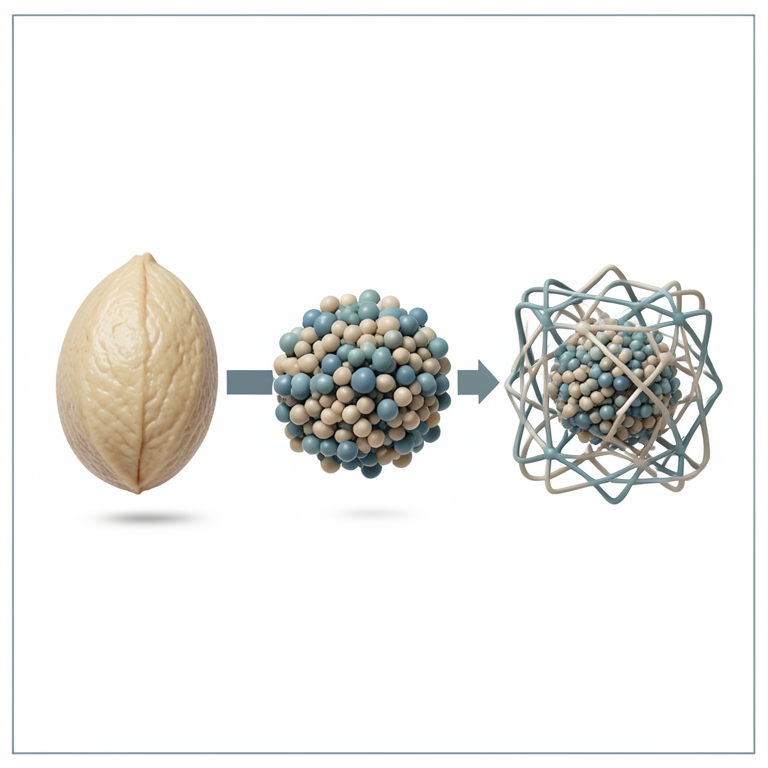
Mechanism of GBF Interaction
AI-generated conceptual illustration (wheat starch granules and legume proteins). It explains the idea and does not show study data.
View source evidence ↗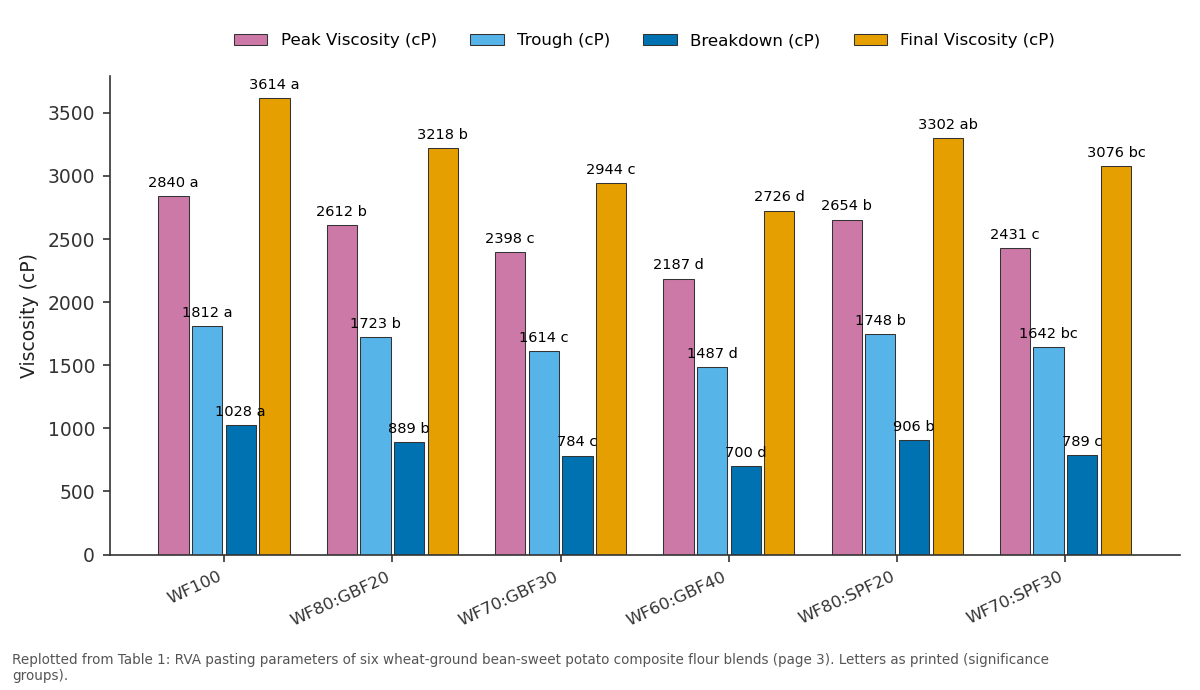
Peak Viscosity (cP) and Trough (cP) and more: WF100 vs WF80:GBF20 vs WF70:GBF30 vs WF60:GBF40 vs WF80:SPF20
Replotted from Table 1 (page 3) of the original paper. Every bar is the paper's own table value.
View source evidence ↗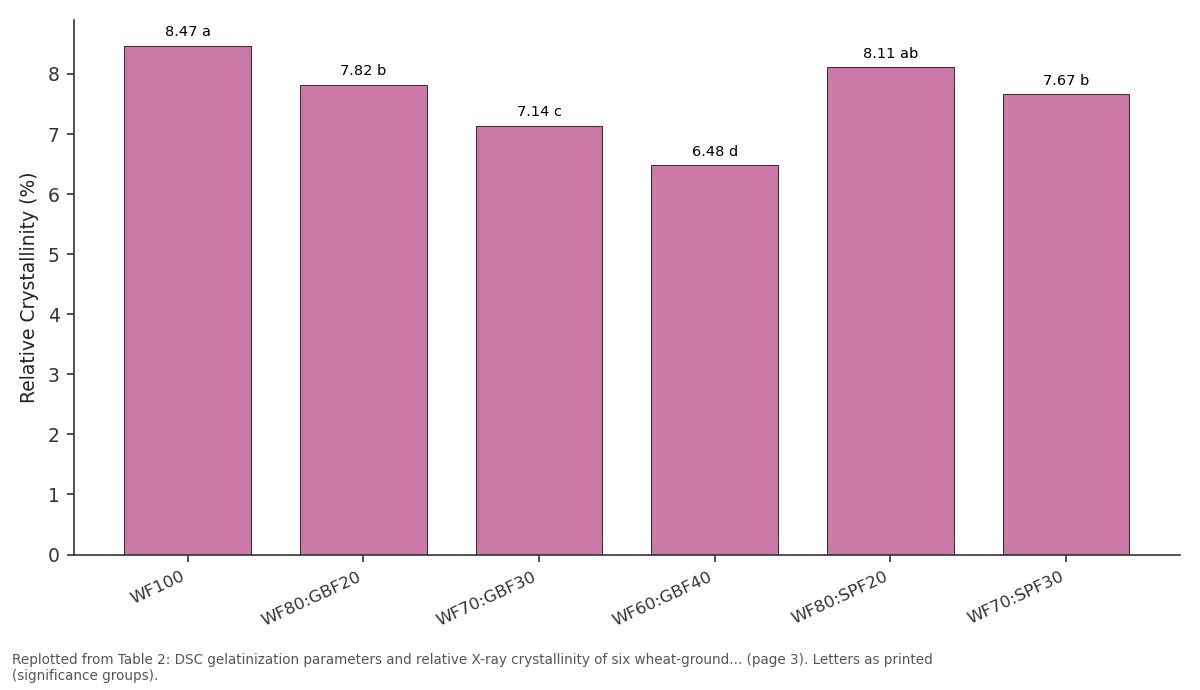
Enthalpy (J/g): WF100 vs WF80:GBF20 vs WF70:GBF30 vs WF60:GBF40 vs WF80:SPF20
Replotted from Table 2 (page 3) of the original paper. Every bar is the paper's own table value.
View source evidence ↗Figures & tables
From the original paper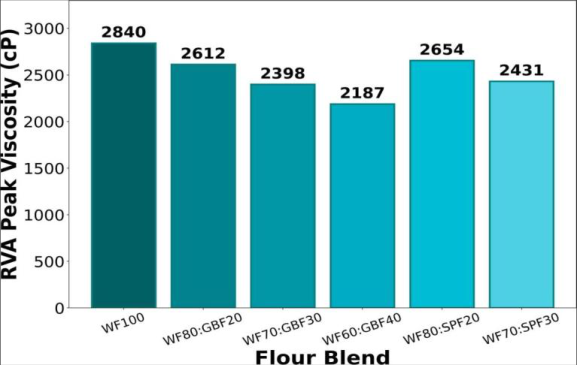 Figure 1
 Table 1
 Table 2
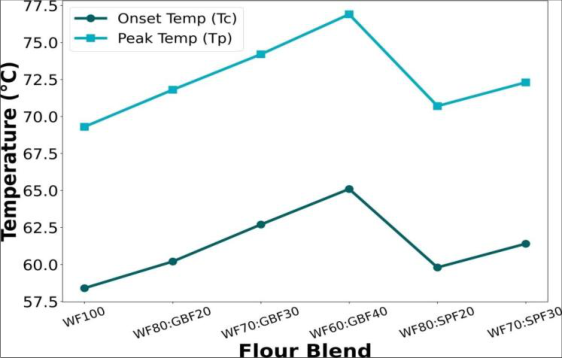 Figure 2
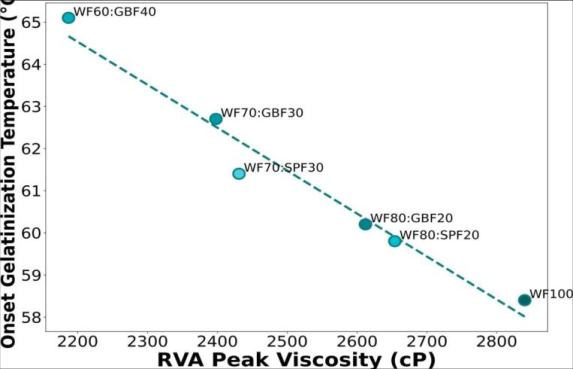 Figure 3
Introduction
From a food science perspective, the definition of starch gelatinization encompasses the irreversible loss of crystalline order in starch granules upon heating in excess water, accompanied by granule swelling, amylose leaching, and a dramatic increase in system viscosity that is central to the texturizing function of starch in baked goods [1] . In composite flour systems incorporating non-wheat ingredients alongside wheat, the starch gelatinization process is complicated by the presence of multiple starch types with diferent crystalline structures, gelatinization temperature ranges, and amylose-to-amylopectin ratios, as well as by the protein, lipid, and fibre fractions of the non-wheat components that can modify the hydration environment of starch granules through competitive water binding and direct molecular interaction [2] . Ground bean (Vigna subterranea) flour contains a characteristic legume starch with C-type crystallinity and a gelatinization onset temperature approximately 8-12 degrees Celsius higher than wheat starch, combined with a high protein content (20-24%) that binds water competitively and forms protein-starch complexes during heating [3,4] . Sweet potato flour starch, while more similar to wheat starch in crystallinity type (A-type), has a higher amylose content (typically 18-24% vs 26-28% for wheat) and a distinct viscosity profile due to the presence of sucrose and other soluble sugars that act as plasticizers during gelatinization [5] . When these two non-wheat components are combined with wheat starch in a ternary composite, the resulting gelatinization behaviour cannot be predicted from the binary blend properties alone, because three-way molecular interactions among wheat starch, legume starch-protein complexes, and sweet potato starch-sugar systems create emergent rheological properties that are not captured by linear additive models [6] . This research aimed to:(i) characterize the RVA viscosity profiles and DSC gelatinization parameters of six wheat-GBF-SPF blend compositions; (ii) investigate the X-ray difraction crystallinity paterns of composite flour blends to understand the contribution of each flour component to the overall crystalline structure; (iii) assess the dynamic oscillatory rheology of composite doughs to understand the viscoelastic consequences of starch gelatinization in these systems; and (iv) establish the molecular mechanistic framework that explains the functional baking performance diferences among wheat-GBF and wheat-SPF binary blends and their ternary combinations.
Materials and Methods
Materials and Methods
Materials
Commercial wheat flour (WF, 11.6% protein, 0.55% ash; Bunge Brasil, Sao Paulo), ground bean flour (GBF, 22.8% protein, processed from Vigna subterranea accession VsB-007 at the Sao Paulo Institute of Food Technology), and sweet potato flour (SPF, prepared from the Beauregard variety, 4.6% protein, 18.7% amylose; Instituto Agronomo de Campinas, Brazil) were the flour components. Potato starch (analytical grade reference standard, Sigma-Aldrich Brazil) was used for XRD calibration. A Newport Viscoamylograph (Brabender) and a RVA-4500 (Perten Instruments, Sweden) were used for viscometry. A TA Discovery DSC 2500 (TA Instruments, USA) was used for diferential scanning calorimetry. An Anton Paar MCR 301 rheometer with CC27 geometry was used for dynamic oscillatory measurements. Ethics approval for the research was granted by the Sao Paulo Institute of Food Technology Scientific Commitee (Reference: SPIT-SC/2021/0067).
Methods
Six flour blend compositions were prepared:WF100 (100% WF), WF80:GBF20 (80% WF, 20% GBF), WF70:GBF30, WF60:GBF40, WF80:SPF20 (80% WF, 20% SPF), and WF70:SPF30. For RVA analysis, 3. RVA peak viscosity declined with increasing non-wheat flour substitution in all blend series. GBF incorporation caused a more pronounced viscosity reduction than SPF at equivalent substitution levels, reflecting the combined efects of ground bean protein competition for water and the higher gelatinization temperature of legume starch that prevents complete pasting during the standard RVA temperature profile. RVA analysis revealed significant diferences in viscosity profiles among the six blend compositions. Peak viscosity declined from 2,840 cP in WF100 to 2,612 cP (WF80:GBF20), 2,398 cP (WF70:GBF30), and 2,187 cP (WF60:GBF40), while the SPF binary series showed less pronounced reduction: 2,654 cP (WF80:SPF20) and 2,431 cP (WF70:SPF30). Breakdown viscosity followed the same declining trend, while setback viscosity (an indicator of retrogradation tendency) was reduced in GBF blends, suggesting that ground bean proteins partially inhibit amylose crystallization during cooling. The SPF series showed less pronounced setback reduction, atributable to the higher amylose content of sweet potato starch relative to the ground bean starch fraction [7] . A significant negative linear correlation was observed between RVA peak viscosity and gelatinization onset temperature (Γ=-0.94 , p < 0.001) , confirming that blends with higher gelatinization temperatures develop lower peak viscosity under the standard RVA temperature protocol because the peak temperature is reached before complete starch gelatinization occurs in the high-Tc blend fractions. Dynamic oscillatory rheology measurements confirmed that Gprime exceeded G-double prime across the full temperature sweep for all blend compositions, indicating predominantly elastic dough behaviour. In the gelatinization plateau zone (75-90 degrees Celsius), G-prime was significantly higher in GBF blends than in equivalent SPF blends, reflecting the gelreinforcing efect of ground bean proteins on the gelatinized starch matrix. Conversely, the loss tangent (tandelta = G-double prime/G-prime) was higher in SPF blends at all temperatures above 65 degrees Celsius, indicating greater viscous contribution from the sweeter, sugar-plasticized sweet potato starch gelatinization environment [7,8] .
Discussion
The progressive increase in gelatinization onset temperature observed with increasing GBF incorporation (from 58.4 degrees Celsius in WF100 to 65.1 degrees Celsius in WF60:GBF40) is consistent with the hypothesized mechanism of ground bean protein-mediated steric hindrance on wheat starch granule hydration. At the molecular level, ground bean storage proteins (primarily 11S legumin and 7S vicilin) carry net negative charges at bakery dough pH (5.2-5.8) that could interact electrostatically with the positively charged surface domains of wheat starch granules, creating a protein coating that delays water penetration into the granule interior and consequently elevates the temperature required to initiate gelatinization [9] . The introduction of C-type XRD difraction paterns at SPF levels exceeding 20% provides novel structural evidence for the incorporation of sweet potato starch crystallites into the composite flour matrix, complementing the DSC data that shows a secondary gelatinization endotherm at 68-72 degrees Celsius in high-SPF blends. The coexistence of wheat starch Atype and sweet potato C-type crystallinity in ternary blends creates a bimodal gelatinization system that has not been previously characterized in the literature on wheat-legumetuber composites and represents an original contribution of this research to the starch chemistry knowledge base [10] . The practical relevance of these molecular findings for bakery formulation is illustrated by the relationship between G-prime elevation in GBF blends and the crumb hardness outcomes documented in Okoye JI, Egbujie AE, and Okechukwu CO [7] , who reported firmer crumb texture in composite breads with higher ground bean flour content. The gel-reinforcing efect of ground bean proteins on gelatinized wheat starch gel networks mechanistically explains the progressive crumb hardness increase with GBF level that has been consistently observed in sensory and textural evaluations of wheat-ground bean composite breads, and provides a molecular rationale for the use of dough conditioning enzymes such as amylases and xylanases to counteract this hardening efect in commercial applications [11] .
Starch Chemistry Background
The molecular architecture of starch consists of two glucose polymers: amylose, a predominantly linear alpha-1,4-linked chain with approximately 200-2000 glucose units and limited branching, and amylopectin, a highly branched polymer with both alpha-1,4-linkages in the chain segments and alpha-1,6linkages at branch points. The ratio of amylose to amylopectin, typically 25:75 in most food starches, profoundly influences gelatinization behaviour, retrogradation rate, and the functional viscosity of starch gels. Ground bean flour starch, with its legume-characteristic C-type crystallinity (a mixture of A-type and B-type crystalline domains), shows markedly diferent gelatinization kinetics compared to A-type wheat and sweet potato starches, contributing to the non-additive gelatinization behaviour observed in ternary composite systems. Understanding these molecular diferences is essential for predicting and controlling the functional outcomes of composite flour formulation for bread and other bakery applications.
Industrial Processing Implications
The molecular insights generated by this research have direct implications for the industrial processing of wheat-ground bean-sweet potato composite flour doughs in bakery production environments. The elevated gelatinization onset temperature in GBF blends (up to 65.1 degrees Celsius) implies that standard baking protocols optimized for wheat flour gelatinization at 55-65 degrees Celsius may be suboptimal for composite blends, potentially requiring adjustment of oven temperature profiles, baking time, or steam injection parameters to ensure complete starch gelatinization and adequate crumb seting. The bimodal crystallinity structure identified in ternary blends with SPF above 20% suggests that these blends may exhibit complex retrogradation behaviour during storage, afecting bread staling rates and shelf life. Industrial bakers adopting wheat-GBF-SPF composite flour formulations should therefore conduct shelflife trials and optimize packaging parameters in parallel with initial formulation development to ensure commercial viability of the composite bread product.
Conclusion
This research established a comprehensive molecular characterization of starch gelatinization behaviour in wheatground bean-sweet potato composite flour systems using RVA, DSC, XRD, and dynamic oscillatory rheology. The key finding was that ground bean flour incorporation elevated gelatinization onset temperature through protein-mediated steric hindrance, while sweet potato flour introduced C-type crystallinity above 20% substitution and reduced tan-delta relative to GBF blends. The practical implication for bakery formulation is that wheat-GBF blends require modified baking temperature profiles to achieve complete starch gelatinization, while the combined use of GBF and SPF in ternary systems ofers opportunities for balanced viscoelastic dough properties that are not achievable with either non-wheat component alone. Future research should investigate the use of starch-modifying enzymes to normalize gelatinization behaviour across blend compositions, and should evaluate the molecular basis of staling diferences between binary and ternary wheat-GBF-SPF composite breads during ambient storage.
Acknowledgement
AcknowledgementsThe Sao Paulo Institute of Food Technology is acknowledged for provision of RVA, DSC, XRD, and rheology equipment used in this research. Financial support was provided by the Brazilian Research Agency (CNPq) through the Food Technology and Nutrition Research Programme (Reference: CNPq-FTNRP/2021/0093). Ms. Isabela Costa and Mr. Rafael Gomes are acknowledged for assistance with starch extraction and instrumental measurements.
Figures and tables from the paper
| Blend | Peak Viscosity (cP) | Trough (cP) | Breakdown (cP) | Final Viscosity (cP) | Setback (cP) |
|---|---|---|---|---|---|
| WF100 | 2840a | 1812a | 1028a | 3614a | 1802a |
| WF80:GBF20 | 2612b | 1723b | 889b | 3218b | 1495b |
| WF70:GBF30 | 2398c | 1614c | 784c | 2944c | 1330c |
| WF60:GBF40 | 2187d | 1487d | 700d | 2726d | 1239d |
| WF80:SPF20 | 2654b | 1748b | 906b | 3302ab | 1554b |
| WF70:SPF30 | 2431c | 1642bc | 789c | 3076bc | 1434bc |
| LSD (0.05) | 148 | 97 | 82 | 162 | 104 |
| p-value | <0.001 | <0.001 | <0.001 | <0.001 | <0.001 |
Table text extracted from the original PDF; superscript letters are shown inline. The original table image is below.
View original table image
| Blend | Tc (onset C) | Tp (peak C) | Tc-Te (range C) | Enthalpy (J/g) | Relative Crystallinity (%) |
|---|---|---|---|---|---|
| WF100 | 58.4a | 64.7a | 11.3b | 8.47a | 28.4a |
| WF80:GBF20 | 60.2b | 67.1b | 13.8ab | 7.82b | 24.6b |
| WF70:GBF30 | 62.7c | 69.8c | 15.2a | 7.14c | 21.3c |
| WF60:GBF40 | 65.1d | 72.4d | 15.8a | 6.48d | 18.7d |
| WF80:SPF20 | 59.8ab | 66.3ab | 12.6ab | 8.11ab | 26.8ab |
| WF70:SPF30 | 61.4b | 68.2bc | 13.4ab | 7.67b | 23.4b |
| LSD (0.05) | 1.8 | 2.1 | 1.9 | 0.42 | 2.3 |
| p-value | <0.001 | <0.001 | 0.018 | <0.001 | <0.001 |
Table text extracted from the original PDF; superscript letters are shown inline. The original table image is below.
View original table image
References
19 in the original paper- BeMiller JN, Whistler RL. Starch: chemistry and technology. 3rd ed. Amsterdam: Academic Press; 2009.
- Eliasson AC. Starch in food: structure, function and applications. Boca Raton: CRC Press; 2004.
- Hoover R, Zhou Y. In vitro and in vivo hydrolysis of legume starches by alpha-amylase and resistant starch formation in legumes -a review. Carbohydr Polym. 2003;54(4):401-417.
- Shimelis EA, Rakshit SK. Proximate composition and physico-chemical properties of improved dry bean varieties grown in Ethiopia. LWT Food Sci Technol. 2005;38(4):331-338.
- Moorthy SN. Physicochemical and functional properties of tropical tuber starches: a review. Starch/Staerke. 2002;54(12):559-592.
- Tester RF, Karkalas J, Qi X. Starch -composition, fine structure and architecture. J Cereal Sci. 2004;39(2):151165.
- Okoye JI, Egbujie AE, Okechukwu CO. Quality assessment and sensory acceptability of bread produced from wheat, ground bean and sweet potato flour blends. J Curr Res Food Sci. 2022;3(2):41-49.
- Ross KA, Pyrak-Nolte LJ, Campanella OH. The use of ultrasound and shear oscillatory tests to characterize the efect of mixing time on the rheological properties of dough. Food Res Int. 2004;37(6):567-577.
- Galliard T, Bowler P. Morphology and composition of starch. In: Galliard T. Starch: Properties and Potential. Chichester: Wiley; 1987. p. 55-78.
- Takeda Y, Shitaozono T, Hizukuri S. Molecular structure of corn starch. Starch/Staerke. 1988;40(2):51-54.
- Courtin CM, Delcour JA. Arabinoxylans and endoxylanases in wheat flour bread-making. J Cereal Sci. 2002;35(3):225-243.
- Lindeboom N, Chang PR, Tyler RT. Analytical, biochemical and physicochemical aspects of starch granule size, with emphasis on small granule starches. Starch/Staerke. 2004;56(3-4):89-99.
- Biliaderis CG. Thermal analysis of food carbohydrates. In: Harwalkar VR, Ma CY. Thermal Analysis of Foods. London: Elsevier Applied Science; 1990. p. 168-220.
- Zobel HF. Starch crystal transformations and their industrial importance. Starch/Staerke. 1988;40(1):1-7.
- Song Y, Jane J. Characterization of barley starches of waxy, normal, and high amylose varieties. Carbohydr Polym. 2000;41(4):365-377.
- Nwosu JN. Efect of soaking, cooking, dehulling and combining processing methods on the proximate composition of cowpea. J Food Agric Environ. 2010;8(34):589-593.
- Ragaee S, Abdel-Aal ESM. Pasting properties of starch and protein in selected cereals and quality of their food products. Food Chem. 2006;95(1):9-18.
- Ring SG, Gee JM, Whitam M, Orford P, Johnson IT. Resistant starch: its chemical form in foodstufs and efect on digestibility in vitro. Food Chem. 1988;28(2):97-109.
- Wang J, Rosell CM, Benedito de Barber C. Efect of the addition of diferent fibres on wheat dough performance and bread quality. Food Chem. 2002;79(2):221-226.