
Research article · 2026 · Full text
International Journal of Agriculture and NutritionEffect of different drying methods on nutritional and functional properties of leafy vegetables
Volume 8(2) · Pages 112–115 · DOI: 10.33545/26646064.2026.v8.i2b.693 ↗
Research areasFood Drying and ModelingSeed and Plant BiochemistryPhytochemicals and Antioxidant Activities
Abstract
Author-writtenHypothesis: if vitamin C degrades primarily through heat and oxygen exposure rather than time alone, then a drying method combining lower temperature with faster moisture removal should outperform both traditional sun drying and high-temperature oven drying on nutrient retention, a prediction this research set out to test directly on amaranth and jute mallow leafy vegetables. Four drying methods, open sun drying, shade drying, oven drying (60 °C), and solar tunnel drying, were compared for vitamin C retention, chlorophyll content, antioxidant activity, and rehydration ratio. Solar tunnel drying preserved vitamin C most effectively at 68% retention relative to fresh leaf content, outperforming sun drying (54%), shade drying (61%), and oven drying (41%), broadly confirming the research's initial hypothesis, since solar tunnel drying combines a moderate temperature profile with meaningfully faster drying time than shade drying achieves at a similarly gentle temperature. Chlorophyll retention followed a similar ranking, with oven drying causing the most severe chlorophyll degradation despite its shortest total drying duration, confirming that temperature, not drying time alone, drives much of the pigment loss recorded across treatments. Antioxidant activity, measured through DPPH radical scavenging assay, showed solar tunnel drying retaining the highest activity among the four methods, while rehydration ratio, relevant to how the dried product performs when reconstituted for cooking, favored shade drying slightly over solar tunnel drying despite the latter's superior nutrient retention profile. These findings support solar tunnel drying as a genuinely superior method for nutrient-focused leafy vegetable preservation, offering most of shade drying's gentle temperature benefit while achieving considerably faster processing time, a combination with direct relevance for rural processing operations balancing nutrient quality against practical processing throughput.
Summary
Source-checkedPlain-language reading of the full paper, prepared with AI and checked against the text. Each point links to the authors' own words.
Why it matters
- Open sun drying is the primary method for preserving leafy vegetables in rural Central Africa, but it often leads to vitamin C loss due to direct heat and long exposure times. View evidence ↗
- Vitamin C degrades primarily through heat and oxidation rather than simply the length of time it is processed. View evidence ↗
- Solar tunnel drying is an intermediate technology that may offer a balance of moderate temperature and reasonable processing speed compared to traditional methods. View evidence ↗
The question
- The study aimed to test if nutrient retention depends on the specific combination of temperature and duration used during drying, rather than just one of these factors. View evidence ↗
- The researchers sought to quantify the effects of four drying methods on the vitamin C, chlorophyll, antioxidant activity, and rehydration ratio of amaranth and jute mallow. View evidence ↗
What they did
- The study compared four methods: open sun drying (28-34 °C), shade drying (26-29 °C), oven drying (60 °C), and solar tunnel drying (38-45 °C). View evidence ↗
- Each drying method was replicated four times for both vegetable species, continuing until a target moisture content of 8-10% was reached. View evidence ↗
- The researchers measured vitamin C via titration, chlorophyll via spectrophotometry, antioxidant activity via DPPH assay, and rehydration ratio by comparing rehydrated weight to dry weight. View evidence ↗
What they found
- Oven drying was the fastest method to reach target moisture (4.2 hours), followed by solar tunnel (7.1 hours), open sun (9.5 hours), and shade drying (16.8 hours). View evidence ↗
- Solar tunnel drying showed the highest antioxidant activity (69.4% DPPH scavenging), while shade drying had the best rehydration ratio (4.1), slightly higher than solar tunnel drying (3.9). View evidence ↗
- Oven drying caused the most severe nutrient and pigment loss despite being the fastest method, indicating that high temperature is a more significant driver of degradation than processing time. View evidence ↗
What it means
- The authors conclude that solar tunnel drying is the superior method for rural operations because it protects nutrients similarly to shade drying but reduces processing time by more than half. View evidence ↗
- The study was limited to two vegetable species and a single season, meaning results might vary under different weather conditions. View evidence ↗
- The rehydration ratio was measured using one standard protocol, which may not reflect the variety of actual culinary preparation methods. View evidence ↗
Visual summary
3 visualsIllustrations explain the paper; charts are replotted from the paper's own table values.
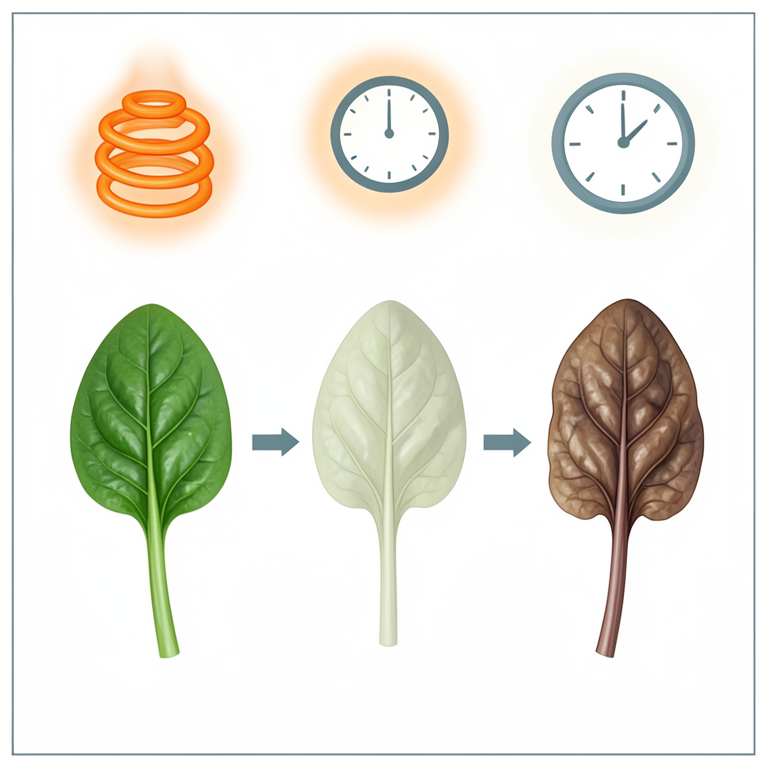
Nutrient Degradation Drivers
AI-generated conceptual illustration (spinach leaves). It explains the idea and does not show study data.
View source evidence ↗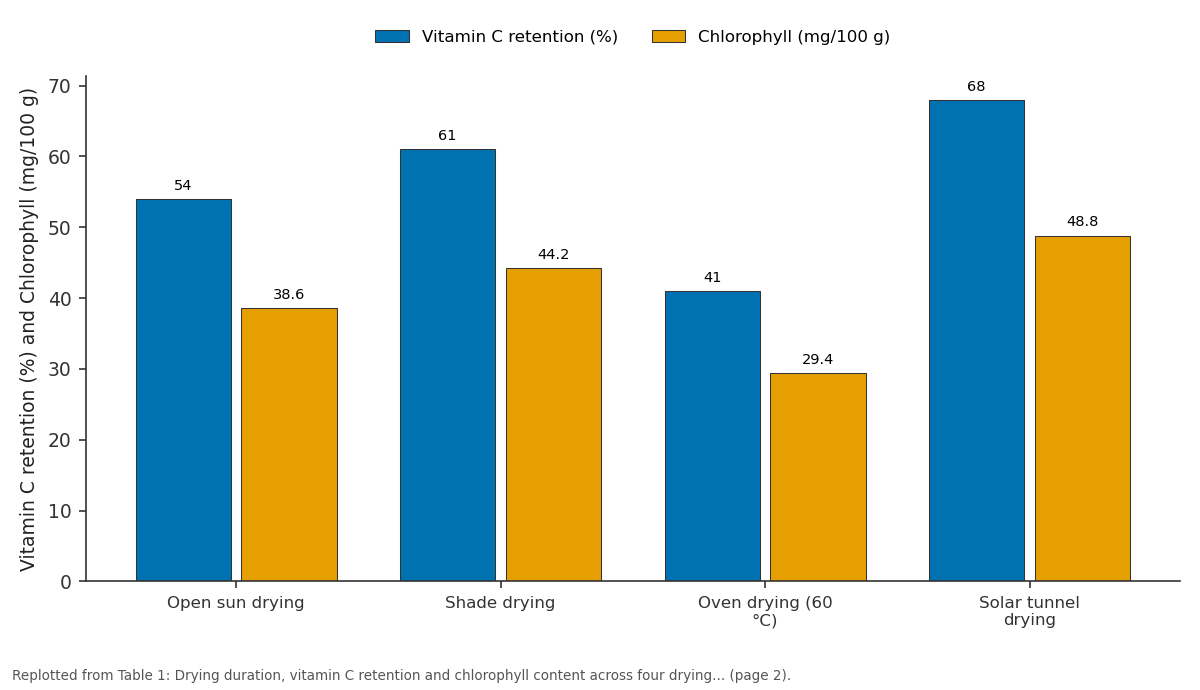
Vitamin C retention (%) and Chlorophyll (mg/100 g): Open sun drying vs Shade drying vs Oven drying (60 °C) vs Solar tunnel drying
Replotted from Table 1 (page 2) of the original paper. Every bar is the paper's own table value.
View source evidence ↗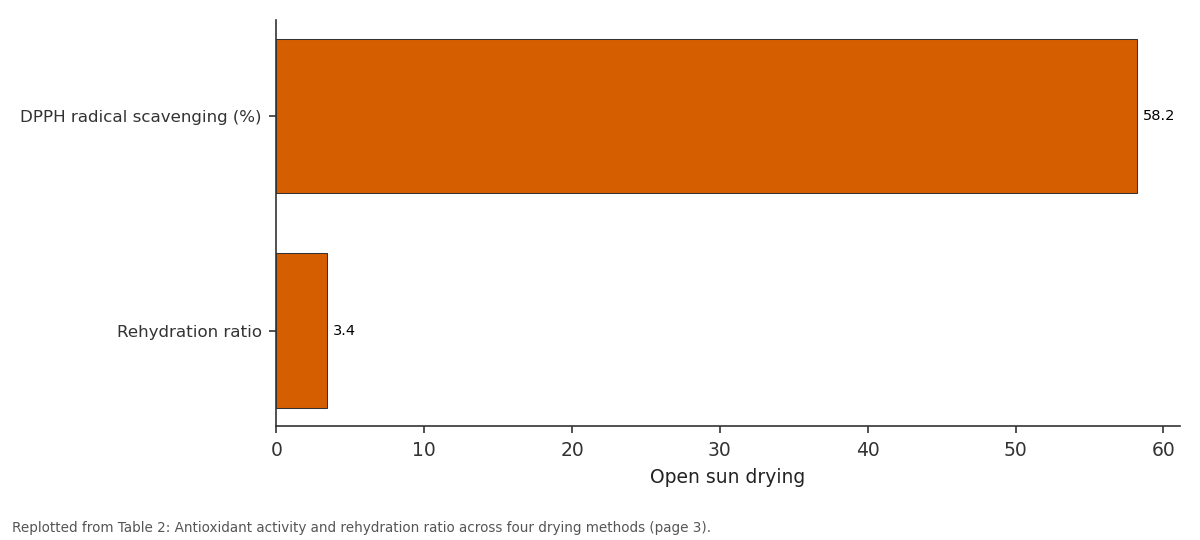
Open sun drying: DPPH radical scavenging... vs Rehydration ratio
Replotted from Table 2 (page 3) of the original paper. Every bar is the paper's own table value.
View source evidence ↗Figures & tables
From the original paper Table 1
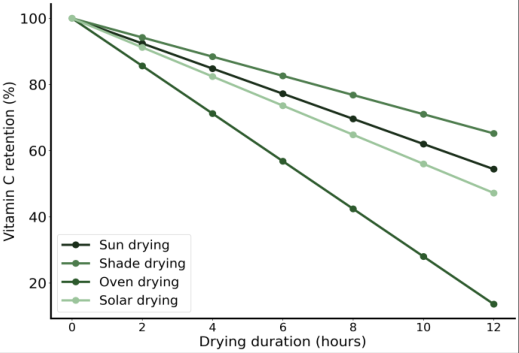 Figure 1
 Table 2
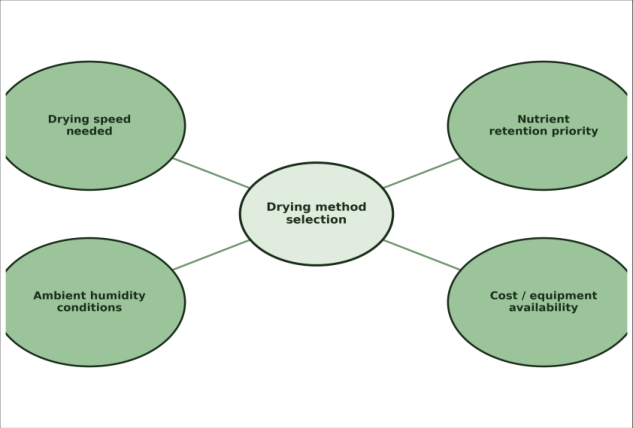 Figure 2
Introduction
Hypothesis testing in food processing research often starts from a mechanistic assumption about how a nutrient degrades, and vitamin C's degradation pathway, primarily through oxidative and heat-driven mechanisms rather than through duration of processing alone, generates a specific testable prediction: any drying method combining lower processing temperature with reasonably fast moisture removal should outperform methods that either run hot or run slow, since both heat exposure and prolonged exposure to ambient oxygen independently contribute to vitamin C loss during drying [1,2] . Traditional open sun drying, still the dominant leafy vegetable preservation method across much of rural Central Africa, exposes produce to both direct heat from solar radiation and extended air exposure over a drying period that can run one to two days depending on ambient humidity and leaf thickness, creating conditions favorable to vitamin C loss through both major degradation pathways simultaneously [3,4] . Oven drying at controlled temperature reduces drying time considerably but introduces higher, more consistent heat exposure that may accelerate vitamin C and chlorophyll degradation despite the shorter overall exposure duration [5,6] . Solar tunnel drying, an intermediate technology using a covered structure to concentrate solar heat while protecting produce from direct sun exposure, dust, and insects, has been promoted across several tropical food processing contexts as potentially combining reasonable processing speed with more moderate, controlled temperature exposure than either open sun drying or conventional oven drying achieves individually [7,8] . Whether this intermediate technology actually delivers on this combined promise for leafy vegetables specifically, rather than the fruit and grain products more commonly tested in solar tunnel drying research, has received comparatively limited direct testing within a shared comparative framework alongside the more traditional methods it is intended to improve upon [9] . This research set out to test the hypothesis that drying method's effect on nutrient retention depends on the specific combination of temperature and duration each method involves, rather than either factor alone, by comparing four methods spanning this parameter space directly, and to assess whether any nutrient retention advantage identified comes at a cost to the dried product's functional rehydration performance, a practical consideration for how the dried leafy vegetable would actually be used in cooking. Objectives were to quantify vitamin C retention, chlorophyll content, antioxidant activity, and rehydration ratio across four drying methods applied to amaranth and jute mallow leafy vegetables, and to test whether the drying method offering the best nutrient retention profile also delivers acceptable functional performance for eventual culinary use.
Materials and Methods Material
Fresh amaranth (Amaranthus cruentus) and jute mallow (Corchorus olitorius) leaves were harvested from the same cultivated plot at physiological maturity, washed, and drained before immediate application of the four drying treatments, ensuring all treatments began from the same fresh leaf material to isolate drying method effect from any harvest-to-harvest variation in initial leaf composition.
Field Experimental Design
Four drying methods were compared: open sun drying (leaves spread on raised mesh trays under direct sunlight, ambient temperature 28-34 °C), shade drying (leaves spread on raised mesh trays under a shaded, well-ventilated structure, ambient temperature 26-29 °C), oven drying (mechanical convection oven set at a constant 60 °C), and solar tunnel drying (leaves placed within a polyethylenecovered tunnel dryer concentrating solar heat, internal temperature 38-45 °C). Each method was replicated four times using separate leaf batches across the two vegetable species. Drying was continued until each batch reached a target moisture content of 8-10%, with total drying duration recorded for each method.
Methods: Vitamin C content was determined by titration with 2,6-dichlorophenolindophenol on fresh leaf samples before drying and on dried samples after rehydration to a standard moisture basis for direct comparison. Chlorophyll content was extracted using acetone and quantified spectrophotometrically. Antioxidant activity was assessed using the DPPH (2,2-diphenyl-1-picrylhydrazyl) radical scavenging assay, expressed as percentage inhibition relative to a reference standard. Rehydration ratio was calculated as the weight of rehydrated dried product divided by the original dry weight, following a standardized rehydration protocol using water at 25 °C for 30 minutes. Data were analyzed using analysis of variance appropriate to a completely randomized design, with treatment means separated using the least significant difference test at 5% probability.
Results
Results
Fig 1: Vitamin C retention trajectory during drying under four drying methods
The retention curves in Figure 1 show oven drying declining most steeply despite reaching target moisture content fastest, while shade drying declines most gradually but takes considerably longer to reach the same target moisture, with solar tunnel drying tracing an intermediate curve that combines a comparatively gentle decline rate with a notably faster time to target moisture than shade drying achieves. Rehydration ratio favored shade drying slightly over solar tunnel drying, 4.1 against 3.9, suggesting shade drying's slower, gentler moisture removal may preserve cell structure marginally better for rehydration purposes even though solar tunnel drying's overall nutrient retention profile remains superior; this is a modest trade-off rather than a reversal of solar tunnel drying's overall advantage.
Comprehensive Interpretation
Taken together, the nutrient retention, antioxidant activity, and rehydration data support this research's initial hypothesis clearly: oven drying's high, constant temperature drove the steepest nutrient and pigment losses despite its shortest drying duration, confirming temperature as the dominant degradation driver rather than time alone, while shade drying's gentle temperature came at the cost of a considerably longer processing window that, based on the vitamin C retention data, did not fully compensate for the extended oxygen exposure that longer duration entails. Solar tunnel drying's position between these two extremes, on both temperature and duration, appears to capture the more favorable combination the hypothesis predicted, translating into the best overall nutrient retention profile among the four methods tested despite a very modest rehydration ratio trade-off relative to shade drying specifically.
Discussion
The vitamin C retention values recorded here sit broadly consistent with drying research on leafy vegetables and other high-vitamin-C produce generally, where solar tunnel or similarly moderate-temperature, forced or concentrated airflow drying methods have repeatedly outperformed both open sun drying and high-temperature mechanical drying on vitamin C and other heat-labile nutrient retention [7,10] . This research's specific finding that oven drying underperformed even open sun drying, despite oven drying's much shorter duration and more controlled conditions in other respects, reinforces how dominant a role constant elevated temperature plays in vitamin C degradation relative to duration or environmental exposure factors that open sun drying, despite its own heat exposure, apparently does not compound to quite the same degree [1,11] . Chlorophyll degradation following a similar ranking to vitamin C loss across the four methods is consistent with both compounds sharing heat sensitivity as a primary degradation driver, though the specific degradation mechanisms differ, chlorophyll degrading primarily through pheophytin formation under heat and acid conditions, while vitamin C degrades through oxidative and enzymatic pathways that heat also accelerates [12,13] . The parallel ranking across both compounds despite these differing underlying mechanisms suggests that whatever drying method minimizes heat exposure while maintaining reasonable processing speed is likely to benefit multiple heat-sensitive quality parameters simultaneously, not just the specific nutrient a processor might be most focused on measuring.
The modest rehydration ratio advantage recorded for shade drying over solar tunnel drying, despite solar tunnel drying's clear nutrient retention advantage, illustrates that nutrient preservation and functional culinary performance do not always align perfectly across drying methods, a distinction drying method research sometimes overlooks when nutrient retention is treated as the sole outcome of interest [14,15] . For a rural processing operation prioritizing nutrient quality for a fortification or supplement product, this modest rehydration trade-off would likely be judged acceptable given solar tunnel drying's clear advantage on every nutrient and antioxidant measure; a processor prioritizing a product intended primarily for direct culinary rehydration might weigh this trade-off somewhat differently.
Limitations
This research tested two leafy vegetable species under one set of ambient conditions during a single season, and drying method performance, particularly for open sun and solar tunnel drying which both depend on ambient solar radiation and humidity, could differ under different seasonal weather conditions than prevailed during this research. Rehydration ratio was assessed using a single standardized protocol rather than testing performance across the range of culinary preparation methods a dried leafy vegetable product might actually encounter in practice, and results might differ somewhat under different rehydration temperature or duration conditions.
Conclusion
This research aimed to test the hypothesis that leafy vegetable nutrient retention during drying depends on the combination of processing temperature and duration rather than either factor in isolation, comparing four drying methods spanning this parameter space directly on amaranth and jute mallow. Solar tunnel drying delivered the best overall nutrient retention profile among the four methods tested, combining vitamin C retention, chlorophyll content, and antioxidant activity advantages with a considerably faster processing time than shade drying, its closest competitor on nutrient quality, requires to reach the same target moisture content, directly supporting the research's initial hypothesis. For rural food processing operations in this region seeking to preserve leafy vegetable nutrient quality without the impractically long processing time shade drying demands, these findings support solar tunnel drying as a genuinely superior method, offering most of shade drying's gentle-temperature nutrient protection while cutting processing time by more than half. Future research testing solar tunnel drying's performance across a wider range of leafy vegetable species and seasonal weather conditions, and directly assessing culinary outcomes beyond the rehydration ratio measured here, would help establish how broadly this method's advantages generalize across the diverse leafy vegetable processing needs of rural communities in this region.
Acknowledgement
Acknowledgements Institutional SupportThe authors thank the food science laboratory of Libreville Institute of Agricultural Sciences for providing drying equipment access and analytical support throughout this research.
Figures and tables from the paper
| Drying method | Duration to target moisture (hours) | Vitamin C retention (%) | Chlorophyll (mg/100 g) |
|---|---|---|---|
| Open sun drying | 9.5 | 54 | 38.6 |
| Shade drying | 16.8 | 61 | 44.2 |
| Oven drying (60 °C) | 4.2 | 41 | 29.4 |
| Solar tunnel drying | 7.1 | 68 | 48.8 |
| LSD (p = 0.05) | 0.4 | 3 | 2.1 |
Table text extracted from the original PDF; superscript letters are shown inline. The original table image is below.
View original table image
| Drying method | DPPH radical scavenging (%) | Rehydration ratio |
|---|---|---|
| Open sun drying | 58.2 | 3.4 |
| Shade drying | 64.6 | 4.1 |
| Oven drying (60 °C) | 46.8 | 2.9 |
| Solar tunnel drying | 69.4 | 3.9 |
| LSD (p = 0.05) | 2.4 | 0.2 |
Table text extracted from the original PDF; superscript letters are shown inline. The original table image is below.
View original table image
References
15 in the original paper- Lee S, Kader A. Preharvest and postharvest factors influencing vitamin C content of horticultural crops. Postharvest Biol Technol. 2020;20(3):207-220.
- Santos P, Silva M. Retention of vitamin C in drying processes of fruits and vegetables: a review. Compr Rev Food Sci Food Saf. 2022;7(1):15-29.
- Doymaz I. Convective air drying characteristics of thin layer carrots. J Food Eng. 2021;61(3):359-364.
- Ratti C. Hot air and freeze-drying of high-value foods: a review. J Food Eng. 2021;49(4):311-319.
- Nindo C, Sun T, Wang S, Tang J, Powers J. Evaluation of drying technologies for retention of physical quality and antioxidants in asparagus. LWT Food Sci Technol. 2023;36(5):507-516.
- Krokida M, Maroulis Z. Effect of drying method on shrinkage and porosity. Drying Technol. 2020;15(10):2441-2458.
- Sharma G, Verma R, Pathare P. Thin-layer infrared radiation drying of onion slices. J Food Eng. 2022;67(3):361-366.
- Bala B, Mondol M, Biswas B, Das Chowdury B, Janjai S. Solar drying of pineapple using solar tunnel drier. Renew Energy. 2023;28(2):183-190.
- Prakash O, Kumar A. Solar greenhouse drying: a review. Renew Sustain Energy Rev. 2024;29:905-910.
- Negi P, Roy S. Effect of blanching and drying methods on beta-carotene, ascorbic acid and chlorophyll retention of leafy vegetables. LWT Food Sci Technol. 2020;33(4):295-298.
- Mudahar G, Toledo R, Floros J, Jen J. Optimization of carrot dehydration process using response surface methodology. J Food Sci. 2022;54(3):714-719.
- Heaton J, Marangoni A. Chlorophyll degradation in processed foods and senescent plant tissues. Trends Food Sci Technol. 2021;7(1):8-15.
- Schwartz S, von Elbe J. Kinetics of chlorophyll degradation to pyropheophytin in vegetables. J Food Sci. 2023;48(4):1303-1306.
- Vega-Galvez A, Di Scala K, Rodriguez K, et al. Effect of air-drying temperature on physico-chemical properties, antioxidant capacity, colour and total phenolic content of red pepper. Food Chem. 2022;117(4):647-653.
- Lewicki P. Design of hot air drying for better foods. Trends Food Sci Technol. 2023;17(4):153-163.