
Research article · 2026 · Full text
International Journal of Agriculture and NutritionPhysical and nutritional characterization of Amaranth and Quinoa
Volume 8(7) · Pages 23–29 · DOI: 10.33545/26646064.2026.v8.i7a.686 ↗
Research areasSeed and Plant BiochemistryFood and Agricultural SciencesFood composition and properties
Abstract
Author-writtenAmaranth (Amaranthus cruentus L.) and quinoa (Chenopodium quinoa Willd.) are nutrient-rich pseudocereals recognized for their superior nutritional quality and potential applications in functional foods. The present study evaluated the physical and nutritional characteristics of these grains to assess their suitability for food applications. Physical properties, including thousand kernel weight, thousand kernel volume, bulk density, true density, swelling capacity, and grain colour, were determined using standard analytical methods. Nutritional characterization comprised proximate composition, dietary fibre, mineral composition (iron and calcium), in vitro protein digestibility, and antioxidant activity. Significant differences (p< 0.05) were observed between amaranth and quinoa for most of the evaluated parameters. Quinoa exhibited higher thousand kernel weight, thousand kernel volume, bulk density, calcium content, total dietary fibre, carbohydrate content, energy value, and in vitro protein digestibility, whereas amaranth showed higher true density, swelling capacity, protein, crude fat, crude fibre, ash, iron content, and soluble dietary fibre. Both pseudocereals demonstrated appreciable nutritional value with high-quality protein, essential minerals, dietary fibre, and antioxidant potential. The results indicate that amaranth and quinoa possess complementary physical and nutritional attributes that make them suitable ingredients for the development of nutrient-enriched, gluten-free, and functional food products. The findings provide valuable scientific information for their effective utilization in food processing and product development.
Summary
Source-checkedPlain-language reading of the full paper, prepared with AI and checked against the text. Each point links to the authors' own words.
Why it matters
- Amaranth and quinoa are nutrient-dense pseudocereals valued for their high nutritional quality and use in functional foods. View evidence ↗
- Unlike traditional cereals, these grains are naturally gluten-free and contain high-quality proteins, essential micronutrients, and antioxidant compounds. View evidence ↗
- The physical properties of grains are essential for determining how they are handled after harvest, stored, and processed. View evidence ↗
The question
- The study aims to systematically evaluate and compare the physical and nutritional characteristics of amaranth and quinoa grains. View evidence ↗
What they did
- Amaranth and quinoa grains were sourced from a local market in Rudrapur, Uttarakhand, India. View evidence ↗
- Physical measurements for the grains were performed in ten replicates. View evidence ↗
- Nutritional analyses were conducted in triplicate and reported on a dry weight basis. View evidence ↗
- A two-sample t-test was used to determine significant differences between the two grains, with significance set at p < 0.05. View evidence ↗
What they found
- Quinoa had a significantly higher thousand kernel weight (2.59±0.07 g) compared to amaranth (0.79±0.05 g). View evidence ↗
- Amaranth showed a marginally higher swelling capacity (99.55±2.07%) than quinoa (96.28±2.25%), indicating better water absorption. View evidence ↗
- Both grains are high in protein, with amaranth (14.40±0.27 g/100 g) being slightly higher than quinoa (14.32±0.18 g/100 g). View evidence ↗
- Amaranth had a significantly higher crude fat content (6.35±0.20 g/100 g) than quinoa (5.85±0.07 g/100 g). View evidence ↗
- Amaranth contained significantly more crude fibre (6.93±0.16 g/100 g) than quinoa (4.62±0.15 g/100 g). View evidence ↗
- Amaranth had a significantly higher iron concentration (8.04±0.04 mg/100 g) than quinoa (7.50±0.10 mg/100 g). View evidence ↗
- Quinoa exhibited a significantly higher calcium content (192.66±2.51 mg/100 g) than amaranth (156.33±7.76 mg/100 g). View evidence ↗
- Quinoa had significantly higher total dietary fibre (14.10±0.40 g/100 g) compared to amaranth (11.33±0.30 g/100 g). View evidence ↗
- Amaranth had significantly higher soluble dietary fibre (3.66±0.15 g/100 g) than quinoa (1.70±0.20 g/100 g). View evidence ↗
- Quinoa showed significantly higher in vitro protein digestibility (70.73±0.20%) than amaranth (63.76±0.15%). View evidence ↗
What it means
- The authors conclude that amaranth and quinoa are nutrient-dense pseudocereals whose incorporation into food formulations can effectively enhance dietary quality. View evidence ↗
- The authors state that further research on nutrient bioavailability, functional properties, and application in various food systems is needed for wider commercial use. View evidence ↗
Visual summary
3 visualsIllustrations explain the paper; charts are replotted from the paper's own table values.
Complementary Nutritional Profiles
AI-generated conceptual illustration (Amaranth and Quinoa seeds). It explains the idea and does not show study data.
View source evidence ↗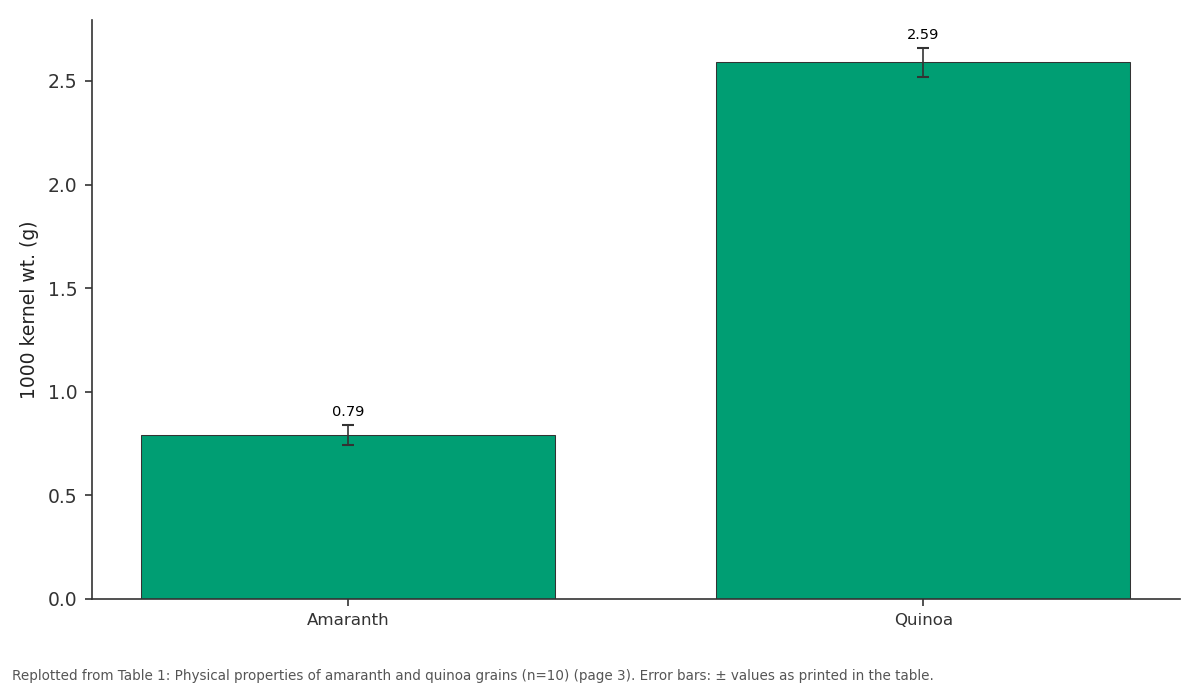
1000 kernel wt. (g): Amaranth vs Quinoa
Replotted from Table 1 (page 3) of the original paper. Every bar is the paper's own table value.
View source evidence ↗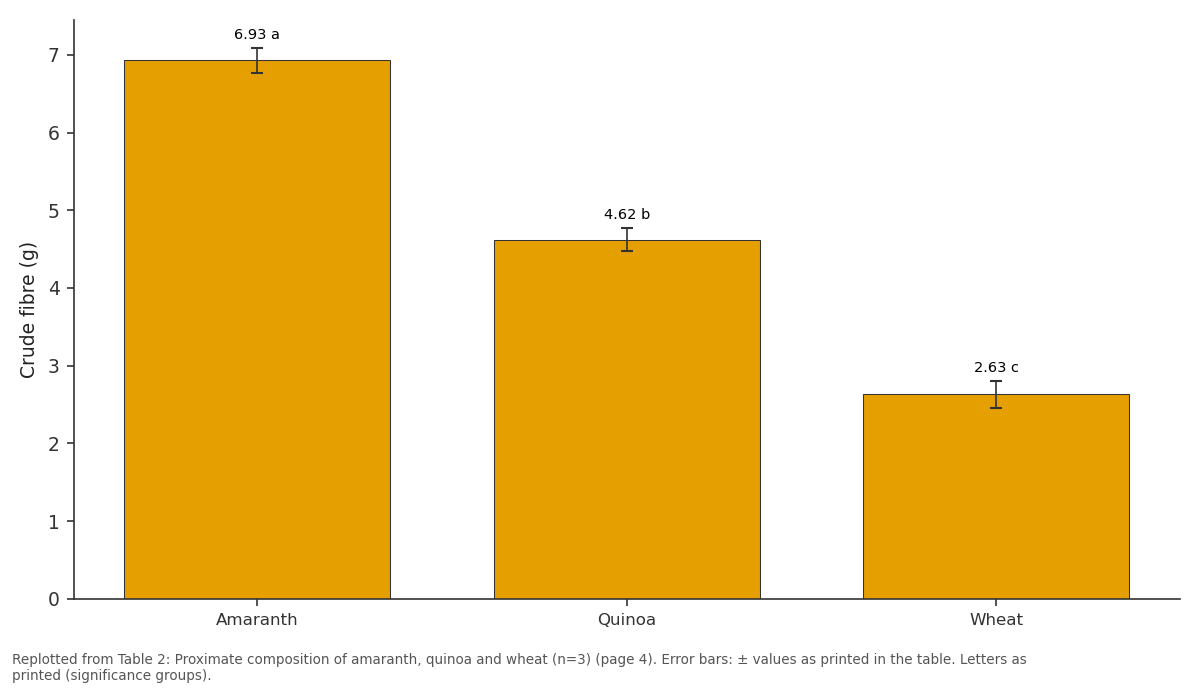
Crude fibre (g): Amaranth vs Quinoa vs Wheat
Replotted from Table 2 (page 4) of the original paper. Every bar is the paper's own table value.
View source evidence ↗Figures & tables
From the original paper Table 1
 Table 2
 Table 3
 Table 4
 Table 5
Introduction
Amaranth (Amaranthus cruentus L.) and quinoa (Chenopodium quinoa Willd.) are nutrientdense pseudocereals that have attracted increasing global attention due to their exceptional nutritional quality and functional food potential (FAO, 2011; Vega-Gálvez et al., 2010) [10,7] . In contrast to traditional cereals, these grains are naturally gluten-free and are characterized by high-quality protein with a well-balanced essential amino acid profile, considerable dietary fibre, essential micronutrients, unsaturated lipids, and a range of bioactive compounds exhibiting antioxidant activity (Alvarez-Jubete et al., 2009; Joshi et al., 2018) [1,11] . Owing to these attributes, both crops are increasingly recognized as valuable ingredients for developing functional and health-promoting food products. Beyond their nutritional composition, the physical properties of grains play a crucial role in determining their post-harvest handling, storage stability, and suitability for processing. Parameters such as thousand-kernel weight, kernel volume, bulk density, true density, swelling capacity, and colour characteristics directly influence milling behavior, hydration properties, and end-product quality (Singh et al., 2015; Bhargava et al., 2006) [12,8] . Similarly, detailed evaluation of nutritional attributes-including proximate composition, dietary fibre fractions, mineral composition, antioxidant activity, and protein digestibility-is essential for understanding their functional performance in food systems and optimizing their utilization in product development (Tang & Tsao, 2017) [6] . In recent years, the growing consumer demand for clean-label, nutrient-rich, and sustainable food products has accelerated the incorporation of pseudocereals into diverse food formulations, including bakery products, gluten-free foods, ready-to-eat snacks, and composite flours (Chandrasekara & Shahidi, 2011) [9] . However, the compositional variability of amaranth and quinoa, influenced by genotype, agro-climatic conditions, and post-harvest handling, presents a significant challenge for their standardized industrial application. This variability necessitates systematic characterization to establish reliable compositional and functional benchmarks for their effective utilization in food systems (Repo-Carrasco-Valencia et al., 2010) [5] . Despite growing interest, comparative studies integrating both physical and nutritional characterization of amaranth and quinoa under a unified analytical framework remain limited. Most existing research has focused either on nutritional composition or selected functional properties in isolation, rather than providing a comprehensive evaluation that links physicochemical attributes with nutritional functionality. Such integrated assessment is critical for food engineers and product developers to better predict processing behavior and formulate value-added foods with improved nutritional quality. Therefore, the present study aims to systematically evaluate and compare the physical and nutritional characteristics of amaranth and quinoa grains. The investigation includes key physical parameters, proximate composition, dietary fibre content, mineral profile, antioxidant activity, and in vitro protein digestibility. This integrated approach is intended to generate a comprehensive dataset that supports their optimized application as functional ingredients in the development of nutritionally enhanced and value-added food products.
Materials and Methods
Materials and Methods
Materials
Amaranth (Amaranthus cruentus L.) and quinoa (Chenopodium quinoa Willd.) grains were procured from the local market of Rudrapur, Uttarakhand, India. The grains were manually cleaned to remove dust, broken kernels, stones, and other foreign materials. The cleaned samples were washed thoroughly with potable water and dried in a hot air oven at 50±2 °C for 6 h. The dried grains were stored in airtight containers at ambient conditions until further analysis.
Physical Characterization of Grains
The physical characteristics of amaranth and quinoa grains were evaluated using standard analytical procedures. Thousand kernel weight was determined by weighing 1000 randomly selected grains on an analytical balance according to the method of Williams et al. (1983). Thousand kernel volume was measured by the water displacement method using a graduated cylinder containing a known volume of distilled water. Swelling capacity was determined by soaking 100 grains in distilled water under refrigerated conditions overnight, after which the increase in grain volume was recorded and expressed as percentage swelling capacity. Bulk density was determined according to the method of Narain et al. (1978) by measuring the weight of grains occupying a known volume after gentle tapping. True density was estimated using the toluene displacement method described by Sobhan et al. (2016). Grain colour was assessed visually using the Munsell Soil Colour Chart (1954). All physical measurements were carried out in ten replicates, and the mean values were recorded.
Nutritional Characterization:
The nutritional composition of amaranth and quinoa grains was determined using standard analytical methods. Moisture, crude protein, crude fat, crude fibre, and ash contents were analysed according to the methods prescribed by the Association of Official Analytical Chemists (AOAC, 2016). Total carbohydrate content was calculated by difference, while the energy value was estimated using Atwater conversion factors. Total dietary fibre, soluble dietary fibre, and insoluble dietary fibre were determined by the enzymatic method described by Asp and Johansson (1981). Iron and calcium contents were estimated following standard AOAC procedures. In vitro protein digestibility was determined using the method of Akeson and Stahman (1964), as modified by Degroot and Slump (1969), involving sequential enzymatic digestion with pepsin and pancreatin. Antioxidant activity was evaluated using the DPPH free radical scavenging assay, and the results were expressed as percentage inhibition. All nutritional analyses were performed in triplicate, and the results were expressed on a dry weight basis.
Statistical Analysis
All analyses were performed in triplicate unless otherwise stated, and the results are presented as mean ± Standard deviation (SD). A two-sample t-test was used to determine the significant differences between the physical and nutritional characteristics of amaranth and quinoa grains. Statistical significance was established at p< 0.05.
Results and Discussions 3.1 Physical Properties of Amaranth and Quinoa Grains
The physical properties of amaranth and quinoa grains are presented in Table 3.1 & Figure1. Significant differences (p< 0.05) were observed between the two pseudocereals for most of the evaluated physical characteristics, reflecting variations in grain morphology, size, and structural composition. These physical attributes are critical quality parameters influencing grain handling, storage, milling performance, packaging, and overall processing behaviour, thereby determining their suitability for diverse food applications (Vega-Gálvez et al., 2010; Balakrishnan & Schneider, 2022) [7,2] . Thousand kernel weight (TKW) differed significantly between the two grains, with quinoa (2.59±0.07 g) exhibiting a substantially higher TKW than amaranth (0.79±0.05 g). Likewise, thousand kernel volume (TKV) was significantly greater for quinoa (2.40±0.06 mL) than for amaranth (0.72±0.04 mL). The larger kernel size and higher grain mass of quinoa are consistent with its inherent botanical characteristics and agree with previous findings reported by Miranda et al. (2012) [4] and Vega-Gálvez et al. (2010) [7] . Variations in kernel weight and volume among pseudocereals are primarily attributed to cultivar, environmental conditions, and agronomic practices (Repo-Carrasco-Valencia et al., 2010; Jan et al., 2023) [5,3] . Larger kernels generally improve milling efficiency, flour recovery, and processing performance, making quinoa particularly suitable for commercial food processing. Bulk density was significantly higher in quinoa (0.70±0.01 g mL⁻¹) than in amaranth (0.66±0.01 g mL⁻¹), indicating more efficient packing characteristics during storage and transportation. In contrast, amaranth exhibited a significantly higher true density (1.16±0.39 g mL⁻¹) than quinoa (0.84±0.03 g mL⁻¹). Similar variations in density have been reported for pseudocereals and are associated with differences in grain size, porosity, and internal structural organization (Alvarez-Jubete et al., 2010; Balakrishnan & Schneider, 2022) [1,2] . Bulk and true density are important engineering properties because they influence the design of storage bins, silos, packaging systems, and conveying equipment while also affecting flowability and processing efficiency. The swelling capacity of amaranth (99.55±2.07%) was marginally higher than that of quinoa (96.28±2.25%), suggesting a greater water absorption potential during hydration. Water absorption is closely associated with starch composition, protein matrix, and cellular structure of the grains. Similar observations have been reported in pseudocereals, where higher swelling capacity contributes to improved hydration, dough formation, cooking quality, and desirable textural characteristics of processed foods (Tang & Tsao, 2017; Balakrishnan & Schneider, 2022) [6,2] . These functional characteristics are particularly advantageous in the formulation of bakery products, extruded snacks, and gluten-free foods.
| S. No. | Minerals | Amaranth | Quinoa | Wheat | CD at 5% |
|---|---|---|---|---|---|
| 1 | Iron | 8.04a±0.04 | 7.50b±0.1 | 2.33c±0.20 | 0.266 |
| 2 | Calcium | 156.33a±7.76 | 192.66b±2.51 | 18.0c±2 | 2.77 |
Table text extracted from the original PDF; superscript letters are shown inline. The original table image is below.
View original table image
Visual assessment using the Munsell Soil Colour Chart revealed that amaranth grains possessed a creamish-white appearance, whereas quinoa grains exhibited a light cream colour. Grain colour is an important quality attribute affecting consumer acceptance and market preference and may also reflect differences in pigment composition and phytochemical constituents (Miranda et al., 2012; Jan et al., 2023) [4,3] . Furthermore, grain colour influences the appearance of flour and finished food products, thereby contributing to the sensory quality and commercial acceptability of value-added formulations. Overall, the physical characterization demonstrated that quinoa grains were larger and exhibited higher bulk density, whereas amaranth possessed greater true density and swelling capacity. These complementary physical characteristics provide valuable information for optimizing processing operations and support the utilization of both pseudocereals as promising ingredients in the development of nutrient-rich, functional, and gluten-free food products (Vega-Gálvez et al., 2010; Balakrishnan & Schneider, 2022; Jan et al., 2023) [7,2,3] . [7,1,2] . Amaranth grains exhibited significantly lower moisture content (8.23±0.03 g/100 g) than quinoa grains (10.27±0.02 g/100 g). Lower moisture content is advantageous for prolonging storage life by minimizing microbial growth and reducing biochemical deterioration. The moisture values obtained in the present study are comparable with those reported by Miranda et al. (2012) [4] and Jan et al. (2023) [3] , who observed that moisture content in pseudocereals varies depending on cultivar, harvesting conditions, and storage practices. Both pseudocereals were excellent sources of protein, with amaranth (14.40±0.27 g/100 g) containing slightly higher protein than quinoa (14.32±0.18 g/100 g). Although the difference was small, the protein contents of both grains were considerably higher than those of conventional cereal grains such as wheat and rice. This nutritional superiority is attributed to their balanced essential amino acid composition, particularly their higher lysine content, which is generally deficient in cereal proteins (Vega-Gálvez et al., 2010; Tang & Tsao, 2017; Balakrishnan & Schneider, 2022) [7, 6, 2] . Consequently, amaranth and quinoa are increasingly recognized as valuable ingredients for protein-enriched, gluten-free, and functional food formulations. Amaranth contained significantly higher crude fat (6.35±0.20 g/100 g) than quinoa (5.85±0.07 g/100 g). The relatively higher lipid content contributes to improved energy density and nutritional quality because the lipids of pseudocereals are predominantly composed of unsaturated fatty acids, including linoleic and oleic acids (Repo-Carrasco-Valencia et al., 2010; Tang & Tsao, 2017) [5,6] . However, increased lipid levels may also accelerate oxidative deterioration during prolonged storage, emphasizing the importance of suitable packaging and storage conditions. Crude fibre content was significantly higher in amaranth (6.93±0.16 g/100 g) than in quinoa (4.62±0.15 g/100 g). Higher fibre intake has been associated with improved gastrointestinal health, enhanced satiety, and better regulation of postprandial glycaemic response (Graf et al., 2015; Balakrishnan & Schneider, 2022). Similarly, the ash content, representing the total mineral fraction, was significantly greater in amaranth (3.01±0.16 g/100 g) than in quinoa (2.60±0.25 g/100 g), indicating a comparatively richer mineral composition. Comparable ash contents have been reported by Miranda et al. (2012) [4] and Alvarez-Jubete et al. (2010) [1] . Quinoa exhibited significantly higher total carbohydrate content (77.22±0.21 g/100 g) than amaranth (76.24±0.22 g/100 g), whereas available carbohydrate content was slightly lower in quinoa (63.12±0.26 g/100 g) than in amaranth (64.91±0.14 g/100 g). These differences may be attributed to the greater dietary fibre fraction present in quinoa. The physiological energy values ranged from 392 to 403 kcal/100 g, with quinoa exhibiting the highest energy content owing to its combined carbohydrate and lipid composition. Similar nutritional characteristics have been reported for pseudocereals by Vega-Gálvez et al. (2010) [7] , Miranda et al. (2012) [4] , and Jan et al. (2023) [3] . Overall, both amaranth and quinoa demonstrated outstanding nutritional quality, characterized by high-quality protein, appreciable dietary fibre, beneficial lipid content, and substantial mineral matter. Amaranth was distinguished by its higher protein, crude fat, crude fibre, and ash contents, whereas quinoa exhibited slightly greater carbohydrate and energy values. These findings corroborate previous reports highlighting pseudocereals as nutrient-dense ingredients with considerable potential for the development of functional foods, gluten-free products, and value-added CV-coefficient of variance, CD-critical difference NS-Non-significant d/w-Dry weight basis N:P conversion factor," 5.70 for wheat flour, 5.75 for quinoa and 5.30 for amaranth"
Mineral Composition
The mineral composition of amaranth and quinoa grains is presented in Table 3. ) [1,7,2] . Amaranth grains contained significantly higher iron (8.04±0.04 mg/100 g) than quinoa grains (7.50±0.10 mg/100 g). Iron is an essential micronutrient involved in oxygen transport, energy metabolism, DNA synthesis, and numerous enzymatic reactions. The comparatively higher iron concentration in amaranth highlights its nutritional importance, particularly for populations at risk of iron deficiency and anaemia. [4,5,3] . In contrast, quinoa exhibited a significantly higher calcium content (192.66±2.51 mg/100 g) than amaranth (156.33±7.76 mg/100 g). Calcium is indispensable for bone mineralization, muscle contraction, nerve transmission, blood coagulation, and several metabolic processes. The calcium concentration recorded for quinoa falls within the range reported in earlier studies, confirming its nutritional value as an important plant-based source of this mineral (Vega-Gálvez et al., 2010; Miranda et al., 2012) [7,4] . The relatively high calcium content of quinoa further enhances its suitability for the formulation of nutrient-enriched, gluten-free, and functional food products aimed at improving dietary mineral intake (Graf et al., 2015;
Balakrishnan & Schneider, 2022). Overall, both amaranth and quinoa exhibited considerably higher mineral contents than those generally reported for conventional cereal grains such as wheat and rice. While amaranth was distinguished by its superior iron concentration, quinoa provided greater calcium content. These complementary mineral profiles further support the utilization of both pseudocereals as functional ingredients for improving the nutritional quality of cereal-based foods and developing nutrient-dense products for health-conscious consumers (Alvarez-Jubete et al., 2010; Jan et al., 2023;
Balakrishnan & Schneider, 2022) [1,3,2] .
Dietary Fibre
The dietary fibre composition of amaranth and quinoa grains, including total dietary fibre (TDF), insoluble dietary fibre (IDF), and soluble dietary fibre (SDF), is presented in Table 4. Significant differences (p< 0.05) were observed between the two pseudocereals for all dietary fibre fractions, indicating their distinct nutritional and functional characteristics. Pseudocereals are recognized as excellent sources of dietary fibre, contributing to improved gastrointestinal health and the prevention of chronic non-communicable diseases (Alvarez-Jubete et al., 2010; Graf et al., 2015; Balakrishnan & Schneider, 2022). Quinoa contained significantly higher total dietary fibre (14.10±0.40 g/100 g) than amaranth (11.33±0.30 g/100 g). Similarly, the insoluble dietary fibre fraction was markedly greater in quinoa (12.40±0.20 g/100 g) than in amaranth (7.66±0.15 g/100 g). Insoluble dietary fibre promotes bowel regularity, increases faecal bulk, and supports intestinal health, making quinoa a valuable ingredient for fibreenriched food formulations. The total dietary fibre values obtained in the present study are consistent with those previously reported for pseudocereals by Repo-Carrasco-Valencia et al. (2010) [5] , Vega-Gálvez et al. (2010) [7] , and Jan et al. (2023) [3] . Conversely, amaranth exhibited significantly higher soluble dietary fibre (3.66±0.15 g/100 g) than quinoa (1.70±0.20 g/100 g). Soluble dietary fibre plays an important physiological role by increasing digesta viscosity, moderating postprandial blood glucose response, and contributing to the reduction of serum cholesterol concentrations. Consequently, the relatively higher soluble fibre content of amaranth may provide additional health benefits, particularly in the development of functional foods designed for individuals with metabolic disorders such as diabetes and cardiovascular diseases (Tang & Tsao, 2017; Graf et al., 2015). The complementary dietary fibre composition of amaranth and quinoa demonstrates that both grains possess desirable nutritional and technological properties. While quinoa serves as an excellent source of total and insoluble dietary fibre, amaranth contributes a greater proportion of soluble fibre. These characteristics support the incorporation of both pseudocereals into cereal-based products to enhance nutritional quality, improve functional performance, and promote consumer health (Balakrishnan & Schneider, 2022; Jan et al., 2023) [2,3] .
| S. No. | Nutrients (g/100 gm) | Amaranth | Quinoa | Wheat | CD at 5% |
|---|---|---|---|---|---|
| 1 | Total dietary fibre | 11.33a±0.30 | 14.10b±0.4 | 12.0c±0.4 | 0.545 |
| A | Insoluble dietary fibre | 7.66c±0.15 | 12.40a±0.2 | 10.40b±0.2 | 0.272 |
| B | Soluble dietary fibre | 3.66a±0.15 | 1.70b±0.2 | 1.60b±0.2 | 0.272 |
Table text extracted from the original PDF; superscript letters are shown inline. The original table image is below.
View original table image
In vitro Protein Digestibility
The in vitro protein digestibility (IVPD) of amaranth and quinoa grains is presented in Table 5. Significant differences (p< 0.05) were observed between the two pseudocereals, indicating variations in protein availability and nutritional quality. Protein digestibility is an important indicator of protein utilization and reflects the extent to which dietary proteins can be hydrolysed into absorbable amino acids during digestion (Tang & Tsao, 2017; Balakrishnan & Schneider, 2022) [6,2] . Quinoa exhibited significantly higher in vitro protein digestibility (70.73±0.20%) than amaranth (63.76±0.15%). The superior digestibility of quinoa proteins may be attributed to differences in protein composition, amino acid profile, and the relatively lower concentration of antinutritional factors that interfere with enzymatic hydrolysis. The IVPD value obtained for quinoa agrees with previous reports on pseudocereals, which have consistently demonstrated the high digestibility and excellent nutritional quality of quinoa proteins (Vega-Gálvez et al., 2010; Miranda et al., 2012; Jan et al., 2023) [7,4,3] .
Although amaranth exhibited comparatively lower protein digestibility, it remains an important source of high-quality protein because of its favourable essential amino acid composition, particularly its high lysine content, which is generally deficient in conventional cereal grains. Overall, both pseudocereals demonstrated satisfactory protein digestibility together with high protein content, highlighting their potential as valuable ingredients for the development of protein-enriched functional foods, glutenfree products, and other value-added cereal-based formulations. Their superior nutritional quality further supports the growing use of pseudocereals as sustainable alternatives to conventional cereal grains in health-oriented food systems (Balakrishnan & Schneider, 2022; Jan et al., 2023) [2,3] .
Conclusion
The present study demonstrated that amaranth and quinoa possess distinct physical and nutritional characteristics that support their utilization as functional ingredients in food applications. Significant differences were observed in physical properties, including thousand kernel weight, thousand kernel volume, bulk density, true density, and swelling capacity, indicating variations in grain morphology and processing behaviour. These characteristics provide valuable information for the design of storage, handling, milling, and processing operations.
Nutritional evaluation revealed that both pseudocereals are excellent sources of high-quality protein, dietary fibre, essential minerals, and natural antioxidants. Amaranth exhibited comparatively higher protein, crude fat, crude fibre, ash, iron content, and swelling capacity, whereas quinoa was characterized by higher calcium content, total dietary fibre, carbohydrate content, energy value, and in vitro protein digestibility. These complementary nutritional attributes highlight the potential of both grains to improve the nutritional quality of cereal-based foods and contribute to the development of functional and gluten-free products. Overall, the findings confirm that amaranth and quinoa are nutrient-dense pseudocereals with promising technological and nutritional properties. Their incorporation into valueadded food formulations offers an effective approach to enhancing dietary quality while meeting the growing consumer demand for healthy and sustainable food products. Further investigations on the functional properties, bioavailability of nutrients, and application of these grains in different food systems would facilitate their wider commercial utilization.
Figures and tables from the paper
| Parameters | Amaranth | Quinoa | T-statistics | T-table/0.05 |
|---|---|---|---|---|
| 1000 kernel wt. (g) | 0.79±0.05 | 2.59±0.07 | -41.93 | 2.26 |
| 1000 kernel vol. (ml) | 0.82±0.22 | 2.89±0.15 | -24.16 | 2.10 |
| Bulk density (g/ml) | 0.79±0.06 | 0.76±0.03 | 1.63 | NS |
| True density (g/ml) | 1.16±0.39 | 0.84±0.03 | 2.48 | 2.10 |
| Swelling capacity (%) | 99.55±2.07 | 96.28±2.25 | 3.37 | 2.10 |
| Pericarp colour | Very pale brown | Pale yellow | - | - |
Table text extracted from the original PDF; superscript letters are shown inline. The original table image is below.
View original table image
| S. No. | Components | Amaranth | Quinoa | Wheat | CD at 5% |
|---|---|---|---|---|---|
| 1 | Moisture (g) | 8.23±0.03c | 10.27±0.02 b | 12.68±0.015a | 0.06 |
| 2 | Crude protein (g) | 14.40±0.27a | 14.32±0.18a | 10.96±0.18b | 0.13 |
| 3 | Crude fat (g) | 6.35±0.20a | 5.85±0.07b | 9.10±0.03c | 0.21 |
| 4 | Crude fibre (g) | 6.93±0.16a | 4.62±0.15b | 2.63±0.17c | 0.34 |
| 5 | Total ash (g) | 3.01±0.16a | 2.6±0.25b | 1.09±0.02c | 0.30 |
| 6 | Total CHO by difference (g) | 76.24±0.22c | 77.22±0.21b | 78.83±0.38a | 0.68 |
| 7 | Available CHO(g) | 64.91±0.14 | 63.12±0.26 | 66.83±0.12 | 0.26 |
| 8 | Physiological energy (Kcal) | 392±2.39b | 403±1.97a | 395±0.36b | NS |
Table text extracted from the original PDF; superscript letters are shown inline. The original table image is below.
View original table image
References
12 in the original paper- Alvarez-Jubete L, Arendt EK, Gallagher E. Nutritive value and chemical composition of pseudocereals as gluten-free ingredients. International Journal of Food Sciences and Nutrition. 2010;61(3):240-257.
- Balakrishnan G, Schneider RG. Quinoa and amaranth as functional ingredients: Nutritional composition and food applications. Foods. 2022;11(16):2442.
- Jan KN, et al. Recent advances in the nutritional and functional properties of pseudocereals. Food Chemistry X. 2023;19:100821.
- Miranda M, et al. Nutritional quality of quinoa (Chenopodium quinoa Willd.): An ancient Andean grain. Food Chemistry. 2012;132(2):656-664.
- Repo-Carrasco-Valencia R, Hellström JK, Pihlava JM, Mattila PH. Flours from quinoa, cañihua and kiwicha: Bioactive compounds and functional characteristics. Journal of Cereal Science. 2010;51(2):239-244.
- Tang Y, Tsao R. Phytochemicals in quinoa and amaranth grains and their antioxidant, antiinflammatory and health-promoting effects: A review. Molecular Nutrition & Food Research. 2017;61(7):1600767.
- Vega-Gálvez A, et al. Nutrition facts and functional potential of quinoa (Chenopodium quinoa Willd.), an ancient Andean grain: A review. Journal of the Science of Food and Agriculture. 2010;90(15):2541-2547.
- Bhargava A, Shukla S, Ohri D. Chenopodium quinoaAn Indian perspective. Industrial Crops and Products. 2006;23(1):73-87.
- Chandrasekara A, Shahidi F. Determination of antioxidant activity in free and hydrolyzed fractions of millet grains. Journal of Agricultural and Food Chemistry. 2011;59(7):3797-3803.
- FAO. Quinoa: An ancient crop to contribute to world food security. Rome: Food and Agriculture Organization of the United Nations; 2011.
- Joshi DC, Mohapatra D, Joshi S, Singh K. Pseudocereals: A review on nutritional and functional properties. Journal of Food Science and Technology. 2018;55(9):3789-3802.
- Singh E, Kaur A, Singh N. Physicochemical, cooking, and textural properties of cereal grains. Food Chemistry. 2015;168:1-8.