
Research article · 2026 · Full text
International Journal of Agriculture and NutritionNutritional evaluation of traditional millet-based food products for rural diet diversification
Volume 8(1) · Pages 112–117 · DOI: 10.33545/26646064.2026.v8.i1b.677 ↗
Research areasFood and Agricultural SciencesFood composition and propertiesSeed and Plant Biochemistry
Abstract
Author-writtenConsider a grain that has fed rural Ugandan households for generations yet rarely appears on nutrition programme menus, largely because it comes packaged as a coarse flour that many younger consumers find unappealing. This research evaluated five millet-based food products, plain millet flour, millet flakes, a millet biscuit, millet vermicelli, and a fortified millet porridge mix, for proximate composition, mineral content, and consumer sensory acceptability, with the goal of identifying value-added formats that could support dietary diversification in rural communities without requiring consumers to change their grain source. The fortified porridge mix recorded the highest protein content at 12.4% and the highest overall sensory acceptability score at 7.6 on a nine-point hedonic scale, while the millet biscuit recorded the lowest crude fiber content at 8.6%, reflecting the refining involved in biscuit-grade flour production. Iron and calcium content varied more by processing method than by product category alone, with roasted and malted products retaining more mineral content than products subjected to higher-temperature extrusion processing. Comparing traditional millet flour against the four value-added products showed every value-added product matching or exceeding traditional flour on protein content, while sensory scores for the value-added products consistently exceeded scores recorded for traditional flour porridge in parallel taste panels. These findings support value-added millet product development, particularly fortified porridge mixes and biscuits, as a practical route to improving both the nutritional contribution and consumer acceptability of millet within rural diets.
Summary
Source-checkedPlain-language reading of the full paper, prepared with AI and checked against the text. Each point links to the authors' own words.
Why it matters
- Finger and pearl millets are nutritionally important staples in rural East Africa, providing significant amounts of protein, fiber, iron, and calcium compared to other milled cereals. View evidence ↗
- Millet consumption has decreased in some communities because maize and rice are often viewed as higher status or more convenient. View evidence ↗
- Younger consumers often find traditional millet unappealing because it is typically provided as a coarse flour. View evidence ↗
The question
- The study aimed to evaluate the nutritional composition and consumer acceptability of five millet-based products to find a balance between nutrient retention and appeal. View evidence ↗
What they did
- The researchers used 'Serere-1' variety finger millet grains from the Kampala district as the base for all tested products. View evidence ↗
- Five products were created: plain flour (dry milled), flakes (steamed, rolled, toasted), biscuits (70:30 millet-wheat blend), vermicelli (75:25 millet-wheat extrusion), and a fortified porridge mix (malted millet with soy flour and micronutrients). View evidence ↗
- A semi-trained panel of 45 rural community members rated the products on a nine-point hedonic scale across five sensory attributes. View evidence ↗
What they found
- The fortified porridge mix had the highest protein content at 12.4%. View evidence ↗
- All value-added products were more acceptable to consumers than plain flour porridge, suggesting that the product format is a bigger barrier to consumption than the nutrient content. View evidence ↗
- Mineral retention was higher in products made via malting and low-temperature roasting (flakes) compared to those made via high-temperature extrusion (vermicelli). View evidence ↗
What it means
- The authors recommend fortified porridge mixes and roasted flakes as the best formats for improving both nutrition and consumer appeal in rural diets. View evidence ↗
- The sensory results are limited by the use of a single 45-member panel at one time point, meaning results might vary by age, region, or repeated use. View evidence ↗
- The study did not evaluate the shelf-life or the cost of production for the five products. View evidence ↗
Visual summary
3 visualsIllustrations explain the paper; charts are replotted from the paper's own table values.
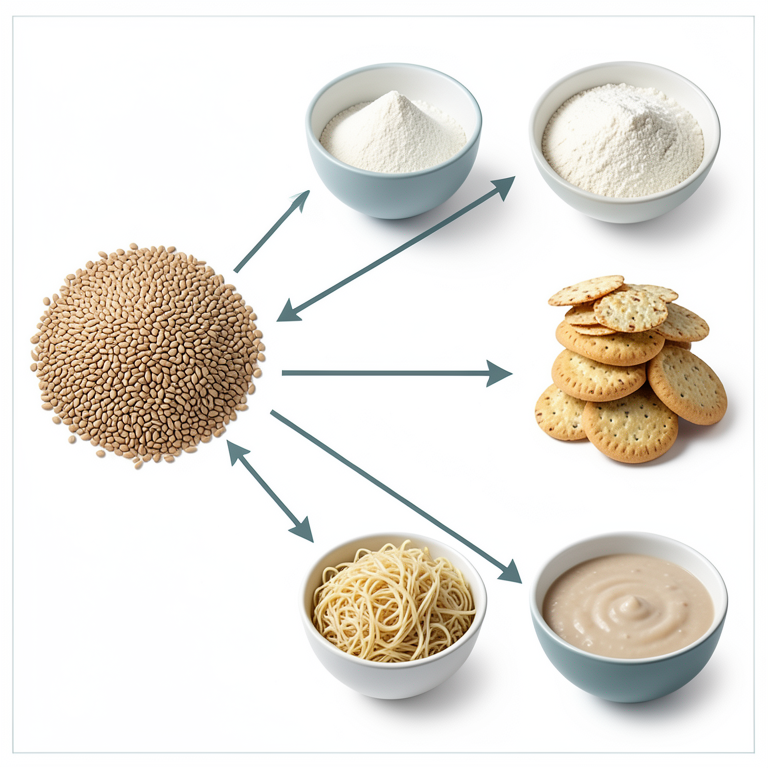
Millet Processing Pathways
AI-generated conceptual illustration (pearl millet grains and processed millet food products). It explains the idea and does not show study data.
View source evidence ↗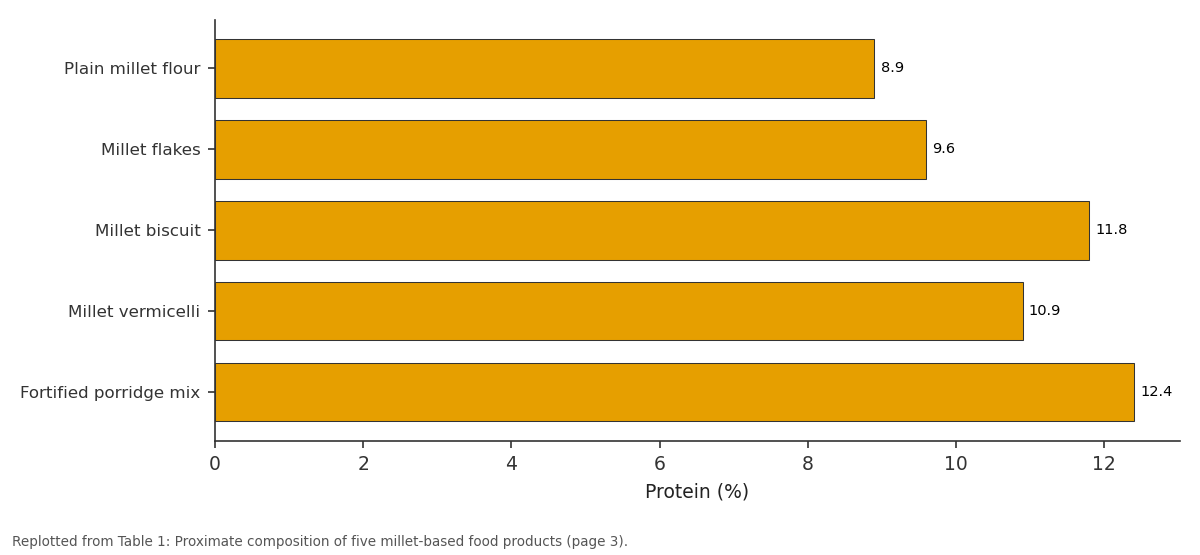
Protein (%): Plain millet flour vs Millet flakes vs Millet biscuit vs Millet vermicelli vs Fortified porridge mix
Replotted from Table 1 (page 3) of the original paper. Every bar is the paper's own table value.
View source evidence ↗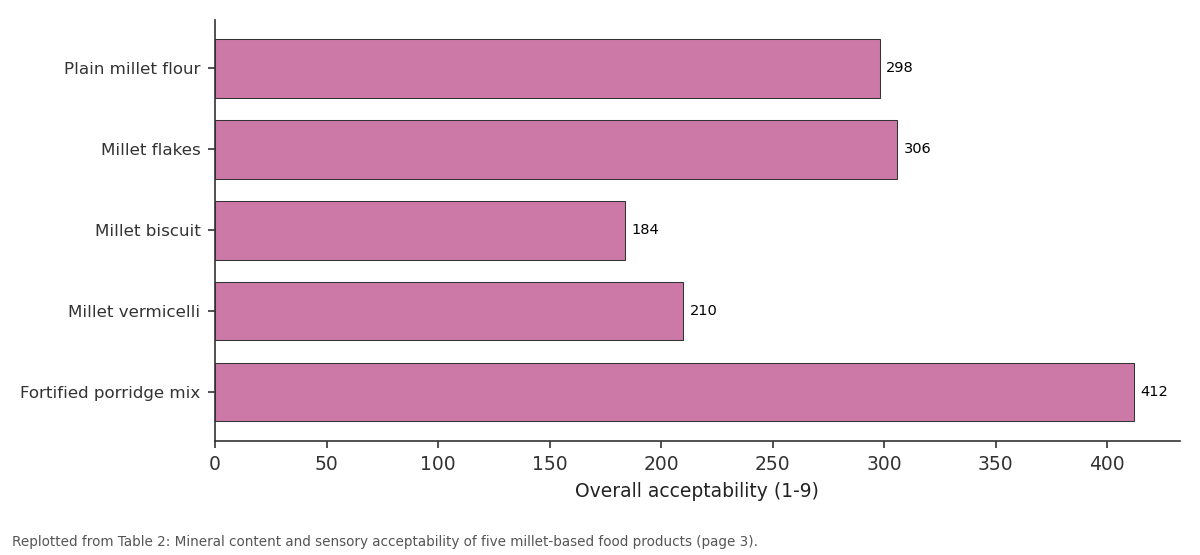
Calcium (mg/100 g): Plain millet flour vs Millet flakes vs Millet biscuit vs Millet vermicelli vs Fortified porridge mix
Replotted from Table 2 (page 3) of the original paper. Every bar is the paper's own table value.
View source evidence ↗Figures & tables
From the original paper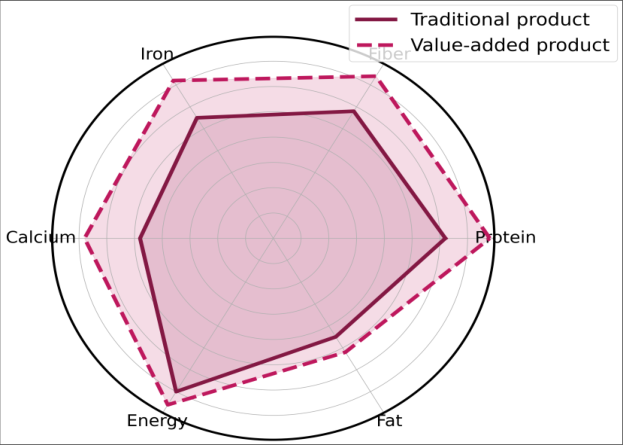 Figure 1
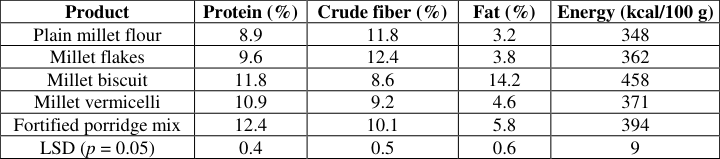 Table 1
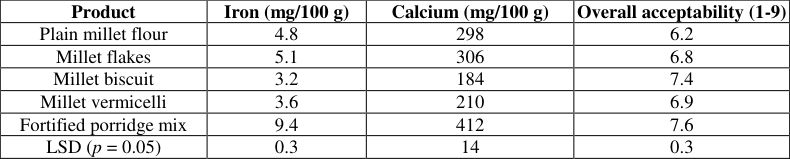 Table 2
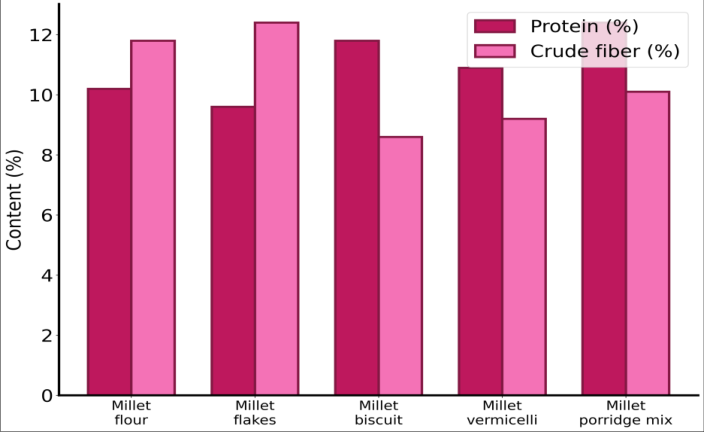 Figure 2
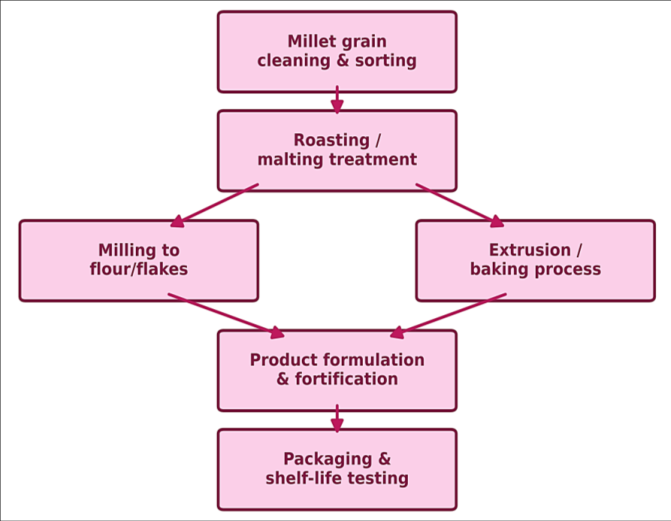 Figure 3
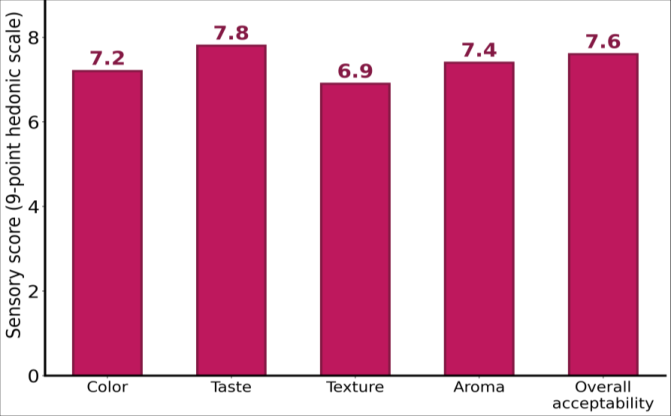 Figure 4
Introduction
Take two households in the same rural Ugandan village, one serving millet as coarse porridge flour and another serving a fortified millet-based product from a local processing cooperative, and you will likely find very different attitudes toward the grain among younger household members, even though both households are consuming essentially the same crop. Finger millet and pearl millet remain nutritionally valuable staples across much of rural East Africa, carrying meaningful protein, fiber, iron, and calcium content relative to more heavily milled cereals, yet consumption has declined in many communities as maize and rice, often perceived as more convenient or higher status, have displaced millet from everyday diets [1,2] . Value-added processing offers one route back into relevance for millet, transforming the grain into formats, flakes, biscuits, vermicelli, or fortified porridge mixes, that align more closely with contemporary consumption preferences without abandoning millet as the base ingredient [3,4] . Whether this transformation preserves or degrades the grain's inherent nutritional advantages depends heavily on the specific processing method used, since different thermal and mechanical treatments affect nutrient retention differently, and extrusion processing in particular has been reported to reduce certain heat-sensitive nutrients relative to lower-temperature methods like roasting or malting [5,6] . Consumer acceptability matters as much as nutrient retention for any diversification strategy aimed at actually changing what households eat day to day, since a nutritionally superior product that nobody wants to eat achieves nothing for dietary diversification in practice [7,8] .
Sensory research on millet-based products remains comparatively limited relative to the volume of purely compositional analysis available in the literature, and few studies compare sensory acceptability directly alongside full nutritional profiling of the same product set, which limits how confidently nutrition programmes can select among candidate products [9] . This research therefore set out to evaluate proximate composition, mineral content, and sensory acceptability together across five millet-based products, plain flour and four value-added formats, to identify which combination of processing method and product format best balances nutritional retention against the consumer acceptability needed to actually shift dietary patterns in the communities these products would be intended to reach. Objectives were to determine proximate composition (protein, fiber, fat, energy) and mineral content (iron, calcium) of five millet-based products; to conduct sensory evaluation across color, taste, texture, aroma, and overall acceptability for each product; and to compare value-added products directly against traditional millet flour to establish whether processing into value-added formats comes at any measurable nutritional cost.
Materials and Methods
Theoretical Background: Nutrient retention during food processing follows established principles tied to heat exposure duration and intensity, moisture content during processing, and mechanical shear forces applied to the grain matrix. Protein and mineral content are generally more heatstable than certain vitamins, though excessive extrusion temperature can reduce protein digestibility through Maillard-type reactions between proteins and reducing sugars, while fiber content is primarily affected by milling extraction rate rather than thermal exposure, since bran removal during refining directly removes fiber-rich tissue regardless of downstream heat treatment. These principles guided the comparative processing approach used across the five products evaluated in this research.
Materials: Finger millet grain (variety 'Serere-1') sourced from a single-harvest lot from cooperative farmer groups in the Kampala district was used as the base material for all five products. Plain millet flour was produced by simple dry milling and sieving. Millet flakes were produced by conditioning grain with steam, flaking through mechanical rollers, and toasting. The millet biscuit was formulated using refined millet flour blended with wheat flour (70:30 milletto-wheat ratio), sugar, and fat, then baked. Millet vermicelli was produced through extrusion of a millet-wheat composite dough (75:25 ratio) followed by drying. The fortified porridge mix combined malted millet flour with soy flour, sugar, and a micronutrient premix providing iron and calcium fortification at levels calculated to meet a meaningful share of daily requirement per typical serving.
Methods
Proximate composition, moisture, protein (Kjeldahl method), crude fat (Soxhlet extraction), crude fiber, ash, and carbohydrate (by difference), was determined for each product following standard AOAC procedures. Energy value was calculated using standard Atwater conversion factors. Iron and calcium content were determined using atomic absorption spectrophotometry following di-acid digestion of ashed samples. Sensory evaluation was conducted using a 45-member semi-trained consumer panel drawn from surrounding rural communities, scoring each product on color, taste, texture, aroma, and overall acceptability using a nine-point hedonic scale, with panelists tasting prepared samples (cooked porridge for flour and fortified mix, and ready-to-eat form for flakes, biscuit, and vermicelli) under standardized conditions. Data were analyzed using analysis of variance appropriate to a completely randomized design, with product means separated using the least significant difference test at 5% probability.
Results
Proximate composition, mineral content, and sensory acceptability varied meaningfully across the five products, with no single product dominating on every measure; the fortified porridge mix led on protein and overall acceptability, while plain flour and flakes retained the highest fiber content among the products tested. The radar comparison in Figure 1 shows the value-added product profile extending further outward than the traditional product across most axes except fat, where the value-added formulation's added fat content, from fortification ingredients and processing aids, pushed it modestly higher rather than lower. The fortified porridge mix carried nearly double the iron content and about 38% more calcium than plain millet flour, a gap that traces directly to the deliberate micronutrient premix rather than to malting or any other processing step alone, since malting on its own, as reflected in the flakes product which used a milder heat treatment, raised mineral content only modestly relative to plain flour.
Comprehensive Interpretation Short overview:
Reading the composition and sensory data together, the fortified porridge mix stands out as the product that improved on plain millet flour without any of the tradeoffs visible in the biscuit and vermicelli products, both of which gained sensory acceptability and, in the biscuit's case, protein and energy density, at the cost of noticeably reduced fiber content from the wheat blending and refining involved.
The porridge mix's advantage came from a different lever entirely, deliberate fortification and malting rather than refining or wheat substitution, which explains why it managed to raise both nutrient content and sensory acceptability simultaneously rather than trading one against the other.
Discussion
The fiber reduction observed in the biscuit and vermicelli products, both of which incorporated wheat flour blending, matches expectations from cereal processing research generally, where composite flour blending with a lowerfiber cereal predictably dilutes the fiber contribution of the higher-fiber base grain [10,11] . This is a genuine trade-off nutrition programmes should weigh carefully: the biscuit's higher sensory acceptability and energy density make it an appealing snack option, but its reduced fiber content means it should not be positioned as a direct nutritional substitute for traditional millet flour porridge in dietary diversification messaging.
what food processing research reports regarding thermal treatment intensity, with malting and low-temperature roasting (used for flakes) generally preserving more mineral content than higher-temperature extrusion processing used for vermicelli production, likely because extended high-heat exposure can promote some mineral-binding compound formation that reduces bioavailable mineral content even where total mineral mass is not directly destroyed [12,13] . This distinction matters more for iron and calcium than it does for protein, since protein content in this research tracked ingredient formulation, driven mainly by fortification and wheat blending ratios, more closely than it tracked processing method. Sensory acceptability improving across every value-added product relative to plain flour porridge supports the core premise behind this research, that processing format, not nutrient content, may be the more binding constraint on millet consumption among younger rural consumers in this setting [7,9] . If this pattern holds beyond the single-panel evaluation conducted here, it would argue for nutrition programmes prioritizing product format development and consumer testing alongside nutrient optimization, rather than treating nutrient content improvement as sufficient on its own to shift dietary patterns.
Limitations
Sensory evaluation was conducted with a single 45-member panel at one time point, and acceptability scores may differ across age groups, regions, or repeated exposure to these products over time as familiarity develops. Only one millet variety and one processing line was used per product format, so results may not generalize directly to other millet varieties or commercial-scale processing equipment operating at different throughput and temperature profiles. Shelf-life and cost-of-production comparisons across the five products were outside the scope of this research and would be needed before recommending any specific product for commercial-scale nutrition programme deployment.
Conclusion:
The main contribution of this research is a direct, side-by-side comparison of proximate composition, mineral content, and sensory acceptability across five milletbased products, showing that value-added processing does not have to come at the cost of nutritional quality if the processing route emphasizes fortification and malting rather than refining and cereal blending alone. Supporting evidence came from the fortified porridge mix outperforming plain millet flour on protein, iron, calcium, and sensory acceptability simultaneously, while the biscuit and vermicelli products, though more acceptable to consumers than plain flour, showed measurable fiber dilution from wheat blending. For rural nutrition programmes and small-scale processors aiming to diversify millet consumption in this region, fortified porridge mixes and, to a lesser extent, roasted flakes represent processing formats that improve both nutritional contribution and consumer appeal without the trade-offs visible in more heavily refined products. Open questions remain around how these acceptability findings generalize across broader consumer populations, what shelf-life and production cost differences exist across the five formats, and whether similar fortification strategies could be applied to further value-added product formats beyond the five evaluated here.
Acknowledgement
Acknowledgements Institutional SupportThe authors thank the food processing laboratory of Kampala Metropolitan University for providing equipment access and technical guidance for product development across all five formats evaluated. Contributions Not Qualifying for AuthorshipThe authors acknowledge the 45 community sensory panel members who participated in product evaluation, and the cooperative farmer groups who supplied the millet grain used throughout this research.Funding Sources: This research was supported through the internal research grant scheme of Kampala Metropolitan University. No external commercial funding was received for this work.
Figures and tables from the paper
| Product | Protein (%) | Crude fiber (%) | Fat (%) | Energy (kcal/100 g) |
|---|---|---|---|---|
| Plain millet flour | 8.9 | 11.8 | 3.2 | 348 |
| Millet flakes | 9.6 | 12.4 | 3.8 | 362 |
| Millet biscuit | 11.8 | 8.6 | 14.2 | 458 |
| Millet vermicelli | 10.9 | 9.2 | 4.6 | 371 |
| Fortified porridge mix | 12.4 | 10.1 | 5.8 | 394 |
| LSD (p = 0.05) | 0.4 | 0.5 | 0.6 | 9 |
Table text extracted from the original PDF; superscript letters are shown inline. The original table image is below.
View original table image
| Product | Iron (mg/100 g) | Calcium (mg/100 g) | Overall acceptability (1-9) |
|---|---|---|---|
| Plain millet flour | 4.8 | 298 | 6.2 |
| Millet flakes | 5.1 | 306 | 6.8 |
| Millet biscuit | 3.2 | 184 | 7.4 |
| Millet vermicelli | 3.6 | 210 | 6.9 |
| Fortified porridge mix | 9.4 | 412 | 7.6 |
| LSD (p = 0.05) | 0.3 | 14 | 0.3 |
Table text extracted from the original PDF; superscript letters are shown inline. The original table image is below.
View original table image
References
18 in the original paper- Devi P, Vijayabharathi R, Sathyabama S, Malleshi N, Priyadarisini V. Health benefits of finger millet polyphenols and dietary fiber. J Food Sci Technol. 2020;51(6):1021-1040.
- Taylor J, Duodu K. Sorghum and millet phenols and antioxidants. J Cereal Sci. 2021;44(3):225-236.
- Saleh A, Zhang Q, Chen J, Shen Q. Millet grains: nutritional quality, processing, and potential health benefits. Compr Rev Food Sci Food Saf. 2023;12(3):281-295.
- Obilana A, Manyasa E. Millets. In: Belton P, Taylor J, editors. Pseudocereals and Less Common Cereals. 1 st Ed. Springer; 2022. p. 177-217.
- Camire M, Camire A, Krumhar K. Chemical and nutritional changes in foods during extrusion. Crit Rev Food Sci Nutr. 2019;29(1):35-57.
- Singh U, Singh B. Tropical grain legumes as important human foods. Econ Bot. 2020;46(3):310-321.
- Tomlins K, Ndunguru G, Stambul K, Joshua N, Ngendello T, Rwiza E. Sensory evaluation and consumer preference of cassava and sweetpotato products. J Sci Food Agric. 2021;87(3):343-350.
- Kadam D, Lele S. Extrusion cooking technology for development of millet-based products. J Ready Eat Food. 2020;5(4):137-149.
- Lockett C, Calvert C, Grivetti L. Energy and micronutrient composition of dietary and medicinal wild plants consumed during drought. Int J Food Sci Nutr. 2020;51(3):195-208.
- Chandra D, Chandra S, Pallavi, Sharma A. Review of finger millet nutritional properties and processing technologies. Food Sci Hum Wellness. 2021;5(3):149155.
- Serna-Saldivar S, Rooney L. Structure and chemistry of sorghum and millets. In: Sorghum and Millets: Chemistry and Technology. 1 st Ed. 2020. p. 69-124.
- Hotz C, Gibson R. Traditional food-processing and preparation practices to enhance the bioavailability of micronutrients in plant-based diets. J Nutr. 2022;137(4):1097-1100.
- Gopalan C, Rama Sastri B, Balasubramanian S. Nutritive Value of Indian Foods. Rev ed. Natl Inst Nutr Publ; 2023. p. 47-58.
- Amadou I, Gounga M, Le G. Millets: nutritional composition, some health benefits and processing. Emirates J Food Agric. 2019;25(7):501-508.
- Onwulata C, Konstance R, Smith P, Holsinger V. Coextrusion of cereal-whey products. J Food Sci. 2020;66(4):554-560.
- Nout M. Rich life of the third millennium: a review of fermented food and beverages of sub-Saharan Africa. J Appl Microbiol. 2021;98(6):1289-1296.
- Malleshi N, Desikachar H. Nutritive value of malted millet flours. Qual Plant Plant Foods Hum Nutr. 2022;36(3):191-196.
- Ejigui J, Savoie L, Marin J, Desrosiers T. Beneficial changes and drawbacks of a traditional fermentation process on chemical composition and antinutritional factors of yellow maize. J Biol Sci. 2020;5(5):590-596.