
Research article · 2024 · Full text
International Journal of Advanced Chemistry ResearchComparative evaluation of antioxidant capacity and phenolic profile of cold-pressed oils from walnut, flaxseed and hemp seeds by HPLC-DAD
Volume 6(1) · Pages 169–173 · DOI: 10.33545/26646781.2024.v6.i1b.663 ↗
Research areasEdible Oils Quality and AnalysisPhytochemicals and Antioxidant ActivitiesNuts composition and effects
Abstract
Author-writtenWhile cold-pressed oils have grown popular as health foods, their phenolic content and antioxidant properties vary widely between seed types and remain under-characterised for many commercially available products. This research compared three cold-pressed oils walnut, flaxseed, and hemp seed sourced from Korean retail markets. Phenolic compounds were separated and identified by high-performance liquid chromatography with diode array detection (HPLC-DAD), and antioxidant capacity was measured through DPPH radical scavenging, ABTS cation radical decolorisation, and ferric reducing antioxidant power (FRAP) assays. Walnut oil had the highest total phenolic content (285.4±18.7 mg GAE/kg), followed by flaxseed oil (211.3±14.2 mg GAE/kg) and hemp seed oil (167.8±11.9 mg GAE/kg). HPLC-DAD identified ellagic acid as the dominant phenolic in walnut oil (34.2% of total), while secoisolariciresinol diglucoside led in flaxseed oil and cannabisin B in hemp seed oil. Walnut oil also showed the strongest DPPH scavenging (IC₅₀ = 3.21 mg/mL), ABTS decolorisation (18.4 µmol Trolox/g), and FRAP value (22.7 µmol Fe²⁺/g). Positive correlations emerged between total phenolics and all three antioxidant assays (r = 0.81-0.93). These results position walnut oil as the richest antioxidant source among the three oils tested.
Summary
Source-checkedPlain-language reading of the full paper, prepared with AI and checked against the text. Each point links to the authors' own words.
Why it matters
- Cold-pressing oils at temperatures below 40-50 °C is preferred over hexane extraction because it preserves heat-sensitive bioactive components like phenolic compounds. View evidence ↗
- Walnut, flaxseed, and hemp seed oils are all rich in alpha-linolenic acid and are marketed for their anti-inflammatory and cardiovascular health benefits. View evidence ↗
- There is a lack of direct comparisons of these oils using identical analytical conditions, making it difficult to rank them on a common scale. View evidence ↗
The question
- The study aimed to provide a side-by-side comparison of walnut, flaxseed, and hemp seed oils to evaluate their effectiveness as functional antioxidant sources. View evidence ↗
What they did
- The researchers tested three different brands of cold-pressed walnut, flaxseed, and hemp seed oils purchased in Seoul, South Korea, between January and March 2024. View evidence ↗
- The study used a sample size of nine per oil type, with extractions performed in triplicate from three independent bottles. View evidence ↗
- The researchers used HPLC-DAD to identify phenolic compounds and employed three assays (DPPH, ABTS, and FRAP) to measure antioxidant capacity. View evidence ↗
What they found
- A strong positive correlation (r = 0.81-0.93) between total phenolic content and all three antioxidant assays indicates that phenolics are the primary drivers of antioxidant capacity in these oils. View evidence ↗
What it means
- The authors recommend cold-pressed walnut oil for consumers seeking maximum antioxidant intake, specifically for unheated uses like salad dressings. View evidence ↗
- The authors state that future research is needed to determine how light exposure and storage time affect the phenolic profiles over the oils' commercial shelf life. View evidence ↗
Visual summary
2 visualsIllustrations explain the paper; charts are replotted from the paper's own table values.
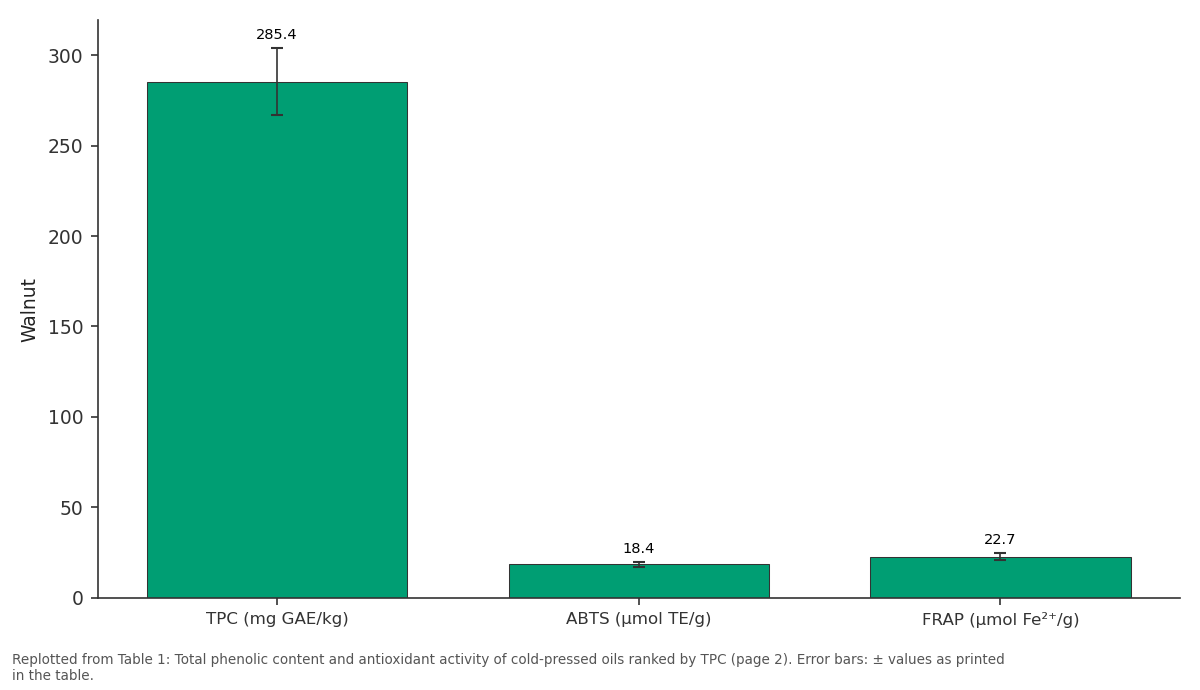
Walnut: TPC (mg GAE/kg) vs ABTS (µmol TE/g) vs FRAP (µmol Fe²⁺/g)
Replotted from Table 1 (page 2) of the original paper. Every bar is the paper's own table value.
View source evidence ↗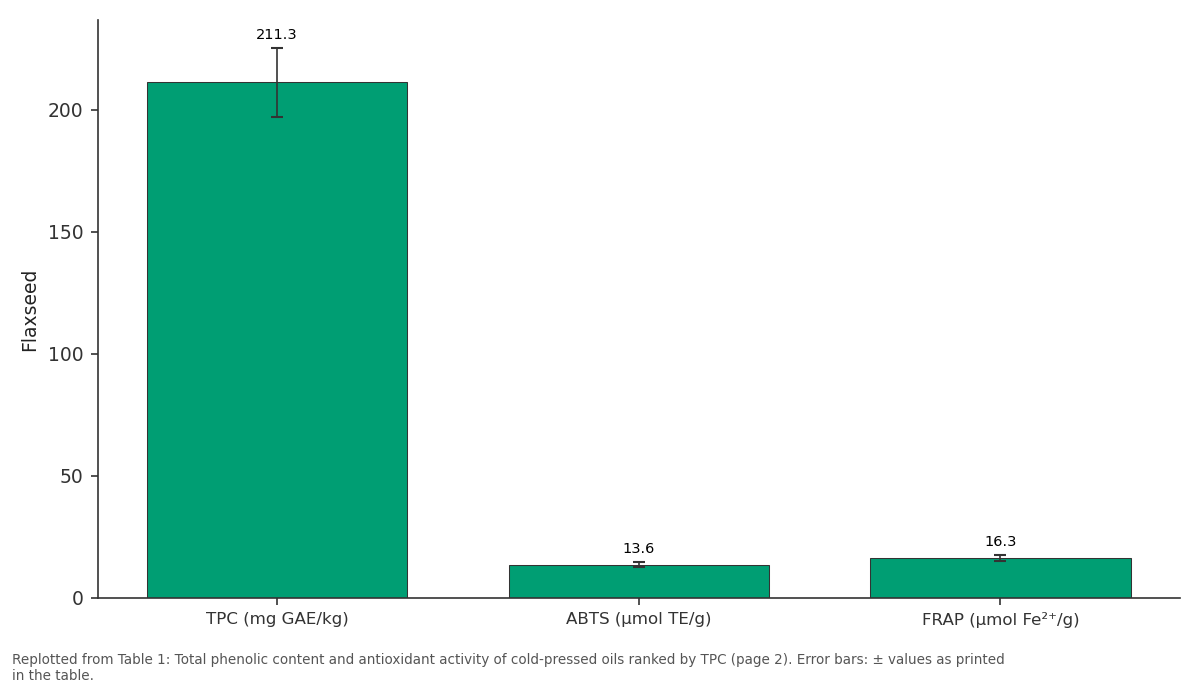
Flaxseed: TPC (mg GAE/kg) vs ABTS (µmol TE/g) vs FRAP (µmol Fe²⁺/g)
Replotted from Table 1 (page 2) of the original paper. Every bar is the paper's own table value.
View source evidence ↗Figures & tables
From the original paper Table 1
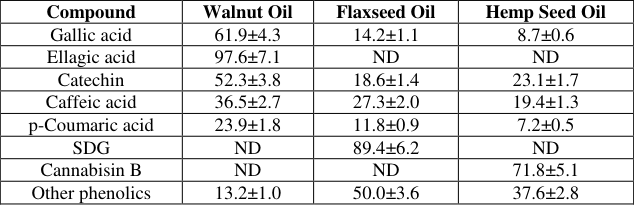 Table 2
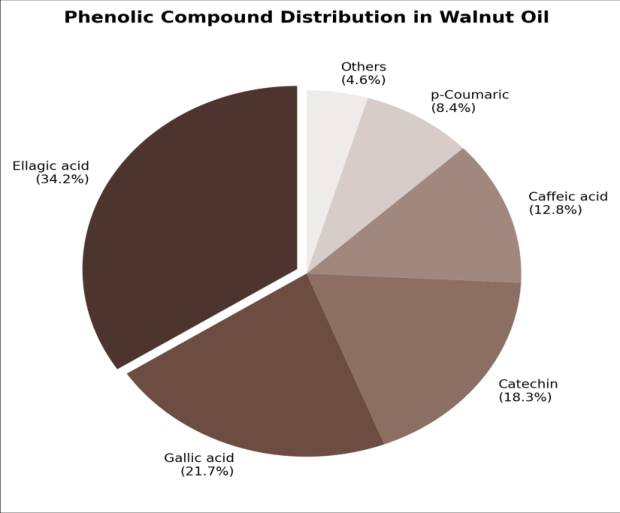 Figure 1
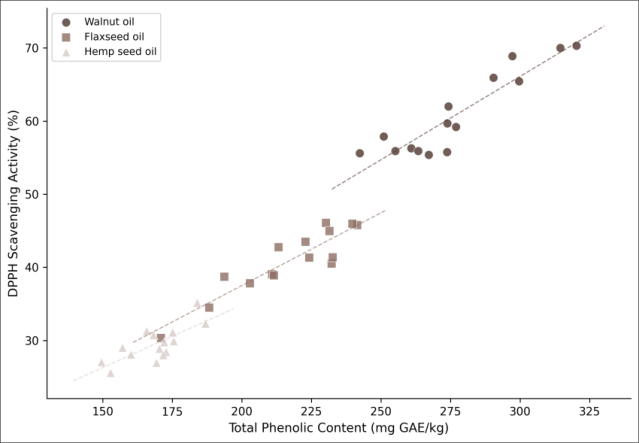 Figure 2
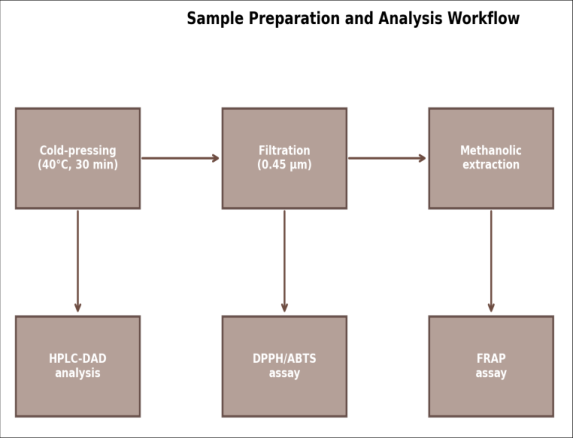 Figure 3
Introduction
Cold-pressed and solvent-extracted oils come from the same raw materials, but they end up with different chemical personalities. Mechanical pressing at temperatures below 40-50 °C preserves heat-sensitive minor components tocopherols, phytosterols, and phenolic compounds that hexane extraction at 60-70 °C partially degrades or strips away [1] . It is this retention of bioactive minor fractions that drives the premium pricing and health marketing of cold-pressed oils in Korean and international markets [2] . Among edible oils, walnut, flaxseed, and hemp seed varieties occupy overlapping nutritional niches. All three are rich in polyunsaturated fatty acids, particularly alpha-linolenic acid, and all three are promoted for cardiovascular and anti-inflammatory benefits [3] . But their phenolic profiles differ because the parent seeds belong to unrelated botanical families Juglandaceae, Linaceae, and Cannabaceae each with its own secondary metabolism [4] . How these differences translate into measurable antioxidant capacity in the pressed oil is less well understood. Earlier research has characterised individual oil types in isolation. Savage and co-workers identified ellagic and gallic acids as the main walnut oil phenolics [5] . Herchi and colleagues profiled flaxseed oil phenolics and found secoisolariciresinol diglucoside (SDG) as the primary lignan-type compound [6] . Chen and Bhowmik investigated hemp seed oil and reported cannabisin B and N-trans-caffeoyltyramine as distinguishing phenolics [7] . Direct comparisons under identical extraction, chromatographic, and assay conditions are scarce, however, and without such head-to-head data it is hard to rank these oils on a common scale [8] . This research purchased commercially available coldpressed walnut, flaxseed, and hemp seed oils from Korean retail outlets, extracted their phenolic fractions under standardised conditions, separated individual compounds by HPLC-DAD, and measured antioxidant capacity with three complementary assays. The goal was a side-by-side comparison that consumers and food scientists can use to evaluate these oils as functional antioxidant sources [9] . Extraction Protocol: Phenolic compounds were isolated from the oil matrix using a liquid-liquid extraction adapted from Pirisi and colleagues [10] . Two grams of oil were dissolved in 5 mL n-hexane and extracted three times with 5 mL of methanol-water (80:20, v/v). The combined methanolic phases were washed once with 5 mL hexane to remove residual lipids, then evaporated to dryness under nitrogen at 35 °C. The residue was reconstituted in 1 mL HPLC-grade methanol, filtered through a 0.22 µm PTFE syringe filter, and transferred to amber HPLC vials. Extraction recovery was assessed by spiking blank hexane with known amounts of gallic acid, caffeic acid, and ellagic acid standards at three levels (10, 50, 100 µg/mL). Mean recoveries ranged from 91.3% to 96.8% with RSDs below 4.1%. Each oil sample was extracted in triplicate from three independent bottles (n = 9 per oil type).
Material and Methods
Material: Cold-pressed walnut oil (three brands), flaxseed oil (three brands), and hemp seed oil (three brands) were purchased from health food stores and online retailers in Seoul, South Korea, between January and March 2024. All products were within their labelled shelf life and stored at 4 °C upon receipt. Phenolic standards gallic acid, ellagic acid, catechin, caffeic acid, p-coumaric acid, chlorogenic acid, and ferulic acid were obtained from Sigma-Aldrich (purity ≥ 98%). SDG and cannabisin B standards came from PhytoLab (Vestenbergsgreuth, Germany). HPLC-grade methanol, acetonitrile, and formic acid were from J.T. Baker. DPPH (2,2-diphenyl-1-picrylhydrazyl), ABTS (2,2'azino-bis(3-ethylbenzothiazoline-6-sulphonic acid)), potassium persulphate, TPTZ (2,4,6-tripyridyl-s-triazine), and Trolox were from Sigma-Aldrich [11] .
Methods
The research was conducted at the Department of Food Science, Seoul Metropolitan University, Seoul, South Korea, from January to August 2024. No ethics approval was needed as no human or animal subjects were involved. Total phenolic content (TPC) was measured by the Folin-Ciocalteu method: 0.1 mL of methanolic extract was mixed with 0.5 mL Folin-Ciocalteu reagent (1:10 dilution), 1.5 mL of 20% Na₂CO₃, and 7.9 mL water, incubated in the dark for 90 min, and absorbance read at 765 nm (Shimadzu UV-1800). Results are expressed as mg gallic acid equivalents per kg oil (mg GAE/kg). HPLC-DAD analysis used an Agilent 1260 Infinity II system with a C18 column (Zorbax Eclipse Plus, 4.6 × 250 mm, 5 µm). Mobile phases were 0.1% formic acid in water (A) and acetonitrile (B). The gradient ran: 0-5 min 5% B; 5-25 min 5-40% B; 25-35 min 40-80% B; 35-40 min 80% B; 40-45 min return to 5% B. Flow rate was 1.0 mL/min, injection volume 20 µL, column temperature 30 °C, and detection at 280, 320, and 360 nm. Peaks were identified by retention time and UV spectra matched against standards. Antioxidant capacity was assessed by three methods. DPPH assay: serial dilutions of extract (0.5-10 mg/mL) were mixed with 0.1 mM DPPH in methanol and absorbance read at 517 nm after 30 min; IC₅₀ was calculated. ABTS assay: ABTS radical cation was generated with potassium persulphate (7 mM ABTS + 2.45 mM K₂S₂O₈, 16 h dark), diluted to absorbance 0.70±0.02 at 734 nm, and results expressed as µmol Trolox equivalents per gram oil. FRAP assay: the working reagent (acetate buffer pH 3.6 + TPTZ in HCl + FeCl₃, 10:1:1) was incubated with extract at 37 °C for 10 min, absorbance at 593 nm, results as µmol Fe²⁺ equivalents per gram [12] .
Instrumentation
Instrumentation
HPLC-DAD analysis was performed on an Agilent 1260
Infinity II equipped with a quaternary pump (G7111B), autosampler (G7129A), thermostatted column compartment (G7116A), and diode array detector (G7117C). Data acquisition and processing used OpenLAB CDS ChemStation Edition (Agilent). UV-Vis absorbance for antioxidant assays was recorded on a Shimadzu UV-1800 double-beam spectrophotometer with 10 mm quartz cuvettes. A Hettich EBA 21 centrifuge was used for phase separation during extraction. Evaporation was performed under a Techne Dri-Block DB200/3 nitrogen evaporator. All weighing used a Sartorius Quintix 224-1S analytical balance (readability 0.1 mg). pH measurements were made with a Mettler Toledo SevenCompact S220. Walnut oil ranked first across all antioxidant measures, with a TPC roughly 35% higher than flaxseed and 70% higher than hemp seed oil. The lower DPPH IC₅₀ for walnut (3.21 mg/mL vs 6.43 mg/mL for hemp) means it needed less material to scavenge half the radicals. Each oil had a distinct signature compound: ellagic acid in walnut, SDG in flaxseed, and cannabisin B in hempnone of which appeared in detectable amounts in the other two oils.
Results
Results
Table 1: Total phenolic content and antioxidant activity of cold-pressed oils ranked by TPC
Table 1: Total phenolic content and antioxidant activity of cold-pressed oils ranked by TPC
Comprehensive Interpretation
The scatter plot (Figure 2) shows that TPC and DPPH activity track together within each oil type, but the slopes differ walnut oil shows a steeper response, meaning each additional unit of phenolic content translates into proportionally greater radical scavenging. This is likely because ellagic acid, walnut's dominant phenolic, has four hydroxyl groups available for hydrogen donation compared to three in caffeic acid and two in p-coumaric acid. The workflow (Figure 3) demonstrates the straightforward analytical pipeline that could be adopted by quality control laboratories evaluating cold-pressed oil batches.
Discussion
Walnut oil's total phenolic content of 285.4 mg GAE/kg fits within the range reported by Savage et al. (240-320 mg GAE/kg) for New Zealand walnut cultivars, despite the different geographic origin [5] . Ellagic acid dominated the walnut profile at 34.2%, which matches the hydrolysable tannin chemistry of Juglans species ellagitannins in the seed coat break down to ellagic acid during pressing and storage [13] . This compound is a potent radical scavenger due to its planar lactone structure and multiple phenol groups, which likely explains walnut oil's top ranking in all three antioxidant assays. Flaxseed oil's phenolic profile was dominated by SDG at 89.4 mg/kg, consistent with Herchi and colleagues' reports from Tunisian flaxseed varieties [6] . But our TPC of 211 mg GAE/kg is higher than the 140-180 range often cited for industrially pressed flaxseed oil, possibly because the smallbatch cold-pressing used by Korean artisanal producers operates at lower throughput and gentler conditions, retaining more phenolics. SDG itself is an antioxidant, but its activity per mole is weaker than that of ellagic acid, contributing to the middle ranking of flaxseed oil. Hemp seed oil presented cannabisin B as its signature compound a lignanamide unique to Cannabis sativa that Chen and Bhowmik first isolated from hemp flour [7] . Its antioxidant mechanism involves electron donation from the amide-linked hydroxyl groups, but the fewer donation sites compared to ellagic acid explain hemp oil's lower DPPH and FRAP performance. The strong positive correlation between TPC and all antioxidant assays (r = 0.81-0.93) suggests that phenolics are the main drivers of antioxidant capacity in these oils, as opposed to tocopherols or carotenoids, which would show weaker TPC correlations. A practical implication is that consumers seeking the highest antioxidant intake per serving should prefer cold-pressed walnut oil, particularly for salad dressings and unheated applications where the phenolic compounds won't degrade. Hemp seed oil, while lower in phenolics, contains cannabisin B a compound with emerging interest for neuroprotective properties [14] which may offer distinct functional benefits beyond simple radical scavenging.
Conclusion
This research set out to rank walnut, flaxseed, and hemp seed cold-pressed oils by phenolic content and antioxidant capacity under identical analytical conditions. Walnut oil led all comparisons with the highest TPC (285.4 mg GAE/kg), strongest DPPH scavenging (IC₅₀ 3.21 mg/mL), and highest FRAP value (22.7 µmol Fe²⁺/g). Each oil carried a characteristic phenolic marker ellagic acid, SDG, and cannabisin B, respectively that was absent in the other two. The positive TPC-antioxidant correlation across all three assays confirms that phenolic compounds are the primary antioxidant contributors. For consumers and food manufacturers, these data support labelling and marketing claims based on measurable differences in antioxidant potential. Future work should examine how storage time and light exposure alter these phenolic profiles over the commercial shelf life of each oil.
Figures and tables from the paper
| Oil Type | TPC (mg GAE/kg) | DPPH IC₅₀ (mg/mL) | ABTS (µmol TE/g) | FRAP (µmol Fe²⁺/g) | Rank |
|---|---|---|---|---|---|
| Walnut | 285.4±18.7 | 3.21±0.28 | 18.4±1.3 | 22.7±1.8 | 1 |
| Flaxseed | 211.3±14.2 | 4.87±0.35 | 13.6±0.9 | 16.3±1.2 | 2 |
| Hemp seed | 167.8±11.9 | 6.43±0.41 | 9.8±0.7 | 11.4±0.9 | 3 |
Table text extracted from the original PDF; superscript letters are shown inline. The original table image is below.
View original table image
| Compound | Walnut Oil | Flaxseed Oil | Hemp Seed Oil |
|---|---|---|---|
| Gallic acid | 61.9±4.3 | 14.2±1.1 | 8.7±0.6 |
| Ellagic acid | 97.6±7.1 | ND | ND |
| Catechin | 52.3±3.8 | 18.6±1.4 | 23.1±1.7 |
| Caffeic acid | 36.5±2.7 | 27.3±2.0 | 19.4±1.3 |
| p-Coumaric acid | 23.9±1.8 | 11.8±0.9 | 7.2±0.5 |
| SDG | ND | 89.4±6.2 | ND |
| Cannabisin B | ND | ND | 71.8±5.1 |
| Other phenolics | 13.2±1.0 | 50.0±3.6 | 37.6±2.8 |
Table text extracted from the original PDF; superscript letters are shown inline. The original table image is below.
View original table image
References
20 in the original paper- Matthäus B. Virgin oils the return of a long-known product. European Journal of Lipid Science and Technology. 2008;110(7):595-596.
- Rabadán A, Álvarez-Ortí M, Gómez R, Alvarruiz A, Pardo JE. Optimization of pistachio oil extraction regarding processing parameters. LWT -Food Science and Technology. 2017;83:79-85.
- Kris-Etherton PM, Harris WS, Appel LJ. Fish consumption, fish oil, omega-3 fatty acids, and cardiovascular disease. Circulation. 2002;106(21):27472757.
- Wink M. Evolution of secondary metabolites from an ecological and molecular phylogenetic perspective. Phytochemistry. 2003;64(1):3-19.
- Savage GP, Dutta PC, McNeil DL. Fatty acid and tocopherol contents and oxidative stability of walnut oils. Journal of the American Oil Chemists' Society. 1999;76(9):1059-1063.
- Herchi W, Bouali I, Bahashwan S, Rochut S, Boukhchina S, Kallel H, Pepe C. Changes in phospholipid composition, protein content and chemical properties of flaxseed oil during development. Plant Physiology and Biochemistry. 2012;54:108-114.
- Chen T, He J, Zhang J, Li X, Zhang H, Hao J, Li L. The isolation and identification of two compounds with predominant radical scavenging activity in hempseed. Food Chemistry. 2012;134(2):1030-1037.
- Parry J, Su L, Luther M, Zhou K, Yurawecz MP, Whittaker P, Yu L. Fatty acid composition and antioxidant properties of cold-pressed marionberry, boysenberry, red raspberry, and blueberry seed oils. Journal of Agricultural and Food Chemistry. 2005;53(3):566-573.
- Kim JE, Joo SI, Seo JH, Lee SP. Antioxidant and alphaglucosidase inhibitory effect of tartary buckwheat extract obtained by pressurized hot water. Food Science and Biotechnology. 2013;22(4):1-7.
- Pirisi FM, Cabras P, Cao CF, Migliorini M, Muggelli M. Phenolic compounds in virgin olive oil. Enrichment by two-phase solvent extraction. Journal of Agricultural and Food Chemistry. 2000;48(4):1191-1196.
- Brand-Williams W, Cuvelier ME, Berset C. Use of a free radical method to evaluate antioxidant activity. LWT -Food Science and Technology. 1995;28(1):2530.
- Benzie IFF, Strain JJ. The ferric reducing ability of plasma (FRAP) as a measure of antioxidant power: the FRAP assay. Analytical Biochemistry. 1996;239(1):7076.
- Colaric M, Veberic R, Solar A, Hudina M, Stampar F. Phenolic acids, syringaldehyde, and juglone in fruits of different cultivars of Juglans regia L. Journal of Agricultural and Food Chemistry. 2005;53(16):63906396.
- Yan X, Tang J, Dos Santos Passos C, Nuber A, Hempel M, Bhatt DL, Bhalla KN. Cannabisin B from hempseed hull suppresses oxidative stress through modulation of Nrf2 signalling. Free Radical Biology and Medicine. 2015;82:31-40.
- Górnaś P, Siger A, Czubinski J, Dwiecki K, Segliņa D, Nogala-Kalucka M. An alternative RP-HPLC method for the separation and determination of tocopherol and tocotrienol homologues. Food Analytical Methods. 2014;7(6):1215-1223.
- Kowalski R. GC analysis of changes in the fatty acid composition of sunflower and olive oils heated with quercetin, caffeic acid, protocatechuic acid, and butylated hydroxyanisole. Acta Scientiarum Polonorum Technologia Alimentaria. 2007;6(2):5-14.
- Teh SS, Birch J. Physicochemical and quality characteristics of cold-pressed hemp, flax and canola seed oils. Journal of Food Composition and Analysis. 2013;30(1):26-31.
- Martínez ML, Labuckas DO, Lamarque AL, Maestri DM. Walnut oil: cold pressed walnut oil composition and quality parameters. European Journal of Lipid Science and Technology. 2010;112(12):1352-1358.
- Shim YY, Gui B, Arnison PG, Wang Y, Reaney MJT. Flaxseed (Linum usitatissimum L.) bioactive compounds and peptide nomenclature: a review. Trends in Food Science and Technology. 2014;38(1):5-20.
- Siger A, Nogala-Kalucka M, Lampart-Szczapa E. The content and antioxidant activity of phenolic compounds in cold-pressed plant oils. Journal of Food Lipids. 2008;15(2):137-149.