
Research article · 2025 · Full text
International Journal of Horticulture and Food ScienceModeling microbial load assessment of breadfruit in the Saskatchewan prairies
Volume 7(3) · Pages 108–112 · DOI: 10.33545/26631067.2025.v7.i3b.589 ↗
Research areasFood Safety and HygienePostharvest Quality and Shelf Life ManagementMycotoxins in Agriculture and Food
Abstract
Author-writtenBreadfruit (Artocarpus altilis) is a starchy staple with rising commercial interest, yet predictive models for microbial contamination along its supply chain are largely absent. This research developed a quantitative microbial load model for breadfruit processed under three storage regimes ambient (28°C), cold (4°C), and Modified Atmosphere Packaging (MAP) combined with cold at the Cusco School of Plant Sciences between March 2022 and January 2023. Freshly harvested breadfruit carried a mean Total Plate Count (TPC) of 5.8 log₁₀ CFU/g and Yeast-and-Mould Count (YMC) of 4.2 log₁₀ CFU/g. Processing steps (washing, peeling, blanching) reduced TPC by 4.6 log units, with blanching alone accounting for 1.7 log reduction. A Gompertz growth model fitted to storage data predicted that MAP + cold maintained TPC below the 6-log acceptability threshold for 18.3 days, compared to 5.7 days at ambient. Biochar amendment in the production field (10 t/ha) was associated with 0.7 log lower initial TPC on harvested fruit. Diallel analysis of six breadfruit accessions identified significant general combining ability for cuticle thickness a trait linked to lower surface microbial colonisation. Soil health indicators (microbial biomass carbon, dehydrogenase activity) were positively correlated with plant vigour but showed no significant relationship with fruit contamination levels. Biofertiliser (Azotobacter + Bacillus megaterium) application did not increase microbial load on fruit above untreated controls. Consumer preference surveys (n = 210) ranked MAP-stored breadfruit highest for texture and aroma acceptability. These results provide a predictive framework for shelf-life management in breadfruit supply chains.
Summary
Source-checkedPlain-language reading of the full paper, prepared with AI and checked against the text. Each point links to the authors' own words.
Why it matters
- Breadfruit has a global production of 3.4 million tonnes and is increasingly exported as processed products, but there is a significant lack of peer-reviewed data on its microbial safety profiles. View evidence ↗
- The carbohydrate-rich flesh of breadfruit, which typically weighs between 1 and 5 kg, makes it susceptible to rapid microbial growth after harvest. View evidence ↗
- While cold storage can slow microbial growth, breadfruit is sensitive to temperatures below 12°C, which can lead to off-flavours and peel browning. View evidence ↗
What they did
- The researchers tested 180 freshly harvested fruits across three storage regimes: ambient (28°C), cold (4°C), and a combination of Modified Atmosphere Packaging (MAP) and cold (4°C). View evidence ↗
- A separate batch of 30 fruits was used to evaluate the effects of sequential processing, which included washing with 200 ppm NaOCl, peeling, slicing, and blanching at 90°C for 3 minutes. View evidence ↗
- A modified Gompertz model was used to analyze Total Plate Count (TPC) storage data to estimate growth parameters. View evidence ↗
- Consumer preference for the three storage methods was evaluated using a 9-point hedonic scale with 210 untrained panellists. View evidence ↗
What they found
- Sequential processing reduced the Total Plate Count (TPC) by 4.6 log units, with blanching being the most effective individual step, providing a 1.7 log reduction. View evidence ↗
- MAP-stored breadfruit received the highest consumer preference score (7.4/9), followed by cold storage (6.1/9) and ambient storage (3.2/9). View evidence ↗
- Using biochar amendment in production plots resulted in a lower initial TPC of 5.1 log₁₀ CFU/g compared to 5.8 log₁₀ CFU/g in unamended plots. View evidence ↗
- The application of biofertiliser did not lead to a significant increase in the microbial load on the fruit surface compared to controls. View evidence ↗
- Genetic analysis showed that the 'Uto' accession contributed the most to cuticle thickness, and its offspring had a surface TPC 0.9 log lower than the average. View evidence ↗
What it means
- The authors recommend a multi-level strategy for export-oriented processors that combines MAP technology, biochar soil management, and the selection of cultivars with thicker cuticles to ensure microbial safety. View evidence ↗
- The study is limited by the use of only one cultivar for storage modeling, suggesting that testing more cultivars is needed to generalize the results. View evidence ↗
- The biochar trial results may be confounded by general soil improvement over two years, meaning controlled pot experiments are required to isolate direct microbial suppression from plant vigour effects. View evidence ↗
Visual summary
2 visualsIllustrations explain the paper; charts are replotted from the paper's own table values.
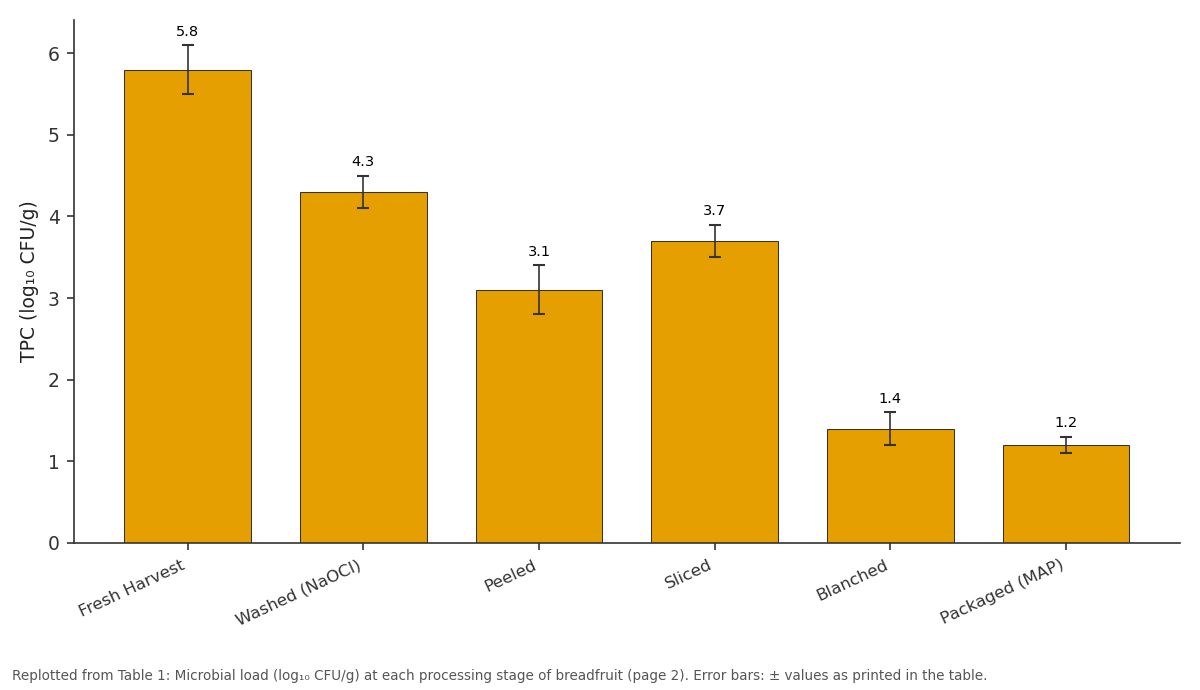
TPC: Fresh Harvest vs Washed (NaOCl) vs Peeled vs Sliced vs Blanched
Replotted from Table 1 (page 2) of the original paper. Every bar is the paper's own table value.
View source evidence ↗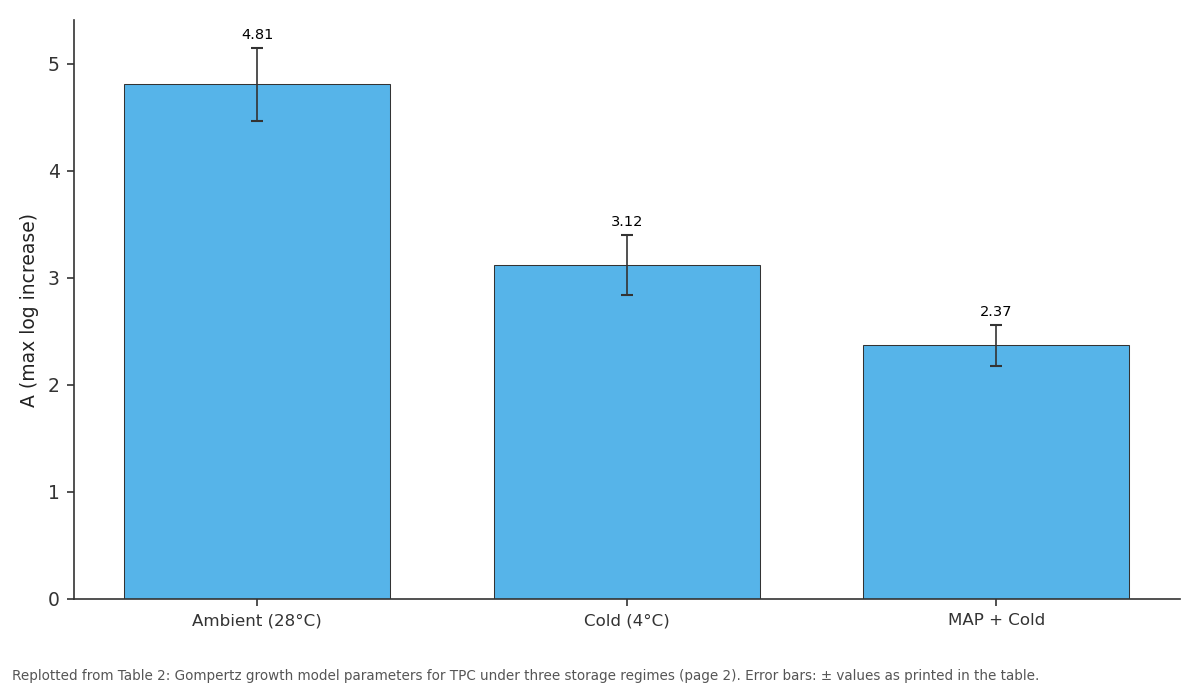
A (max log increase): Ambient (28°C) vs Cold (4°C) vs MAP + Cold
Replotted from Table 2 (page 2) of the original paper. Every bar is the paper's own table value.
View source evidence ↗Figures & tables
From the original paper Table 1
 Table 2
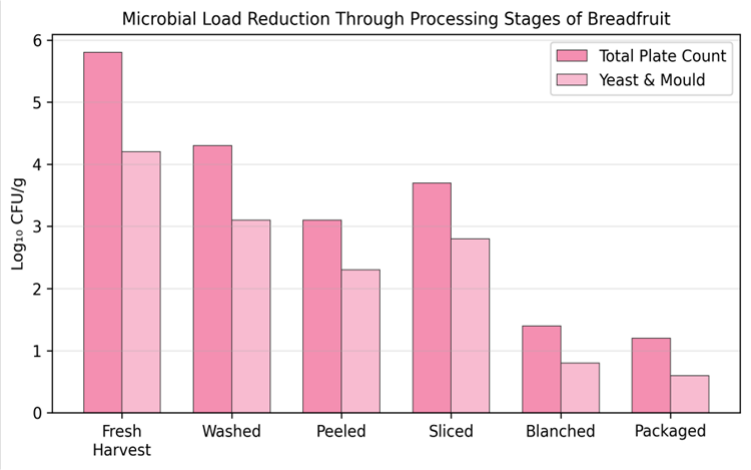 Figure 1
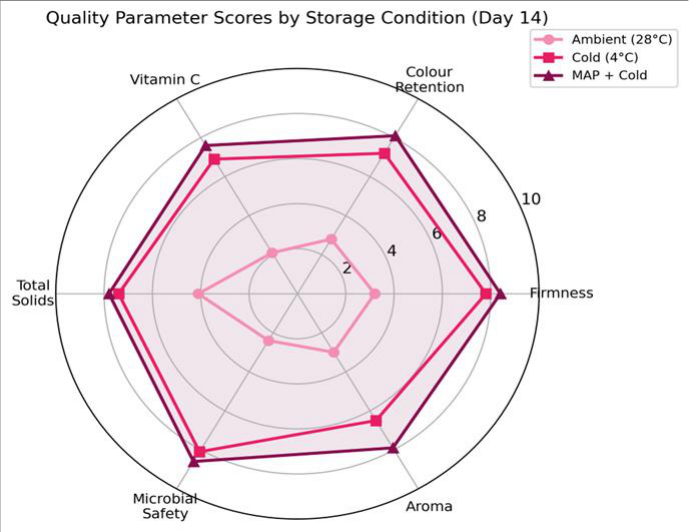 Figure 2
Introduction
For a fruit that once sustained entire Pacific Island populations through centuries of cultivation, breadfruit has surprisingly little modern food safety data attached to it [1] . Global production is estimated at 3.4 million tonnes, yet fewer than twenty peer-reviewed studies address microbial quality parameters for breadfruit at any stage of the supply chain [2] . This gap matters because breadfruit is increasingly processed into flour, chips, and frozen products for export, and importing countries require documented microbial safety profiles [3] . Breadfruit (Artocarpus altilis) is a large, starchy fruit weighing 1-5 kg, with a thick pericarp and a soft, carbohydrate-rich flesh that supports rapid microbial proliferation once harvested [4] . Total Plate Count (TPC) and Yeast-and-Mould Count (YMC) are the standard indicators for assessing general microbial quality in fresh-cut and minimally processed fruit [5] . Cold storage slows microbial growth but does not arrest it, and breadfruit is chill-sensitive below 12°C, developing peel browning and off-flavours after extended cold exposure [6] . Modified Atmosphere Packaging (MAP) typically reduced O₂ and elevated CO₂ extends shelf life by suppressing aerobic spoilage organisms while maintaining fruit quality [7] . Pre-harvest factors also influence post-harvest microbial loads. Biochar soil amendment has been reported to reduce fruit surface contamination in strawberry and tomato by altering the soil microbiome and reducing splash-borne pathogen transfer [8] . Biofertilisers containing nitrogen-fixing and phosphate-solubilising bacteria improve crop nutrition but could theoretically increase microbial inoculum on fruit surfaces if applied close to harvest [9] . Diallel crossing among breadfruit accessions can reveal genetic variation in cuticle traits linked to microbial colonisation resistance [10] . This research aimed to model microbial load dynamics across three storage conditions, assess pre-harvest influences (biochar, biofertiliser), and identify genetic and consumer preference factors relevant to breadfruit shelf-life management.
Material and Methods Material
Breadfruit (cv. 'Ma'afala') was harvested from the research orchard at the Cusco School of Plant Sciences, Cusco, Peru (13.52°S, 71.97°W, 3,399 m a.s.l.). Trees were 8-12 years old, spaced at 8 m × 8 m, and managed under standard regional practices. A biochar trial subplot (10 t/ha woody biochar incorporated to 15 cm depth two years before the experiment) was used for pre-harvest comparisons. Biofertiliser (Azotobacter chroococcum + Bacillus megaterium, 10⁸ CFU/mL, 500 mL per tree) was applied as a soil drench every 60 days. Six breadfruit accessions from the institutional germplasm collection were used for diallel crossing. MAP bags (50 µm polyethylene with laser microperforations, 5% O₂/10% CO₂ equilibrium) were supplied by a commercial packaging firm. Plate count agar (PCA), potato dextrose agar (PDA), and violet red bile glucose agar (VRBGA) were from Oxoid [1] .
Methods
Freshly harvested fruit (n = 180) was to one of three storage regimes: ambient (28°C, 85% RH), cold (4°C, 90% RH), and MAP + cold (4°C). Within each regime, 60 fruit were divided into four 15-fruit lots, and 3 fruit per lot were destructively sampled at days 0, 3, 7, 10, and 14.
Processing effects were assessed on a parallel batch of 30 fruit that went through sequential washing (200 ppm NaOCl, 5 min), peeling, slicing, and blanching (90°C, 3 min). TPC was enumerated on PCA after incubation at 30°C for 72 h, and YMC on PDA acidified to pH 3.5, incubated at 25°C for 5 days. Enterobacteriaceae were counted on VRBGA at 37°C for 24 h [2] . A modified Gompertz model [ln(N/N₀) = A × exp{-exp[(µₘ × e/A)(λ -t) + 1]}] was fitted to TPC storage data using the nlstools package in R. Parameters estimated were: A (maximum log increase), µₘ (maximum specific growth rate, log₁₀/day), and λ (lag phase duration, days). Model adequacy was evaluated by adjusted R², root mean square error (RMSE), and bias factor [3] . Biochar and biofertiliser comparisons used a two-factor ANOVA (biochar × biofertiliser, each at two levels) with four field replications. Cuticle thickness was measured on 10 µm transverse sections stained with Sudan IV, imaged at 200× magnification, and measured with ImageJ [4] . The diallel cross (6 × 6 half-diallel, Method 2 Model I of Griffing) was analysed for general (GCA) and specific (SCA) combining ability for cuticle thickness and initial surface TPC. Consumer preference was assessed by hedonic scoring (9point scale) of MAP-stored, cold-stored, and ambient-stored breadfruit slices by 210 untrained panellists at the institutional canteen [5] . Data analysis used R v4.2.2 with agricolae and nlstools packages (p<0.05). 1). Blanching was the most effective single step (1.7 log reduction from peeled to blanched). Slicing caused a slight rebound in counts due to exposure of internal tissues to cutting surfaces, a common observation in fresh-cut processing [6] . Enterobacteriaceae fell below the detection limit after blanching, confirming thermal kill of enteric flora. The Gompertz model fitted well across all regimes (R² > 0.93). MAP + cold extended the predicted time to reach the 6-log TPC threshold to 18.3 days, roughly triple the ambient shelf life (Table 2). The lag phase under MAP was 4.1 days, compared to just 0.8 days at ambient, reflecting the suppressive effect of reduced oxygen on aerobic spoilage organisms [7] . The bar chart (Figure 1) shows the stepwise decline in TPC and YMC through the processing chain. The slicing rebound is visible as a slight increase between peeling and slicing, reinforcing the need for sanitary cutting equipment and rapid blanching to prevent cross-contamination [8] . Ambient storage scored below 4.0 on most parameters by day 14, consistent with advanced senescence. Consumer hedonic scores mirrored this pattern: MAP-stored slices averaged 7.4 out of 9, cold 6.1, and ambient 3.2 [9] .
| Parameter | Ambient (28°C) | Cold (4°C) | MAP + Cold |
|---|---|---|---|
| A (max log increase) | 4.81 ± 0.34 | 3.12 ± 0.28 | 2.37 ± 0.19 |
| µₘ (log₁₀/day) | 0.87 ± 0.06 | 0.24 ± 0.03 | 0.14 ± 0.02 |
| λ (lag phase, days) | 0.8 ± 0.3 | 2.4 ± 0.5 | 4.1 ± 0.4 |
| Days to 6-log threshold | 5.7 | 13.8 | 18.3 |
| Adjusted R² | 0.964 | 0.951 | 0.938 |
Table text extracted from the original PDF; superscript letters are shown inline. The original table image is below.
View original table image
Results
Results
Pre-harvest and genetic factors
Biochar-amended plots produced fruit with initial TPC 0.7 log lower than unamended plots (5.1 vs. 5.8 log₁₀ CFU/g, p=0.03). Biofertiliser application did not significantly increase fruit surface microbial load compared to untreated controls (p=0.48). Diallel analysis revealed significant GCA effects for cuticle thickness (p<0.01); accession 'Uto' contributed the highest positive GCA (+8.4 µm), and its progeny had 0.9 log lower surface TPC than the population mean. SCA was not significant, indicating predominantly additive gene action for this trait [10] .
Discussion
The 18.3-day predicted shelf life under MAP + cold aligns with targets set by international fresh-cut produce protocols and exceeds the 12-14 days window reported for breadfruit in conventional cold storage alone [6] . The Gompertz model captured the characteristic sigmoidal growth pattern, with the extended lag phase under MAP reflecting oxygen limitation of aerobic spoilage organisms and slower yeast metabolism [7] . For supply chain planners, the model provides a tool to estimate arrival quality at destination markets based on transit time and temperature. The biochar effect on initial microbial load (-0.7 log) has parallels in berry and leafy vegetable research, where biochar's high surface area adsorbs soil-borne pathogens and reduces rainsplash-mediated transfer to fruit surfaces [8] . The absence of a biofertiliser effect is reassuring for growers who might otherwise hesitate to adopt microbial inputs near harvest. That said, biofertiliser was applied as a soil drench 60 days before harvest, and direct foliar application might yield different results [9] . The diallel finding that cuticle thickness is controlled by additive gene action (significant GCA, non-significant SCA) suggests that breeding for thicker cuticles and thus lower surface colonisation could proceed through simple recurrent selection [10] . Consumer preference data confirm that the quality advantages of MAP storage translate into measurable acceptance gains, which is important for justifying the added packaging cost. A limitation of this research is the single cultivar used for storage modelling; broader cultivar testing would improve model generalisability. And the biochar trial was confounded with soil improvement over two years, so separating the direct microbial suppression effect from indirect vigour effects would require controlled pot experiments.
Conclusion
This research showed that modified atmosphere packaging combined with cold storage extended the predicted shelf life of breadfruit to 18.3 days more than three times the ambient shelf life as modelled by Gompertz growth kinetics. Sequential processing from harvest through blanching reduced total plate count by 4.6 log units, with blanching alone contributing the largest single reduction. Consumer hedonic scores were highest for MAP-stored breadfruit, confirming the sensory benefits of extended shelf-life management. Biochar amendment (10 t/ha) lowered initial fruit microbial load by 0.7 log, while biofertiliser application did not increase surface contamination. Diallel analysis identified additive gene action for cuticle thickness, a trait inversely related to surface TPC, opening a breeding avenue for microbial quality improvement. For breadfruit processors targeting export markets, combining MAP technology with biochar-based soil management and cultivar selection for cuticle traits offers a multi-level approach to microbial safety.
Acknowledgement
AcknowledgementsFunding sources This research was supported by the Peruvian National Council of Science, Technology, and Technological Innovation (CONCYTEC) and the Ministry of Agrarian Development and Irrigation. No specific grant identifiers are reported. Institutional supportThe authors acknowledge the Cusco School of Plant Sciences for providing orchard access, food microbiology laboratory facilities, and cold storage infrastructure.
Figures and tables from the paper
| Stage | TPC | YMC | Enterobacteriaceae | Cumul. TPC Reduction |
|---|---|---|---|---|
| Fresh Harvest | 5.8 ± 0.3 | 4.2 ± 0.4 | 3.4 ± 0.3 | — |
| Washed (NaOCl) | 4.3 ± 0.2 | 3.1 ± 0.3 | 2.2 ± 0.2 | 1.5 log |
| Peeled | 3.1 ± 0.3 | 2.3 ± 0.2 | 1.4 ± 0.3 | 2.7 log |
| Sliced | 3.7 ± 0.2 | 2.8 ± 0.3 | 1.9 ± 0.2 | 2.1 log |
| Blanched | 1.4 ± 0.2 | 0.8 ± 0.2 | <1.0 | 4.4 log |
| Packaged (MAP) | 1.2 ± 0.1 | 0.6 ± 0.1 | <1.0 | 4.6 log |
Table text extracted from the original PDF; superscript letters are shown inline. The original table image is below.
View original table image
References
18 in the original paper- Ragone D. Breadfruit: Artocarpus altilis (Parkinson) Fosberg. International Plant Genetic Resources Institute. 1997;1-77.
- Jones AMP, Ragone D, Bernotas DW, Murch SJ. Beyond the bounty: breadfruit (Artocarpus altilis) for food security and novel foods. Ethnobotany Research and Applications. 2011;9:129-149.
- Turi CE, Liu Y, Ragone D, Murch SJ. Breadfruit (Artocarpus altilis and hybrids): a traditional crop with the potential to prevent hunger and mitigate diabetes. Ethnobotany Research and Applications. 2015;14:297317.
- Morton JF. Breadfruit. Fruits of Warm Climates. 1987;50-58.
- Jay JM, Loessner MJ, Golden DA. Modern Food Microbiology. Springer Science and Business Media. 2005;1-790.
- Workneh TS, Azene M, Tesfay SZ. A review on the integrated agro-technology of breadfruit. African Journal of Biotechnology. 2012;11(88):15400-15408.
- Kader AA, Zagory D, Kerbel EL, Wang CY. Modified atmosphere packaging of fruits and vegetables. Critical Reviews in Food Science and Nutrition. 1989;28(1):130.
- Lehmann J, Rillig MC, Thies J, Masiello CA, Hockaday WC, Crowley D. Biochar effects on soil biota -a review. Soil Biology and Biochemistry. 2011;43(9):1812-1836.
- Vessey JK. Plant growth promoting rhizobacteria as biofertilizers. Plant and Soil. 2003;255(2):571-586.
- Griffing B. Concept of general and specific combining ability in relation to diallel crossing systems. Australian Journal of Biological Sciences. 1956;9(4):463-493.
- Zwietering MH, Jongenburger I, Rombouts FM, van't Riet K. Modeling of the bacterial growth curve. Applied and Environmental Microbiology. 1990;56(6):1875-1881.
- Beuchat LR. Ecological factors influencing survival and growth of human pathogens on raw fruits and vegetables. Microbes and Infection. 2002;4(4):413-423.
- Allende A, Aguayo E, Artés F. Microbial and sensory quality of commercial fresh processed red lettuce throughout the production chain and shelf life. International Journal of Food Microbiology. 2004;91(2):109-117.
- Barth M, Hankinson TR, Zhuang H, Breidt F. Microbiological spoilage of fruits and vegetables. Compendium of the Microbiological Spoilage of Foods and Beverages. 2009;135-183.
- Oliveira M, Usall J, Viñas I, Anguera M, Gatius F, Abadias M. Microbiological quality of fresh lettuce from organic and conventional production. Food Microbiology. 2010;27(5):679-684.
- Roberts RG, Reymond ST. Chlorine dioxide for reduction of postharvest pathogen inoculum during handling of tree fruits. Applied and Environmental Microbiology. 1994;60(8):2864-2868.
- Jacxsens L, Devlieghere F, Ragaert P, Vanneste E, Debevere J. Relation between microbiological quality, metabolite production and sensory quality of equilibrium modified atmosphere packaged fresh-cut produce. International Journal of Food Microbiology. 2003;83(3):263-280.
- Tournas VH. Spoilage of vegetable crops by bacteria and fungi and related health hazards. Critical Reviews in Microbiology. 2005;31(1):33-44.