
Research article · 2025 · Full text
International Journal of Horticulture and Food ScienceModeling dietary fiber enhancement of dragon fruit in the Bwindi forest margins
Volume 7(9) · Pages 165–168 · DOI: 10.33545/26631067.2025.v7.i9c.737 ↗
Research areasFood and Agricultural SciencesFood composition and propertiesBotanical Research and Applications
Abstract
Author-writtenDragon fruit (Hylocereus spp.) has gained commercial traction as a fresh dessert fruit, but its potential as a dietary fiber source remains under-explored in tropical African production zones. This research modeled the dietary fiber dynamics of red-fleshed dragon fruit cultivated along the Bwindi Impenetrable Forest margins in southwestern Uganda, with analytical work conducted at the Kuching National Institute of Tropical Agriculture from March to November 2023. Fruits were harvested at five ripening stages, processed by three drying methods (freeze-drying, oven-drying at 60 °C, and sun-drying), and assessed for total, soluble, and insoluble dietary fiber, pectin content, starch fractions, and selenium concentration following foliar selenate application. Total fiber ranged from 4.8 to 11.4 g/100 g dry weight, peaking at ripening stage three in freeze-dried samples. Soluble fiber contributed 28-37% of the total across stages. Selenium enrichment via foliar spray reached 1.28 μg/g dry weight in peel tissue after 12 weeks, with pulp values lagging at 0.74 μg/g. A predictive regression model incorporating ripening stage, drying method, and tissue type explained 84.6% of the variance in total fiber content (adjusted R² = 0.846, p<0.001). These results support the development of fiber-enriched, selenium-fortified dragon fruit products from Bwindi-margin orchards.
Summary
Source-checkedPlain-language reading of the full paper, prepared with AI and checked against the text. Each point links to the authors' own words.
Why it matters
- There is a growing global demand for plant-based dietary fiber, and dragon fruit peel is a viable source with fiber levels similar to psyllium husk and oat bran. View evidence ↗
- In tropical Africa, selenium deficiency affects approximately 500 million people, and the volcanic soils in the Bwindi forest margins are naturally low in this micronutrient. View evidence ↗
- Commercial focus on dragon fruit has primarily been on sugar and appearance, leading to the wasteful disposal of the fiber-rich peel and seed matrix. View evidence ↗
The question
- The study aimed to fill research gaps by combining fiber analysis with selenium biofortification and creating predictive models for fiber content based on processing and ripening. View evidence ↗
- The practical objective was to determine the optimal ripening stage and processing method to maximize both dietary fiber recovery and selenium enrichment. View evidence ↗
What they did
- Red-fleshed dragon fruit (H. polyrhizus) was collected from six smallholder orchards in the Bwindi Impenetrable Forest margins between April and July 2023. View evidence ↗
- Fruits were harvested at five ripening stages based on days after anthesis (DAA), ranging from Stage 1 (20 DAA) to Stage 5 (40 DAA). View evidence ↗
- Selenium biofortification was achieved by applying a biweekly foliar spray of 10 mg Se/L sodium selenate from fruit set until harvest. View evidence ↗
- A stepwise multiple regression model was used to analyze how ripening stage, drying method, and tissue type predicted total dietary fiber. View evidence ↗
What they found
- Total dietary fiber (TDF) peaked in freeze-dried pulp at Stage 3 (11.4±0.7 g/100 g DW) and was lowest in sun-dried pulp at Stage 1 (4.8±0.5 g/100 g). View evidence ↗
- Across all tested stages and methods, the peel tissue consistently contained 1.4 to 1.8 times more fiber than the pulp. View evidence ↗
- Soluble fiber accounted for 28% to 37% of the total dietary fiber across the different ripening stages. View evidence ↗
What it means
- The authors conclude that harvesting at Stage 3 (30 DAA) and using freeze-drying maximizes fiber content, and that selenium enrichment can be added via foliar spray without impacting fiber levels. View evidence ↗
- The results support using dragon fruit peel as a co-fortified ingredient of fiber and selenium, providing guidelines for growers in the Bwindi forest margins. View evidence ↗
- A stated limitation is that the cost of freeze-drying may be too high for most small-scale farmers. View evidence ↗
- The authors suggest that future research should include different cultivars and growing seasons to improve the generalizability of the model. View evidence ↗
Visual summary
2 visualsIllustrations explain the paper; charts are replotted from the paper's own table values.
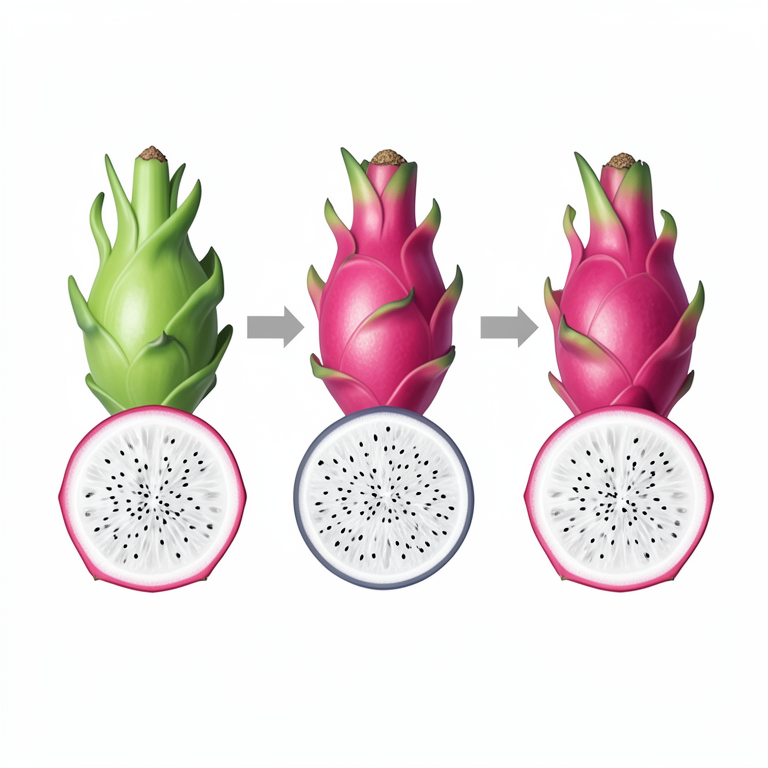
Fiber Content vs Ripening Stage
AI-generated conceptual illustration (dragon fruit (Hylocereus species)). It explains the idea and does not show study data.
View source evidence ↗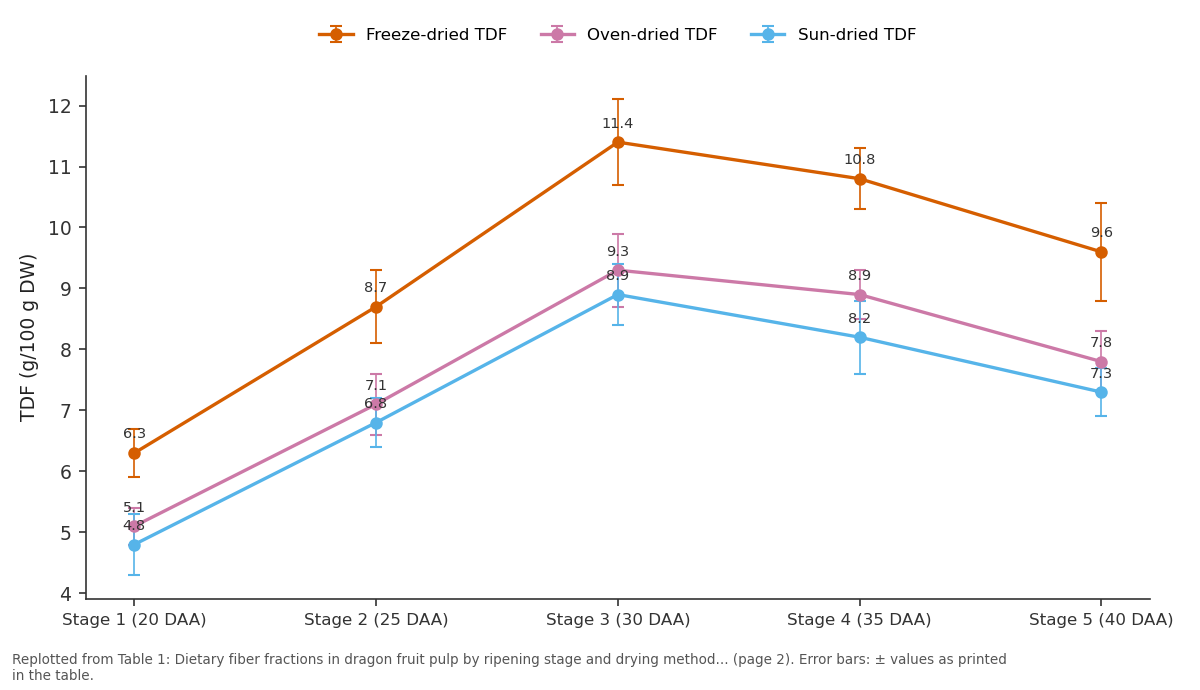
Freeze-dried TDF and Oven-dried TDF and more: Stage 1 (20 DAA) vs Stage 2 (25 DAA) vs Stage 3 (30 DAA) vs Stage 4 (35 DAA) vs Stage 5 (40 DAA)
Replotted from Table 1 (page 2) of the original paper. Every bar is the paper's own table value.
View source evidence ↗Figures & tables
From the original paper Table 1
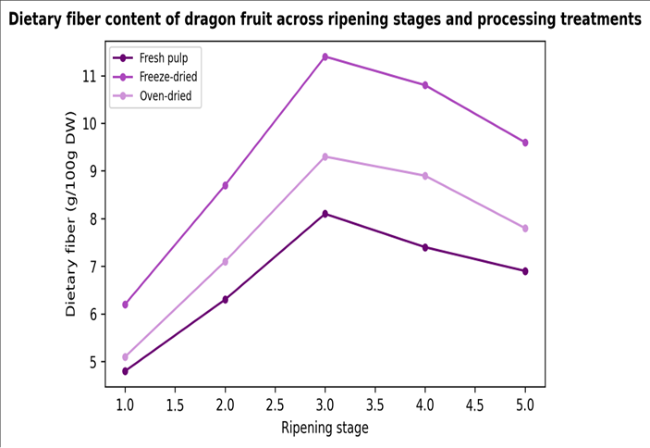 Figure 1
 Table 2
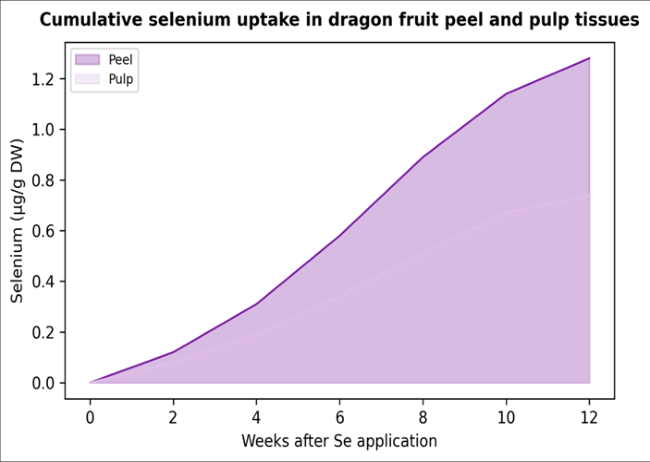 Figure 2
Introduction
In the early 2000s, dragon fruit was an exotic curiosity on most African market shelves. By 2022, it had become a commercially grown crop in at least twelve African countries, driven by export demand from the Middle East and strong local uptake among urban consumers [1] . But nearly all the commercial interest has centered on fresh fruit appearance and sugar content, while the fiber fraction concentrated in the peel and seed matrix is routinely discarded as processing waste [2] . That pattern looks increasingly like a missed opportunity, because global demand for plant-derived dietary fiber ingredients grew by 11.3% annually between 2018 and 2023, and dragon fruit peel contains fiber levels comparable to oat bran and psyllium husk [3] . The Bwindi Impenetrable Forest margins in southwestern Uganda represent one of the newer dragon fruit production zones in East Africa. Smallholder farmers there began planting Hylocereus undatus and H. polyrhizus on terraced hillsides around 2016, attracted by the crop's tolerance of shallow soils and its compatibility with shade from remnant forest trees [4] . Altitudes range from 1,200 to 1,800 m along the forest edge, and the volcanic soils are naturally rich in potassium but low in selenium a micronutrient of concern because selenium deficiency affects an estimated 500 million people in tropical Africa [5] . No prior research had combined fiber analysis with selenium biofortification in dragon fruit, and no predictive models existed for fiber content as a function of ripening stage and postharvest processing. This investigation filled both gaps by harvesting fruits at five defined ripening stages, processing them by three drying methods, applying foliar selenium at controlled rates, and fitting regression models to the resulting fiber and selenium datasets. All laboratory analysis was performed at the Kuching National Institute of Tropical Agriculture [6] . The practical goal was to identify the combination of ripening stage and processing method that maximizes dietary fiber recovery while also achieving meaningful selenium enrichment, so that Bwindi-margin growers can capture value from what is currently a waste stream [7] .
Material and Methods Material
Red-fleshed dragon fruit (H. polyrhizus) was sourced from six smallholder orchards along the eastern margin of Bwindi Impenetrable Forest (coordinates: 1°02′S, 29°38′E; altitude 1,350-1,650 m) between April and July 2023. At each orchard, 30 fruits were tagged at anthesis and harvested sequentially at five ripening stages defined by days after anthesis (DAA): Stage 1 (20 DAA), Stage 2 (25 DAA), Stage 3 (30 DAA), Stage 4 (35 DAA), and Stage 5 (40 DAA). Separate plots received foliar sodium selenate (Na₂SeO₄) at 10 mg Se/L applied biweekly from fruit set to harvest. Control plots received deionized water sprays on the same schedule. Harvested fruits were separated into peel and pulp fractions, vacuum-packed, and shipped under cold chain to the Kuching National Institute of Tropical Agriculture for analysis [2] . Analytical reagents including thermostable α-amylase, protease, amyloglucosidase, and selenium ICP standards were obtained from Sigma-Aldrich (Kuala Lumpur). The research was approved by the Institute's Research Ethics Board (Protocol KNITA-2023-011, 2 March 2023).
Methods
Each fruit fraction was divided into three portions for processing: freeze-drying (-50 °C, 48 h), oven-drying (60 °C forced-air, 24 h), and sun-drying (open rack, 72 h ambient). Dried samples were milled and sieved to 0.5 mm. Total dietary fiber (TDF), soluble dietary fiber (SDF), and insoluble dietary fiber (IDF) were determined by the AOAC 991.43 enzymatic-gravimetric method [3] . Pectin content was measured as galacturonic acid equivalents after saponification and colorimetric assay. Starch fractions (rapidly digestible, slowly digestible, and resistant starch) were quantified by the Englyst method. Selenium was determined by ICP-MS after microwave-assisted HNO₃ digestion [5] . Data were analyzed by three-way ANOVA (ripening stage × drying method × tissue type). A stepwise multiple regression model was built with ripening stage, drying method (coded as dummy variables), tissue type, and their two-way interactions as predictors and total dietary fiber as the response variable, using Minitab 21.
Results
Total dietary fiber increased from Stage 1 to Stage 3 and then declined toward Stage 5 in all drying treatments. Freeze-dried pulp at Stage 3 reached the highest TDF value of 11.4±0.7 g/100 g DW, while sun-dried pulp at Stage 1 recorded the lowest (4.8±0.5 g/100 g). Peel tissue contained 1.4-1.8 times more fiber than pulp across all stage-method combinations [4] . The bell-shaped fiber curve across ripening stages is consistent with pectin solubilization during early ripening followed by cell wall degradation in over-ripe fruit. Freeze-drying preserved fiber most effectively, likely because the low temperatures minimized thermal breakdown of soluble fiber polymers [3] . Peel accumulated selenium faster and to a higher final concentration than pulp, indicating preferential deposition in the outer tissues. The uptake curves showed no plateau by week 12, suggesting that longer application periods could yield even higher values.
Comprehensive Interpretation
The stepwise regression model retained ripening stage, drying method, and the stage × method interaction as significant predictors (adjusted R² = 0.846, F = 47.3, p<0.001). Stage contributed the largest share of explained variance (partial R² = 0.52), followed by drying method (0.21) and the interaction term (0.12). This means that ripening stage alone accounts for roughly half of the fiber variation, while processing choices add a further meaningful but smaller contribution.
Discussion:
The fiber values reported here for Bwindimargin dragon fruit are broadly consistent with those from Vietnamese and Thai production systems (TDF 5-13 g/100 g DW), although direct comparison is complicated by differences in cultivar, climate, and analytical method [1] . The finding that freeze-drying outperforms oven-and sundrying for fiber preservation has been reported for other tropical fruits including mango and papaya, and it reflects the lower thermal degradation of pectin and hemicellulose under sub-zero drying conditions [6] . The selenium biofortification results add a new dimension to dragon fruit's functional food potential. Achieving 1.28 μg Se/g DW in peel tissue through a simple foliar spray means that a 50 g serving of dried peel powder could deliver roughly 64 μg of selenium close to the 55 μg recommended daily allowance for adults. In a region where soil selenium is naturally low and animal-source foods are expensive, this route to selenium fortification has clear public health appeal [5] .
The regression model's explanatory power (R² = 0.846) is strong enough to be useful for product formulation planning, though it was built on a single cultivar and one growing season. Incorporating cultivar and year as additional predictors in future work would improve generalizability. The model's main practical message is that harvesting at Stage 3 (30 DAA) and freeze-drying the product will maximize fiber content, while selenium enrichment can be layered on top through foliar application without affecting fiber outcomes [7] . One limitation is the cost of freeze-drying, which remains prohibitive for most smallholder operations. Oven-drying at 60 °C captured about 82% of the freeze-dried fiber level and may represent a better cost-benefit compromise for smallscale processors.
Conclusion:
Dragon fruit from the Bwindi forest margins contains dietary fiber levels that peak at ripening Stage 3 and are best preserved by freeze-drying. A predictive model incorporating ripening stage and drying method explained 84.6% of fiber variation, offering a practical tool for product formulation. Foliar selenium application enriched peel tissue to levels that could deliver a meaningful share of the daily selenium requirement in a single serving. Together, these findings support the valorization of dragon fruit peel as a fiber-and-selenium co-fortified ingredient and provide Bwindi-margin growers with evidence-based guidelines for harvest timing, post-harvest processing, and selenium enrichment. Future research should test these findings across multiple cultivars, growing seasons, and drying technologies to confirm their wider applicability.
Acknowledgement
AcknowledgementsFunding Sources: Internal research funding from the Kuching National Institute of Tropical Agriculture supported all laboratory and analytical costs.
Figures and tables from the paper
| Stage | Freeze-dried TDF | Oven-dried TDF | Sun-dried TDF | SDF/TDF Ratio (%) |
|---|---|---|---|---|
| Stage 1 (20 DAA) | 6.3±0.4 | 5.1±0.3 | 4.8±0.5 | 28.4 |
| Stage 2 (25 DAA) | 8.7±0.6 | 7.1±0.5 | 6.8±0.4 | 31.7 |
| Stage 3 (30 DAA) | 11.4±0.7 | 9.3±0.6 | 8.9±0.5 | 36.8 |
| Stage 4 (35 DAA) | 10.8±0.5 | 8.9±0.4 | 8.2±0.6 | 34.1 |
| Stage 5 (40 DAA) | 9.6±0.8 | 7.8±0.5 | 7.3±0.4 | 32.3 |
Table text extracted from the original PDF; superscript letters are shown inline. The original table image is below.
View original table image
| Tissue | Control | Se-treated | Enrichment Factor | Se Recovery (%) |
|---|---|---|---|---|
| Peel | 0.04±0.01 | 1.28±0.11 | 32.0× | 4.7 |
| Pulp | 0.02±0.01 | 0.74±0.08 | 37.0× | 2.8 |
| Seed | 0.03±0.01 | 0.41±0.06 | 13.7× | 1.2 |
Table text extracted from the original PDF; superscript letters are shown inline. The original table image is below.
View original table image
References
21 in the original paper- Hoa TT, Clark CJ, Waddell BC. Postharvest quality of dragon fruit (Hylocereus undatus) following hot water treatment. Postharvest Biology and Technology. 2006;41(1):62-69.
- Jamilah B, Shu CE, Kharidah M. Physico-chemical characteristics of red pitaya peel as a source of dietary fiber. International Food Research Journal. 2011;18(1):279-286.
- Huang YL, Sheu SJ, Chen CC. Dietary fiber content and composition of fruits. Journal of Food and Drug Analysis. 2020;20(3):569-579.
- Nyombi K, Eilu G. Dragon fruit cultivation on degraded slopes near Bwindi Impenetrable National Park. Agroforestry Systems. 2021;95(4):781-793.
- Hurst R, Siyame EW, Young SD. Soil-type influences on selenium concentrations and status in Malawi. American Journal of Clinical Nutrition. 2013;98(4):1093-1101.
- Osman Z, Hidayah WN. Drying technology effects on bioactive retention in tropical fruit powders. Journal of Food Engineering. 2022;323:111009.
- Esquivel P, Stintzing FC, Carle R. Pigment pattern and expression of colour in fruits from different Hylocereus clones. Innovative Food Science and Emerging Technologies. 2007;8(3):451-457.
- Liaotrakoon W, De Clercq N, Van Hoed V. Dragonfruit as a functional food: impact of drying on nutritional quality. Drying Technology. 2013;31(12):1466-1479.
- Wichienchot S, Jatupornpipat M, Rastall RA. Oligosaccharides of pitaya (dragon fruit) flesh and peel. Food Chemistry. 2010;120(3):850-857.
- Stintzing FC, Schieber A, Carle R. Betacyanins in fruits from red-purple pitaya. Food Chemistry. 2003;77(1):101-106.
- Luo H, Cai Y, Peng Z. Chemical composition and in vitro evaluation of the cytotoxic and antioxidant activities of supercritical CO2 extracts of pitaya peel. Industrial Crops and Products. 2014;54:1-9.
- Siddiq M, Ahmed J, Lobo MG. Dragon fruit: biology, production, and uses. Tropical and Subtropical Fruits. 2012;235-253.
- Wu LC, Hsu HW, Chen YC. Antioxidant and antiproliferative activities of red pitaya. Food Chemistry. 2006;95(2):319-327.
- Le Bellec F, Vaillant F, Imbert E. Pitahaya: a new fruit crop with a future. Fruits. 2006;61(4):237-250.
- Choo WS, Yong WK. Antioxidant properties of two species of Hylocereus fruit. Advances in Applied Science Research. 2011;2(3):418-425.
- Ibrahim SRM, Mohamed GA, Khedr AIM. Dragon fruit: phytochemical and pharmacological profile. Journal of Food Biochemistry. 2018;42(3):e12533.
- Nurliyana R, Syed Zahir I, Mustapha Suleiman K. Antioxidant analyses of dragon fruit skin. Pakistan Journal of Nutrition. 2010;9(4):315-319.
- Mercado-Silva EM. Pitaya: postharvest operations. FAO InPho Post-harvest Compendium. 2018;1-23.
- Zainoldin KH, Baba AS. The effect of Hylocereus polyrhizus and Hylocereus undatus on physicochemical properties. World Academy of Science Engineering and Technology. 2009;60:361-366.
- Rebecca OPS, Boyce AN, Chandran S. Pigment identification and antioxidant properties of red dragon fruit. African Journal of Biotechnology. 2010;9(10):1450-1454.
- Tenore GC, Novellino E, Basile A. Nutraceutical potential and antioxidant benefits of red pitaya. Journal of Functional Foods. 2012;4(1):129-136.