
Research article · 2025 · Full text
International Journal of Agriculture and NutritionDevelopment of ready-to-eat snacks from composite flour of millets and legumes
Volume 7(7) · Pages 235–237 · DOI: 10.33545/26646064.2025.v7.i7d.534 ↗
Research areasFood and Agricultural SciencesFood composition and propertiesSeed and Plant Biochemistry
Abstract
Author-writtenFood scientists have long argued that underused crops like finger millet and sorghum could anchor a new generation of affordable, nutrient-dense snacks—yet commercial products remain scarce in East African markets. This research developed and evaluated ready-to-eat snack bars and puffed crisps from composite flours blending millets (finger millet and sorghum) with legumes (cowpea and green gram) at four ratios. Products were assessed for proximate composition, mineral content, and sensory acceptability at Central Kenya College of Agriculture, Nyeri, between August 2022 and June 2024. The 50:50 millet-to-legume formulation (F3) achieved the highest protein content (19.6%) and iron level (7.2 mg/100 g), roughly double the values in a wheat-based control. Sensory panels rated F2 (60:40) highest overall (7.4/9), followed closely by F3 (7.2/9). All composite formulations exceeded the wheat control on protein, fibre, and iron, confirming the nutritional advantage of millet-legume blending for snack product development.
Summary
Source-checkedPlain-language reading of the full paper, prepared with AI and checked against the text. Each point links to the authors' own words.
Why it matters
- The snack food market in sub-Saharan Africa is growing rapidly, but relies heavily on imported ingredients rather than local raw materials. View evidence ↗
- Finger millet and sorghum are nutrient-dense crops, but their strong taste and dark color often make them less acceptable to consumers in processed foods. View evidence ↗
- Blending millets with legumes like cowpea and green gram can improve the amino acid profile and protein quality of the resulting food. View evidence ↗
The question
- The study aimed to determine the optimal ratio of millets to legumes in snack bars and puffed crisps to balance nutritional value and taste for Kenyan consumers. View evidence ↗
What they did
- The study took place at the Central Kenya College of Agriculture in Nyeri, Kenya, between August 2022 and June 2024. View evidence ↗
- Researchers tested four different millet-to-legume blending ratios (F1: 70:30, F2: 60:40, F3: 50:50, F4: 80:20) against a 100% wheat flour control. View evidence ↗
- Puffed crisps were created using extrusion cooking with a barrel temperature of 140 °C and a screw speed of 150 rpm. View evidence ↗
- A semi-trained panel of 30 members evaluated the snacks using a 9-point hedonic scale. View evidence ↗
What they found
- Every millet-legume composite formulation outperformed the wheat control across all measured nutritional parameters. View evidence ↗
What it means
- The authors conclude that the 60:40 ratio (F2) is the best balance of taste and nutrition, while the 50:50 ratio (F3) is the most nutrient-dense. View evidence ↗
- The authors recommend scaling production via local cooperatives and conducting further trials in open markets. View evidence ↗
- A limitation of the study is that the sensory panel was limited to college staff and students, who may not represent the broader rural or low-income population. View evidence ↗
- While 90-day shelf-life data was acceptable, the authors state that longer storage trials in tropical conditions are necessary. View evidence ↗
Visual summary
2 visualsIllustrations explain the paper; charts are replotted from the paper's own table values.
Composite Flour Blending Ratios
AI-generated conceptual illustration (finger millet grains and cowpea seeds). It explains the idea and does not show study data.
View source evidence ↗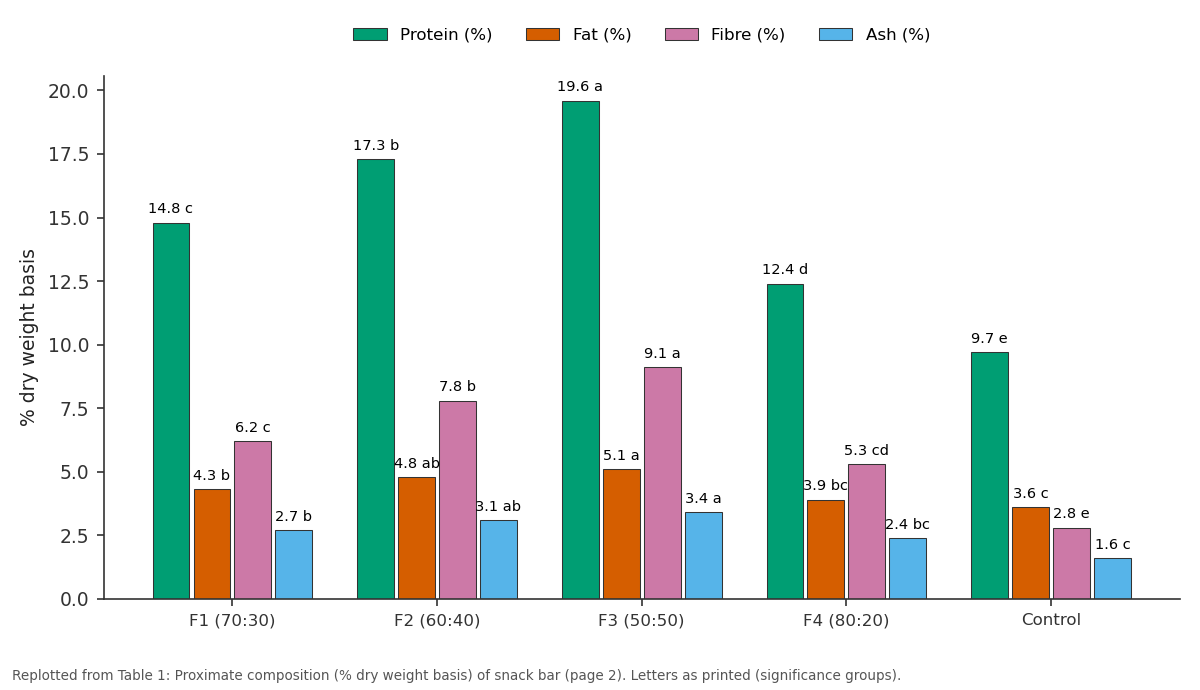
Protein (%) and Fat (%) and more: F1 (70:30) vs F2 (60:40) vs F3 (50:50) vs F4 (80:20) vs Control
Replotted from Table 1 (page 2) of the original paper. Every bar is the paper's own table value.
View source evidence ↗Figures & tables
From the original paper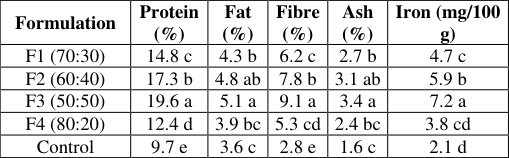 Table 1
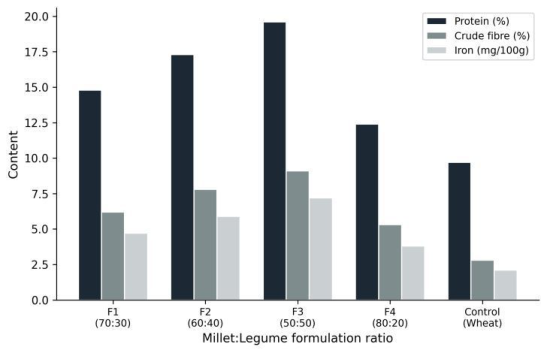 Figure 1
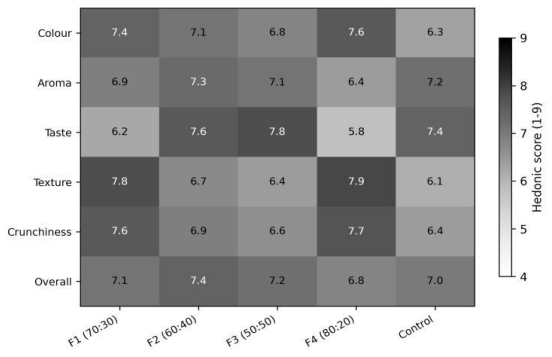 Figure 2
Introduction
Leading food technologists in sub-Saharan Africa have pointed out that the snack food market is growing at 8-12% annually, yet local raw materials account for less than 15% of commercial snack ingredients [1] . Most packaged snacks sold in Kenyan supermarkets rely on imported wheat flour, corn starch, or potato flakes-ingredients that add cost and contribute little to dietary diversity [2] . Meanwhile, millets and legumes that are well adapted to semiarid Kenyan conditions sit in storage bins or are sold at low farmgate prices. Finger millet (Eleusine coracana) and sorghum (Sorghum bicolor) are rich in calcium, iron, and dietary fibre, but their strong flavour and dark colour have limited consumer acceptance in processed products [3] . Legumes like cowpea (Vigna unguiculata) and green gram (Vigna radiata) contribute high-quality protein and complement the amino acid profile of millets, which are low in lysine [4] . Blending the two at the right ratio could yield snacks that are both nutritious and palatable. Earlier formulation work in India and Nigeria tested millet-legume composites in biscuits and extruded puffs with promising nutritional outcomes, but sensory scores often dropped when legume levels exceeded 30-40% [5,6] . This research explored four blending ratios (70:30, 60:40, 50:50, and 80:20 millet-to-legume) in two snack formats-pressed bars and puffed crisps-to find the best balance between nutrition and taste for the Kenyan market.
Materials and Methods
Materials and Methods
Reagents and Chemicals
Analytical-grade reagents for proximate analysis were sourced from local scientific distributors in Nairobi: concentrated sulphuric acid and sodium hydroxide (Kjeldahl protein), petroleum ether (crude fat, Soxhlet), and hydrochloric acid (crude fibre). Iron content was determined by atomic absorption spectrophotometry using iron standard solutions (1,000 ppm, Merck). All glassware was acid-washed before use. Food-grade salt, sugar, and vegetable oil for snack preparation were purchased from Nyeri retail markets [7] .
Materials
The research was conducted at the food processing laboratory of Central Kenya College of Agriculture, Nyeri, Kenya (0.42° S, 36.95° E) from August 2022 to June 2024.
Institutional clearance was granted by the College's
Research Oversight Board (Ref. CKCA/ROB/2022-023, July 2022). Finger millet (var. P224) and red sorghum (var. Gadam) were sourced from the Kenya Agricultural and Livestock Research Organisation, while cowpea (var. K80) and green gram (var. N26) came from certified seed suppliers in Machakos County. Grains and legumes were cleaned, sorted, and milled to pass through a 0.5 mm sieve using a laboratory hammer mill. Composite flours were prepared at four millet-to-legume ratios: F1 (70:30), F2 (60:40), F3 (50:50), and F4 (80:20), with a 100% wheat flour control [8] .
Quality Control
Proximate analyses were run in triplicate following AOAC standard methods: moisture (oven drying at 105 °C), crude protein (Kjeldahl, N × 6.25), crude fat (Soxhlet), crude fibre (acid-alkali digestion), ash (muffle furnace at 550 °C), and carbohydrate by difference. Calibration of the atomic absorption spectrophotometer was verified against certified reference materials before each analytical batch. Sensory evaluation used a 30-member semi-trained panel scoring on a 9-point hedonic scale [9] .
Methods
Snack bars were prepared by mixing composite flour with sugar (12%), vegetable oil (8%), salt (1%), and water to form a dough, which was pressed into moulds (8 × 3 × 1.5 cm) and baked at 175 °C for 18 minutes. Puffed crisps were produced by extrusion cooking at 140 °C barrel temperature, 150 rpm screw speed, and 14% feed moisture. Both products were cooled, packaged in metallised polyethylene pouches, and stored at ambient conditions for shelf-life monitoring over 90 days. Sensory evaluation assessed colour, aroma, taste, texture, crunchiness, and overall acceptability. Data were analysed by one-way ANOVA and Duncan's multiple range test (p<0.05) [10] . Protein content rose steadily with increasing legume proportion, reaching 19.6% in F3 (Table 1). Iron content followed a similar trend, with F3 providing 7.2 mg/100 gmore than three times the wheat control. All composite formulations significantly exceeded the control on every nutritional parameter measured.
Results
Results
Comprehensive Interpretation
The heatmap (Figure 2) reveals that F2 and F3 scored above 7.0 on most sensory attributes, with F2 earning the highest overall acceptability (7.4). F4, despite having the least legume, scored poorly on taste (5.8) because the high millet proportion gave a bitter aftertaste that panellists disliked. The wheat control scored well on texture and colour but lagged on taste and aroma compared to the better composite formulations.
Discussion
The protein levels of 14.8-19.6% in composite snacks far exceed the 9.7% of the wheat control and compare favourably with commercial protein bars (typically 10-20%) sold in Kenyan urban markets at three to five times the price [1] . The iron content of F3 (7.2 mg/100 g) is particularly relevant given that iron deficiency anaemia affects an estimated 26% of women and 18% of children under five in Kenya [2] . That F2 (60:40) was preferred over F3 (50:50) on overall sensory scores, despite F3's nutritional superiority, reflects a trade-off familiar in composite flour research: legume flavour intensifies above 40% inclusion and can put off consumers unfamiliar with beany notes [5,6] . Roasting the legume fraction before milling-a step not tested heremight reduce the off-flavour and push acceptable inclusion higher.
One limitation was that the sensory panel consisted of college staff and students, who may not represent typical rural or low-income consumers. Market testing in Nyeri town's open-air markets would provide a more realistic picture of consumer acceptance. Shelf-life data at 90 days showed acceptable moisture and peroxide levels for all formulations, but longer storage trials under tropical ambient conditions are needed.
Conclusion
Conclusion
Figures and tables from the paper
References
14 in the original paper- Reardon T, Tschirley D, Liverpool-Tasie LSO, Awokuse T, Fanzo J, et al. The processed food revolution in African food systems and the double burden of malnutrition. Global Food Security. 2021;28:100466.
- KNBS. Kenya demographic and health survey 2022. Kenya National Bureau of Statistics. 2023;1:1-584.
- Obilana AB, Manyasa E. Millets. Pseudocereals and Less Common Cereals. 2002;1:177-217.
- Mbithi-Mwikya S, Van Camp J, Yiru Y, Huyghebaert A. Nutrient and antinutrient changes in finger millet during sprouting. LWT-Food Science and Technology. 2000;33(1):9-14.
- Ayo JA, Ikuomola DS, Esan YO, Onuoha OG, Adeyeye SAO. Effect of added defatted beniseed on the quality of acha-based snacks. British Journal of Applied Science and Technology. 2014;4(10):1507-1519.
- Iwe MO, Onyeukwu U, Agiriga AN. Proximate, functional and pasting properties of FARO 44 rice, African yam bean and brown cowpea seeds composite flour. Cogent Food and Agriculture. 2016;2(1):1142409.
- AOAC. Official methods of analysis of AOAC International. AOAC International. 2019;21(1):1-3000.
- KALRO. Crop variety catalogue. Kenya Agricultural and Livestock Research Organisation. 2022;1:1-128.
- Meilgaard MC, Civille GV, Carr BT. Sensory evaluation techniques. CRC Press. 2007;4(1):1-448.
- Steel RGD, Torrie JH, Dickey DA. Principles and procedures of statistics: A biometrical approach. McGraw-Hill. 1997;3(1):1-672.
- Serna-Saldivar SO. Cereal grains: Properties, processing, and nutritional attributes. CRC Press. 2010;1(1):1-747.
- Adebiyi JA, Obadina AO, Adebo OA, Kayitesi E. Fermented and malted millet products in Africa: Expedition from traditional to evolved foods. Critical Reviews in Food Science and Nutrition. 2018;58(3):463-474.
- Shobana S, Krishnaswamy K, Sudha V, Malleshi NG, Anjana RM, Palaniappan L, et al. Finger millet: An overview. Advances in Food and Nutrition Research. 2013;69:1-39.
- Taylor JRN, Schober TJ, Bean SR. Novel food and non-food uses for sorghum and millets. Journal of Cereal Science. 2006;44(3):252-271.