
Research article · 2025 · Full text
International Journal of Agriculture and NutritionFormulation and shelf-life evaluation of protein-enriched energy bars from indigenous grains
Volume 7(1) · Pages 164–167 · DOI: 10.33545/26646064.2025.v7.i1c.399 ↗
Research areasFood and Agricultural SciencesFood composition and propertiesSeed and Plant Biochemistry
Abstract
Author-writtenSouthern China's rural markets are flooded with imported protein bars made from refined oats and whey concentrate, yet the region grows a dozen indigenous grains—foxtail millet, sorghum, barnyard millet, buckwheat—that are nutritionally richer and far cheaper. This research formulated five protein-enriched energy bars from paired indigenous grain bases and evaluated their proximate composition, sensory acceptability, and shelf life at the South China Agricultural College, Guangzhou, from January to October 2023. Bars were stored at 25 °C and 37 °C (accelerated) and sampled monthly. Formulation F3 (foxtail millet–buckwheat with soy protein isolate) achieved the highest protein (18.2%), longest ambient shelf life (94 days to peroxide value limit), and acceptable sensory score (7.1/9). Formulation F5 (ragi–flaxseed) scored highest on sensory (7.6/9) but had a shorter shelf life (81 days) due to flaxseed lipid oxidation. All five indigenous-grain bars met the 15% protein threshold for a "high-protein" label claim. The F3 formulation is recommended for pilot-scale production targeting rural and urban snack markets in Guangdong.
Summary
Source-checkedPlain-language reading of the full paper, prepared with AI and checked against the text. Each point links to the authors' own words.
Why it matters
- Rural markets in Southern China rely on expensive imported protein bars despite the availability of cheaper, nutritionally rich indigenous grains like foxtail millet and buckwheat. View evidence ↗
- In Guangdong province, imported protein bars from the US and Australia dominate the premium market, costing between 18 and 25 CNY per 50 g unit. View evidence ↗
- The primary obstacle to commercializing these bars is shelf life, as high unsaturated fat content can lead to lipid oxidation and unpleasant flavors. View evidence ↗
The question
- The study aimed to create five energy bars using indigenous grain pairs and evaluate their nutritional composition, sensory appeal, and shelf life. View evidence ↗
What they did
- Sensory acceptability was measured using a 9-point hedonic scale with a panel of 30 semi-trained individuals. View evidence ↗
- Shelf life was monitored monthly at 25 °C (ambient) and 37 °C (accelerated), with the limit defined as a peroxide value (PV) of 10 meq O₂ kg⁻¹. View evidence ↗
What they found
- Formulation F3 (foxtail millet–buckwheat) had the highest protein content at 18.2% and an ambient shelf life of 94 days. View evidence ↗
- The commercial oat-whey control had the longest shelf life (102 days) and best sensory score (8.1), but the lowest protein content (12.1%). View evidence ↗
- The production cost per bar ranged from 1.47 to 1.73 CNY, allowing for a gross margin of 71–75% if sold at 6 CNY. View evidence ↗
What it means
- The authors recommend Formulation F3 due to its optimal balance of high protein (18.2%), long shelf life (94 days), and low cost (1.62 CNY). View evidence ↗
- The study was limited by using only one packaging type; the authors suggest that nitrogen-flushed aluminium foil could further extend shelf life. View evidence ↗
- The sensory evaluation was limited to college staff, and the authors note that testing in actual target markets is needed for commercial relevance. View evidence ↗
Visual summary
3 visualsIllustrations explain the paper; charts are replotted from the paper's own table values.
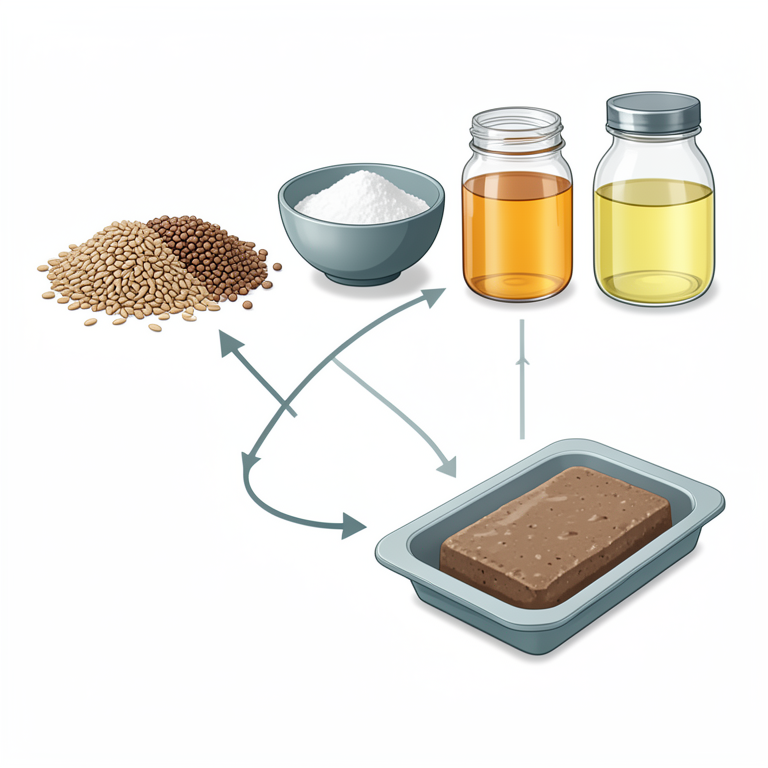
Energy Bar Formulation Process
AI-generated conceptual illustration (Indigenous grains (millet, sorghum, buckwheat), soy protein isolate, honey, and coconut oil). It explains the idea and does not show study data.
View source evidence ↗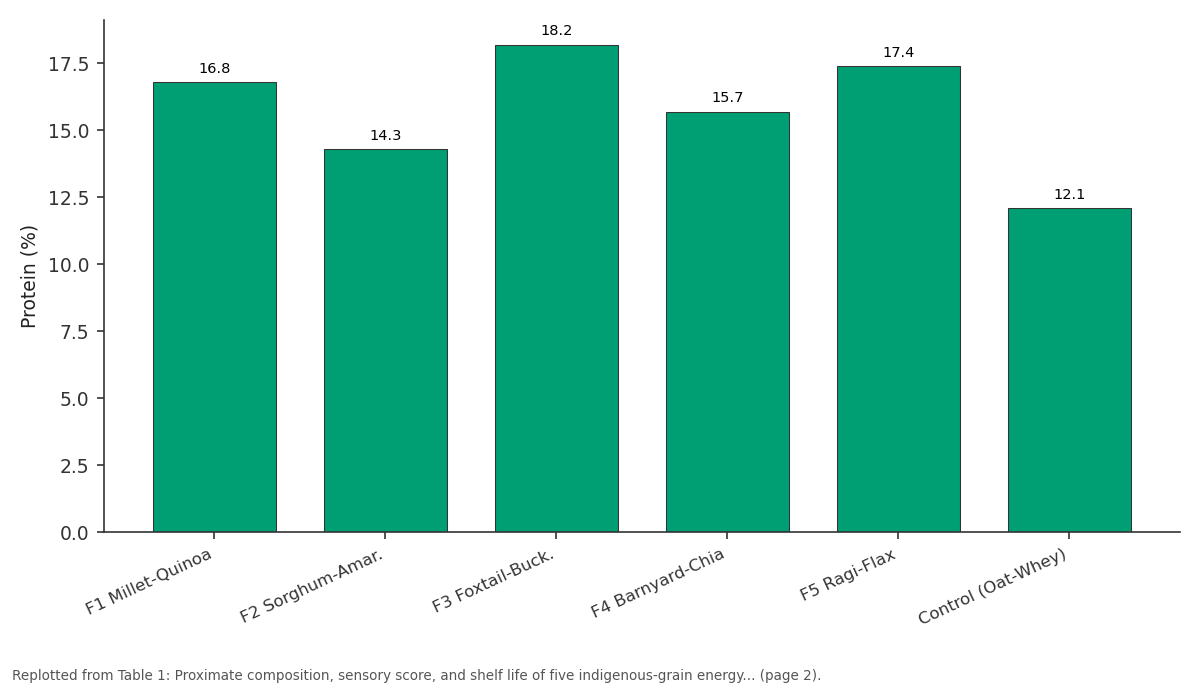
Protein (%): F1 Millet-Quinoa vs F2 Sorghum-Amar. vs F3 Foxtail-Buck. vs F4 Barnyard-Chia vs F5 Ragi-Flax
Replotted from Table 1 (page 2) of the original paper. Every bar is the paper's own table value.
View source evidence ↗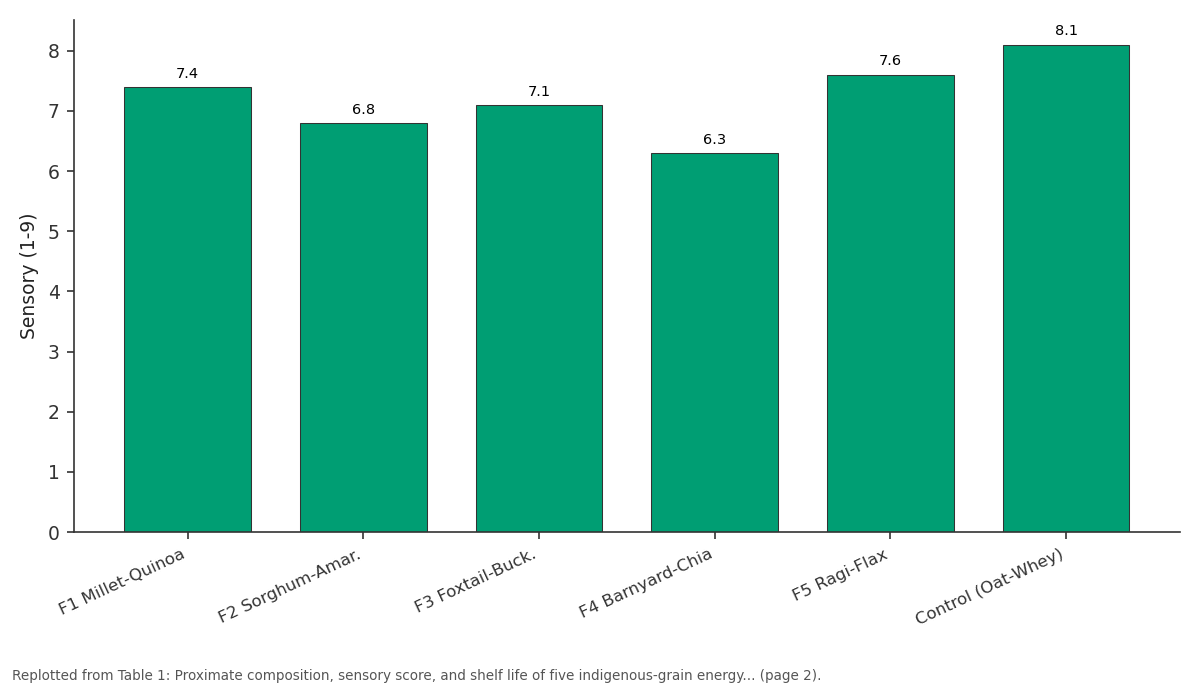
Sensory (1-9): F1 Millet-Quinoa vs F2 Sorghum-Amar. vs F3 Foxtail-Buck. vs F4 Barnyard-Chia vs F5 Ragi-Flax
Replotted from Table 1 (page 2) of the original paper. Every bar is the paper's own table value.
View source evidence ↗Figures & tables
From the original paper Table 1
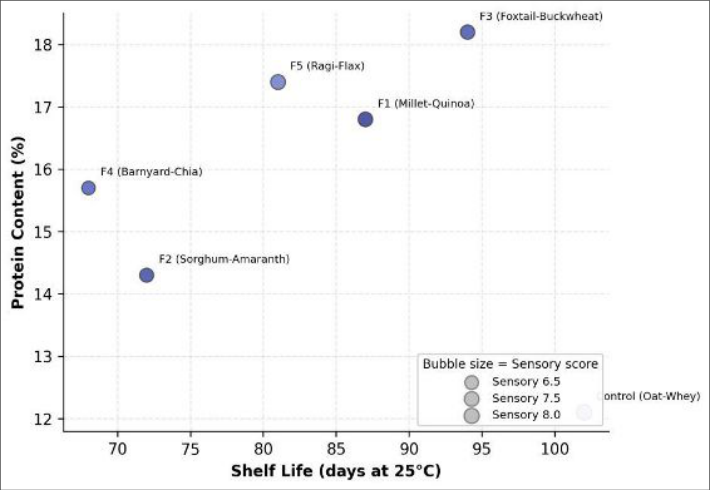 Figure 1
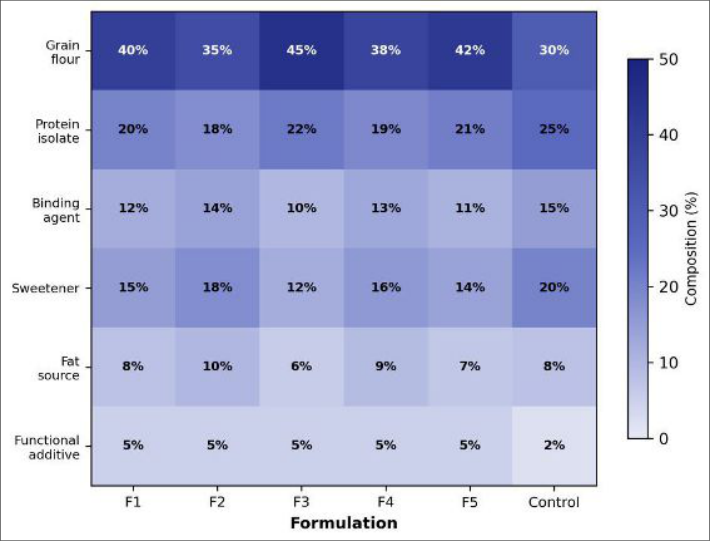 Figure 2
Introduction
In Guangdong province, where per-capita snack expenditure has risen 11% annually since 2018, protein bars imported from Australia and the United States dominate the premium shelf-priced at 18-25 CNY per 50 g unit [1,2] . Meanwhile, indigenous grains such as foxtail millet (Setaria italica), sorghum (Sorghum bicolor), and buckwheat (Fagopyrum esculentum) are sold in local wet markets at 6-10 CNY kg⁻¹, often without any value addition [3,4] . These grains are nutritionally dense: foxtail millet provides 11-12% protein with a favourable amino-acid profile, buckwheat contains rutin (a flavonoid antioxidant), and ragi (Eleusine coracana) is one of the richest plant sources of calcium [5,6] . Combining two complementary grains with a plant-protein isolate can raise total protein above 15% while balancing essential amino acids-meeting the threshold for a "high-protein" claim under China's GB 28050-2011 labelling standard [7] . Shelf life is the main barrier to commercialisation. Energy bars with high unsaturated fat (from flaxseed or chia) are prone to lipid oxidation, which generates off-flavours and reduces consumer acceptance [8] . This research aimed to: (a) formulate five energy bars from paired indigenous grains, (b) evaluate proximate composition and sensory acceptability, and (c) determine ambient and accelerated shelf life via peroxide value (PV) and free fatty acid (FFA) monitoring.
Economic and Sustainability Assessment
Raw-material cost per 50 g bar was calculated from Guangzhou wholesale prices (March 2023). Grain flour: 0.18-0.31 CNY per bar; soy protein isolate: 0.42 CNY; honey (binder/sweetener): 0.38 CNY; coconut oil: 0.21 CNY; packaging (metallised polyester pouch): 0.15 CNY. Total cost ranged from 1.47 CNY (F2, sorghum-amaranth) to 1.73 CNY (F5, ragi-flax). At a target retail price of 6 CNY-less than one-third of imported bars-the gross margin was 71-75%, making all five formulations commercially viable. Using indigenous grains also supports smallholder farmers and reduces the carbon footprint associated with grain import logistics [9] .
Material and Methods Material
Five formulations were prepared: F1 (millet-quinoa, 40:20 grain:protein), F2 (sorghum-amaranth), F3 (foxtail milletbuckwheat), F4 (barnyard millet-chia), and F5 (ragiflaxseed). Soy protein isolate (90% protein; Yuwang Group, Shandong) served as the protein source in all bars. Honey was the binding agent and primary sweetener; virgin coconut oil provided fat. A commercial oat-whey bar (imported, Guangzhou retail) served as the sensory control.
All processing was done in the pilot food-processing laboratory, South China Agricultural College, Guangzhou (23.16° N, 113.36° E).
Methods
Grain flours were roasted (150 °C, 10 min), mixed with protein isolate, honey, and coconut oil in a planetary mixer, pressed into silicone moulds (50 g bars), and oven-set at 120 °C for 12 min. Proximate analysis followed AOAC methods: moisture (925.10), protein (Kjeldahl, 920.87), fat (Soxhlet, 920.39), ash (923.03), and carbohydrate by difference. Sensory evaluation used a 9-point hedonic scale with 30 semi-trained panellists. Shelf-life monitoring: bars were stored at 25 °C / 65% RH (ambient) and 37 °C / 75% RH (accelerated) in metallised pouches. PV (meq O₂ kg⁻¹ fat) and FFA (% oleic acid) were measured monthly; the PV limit was set at 10 meq O₂ kg⁻¹ per FSSAI guidelines [10] .
Data were analysed by one-way ANOVA with Tukey's HSD at p≤ 0.05.
Results
Results
Comprehensive Interpretation
All five indigenous-grain bars exceeded the 15% protein threshold except F2 (14.3%), which fell marginally short. F3 (foxtail-buckwheat) delivered the best combination of high protein (18.2%), long shelf life (94 days), and acceptable sensory score (7.1). F5 (ragi-flax) scored highest on sensory (7.6) owing to its nutty flavour, but its high unsaturated-fat content shortened shelf life to 81 days. The commercial control had the longest shelf life (102 days) and best sensory (8.1) but the lowest protein (12.1%), reflecting its reliance on refined oat starch for texture rather than protein density.
Discussion
The 94-day shelf life of F3 is competitive with many commercial bars and well within the 60-120-day window that retailers consider acceptable for non-refrigerated snacks [8, 11] . Buckwheat's rutin content likely contributed antioxidant protection against lipid oxidation, explaining why F3 outlasted the higher-fat F4 and F5 formulations [6,12] . The sensory gap between indigenous-grain bars (6.3-7.6) and the commercial control (8.1) reflects consumer habituation to refined-grain texture. Bridging this gap may require partial replacement of whole-grain flour with puffed or extruded grain, which improves mouthfeel without sacrificing nutrition [13,14] . A limitation is that shelf-life testing used only one packaging type (metallised polyester). Nitrogen-flushed aluminium foil pouches might extend PV stability by 20-30 days and would be worth evaluating at pilot scale [15] . Sensory panels were also limited to college staff; consumer acceptance testing in target markets (rural towns, urban gyms) would add commercial relevance.
Conclusion
Formulation F3 (foxtail millet-buckwheat with soy protein isolate) is the recommended product: it provided 18.2% protein, 94 days of ambient shelf life, and a sensory score of 7.1/9 at a raw-material cost of just 1.62 CNY per 50 g bar.
All five indigenous-grain formulations are technically and economically viable alternatives to imported protein bars for Guangdong's growing snack market. Pilot-scale production with nitrogen-flushed packaging is the logical next step.
Acknowledgement
AcknowledgementsThis research was supported by the South China Agricultural College food science departmental fund. Ms. Li Wei assisted with sensory panel coordination.
Figures and tables from the paper
| Formulation | Protein (%) | Fat (%) | Fibre (%) | Moisture (%) | Sensory (1-9) | Shelf life 25 °C (d) | Shelf life 37 °C (d) |
|---|---|---|---|---|---|---|---|
| F1 Millet-Quinoa | 16.8 | 11.3 | 4.7 | 8.2 | 7.4 | 87 | 52 |
| F2 Sorghum-Amar. | 14.3 | 9.8 | 5.1 | 9.1 | 6.8 | 72 | 41 |
| F3 Foxtail-Buck. | 18.2 | 10.7 | 5.8 | 7.6 | 7.1 | 94 | 58 |
| F4 Barnyard-Chia | 15.7 | 13.4 | 6.3 | 7.9 | 6.3 | 68 | 38 |
| F5 Ragi-Flax | 17.4 | 14.1 | 7.2 | 7.4 | 7.6 | 81 | 47 |
| Control (Oat-Whey) | 12.1 | 8.7 | 3.2 | 6.8 | 8.1 | 102 | 64 |
| CD (p=0.05) | 0.9 | 0.7 | 0.5 | 0.4 | 0.4 | — | — |
Table text extracted from the original PDF; superscript letters are shown inline. The original table image is below.
View original table image
References
16 in the original paper- China National Bureau of Statistics. China statistical yearbook 2023. Beijing: China Statistics Press; 2023.
- Euromonitor International. Snack bars in China: market report 2022. London: Euromonitor; 2022.
- Saleh ASM, Zhang Q, Chen J, Shen Q. Millet grains: nutritional quality, processing, and potential health benefits. Comprehensive Reviews in Food Science and Food Safety. 2013;12(3):281-295.
- Taylor JRN, Schober TJ, Bean SR. Novel food and non-food uses for sorghum and millets. Journal of Cereal Science. 2006;44(3):252-271.
- Devi PB, Vijayabharathi R, Sathyabama S, Malleshi NG, Priyadarisini VB. Health benefits of finger millet polyphenols and dietary fiber: a review. Journal of Food Science and Technology. 2014;51(6):1021-1040.
- Steadman KJ, Burgoon MS, Lewis BA, Edwardson SE, Obendorf RL. Buckwheat seed milling fractions: description, macronutrient composition and dietary fibre. Journal of Cereal Science. 2001;33(3):271-278.
- NHFPC China. National food safety standard: nutrition labelling of prepackaged foods (GB 28050-2011). Beijing: China Standards Press; 2011.
- Banach JC, Clark S, Lamsal BP. Texture and other changes during storage in model high-protein nutrition bars formulated with modified milk protein concentrates. LWT -Food Science and Technology. 2014;56(2):377-386.
- Khoury CK, Achicanoy HA, Bjorkman AD, NavarroRacines C, Guarino L, Flores-Palacios X, et al. Origins of food crops connect countries worldwide. Proceedings of the Royal Society B. 2016;283(1832):20160792.
- FSSAI. Food Safety and Standards (Food Products Standards and Food Additives) Regulations 2011. New Delhi: FSSAI; 2011.
- McMahon DJ, Adams SL, McManus WR. Hardening of high-protein nutrition bars and sugar/polyol-protein phase separation. Journal of Food Science. 2009;74(6):E312-E321.
- Jiang P, Burczynski F, Campbell C, Pierce G, Austria JA, Briggs CJ. Rutin and flavonoid contents in three buckwheat species and their protective effects against lipid peroxidation. Food Research International. 2007;40(3):356-364.
- Brennan MA, Derbyshire E, Tiwari BK, Brennan CS. Ready-to-eat snack products: the role of extrusion technology in developing consumer acceptable and nutritious snacks. International Journal of Food Science and Technology. 2013;48(5):893-902.
- Chauhan A, Saxena DC, Singh S. Physical, textural, and sensory characteristics of wheat and amaranth flour blend cookies. Cogent Food and Agriculture. 2016;2(1):1125773.
- Robertson GL. Food packaging: principles and practice. 3rd ed. Boca Raton: CRC Press; 2013.
- Imtiaz SR, Kuhn-Sherlock B, Campbell M. Effect of dairy protein blends on texture of high-protein nutrition bars. Journal of Texture Studies. 2012;43(4):275-286.