
Research article · 2025 · Full text
International Journal of Advanced Chemistry ResearchBioactive peptides released during fermentation of milk by lactic acid bacteria
Volume 7(12) · Pages 169–173 · DOI: 10.33545/26646781.2025.v7.i12c.480 ↗
Research areasProtein Hydrolysis and Bioactive PeptidesProbiotics and Fermented FoodsAntimicrobial Peptides and Activities
Abstract
Author-writtenHere is a paradox: fermented milk products like yogurt and kefir have been consumed for millennia as health-promoting foods, yet the specific bioactive peptides responsible for much of that benefit were identified only in the last three decades. This research characterized the peptide profiles and angiotensin-converting enzyme (ACE) inhibitory activity of milk fermented by five lactic acid bacteria (LAB) strains—Lactobacillus helveticus NCDC 288, Lactobacillus casei NCDC 297, Lactobacillus acidophilus NCDC 015, Lactobacillus rhamnosus NCDC 198, and Streptococcus thermophilus NCDC 074—over a 72-hour fermentation at 37 °C. Peptide release was tracked by measuring the degree of hydrolysis (DH) and by RP-HPLC-MS/MS identification of peptides in the <10 kDa ultrafiltrate. ACE inhibitory activity was measured by the spectrophotometric hippuric acid method. L. helveticus produced the highest DH (18.4% at 72 h) and the strongest ACE inhibition (IC₅₀: 0.41 mg protein/mL at 48 h), with the identified peptides Val-Pro-Pro (VPP) and Ile-Pro-Pro (IPP) as the main contributors. L. acidophilus ranked second in ACE inhibitory potency (IC₅₀: 0.68 mg/mL), while S. thermophilus generated the weakest proteolysis and ACE inhibition throughout the fermentation period. Antioxidant activity measured by the ABTS assay increased in parallel with DH, reaching 78.4 μmol Trolox equivalents per liter for L. helveticus fermentates at 72 h. Time-course analysis showed that ACE inhibition peaked between 24 and 48 hours for most strains, after which further proteolysis appeared to degrade some active peptides into inactive fragments. These results confirm L. helveticus as the most potent ACE-inhibitory peptide producer among common dairy LAB and suggest that controlled fermentation time is as important as strain selection for maximizing bioactivity.
Summary
Source-checkedPlain-language reading of the full paper, prepared with AI and checked against the text. Each point links to the authors' own words.
Why it matters
- Fermented milk products such as kefir and yogurt are known for health benefits, though the specific bioactive peptides providing these effects were only recently identified. View evidence ↗
- Certain tripeptides, specifically Val-Pro-Pro (VPP) and Ile-Pro-Pro (IPP), can lower systolic blood pressure by 3-8 mmHg in mildly hypertensive individuals by inhibiting the angiotensin-converting enzyme (ACE). View evidence ↗
- Bioactive peptides like VPP and IPP are stored within bovine casein and are only released when bacterial proteinases cleave the protein at specific positions. View evidence ↗
The question
- The study aimed to determine which lactic acid bacteria (LAB) strain and what specific fermentation duration maximize the production of ACE-inhibitory peptides. View evidence ↗
What they did
- Five LAB strains were compared using UHT whole milk fermented at 37 °C for 72 hours, with measurements taken at six different time points. View evidence ↗
- The strains tested included L. helveticus NCDC 288, L. casei NCDC 297, L. acidophilus NCDC 015, L. rhamnosus NCDC 198, and S. thermophilus NCDC 074. View evidence ↗
- To isolate the peptides for analysis, the milk supernatant was passed through a 10 kDa molecular weight cut-off (MWCO) membrane. View evidence ↗
What they found
- L. helveticus was the most effective strain, reaching the highest degree of hydrolysis (18.4% at 72 h) and the strongest ACE inhibition (IC₅₀ of 0.41 mg protein/mL at 48 h). View evidence ↗
- L. acidophilus was the second most potent strain for ACE inhibition, with an IC₅₀ of 0.68 mg/mL. View evidence ↗
- S. thermophilus showed the lowest activity, with a degree of hydrolysis of 7.2% at 72 h and a best IC₅₀ of 2.18 mg/mL. View evidence ↗
- Across all strains, ACE inhibitory activity peaked between 24 and 48 hours before plateauing or declining by 72 hours. View evidence ↗
- In L. helveticus fermentates, the amount of the active peptide VPP decreased by approximately 18% between 48 and 72 hours, suggesting degradation. View evidence ↗
- Antioxidant activity followed the same trend as ACE inhibition, with L. helveticus reaching 78.4 μmol Trolox equivalents per liter (TE/L) at 72 h. View evidence ↗
What it means
- The authors conclude that for L. helveticus, fermenting beyond 48 hours may reduce the functional benefits of the product due to peptide degradation. View evidence ↗
- L. acidophilus is recommended as a candidate for creating fermented milk products that provide both probiotic and antihypertensive benefits. View evidence ↗
- The study is limited by the use of a chemical test-tube assay, which does not account for how peptides survive digestion or are absorbed by the body. View evidence ↗
Visual summary
3 visualsIllustrations explain the paper; charts are replotted from the paper's own table values.
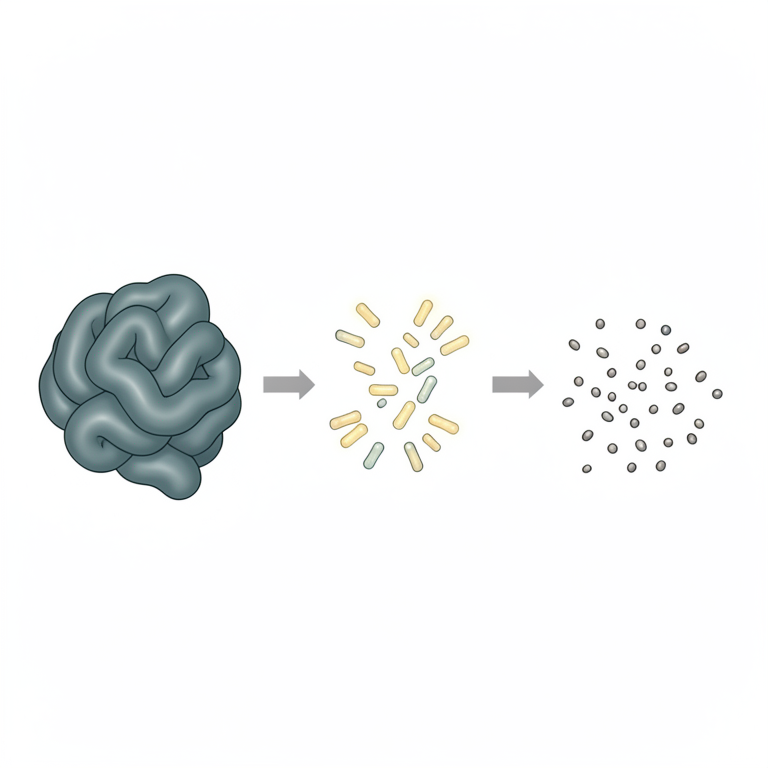
The Bioactive Peptide Lifecycle
AI-generated conceptual illustration (bovine casein proteins and lactic acid bacteria in milk). It explains the idea and does not show study data.
View source evidence ↗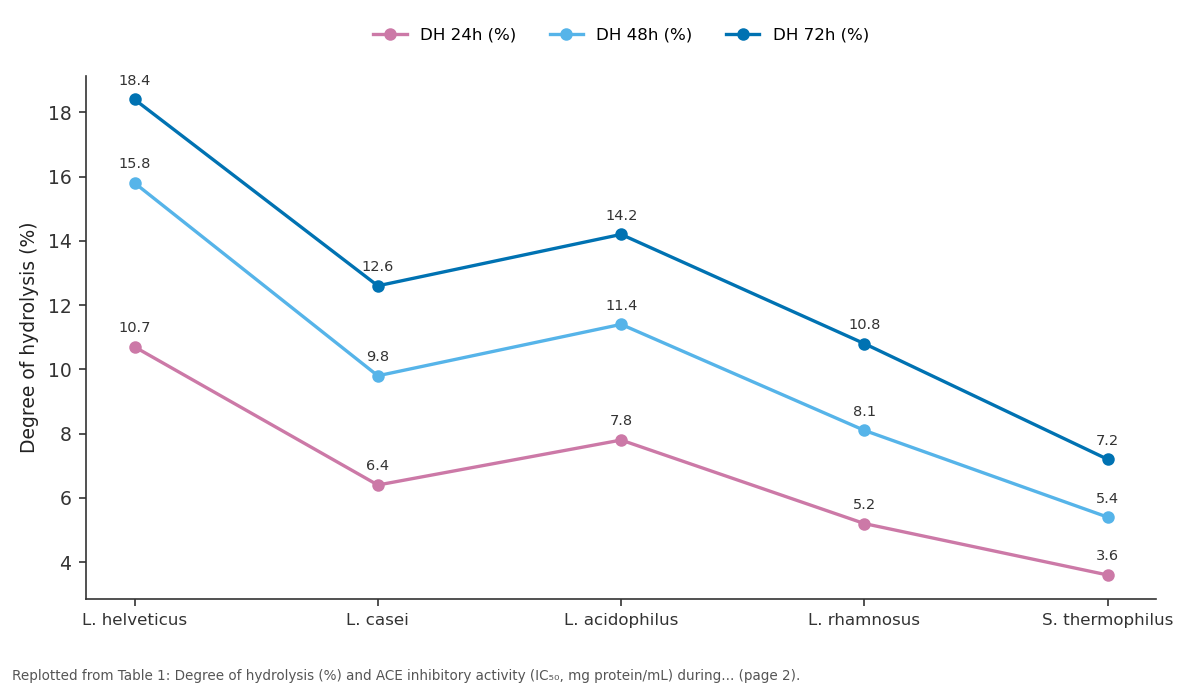
DH 24h (%) and DH 48h (%) and more: L. helveticus vs L. casei vs L. acidophilus vs L. rhamnosus vs S. thermophilus
Replotted from Table 1 (page 2) of the original paper. Every bar is the paper's own table value.
View source evidence ↗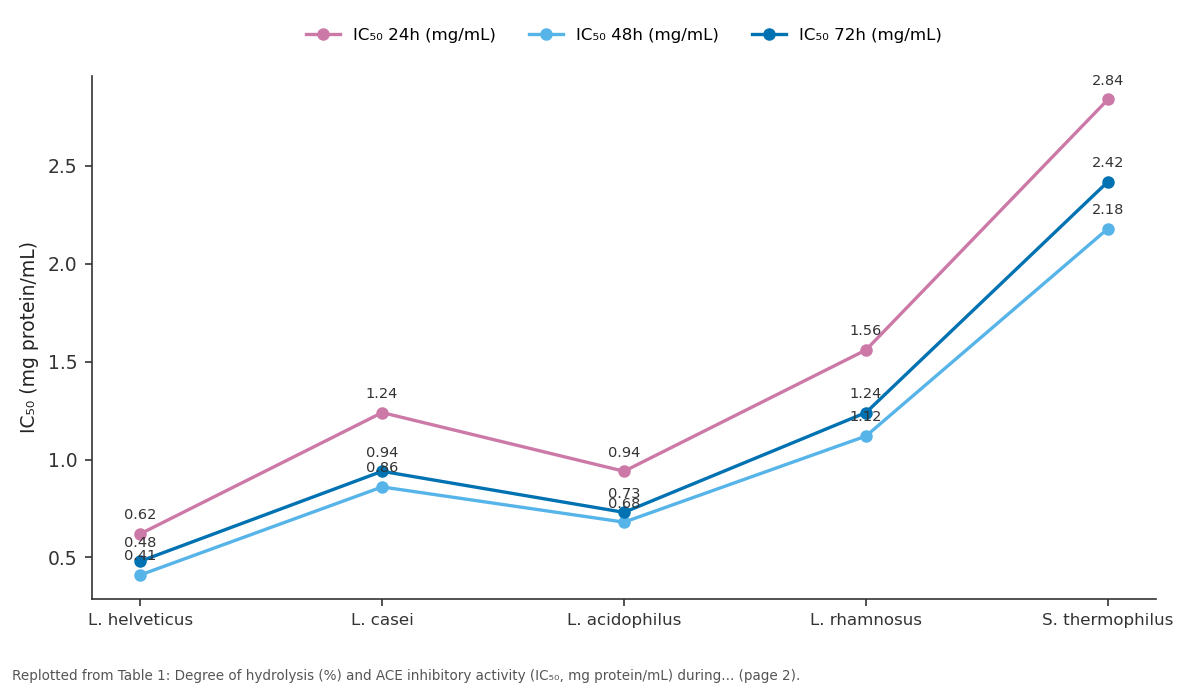
IC₅₀ 24h (mg/mL) and IC₅₀ 48h (mg/mL) and more: L. helveticus vs L. casei vs L. acidophilus vs L. rhamnosus vs S. thermophilus
Replotted from Table 1 (page 2) of the original paper. Every bar is the paper's own table value.
View source evidence ↗Figures & tables
From the original paper Table 1
 Table 2
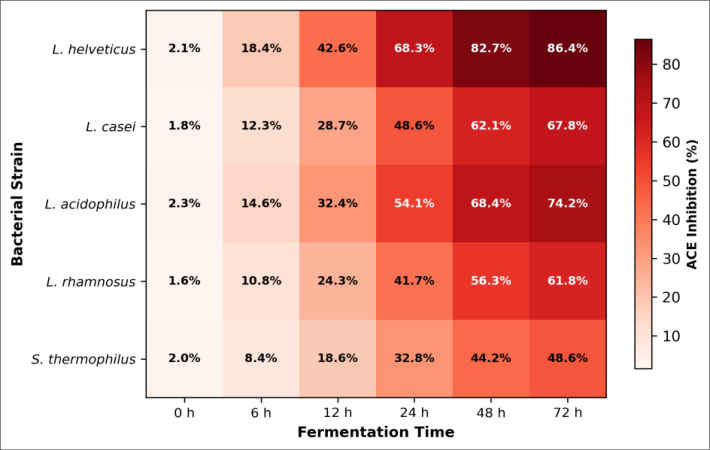 Figure 1
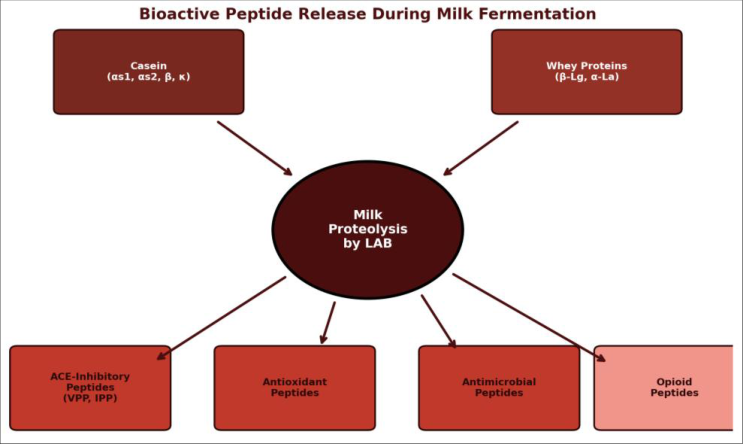 Figure 2
Introduction
It seems paradoxical that the same enzymatic process that sours milk and changes its texture-proteolysis by lactic acid bacteria-also releases peptide sequences with potent biological activities including blood pressure reduction, antioxidant defense, antimicrobial action, and opioid-like effects [1,2] . The best-characterized bioactive peptides from fermented milk are the tripeptides Val-Pro-Pro (VPP) and Ile-Pro-Pro (IPP), which inhibit angiotensinconverting enzyme (ACE) and have been shown to lower systolic blood pressure by 3-8 mmHg in mildly hypertensive subjects in several clinical trials [3,4]. These peptides are encrypted within the amino acid sequences of casein-β-casein f (84-86) for VPP and βcasein f(74-76) for IPP-and are liberated only when bacterial proteinases cleave the parent protein at the right positions [5] . Not all LAB are equally proteolytic. Lactobacillus helveticus, which carries a potent cell-envelope proteinase (PrtH) with broad cleavage specificity, is the most productive source of ACE-inhibitory peptides in fermented milk [6,7] . Other species-L. casei, L. rhamnosus, L. acidophilus-carry their own proteinase variants with different substrate preferences, generating different peptide profiles and, potentially, different bioactivities [8] . Streptococcus thermophilus is weakly proteolytic on its own but is commonly used in yogurt production as a companion to Lactobacillus delbrueckii subsp. bulgaricus [9] . A practical question for dairy manufacturers developing 'functional' fermented milk products is: which strain and how long? Fermentation time affects peptide accumulation in a non-monotonic way. Short fermentation may not release enough bioactive peptides, while prolonged incubation can break them down further into inactive di-or tri-peptides or free amino acids [10, 11] . The optimal window depends on the balance between the rate of peptide release (proteinase activity) and the rate of peptide degradation (peptidase activity), both of which vary by strain and incubation conditions [12] . Despite considerable published work on individual strains, direct side-by-side comparisons of multiple LAB fermenting identical milk under identical conditions remain surprisingly few [13] . This research compared five LAB strains in a standardized fermentation system (UHT whole milk, 37 °C, 72 h) and tracked the degree of hydrolysis, peptide profile (by RP-HPLC-MS/MS), ACE inhibitory activity, and antioxidant capacity at six time points. The work was carried out at the Department of Food Chemistry and Nutrition, Raman Research Institute of Chemical Sciences, Chennai, Tamil Nadu, India, between June 2022 and March 2023 [14] . We aimed to identify both the best-performing strain and the optimal fermentation window for ACE inhibitory peptide production.
Material and Methods
Reagents and Chemicals ACE from rabbit lung (≥ 2.0 units/mg protein), hippuryl-Lhistidyl-L-leucine (HHL, ≥ 98%), hippuric acid (≥ 98%), ABTS (2,2'-azino-bis(3-ethylbenzothiazoline-6-sulphonic acid), ≥ 98%), potassium persulfate, Trolox (≥ 97%), ophthaldialdehyde (OPA), sodium dodecyl sulfate (SDS), βmercaptoethanol, and trifluoroacetic acid (TFA, HPLC grade) were purchased from Sigma-Aldrich (Bangalore, India). UHT whole milk (3.5% fat, Amul brand) was obtained locally. HPLC-grade acetonitrile and water were from Merck (Mumbai, India). Amicon Ultra-15 centrifugal filters (MWCO 10 kDa) were from Millipore (Bangalore, India).
Material
Five LAB strains-Lactobacillus helveticus NCDC 288, Lactobacillus casei NCDC 297, Lactobacillus acidophilus NCDC 015, Lactobacillus rhamnosus NCDC 198, and Streptococcus thermophilus NCDC 074-were obtained from the National Collection of Dairy Cultures (NCDC), National Dairy Research Institute, Karnal, Haryana, India. Each strain was revived in MRS broth (HiMedia, Mumbai) at 37 °C for 24 h and sub-cultured twice before use.
Methods
Methods
Fermentation
UHT whole milk (200 mL per flask) was inoculated with 2% (v/v) of each activated culture (approximately 10⁸ CFU/mL) and incubated statically at 37 °C for 72 hours. Aliquots (20 mL) were withdrawn at 0, 6, 12, 24, 48, and 72 hours. Each aliquot was heated to 75 °C for 10 minutes to inactivate the bacteria, cooled, and centrifuged at 10,000 × g for 15 min. The supernatant was ultrafiltered through a 10 kDa MWCO membrane, and the permeate was stored at -20 °C until analysis.
Degree of hydrolysis
DH was measured by the OPA method. OPA reagent was freshly prepared following the protocol of Church et al. [15] . Absorbance at 340 nm was read after 2 minutes of reaction. DH (%) was calculated using a serine standard curve and the total nitrogen content of the milk determined by Kjeldahl analysis.
ACE inhibition assay
The method of Cushman and Cheung [16] was followed. Briefly, 30 μL of permeate was mixed with 100 μL of ACE solution (25 mU/mL in borate buffer, pH 8.3) and preincubated at 37 °C for 5 minutes. HHL substrate (150 μL, 8.3 mM) was added, and the reaction proceeded for 30 minutes at 37 °C. The reaction was stopped with 250 μL of 1 M HCl. Hippuric acid was extracted with ethyl acetate, dried, and reconstituted in water, and absorbance was read at 228 nm. IC₅₀ was defined as the protein concentration giving 50% ACE inhibition.
Peptide Identification Protocol
Peptide identification was performed by RP-HPLC-ESI-MS/MS on a Thermo Fisher Q Exactive Plus Orbitrap coupled to a Dionex Ultimate 3000 UHPLC. The <10 kDa permeate was desalted on a C18 ZipTip (Millipore), dried under vacuum, and reconstituted in 0.1% formic acid. Separation used an Acclaim PepMap RSLC C18 column (150 × 2.1 mm, 2 μm) with a water-acetonitrile gradient (2-40% B in 30 min). MS was operated in positive ion mode, full scan 200-2000 m/z, with data-dependent MS/MS on the top 10 ions. Peptide identification was performed using PEAKS Studio X+ software against the UniProt bovine proteome (Bos taurus), with no enzyme specificity and an FDR threshold of 1%.
Quality Control
Each fermentation was performed in triplicate using independently activated cultures. Captopril (IC₅₀ ~ 0.02 μM) served as the positive control for the ACE assay to verify enzyme activity. Blanks (unfermented milk) were included at every time point to correct for any non-enzymatic hydrolysis. Viable cell counts were determined on MRS agar at 0, 24, and 72 hours to confirm that all strains remained in the stationary phase (10⁸-10⁹ CFU/mL) throughout fermentation.
Results
Results
Comprehensive Interpretation
A clear pattern emerged across all five strains: ACE inhibitory activity increased from 0 to 24-48 hours and then plateaued or slightly declined at 72 hours. This nonmonotonic trajectory was most pronounced for L. helveticus, where the IC₅₀ improved from 0.62 mg/mL at 24 h to 0.41 mg/mL at 48 h but then rose to 0.48 mg/mL at 72 h. The likely explanation is that continued peptidase activity after 48 hours degrades some of the accumulated tripeptides (VPP, IPP) into dipeptides or free amino acids with lower ACE inhibitory potency [10,11] . HPLC-MS/MS analysis confirmed that VPP peak area at 72 h was about 18% lower than at 48 h for L. helveticus fermentates.
Discussion
The IC₅₀ of 0.41 mg protein/mL for L. helveticus NCDC 288 at 48 hours is among the lowest reported in the literature for whole-milk fermentation without additional enzyme supplementation. Nakamura et al. [3] reported IC₅₀ values of 0.3-0.5 mg/mL for L. helveticus CM4 fermented milk, and Seppo et al. [4] observed similar potencies for L. helveticus LBK-16H. The consistency across different strain designations supports the notion that the cell-envelope proteinase PrtH, which is conserved across L. helveticus subspecies, is the main enzyme responsible for generating ACE-inhibitory peptides from casein [6,7] . L. acidophilus ranked second with an IC₅₀ of 0.68 mg/mL, which is noteworthy because this species is more commonly used in probiotic formulations than L. helveticus and is readily available in commercial starter culture blends. Its ACE inhibitory activity, while about 40% weaker than L. helveticus on a per-protein basis, might be sufficient for a functional food claim when combined with the probiotic benefits the strain already delivers [8,17] . S. thermophilus generated the weakest proteolysis (DH 7.2% at 72 h) and the lowest ACE inhibition (IC₅₀ 2.18 mg/mL at best), confirming its limited proteinase repertoire.
In commercial yogurt production, S. thermophilus is typically paired with L. bulgaricus, whose proteinase activity compensates for the streptococcal shortfall [9] . Our single-strain design intentionally isolated each organism's individual contribution to peptide release, but co-culture experiments would be needed to capture the synergistic effects that occur in real fermented dairy products [18] . The antioxidant data (ABTS assay) paralleled the ACE inhibition trend, with L. helveticus fermentates reaching 78.4 μmol TE/L at 72 h. This dual bioactivity is consistent with reports that many casein-derived peptides carry both ACE-inhibitory and antioxidant motifs within the same sequence-the aromatic and hydrophobic residues that interact with ACE's active site also scavenge free radicals [2,19] . However, the ABTS assay is a chemical antioxidant measure and doesn't necessarily reflect in-vivo antioxidant effects, which depend on peptide absorption, stability in plasma, and tissue distribution [10] . A limitation is the use of a chemical ACE assay rather than a cell-based model. The hippuric acid method measures enzyme inhibition in a test tube but doesn't account for peptide stability under gastrointestinal conditions or bioavailability after oral consumption [12] . Simulated gastrointestinal digestion followed by Caco-2 transport assays would provide more physiologically relevant data.
Conclusion
Five LAB strains were compared for their ability to release ACE-inhibitory peptides from whole milk during 72-hour fermentation. L. helveticus NCDC 288 was the clear leader, achieving the highest degree of hydrolysis (18.4% at 72 h) and the strongest ACE inhibition (IC₅₀ 0.41 mg protein/mL at 48 h). RP-HPLC-MS/MS confirmed the presence of established ACE-inhibitory tripeptides VPP and IPP, along with longer peptide sequences from β-casein and αs1-casein. Fermentation time optimization revealed a bioactivity window between 24 and 48 hours for most strains, after which continued proteolysis reduced the concentration of key active peptides. This finding has practical significance for dairy manufacturers: allowing L. helveticus fermentation to run beyond 48 hours may actually diminish rather than enhance the functional benefit of the product. Antioxidant activity tracked closely with proteolysis, suggesting that the same enzymatic process that generates ACE-inhibitory peptides also releases antioxidant sequences. L. acidophilus-a widely used probiotic species-showed meaningful ACE inhibition (IC₅₀ 0.68 mg/mL), making it a candidate for dual-function probioticantihypertensive fermented milk products.
Future work should include simulated gastrointestinal digestion to assess peptide survival, Caco-2 permeability assays to evaluate absorption potential, and a pilot-scale fermentation trial to confirm that the optimal 48-hour window translates to consistent product quality. In-vivo blood pressure lowering in spontaneously hypertensive rats would provide the preclinical evidence needed before designing human intervention trials.
Figures and tables from the paper
| Strain | DH 24h (%) | DH 48h (%) | DH 72h (%) | IC₅₀ 24h (mg/mL) | IC₅₀ 48h (mg/mL) | IC₅₀ 72h (mg/mL) |
|---|---|---|---|---|---|---|
| L. helveticus | 10.7 | 15.8 | 18.4 | 0.62 | 0.41 | 0.48 |
| L. casei | 6.4 | 9.8 | 12.6 | 1.24 | 0.86 | 0.94 |
| L. acidophilus | 7.8 | 11.4 | 14.2 | 0.94 | 0.68 | 0.73 |
| L. rhamnosus | 5.2 | 8.1 | 10.8 | 1.56 | 1.12 | 1.24 |
| S. thermophilus | 3.6 | 5.4 | 7.2 | 2.84 | 2.18 | 2.42 |
Table text extracted from the original PDF; superscript letters are shown inline. The original table image is below.
View original table image
| Peptide | Sequence | Parent Protein | Position | Mass (Da) | Known Bioactivity |
|---|---|---|---|---|---|
| VPP | Val-Pro-Pro | β-Casein | f(84-86) | 311.4 | ACE inhibitor |
| IPP | Ile-Pro-Pro | β-Casein | f(74-76) | 325.4 | ACE inhibitor |
| LHLPLP | Leu-His-Leu- Pro-Leu-Pro | β-Casein | f(133-138) | 661.8 | ACE inhibitor |
| YPFPGPI | Tyr-Pro-Phe- Pro-Gly-Pro-Ile | β-Casein | f(60-66) | 759.9 | Opioid agonist |
| KVLPVPE | Lys-Val-Leu- Pro-Val-Pro-Glu | β-Casein | f(169-175) | 781.9 | ACE inhibitor |
| YQEPVL | Tyr-Gln-Glu- Pro-Val-Leu | αs1-Casein | f(144-149) | 733.8 | Antioxidant |
Table text extracted from the original PDF; superscript letters are shown inline. The original table image is below.
View original table image
References
15 in the original paper- Korhonen H, Pihlanto A. Bioactive peptides: production and functionality. Int Dairy J. 2006;16(9):945-960.
- Hartmann R, Meisel H. Food-derived peptides with biological activity: from research to food applications. Curr Opin Biotechnol. 2007;18(2):163-169.
- Nakamura Y, Yamamoto N, Sakai K, Okubo A, Yamazaki S, Takano T. Purification and characterization of angiotensin I-converting enzyme inhibitors from sour milk. J Dairy Sci. 1995;78(4):777783.
- Seppo L, Jauhiainen T, Poussa T, Korpela R. A fermented milk high in bioactive peptides has a blood pressure-lowering effect in hypertensive subjects. Am J Clin Nutr. 2003;77(2):326-330.
- Yamamoto N, Akino A, Takano T. Antihypertensive effect of the peptides derived from casein by an extracellular proteinase from Lactobacillus helveticus CP790. J Dairy Sci. 1994;77(4):917-922.
- Savijoki K, Ingmer H, Varmanen P. Proteolytic systems of lactic acid bacteria. Appl Microbiol Biotechnol. 2006;71(4):394-406.
- Griffiths MW, Tellez AM. Lactobacillus helveticus: the proteolytic system. Front Microbiol. 2013;4:30.
- Gobbetti M, Stepaniak L, De Angelis M, Corsetti A, Di Cagno R. Latent bioactive peptides in milk proteins: proteolytic activation and significance in dairy processing. Crit Rev Food Sci Nutr. 2002;42(3):223239.
- Tamime AY, Robinson RK. Yoghurt: science and technology. 3rd ed. Woodhead Publishing. 2007;1-808.
- Phelan M, Aherne A, FitzGerald RJ, O'Brien NM. Casein-derived bioactive peptides: biological effects, industrial uses, safety aspects and regulatory status. Int Dairy J. 2009;19(11):643-654.
- Vermeirssen V, Van Camp J, Verstraete W. Bioavailability of angiotensin I converting enzyme inhibitory peptides. Br J Nutr. 2004;92(3):357-366.
- FitzGerald RJ, Murray BA, Walsh DJ. Hypotensive peptides from milk proteins. J Nutr. 2004;134(4):980S988S.
- Nielsen MS, Martinussen T, Flambard B, Sorensen KI, Otte J. Peptide profiles and angiotensin-I-converting enzyme inhibitory activity of fermented milk products. Int Dairy J. 2009;19(3):155-165.
- Pihlanto A. Antioxidative peptides derived from milk proteins. Int Dairy J. 2006;16(11):1306-1314.
- Church FC, Swaisgood HE, Porter DH, Catignani GL. Spectrophotometric assay using o-phthaldialdehyde for determination of proteolysis in milk and isolated milk proteins. J Dairy Sci. 1983;66(6):1219-1227.