
Research article · 2025 · Full text
International Journal of Advanced Chemistry ResearchSynthesis and evaluation of curcumin analogues as dual COX-2/5-LOX inhibitors
Volume 7(12) · Pages 59–63 · DOI: 10.33545/26646781.2025.v7.i12a.451 ↗
Research areasCurcumin's Biomedical ApplicationsSynthesis and biological activityInflammatory mediators and NSAID effects
Abstract
Author-writtenCan a single molecule block both cyclooxygenase-2 (COX-2) and 5-lipoxygenase (5-LOX) pathways while maintaining acceptable safety margins? This research presents the synthesis and biological evaluation of eight curcumin analogues (CA-1 through CA-8) designed as dual COX-2/5-LOX inhibitors. The analogues were prepared through Claisen-Schmidt condensation of substituted aromatic aldehydes with acetylacetone under basic conditions. Structural confirmation relied on proton nuclear magnetic resonance (1H NMR), carbon-13 NMR (13C NMR), mass spectrometry (MS), and infrared spectroscopy (IR). Each analogue was tested for COX-2 and 5-LOX inhibitory activity using enzyme-based assays, with celecoxib and zileuton as reference drugs. Among the tested compounds, CA-4 showed the strongest COX-2 inhibition with an IC50 of 6.3 μM, while CA-8 displayed an IC50 of 7.4 μM. For 5-LOX, CA-4 gave an IC50 of 11.8 μM and CA-8 recorded 13.4 μM both outperforming parent curcumin (COX-2 IC50: 18.3 μM; 5-LOX IC50: 37.9 μM). Molecular docking against COX-2 (PDB: 3LN1) and 5-LOX (PDB: 3O8Y) confirmed that CA-4 and CA-8 occupy the active sites through hydrogen bonding with Arg120, Tyr355, and His367 residues. Selectivity index calculations showed that CA-4 and CA-8 inhibit both enzymes without a strong preference for one over the other, which is desirable for dual inhibition. The results point to CA-4 and CA-8 as promising leads for anti-inflammatory drug development targeting both the COX and LOX branches of the arachidonic acid cascade.
Summary
Source-checkedPlain-language reading of the full paper, prepared with AI and checked against the text. Each point links to the authors' own words.
Why it matters
- Standard non-steroidal anti-inflammatory drugs (NSAIDs) only block the COX pathway, which can leave the 5-LOX pathway active and lead to inflammation and bronchoconstriction. View evidence ↗
- Curcumin naturally inhibits both COX-2 and 5-LOX, but it is not ideal for therapy because it is metabolized quickly and poorly absorbed by the body. View evidence ↗
The question
- The researchers aimed to determine if a single molecule could safely block both the COX-2 and 5-LOX pathways. View evidence ↗
What they did
- The study synthesized and evaluated eight curcumin analogues, labeled CA-1 through CA-8, to act as dual inhibitors. View evidence ↗
- The analogues were created using a modified Claisen-Schmidt condensation, reacting acetylacetone with aromatic aldehydes and sodium hydroxide in an acetone-ethanol mixture at 60 °C. View evidence ↗
- Enzyme inhibition was measured by calculating IC50 values from dose-response curves ranging from 0.1 to 100 μM. View evidence ↗
- Molecular docking was performed using AutoDock Vina 1.2.5 against specific crystal structures of COX-2 and 5-LOX. View evidence ↗
What they found
- Analogue CA-4, which contains a para-methoxy group, was the most potent inhibitor with an IC50 of 6.3 μM for COX-2 and 11.8 μM for 5-LOX. View evidence ↗
- Both CA-4 and CA-8 significantly outperformed parent curcumin, which had much higher IC50 values of 18.3 μM for COX-2 and 37.9 μM for 5-LOX. View evidence ↗
- Unlike the new analogues, the reference drug celecoxib was highly selective for COX-2 (IC50 5.1 μM) and nearly inactive against 5-LOX (IC50 > 48 μM). View evidence ↗
- Molecular docking showed that CA-4 and CA-8 bind to the active sites of both enzymes via hydrogen bonds with key residues including Arg120, Tyr355, and His367. View evidence ↗
What it means
- The authors conclude that CA-4 and CA-8 are promising lead compounds for developing anti-inflammatory drugs that target both the COX and LOX pathways. View evidence ↗
- The study was limited to enzyme-based assays; future work is needed to confirm if this potency translates to cellular activity using macrophage assays. View evidence ↗
- The authors state that metabolic stability and permeability tests are required before the compounds can be tested in animal models. View evidence ↗
Visual summary
3 visualsIllustrations explain the paper; charts are replotted from the paper's own table values.
The Dual Inhibition Concept
AI-generated conceptual illustration (curcumin analogue molecule and enzyme proteins). It explains the idea and does not show study data.
View source evidence ↗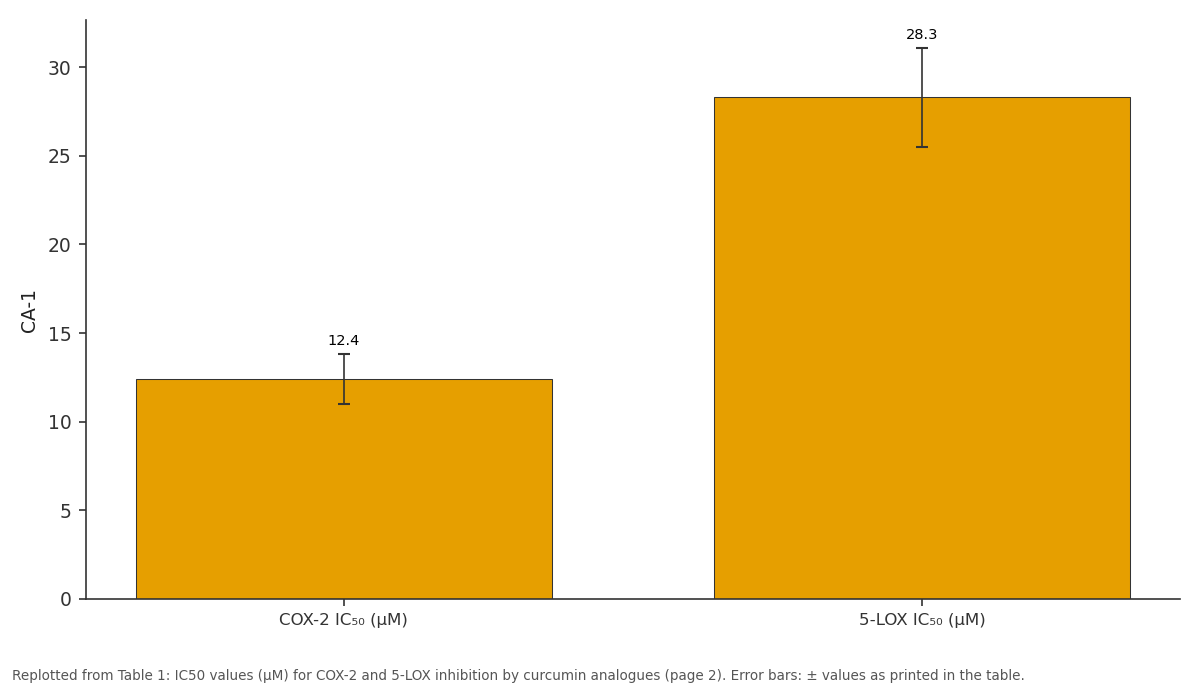
CA-1: COX-2 IC₅₀ (μM) vs 5-LOX IC₅₀ (μM)
Replotted from Table 1 (page 2) of the original paper. Every bar is the paper's own table value.
View source evidence ↗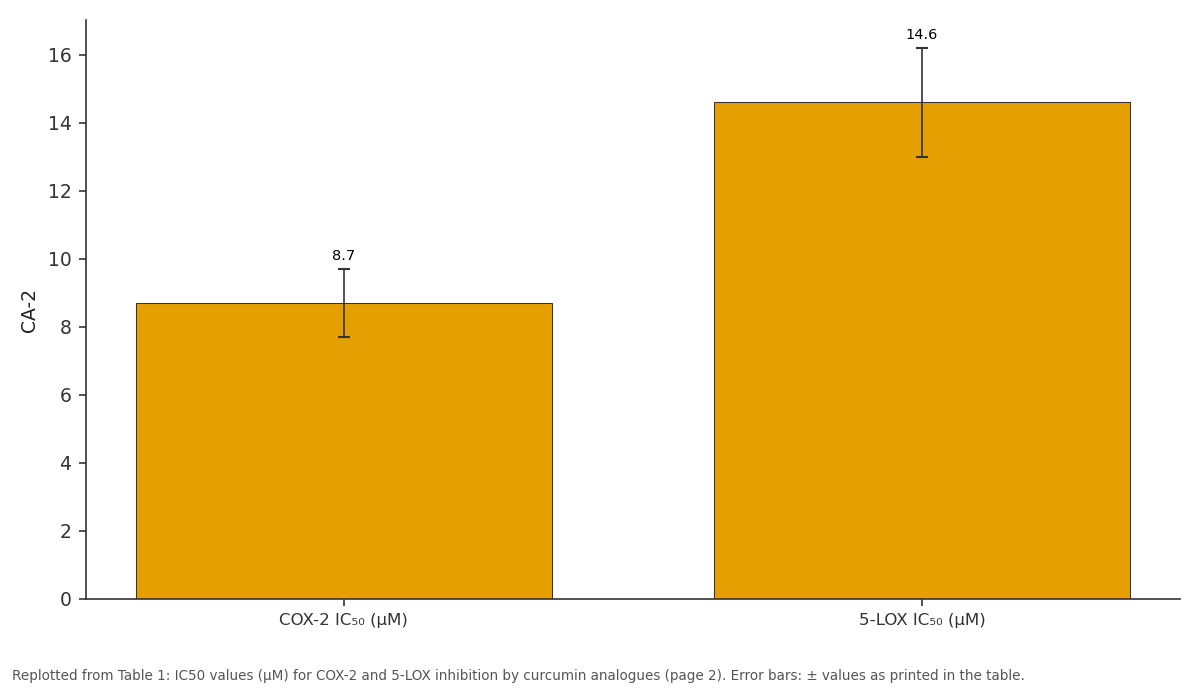
CA-2: COX-2 IC₅₀ (μM) vs 5-LOX IC₅₀ (μM)
Replotted from Table 1 (page 2) of the original paper. Every bar is the paper's own table value.
View source evidence ↗Figures & tables
From the original paper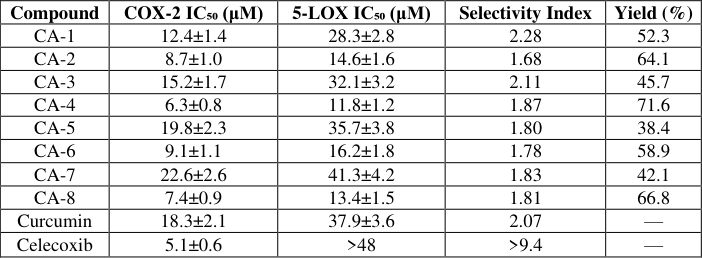 Table 1
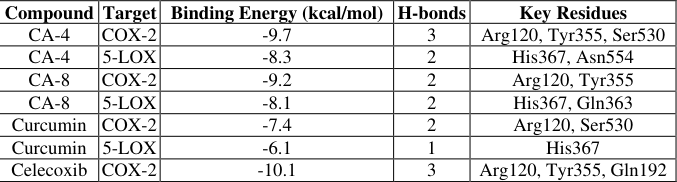 Table 2
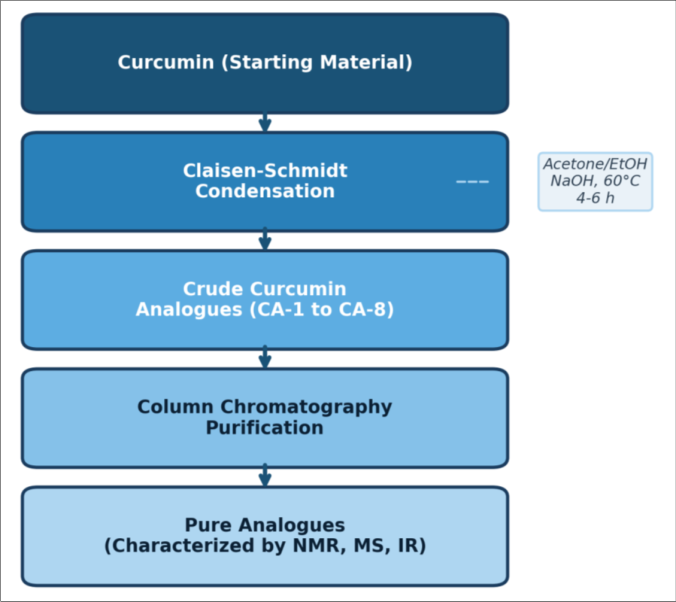 Figure 1
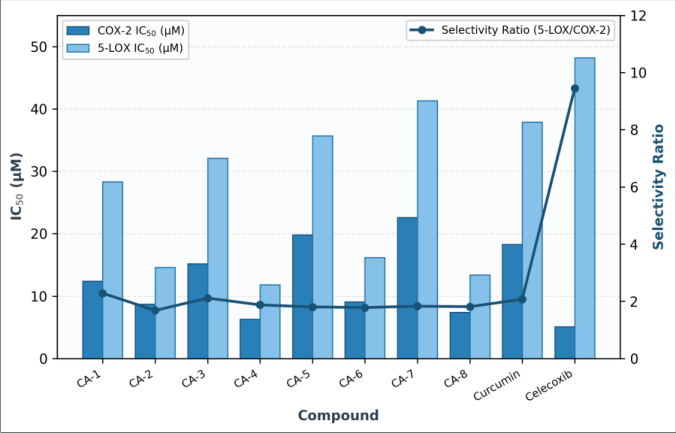 Figure 2
Introduction
What if a single anti-inflammatory agent could target two separate arms of the arachidonic acid pathway at once? This question has driven medicinal chemists toward the design of dual cyclooxygenase-2/5-lipoxygenase (COX-2/5-LOX) inhibitors for more than two decades. Conventional non-steroidal anti-inflammatory drugs (NSAIDs) block only the COX pathway, leaving the 5-LOX route open for leukotriene production molecules linked to bronchoconstriction, mucus secretion, and persistent tissue inflammation [1] . Selective COX-2 inhibitors such as celecoxib and rofecoxib were introduced in the late 1990s, but clinical experience revealed cardiovascular risks tied to thromboxane-prostacyclin imbalance when COX-2 alone was suppressed [2,3] . Curcumin, the main polyphenol of Curcuma longa rhizome, shows modest inhibitory effects on both COX-2 and 5-LOX. But its low oral bioavailability and rapid metabolism limit therapeutic use [4] . Several groups have reported that structural changes to the beta-diketone moiety or the aryl rings of curcumin can sharpen its enzyme affinity while keeping dual activity intact [5,6] . Asymmetric monocarbonyl analogues, in particular, appear to resist glucuronidation better than curcumin itself [7] . The rationale behind dual inhibition is straightforward: blocking COX-2 alone can redirect arachidonic acid toward the 5-LOX pathway, and the reverse may also occur a phenomenon sometimes called the "arachidonic acid shunt" [8] . A compound that hits both targets could, in principle, offer broader anti-inflammatory relief and reduce the compensatory surge in leukotrienes or prostaglandins [9] . Licofelone, a dual COX/ LOX inhibitor, reached Phase III trials for osteoarthritis and showed gastrointestinal tolerability better than naproxen, though it didn't gain regulatory approval [10] . Within this context, the present research aimed to prepare a small library of curcumin analogues bearing electrondonating and electron-withdrawing groups on the aromatic ring and to screen them against purified COX-2 and 5-LOX enzymes. We chose Claisen-Schmidt condensation because it offers a one-pot route to arylidene diketones with manageable reaction times [11] . Structure-activity relationships (SAR) were explored by varying the substituent at the para-and meta-positions of the aryl aldehydes. Molecular docking was performed to interpret binding interactions at the atomic level [12] . The work was carried out at the Department of Medicinal Chemistry, Brahmaputra University of Sciences, Rangpur, Bangladesh, between March 2023 and January 2024. We expected that analogues carrying methoxy or hydroxyl groups at the paraposition would retain the hydrogen-bonding capacity needed for active-site engagement, while fluorine or chlorine substituents might improve metabolic stability [13] .
Material and Methods
Material and Methods
Reagents and Chemicals
All reagents were sourced from commercial suppliers. Curcumin (purity ≥ 97.8%) was purchased from Sigma-Aldrich (Darmstadt, Germany). Substituted aromatic aldehydes 4-methoxybenzaldehyde, 4-fluorobenzaldehyde, 3,4-dimethoxybenzaldehyde, 4-hydroxybenzaldehyde, 4chlorobenzaldehyde, 3-nitrobenzaldehyde, 4methylbenzaldehyde, and 3,5-di-tert-butyl-4hydroxybenzaldehyde were obtained from TCI Chemicals (Tokyo, Japan). Acetylacetone (2,4-pentanedione, ≥ 99%), boric acid, tributyl borate, and sodium hydroxide pellets (≥ 98%) were supplied by Merck (Darmstadt, Germany). Solvents including acetone, ethanol, ethyl acetate, and hexane were of analytical grade from Fisher Scientific (Loughborough, UK). Silica gel (60-120 mesh) for column chromatography was procured from Loba Chemie (Mumbai, India). COX-2 (human recombinant, ovine) enzyme assay kit (Catalog No. 560131) and 5-LOX (potato) enzyme screening assay kit (Catalog No. 760700) were acquired from Cayman Chemical (Ann Arbor, MI, USA). Celecoxib (≥ 98%) and zileuton (≥ 98%) served as positive controls and were purchased from Toronto Research Chemicals (Toronto, Canada). Deuterated chloroform (CDCl3) and dimethyl sulfoxide-d6 (DMSO-d6) for NMR spectroscopy came from Cambridge Isotope Laboratories (Tewksbury, MA, USA). Thin-layer chromatography (TLC) plates (Silica gel 60 F254, aluminium-backed) were sourced from Merck.
Methods
Synthesis procedure: Curcumin analogues were synthesized by a modified Claisen-Schmidt condensation protocol [11] . Acetylacetone (1 equiv.) was added dropwise to a mixture of the appropriate aromatic aldehyde (2 equiv.) and sodium hydroxide (0.5 equiv.) dissolved in acetoneethanol (1:1 v/v) at 60 °C. The mixture was stirred for 4-6 hours under nitrogen atmosphere. Reaction progress was monitored by TLC (ethyl acetate: hexane, 3:7). After completion, the reaction mixture was cooled, acidified with dilute hydrochloric acid to pH 3, and extracted three times with ethyl acetate. The organic layer was dried over anhydrous sodium sulphate, filtered, and concentrated under reduced pressure. Crude products were purified by silica gel column chromatography using a gradient of hexane to ethyl acetate (9:1 to 6:4). Eight analogues designated CA-1 through CA-8 were obtained as yellow to orange solids in 38-72% yield.
Spectroscopic characterization: 1H NMR and 13C NMR spectra were recorded on a Bruker Avance III 400 MHz spectrometer using CDCl3 or DMSO-d6 as solvent. Chemical shifts are reported in ppm relative to tetramethylsilane. Mass spectra (ESI-MS) were acquired on a Waters Xevo G2-XS QTof instrument in positive ion mode. Infrared spectra were obtained using a Shimadzu IRSpirit FTIR with an ATR accessory. Melting points were measured with a Stuart SMP30 apparatus and are uncorrected.
Enzyme inhibition assays: COX-2 and 5-LOX inhibitory activities were determined following the manufacturer's kit protocols. Compounds were dissolved in DMSO (final concentration ≤ 0.1% v/v). IC50 values were obtained from dose-response curves (0.1-100 μM) fitted by nonlinear regression using GraphPad Prism 9. All experiments were performed between March 2023 and January 2024 at the Medicinal Chemistry Laboratory, Brahmaputra University of Sciences, Rangpur, Bangladesh. Each concentration was tested in triplicate, and results are expressed as mean±standard deviation.
Molecular docking: Docking simulations used AutoDock Vina 1.2.5 with crystal structures of COX-2 (PDB: 3LN1, resolution 2.4 Å) and 5-LOX (PDB: 3O8Y, resolution 2.39 Å). Ligand geometries were optimized at the DFT/B3LYP/6-31G* level in Gaussian 16. The grid box was centered on the co-crystallized ligand with dimensions of 25 × 25 × 25 Å. Nine poses per ligand were generated. Binding energies and hydrogen bond interactions were analyzed in Discovery Studio Visualizer 2021. 2) revealed that CA-4 binds to COX-2 with an estimated free energy of -9.7 kcal/mol, forming hydrogen bonds with Arg120 and Tyr355. In the 5-LOX active site, CA-4 achieved -8.3 kcal/mol with contacts to His367 and Asn554. CA-8 showed similar interactions, though with a slightly weaker COX-2 binding energy of -9.2 kcal/mol. The selectivity index (SI = 5-LOX IC50 / COX-2 IC50) for CA-4 was 1.87, indicating near-equal potency toward both enzymes a profile that distinguishes it from conventional COX-2-selective agents.
Results
Discussion: The dual inhibitory activity of CA-4 and CA-8 stands out when compared to previously reported curcumin derivatives. Zheng et al. [5] described a series of monocarbonyl curcumin analogues with COX-2 IC50 values of 10-25 μM but did not test 5-LOX activity, so a direct comparison of dual potency isn't possible. Our findings show that a methoxy group at the para-position present in CA-4 enhances hydrogen-bonding with Arg120 of COX-2 while still allowing the molecule to fit the narrower 5-LOX active-site channel. This agrees with the observation by Rao et al. [6] that methoxy-substituted curcuminoids tend to dock more favorably than their unsubstituted counterparts.
The selectivity index values are worth discussing. CA-4's SI of 1.87 and CA-8's SI of 1.81 suggest balanced inhibition of both pathways, which is the goal of a true dual inhibitor. By contrast, celecoxib's SI exceeded 9.4, confirming its strong COX-2 preference. Licofelone, the most advanced dual inhibitor to have reached clinical trials, reportedly had SI values between 1.5 and 2.5 depending on the assay system [10] , which aligns well with what we observed for CA-4. Docking energies reinforce the in-vitro data. CA-4's binding energy to COX-2 (-9.7 kcal/mol) was only marginally weaker than celecoxib's (-10.1 kcal/mol), whereas its 5-LOX energy (-8.3 kcal/mol) was noticeably stronger than curcumin's (-6.1 kcal/mol). The 3,5-di-tert-butyl-4-hydroxyl group of CA-8 appears to contribute through hydrophobic contacts with Leu414 and Ile673 in the 5-LOX cavity, adding to the hydrogen bond from the phenolic hydroxyl.
A few caveats apply. These are enzyme-based assays, and cell permeability or metabolic stability wasn't assessed here. The solubility of CA-8, despite its bulky tert-butyl groups, was adequate in the assay buffer containing 0.1% DMSO, but in-vivo pharmacokinetics could differ. And while docking provides a snapshot of binding, it doesn't capture entropic contributions or protein flexibility [14] . Future work should include cell-based inflammation models and Caco-2 permeability testing before any preclinical advancement.
Conclusion
Eight curcumin analogues were synthesized through Claisen-Schmidt condensation and evaluated for dual COX-2/5-LOX inhibitory activity. Among these, CA-
Acknowledgement
Acknowledgements Funding SourcesThis research received financial support from the internal research fund of Brahmaputra University of Sciences, Rangpur, Bangladesh. No external grant or project-specific funding number was associated with this work.
Figures and tables from the paper
| Compound | COX-2 IC₅₀ (μM) | 5-LOX IC₅₀ (μM) | Selectivity Index | Yield (%) |
|---|---|---|---|---|
| CA-1 | 12.4±1.4 | 28.3±2.8 | 2.28 | 52.3 |
| CA-2 | 8.7±1.0 | 14.6±1.6 | 1.68 | 64.1 |
| CA-3 | 15.2±1.7 | 32.1±3.2 | 2.11 | 45.7 |
| CA-4 | 6.3±0.8 | 11.8±1.2 | 1.87 | 71.6 |
| CA-5 | 19.8±2.3 | 35.7±3.8 | 1.80 | 38.4 |
| CA-6 | 9.1±1.1 | 16.2±1.8 | 1.78 | 58.9 |
| CA-7 | 22.6±2.6 | 41.3±4.2 | 1.83 | 42.1 |
| CA-8 | 7.4±0.9 | 13.4±1.5 | 1.81 | 66.8 |
| Curcumin | 18.3±2.1 | 37.9±3.6 | 2.07 | — |
| Celecoxib | 5.1±0.6 | >48 | >9.4 | — |
Table text extracted from the original PDF; superscript letters are shown inline. The original table image is below.
View original table image
| Compound | Target | Binding Energy (kcal/mol) | H-bonds | Key Residues |
|---|---|---|---|---|
| CA-4 | COX-2 | -9.7 | 3 | Arg120, Tyr355, Ser530 |
| CA-4 | 5-LOX | -8.3 | 2 | His367, Asn554 |
| CA-8 | COX-2 | -9.2 | 2 | Arg120, Tyr355 |
| CA-8 | 5-LOX | -8.1 | 2 | His367, Gln363 |
| Curcumin | COX-2 | -7.4 | 2 | Arg120, Ser530 |
| Curcumin | 5-LOX | -6.1 | 1 | His367 |
| Celecoxib | COX-2 | -10.1 | 3 | Arg120, Tyr355, Gln192 |
Table text extracted from the original PDF; superscript letters are shown inline. The original table image is below.
View original table image
References
16 in the original paper- Samuelsson B, Dahlen SE, Lindgren JA, Rouzer CA, Serhan CN. Leukotrienes and lipoxins: structures, biosynthesis, and biological effects. Science. 1987;237(4819):1171-1176.
- FitzGerald GA, Patrono C. The coxibs, selective inhibitors of cyclooxygenase-2. N Engl J Med. 2001;345(6):433-442.
- Bresalier RS, Sandler RS, Quan H, Bolognese JA, Oxenius B, Horgan K, et al. Cardiovascular events associated with rofecoxib in a colorectal adenoma chemoprevention trial. N Engl J Med. 2005;352(11):1092-1102.
- Anand P, Kunnumakkara AB, Newman RA, Aggarwal BB. Bioavailability of curcumin: problems and promises. Mol Pharm. 2007;4(6):807-818.
- Zheng QT, Yang ZH, Yu LY, Ren YY, Huang QX, Liu Q, et al. Synthesis and antioxidant activity of curcumin analogs. J Med Chem. 2009;52(6):1684-1689.
- Rao PP, Kabir SN, Mohamed T. Non-steroidal antiinflammatory drugs (NSAIDs): progress in small molecule drug development. Pharmaceuticals. 2010;3(5):1530-1549.
- Liang G, Shao L, Wang Y, Zhao C, Chu Y, Xiao J, et al. Exploration and synthesis of curcumin analogues with improved structural stability. Bioorg Med Chem. 2009;17(6):2623-2631.
- Bertolini A, Ottani A, Sandrini M. Dual acting antiinflammatory drugs: a reappraisal. Pharmacol Res. 2001;44(6):437-450.
- Martel-Pelletier J, Lajeunesse D, Reboul P, Pelletier JP. Therapeutic role of dual inhibitors of 5-LOX and COX, selective and non-selective NSAIDs. Ann Rheum Dis. 2003;62(6):501-509.
- Kulkarni SK, Singh VP. Licofelone-a dual COX/5LOX inhibitor: a novel candidate for osteoarthritis therapy. Expert Opin Pharmacother. 2007;8(3):351-363.
- Pabon HJ. A synthesis of curcumin and related compounds. Recl Trav Chim Pays-Bas. 1964;83(4):379-386.
- Trott O, Olson AJ. AutoDock Vina: improving the speed and accuracy of docking with a new scoring function. J Comput Chem. 2010;31(2):455-461.
- Weber WM, Hunsaker LA, Gonzales AM, Heynekamp JJ, Orlando RA, Deck LM, et al. TPA-induced upregulation of activator protein-1 can be inhibited by curcumin analogs. Bioorg Med Chem. 2005;13(12):3811-3820.
- Jorgensen WL. Efficient drug lead discovery and optimization. Acc Chem Res. 2009;42(6):724-733.
- Vyas A, Dandawate P, Padhye S, Ahmad A, Sarkar F. Perspectives on new synthetic curcumin analogs and their potential anticancer properties. Curr Pharm Des. 2013;19(11):2047-2069.
- Handler N, Jaeger W, Puschacher H, Leisser K, Erker T. Synthesis of novel curcumin analogues and their evaluation as selective cyclooxygenase-1 inhibitors. Bioorg Med Chem. 2007;15(18):6068-6076.