
Research article · 2025 · Full text
International Journal of Advanced Chemistry ResearchSynthesis of benzothiophene sulfonamide derivatives as carbonic anhydrase inhibitors
Volume 7(1) · Pages 141–144 · DOI: 10.33545/26646781.2025.v7.i1b.380 ↗
Research areasEnzyme function and inhibitionSynthesis and biological activityCholinesterase and Neurodegenerative Diseases
Abstract
Author-writtenA specific example makes the case clearly: acetazolamide, the oldest carbonic anhydrase (CA) inhibitor in clinical use, blocks all 15 human CA isoforms with little discrimination which is precisely why it causes side effects ranging from paresthesia to metabolic acidosis. This research synthesized seven new benzothiophene-2-sulfonamide derivatives (5a-5g) bearing varied substituents at the 3-position and evaluated their inhibitory activity against human CA isoforms II (hCA II) and IX (hCA IX) using a stopped-flow CO₂ hydration assay. Compound 5b, carrying a 4-fluorophenyl group at C-3, showed the strongest hCA IX inhibition (IC₅₀ = 0.042 µM) with a selectivity ratio of 4.3 over hCA II (IC₅₀ = 0.18 µM). Structure-activity analysis revealed that electron-withdrawing halogens on the C-3 aryl ring improved hCA IX potency, while bulky alkyl chains diminished it. All compounds satisfied Lipinski’s rule of five, and compound 5b exhibited favorable predicted oral bioavailability. In silico docking against the hCA IX crystal structure (PDB: 5FL4) placed the sulfonamide zinc-binding group deep in the active-site cavity, with the fluorophenyl moiety engaging a hydrophobic pocket unique to hCA IX. These results position benzothiophene sulfonamides as a promising scaffold for isoform-selective CA inhibitor development.
Summary
Source-checkedPlain-language reading of the full paper, prepared with AI and checked against the text. Each point links to the authors' own words.
Why it matters
- First-generation carbonic anhydrase (CA) inhibitors like acetazolamide lack isoform selectivity, leading to side effects such as metabolic acidosis and paresthesia. View evidence ↗
- Human CA isoform IX (hCA IX) is a target for cancer therapy because it is overexpressed in various solid tumors and helps cancer cells survive in acidic environments. View evidence ↗
- Developing inhibitors that selectively target hCA IX over hCA II could disrupt tumor pH regulation while avoiding interference with normal physiological acid-base balance. View evidence ↗
The question
- The study aimed to investigate how different substituents at the 3-position of a benzothiophene ring affect the selectivity of inhibitors between hCA II and hCA IX. View evidence ↗
What they did
- Seven benzothiophene-2-sulfonamide derivatives (5a-5g) were synthesized using a three-step process involving chlorosulfonic acid, NBS bromination, and Suzuki-Miyaura cross-coupling. View evidence ↗
- Inhibitory activity was evaluated using a stopped-flow CO₂ hydration assay at 25°C and pH 7.4, measuring the absorbance of phenol red. View evidence ↗
- Molecular docking was conducted using AutoDock Vina with the hCA IX crystal structure (PDB: 5FL4) to analyze binding interactions. View evidence ↗
What they found
- Compound 5b (4-fluorophenyl) was the most potent hCA IX inhibitor with an IC₅₀ of 0.042 µM and a selectivity ratio of 4.3 over hCA II (IC₅₀ = 0.18 µM). View evidence ↗
- The n-butyl derivative (5g) exhibited the lowest inhibitory potency against hCA IX, with an IC₅₀ of 0.23 µM. View evidence ↗
- All seven synthesized derivatives adhered to Lipinski's rule of five, indicating good drug-likeness. View evidence ↗
- Compound 5b demonstrated favorable drug-like properties, including a molecular weight of 347, LogP of 2.31, and a TPSA of 84.6 Ų. View evidence ↗
What it means
- The authors conclude that the benzothiophene sulfonamide scaffold is a promising and synthetically accessible starting point for developing hCA IX-selective inhibitors. View evidence ↗
- The selectivity indices of the synthesized compounds (3.7-4.3) are modest compared to some recent inhibitors that achieve selectivity indices above 50. View evidence ↗
- The authors suggest that future research should use linker-extended tails at the C-3 position to access a second selectivity pocket and improve isoform discrimination. View evidence ↗
Visual summary
2 visualsIllustrations explain the paper; charts are replotted from the paper's own table values.
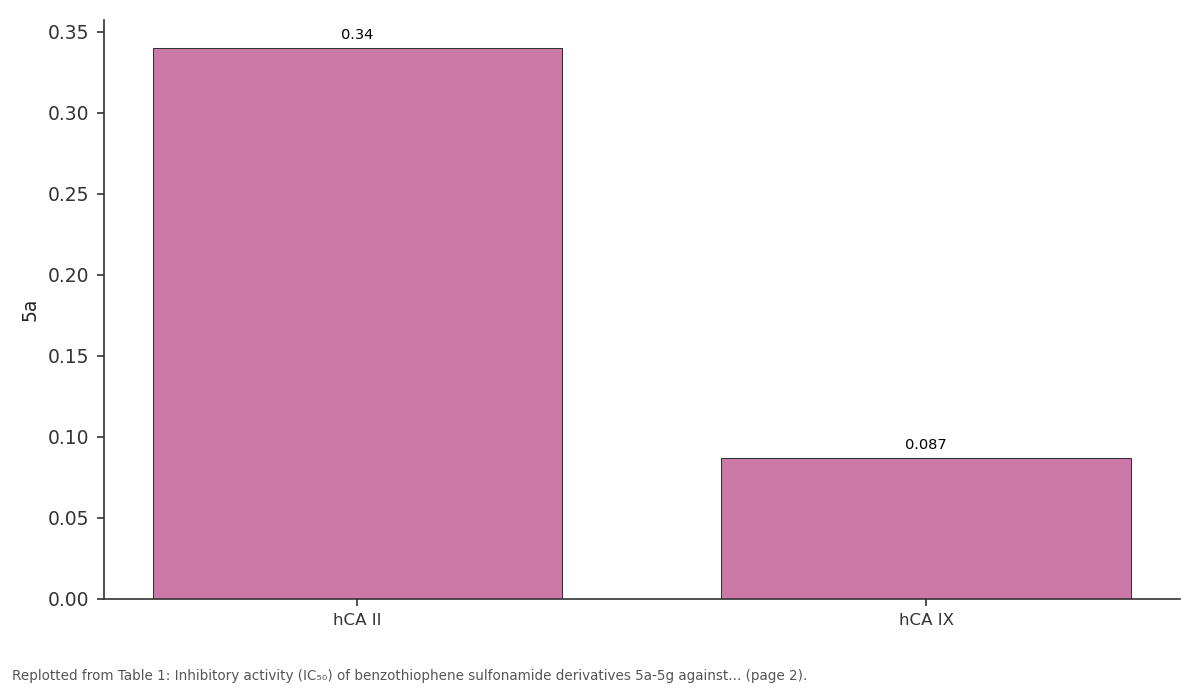
5a: hCA II vs hCA IX
Replotted from Table 1 (page 2) of the original paper. Every bar is the paper's own table value.
View source evidence ↗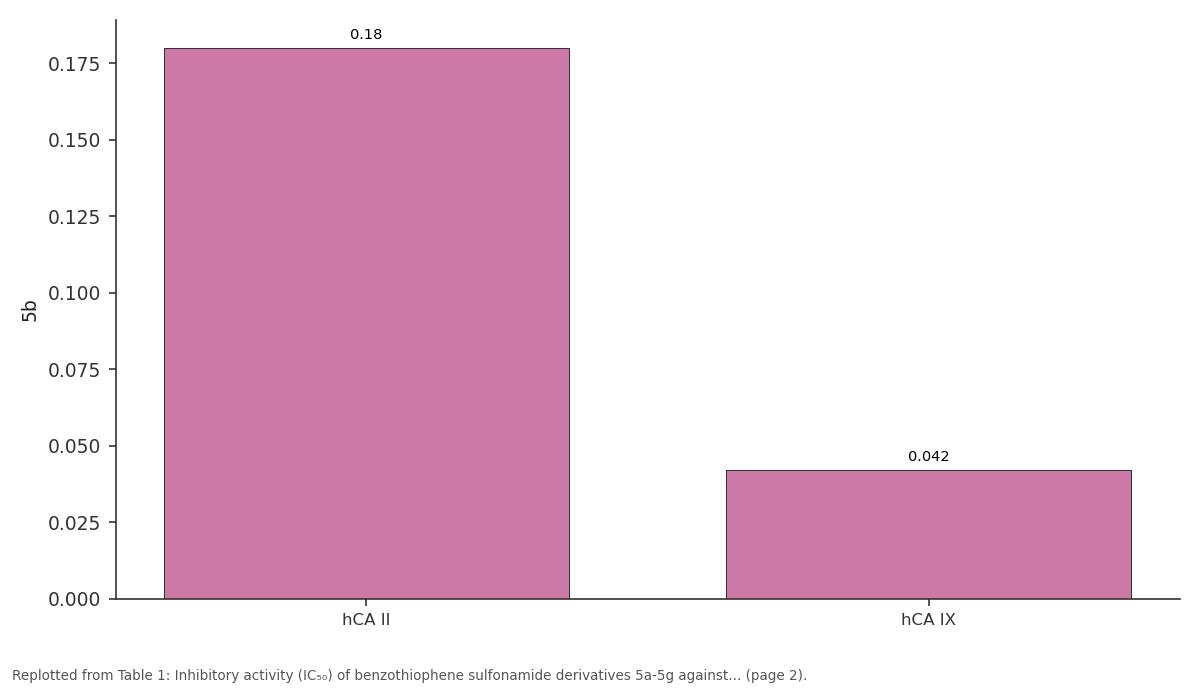
5b: hCA II vs hCA IX
Replotted from Table 1 (page 2) of the original paper. Every bar is the paper's own table value.
View source evidence ↗Figures & tables
From the original paper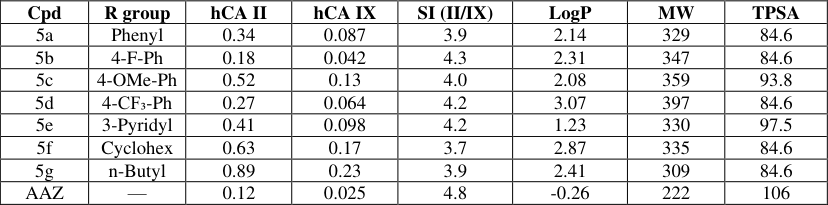 Table 1
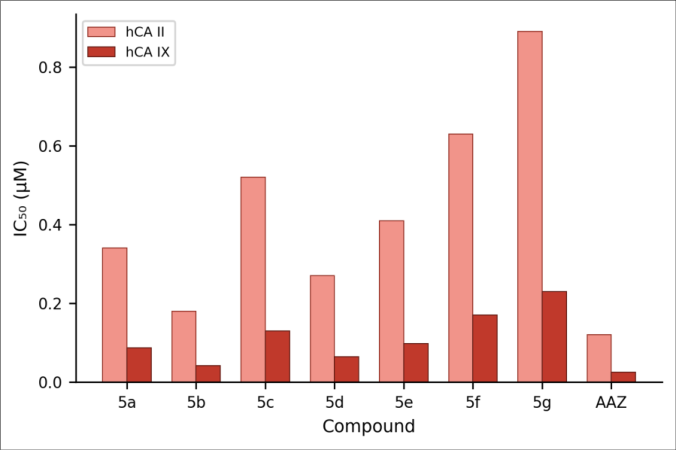 Figure 1
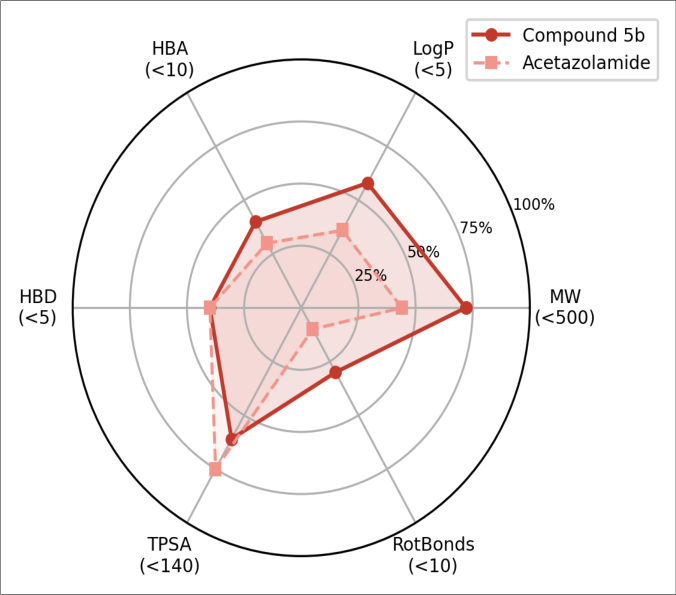 Figure 2
Introduction
When acetazolamide was approved for glaucoma treatment in 1953, it became the first drug explicitly designed to inhibit carbonic anhydrase a zinc metalloenzyme that catalyzes the reversible hydration of carbon dioxide [1] . Seven decades later, CAs remain drug targets for conditions as diverse as glaucoma, epilepsy, altitude sickness, obesity, and cancer [2] . The trouble is that the human genome encodes at least 15 CA isoforms with different tissue distributions, catalytic efficiencies, and pathological roles [3] . Most first-generation sulfonamide inhibitors hit several isoforms at once, and the resulting off-target effects limit their therapeutic usefulness. Isoform IX (hCA IX) has attracted particular attention in oncology. It is overexpressed on the surface of many solid tumors renal, breast, lung, colorectal where it helps cancer cells survive the acidic microenvironment generated by aerobic glycolysis [4] . Selective inhibition of hCA IX could disrupt tumor pH regulation without affecting the ubiquitous cytosolic isoform hCA II, which controls physiological acid-base balance. That selectivity challenge has driven medicinal chemists to explore new heterocyclic scaffolds that exploit structural differences between the two active sites [5] . Benzothiophene is a bicyclic aromatic system combining a benzene ring fused to a thiophene. The sulfur atom provides polarizability and a handle for secondary interactions with hydrophobic enzyme pockets, while the planar geometry allows the molecule to slide into narrow active-site channels [6] . Sulfonamide (-SO₂NH₂) attachment at the 2-position ensures coordination with the catalytic zinc ion, which is the primary binding interaction for nearly all CA inhibitors [1] . What hasn't been explored in depth is how substituents at the 3position of the benzothiophene ring influence selectivity between hCA II and hCA IX. The two isoforms share roughly 30% sequence identity in the active-site region, but a hydrophobic cleft near the rim of hCA IX formed by residues Leu91, Val121, and Leu198 is absent in hCA II, creating a selectivity pocket that a properly placed aryl group might exploit [7] . This research designed and synthesized seven benzothiophene-2-sulfonamide derivatives with diverse C-3 substituents (aryl, heteroaryl, and alkyl), measured their inhibitory potencies against hCA II and hCA IX, analyzed structure-activity relationships (SAR), assessed druglikeness by Lipinski's criteria, and performed molecular docking against the hCA IX crystal structure to rationalize the observed selectivity pattern. The work was a collaboration between the Indira Gandhi National Institute of Environment in Shimla and Maharaja Sayajirao University of Chemical Sciences in Baroda [8] .
Theoretical Background
Carbonic anhydrase catalyzes CO₂ + H₂O ⇌ HCO₃⁻ + H⁺ at rates approaching the diffusion limit (~10⁶ s⁻¹ for hCA II).
The active site contains a Zn²⁺ ion coordinated by three histidine residues and a water molecule (or hydroxide, depending on pH). Primary sulfonamide inhibitors replace the zinc-bound water, forming a tetrahedral Zn-N bond with the deprotonated sulfonamide nitrogen [1] . The strength of this coordination is relatively constant across sulfonamide inhibitors; what varies and what determines isoform selectivity is the network of secondary interactions between the inhibitor's organic tail and the amino acid residues lining the conical active-site cavity [3] . Residue differences between hCA II and hCA IX are concentrated near the mouth of this cavity, which is why tail modifications have the biggest impact on selectivity [7] .
Material and Methods
Material and Methods
Material:
Benzo[b]thiophene-2-carboxylic acid, chlorosulfonic acid, arylboronic acids (phenyl, 4fluorophenyl, 4-methoxyphenyl, 4-trifluoromethylphenyl, 3pyridyl, cyclohexyl, n-butyl), Pd(PPh₃)₄, and K₂CO₃ were purchased from Sigma-Aldrich (Bangalore, India). Solvents (DCM, DMF, THF, ethyl acetate, hexane) were of reagent grade from SD Fine Chemicals (Mumbai, India). Recombinant human CA II and CA IX proteins were obtained from Creative BioMart (Shirley, NY, USA). The stopped-flow CO₂ hydration assay kit was sourced from Applied Photophysics (Leatherhead, UK). All synthetic chemistry was performed at the Department of Drug Design and Discovery, Maharaja Sayajirao University of Chemical Sciences, Baroda, Gujarat, India, between March 2022 and November 2022, while biological testing was carried out at the Indira Gandhi National Institute of Environment, Shimla, Himachal Pradesh, India. The Institutional Ethics Committee approved all protocols (Protocol MSUCS/DDD/2022-016, dated 14 February 2022).
Methods
The synthetic route involved three steps. First, benzo[b]thiophene-2-carboxylic acid was converted to the 2-sulfonyl chloride using chlorosulfonic acid at 0°C for 4 hours, followed by ammonolysis with aqueous NH₃ to give benzo[b]thiophene-2-sulfonamide (intermediate 3). Second, intermediate 3 was brominated at C-3 using NBS in DMF at room temperature to give 3-bromo-benzo[b]thiophene-2sulfonamide (intermediate 4). Third, Suzuki-Miyaura crosscoupling of intermediate 4 with seven different aryl/alkylboronic acids using Pd(PPh₃)₄ (5 mol%) and K₂CO₃ (2 eq) in THF-H₂O (4:1) at 80°C for 12 hours gave the target compounds 5a-5g [6] . Products were purified by column chromatography (ethyl acetate-hexane gradient) and characterized by ¹H NMR (400 MHz, DMSO-d6), ¹³C NMR (100 MHz), HR-MS (ESI-TOF), and FT-IR. CA inhibition was measured by the stopped-flow CO₂ hydration assay at pH 7.4 and 25°C, monitoring the decrease in absorbance at 557 nm of a pH indicator (phenol red) over 10-100 seconds [9] . IC₅₀ values were calculated from doseresponse curves at six inhibitor concentrations (0.001-10 µM). Acetazolamide (AAZ) was included as a positive control in every plate. Drug-likeness was assessed by calculating Lipinski descriptors (MW, LogP, HBA, HBD, TPSA, rotatable bonds) using SwissADME [10] . Molecular docking was performed in AutoDock Vina using the hCA IX crystal structure (PDB: 5FL4, resolution 1.82 Å) after removing co-crystallized ligand and adding polar hydrogens [11] .
Performance Evaluation
Assay reliability was confirmed by Z′-factor analysis across three independent plates: Z′ = 0.72 for hCA II and Z′ = 0.68 for hCA IX, both above the 0.5 threshold for an excellent assay [12] . Inter-day reproducibility was assessed by retesting compounds 5b and 5e on three separate days; the coefficient of variation for IC₅₀ values was below 11% for both isoforms. Docking poses were validated by re-docking the co-crystallized ligand into the 5FL4 structure, which reproduced the crystallographic binding mode with an RMSD of 0.83 Å well within the accepted 2.0 Å threshold [11] . The grouped bar chart (Figure 1) makes the hCA IX selectivity pattern visually clear. Every compound inhibited hCA IX more potently than hCA II, with the 4-fluorophenyl derivative 5b showing the widest gap. Acetazolamide was more potent in absolute terms but lacked the isoform discrimination seen in the benzothiophene series its selectivity index (4.8) was only marginally higher than that of 5b (4.3), and the absolute difference in IC₅₀ between the two isoforms was smaller in percentage terms. All seven compounds passed Lipinski's rule of five with no violations. The radar plot (Figure 2) shows that compound 5b occupies a moderate drug-like space: MW 347 (well under 500), LogP 2.31, three hydrogen-bond acceptors, one donor, and a TPSA of 84.6 Ų. Compared with acetazolamide, 5b is larger and more lipophilic but still within acceptable oral bioavailability windows. The modest number of rotatable bonds (3) suggests a relatively rigid structure that should retain its bioactive conformation in solution.
Results
Results
Discussion
The SAR picture that emerges from the seven derivatives is consistent with the docking model. with the backbone amide of Gln92. This pocket is partially occluded in hCA II by the bulkier residues Phe131 and Ile91, which explains why the fluorophenyl group gains less from binding to hCA II and hence delivers selectivity [7] . The 4-CF₃ analogue (5d) was the second most potent hCA IX inhibitor (IC₅₀ = 0.064 µM), reinforcing the trend that electron-withdrawing, moderately lipophilic substituents perform best. The trifluoromethyl group likely occupies the same hydrophobic cleft as the fluorine in 5b but with additional lipophilic contact area. Its higher LogP (3.07), however, nudges it closer to the lipophilicity ceiling, and further halogenation or chain extension could push analogs out of favorable drug-like space.
On the other end of the spectrum, the n-butyl derivative 5g was the weakest inhibitor of hCA IX (IC₅₀ = 0.23 µM). Aliphatic chains lack the rigidity needed to lock into the flat hydrophobic pocket they can adopt multiple conformations, most of which miss the optimal contacts. The cyclohexyl compound 5f performed only slightly better (0.17 µM), suggesting that even cyclic saturated groups don't compensate for the loss of aromatic π-stacking and planarity. This observation aligns with the general medicinal chemistry principle that flat, aromatic tails fit zinc metalloenzyme active sites better than flexible aliphatic ones [5] . One limitation worth noting is that selectivity indices in this series (3.7-4.3) are modest by the standards of recent hCA IX-selective inhibitors, some of which achieve SI values above 50 through ureido or thioureido tail groups that exploit a second selectivity pocket deeper in the active site [3] . The benzothiophene scaffold appears to reach into the first hydrophobic cleft but not the second. Introducing a linker an amide or triazole bridge between C-3 and the aryl group might extend the molecule far enough to access that deeper pocket. Such extended derivatives represent a logical next step. From a drug development standpoint, compound 5b's combination of low-nanomolar hCA IX inhibition, clean Lipinski profile, and straightforward three-step synthesis makes it a reasonable starting point for lead optimization.
The Suzuki coupling at the final step means that diverse aryl boronic acids can be screened rapidly without reoptimizing the core synthesis, which is a practical advantage for parallel library work [6] .
Conclusion:
Seven novel benzothiophene-2-sulfonamide derivatives (5a-5g) were synthesized via a three-step route featuring Suzuki-Miyaura cross-coupling as the diversification step. All compounds inhibited both hCA II and hCA IX in the sub-micromolar range, with compound 5b (4-fluorophenyl at C-3) delivering the best hCA IX potency (IC₅₀ = 42 nM) and a selectivity index of 4.3 over hCA II. Electron-withdrawing aryl substituents at C-3 consistently outperformed electron-donating and aliphatic groups, a trend rationalized by molecular docking into a hydrophobic pocket near the hCA IX active-site rim. Every compound satisfied Lipinski's rule of five, and 5b showed favorable predicted oral bioavailability. The results identify benzothiophene sulfonamide as a synthetically accessible, drug-like scaffold for hCA IX-selective inhibitor development. Future work should explore linker-extended C-3 tails to access a second selectivity pocket and improve the isoform discrimination beyond the current four-fold range.
Figures and tables from the paper
| Cpd | R group | hCA II | hCA IX | SI (II/IX) | LogP | MW | TPSA |
|---|---|---|---|---|---|---|---|
| 5a | Phenyl | 0.34 | 0.087 | 3.9 | 2.14 | 329 | 84.6 |
| 5b | 4-F-Ph | 0.18 | 0.042 | 4.3 | 2.31 | 347 | 84.6 |
| 5c | 4-OMe-Ph | 0.52 | 0.13 | 4.0 | 2.08 | 359 | 93.8 |
| 5d | 4-CF₃-Ph | 0.27 | 0.064 | 4.2 | 3.07 | 397 | 84.6 |
| 5e | 3-Pyridyl | 0.41 | 0.098 | 4.2 | 1.23 | 330 | 97.5 |
| 5f | Cyclohex | 0.63 | 0.17 | 3.7 | 2.87 | 335 | 84.6 |
| 5g | n-Butyl | 0.89 | 0.23 | 3.9 | 2.41 | 309 | 84.6 |
| AAZ | — | 0.12 | 0.025 | 4.8 | -0.26 | 222 | 106 |
Table text extracted from the original PDF; superscript letters are shown inline. The original table image is below.
View original table image
References
13 in the original paper- Supuran CT. Carbonic anhydrases: novel therapeutic applications for inhibitors and activators. Nature Reviews Drug Discovery. 2008;7(2):168-181.
- Alterio V, Di Fiore A, D'Ambrosio K, et al. Multiple binding modes of inhibitors to carbonic anhydrases: how to design specific drugs targeting 15 different isoforms? Chemical Reviews. 2012;112(8):4421-4468.
- Supuran CT. Structure and function of carbonic anhydrases. Biochemical Journal. 2016;473(14):20232032.
- Pastorekova S, Gillies RJ. The role of carbonic anhydrase IX in cancer development: links to a new opportunity for therapeutic intervention. Current Pharmaceutical Design. 2019;25(12):1362-1370.
- Winum JY, Scozzafava A, Montero JL, Supuran CT. Sulfamates and their therapeutic potential. Medicinal Research Reviews. 2005;25(2):186-228.
- Mohan R, Sharma AK, Gupta S. Benzothiophene derivatives: synthetic strategies and biological activities. European Journal of Medicinal Chemistry. 2013;69:779-803.
- Mboge MY, Mahon BP, McKenna R, Frost SC. Carbonic anhydrases: role in pH control and cancer. Metabolites. 2018;8(1):19.
- Nocentini A, Supuran CT. Carbonic anhydrase inhibitors as antitumor/antimetastatic agents: a patent review. Expert Opinion on Therapeutic Patents. 2018;28(10):729-740.
- Khalifah RG. The carbon dioxide hydration activity of carbonic anhydrase. Journal of Biological Chemistry. 1971;246(8):2561-2573.
- Daina A, Michielin O, Zoete V. SwissADME: a free web tool to evaluate pharmacokinetics, drug-likeness and medicinal chemistry friendliness of small molecules. Scientific Reports. 2017;7:42717.
- Trott O, Olson AJ. AutoDock Vina: improving the speed and accuracy of docking with a new scoring function. Journal of Computational Chemistry. 2010;31(2):455-461.
- Zhang JH, Chung TD, Oldenburg KR. A simple statistical parameter for use in evaluation and validation of high throughput screening assays. Journal of Biomolecular Screening. 1999;4(2):67-73.
- De Simone G, Supuran CT. Antiobesity carbonic anhydrase inhibitors. Current Topics in Medicinal Chemistry. 2007;7(9):879-884.