
Research article · 2025 · Full text
International Journal of Agriculture and Food SciencePotentiality of phytoextracts against anthracnose [Colletotrichum Gloeosporioides] of Dragon fruit under in vitro condition
Volume 7(11) · Pages 448–452 · DOI: 10.33545/2664844x.2025.v7.i11f.990 ↗
Research areasBotanical Research and ApplicationsChemical synthesis and alkaloidsPlant Pathogens and Fungal Diseases
Abstract
Author-writtenThe investigation was conducted during October to December 2024-2025 in the Department of Plant Pathology, College of Agriculture, Junagadh Agricultural University, Junagadh, with the objective of assessing the effectiveness of various phytoextracts against Colletotrichum gloeosporioides under in vitro conditions. Dragon fruit (Hylocereus spp.), a member of the Cactaceae family, has recently emerged as a valuable “super fruit” owing to its high nutritional content and notable antioxidant properties. Samples of infected stems and fruits showing typical anthracnose lesions were collected from the farm of the Polytechnic College of Horticulture, Junagadh Agricultural University. The pathogen was isolated through the standard tissue isolation technique and subsequently purified by the hyphal tip method on Potato Dextrose Agar. Based on cultural and morphological attributes, the organism was initially identified as Colletotrichum spp., and its identity as C. gloeosporioides was later confirmed by SLS Research Station Pvt. Ltd., Surat, Gujarat, with the validation supported by the NCBI GenBank accession number PV800860. Various phytoextracts at different concentrations were tested using the poisoned food technique. Nine phytoextracts at 5, 7.5, and 10 percent concentrations were screened in vitro for their suppressive effect on C. gloeosporioides. Among them, Allium cepa bulb extract demonstrated the highest mycelial inhibition (83.19%) at 10%, closely followed by Ocimum sanctum (82.28%), whereas Datura stramonium showed the lowest efficacy (36.70%). These in vitro evaluations of phytoextracts provided essential preliminary information that may guide the development of effective field-based management strategies for anthracnose in dragon fruit cultivation.
Summary
Source-checkedPlain-language reading of the full paper, prepared with AI and checked against the text. Each point links to the authors' own words.
Why it matters
- Dragon fruit is considered a valuable 'super fruit' because of its high antioxidant properties and nutritional content. View evidence ↗
- Anthracnose, caused by several Colletotrichum species including C. gloeosporioides, is one of the primary diseases affecting dragon fruit. View evidence ↗
The question
- The study aimed to evaluate how effective different plant extracts (phytoextracts) are at inhibiting the growth of Colletotrichum gloeosporioides in a laboratory setting. View evidence ↗
What they did
- The research was conducted between October and December 2024-2025 at Junagadh Agricultural University in Gujarat, India. View evidence ↗
- The researchers used the 'poisoned food technique' on Potato Dextrose Agar (PDA) to measure the inhibition of fungal mycelial growth. View evidence ↗
- Nine different plant extracts were tested at three specific concentrations: 5%, 7.5%, and 10%. View evidence ↗
- The experiment utilized a Completely Randomized Design (CRD) with a factorial arrangement, and each of the nine treatments was replicated three times. View evidence ↗
What they found
- Every plant extract tested showed some level of inhibition of the fungus compared to the untreated control group. View evidence ↗
- Onion (Allium cepa) bulb extract was the most effective overall, with a mean mycelial growth inhibition of 71.10%. View evidence ↗
- Garlic (Allium sativum) clove extract was the second most effective treatment, achieving a mean inhibition of 61.71%. View evidence ↗
- The least effective extracts were from Ardusi (38.56% mean inhibition) and Datura (36.70% mean inhibition). View evidence ↗
- There was a direct correlation between concentration and efficacy; higher concentrations of the extracts led to greater inhibition of fungal growth. View evidence ↗
- The single most effective treatment was the 10% concentration of onion bulb extract, which inhibited growth by 83.19%. View evidence ↗
- Tulsi leaf extract at 10% concentration was the second most effective specific treatment, with 82.28% inhibition. View evidence ↗
- The lowest level of antifungal activity was observed in the 5% concentration of Datura stramonium leaf extract. View evidence ↗
What it means
- The authors conclude that onion and garlic extracts show significant potential and could be used as part of integrated disease management strategies to control anthracnose in dragon fruit. View evidence ↗
Visual summary
1 visualsIllustrations explain the paper; they do not show study data.
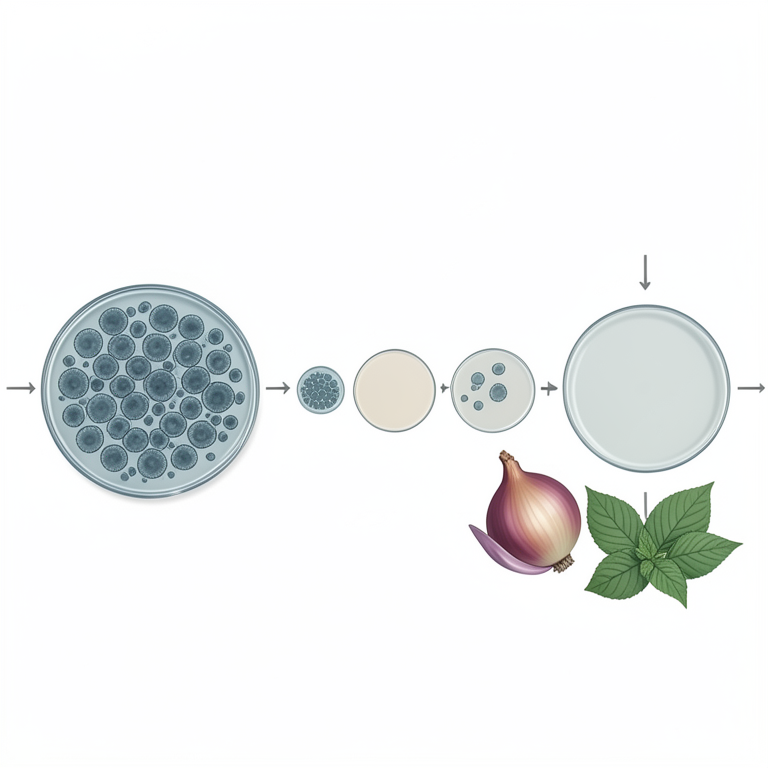
Concentration vs Inhibition Effect
AI-generated conceptual illustration (Colletotrichum gloeosporioides fungus on dragon fruit tissue). It explains the idea and does not show study data.
View source evidence ↗Figures & tables
From the original paper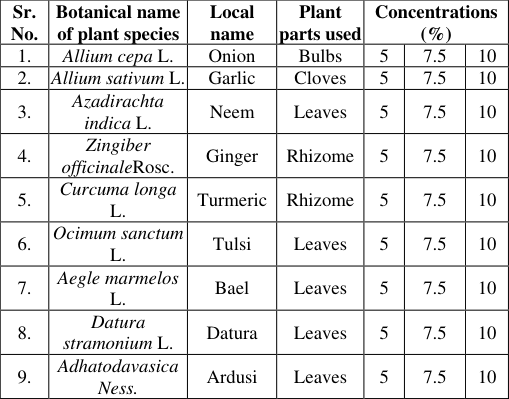 Table 1
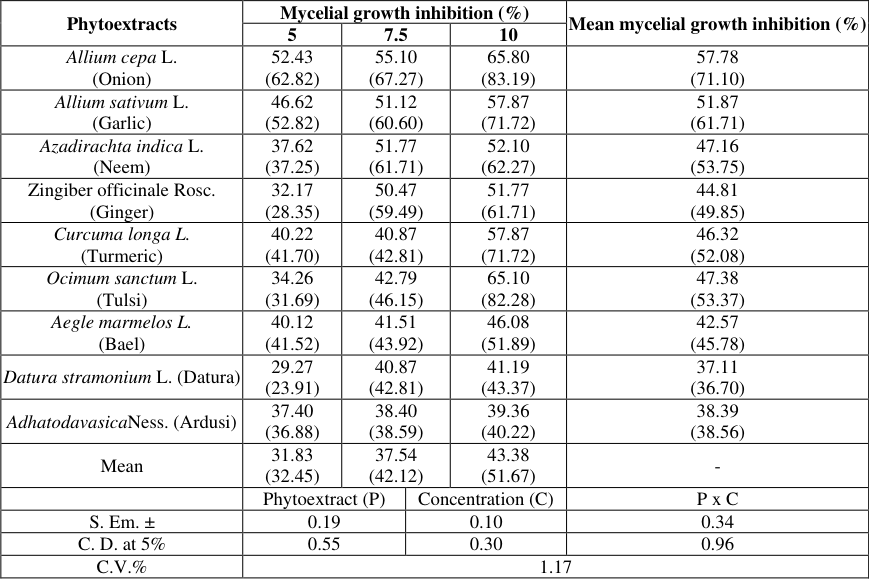 Table 2
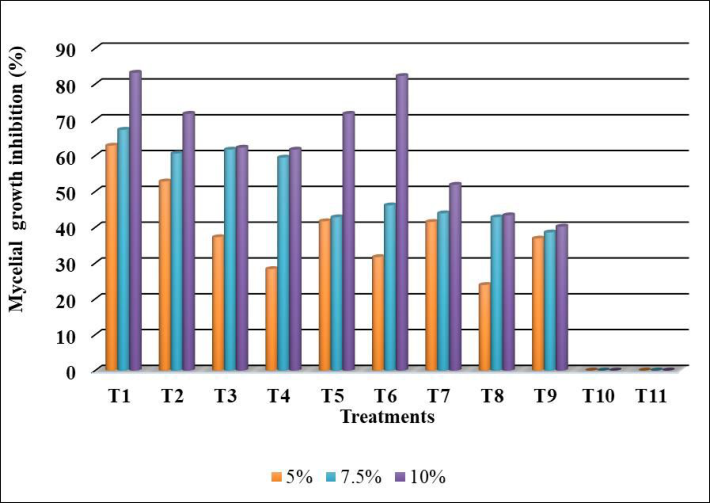 Figure 1
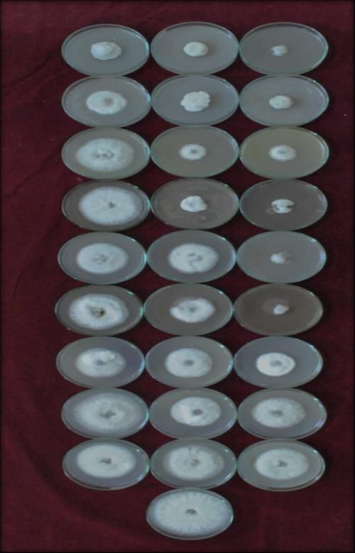 Plate 1
Introduction
Dragon fruit is a climbing cactus belonging to the tropical fruit group of the Cactaceae family. It is popularly known as pitaya, pitahaya or strawberry pear. In India, it is called Kamalam because its outer appearance resembles a lotus flower. The crop originates from South and Central America and is now grown widely across tropical and subtropical regions. The major cultivated species include Hylocereus undatus (red peel with white pulp), Hylocereus monacanthus (formerly H. polyrhizus, red peel with red pulp), H. costaricensis (red peel with purple pulp) and H. megalanthus (yellow peel with white pulp), contributing roughly 94%, 4.0%, 1.5% and 0.5% of the global market share, respectively (Wakchaure et al., 2020) [12] . The plant is known by several common names, such as dragon fruit, pitaya, pitahaya, night-blooming cereus, strawberry pear, Belle of the Night and Cinderella plant (Perween et al., 2018) [11] . In Vietnam, it is referred to as Thanh Long (Green Dragon). Among these names, pitaya is widely used and is derived from a Haitian term meaning "scaly fruit," referring to the scale-like bracts on the fruit surface (Valero et al., 2025) [13] .
The fruit is berry-like in nature, usually ranging from 7-14 cm in length and 5-9 cm in diameter and contains numerous tiny black seeds (Shah et al., 2023) [12] . Dragon fruit is recognized for its rich nutrient profile and associated health-promoting properties. Its seeds are a good source of essential fatty acids-particularly linoleic and linolenic acids-which are known to aid digestion and provide a mild laxative effect (Huang et al., 2021) [7] . The peel of red dragon fruit also contains significant amounts of important lipids, including linoleic, oleic and palmitic acids (Jiang et al., 2021) [9] . Dragon fruit is considered a highly nutritious crop because it contains an array of vital nutrients such as vitamins, minerals, carbohydrates, dietary fiber and natural antioxidants. The edible pulp is especially rich in polysaccharides (Xu et al., 2016) [16] and mixed oligosaccharides (Havas et al., 2024) [6] , which help stimulate the growth of beneficial gut microorganisms like Lactobacillus and Bifidobacterium. Dragon fruit is a semi-epiphytic cactus that flourishes in warm, dry tropical or subtropical environments where temperatures typically range between 21-29°C. However, the plant can also endure higher temperatures up to 38-40°C and brief exposure to low temperatures. Optimal growth requires abundant sunlight, 600-1300 mm of rainfall annually and a climate with alternating dry and wet periods. It can grow throughout the year in sandy, well-drained soils with adequate moisture and favorable photoperiod conditions (Jena et al., 2024) [8] . Dragon fruit originated primarily from the tropical and subtropical forest regions of Latin America, including North, Central and South America. According to Aztec literature, pitahaya fruits date back to the 13 th century. In India, dragon fruit is cultivated in an area of 14,640 ha yielding a production of 55,780 MT in 2024-2025. The major dragon fruit growing states are Andhra Pradesh, Mizoram, Maharashtra, Karnataka, Gujarat, Kerala, Tamil Nadu, Orissa, West Bengal, Tripura, Telangana and Andaman and Nicobar Islands. (Anonymous., 2024) [2] . The major dragon fruit producing regions of the country are areas of Kutch in Gujarat. In Gujarat dragon fruit cultivated in 1214 ha with the production of 4079.
Materials and Methods
The present research work entitled "Potentiality of phytoextracts against anthracnose [Colletotrichum gloeosporioides] of dragon fruit under in vitro conditions" was carried out from October to December 2024-2025 at the P.G. Laboratory, Department of Plant Pathology, College of Agriculture, Junagadh Agricultural University, Junagadh, Gujarat. The experiment was conducted using a Completely Randomized Design (CRD) with a factorial concept.
Preparation of Phytoextract
Fresh leaves, rhizomes, cloves and bulbs from nine locally available plant species were thoroughly washed under running tap water, followed by rinsing with sterile distilled water. Each sample was then ground in sterile distilled water at a ratio of 1 ml per gram of tissue (1:1 v/w) using a mortar and pestle. The resulting homogenate was filtered through fine muslin cloth, and the filtrate was centrifuged at 5000 rpm for 10 minutes. The supernatant obtained was further filtered using a sterile funnel fitted with a 1-2 µm pore-size filter. This final filtrate served as the standard (100%) plant extract solution and was stored at 4°C until use. The required concentrations of each plant extract were prepared following the method described by Ansari (1995) [3] . Details of the plant extracts used and their respective concentrations are provided in Table 1.
| Sr. No. | Botanical name of plant species | Local name | Plant parts used | Concentrations (%) | — | — |
|---|---|---|---|---|---|---|
| 1. | Allium cepa L. | Onion | Bulbs | 5 | 7.5 | 10 |
| 2. | Allium sativum L. | Garlic | Cloves | 5 | 7.5 | 10 |
| 3. | Azadirachta indica L. | Neem | Leaves | 5 | 7.5 | 10 |
| 4. | Zingiber officinaleRosc. | Ginger | Rhizome | 5 | 7.5 | 10 |
| 5. | Curcuma longa L. | Turmeric | Rhizome | 5 | 7.5 | 10 |
| 6. | Ocimum sanctum L. | Tulsi | Leaves | 5 | 7.5 | 10 |
| 7. | Aegle marmelos L. | Bael | Leaves | 5 | 7.5 | 10 |
| 8. | Datura stramonium L. | Datura | Leaves | 5 | 7.5 | 10 |
| 9. | Adhatodavasica Ness. | Ardusi | Leaves | 5 | 7.5 | 10 |
Table text extracted from the original PDF; superscript letters are shown inline. The original table image is below.
View original table image
Evaluation of phytoextracts against C. gloeosporioides in vitro
The inhibitory effect of different phytoextracts on the mycelial growth of Colletotrichum gloeosporioides was assessed in vitro using the poisoned food technique on Potato Dextrose Agar (PDA). The study included nine treatments, each replicated three times and data were analyzed using a Completely Randomized Design (CRD) with a factorial arrangement. To obtain final concentrations of 5%, 7.5% and 10%, specific quantities of each plant extract were incorporated into known volumes of PDA without altering the medium's composition. For every treatment, the mixtures were prepared in 250-ml conical flasks to a final volume of 100 ml and sterilized in an autoclave at 1.055 kg/cm² (15 psi) and 121.6°C for 15 minutes. After sterilization, 20 ml of the molten amended medium was poured into sterile 90-mm Petri plates. Once solidified, each plate was centrally inoculated with a 4-mm disc of actively growing C. gloeosporioides, placed mycelial side down to ensure proper contact with the PDA surface.
Plates were incubated at 28 ± 1°C, and untreated control plates were maintained for comparison. Radial mycelial growth was recorded, and the percentage inhibition for each treatment was determined using the formula proposed by Vincent (1947) [14] .
Where, I = Per cent inhibition of mycelial growth T = Mean radial growth of test pathogen in treated plate (mm) C = Mean radial growth of test pathogen in control plate (mm).
Results and Discussion
The efficacy of nine naturally available phytoextracts was assessed against C. gloeosporioides under in vitro conditions. The bioassay was conducted using the Poisoned Food Technique and the experiment was repeated three times to ensure accuracy and reproducibility of the results.
Each phytoextract was evaluated at three concentrations viz., 5%, 7.5% and 10%, along with an untreated control for comparison. Potato Dextrose Agar (PDA) medium was supplemented with the respective phytoextract concentrations and mycelial discs of the pathogen were centrally inoculated onto the plates. The data presented in Table 2, Plate 1 and Figure 1 clearly revealed that all tested phytoextracts exerted inhibitory effects on the mycelial growth of C. gloeosporioides when compared with the untreated control. Among the nine phytoextracts examined in vitro, the bulb extract of Allium cepa (onion) exhibited the highest antifungal effectiveness, recording a maximum mean mycelial growth inhibition of 71.10%. This treatment proved to be significantly superior to all other phytoextracts tested. The clove extract of Allium sativum (garlic) also showed strong antifungal activity, achieving 61.71% mean mycelial growth inhibition and ranking as the second most effective treatment. This was followed by the leaf extract of Azadirachta indica (neem), which recorded a mean inhibition of (53.75%). Ocimum sanctum (tulsi) leaf extract also demonstrated moderate efficacy with (53.37%) inhibition of mycelial growth. Other phytoextracts such as Curcuma longa (turmeric), Zingiber officinale (ginger) and Aegle marmelos (bael) recorded (52.08%, 49.85% and 45.78%) inhibition, respectively. Among the least effective treatments were the extracts of Adhatoda vasica (ardusi) and Datura stramonium (datura), which exhibited (38.56%) and (36.70%) mean mycelial growth inhibition, respectively. Overall, these findings suggested that certain phytoextracts especially those from onion and garlic possessed considerable antifungal potential against C. gloeosporioides and might serve as promising components in integrated disease management strategies for anthracnose in dragon fruit. As the concentration of phytoextracts increased, the mycelial growth inhibition of C. gloeosporioides also showed a corresponding increase. All three concentration levels differed significantly from one another in terms of their inhibitory efficacy. Among these, the highest concentration (10%) of all phytoextracts produced markedly greater inhibition, recording a mean mycelial growth reduction of 51.67%, compared with the lower concentrations. Considering the interaction effect between various phytoextracts and their concentrations, the bulb extract of onion at 10% concentration exhibited the highest mycelial growth inhibition (83.19%) and was significantly superior to the other treatments. The leaf extract of tulsi at 10% concentration ranked next, showing 82.28% inhibition of mycelial growth. The onion bulb extract at 10% (83.19%) was statistically comparable to the tulsi leaf extract at 10% (82.28%). The results obtained in the present study were in close agreement with the findings reported by Bal and Behera (2012) [4] , who observed similar trends in the effectiveness of certain plant extracts against Colletotrichum capsici, the causal agent of anthracnose or ripe fruit rot in chilli. In their study, various phytoextracts demonstrated significant antifungal activity, thereby supporting the current findings that plant-based treatments could effectively inhibit the mycelial growth of this pathogen. The consistency of results across studies reinforced the potential role of botanical extracts as eco-friendly and sustainable alternatives to synthetic fungicides in integrated disease management strategies for chilli crop.
| Phytoextracts | Mycelial growth inhibition (%) | — | — | — | Mean mycelial growth inhibition (%) |
|---|---|---|---|---|---|
| 5 | 7.5 | 10 | |||
| Allium cepa L. (Onion) | 52.43 (62.82) | 55.10 (67.27) | 65.80 (83.19) | 57.78 (71.10) | |
| Allium sativum L. (Garlic) | 46.62 (52.82) | 51.12 (60.60) | 57.87 (71.72) | 51.87 (61.71) | |
| Azadirachta indica L. (Neem) | 37.62 (37.25) | 51.77 (61.71) | 52.10 (62.27) | 47.16 (53.75) | |
| Zingiber officinale Rosc. (Ginger) | 32.17 (28.35) | 50.47 (59.49) | 51.77 (61.71) | 44.81 (49.85) | |
| Curcuma longa L. (Turmeric) | 40.22 (41.70) | 40.87 (42.81) | 57.87 (71.72) | 46.32 (52.08) | |
| Ocimum sanctum L. (Tulsi) | 34.26 (31.69) | 42.79 (46.15) | 65.10 (82.28) | 47.38 (53.37) | |
| Aegle marmelos L. (Bael) | 40.12 (41.52) | 41.51 (43.92) | 46.08 (51.89) | 42.57 (45.78) | |
| Datura stramonium L. (Datura) | 29.27 (23.91) | 40.87 (42.81) | 41.19 (43.37) | 37.11 (36.70) | |
| AdhatodavasicaNess. (Ardusi) | 37.40 (36.88) | 38.40 (38.59) | 39.36 (40.22) | 38.39 (38.56) | |
| Mean | 31.83 (32.45) | 37.54 (42.12) | 43.38 (51.67) | - | |
| Phytoextract (P) | Concentration (C) | P x C | |||
| S. Em. ± | 0.19 | 0.10 | 0.34 | ||
| C. D. at 5% | 0.55 | 0.30 | 0.96 | ||
| C.V.% | 1.17 |
Table text extracted from the original PDF; superscript letters are shown inline. The original table image is below.
View original table image
Acknowledgement
Acknowledgement:The authors sincerely express their gratitude to the Director of Research and the Dean of the Faculty of P.G. Studies, Junagadh Agricultural University, Junagadh, Gujarat, India, for providing the essential facilities and support to carry out this research.
References
17 in the original paper- Abirami K, Sakthivel K, Sheoran N, Baskaran V, Gautam RK, Jerard BA, et al. Occurrence of anthracnose disease caused by Colletotrichum siamense on dragon fruit (Hylocereus undatus) in Andaman Islands, India. Plant Dis. 2019;103(4):768.
- Anonymous. Department of Agriculture and Farmers Welfare, Ministry of Agriculture and Farmers Welfare, Government of India. 2024. Available from: Home | Department of Agriculture & Farmers Welfare | MoA & FW | Government of India. Accessed 25 May 2025.
- Ansari MM. Control of sheath blight of rice by plant extracts. Indian Phytopathol. 1995;48(1):268-70.
- Bal SS, Behera B. Studies on bioefficacy of phytoextracts against Colletotrichum capsici causing anthracnose and fruit rot of chilli. J Plant Prot Environ. 2012;9(2):85-7.
- Grover RK, Moore JD. Toximetric studies of fungicides against the brown rot organisms Sclerotinia fruticola and S. laxa. Phytopathology. 1962;52(9):876-80.
- Havas F, Krispin S, Cohen M, Attia-Vigneau J. A Hylocereus undatus extract enhances skin microbiota balance and delivers in-vivo improvements in skin health and beauty. Cosmetics. 2024;11(2):39.
- Huang Y, Brennan MA, Kasapis S, Richardson SJ, Brennan CS. Maturation process, nutritional profile, bioactivities and utilisation in food products of red pitaya fruits: a review. Foods. 2021;10(11):2862.
- Jena S, Routray S, Phonglosa A. Prospects for dragon fruit cultivation in Odisha. Biotica Res Today. 2024;6(8):416-8.
- Jiang H, Zhang W, Li X, Shu C, Jiang W, Cao J. Nutrition, phytochemical profile, bioactivities and applications in food industry of pitaya (Hylocereus spp.) peels: a comprehensive review. Trends Food Sci Technol. 2021;116:199-217.
- Meetum P, Leksomboon C, Kanjanamaneesathian M. First report of Colletotrichum aenigma and C. siamense, the causal agents of anthracnose of dragon fruit in Thailand. J Plant Pathol. 2015;97(2):391-403.
- Perween T, Mandal KK, Hasan MA. Dragon fruit: an exotic super future fruit of India. 2018.
- Shah K, Chen J, Chen J, Qin Y. Pitaya nutrition, biology and biotechnology: a review. Int J Mol Sci. 2023;24(18):13986.
- Valero D, Erazo Lara A, García Pastor ME, Padilla González PA, Serrano M. Yellow pitahaya (Selenicereus megalanthus Haw.): the less known of the pitahayas. Foods. 2025;14(2):202.
- Vincent JM. Distortion of fungal hyphae in the presence of certain inhibitors. Nature. 1947;159(4051):850.
- Wakchaure GC, Kumar S, Meena KK, Rane J, Pathak H. Dragon fruit cultivation in India: scope, marketing, constraints and policy issues. Tech Bull. 2020;46(1):54.
- Xu L, Zhang Y, Wang L. Structure characteristics of a water-soluble polysaccharide purified from dragon fruit (Hylocereus undatus) pulp. Carbohydr Polym. 2016;146:224-30.
- Zhao HJ, Chen SC, Chen YF, Zou CC, Wang XL, Wang ZH, et al. First report of red dragon fruit (Hylocereus polyrhizus) anthracnose caused by Colletotrichum siamense in China. Plant Dis. 2018;102(6):1175.