
Research article · 2025 · Full text
International Journal of Agriculture and Food ScienceEffect of fermentation on physico-chemical and biofunctional properties of concentrated cheese whey
Volume 7(9) · Pages 292–296 · DOI: 10.33545/2664844x.2025.v7.i9d.756 ↗
Research areasFood Industry and Aquatic BiologyProbiotics and Fermented FoodsProtein Hydrolysis and Bioactive Peptides
Abstract
Author-writtenThis study investigated the proximate composition, chemical properties, and the effect of fermentation on physico-chemical and biofunctional properties of concentrated cheese whey fermented with probiotic culture Lactobacillus helveticus MTCC 5463. Cheese whey, a nutrient-rich by-product of cheese production, was concentrated to ~20% total solids and fermented at 37 °C for various durations. The optimal fermentation period was determined based on flavour acceptability, acidity, pH, and antioxidant potential assessed by ABTS, DPPH, and FRAP assays. Results showed that fermentation for 5 hours yielded the highest flavour score (8.17 on a 9-point hedonic scale) while significantly enhancing biofunctional property specifically the antioxidant activity as estimated by ABTS (1.36 mM trolox/mg protein), DPPH (0.29 mM trolox/mg protein), and FRAP (0.86 mM trolox/mg protein) assay. Although incubation up to 8 hours increased antioxidant activity but it simultaneously lowered the sensory acceptability due to excessive acidity and perception of bitterness. These findings suggest that controlled fermentation of concentrated cheese whey can improve its biofunctional properties, offering a promising approach for valorisation of dairy by-products.
Summary
Source-checkedPlain-language reading of the full paper, prepared with AI and checked against the text. Each point links to the authors' own words.
Why it matters
- The disposal of cheese whey is an environmental concern due to its high polluting potential and the loss of nutrients and energy. View evidence ↗
- Whey proteins are valuable because they contain bioactive peptides with antibacterial, antihypertensive, and anticarcinogenic properties. View evidence ↗
- The study aims to valorize cheese whey by fermenting it with Lactobacillus helveticus MTCC 5463 to create a functional ingredient with improved antioxidant properties. View evidence ↗
The question
- The research objective was to find the optimal fermentation time that maximizes antioxidant activity while maintaining acceptable sensory qualities. View evidence ↗
What they did
- Cheese whey was concentrated to 20% total solids (TS) using a batch condensing vacuum evaporator at 55 °C and 60 mm Hg pressure. View evidence ↗
- Concentrated whey was pasteurized at 85 °C for 10 minutes, cooled to 37 °C, and inoculated with 2% Lactobacillus helveticus MTCC 5463. View evidence ↗
- Samples were analyzed at 3, 4, 5, 6, 7, and 8 hours of incubation for pH, acidity, flavor, proteolytic activity, and antioxidant activity. View evidence ↗
- Sensory evaluation of flavor was conducted by a trained panel of 10 judges using a 9-point hedonic scale. View evidence ↗
What they found
- The initial cheese whey had a mean composition of 6.18% total solids, 0.51% fat, 0.66% protein, 4.39% lactose, and 0.61% ash. View evidence ↗
- Concentrated cheese whey averaged 20.18% total solids, 1.56% fat, 2.36% protein, 15.16% lactose, and 1.63% ash. View evidence ↗
- Flavor scores peaked at 5 hours of fermentation (8.17) and declined to 4.83 by 8 hours. View evidence ↗
- Proteolytic activity, measured by tyrosine value, increased steadily from 4.35 mg/mL at 0 hours to 9.32 mg/mL after 8 hours of fermentation. View evidence ↗
- Antioxidant activity increased with fermentation time; at 8 hours, ABTS, DPPH, and FRAP values reached 2.36, 0.50, and 1.31 mM trolox/mg protein, respectively. View evidence ↗
- The optimal fermentation period was determined to be 5 hours, as it balanced high antioxidant activity with the best sensory acceptability. View evidence ↗
What it means
- The authors conclude that controlled fermentation of concentrated cheese whey is a sustainable way to transform a waste product into a functional food ingredient rich in bioactive peptides. View evidence ↗
Visual summary
3 visualsIllustrations explain the paper; charts are replotted from the paper's own table values.
Fermentation Trade-off
AI-generated conceptual illustration (concentrated cheese whey). It explains the idea and does not show study data.
View source evidence ↗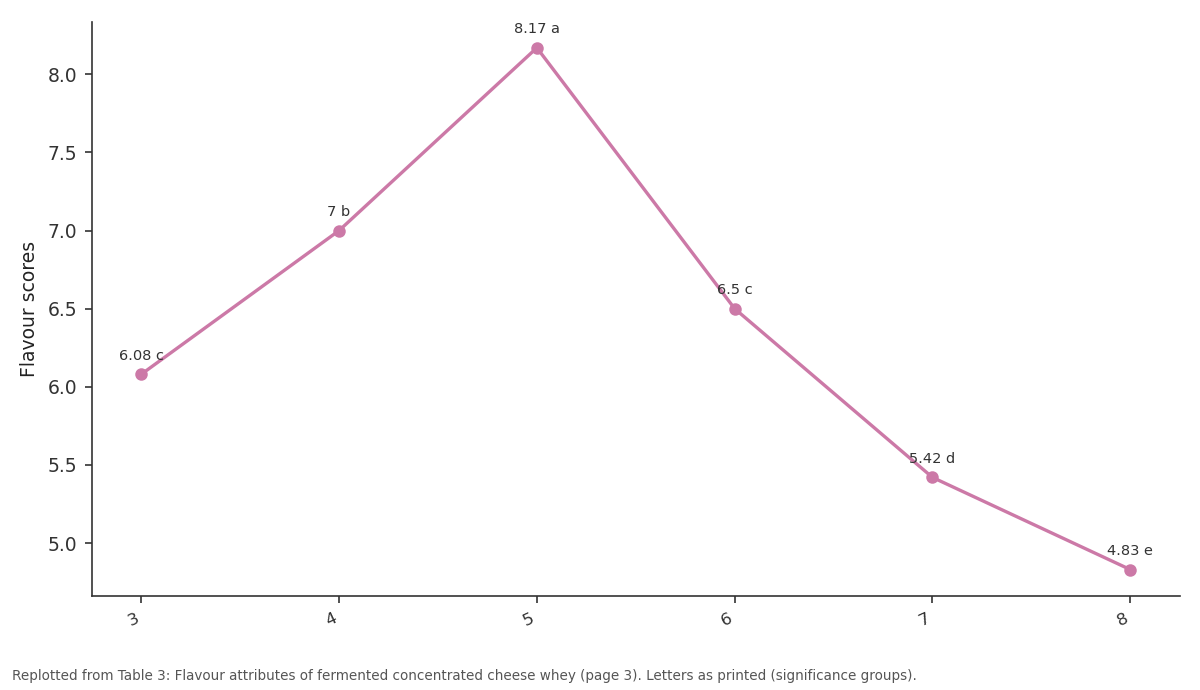
Flavour scores: 3 vs 4 vs 5 vs 6 vs 7
Replotted from Table 3 (page 3) of the original paper. Every bar is the paper's own table value.
View source evidence ↗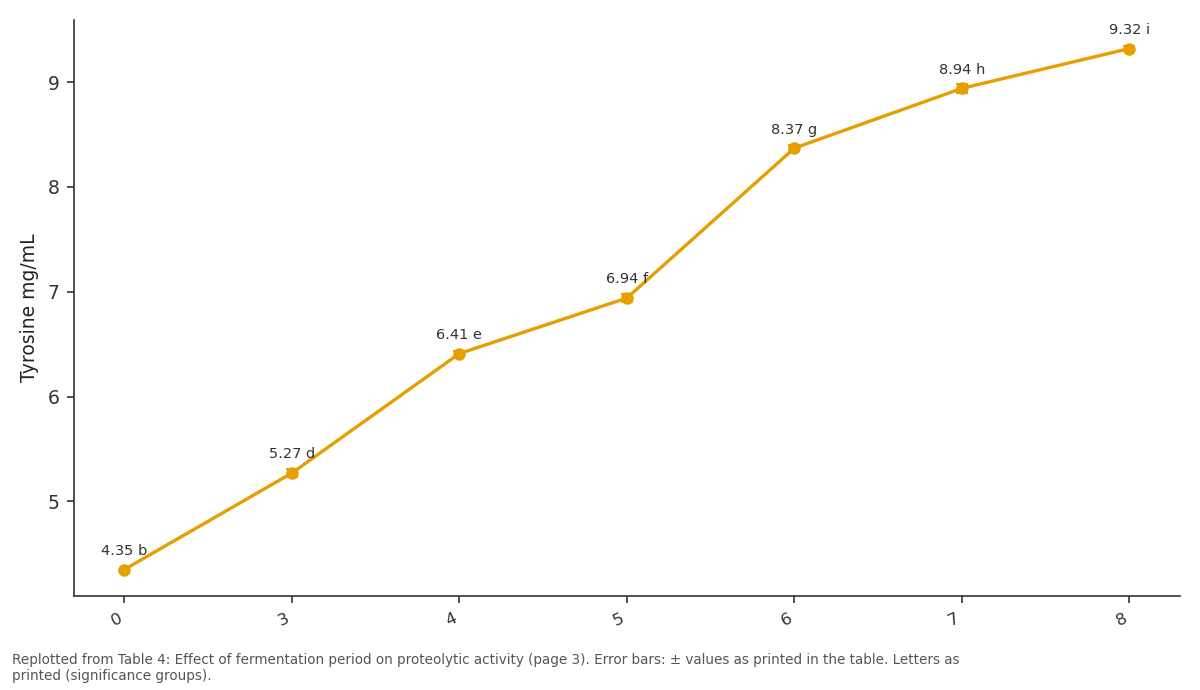
Tyrosine mg/mL / Mean ±SD: 0 vs 3 vs 4 vs 5 vs 6
Replotted from Table 4 (page 3) of the original paper. Every bar is the paper's own table value.
View source evidence ↗Figures & tables
From the original paper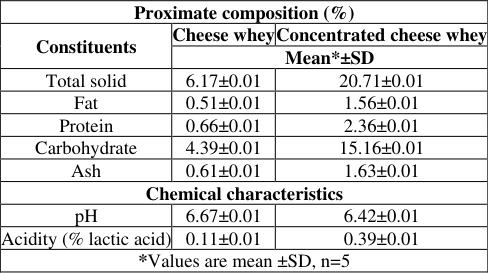 Table 1
 Table 2
 Table 3
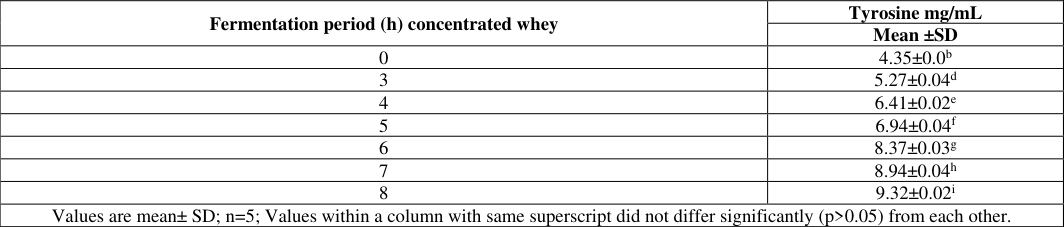 Table 4
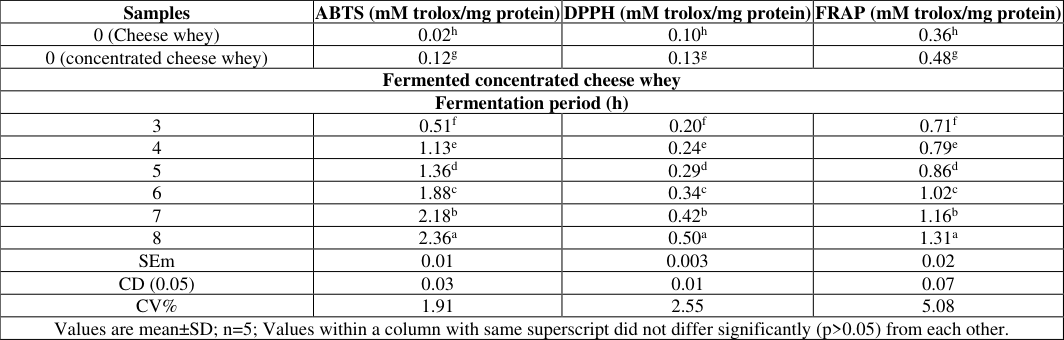 Table 5
Introduction
Whey is an important by-product of the dairy industry, generated during the manufacture of cheese, chhana, paneer, and casein. Disposal of whey not only leads to nutrient and energy losses but also raises serious concerns among environmentalists and engineers because of its strong polluting potential. Moreover, the dairy industry incurs substantial expenses for the treatment and safe disposal of whey. Whey is now increasingly valued not as waste but as a rich source of nutritionally important whey proteins, which can be economically recovered in their native form thanks to modern processing technologies. Whey proteins are valued for their content of bioactive peptides that exhibit antihypertensive, antibacterial, and anticarcinogenic effects. In foods, they serve multiple biological functions that contribute to human health and nutrition. The present study focused on valorising cheese whey, a nutrient-rich by-product of cheese production, through fermentation with probiotic bacteria lactobacillus helveticus MTCC 5463 to develop a functional dairy ingredient with enhanced antioxidant properties. The efficacy of this culture for preparation of good quality fermented milk was already established and some of the probiotic potentials of Lactobacillus helveticus MTCC 5463 were also established and reported by earlier workers (Ashar, 1998) [1] . The primary objective was to optimise the fermentation period to balance improved antioxidant activity and desirable sensory attributes, thereby transforming whey from an environmental pollutant into a value-added product. By concentrating whey and subjecting it to fermentation, the study aimed to study changes in biofunctional properties that contribute to antioxidant activity.
• Analysis of Whey and concentrated whey: Titratable acidity of whey and concentrated whey sample was determined as per BIS method (IS: SP-18, 1981) as described for milk. The pH reading of whey was taken using digital pH meter (CH-8603, M/s. Mettler Toledo AG, Schwerzenbach). The total solids (TS) content of whey and concentrated whey sample was estimated by gravimetric method (IS: SP-18, 1981) while fat content was analyzed by gravimetric method given by FSSAI (2022). The concentration of protein in the whey and concentrated whey samples were estimated by the method of Lowry et al. (1951) [12] . The lactose content of whey and concentrated whey was determined by Lane-Eynon method (FSSAI, 2022) with some modification and ash content was determined by procedure described in BIS handbook (IS: SP -18, 1981). The antioxidant activity of cheese whey samples and concentrated whey samples was estimated by ABTS radical scavenging activity (Re et al., 1999) [18] , DPPH radical scavenging activity (McCune and Johns, 2002) [13] and ferric reducing antioxidant potential (FRAP) assay (Benzie and Strain, 1996) [3] . • Preparation of concentrated cheese whey: The cheese whey was preheated to 60 °C before condensing and were concentrated in the batch condensing vacuum evaporator at 60 mm Hg pressure and 55 °C temperature, to a concentration of 20 per cent TS. • Fermentation of concentrated cheese whey: The concentrated cheese whey (20% TS) was pasteurized at 85°C for 10 min followed by cooling to 37 °C. It was then inoculated with 2% of lactobacillus helveticus MTCC 5463 followed by incubation at 37 °C. The whey was analysed at time intervals of 3, 4, 5, 6, 7 and 8 h for flavour score, acidity, pH, proteolytic and antioxidant activity.
• Analysis of fermented concentrated cheese whey:
The cheese whey after fermentation at different interval (i.e. 3, 4, 5, 6, 7 and 8 h) were analysed for acidity (IS: SP-18, 1981), pH and for biofunctional properties namely antioxidant activity by ABTS, DPPH and FRAP assay.
• Sensory evaluation fermented concentrated cheese whey: Fermented concentrated cheese whey samples were judged for flavour by a trained panel of 10 judges using 9-point hedonic scale. (Meilgaard et al., 1999) [
• Statistical analysis:
The statistical analysis of the experimental data was carried out using Completely Randomized Design (CRD). This approach was applied to evaluate the effects of fermentation time on sensory attributes, acidity, pH and antioxidant activity of the fermented concentrated cheese whey, ensuring the reliability and validity of the observed results.
Results and Discussion
The cheese whey as well as the concentrated cheese whey samples were analyzed for various parameters and the results are presented in Table 1.0. The mean values for TS, fat, lactose, protein and ash of whey were 6.18, 0.51, 0.66, 4.39 and 0.61 per cent, respectively. The pH and acidity of whey were 6.67 and 0.11 per cent lactic acid, respectively as shown in Table 1. The concentrated cheese whey contained on an average of 20.18 per cent TS. The fat and protein content of concentrated cheese whey was 1.56 and 2.36 per cent while the lactose and ash content were 15.16 per cent 1.63 per cent, respectively. The pH and acidity of concentrated cheese whey were 6.42 and 0.39 per cent lactic acid, respectively as shown in Table 1. Patel (2013) [16] reported that cheese whey and concentrated cheese whey contained 6.35 and 11.5 per cent total solids, 0.06 and 0.11 per cent fat, 0.9 and 1.63 per cent protein, 5.0 and 9.05 per cent lactose, and 0.59 and 1.07 per cent ash, respectively. The average pH values of cheese whey and concentrated cheese whey were 5.8 and 5.6, while their corresponding titratable acidity was 0.13 and 0.24 per cent lactic acid, respectively.
| Proximate composition (%) | — | — |
|---|---|---|
| Constituents | Cheese whey | Concentrated cheese whey |
| Mean*±SD | ||
| Total solid | 6.17±0.01 | 20.71±0.01 |
| Fat | 0.51±0.01 | 1.56±0.01 |
| Protein | 0.66±0.01 | 2.36±0.01 |
| Carbohydrate | 4.39±0.01 | 15.16±0.01 |
| Ash | 0.61±0.01 | 1.63±0.01 |
| Chemical characteristics | ||
| pH | 6.67±0.01 | 6.42±0.01 |
| Acidity (% lactic acid) | 0.11±0.01 | 0.39±0.01 |
| *Values are mean ±SD, n=5 |
Table text extracted from the original PDF; superscript letters are shown inline. The original table image is below.
View original table image
Optimization of fermentation period of concentrated cheese whey
The whey samples were withdrawn after 3, 4, 5, 6, 7 and 8 h of incubation period and analyzed for flavour characteristics, acidity, pH and antioxidant activity.
Effect of Fermentation Period on Titratable Acidity and pH of Concentrated Whey
The total titratable acidity of a fermented sample is the total quantity of hydrogen ions present, excluding those coupled to alkaline ions. The assessment of total titratable acid is more important in evaluating microbial fermentation ability (Geidam et al., 2007) [9] . The titratable acidity and pH value of unfermented cheese whey were 0.11 per cent lactic acid and 6.68 while that of concentrated whey was 0.39 per cent lactic acid and 0.39, respectively. The acidity of concentrated whey after 3, 4, 5, 6, 7 and 8 h of fermentation was 0.49, 0.52, 0.57, 0.65, 0.71 and 0.78 percent lactic acid, respectively and the difference among all samples was significant (p<0.05). The pH of fermented whey after 3, 4, 5, 6, 7 and 8 h of fermentation was 6.41, 6.34, 6.21, 6.14, 6.05, 5.94, 5.85 and 5.78, respectively and the difference among all samples was significant (p<0.05) as depicted in Table 2.
| Incubation time (h) | Acidity (% lactic acid) | pH |
|---|---|---|
| 3 | 0.49f | 6.21f |
| 4 | 0.52e | 6.14e |
| 5 | 0.57d | 6.05d |
| 6 | 0.65c | 5.94c |
| 7 | 0.71b | 5.85b |
| 8 | 0.78a | 5.78a |
| Values are mean± SD; n=5; Values within a column with same superscript did not differ significantly (p>0.05) from each other. |
Table text extracted from the original PDF; superscript letters are shown inline. The original table image is below.
View original table image
Effect of Fermentation Period on Flavour of Concentrated Whey
Flavour is the most significant characteristic for judging the quality of any product which in turn influences its acceptance. Examination of the data for flavour of fermented whey indicated that the flavour scores for different incubation periods i.e. 3, 4, 5, 6, 7 and 8 h were 6.08, 7.00, 8.17, 6.50, 5.42 and 4.83, respectively and they differed significantly from each other (p<0.05) as shown in Table 3. The flavour scores of concentrated whey obtained after 5 h of fermentation were the best among all experimental with a clean acid taste and therefore was judged as the best.
| Incubation time (h) | Flavour scores | Comments |
|---|---|---|
| 3 | 6.08c | Flavour of whey |
| 4 | 7.00b | Slightly sour |
| 5 | 8.17a | Clean pleasant acid taste |
| 6 | 6.50c | Highly acidic |
| 7 | 5.42d | Highly acidic |
| 8 | 4.83e | Highly acidic and bitterness |
| Values are mean± SD; n=5; Values within a column with same superscript did not differ significantly (p>0.05) from each other. |
Table text extracted from the original PDF; superscript letters are shown inline. The original table image is below.
View original table image
The flavour score of concentrated cheese whey correlated well with increase in acidity during different durations of fermentation.
Effect of Fermentation Period on proteolytic activity of Concentrated Whey
Milk, although a rich growth medium, contains low concentration of free amino acids and peptides to efficiently support growth of LAB (Shihata and Shah, 2000) [19] . In response to this limitation, LAB has developed a complex system of proteinases and peptidases, which enable them to utilize casein, the milk protein as an additional source of organic nitrogen (Vasiljevic et al., 2005) [20] . The extent of the proteolytic activity of concentrated whey after different hours of fermentation was analyzed by measuring the tyrosine value and the results of the analysis are shown in the Table 4. As the fermentation time increased the proteolytic activity increased as evident from increased tyrosine value. In the present study L. helveticus MTCC 5463 was used as common starter culture for the fermenting concentrated whey and many research workers have confirmed that various strains of L. helveticus have remarkable proteolytic activity and they present a potential system to liberate dormant bioactive peptides from milk proteins through proteolytic hydrolysis during fermentation of milk (Virtanen et al. 2007) [21] . In the present study Lactobacillus helveticus MTCC 5463 was used as a starter culture which has remarkable proteolytic activity and it was found that the proteolytic activity determined by degree of hydrolysis increased with increase in incubation time.
| Fermentation period (h) concentrated whey | Tyrosine mg/mL |
|---|---|
| Mean ±SD | |
| 0 | 4.35±0.0b |
| 3 | 5.27±0.04d |
| 4 | 6.41±0.02e |
| 5 | 6.94±0.04f |
| 6 | 8.37±0.03g |
| 7 | 8.94±0.04h |
| 8 | 9.32±0.02i |
| Values are mean± SD; n=5; Values within a column with same superscript did not differ significantly (p>0.05) from each other. |
Table text extracted from the original PDF; superscript letters are shown inline. The original table image is below.
View original table image
Effect of Fermentation Period on Antioxidant Potential of Concentrated Whey
Oxidative metabolism can produce extremely reactive free radicals which are molecules having unpaired electron and are capable of carrying out a rapid change reaction which can destabilize other molecules and generate free radicals. Because of their different reaction mechanisms, the antioxidant activity of natural compounds is dependent on the experimental procedures. As a result, DPPH assay to determine free radical scavenging activity, ABTS assay to determine cation radical scavenging activity, and a FRAP assay to determine reducing ability. The antioxidant capacity of whey, concentrated whey and fermented concentrated whey was determined based on ABTS, FRAP, and DPPH assays and results are presented in Table 5. Values for ABTS radical scavenging activity for whey and concentrated whey were 0.02 and 0.12 mM trolox/mg protein, respectively. While that of fermented concentrated whey was 0.11, 0.24, 0.51, 1.13, 1.36, 1.88, 2.18 and 2.36 mM trolox/mg protein for 3, 4, 5, 6, 7 and 8 h of fermentation, respectively. DPPH radical scavenging activity of whey and concentrated whey were 0.10 and 0.13 mM trolox/mg protein, respectively. While that of fermented concentrated whey was 0.20, 0.24, 0.29, 0.34, 0.42 and 0.50 mM trolox/mg protein for 3, 4, 5, 6, 7 and 8 h of fermentation, respectively. FRAP radical scavenging activity for whey and concentrated whey were 0.36 and 0.48 mM trolox/mg protein, respectively. While that of fermented concentrated whey was 0.71, 0.79, 0.86, 1.02, 1.16 and 1.31mM trolox/mg protein for 3, 4, 5, 6, 7 and 8 h of fermentation, respectively.
| Samples | ABTS (mM trolox/mg protein) | DPPH (mM trolox/mg protein) | FRAP (mM trolox/mg protein) |
|---|---|---|---|
| 0 (Cheese whey) | 0.02h | 0.10h | 0.36h |
| 0 (concentrated cheese whey) | 0.12g | 0.13g | 0.48g |
| Fermented concentrated cheese whey | |||
| Fermentation period (h) | |||
| 3 | 0.51f | 0.20f | 0.71f |
| 4 | 1.13e | 0.24e | 0.79e |
| 5 | 1.36d | 0.29d | 0.86d |
| 6 | 1.88c | 0.34c | 1.02c |
| 7 | 2.18b | 0.42b | 1.16b |
| 8 | 2.36a | 0.50a | 1.31a |
| SEm | 0.01 | 0.003 | 0.02 |
| CD (0.05) | 0.03 | 0.01 | 0.07 |
| CV% | 1.91 | 2.55 | 5.08 |
| Values are mean±SD; n=5; Values within a column with same superscript did not differ significantly (p>0.05) from each other. |
Table text extracted from the original PDF; superscript letters are shown inline. The original table image is below.
View original table image
As fermentation time increased it showed an increase in the antioxidant activity due to the increased production of peptides and metabolites. The results showed that fermented whey had the highest radical scavenging activity after 8 hours of incubation at 37 °C. Ramesh et al. (2012) [17] in his study fermented skim milk for 24 h at 37 °C with nineteen selected Lactobacillus strains and evaluated their antioxidant activity by ABTS decolourization assay. The radical scavenging activity varied between 0.12 to 0.49 mM TEAC/mg protein. Athira et al. (2015) [2] studied hydrolysis of UF retentate of whey as an effective method for the production of WPH directly from whey using the enzyme alcalase. WPH showed a potent radical scavenging activity, which is contributed by several peptides contained in this hydrolysate measured using ABTS radical scavenging activity. Whey protein hydrolyzed for 8 h at pH 9.00 and 55 °C showed a maximum antioxidant activity of 1.18±0.015 μmol trolox/mg protein. The antioxidant peptides were further enriched by ultrafiltration through 3 kDa membrane. Chavda (2009) [7] reported the antioxidant capacity of paneer whey as 0.34 µMol TE /ml by ABTS method, 0.11 µMol TE /ml by DPPH radical scavenging method and 0.45 µMol TE /ml based on FRAP assay method while WPC-70 (1%) solution showed antioxidant capacity of 0.58, 0.82 and 0.66 µMol TE /ml for ABTS, DPPH and FRAP assay methods, respectively. Results on antioxidant potential of concentrated cheese whey subjected to different periods of fermentation revealed that lactobacillus helveticus MTCC 5463 due to their significant proteolytic activity, present a potential agent to liberate bioactive peptide with antioxidant activity from milk proteins which is confirmed by various research workers (Chaudhari, 2018; Gobbetti et al., 2007; Parekh et al., 2016) [6,10,15] . The result of analysis of antioxidant activity of fermented whey showed an increase in the antioxidant activity with an increase in incubation time, but the flavour scores of the fermented whey decreased drastically after 5 h of incubation time. Hence, the optimum period for fermentation of concentrated cheese whey using 2 per cent lactobacillus helveticus MTCC 5463 at 37 °C was selected as 5 h.
Conclusion
The study demonstrated that fermentation of concentrated cheese whey with Lactobacillus helveticus MTCC 5463 effectively enhanced its antioxidant potential, with fermentation time playing a critical role in balancing bioactivity and sensory quality. A fermentation period of five hours at 37 °C was identified as optimal, providing significant improvements in antioxidant capacity while maintaining desirable flavour. The process offers a sustainable and value added utilization of whey, transforming it from an environmental burden into a functional food ingredient rich in bioactive peptides.
References
21 in the original paper- Ashar MN, Prajapati JB. Bile tolerance, bile deconjugation and cholesterol reducing properties of dietary lactobacilli. Indian J Microbiol. 1998;38(3):1458.
- Athira S, Mann B, Saini P, Sharma R, Kumar R, Singh AK. Production and characterisation of whey protein hydrolysate having antioxidant activity from cheese whey. J Sci Food Agric. 2015;95(14):2908-15.
- Benzie IF, Strain JJ. The ferric reducing ability of plasma (FRAP) as a measure of "antioxidant power": the FRAP assay. Anal Biochem. 1996;239(1):70-6.
- Bureau of Indian Standards. Milk, cream and evaporated milk -Determination of total solids content (reference method). IS:12333. New Delhi: Bureau of Indian Standards; 1997.
- Bureau of Indian Standards. Method of test for dairy industry. Chemical analysis of milk. IS:1479 (Part II). New Delhi: Bureau of Indian Standards; 1961.
- Chaudhari NA. Evaluating selected spices for extending shelf life of cultured buttermilk [PhD thesis]. Anand: Sheth MC College of Dairy Science, Anand Agricultural University; 2018.
- Chavda VR. Antioxidant potential of whey protein enriched fruit beverage [PhD thesis]. Karnal: NDRI; 2009.
- Food Safety and Standards Authority of India. Manual of methods of analysis of foods: Dairy and dairy products. New Delhi: FSSAI; 2022.
- Geidam YA, Ambali AG, Onyeyili PA. Phytochemical screening and antibacterial properties of organic solvent fractions of Psidium guajava aqueous leaf extracts. 2007;68-73.
- Gobbetti M, Minervini F, Rizzello CG. Bioactive peptides in dairy products. In: Handbook of food products manufacturing. 2007. p. 489-517.
- Indian Standards Institution. ISI handbook of food analysis. Part XI: Dairy products. New Delhi: ISI; 1981.
- Lowry OH, Rosebrough NJ, Farr AL, Randall RJ. Protein measurement with the Folin phenol reagent. J Biol Chem. 1951;193(1):265-75.
- McCune LM, Johns T. Antioxidant activity in medicinal plants associated with the symptoms of diabetes mellitus used by the indigenous peoples of the North American boreal forest. J Ethnopharmacol. 2002;82(2-3):197-205.
- Meilgaard MC, Carr BT, Civille GV. Sensory evaluation techniques. 4th ed. Boca Raton: CRC Press; 1999. doi:10.1201/9781003040729
- Parekh SL, Balakrishnan S, Aparnathi KD. Sensory attributes and physicochemical characteristics of cultured buttermilk prepared by partial substitution of milk with paneer whey. Int J Curr Microbiol Appl Sci. 2016;5:333-48. http://dx.doi.org/10.20546/ijcmas.2016.512.036
- Patel S, Shende S, Arora S, Singh AK. An assessment of the antioxidant potential of coriander extracts in ghee when stored at high temperature and during deep fat frying. Int J Dairy Technol. 2013;66(2):207-13.
- Ramesh V, Kumar R, Singh RR, Kaushik JK, Mann B. Comparative evaluation of selected strains of lactobacilli for the development of antioxidant activity in milk. Dairy Sci Technol. 2012;92(2):179-88.
- Re R, Pellegrini N, Proteggente A, Pannala A, Yang M, Rice-Evans C. Antioxidant activity applying an improved ABTS radical cation decolorization assay. Free Radic Biol Med. 1999;26(9-10):1231-7.
- Shihata A, Shah NP. Proteolytic profiles of yogurt and probiotic bacteria. Int Dairy J. 2000;10(5-6):401-8.
- Vasiljevic T, Shah NP, Jelen P. Growth characteristics of Lactobacillus delbrueckii subsp. bulgaricus ATCC 11842 as affected by different neutralizer. Aust J Dairy Technol. 2005;60:3-9.
- Virtanen T, Pihlanto A, Akkanen S, Korhonen H. Development of antioxidant activity in milk whey during fermentation with lactic acid bacteria. J Appl Microbiol. 2007;102(1):106-15.