
Research article · 2025 · Full text
International Journal of Advanced Chemistry ResearchCharacterization of phenolic compounds and antioxidant activity in spirulina-enriched cookies
Volume 7(5) · Pages 81–83 · DOI: 10.33545/26646781.2025.v7.i5a.307 ↗
Research areasMicrobial Metabolites in Food BiotechnologyPotato Plant Research
Abstract
Author-writtenThis study explores the phenolic profile and antioxidant potential of cookies enriched with Spirulina platensis, a microalga known for its functional bioactivity. The growing demand for health-enhancing bakery products has driven interest in incorporating natural antioxidants into widely consumed formats like cookies. Using spectrophotometric and chromatographic techniques, we quantified total phenolic content (TPC), identified individual phenolic compounds, and evaluated antioxidant activity via DPPH and ABTS assays in control and spirulina-fortified samples. Our findings demonstrate a marked increase in both phenolic concentration and radical scavenging capacity following spirulina enrichment, supporting its role in functional bakery product development.
Summary
Source-checkedPlain-language reading of the full paper, prepared with AI and checked against the text. Each point links to the authors' own words.
Why it matters
- Cookies are globally popular but are typically nutritionally deficient, lacking functional compounds like antioxidants while being high in simple carbohydrates and saturated fats. View evidence ↗
- Spirulina platensis is a cyanobacterium rich in proteins, vitamins, minerals, and phenolic compounds that can help support metabolic health and reduce oxidative damage. View evidence ↗
- While adding spirulina to bakery products is promising, there is insufficient data on how its phenolic profile and antioxidant activity are affected by the heat of baking. View evidence ↗
The question
- The study aims to evaluate the antioxidant activity and phenolic content of cookies fortified with Spirulina platensis. View evidence ↗
What they did
- Cookies were prepared by mixing dough for 5 minutes, rolling it to 5 mm thickness, and baking 5 cm discs at 180 °C for 12 minutes. View evidence ↗
- Total phenolic content (TPC) was measured using the Folin-Ciocalteu method and reported as mg gallic acid equivalents (GAE) per 100 g of dry weight. View evidence ↗
- HPLC with a diode array detector was used to profile specific phenolic compounds, including quercetin, chlorogenic acid, ferulic acid, and caffeic acid. View evidence ↗
- Antioxidant capacity was evaluated using DPPH and ABTS assays, with results expressed as µmol Trolox equivalents (TE) per gram of dry weight. View evidence ↗
What they found
- The spirulina group showed higher concentrations of ferulic acid (6.2 µg/g vs. 2.1 µg/g) and chlorogenic acid (4.7 µg/g vs. 1.5 µg/g) compared to the control. View evidence ↗
- Spirulina-enriched cookies exhibited significantly higher antioxidant activity than control cookies, with DPPH values of 12.6 ± 0.4 vs 5.8 ± 0.2 µmol TE/g and ABTS values of 13.8 ± 0.6 vs 6.3 ± 0.3 µmol TE/g. View evidence ↗
What it means
- The authors conclude that phenolic compounds from spirulina are thermally stable when incorporated into cookies, maintaining their activity after baking. View evidence ↗
- The study suggests that spirulina is a sustainable and natural way for the food industry to improve the nutritional profile of common snacks. View evidence ↗
Visual summary
2 visualsIllustrations explain the paper; charts are replotted from the paper's own table values.
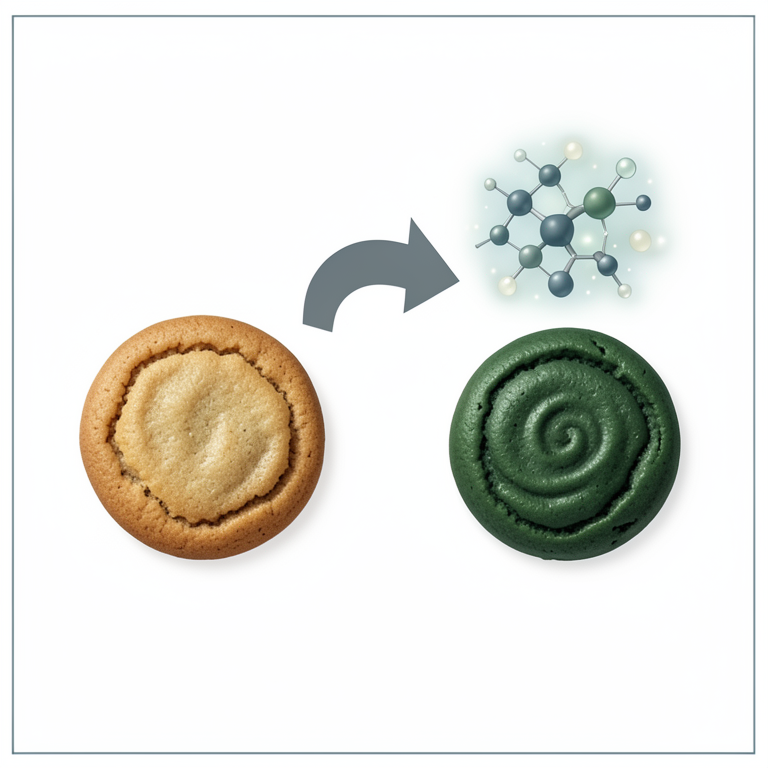
Effect of Spirulina Fortification on Cookie Properties
AI-generated conceptual illustration (Spirulina platensis enriched cookies). It explains the idea and does not show study data.
View source evidence ↗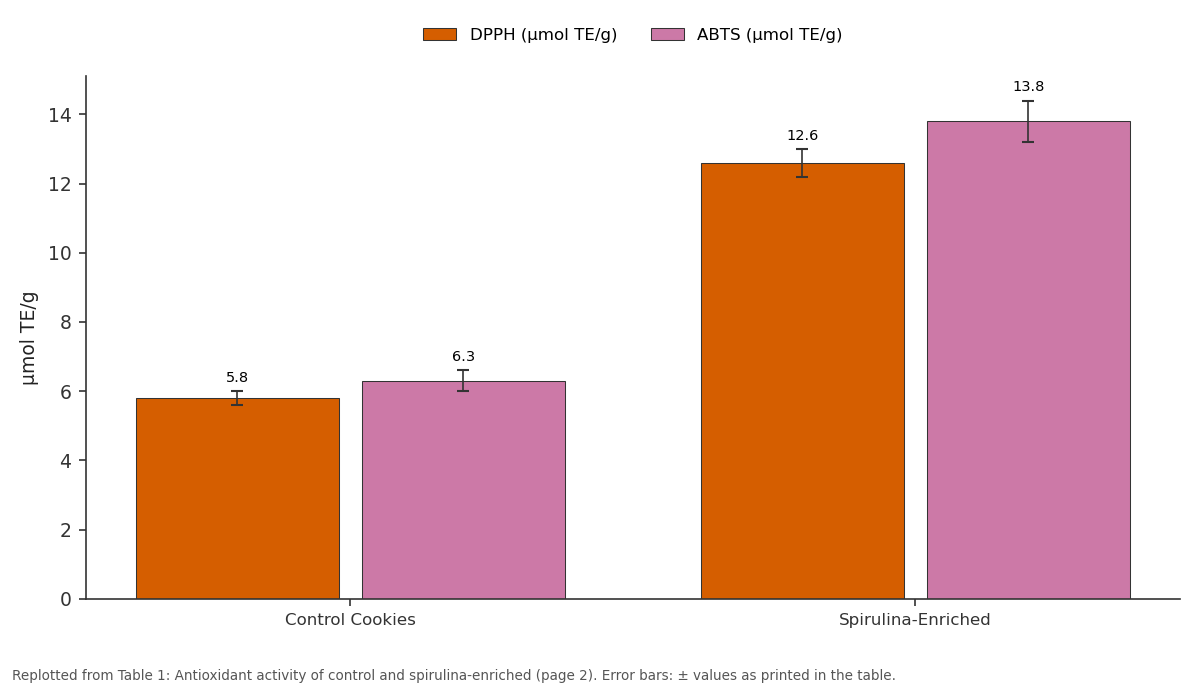
DPPH (µmol TE/g) and ABTS (µmol TE/g): Control Cookies vs Spirulina-Enriched
Replotted from Table 1 (page 2) of the original paper. Every bar is the paper's own table value.
View source evidence ↗Figures & tables
From the original paper Table 1
Introduction
Cookies are among the most widely consumed baked products worldwide due to their taste, texture, and convenience. However, conventional cookies are often considered nutritionally poor, typically high in saturated fat and simple carbohydrates, and low in functional compounds such as antioxidants. In response to rising public health concerns, particularly those related to oxidative stress and chronic disease, there is a growing emphasis on the development of functional bakery products. These aim to deliver both sensory appeal and physiological benefits. Among the natural bioactive ingredients under investigation, Spirulina platensis, a filamentous cyanobacterium, has gained significant attention. It is rich in protein, polyunsaturated fatty acids, vitamins, minerals, and phenolic compounds-bioactives known to mitigate oxidative damage and support metabolic health. Spirulina's antioxidant potential is largely attributed to its phenolic acids, flavonoids, and unique pigments such as phycocyanin. However, limited data exist on how spirulina's functional compounds behave when incorporated into thermally processed foods like cookies. Phenolic compounds in food matrices have been extensively studied for their ability to neutralize free radicals, reduce inflammation, and provide a protective effect against noncommunicable diseases. Nevertheless, the stability of phenolics during baking and their impact on final antioxidant activity require careful evaluation. Previous studies have reported promising results when incorporating spirulina into bakery formulations, but comprehensive characterization of its phenolic profile post-baking remains insufficient. The aim of this study is to assess the phenolic content and antioxidant activity of cookies enriched with Spirulina platensis. Using both spectrophotometric and chromatographic methods, we provide quantitative and qualitative insights into the retention and behavior of phenolic compounds during cookie production. Furthermore, we evaluate the antioxidant potential of the final product to determine the efficacy of spirulina fortification in enhancing health-promoting properties in a widely consumed food format
Materials and Methods
Materials and Methods
Extraction of Phenolic Compounds
After freeze-drying, cookie samples were ground into a fine powder using a laboratory grinder. An aliquot of 2 g from each sample was mixed with 20 mL of 80% methanol (v/v) and vortexed for 5 minutes. The mixture was then sonicated at 40 kHz for 30 minutes at room temperature and shaken on an orbital shaker at 200 rpm for 1 hour. The supernatant was collected by centrifugation (4000 rpm, 15 min), filtered through a 0.45 µm membrane, and stored at 4 °C in amber vials until further analysis.
Determination of Total Phenolic Content (TPC)
Total phenolic content was determined using the Folin-Ciocalteu colorimetric method. Briefly, 0.5 mL of each methanolic extract was mixed with 2.5 mL of 10% Folin-Ciocalteu reagent and incubated for 5 minutes. Next, 2.0 mL of 7.5% sodium carbonate solution was added. The reaction mixture was incubated in the dark at room temperature for 30 minutes. Absorbance was read at 765 nm using a UV-Vis spectrophotometer. Gallic acid was used to prepare the calibration curve (10-100 mg/L), and results were expressed as mg gallic acid equivalents (GAE) per 100 g dry weight.
HPLC Analysis of Phenolic Profile
Phenolic compound profiling was conducted using highperformance liquid chromatography (HPLC) equipped with a diode array detector (DAD). Separation was achieved on a C18 reversed-phase column (250 mm × 4.6 mm, 5 µm) using a gradient mobile phase: solvent A (0.1% formic acid in water) and solvent B (acetonitrile). The flow rate was maintained at 1.0 mL/min, and the injection volume was 20 µL. Detection was performed at 280 nm and 320 nm. Phenolic standards included caffeic acid, ferulic acid, chlorogenic acid, and quercetin. Identification was based on retention time comparison and spectral matching.
Antioxidant Assays
Two in vitro assays were used to evaluate antioxidant capacity: DPPH (2, 2-diphenyl-1-picrylhydrazyl) and ABTS (2, 2'-azino-bis(3-ethylbenzothiazoline-6-sulfonic acid)). For the DPPH assay, 100 µL of extract was added to 3.9 mL of DPPH solution (0.1 mM in methanol). The mixture was incubated in the dark for 30 minutes, and absorbance was read at 517 nm. For the ABTS assay, ABTS radicals were generated by mixing 7 mM ABTS with 2.45 mM potassium persulfate and incubating the solution in the dark for 12-16 hours. The radical solution was diluted to an absorbance of 0.70 ± 0.02 at 734 nm before use. Then, 100 µL of extract was added to 3.9 mL of ABTS solution and measured at 734 nm after 6 minutes. Results from both assays were expressed as µmol Trolox equivalents (TE) per gram of dry weight.
Results
Results
Total Phenolic Content
The TPC of spirulina-enriched cookies was significantly higher than that of the control group. Control cookies yielded 42.5 ± 1.3 mg GAE/100g DW, while spirulina cookies reached 89.4 ± 2.1 mg GAE/100g DW, more than doubling the phenolic content.
HPLC Phenolic Profiling
HPLC-DAD revealed enhanced concentrations of key phenolic acids in the spirulina group, particularly ferulic acid (6.2 µg/g vs. 2.1 µg/g in control) and chlorogenic acid (4.7 µg/g vs. 1.5 µg/g). Minor increases were also noted in quercetin and caffeic acid levels.
Antioxidant Activity
As summarized in Table 1, both antioxidant assays demonstrated superior radical scavenging capacity in spirulina-fortified cookies.
| Sample | DPPH (µmol TE/g) | ABTS (µmol TE/g) |
|---|---|---|
| Control Cookies | 5.8 ± 0.2 | 6.3 ± 0.3 |
| Spirulina-Enriched | 12.6 ± 0.4 | 13.8 ± 0.6 |
Table text extracted from the original PDF; superscript letters are shown inline. The original table image is below.
View original table image
Discussion
The results confirm that spirulina is a valuable source of phenolic compounds capable of enhancing the antioxidant potential of cookies. The increase in TPC aligns with previous studies emphasizing the contribution of spirulina's phycocyanin and flavonoid content to oxidative stress mitigation.
The HPLC data suggest that specific phenolic acids in spirulina remain stable during the baking process, although some degradation may occur. Importantly, the preservation of functional compounds post-baking reinforces the feasibility of spirulina fortification in commercial bakery production.
The antioxidant activity measured by DPPH and ABTS confirms that spirulina inclusion yields not only higher phenolic content but also bioactive functionality, validating its role as a natural antioxidant enhancer.
Conclusion
This study presents clear evidence that spirulina enrichment significantly enhances the phenolic content and antioxidant potential of cookies. The integration of Spirulina platensis into a conventional shortbread recipe led to a marked increase in total phenolic concentration and radical scavenging activity, as measured by DPPH and ABTS assays. High-performance liquid chromatography confirmed the presence of several key phenolic compounds-most notably ferulic acid, chlorogenic acid, and caffeic acid-in appreciable concentrations, demonstrating the compoundspecific contribution of spirulina to the overall phytochemical profile. Importantly, the retention of phenolic activity post-baking underscores the thermal stability of these compounds when incorporated into food matrices such as cookies. These findings are significant not only for food scientists but also for the functional food industry, where spirulina offers a natural and sustainable means of improving the nutritional profile of widely consumed snack items.
Nevertheless, this study also highlights the need for further investigation. Future work should focus on the bioavailability of spirulina-derived phenolics following ingestion, sensory acceptance among different consumer groups, and the optimization of formulation parameters for industrial-scale applications. Moreover, clinical trials are necessary to substantiate the health claims associated with regular consumption of spirulina-enriched baked goods.
In conclusion, spirulina holds considerable promise as a fortifying agent in functional cookie development, offering both nutritional enhancement and potential antioxidant protection. Its inclusion aligns with current trends in healthoriented food innovation, representing a valuable step toward the creation of bakery products with tangible health benefits.
References
5 in the original paper- Belay A. The potential application of spirulina (Arthrospira) as a nutritional and therapeutic supplement. Journal of the American Nutraceutical Association. 2002;5(2):27-48.
- Prakash G, Pandey V. Development and quality evaluation of cookies fortified with spirulina. International Journal of Agriculture and Food Science. 2023;5(1):162-166.
- Finamore A, et al. Antioxidant activities of spirulina. Oxidative Medicine and Cellular Longevity. 2017;2017:Article ID 3247528.
- Hwang JH, Lee IT. Functional cookie development using spirulina. Korean Journal of Food and Cookery Science. 2016;32(5):587-596.
- Wu LC, Ho JA, Shieh MC, Lu IW. Antioxidant activities of spirulina and chlorella water extracts. Journal of Agricultural and Food Chemistry. 2005;53(10):4207-4212.