
Research article · 2025 · Full text
International Journal of Horticulture and Food ScienceDeterminants of refrigerated cow milk curd pH based on starter cultures and incubation temperatures
Volume 7(1) · Pages 97–99 · DOI: 10.33545/26631067.2025.v7.i1b.249 ↗
Research areasProbiotics and Fermented FoodsNutrition, Health and Food BehaviorProtein Hydrolysis and Bioactive Peptides
Abstract
Author-writtenAccurate regulation\r\nof cow milk curd pH is mandatory for processing and maintenance of shelf life;\r\nDysregulation of cow milk curd pH has been associated with easy spoilage of\r\ncurd. Curd manufacture in India needs improvements in the existing methods of\r\nproduction and marketing so as to ensure a uniformly high standard in the\r\nquality of curd. Research was\r\nundergone to identify the starter cultures and incubation temperatures,\r\nwhich can maintain desirable pH and in turn increase the shelf life without\r\ncompromising with the standard curd quality. Significant (p
Summary
Source-checkedPlain-language reading of the full paper, prepared with AI and checked against the text. Each point links to the authors' own words.
Why it matters
- Precise control of pH in cow milk curd is essential for proper processing and extending shelf life, as poor pH regulation leads to faster spoilage. View evidence ↗
- There is a need to improve curd production and marketing methods in India to ensure consistent high quality. View evidence ↗
- Variations in pH significantly affect the taste and preservation quality of milk products. View evidence ↗
The question
- The study aimed to identify the specific starter culture combinations and incubation temperatures that optimize cow milk curd production and extend its shelf life. View evidence ↗
What they did
- Cow milk curd was prepared using a combination of 5% fat and 9% solids-not-fat (SNF), with incubation temperatures set at 37 °C and 40 °C. View evidence ↗
- pH levels were measured using a Hanna digital pH meter following AOAC (2016) standard methods. View evidence ↗
- After incubation, the curd samples were stored at a refrigeration temperature of 5 °C to monitor pH changes. View evidence ↗
What they found
- On day 0, the initial pH of cow milk curd ranged from 4.52 to 4.59 for samples incubated at 37 °C and 4.51 to 4.57 for those at 40 °C. View evidence ↗
- By day 6 of storage, the pH ranged from 4.11 to 4.37 for the 37 °C group and 3.92 to 4.08 for the 40 °C group. View evidence ↗
- The combination of L. lactis subsp. lactis, L. lactis subsp. cremoris, and L. lactis subsp. lactis biovar diacetylactis maintained a higher pH on both day 0 and day 6 compared to other cultures. View evidence ↗
- When stored at 5.00±0.5 °C, the combined L. lactis culture incubated at 37 °C resulted in a higher pH than the same culture combination incubated at 40 °C. View evidence ↗
- There was a statistically significant difference (p < 0.01) in pH between the control and treatment samples. View evidence ↗
What it means
- The authors conclude that cow milk curd made with the combined L. lactis cultures and incubated at 37 °C is the best option, as it can be refrigerated for approximately 6 days without defects. View evidence ↗
Figures & tables
From the original paper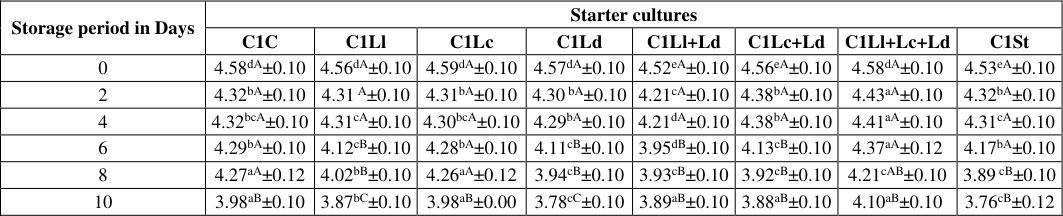 Table 1
 Table 2
Introduction
The critical role of pH in milk and milk products has been recognized from the earliest days of fermentation. The pH differences generate remarkable changes in taste, keeping quality and serve as an interconvertible source of metabolic energy. The central role of organellar pH regulation in cellular homeostasis and survival is therefore evident and unquestionable. In this light, it is remarkable that our knowledge of the determinants of cow milk curd pH is rather primitive. The pH remains understudied as well as underappreciated perhaps because of the multiplicity of variables involved in pH regulation and the technical challenges it presents. Preservation of dairy foods with the help of specific group of bacteria known as lactic acid bacteria has been the most common practice. There are a variety of control measures and processes to prevent microbial contamination, some of which are even capable of extending shelf life. Research in the area of extending shelf life of dairy foods is very aggressive. Thus it is immensely important to meet the current market trend of dairy products. With this view the main objective of this Research work is to find starter culture combinations and incubation temperatures prominent for cow milk curd production with a better shelf life.
Materials and Methods
Cow milk curd and buffalo milk curd were prepared and incubated at 37 °C and 40 °C separately using 5 per cent fat and 9 per cent SNF combination in cow milk using the starter culture combination viz. Dahi culture, Lactococcus lactis subsp. [11]
Results and Discussion
The pH of cow milk curd samples prepared by using different starter cultures and incubated at 37 °C and 40 °C and stored at 5 °C is presented in Tables 1 and2 respectively. The initial pH of cow milk curd incubated at 37 °C and 40 °C on day 0 of storage ranged from 4.52 to 4.59 and 4.51 to 4.57, respectively. There was a decrease in the pH during the entire storage period. The pH of cow milk curd incubated at 37 °C and 40 °C on day 6 day ranged from 4.11 to 4.37 and 3.92 to 4.08, respectively. The pH was high in cow milk curd samples prepared using Lactococcus lactis subsp. lactis, Lactococcus lactis subsp. cremoris and Lactococcus lactis subsp. lactis biovar diacetylactis combined cultures on day 0 as well on day 6 of storage at refrigeration temperature. On storage at 5.00±0.5 °C, the pH of the cow milk curd sample prepared using the starter cultures Lactococcus lactis subsp. lactis, Lactococcus lactis subsp. cremoris and Lactococcus lactis subsp. lactis biovar diacetylactis combined cultures incubated at 37 °C was higher compared to Lactococcus lactis subsp. lactis, Lactococcus lactis subsp. cremoris and Lactococcus lactis subsp. lactis biovar diacetylactis combined cultures incubated at 40 °C. The data pertaining to the pH of the cow milk curd samples prepared by inoculating different starter cultures at incubation temperature of 37º and 40 °C at refrigeration is presented in Table 1 and 2 respectively. Significant (p<0.01) difference between the control and treatment samples was observed. The Lactococcus lactis subsp. lactis, Lactococcus lactis subsp. cremoris and Lactococcus lactis subsp. lactis biovar diacetylactis sample showed desirable pH during storage than other curd samples incubated at 37 °C and 40 °C of incubation. Gandhi, et al 2022 [5] ; Jaros and Rohm (2003) [7] analyzed that enhanced acidification to pH values below 4.0 may lead to body and texture defects such as gel shrinkage and syneresis. They recorded that the average pH value of laboratory made curd samples was 4.55 and average pH value curd samples from different local markets varied between 4.37, 4.17 and 4.10. In this study, few cow curd samples were rejected for further analysis. This is justified by Beena, 2010 [1] ; Kroger, 1976 [9] who had stated that a weak coagulum is obtained above the pH of 4.5. For a lower pH, 4.5 the gel is generally firmer, presumably because the protein-protein bonds are stronger (Ray 2025 ] ; Nishinari 2021; Walstra et al, 1999) [12,10,5] . The results were in accordance with Coetzer 2012 [3] and Beyene et al. (1998) [2] who had reported that a total of 25 single strains of Lactococcus lactis cultures capable of reducing pH of milk to below 4.6 within 24hrs at 30 °C incubation at 1 per cent inoculation rate. L. plantarum strains and L. paraplantarum strains grow poorly in milk without supplementation (Siezen et [13,15,3] , which suggest that L. plantarum could not efficiently use some milk ingredients such as casein. Kiran et al. (2012) [8] recorded that Brevibacillus brevis MMB 12 does not have the ability to ferment lactose and observed that the culture did not develop acidity. Vannini and Siroli (2025) [14] ; Holland and Liu (2011) [6] stated that Leuconostocs are mesophilic grows poorly in milk. Leuconostocs usually grow associatively with lactococci in milk, although strains of Ln. lactis can grow independently and produce acid in milk. It is well known that curd cannot be kept for long at ordinary conditions. Therefore different methods are applied to restrict the growth of undesirable microorganisms. One of the valuable properties of starter culture is their ability to inhibit growth of undesirable microorganisms. The main preservative action of lactic starter culture is a result of acid production. Factors such as reduced water content, acidity and pH of the product ensure that milk solids can be stored for a prolonged time.
| Storage period in Days | Starter cultures | — | — | — | — | — | — | — |
|---|---|---|---|---|---|---|---|---|
| C1C | C1Ll | C1Lc | C1Ld | C1Ll+Ld | C1Lc+Ld | C1Ll+Lc+Ld | C1St | |
| 0 | 4.58dA±0.10 | 4.56dA±0.10 | 4.59dA±0.10 | 4.57dA±0.10 | 4.52eA±0.10 | 4.56eA±0.10 | 4.58dA±0.10 | 4.53eA±0.10 |
| 2 | 4.32bA±0.10 | 4.31 A±0.10 | 4.31bA±0.10 | 4.30 bA±0.10 | 4.21cA±0.10 | 4.38bA±0.10 | 4.43aA±0.10 | 4.32bA±0.10 |
| 4 | 4.32bcA±0.10 | 4.31cA±0.10 | 4.30bcA±0.10 | 4.29bA±0.10 | 4.21dA±0.10 | 4.38bA±0.10 | 4.41aA±0.10 | 4.31cA±0.10 |
| 6 | 4.29bA±0.10 | 4.12cB±0.10 | 4.28bA±0.10 | 4.11cB±0.10 | 3.95dB±0.10 | 4.13cB±0.10 | 4.37aA±0.12 | 4.17bA±0.10 |
| 8 | 4.27aA±0.12 | 4.02bB±0.10 | 4.26aA±0.12 | 3.94cB±0.10 | 3.93cB±0.10 | 3.92cB±0.10 | 4.21cAB±0.10 | 3.89 cB±0.10 |
| 10 | 3.98aB±0.10 | 3.87bC±0.10 | 3.98aB±0.00 | 3.78cC±0.10 | 3.89aB±0.10 | 3.88aB±0.10 | 4.10aB±0.10 | 3.76cB±0.12 |
Table text extracted from the original PDF; superscript letters are shown inline. The original table image is below.
View original table image
Conclusion
The pH was high in cow milk curd samples prepared using Lactococcus lactis subsp. lactis, Lactococcus lactis subsp. cremoris and Lactococcus lactis subsp. lactis biovar diacetylactis combined cultures on day 0 as well on day 6 of storage at refrigeration temperature. On storage at 5.00±0.5 °C, the pH of the Lactococcus lactis subsp. lactis, Lactococcus lactis subsp. cremoris and Lactococcus lactis subsp. lactis biovar diacetylactis combined cultures curd sample incubated at 37 °C was higher compared Lactococcus lactis subsp. lactis, Lactococcus lactis subsp. cremoris and Lactococcus lactis subsp. lactis biovar diacetylactis combined cultures incubated at 40 °C. Thus based on this research, compared to other starter cultures cow milk curd samples prepared using Lactococcus lactis subsp. lactis, Lactococcus lactis subsp. cremoris and Lactococcus lactis subsp. lactis biovar diacetylactis combined cultures incubated at 37 °C can be kept under refrigeration temperature for about 6 days without any defects.
Acknowledgement
AcknowledgementsAuthors sincerely thank Tamil Nadu Veterinary and Animal Sciences University for providing necessary facilities to carry out this research work.
Figures and tables from the paper
| Storage period in Days | Starter cultures | — | — | — | — | — | — | — |
|---|---|---|---|---|---|---|---|---|
| C2C | C2Ll | C2Lc | C2Ld | C2Ll+Ld | C2Lc+Ld | C2Ll+Lc+Ld | C2St | |
| 0 | 4.57eA±0.10 | 4.55eA±0.10 | 4.52fA±0.10 | 4.55eA±0.10 | 4.51fA±0.10 | 4.54eA±0.10 | 4.58eA±0.10 | 4.51fA±0.10 |
| 2 | 4.28bA±0.10 | 4.37aA±0.10 | 4.30bA±0.10 | 4.30bA±0.10 | 4.30bA±0.12 | 4.29bA±0.10 | 4.41aA±0.10 | 4.20cA±0.10 |
| 4 | 4.11cA±0.10 | 4.16cA±0.10 | 4.26bA±0.10 | 4.09cA±0.10 | 4.01dA±0.10 | 3.94eB±0.10 | 4.29aA±0.10 | 4.29aA±0.10 |
| 6 | 4.08bA±0.03 | 3.98cB±0.10 | 4.09bA±0.10 | 3.96cB±0.10 | 3.94cB±0.10 | 3.92dB±0.10 | 4.17aA±0.10 | 4.15aA±0.10 |
| 8 | 4.01aB±0.10 | 3.92bB±0.10 | 4.06aA±0.10 | 3.87cB±0.10 | 3.89cB±0.10 | 3.92bB±0.10 | 3.99cB±0.12 | 3.87cB±0.10 |
| 10 | 3.77aB±0.10 | 3.97aB±0.10 | 3.96aB±0.10 | 3.87aB±0.10 | 3.87aB±0.10 | 3.86aB±0.10 | 3.97aB±0.10 | 3.74 aB±0.10 |
Table text extracted from the original PDF; superscript letters are shown inline. The original table image is below.
View original table image
References
16 in the original paper- Beena AK. Detergent potential of enzymes of dairy microflora and their effect on the shelf life of milk products. Diss. Department of Dairy Science, College of Veterinary and Animal Sciences, Mannuthy; 2010.
- Beyene F, Narvhus J, Abrahamsen RK. Evaluation of new strains of Lactic acid bacteria as a starter for cultured milk production. Ethiop J Sci. 1998;21:67-80.
- Coetzer SM. Microbial interactions associated with indigenous fermented milk. Doctoral dissertation, University of the Free State; 2012.
- Corsetti A, Valmorri S. Lactobacillus spp.: Lactobacillus plantarum. Università degli Studi di Teramo, Mosciano S. Angelo, Italy. 2011;3:111-118.
- Gandhi K, Gautam PB, Sharma R, Mann B, Kumar K. Effect of incorporation of iron-whey protein concentrate (Fe-WPC) conjugate on physicochemical characteristics of dahi (curd). J Food Sci Technol. 2022;1-10.
- Holland R, Liu SQ. Lactic acid bacteria: Leuconostoc spp. In: Fuquay JW, Fox PE, McSweeney PLH, editors. Encyclopedia of dairy sciences. 2nd ed. Cambridge, Massachusetts, USA: Elsevier; 2011. p. 138-142.
- Jaros D, Rohm H. Controlling the texture of fermented dairy products: The case of yoghurt. In: Smit G, editor. Dairy Processing. Woodhead Publishing Limited; 2003. p. 155-184.
- Kiran UKA, Appaiah KAA, Appaiah S. Extension of shelf life of curd -An Indian fermented milk by using a new isolate of Brevibacillus brevis strain as starter culture. Innov Rom Food Biotechnol. 2012;10:48-55.
- Kroger M. Quality of yogurt. J Dairy Sci. 1976;52:344350.
- Nishinari K. Gelling properties. In: Food Hydrocolloids: Functionalities and Applications. 2021. p. 119-170.
- Official Methods of Analysis. 21st ed. AOAC International, Rockville, MD; 2019.
- Ray RC, Paramithiotis S, Thekkangil A, Nethravathy V, Rai AK, Martin JGP. Trending topics on fermented foods in human history. 2025. p. 237-346.
- Siezen RJ, Tzeneva VA, Castioni A, Wels M, Phan HTK, Rademaker JLW, et al. Phenotypic and genomic diversity of Lactobacillus plantarum strains isolated from various environmental niches. Environ Microbiol. 2010;12:758-773.
- Vannini L, Siroli L. Canned and heat preserved foods. In: The Microbiological Quality of Food. Elsevier Science Ltd.; 2025. p. 261-271.
- Zalan Z, Hudacek J, Stetina J. Lactobacillus production of organic acids by strains in three different media. Eur Food Res Technol. 2010;230:302.
- Walstra P. Physical chemistry of foods. New York: Marcel Dekker; 2003