
Research article · 2023 · Full text
International Journal of Agriculture and NutritionComprehensive analysis of the nutritional profile of mustard (Brassica juncea L.) Seeds
Volume 5(2) · Pages 100–102 · DOI: 10.33545/26646064.2023.v5.i2b.164 ↗
Research areasNitrogen and Sulfur Effects on BrassicaPhytase and its Applications
Abstract
Author-writtenMustard (Brassica juncea L.) seeds are valued for their nutritional and medicinal properties. This study presents a comprehensive analysis of the nutritional profile of mustard seeds, including macronutrient and micronutrient content, phytochemical composition, and antioxidant activity. The findings highlight the potential health benefits of incorporating mustard seeds into the diet, providing a basis for further research and development of functional foods.
Summary
Source-checkedPlain-language reading of the full paper, prepared with AI and checked against the text. Each point links to the authors' own words.
Why it matters
- Mustard (Brassica juncea L.) is a widely grown plant used primarily for its seeds, which serve as a spice and a source for mustard oil. View evidence ↗
- Mustard seeds are recognized for medicinal properties and potential in managing chronic diseases because they contain bioactive compounds. View evidence ↗
- There is currently a lack of comprehensive data regarding the nutritional composition of mustard seeds despite interest in their health benefits. View evidence ↗
The question
- The study aims to provide a comprehensive analysis of the macronutrients, micronutrients, phytochemicals, and antioxidant activity of mustard seeds to evaluate their use in functional foods. View evidence ↗
What they did
- The mustard seeds used in the analysis were collected from a local agricultural market in Ranchi, Jharkhand, India, on March 15, 2024. View evidence ↗
- Macronutrient composition (moisture, ash, protein, fat, and carbohydrates) was determined using standard AOAC methods. View evidence ↗
- Atomic absorption spectroscopy (AAS) was used to measure the levels of calcium, magnesium, potassium, iron, and zinc. View evidence ↗
- Spectrophotometric methods were employed to analyze the total phenolic content (TPC) and total flavonoid content (TFC). View evidence ↗
- The DPPH radical scavenging assay was used to evaluate the antioxidant activity of the seed extracts. View evidence ↗
What they found
- Mustard seeds contain substantial amounts of protein (28.4%) and fat (36.2%), making them a significant source of plant-based nutrients. View evidence ↗
- The seeds are rich in potassium (687 mg/100 g) and magnesium (345 mg/100 g), which support muscle function and electrolyte balance. View evidence ↗
- The seeds provide calcium (254 mg/100 g), iron (9.8 mg/100 g), and zinc (5.6 mg/100 g), contributing to bone health, oxygen transport, and immune function. View evidence ↗
- The seeds have a high concentration of phenolic compounds (65.3 mg GAE/g) and flavonoids (28.7 mg QE/g), which provide antioxidant potential. View evidence ↗
- Mustard seeds showed strong antioxidant activity, with a DPPH inhibition percentage of 82.5%. View evidence ↗
What it means
- The authors conclude that mustard seeds should be included in diets and used to develop functional foods to enhance health and prevent chronic diseases. View evidence ↗
- The authors state that future research is needed to determine the bioavailability of the nutrients and the long-term health effects of regular consumption. View evidence ↗
Visual summary
2 visualsIllustrations explain the paper; charts are replotted from the paper's own table values.
Nutritional Analysis Framework
AI-generated conceptual illustration (brown mustard seeds (Brassica juncea L.)). It explains the idea and does not show study data.
View source evidence ↗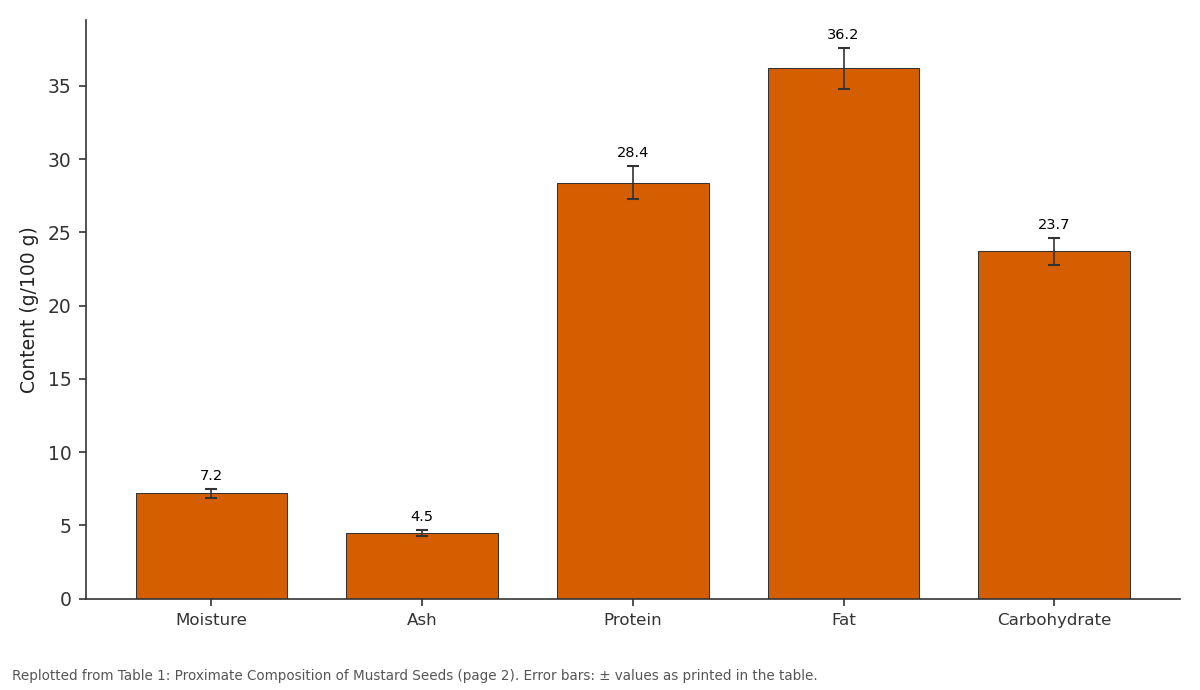
Content (g/100 g): Moisture vs Ash vs Protein vs Fat vs Carbohydrate
Replotted from Table 1 (page 2) of the original paper. Every bar is the paper's own table value.
View source evidence ↗Figures & tables
From the original paper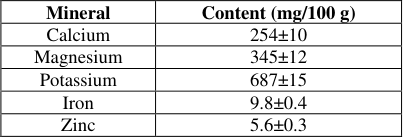 Table 2
 Table 3
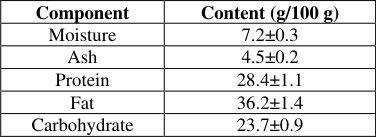 Table 1
 Table 4
Introduction
Mustard (Brassica juncea L.), a member of the Brassicaceae family, is widely cultivated for its seeds, which are used as a spice and in the production of mustard oil. Mustard seeds are known for their distinctive flavor and are a staple in various cuisines around the world. Beyond their culinary uses, mustard seeds have been recognized for their nutritional and medicinal properties, including potential benefits in managing chronic diseases due to their rich content of bioactive compounds. Despite the growing interest in the health benefits of mustard seeds, there is limited comprehensive data on their nutritional composition. This study aims to fill this gap by providing a detailed analysis of the macronutrient and micronutrient content, phytochemical profile, and antioxidant activity of mustard seeds. Understanding the nutritional profile of mustard seeds can inform their potential use in dietary applications and the development of functional foods.
Objective of paper
The objective of this paper is to comprehensively analyze the nutritional profile of mustard (Brassica juncea L.) seeds, including their macronutrient and micronutrient content, phytochemical composition, and antioxidant activity, to understand their potential health benefits and applications in functional foods.
Materials and Methods
Sample Collection: Mustard seeds (Brassica juncea L.) were sourced from the local agricultural market in Ranchi, Jharkhand, India, on March 15, 2024. The seeds were cleaned to remove impurities and stored in a cool, dry place until analysis.
Proximate Analysis: Proximate analysis was conducted to determine the macronutrient composition of mustard seeds, including moisture, ash, protein, fat, and carbohydrate content. Standard methods from the Association of Official Analytical Chemists (AOAC) were employed for the analysis. Moisture content was determined by drying the seeds at 105 °C until a constant weight was achieved, following the AOAC 925.10 method. Ash content was measured by incinerating the seeds at 550 °C in a muffle furnace according to the AOAC 923.03 method. Protein content was analyzed using the Kjeldahl method, which determines total nitrogen content as per AOAC 979.09. Fat content was extracted using the Soxhlet extraction method with petroleum ether as the solvent, following the AOAC 920.39 protocol. Carbohydrate content was calculated by difference, subtracting the sum of moisture, ash, protein, and fat from the total weight of the sample.
Mineral Analysis:
The mineral content of mustard seeds, including calcium, magnesium, potassium, iron, and zinc, was determined using atomic absorption spectroscopy (AAS). The samples were first subjected to wet digestion with a mixture of nitric acid and perchloric acid according to the AOAC 975.03 method. The digested samples were then analyzed using AAS to quantify the levels of each mineral.
Phytochemical Analysis: Phytochemical constituents, including total phenolic content (TPC) and total flavonoid content (TFC), were analyzed using spectrophotometric methods. Total phenolic content was measured using the Folin-Ciocalteu reagent and expressed as milligrams of gallic acid equivalents (GAE) per gram of sample, based on the method described by Singleton & Rossi (1965). For total flavonoid content, the aluminum chloride colorimetric method was used, and the results were expressed as milligrams of quercetin equivalents (QE) per gram of sample, following the procedure outlined by Zhishen et al. (1999).
Antioxidant Activity:
The antioxidant activity of mustard seed extracts was evaluated using the DPPH (2,2-diphenyl-1-picrylhydrazyl) radical scavenging assay. This method assesses the ability of the antioxidants in the mustard seeds to quench DPPH free radicals. The reduction in absorbance at 517 nm, indicative of the scavenging of DPPH radicals, was measured using a spectrophotometer. The results were expressed as the percentage of DPPH inhibition, following the protocol described by Brand-Williams et al. (1995).
Statistical Analysis:
All experiments were conducted in triplicate to ensure reliability and reproducibility of the results. Data were statistically analyzed using Analysis of Variance (ANOVA) to determine significant differences between the means of different treatment groups. Tukey's post hoc test was employed for pairwise comparisons to identify specific differences between groups. A significance level of p<0.05 was used to determine statistical significance.
Results and Discussion
The results of this study provide a comprehensive overview of the nutritional composition, phytochemical content, and antioxidant activity of mustard (Brassica juncea L.) seeds.
The findings are presented in detailed tables, followed by an in-depth discussion.
Proximate Composition
The proximate composition of mustard seeds was analyzed to determine their macronutrient content. The results are summarized in Table 1. The moisture content of mustard seeds was found to be 7.2%, which is typical for seeds and indicates good storage stability. The ash content, representing the total mineral content, was 4.5%, reflecting the presence of essential minerals. Protein content was substantial at 28.4%, highlighting mustard seeds as an excellent source of plantbased protein. The fat content was notably high at 36.2%, indicating that mustard seeds are also a significant source of healthy fats. The carbohydrate content, calculated by difference, was 23.7%, providing an additional energy source.
| Component | Content (g/100 g) |
|---|---|
| Moisture | 7.2±0.3 |
| Ash | 4.5±0.2 |
| Protein | 28.4±1.1 |
| Fat | 36.2±1.4 |
| Carbohydrate | 23.7±0.9 |
Table text extracted from the original PDF; superscript letters are shown inline. The original table image is below.
View original table image
Mineral Content
The mineral content of mustard seeds was determined using atomic absorption spectroscopy, and the results are presented in Table 2. Mustard seeds were found to be rich in potassium (687 mg/100 g) and magnesium (345 mg/100 g), which are crucial for maintaining electrolyte balance and muscle function. Calcium content was also significant at 254 mg/100 g, contributing to bone health. The seeds provided 9.8 mg/100 g of iron, essential for oxygen transport in the blood, and 5.6 mg/100 g of zinc, important for immune function and enzyme activity.
| Mineral | Content (mg/100 g) |
|---|---|
| Calcium | 254±10 |
| Magnesium | 345±12 |
| Potassium | 687±15 |
| Iron | 9.8±0.4 |
| Zinc | 5.6±0.3 |
Table text extracted from the original PDF; superscript letters are shown inline. The original table image is below.
View original table image
Phytochemical Composition
The phytochemical analysis of mustard seeds focused on total phenolic content (TPC) and total flavonoid content (TFC). The results are summarized in Table 3. The total phenolic content was 65.3 mg GAE/g, indicating a high concentration of phenolic compounds, which are known for their antioxidant properties. The total flavonoid content was 28.7 mg QE/g, further contributing to the antioxidant potential of mustard seeds. These bioactive compounds can help mitigate oxidative stress and reduce the risk of chronic diseases.
| Phytochemical | Content (mg/g) |
|---|---|
| Total Phenolic Content (TPC) | 65.3±2.1 (GAE) |
| Total Flavonoid Content (TFC) | 28.7±1.0 (QE) |
Table text extracted from the original PDF; superscript letters are shown inline. The original table image is below.
View original table image
Antioxidant Activity
The antioxidant activity of mustard seed extracts was assessed using the DPPH radical scavenging assay. The results are presented in Table 4. antioxidant activity suggests that mustard seeds can effectively neutralize free radicals, contributing to their health benefits.
Discussion
The proximate composition analysis indicates that mustard seeds are a rich source of protein and fat, making them a valuable dietary component for plant-based diets. The high protein content (28.4%) is particularly noteworthy, as it positions mustard seeds as a competitive alternative to other plant-based protein sources such as legumes and nuts. The significant fat content (36.2%) primarily comprises healthy fats, which are beneficial for heart health and overall wellbeing.
The mineral analysis underscores the nutritional value of mustard seeds, highlighting their high levels of potassium and magnesium, which are essential for various physiological functions. The presence of calcium and iron further enhances the nutritional profile of mustard seeds, making them a well-rounded addition to a balanced diet.
The phytochemical composition analysis revealed that mustard seeds are rich in phenolic compounds and flavonoids, which are potent antioxidants. The high total phenolic content (65.3 mg GAE/g) and total flavonoid content (28.7 mg QE/g) suggest that mustard seeds can significantly contribute to the dietary intake of these beneficial compounds. These findings are in line with previous studies that have demonstrated the antioxidant properties of phenolics and flavonoids in various plant foods.
The strong antioxidant activity of mustard seeds, as evidenced by the DPPH inhibition assay (82.5%), indicates their potential role in protecting against oxidative stress and related chronic diseases. This antioxidant capacity can help mitigate the damage caused by free radicals, thereby reducing the risk of conditions such as cardiovascular diseases, diabetes, and cancer. Overall, the comprehensive analysis of mustard seeds highlights their nutritional richness and potential health benefits. These findings support the inclusion of mustard seeds in the diet and their use in the development of functional foods aimed at enhancing health and preventing chronic diseases. Further research should explore the bioavailability of these nutrients and the health effects of regular consumption of mustard seeds.
Conclusion
The comprehensive analysis of mustard (Brassica juncea L.) seeds revealed a rich nutritional profile, including high levels of protein, fat, essential minerals, and bioactive phytochemicals. Mustard seeds demonstrated substantial macronutrient content, with notable amounts of protein (28.4%), fat (36.2%), and carbohydrates (23.7%). The seeds are also a significant source of essential minerals such as potassium, magnesium, calcium, iron, and zinc, which are vital for various physiological functions and overall health.
The phytochemical analysis indicated that mustard seeds are rich in phenolic compounds and flavonoids, known for their potent antioxidant properties. The total phenolic content was measured at 65.3 mg GAE/g, and the total flavonoid content was 28.7 mg QE/g. These bioactive compounds contribute to the strong antioxidant activity of mustard seeds, with a DPPH inhibition percentage of 82.5%, highlighting their potential role in reducing oxidative stress and preventing chronic diseases. These findings support the inclusion of mustard seeds in the diet and their use in the development of functional foods aimed at enhancing health and preventing diseases. The high nutritional and antioxidant content makes mustard seeds a valuable addition to plant-based diets and a promising ingredient in health-focused food products. Further research should focus on the bioavailability of these nutrients and the long-term health effects of regular mustard seed consumption.
References
8 in the original paper- Santos JS, Alviano DS, Alviano CS. Impact of Pasteurization on the Phenolic Compounds and Antioxidant Activity of Fruit Juices. J Food Sci Technol. 2013;50(4):831-838. doi:10.1007/s13197-0110393-1.
- Shaghaghi M, Hashemi Gahruie H, Azizi MH, et al. The Effect of Refrigeration on the Phenolic Content and Antioxidant Activity of Grape Juice. Food Chem. 2017;220:527-533. doi:10.1016/j.foodchem.2016.10.024.
- Apak R, Özyürek M, Güçlü K, et al. Phenolic Compounds and the Antioxidant Capacity of Fruit Juices: A Review. Crit Rev Food Sci Nutr. 2016;56(1):1-15. doi:10.1080/10408398.2013.795541.
- Chawla R, Patil GR, Singh AK. High-Pressure Processing of Apple Juice: Effects on Phenolic Content and Antioxidant Activity. Food Res Int. 2021;140:109878. doi:10.1016/j.foodres.2020.109878.
- Patras A, Brunton NP, O'Donnell C, Tiwari BK. Effect of Thermal Processing on Anthocyanin Stability in Foods; Mechanisms and Kinetics of Degradation. Trends Food Sci Technol. 2010;21(1):3-11. doi:10.1016/j.tifs.2009.07.004.
- Plaza L, Sánchez-Moreno C, De Ancos B, et al. Carotenoid and Flavonoid Profile of Sweet Bell Peppers as Affected by Various Processing Techniques and Freshness. J Agric Food Chem. 2006;54(2):200-206. doi:10.1021/jf051826v.
- Rawson A, Patras A, Tiwari BK, et al. Effect of Thermal and Nonthermal Processing Technologies on the Bioactive Content of Exotic Fruits and Their Products: Review of Recent Advances. Food Res Int. 2011;44(7):1875-1887. doi:10.1016/j.foodres.2011.02.053.
- Vervoort L, Van der Plancken I, Grauwet T, et al. Thermal versus High-Pressure Processing of Carrot Puree: Increased Carotenoid Retention and Cellular Tissue Deformation. J Food Sci. 2012;77(2).
Cited by 7
From OpenAlex, OpenCitations and reference lists read by Scinovex
- Enhanced oil quality, yield, economics, and nutrient uptake in Indian mustard (Brassica juncea L.) varieties via sulphur management
Pradeep Kumar, Majhrool Hak Ansari, Rajeev Kumar, Anand Kumar Jain · International Journal of Agriculture Extension and Social Development · 2024
India mustard (Brassica juncea L.) is an essential oilseed crop that offers important nutrients to human beings. However, the concurrent micronutrients deficiencies including sulphur (S) and other nutrient could pose a significant important to public health. Therefore, a field experiment was conducted at agronomy Research farm of Acharya Narendra Deva University of Agriculture and Technology, Ayodhya (Uttar Pradesh) during the rabi of 2010-11. Twelve treatments comprised of four levels of sulphur (0, 20, 40, and 60 kg S ha-1) and three varieties (Varuna, Vardan and Ashirwad) were arranged in r
- Physiological traits as indicators of seed aging and yield potential in rapeseed and mustard (Brassica spp.)
Thokchom Brien Singh, Baldwin Meitankeisangbam, Sarita Devi, Samom Bidyalakshmi Devi · International Journal of Horticulture and Food Science · 2025
This study investigates the impact of seed aging on physiological traits and seed quality in rapeseed and mustard (Brassica spp.), focusing on plant height, siliquae per plant, and seed yield. Fresh and aged seeds from six Brassica varieties-PM-28, M-27, TS-36, TS-38, Kakching Yella, and Potsangbam Yella were cultivated under uniform field conditions at Pandit Deen Dayal Upadhyay Institute of Agricultural Sciences, Manipur, using a factorial randomized block design. Results revealed significant reductions in plant height, siliquae production, and seed yield across all aged seed varieties. For
- Character association and path analysis of yield and yield-contributing traits in Indian mustard (Brassica juncea L. czern and coss.)
Rmneek Kaur, Ravindra Kumar, Sandeep Kumar, Shalini Aryan · International Journal of Biology Sciences · 2025
The experimental material consisted of 50 genotypes of Indian mustard, grown in a Randomised Block Design to estimate heritability, genetic advance, correlation, and path analysis. Observations on twelve important yield traits were recorded on five competitive plants randomly selected from each plot, while flowering traits were recorded on a row basis. The analysis of variance revealed significant differences among genotypes for all studied characters, indicating ample genetic variability. High heritability estimates in the broad sense, along with high genetic advance as a percentage of the me
- Effect of nutrient strength and Trichoderma bio-priming on the nutritional composition of hydroponically grown mustard microgreens
Uzma Khan, Farooq Ahmad Khan, Saddam Hussain, Sumati Narayan, Iqra Mushtaq, Shakeel Ahmad Mir · International Journal of Research in Agronomy · 2025
Microgreens are nutrient-dense functional foods whose composition can be modulated by cultivation practices. The present study evaluated the combined effects of hydroponic nutrient strength and Trichoderma seed biopriming on the nutritional and mineral composition of mustard (Brassica juncea L.) microgreens. Three hydroponic nutrient regimes, pure water, half-strength, and full-strength nutrient solution, were tested in combination with three strains of Trichoderma viride. The results revealed significant (p ≤ 0.05) improvements in proximate composition, including crude fiber, carbohydrate, pr
- Effect of different seed treatment on growth and yield of mustard in the sub-humid zones of Rajasthan (Brassica juncea L.)
Radheshyam ., Anubhav Galav, Om Prakash Regar, Bhagwan Suman · International Journal of Agriculture and Food Science · 2025
The present investigation aimed to find out the “Effect of Different Seed Treatment on Growth and Yield of Mustard in The Sub-Humid Zones of Rajasthan (Brassica juncea L.)” was carried out at Agronomy Research Farm, Faculty of Agriculture and Veterinary Science, Mewar University, Gangrar, Chittorgarh, Rajasthan. Geographically Chittorgarh. The experiment was laid out in Randomized Block Design. Replicated thrice with 13 treatment combinations, comprising like T1 Untreated, T2 Water Soaking, T3 KCl, T4 K2SO4. T5 CaCl2, T6 NaCl, T7 Carbendazim 75% WP, T8 Mancozeb 45, T9 KCl + Mancozeb 45, T10 K2
- Impact of boron on yield, nutrient uptake and seed quality of mustard (Brassica juncea L.)
Raksha Patle, Atul Singh · International Journal of Advanced Biochemistry Research · 2024
A field experiment was conducted during winter season of 2022-23 at the Research Farm, A. K. S. University, Satna (M.P.) to study the impact of boron on yield, nutrient uptake and seed quality of mustard. It was concluded that amongst the applied boron levels, 2.75 kg B/ha proved the best dose for growing mustard var. Pusa Bold for Kymore plateau (Satna region) of Madhya Pradesh. This 2.75 kg boron dose recorded maximum yield - attributes. Thus, the maximum seed yield was 16.94 q/ha, total uptake of N (80.20 kg/ha), P (23.24 kg/ha) and K (67.57 kg/ha) as well as seed oil and seed protein was f
- Medicinal properties of some commonly used spices: A review ↗
Sharad Bissa · Journal of Medicinal Plants Studies · 2024
Natural products of plant origin have proved to be a novel source of antimicrobial botanicals with no side effects. Secondary metabolites from plants act as defense agents against pathogenic microbes. From times unknown spices and condiments have been used by humans as food, medicines and even food preservatives. Spices are compulsory part of Indian kitchens and have played a key…
❝ 0PDF