
Research article · 2024 · Full text
International Journal of Geography Geology and EnvironmentWildlife conservation in India: Issues and challenges
Volume 6(1) · Pages 242–245 · DOI: 10.22271/27067483.2024.v6.i1d.226 ↗
Research areasRangeland Management and Livestock EcologyWildlife Ecology and ConservationLivestock Management and Performance Improvement
Abstract
Author-writtenWildlife refers to those plants and animal species which live and grow in areas uninhabited by human. It includes all non-domesticated animals & plants including many other organisms & fungi. Wildlife is found in all ecosystems such as forests, plains, grasslands, deserts and all other areas and have a specific and different form of wildlife. But as the human civilizations developed, the domestication of wild animals and plants began for the benefit of human beings and this had a considerable impact on the environment. Due to human activities, many wild animals adapted to the changes in the environment and started to live in a domestic environment along with humans. Examples of such animals are dogs, cats, cows, buffaloes, goats, rodents and a few species of birds etc. As the human activities increased and development took place on a large scale, the wildlife and the ecosystems were seen being affected by it. It was noticed that the exploitation of the wild animals for the benefit of human beings and recreation purposes increased.
Summary
Source-checkedPlain-language reading of the full paper, prepared with AI and checked against the text. Each point links to the authors' own words.
Why it matters
- India is recognized as one of the world's richest biodiversity hotspots, containing a vast variety of flora and fauna. View evidence ↗
- The subcontinent supports a massive array of life, including 411 mammal species, 1,232 bird species, 456 reptile species, 219 amphibian species, 2,546 fish species, 83,436 invertebrate kinds, and over 50,000 plant species. View evidence ↗
- Out of the 34 global biodiversity hotspots, India contains three: the Western Ghats, the Eastern Himalayas, and the Indo-Burma region. View evidence ↗
The question
- The primary objective of wildlife conservation is to protect wildlife and preserve natural habitats for the benefit of both humans and animals. View evidence ↗
What they did
- To preserve its species, India has established 104 National Parks, 18 bio-reserves, and over 515 sanctuaries. View evidence ↗
- Research indicates high endemism in India, with 12.6% of birds, 7.6% of mammals, 6.2% of reptiles, 6.0% of flower species, and approximately 33% of all plant species being native to the country. View evidence ↗
What they found
- Human activities, including deforestation, dam construction, and agricultural expansion, lead to the destruction and fragmentation of wildlife habitats. View evidence ↗
- Illegal poaching and hunting remain major threats, exacerbated by inadequate resource management by forest officials. View evidence ↗
- Legal enforcement is hindered by court backlogs, with verdicts often taking approximately 10 years, allowing offenders to continue their activities. View evidence ↗
- Forest officers often struggle to implement conservation laws effectively due to a lack of adequate training and resources. View evidence ↗
- A significant gap in conservation is the failure of forest officials to involve local residents, who could otherwise assist in protecting wildlife resources. View evidence ↗
- India currently maintains 18 biosphere reserves to protect and conserve wildlife. View evidence ↗
What it means
- The authors conclude that there is an urgent need for increased public awareness and stricter, more effective implementation of wildlife laws by state governments. View evidence ↗
- The authors recommend coordinated action between central and state governments to implement conservation strategies and prevent the illegal trade of endangered species. View evidence ↗
Visual summary
1 visualsIllustrations explain the paper; they do not show study data.
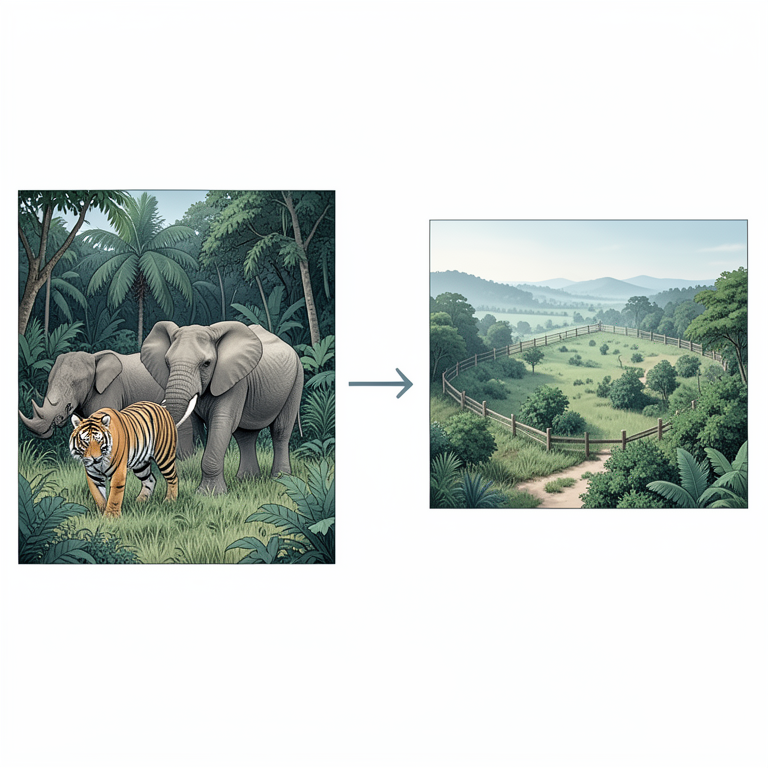
Study overview
AI-generated conceptual illustration (Indian wildlife including Bengal tigers, Asian elephants, and Indian rhinoceroses within diverse natural habitats). It explains the idea and does not show study data.
View source evidence ↗Introduction
India is home to 16 percent of the world's population is a well-known fact. However, it is a lesser known fact that 411 species of mammals, 1,232 birds, 456 reptiles, 219 amphibians, 2,546 fish, and 83,436 kinds of invertebrates and over 50,000 plant species also call this subcontinent home. Wildlife in India is a precious gift of nature with a rich variety of diverse flora and fauna. India is a land which is one of the richest biodiversity hotspots in the world. The wildlife in this country has a wide variety of species among plants and animals. The wild animals such as tiger, lion, wolves, bears, rhinoceros, camels, monkeys, various species of reptiles, crocodiles, deer, bison and the Asian elephant are all native to this country. It also has a variety of species of birds such as peafowl, pelican, parakeets, wood-pecker and flamingos. India has three biodiversity hotspots among the 34 biodiversity hotspots of the world which are found in the Western Ghats, the Easter Himalayas and the Indo-Burma region respectively. The grasslands of western India are as famous for their hunting animals as they are for their grazing herds. The Indian cheetah is now extinct in its range but the other big cats -lions and leopards still prowl the plains. With its rich, varied and diverse wildlife reserve, India has set up 104 National Parks, 18 bioreserves and more than 515 sanctuaries to protect and preserve these species of wildlife. India is endemic to many species of plants and animals which are evident from one of the study conducted which says that 12.6% avian, 7.6% mammals, 6.2% reptiles and 6.0% species of flowers are native to this country. The study also states that around 33% plant species are endemic to India and hence it is one of the biodiversity reserves in the world with around 70% endemic and diverse plants and animal species. India also has a wide range of forest belt which also depicts the diverse climatic pattern in the sub-continent which has provided home to such a rich and varied wildlife species. India has a vast belt of forests which ranges from tropical rainforest in Andaman Islands, North-Eastern region and the Western Ghats to the moist deciduous forest in the East, dry deciduous forest in Central and South India, Thorn forest in the Deccan and Western Gangetic Plain to the Coniferous forest in the Himalayas.
Wildlife conservation and its problems & threats
Wildlife conservation is referred to as the process by which the animal and plant species are protected in their natural habitats.
The main aim of wildlife conservation is to ensure protection of the wildlife and preservation of the nature and natural habitats for humans as well as wildlife. Towards this initiative, many governmental and non-governmental organizations have been set up for the very cause of wildlife conservation and protection. The human activities for their own living and benefits have affected the wildlife considerably across the world. This has resulted in extinction of many wild animals & plants and biodiversity loss. It has been observed that a considerable number of species of animals and birds have become extinct in the past 2000 years. Some reasons were because of climatic change and some have been because of human activities for their own benefits such as food, clothing, shelter, medicine etc. It is also expected that many more species of wildlife will become extinct very soon if they are not protected by proper means of conservation and by enacting effective legislations. Wildlife conservation has become a major area of concern though. The conservation of animals and plant species mainly aims at protecting the endangered species from becoming extinct due to various human and human-induced activities. The wildlife is facing many threats due to the human encroachment and their activities as well as few natural factors which can be enumerated below 1. Habitat loss by destruction, fragmentation and degradation: Habitat destruction and fragmentation can take place by human activities such as felling of trees, dredging rivers, constructing dams, filling wetlands and mowing fields, use of lands for agriculture, construction of houses and roads etc. Habitat degradation can take place because of the increasing pollution level, invasion of new species and changing ecosystems etc.
Illegal Trading, Hunting and poaching of endangered species:
Illegal hunting and poaching has posed a major threat to wildlife which is further fuelled by the lack of proper management and use of resources by the forest officials to curb the menace and save the wildlife.
Climate change:
Global warming and climate change has also played a major role in posing threat to the wildlife. This is also again due to human induced activities which is done by the burning of fossil fuels etc. which resulted in the changing of the climate globally.
Over exploitation of resources:
Exploitation and over exploitation of resources for food and other purposes has resulted in posing a threat to the wildlife, especially to the endangered species. The over use of the wild animals and plants for food, medicines, clothing etc has badly affected the wildlife populations and thus has become a threat to their existence.
Pollution:
The ever increasing pollution level due to human activities and industrial operations has resulted in the release of harmful and toxic pollutants in the air, water and land. Hence, it has affected the wildlife in an adverse manner and ultimately posed a threat to become extinct. Thus, the threat to the wildlife and the endangered species of plants and animals calls for their conservation so as to maintain the balance of the ecosystem and save the world. Towards this objective, the governments across the world are working so as to protect and conserve wildlife by enacting legislations and Acts and providing effective implementation of these legislations and Acts. The Government of India has also recognized the threats and has established national parks, wildlife sanctuaries, biosphere reserves and protected areas.
Challenges in effective implementation of wildlife protection laws in India
The exploitation of wildlife for trade and other benefits of human have resulted in enacting and enforcing various legislations and Acts in almost all the countries of the world. India is also not untouched with this as it is a country with rich biodiversity. The laws enacted with the objective of protecting and conserving wildlife has strict provisions but despite these laws, the exploitation of wildlife resources and their illegal trade continues. The hunting, poaching of animals and uprooting of trees, using of various endemic species of plants for various purposes have led to the threat of extinction and loss of biodiversity in the country. The Wildlife Protection Act, Customs Act, Import-Export policies in India though has provisions in regulating the conservational measures and trade of wildlife species, especially the endangered species, the illegal hunting and poaching activities and trade is still flourishing and these endangered species are still exploited. It is noticed that the punishment and penalties for offences made under the Act is not enough to stop and control exploitation of wildlife. The offenders are still able to get away by paying fines and those who are fighting cases are also not bothered since the cases in the Indian Courts are resolved too slowly. The reason for it also accounts for the lakhs of backlog cases pending in the District Courts and other courts. Hence, the verdict by the courts in such cases takes approximately 10 years and by this time the offenders flourish in their activities and the exploitation of wildlife continues.
There is another problem identified that the Forest departments and the Forest Officers are not able to work effectively in implementing the laws and facilitate the conservation activities because they are not adequately trained or have adequate resources. It is seen that the enforcement mechanism of the laws in India for the conservation and protection of wildlife is also complicated in nature. The laws, on one hand, enable the forest officers to protect the forests resources, but they are not given any powers to make policies pertaining to the situation which further creates problems in the confiscation of the felled timber or the poached animal. This has further helped in increasing exploitation activities. On the other hand, the forest department itself plays a role in the exploitation activities for their selfish reasons and corruption. It has been noticed that the forest officials have never involved the local people residing in the surrounding places to stop the exploitation of wildlife despite the fact that these people can actually help in preventing the exploitation and protecting the wildlife resources.
Possible solutions in wildlife conservation and implementation of laws
All the problems pertaining to wildlife protection and conservation needs to be addressed strictly adhering to the law and finding some alternative solutions too so that the wildlife could be protected and conserved. To stop the criminal and illegal activities of exploitation of wildlife resources in India, some stronger measures are required to be introduced. These measures could be in the manner of conducting awareness programmes among the public and the officials concerned with wildlife protection and the law enforcement personnel.
A. Awareness among Public and Officials:
Towards the objective of protecting and conserving wildlife, there is a need to provide awareness among the forest and other government officials who are deputed in the protected areas and reserves. These concerned personnel should be provided with training and research in wildlife conservation measures and the legal provisions available for their protection. There is also a need to involve the local people who live in the surrounding areas of the protected areas by sensitizing them about the importance of wildlife conservation and protection and the relevant laws governing it. The local people should be apprised of all the available provisions of laws in protecting and conserving the wildlife and the threatened species. They should also be informed about the penalty and punishment in case of violation of any laws and harming the wildlife. This will help in an increased awareness among the local people which will further help in providing support to the forest officials who are working in these protected areas as well as the government officials.
B. Recognizing and involving NGOs:
The Non-Governmental Organizations (NGOs) also play an important role in the protection and conservation of wildlife with the help of their initiatives. One such organization is the Wildlife Protection Society of India which works towards providing information and support to the authorities of the government concerned with wildlife protection and conservation so as to fight illegal trade of wildlife and poaching of wild animals thereby saving the environment. The involvement of such NGOs will considerably help in protecting the wildlife resources in India. Some more solutions to protect and conserve wildlife can be done by insitu & ex-situ breeding, increasing resilience of natural reserves and creation of biosphere reserves and their management.
C. In-situ and Ex-situ Conservation:
In-situ and Ex-situ conservation strategies are one of the important strategies for conservation of wildlife, especially the endangered species of plants and animals. In-situ conservation strategy is carried out in the natural habitat of these species while exsitu conservation is carried out in a place outside their natural habitat. These conservation strategies are beneficial in the reintroduction and translocation of wildlife thereby protecting the threatened species from the threat of climate change and human activities. These types of conservation of plants and animals includes captive breeding of animals and plants which are threatened by various activities of human and the climate change and are found to be on the verge of extinction. These conservation activities are carried out in protected areas but these strategies also depend on the severity of climate change and its effect on the species.
D. Increasing Resilience of Nature Reserves:
This strategy includes maintaining natural reserves, creating buffer zones, minimization of human activities such as construction of buildings, roads and transportation activities, minimization of wildlife tourism, minimization of habitat fragmentation, conversation of genetic diversity, protection of biodiversity 'hot spots' thereby preventing extinction and protecting threatened species. Creation of buffer zones around fragmented landscapes is important in maximizing resilience. Areas protected by buffer zones also require restoration for which it focuses on reduction of specific impacts of climate change. There are some ecosystems which have intact landscapes and may have sufficient resilience but the use of land and water by the people residing in these regions needs to be controlled in a manner so as to prevent loss of resilience. Management of vegetation within these reserves also helps in maintaining resilience. Such strategies need to be implemented by the government in areas where the threat to wildlife and endangered species is more. The government also needs to have controlled wildlife tourism in these natural reserves and buffer zones. The wildlife tourism has adverse effect on the breeding and feeding pattern, disturb the nesting sites and thus government is required to have a vigilance on these activities and ensure that the rules and regulations under the relevant Acts and legislations are followed by the forest officials and concerned persons. This strategy, if strictly followed, will prove to be very beneficial towards protection and conservation of wildlife and maintenance of wildlife in their natural habitat. Creation and Management of Biosphere Reserves Biosphere reserve consists of a micro-territory or a large area of land which addresses different issues of protection of plants and animal species using different means according to their situation. Sometimes these reserves are divided into small units defined by geographical or human factors. Biosphere reserve consists of three zones, viz., core, and buffer and transition zone. Each zone is approached differently, depending on the need and objectives of biosphere reserve. Creation and management of several biosphere reserves and other protected areas is an important strategy to protect and conserve wildlife. It includes connecting the corridors and habitat matrices which helps in linking fragmented reserves and landscapes by providing dispersal and migration of flora and fauna. In, India, there are 18 biosphere reserves at present. These reserves have been set up by the Government of India in order to protect and conserve wildlife. The human activities in and around these protected areas have posed various kinds of problems and threats to the wild animals and plants. Thus, the government needs to be alert and watchful about the activities of human, including research activities in these reserves. The Central government as well as the state governments should work together in coordination in maintaining these biosphere reserves and oversee that the officials deputed in these reserves are working in consonance with the legal provisions and regulations. The government should make stricter provisions of punishment also if the laws are violated and wildlife is harmed.
Conclusion
The wildlife protection and conservation is a huge task in India with the growing concerns of illegal trade and exploitation of wildlife resources. This objective cannot be achieved until and unless all branches of the government authorities, villagers & local people residing in and around the protected areas, non-profit and nongovernmental organizations, law enforcement officers and the general public work together towards this goal. India has a rich heritage and is gifted with natural resources which are precious and endemic to the country and thus makes it a biodiversity rich country. Hence, there is a need for everyone to protect this rich resource and maintain a balanced environment. The laws pertaining to the protection of wildlife and their natural habitat enacted and enforced in the country though provides strict legal provisions for the very cause of wildlife protection and conservation, it is still observed that the ground reality is not the same. The wildlife is still exploited; the animals are still hunted and traded for human benefits. Even the use of harmful substances in industries, daily activities of man, construction of roads and buildings, leisure and entertainment activities causes adverse effect on the environment which in turn affects the wildlife and their natural environment. Illegal hunting and trade of wildlife are still taking place in India without abiding by the norms of these laws. Thus, a strong need for awareness of wildlife protection and conservation among the public is required and effective & strict implementation of these laws needs to be done by every state. The state governments are required to keep vigilance on the effective implementation of wildlife protection laws and conservation at the district and municipal level. The need for effective strategies and solutions for the protection of wildlife in India and conservation of wildlife is the need of the hour. The government must work in accordance to the present needs and demands in a situation when these wildlife species are threatened and many of which have come to the verge of extinction. The state governments and central government is required to work together and implement all the relevant laws and conservation strategies in order to protect the wildlife and prevent illegal hunting and trade of these endangered species and wildlife as a whole.
References
4 in the original paper- Groombridge B. (ed). The 1994 IUCN Red List of Threatened Animals. IUCN, Gland, Switzerland and Cambridge, UK; c1993. p. 286.
- Klappenbach L. Understanding the Threats to Animals and Wildlife -Examining Natural Threats and Manmade Threats, Available from http://animals.about.com/od/animalswildlife101/a/threat s.htm. Accessed on January 10, 2014.
- Singh C. India's Forest Policy and Forest Law, Natraj Publishers, Dehradun. Journal of Interdisciplinary Cycle Research. 2000;12(10):801. ISSN NO: 00221945;
- Rich RL, Frelich LE, Reich PB. Wind-throw mortality in the southern boreal forest: Effects of species, diameter and stand age. Journal of Ecology. 2007;95(6):1261-1273.
Cited by 11
From OpenAlex, OpenCitations and reference lists read by Scinovex
- Bio-ecology, behaviour and management of blue bull, Boselaphus tragocamelus ↗
Bhupinder Kaur Babbar, Neena Singla, Harjinder Kaur, Meenu Verma, Kiran Rani, Bindu Bala et al. · International Journal of Pest Management · 2022
Blue bull (Boselaphus tragocamelus) is considered a pest in several north Indian states. It is destroying many crops both by trampling and eating plants and its damage is more in fields that are close to forest areas. Blue bull harshly affects trees and timber resources by feeding upon tree bark and flowers. Its damage in crop fields can be identified…
❝ 10 - Forest fragmentation and human-wildlife conflict: assessing the impact of land use land cover change in Ranthambhore Tiger Reserve, India ↗
Bhanwar Vishvendra Raj Singh, Amit Kumar Batar, Vivek Agarwal, Anjan Sen, Khusbhu Kulhari · Environmental Research Communications · 2025
Abstract Habitat degradation, land-use transformation, and human-wildlife conflicts pose significant challenges to biodiversity conservation in protected areas. The Ranthambhore Tiger Reserve (RTR), a globally significant conservation landscape in India, has experienced extensive land use and land cover (LULC) changes over the past 45 years, influencing habitat connectivity and species distribution. This study aims to assess the spatiotemporal transformations in RTR’s…
❝ 9PDF - Convention on international trade in endangered species of wild fauna and flora and its implementation in the united states of america, the european union, tanzania, india and colombia ↗
Frank Eliud Chibole Sina · 2023
Convention on International Trade in Endangered Species of Wild Fauna and Flora (CITES), is a global agreement among governments concluded in 1973. CITES has 184 Parties and covers well over 38,700 species. Its main objective is to ensure that international trade in specimens of wild animals and plants does not threaten their survival through international co-operation. Despite its existence, illegal…
❝ 1PDF - Unveiling Canine Distemper epidemiology in association with climatic impacts: longitudinal analysis and forecasting in Chennai, India ↗
V. Naveenkumar, Mangalanathan Vijaya Bharathi, Porteen Kannan, G. Selvaraju, B. S. Pradeep Nag, Kumanan Vijayarani · International Journal of Biometeorology · 2025
❝ 0 - When AI Meets Wildlife: Predicting Animal Migration from Habitat Cues ↗
Daksh Kuraichya · Research Square · 2025
❝ 0PDF - When AI Meets Wildlife: Predicting Animal Migration from Habitat Cues ↗
Daksh Kuraichya · Research Square · 2025
❝ 0PDF - Field based standard operating procedure for reuniting Indian Leopard (Panthera pardus fusca) cubs in Maharashtra, India: Consolidating years of successful practice
S Ilayaraja, Mahendra Dhore, Smita Rajhans, K. Satyanarayan, Baiju Raj MV, Arun A Sha · International Journal of Veterinary Sciences and Animal Husbandry · 2025
Indian Leopard (Panthera pardus fusca) cubs are frequently separated from their mothers due to natural calamities, human interference, or habitat encroachment, necessitating timely intervention to facilitate effective reunification. This report documents 73 successful reunions involving 112 leopard cubs between 2009 and 2024 across the districts of Ahmednagar, Pune, Satara, and Nashik in Maharashtra State, India. A standardized reunification protocol was developed and implemented, emphasizing rapid response, comprehensive health assessments, and specific procedures to maximize the chances of m
- First breeding record of the small Pratincole (Glareola lactea) in Regadi Dam Area, Ghot Range of forest, Gadchiroli district, Central India
Narendra G Chandewar, Nilesh Wadighare, Avinash Londhe, Sachin Borkar · International Journal of Biology Sciences · 2025
The Small Pratincole (Glareola lactea), a small shorebird, is primarily found in South and Southeast Asia. This study documents the first breeding record of the species in the Regadi Dam area, located in the Ghot Range of Forest Department, Gadchiroli District, Central India. Field observations were conducted between March to May 2025, during which nesting behavior, egg-laying, and chick-rearing activities were recorded. Total 22 active nests found. Clutch size is 1-3 eggs per nest and size of egg, measuring 2-2.5 cm in length and 1.5-2.0 cm breadth. The discovery of breeding pairs and fledgli
- Odonata diversity as a Bioindicator of Habitat quality in an urban landscape: Insights from Tripura University campus, Northeast India ↗
Animesh Dey, Debarup Das · Acta Entomology and Zoology · 2025
Odonates (dragonflies and damselflies) are widely recognised as ecological bioindicators due to their sensitivity to environmental conditions and habitat integrity. This study documents the diversity and community structure of Odonata within the semi-urban landscape of Tripura University campus, Northeast India, over a one-year period (April 2024-March 2025). A total of 33 species belonging to 25 genera and 5 families were
- Analysing the Ecotourism Marketing and Wildlife Branding of Bodoland Territorial Region, Assam, India ↗
Rabindra Mahato, Manas Das, Sanjay Kumar Thakur, Krishna K. Thakur · International Journal of Tourism and Hotel Management · 2025
This paper presents a secondary research-based analysis of the ecotourism marketing strategies and wildlife branding initiatives employed in the Bodoland Territorial Region (BTR) of Assam, India. Historically marked by socio-political conflict, BTR is rebranding itself as a premier ecotourism destination, leveraging its unique assets like Manas National Park (a UNESCO World Heritage Site), its population of wild water buffalo, and
- WILDLIFE CONSERVATION: AN ANALYSIS OF MALAYSIA’S LEGAL FRAMEWORK FOR COMBATING ILLEGAL WILDLIFE TRADE AND ENFORCING CITES COMPLIANCE TOWARDS A SUSTAINABLE FUTURE ↗
Nur Irinah Mohamad Sirat, Mohd Zulhelmey Abdullah, Siti Khadijah Abdullah Sanek, Salmah Roslim, Syatirah Abu Bakar · International Journal of Law Government and Communication · 2024
Wildlife conservation represents a significant global challenge, particularly in nations abundant with biodiversity like Malaysia, where illegal wildlife trafficking jeopardises ecosystems and threatens endangered species. This paper analyses Malaysia's legal framework concerning wildlife conservation and its harmonisation with international agreements, notably the Convention on International Trade in Endangered Species of Wild Fauna and Flora (CITES). Through an extensive examination of…
❝ 0PDF