
Research article · 2025 · Full text
International Journal of Biology SciencesFirst breeding record of the small Pratincole (Glareola lactea) in Regadi Dam Area, Ghot Range of forest, Gadchiroli district, Central India
Volume 7(7) · Pages 89–94 · DOI: 10.33545/26649926.2025.v7.i7b.416 ↗
Research areasGenetic and phenotypic traits in livestockWildlife Ecology and ConservationAnimal Diversity and Health Studies
Abstract
Author-writtenThe Small Pratincole (Glareola lactea), a small shorebird, is primarily found in South and Southeast Asia. This study documents the first breeding record of the species in the Regadi Dam area, located in the Ghot Range of Forest Department, Gadchiroli District, Central India. Field observations were conducted between March to May 2025, during which nesting behavior, egg-laying, and chick-rearing activities were recorded. Total 22 active nests found. Clutch size is 1-3 eggs per nest and size of egg, measuring 2-2.5 cm in length and 1.5-2.0 cm breadth. The discovery of breeding pairs and fledglings confirms the species' reproductive presence in this region, expanding its known breeding range. This finding highlights the ecological significance of the Regadi Dam area as a potential habitat for wetland-dependent bird species and underscores the need for conservation efforts in this region.
Summary
Source-checkedPlain-language reading of the full paper, prepared with AI and checked against the text. Each point links to the authors' own words.
Why it matters
- The Small Pratincole is a small shorebird species primarily distributed across South and Southeast Asia. View evidence ↗
- This species typically lives in wetlands, sandbanks, and riverbeds, where it hunts insects while flying. View evidence ↗
- While the Small Pratincole breeds in various parts of India, there are very few documented breeding records for the species in Central India, specifically in the Gadchiroli District. View evidence ↗
The question
- The study aims to provide the first confirmed breeding record of the Small Pratincole in the Regadi Dam area to better understand its breeding ecology and distribution in Central India. View evidence ↗
What they did
- Research was conducted at the Regadi Dam area within the Ghot Range of the Allapalli Forest Division in Maharashtra. View evidence ↗
- Field surveys took place from March to May 2025 to observe the full cycle of pre-breeding, breeding, and post-breeding. View evidence ↗
What they found
- The researchers identified a total of 22 active nests located on the exposed shoreline of the dam. View evidence ↗
- Clutch sizes varied: 18 nests had two eggs, three nests had one egg, and one nest had three eggs. View evidence ↗
- The eggs measured between 2-2.5 cm in length and 1.5-2.0 cm in breadth. View evidence ↗
- Nests were shallow scrapes (1-3 cm deep) with a diameter of 20-25 cm, located 15-17 meters from the dam's shore. View evidence ↗
- The birds preferred nesting in open areas with minimal vegetation on sandy, lateritic, or hardpan murrum soil to avoid predators. View evidence ↗
- The species exhibited biparental care, with both parents participating in egg incubation and feeding the chicks. View evidence ↗
- Observations during the fourth and fifth visits confirmed the presence of chicks and juveniles, as well as 'broken wing pretension' behavior. View evidence ↗
- During the final visit, the population count increased to between 120 and 130 birds. View evidence ↗
What it means
- The authors conclude that the first breeding record in the Regadi Dam area demonstrates the ecological importance of this region for wetland birds. View evidence ↗
- The authors recommend implementing habitat protection and awareness programs to safeguard the local population. View evidence ↗
- The authors note that gaps still exist in the understanding of the species' population dynamics, migration patterns, and specific habitat needs. View evidence ↗
Visual summary
2 visualsIllustrations explain the paper; charts are replotted from the paper's own table values.
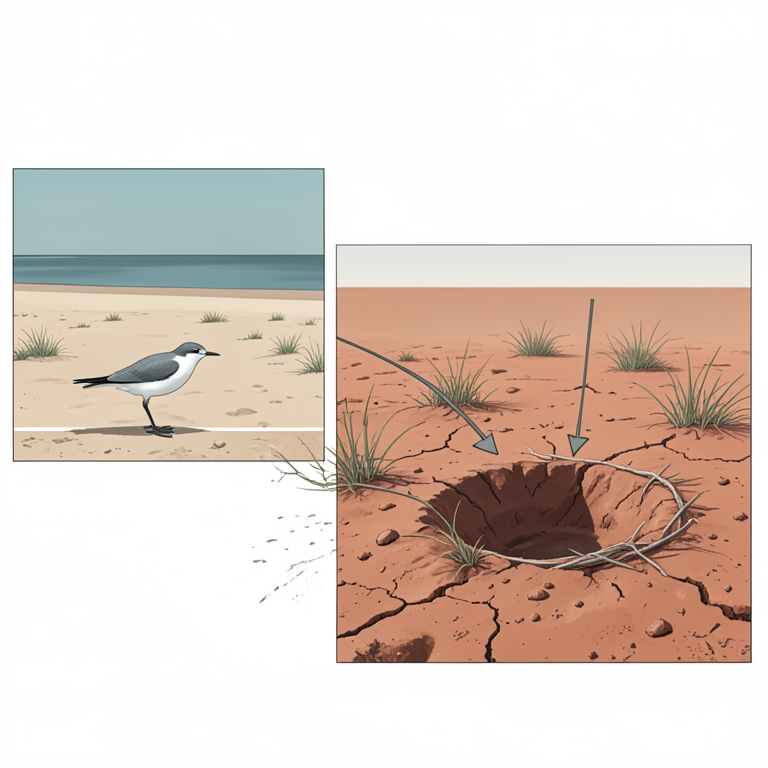
Nesting Site Characteristics
AI-generated conceptual illustration (Small Pratincole (Glareola lactea) in a sandy dam environment). It explains the idea and does not show study data.
View source evidence ↗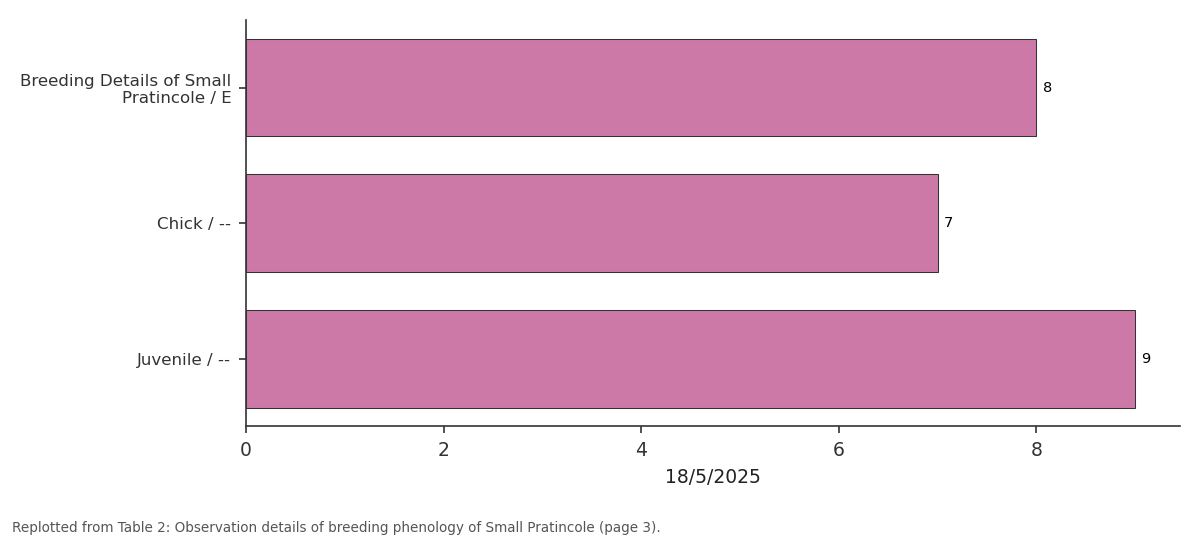
18/5/2025: Breeding Details of... vs Chick / -- vs Juvenile / --
Replotted from Table 2 (page 3) of the original paper. Every bar is the paper's own table value.
View source evidence ↗Figures & tables
From the original paper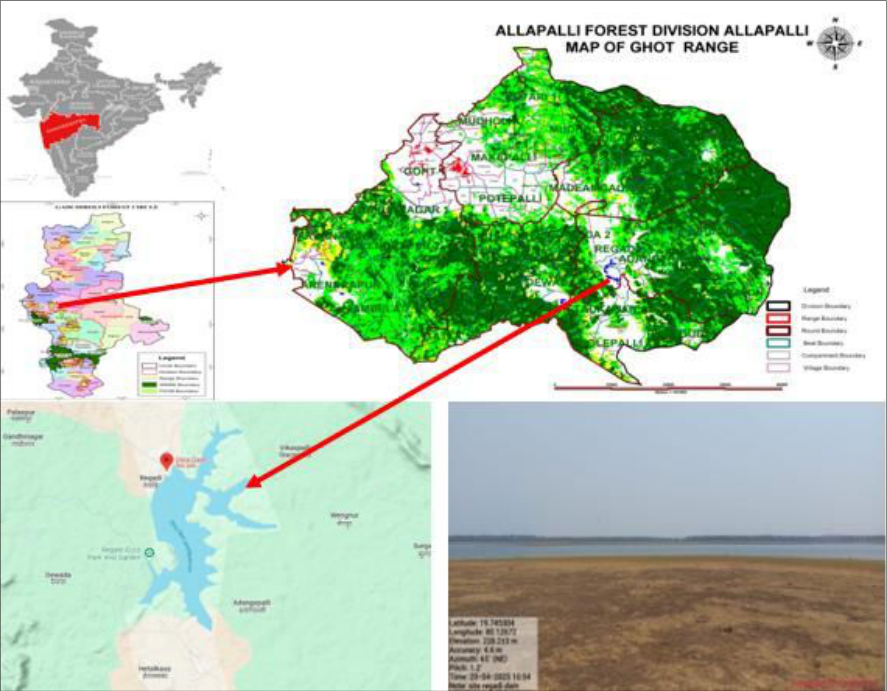 Figure 1
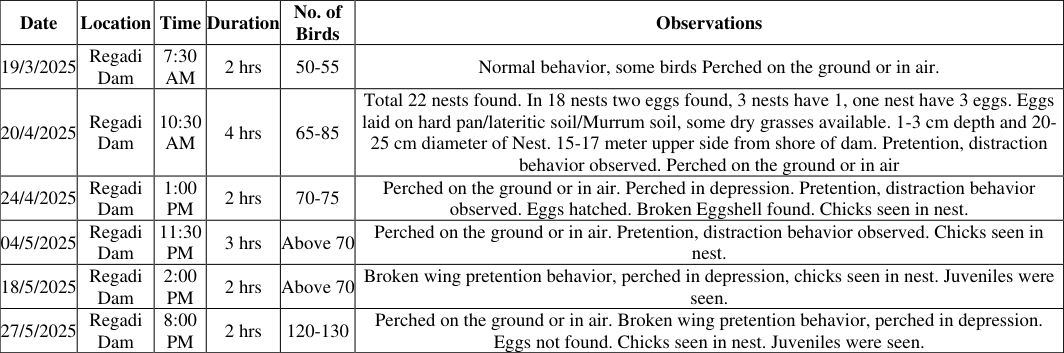 Table 1
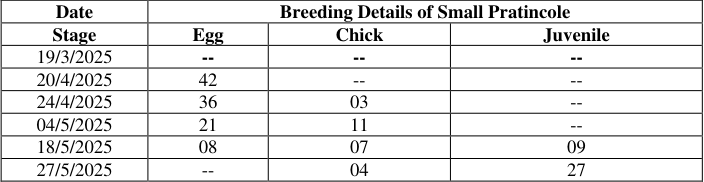 Table 2
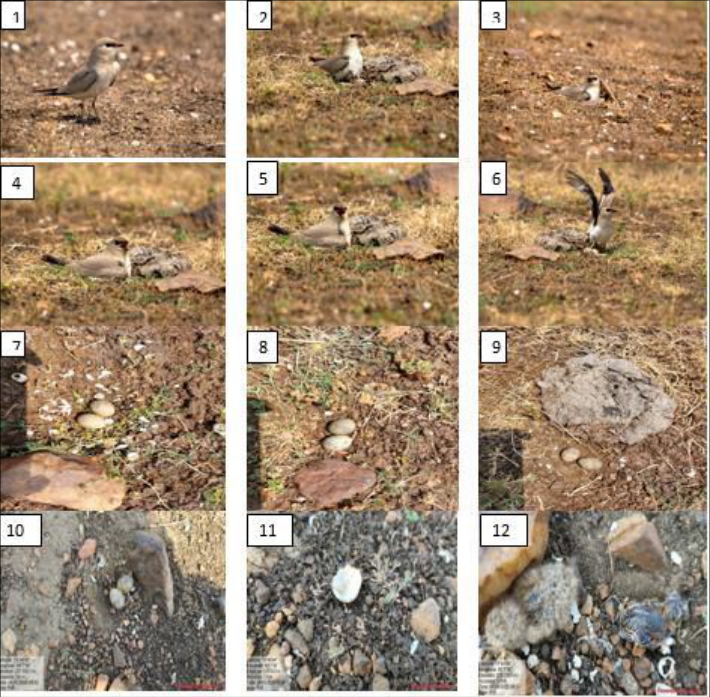 Figure 2
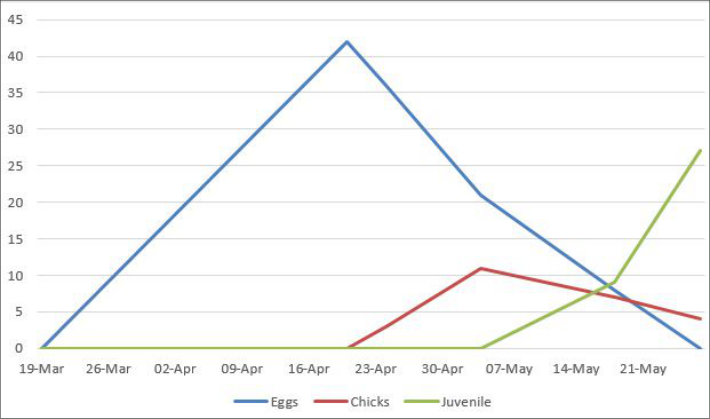 Figure 3
Introduction
Allapalli Forest Division lies between 79° 42' 30" to 80°23' 50" North latitudes and 19° 17 ' 15" to 20° 03' 00" East longitudes. The boundary of the division in the North is bounded by Gadchiroli Forest Division and Wainganga River and in the East by Bhamragarh Division and Bandia River and in the west by Pranhita and Wainganga River and in the south by Sironcha Forest Division and Zamela Nala. The forest areas of Allapalli Forest Division occur within the territories of present Gadchiroli District and spread over Aheri, Mulchera, Chamorshi and Etapalli talukas. The total geographical area of the district is 1491500 ha. and the area of the Allapalli Forest Division is 291151.428 ha. this is 19.52% of the district. Out of this 181000.105 ha is reserved forest, 23533.290 ha is protected forest and 13409.290 ha is unclassed forest. The Forest areas of the Allapalli Forest Division are mostly plain however some undulating and hilly terrain is also present such as Bhimaram hills. The forest of Allapalli Division dealt under this plan comes under two subgroups 3B-South Indian Moist Dedicuous Forest and sub group 5A-Southern Tropical Dry deciduous Forests as per the revised classification of Forest types of India by H.G. Champion and S.K. Seth. Within these main sub types, considerable local variation occurs depending mainly upon edaphic and topographic factors. The tract comprises of archean age of rocks which are rich in lime stone, clays, granites, gneisses, quartzites, magnesites, laterites, sandstones etc. The soils are red as well as black soils. Climate is hot summer with well distributed rainfall during southwest monsoons. The mean daily maximum temperature in May is 47.06 0 C and mean daily minimum is 22.86 0 C. The humidity exceeds 70% in the South-West monsoon season. Climate of Allapalli areas is hot and dry i.e. tropical type. The cold season starts from November and continues up to mid February. The cold is mild and the weather is extremely pleasant. It is followed by hot season from the middle of February till onset of monsoon in the middle of June. During April and May the heat of day is unbearable in spite of the dryness. The monsoon season is from the middle of June to September, October and November are post monsoon months. The climate is humid and hot (Shrivastav, 2004) [19] . The Small Pratincole (Glareola lactea), also known as the Little Pratincole, is a migratory and resident bird species distributed across the Indian subcontinent, Sri Lanka, and Southeast Asia (Birdlife International, 2021). The German scientist Wilhelm Heinrich Kramer created the phrase "pratincole" by combining the Latin terms prātum meadow and incola inhabitant (Lockwood, W B, 1993) [14] . Small Indian pratincole is a small wader belonging to the pratincole family, Glareolidae and order, Charadriiformes. It typically inhabits riverbeds, sandbanks, and wetlands, where it feeds on insects in flight. Although the species is known to breed in parts of India, documented breeding records in Central India, particularly in Regadi dam, Gadchiroli District, Maharashtra, are scarce. The Regadi Dam area, situated in the Ghot Range of Forest, Allapalli Forest Division, Gadchiroli Circle, provides a mosaic of aquatic and terrestrial habitats, making it suitable for various avian species. This study presents the first confirmed breeding record of Small Pratincole (Glareola lactea) in this region, contributing to the understanding of its distribution, behavior and breeding ecology in Central India.
Material and Methods
Material and Methods
A. Study Area
The study was conducted in the Regadi Dam area (19.35°N, 80.25°E), located in the Ghot Range, Allapalli Forest Division, Gadchiroli District, Maharashtra (Fig. 1). The region comprises a mix of water bodies, sandbanks, and dry deciduous forests, providing an ideal habitat for shorebirds. The dam's fluctuating water levels create exposed mudflats and sandbars, which are crucial for nesting and foraging.
B. Data Collection
Closer investigation of study area and nest carried out without disturbing habitat of small pratincole. While collecting data, care was taken not to damage or disturb the bird's habitat and nest. Also, while searching the study area, care was taken to walk around with caution. Field surveys were carried out from March to May 2025, covering the pre-breeding, breeding, and post-breeding phases. Nest sites were identified based on behavioral cues such as courtship displays, territorial defense, and chickrearing activities. Photographic evidence was collected to confirm breeding behavior. The researchers observed birds along a specific accessible path, employing the "Look and See" method (Bibby et al., 1992) [3] . They made a point to visit all habitats within the study area, with a particular focus on the dam's bank, its upper shoreline, and the surrounding areas. The Regadi Dam, an isolated location approximately 15 km from Ghot village, was also visited frequently. The primary goal of this research was to identify summer nesting bird species around the Regadi Dam's beds and banks. To achieve this, a deliberate "Nest and Roost count" (Javed and Kaul, 2002) [13] was carried out. Fieldwork was supported by using binoculars, DSLR cameras, Mobile cameras, field guides, and standard ornithological literature (Vijay Gonekar et al., 2024) [20] . The study was conducted during different daylight hours, with a particular emphasis on identifying summer nesting birds in the chosen sections of the Regadi Dam. The nesting ecology and breeding phenology of the observed bird species were documented and then compared with existing literature to validate and confirm these observations (Rasmussen and Anderton, 2012) [16] . C. Data Analysis Data on nest locations, clutch size, incubation behavior, and fledgling success were recorded. GPS coordinates of nesting sites were taken. Behavioral observations were compared with existing literature to validate breeding confirmation (Fig. 2 and3).
Results
On the first visit, small pratincoles exhibited normal behavior, perching on the ground or in the air. During the second visit, additional behaviors such as pretention and distraction were observed while the birds remained perched on the ground or in the air. A total of 22 active nests were observed on exposed shoreline of dam. Nests were shallow scrapes on the land, typical of pratincoles. Breeding pairs preferred open sandy/lateritic/hardpan murrum soil areas with minimal vegetation, likely to avoid terrestrial predators. Both parents were observed incubating eggs and feeding chicks, exhibiting biparental care. Some of the birds in the flock were observed head bobbing, which was interpreted as a courtship dance. The eggs were small, measuring 2-2.5 cm in length and 1.5-2.0 cm breadth. Their color ranged from a dull white with brownish marble patterns to a pale light green, with speckles covering the entire surface. Some eggs also had dark brown spots. These eggs were laid on the dam's banks, specifically on hard, firm lateritic or murrum soil covered with minimal dry grass, close to the edge of small to medium-sized stones In 18 nests, two eggs were found; three nests contained one egg each, and one nest had three eggs. The eggs were laid on hardpan, lateritic soil, or murrum soil, with some dry grasses present (Fig. 2). The nest was located at a depth of 1-3 cm, with a diameter ranging from 20 to 25 cm, positioned 15-17 meters inland from the shore of the dam. On the third visit, small pratincoles were observed perched on the ground or in the air. Some birds displayed behaviors such as perching in a depression and exhibiting distraction behavior. Eggs hatched, and broken eggshells were found. Chicks were observed in the nest.
During the fourth and fifth visits, there was broken wing pretension behavior, and chicks were seen in the nest while some birds perched in a depression. Juveniles were seen. In the last visit, the bird's number was 120-130, and the birds were perched on the ground or in the air, exhibiting broken wing pretention behavior, and perched in depression. Eggs not found. The nest contained chicks. Juveniles were seen (Table -1and 2).
Discussion
This study confirms the first breeding record of Glareola lactea in the Regadi Dam area, extending its known breeding range in Central India. The presence of suitable nesting sites (sandbars) and abundant insect prey likely facilitated breeding. However, anthropogenic disturbances such as livestock grazing and dam-related activities pose potential threats to nesting success. Conservation measures, including habitat protection and awareness programs, are recommended to safeguard this population. However, there are threats to small pratincole. Many wetlands such as lakes, ponds, dams are the habitats of Small pratincole, but often fishing communities build fishing facilities in such places and this hinders the breeding period of such a shorebird. Illegal sand mining on the banks of the river leads to the destruction of eggs before they hatch. Their nests have been destroyed. Conversion or seasonal use of wetland fallen lands into agricultural fields, leading to habitat destruction. Often during the breeding season (from March to May), farmers cultivate summer crops such as watermelon, cucumber, melon in the interior of the wetland. The chemicals used in it -pesticides, chemical fertilizers, etc. cause many adverse changes on their reproduction, on body, as well as inner side of body and it's not also good for the environment. Human activity in their nests has increased. Often, beyond discovery, research, curiosity, their eggs or chicks are collected and used as food and then such birds move towards extinction. Stray dogs come to the lake with the smell of fishing and this is the reason for the hunting of eggs and chicks of Small pratincole. There are also some natural hazards -such as large wild animal such as elephants and wild boars come towards the water in summer, and these eggs trampled under their feet. Monitor Lizards, Mongoose, Snakes act as an eggs predator and threat to small pratincole species. But, we did not find any mammalian predator.
Conclusion
The discovery of first breeding record of Small Pratincoles in the Regadi Dam area highlights the region's ecological importance for wetland birds. The Small Pratincole is highly dependent on undisturbed sandy riverbanks, wetlands, and mudflats for nesting and foraging. These habitats are increasingly threatened by agricultural expansion, sand mining, dam construction, and urban development. Protecting these ecosystems is crucial not only for the pratincole but also for other wetland-dependent species. The conservation of the Small Pratincole requires a multifaceted approach, integrating habitat protection, threat mitigation, community engagement, and scientific research. By safeguarding wetland and riverine ecosystems, minimizing human disturbances, and fostering public awareness, we can ensure the survival of this remarkable shorebird. Protecting the Small Pratincole not only benefits this species but also contributes to the broader health of wetland biodiversity, underscoring the interconnectedness of ecosystems and the urgent need for proactive conservation efforts.
Acknowledgement
AcknowledgmentAuthors are thankful to Government of Maharashtra, Forest Department for support and giving opportunity for this research work. Special thankful to Shri. Srinivasa Rao, IFS, PCCF (wildlife), Maharashtra State. Also thankful to Shri. S. Rameshkumar, IFS, Chief Conservator of Forests (T), Gadchiroli Circle, Smt. Dipali Talmale, IFS, Deputy Conservator of Forest, Allapalli Division, Shri. Dudhbale, RO and Santosh Pawar, Forest Guard, Ghot Range.
Figures and tables from the paper
| Date | Breeding Details of Small Pratincole | — | — |
|---|---|---|---|
| Stage | Egg | Chick | Juvenile |
| 19/3/2025 | -- | -- | -- |
| 20/4/2025 | 42 | -- | -- |
| 24/4/2025 | 36 | 03 | -- |
| 04/5/2025 | 21 | 11 | -- |
| 18/5/2025 | 08 | 07 | 09 |
| 27/5/2025 | -- | 04 | 27 |
Table text extracted from the original PDF; superscript letters are shown inline. The original table image is below.
View original table image
References
21 in the original paper- Ali S, Ripley SD. Handbook of the Birds of India and Pakistan. Oxford University Press; 1983.
- Bensaci E, Boutera N, Cherief A, Saheb M, Moali A, Houhamdi M. Breeding ecology studies of Collared Pratincoles Glareola pratincola in the Central Hauts Plateaux of Algeria. Wader Study Group Bulletin. 2014;121:43-48.
- Bibby C, Burguess ND, Hill DA. Bird Census Techniques. London: Academic Press; 1992. 257 p.
- Bird Life International. Species Factsheet: Glareola lactea. 2023. Retrieved from: http://www.birdlife.org on 2025 Jul 9.
- BirdLife International. Glareola lactea. The IUCN Red List of Threatened Species 2016: e.T22694152A93441581. 2016. DOI: 10.2305/IUCN.UK.2016.
- BirdLife International. Waterbirds are showing widespread declines, particularly in Asia. 2017. http://www.birdlife.org on 2024 Feb 03.
- Bux F, Bharos AMK. Aquatic Avian Composition, Diversity and Their Food Resources in the selected Ponds of Naya Raipur, Chhattisgarh, India. Int Journ of Life Sciences Research. 2018;6(3):34-48.
- D'Abreu EA. Notes on the Fauna of British India; Birds, chiefly with reference to the Central Province. Journ Bomb Nat His Soc. 1931;35:217-219.
- D'Abreu EA. A List of the Birds of the Central Province. Journ Bomb Nat Hist Soc. 1935;38(1):95116.
- David JP, Sivakumar C, Kumar SV, Matchachan G. First breeding record of the Small Pratincole Glareola lactea and River Tern Sterna aurantia in Periyar Lake, Periyar Tiger Reserve, Kerala, India. Bird-o-soar #40. In: Zoo's Print. 2020;35(2):25-27.
- Fasola M, Canova L. Nest habitat selection by eight syntopic species of Mediterranean gulls and terns. Colonial Waterbirds. 1992;15(2):169-178. DOI: 10.2307/152145.
- Grimmett R, Inskipp C, Inskipp T. Birds of the Indian Subcontinent: India, Pakistan, Sri Lanka, Nepal, Bhutan, Bangladesh and the Maldives. Bloomsbury Publishing; 2016.
- Javed S, Kaul R. Field Methods for Bird Services. Indian Bird Conservation Network, Bombay Natural history society; 2002.
- Lockwood WB. The Oxford Dictionary of British Bird Names. OUP; 1993. ISBN 978-0-19-866196-2.
- Cornell Lab of Ornithology, Ithaca, NY, USA; 2020. DOI: 10.2173/bow.smapra1.01.
- Rasmussen PC, Anderton JC. Birds of South Asia. The Ripley Guide. Vols 1 & 2. 2nd ed. National Museum of Natural History-Smiths. Inst., Michigan State Univ. and Lynx Edicions; 2012.
- Sadik AS, Datta AK. Communal nesting ecology of Little Tern (Sternula albifrons) and Small Pratincole (Glareola lactea) in two seasonally emerged riverine islands in Bangladesh. Ornis Hungarica. 2024;32(2):287-297. DOI: 10.2478/orhu-2024-0036.
- Siva T. Unexpected sighting of Small Pratincole nest site in the Cauvery River in Tamil Nadu. Bird-o-soar #99. In: Zoo's Print. 2021;36(10):59-61.
- Shrivastav SS. Working plan of Allapalli Forest Division, Volume I, Period 2004-05 to 2013-14.
- Gonekar V, Gonekar MG. Wildlife conservation in India: Issues and challenges. Int J Geogr Geol Environ 2024;6(1):242-245. DOI: 10.22271/27067483.2024.v6.i1d.226
- Tavares DC, Guadagnin DL, de Moura JF, Siciliano S, Merico A. Environmental and anthropogenic factors structuring waterbird habitats of tropical coastal lagoons: Implications for management. Biological Conservation. 2015;186:12-21. DOI: 10.1016/j.biocon.2015.02.027.