
Research article · 2024 · Full text
International Journal of Advanced Biochemistry ResearchBioactive compounds and antioxidant activity of mango peel (Mangifera indica L.) produced by different methods of extraction and solvents
Volume 8(1) · Pages 283–286 · DOI: 10.33545/26174693.2024.v8.i1d.460 ↗
Research areasPhytochemicals and Antioxidant ActivitiesMangiferin and Mango ExtractsPlant Physiology and Cultivation Studies
Abstract
Author-writtenMango, a prominent tropical fruit, holds significant global importance, with India leading in its production. The processing of mango, primarily for pulp and amchur powder preparation, generates peel as a by-product, constituting approximately 20% of the whole fruit. Currently, mango peel is considered a waste product, posing challenges for its disposal. In this study, an effort was made to harness the potential of mango peel by examining its proximate composition, phenolic compounds, flavonoids, carotenoid, and antioxidant activity. The analysis involved three solvents (distilled water, ethanol, and hydroalcoholic) and two extraction methods (conventional solvent extraction and microwave-assisted extraction). The goal was to explore the valuable components within mango peels, providing insights into its potential applications and addressing the environmental concerns associated with its disposal. Highest extraction like total phenolic content contents 32.77 mgGAE/100 gm, flavonoid content 20.13 mgQE/gm, carotenoid 8.25 mg/100 gm and antioxidant activity 77.32% was recorded in microwave assisted extraction. Therefore, hydro alcohol (70:30) is recommended for extraction of phenolic compounds, their secondary metabolites, and antioxidant capacity from the mango peel further isolation and utilization.
Summary
Source-checkedPlain-language reading of the full paper, prepared with AI and checked against the text. Each point links to the authors' own words.
Why it matters
- Mango processing for products like pulp and amchur powder creates peel by-products that make up about 20% of the fruit. View evidence ↗
- Because mango peel is not currently used commercially, it is discarded as waste, which causes environmental pollution. View evidence ↗
- Phenolic compounds in mangoes can act as antioxidants, which may help reduce the risk of cardiovascular diseases. View evidence ↗
The question
- The study aims to identify valuable bioactive compounds, such as polyphenols and carotenoids, in mango peels to explore their potential value. View evidence ↗
What they did
- The researchers tested two extraction methods, conventional solvent extraction (CSE) and microwave-assisted extraction (MAE), using three different solvents: distilled water, ethanol, and a hydroalcoholic mixture. View evidence ↗
- The experiment used a completely randomized design with three replicates for each test. View evidence ↗
- Total phenolic content was measured using the Folin-Ciocalteu assay and reported in mg GAE/g. View evidence ↗
What they found
- The highest total phenolic content was achieved using microwave-assisted extraction with a hydro-alcoholic solvent, reaching 32.77 mg GAE/g (reported as mgGAE/100 gm in text). View evidence ↗
- The highest flavonoid content was found in the hydro-alcoholic solvent using microwave-assisted extraction at 20.13 mg QE/g (reported as mg QE/100 gm in text). View evidence ↗
- The highest carotenoid content was obtained using ethanol with microwave-assisted extraction, measuring 9.58 mg/100 g. View evidence ↗
- The maximum antioxidant activity was recorded at 77.32% using microwave-assisted extraction with a hydro-alcoholic solvent. View evidence ↗
- The proximate composition of mango peel was found to be 72.50±0.50% moisture, 25.10±0.60% carbohydrate, 6.70±0.10% crude fiber, 2.12±0.02% crude fat, 2.08±0.02% protein, and 1.18±0.14% ash. View evidence ↗
What it means
- The authors recommend using a 70:30 hydro-alcoholic solvent for the extraction of phenolic compounds and antioxidant capacity from mango peel. View evidence ↗
- The authors conclude that mango peel is a promising source of bioactive compounds and enzymes, making it suitable for use as a functional food or value-added dietary ingredient. View evidence ↗
Visual summary
2 visualsIllustrations explain the paper; charts are replotted from the paper's own table values.
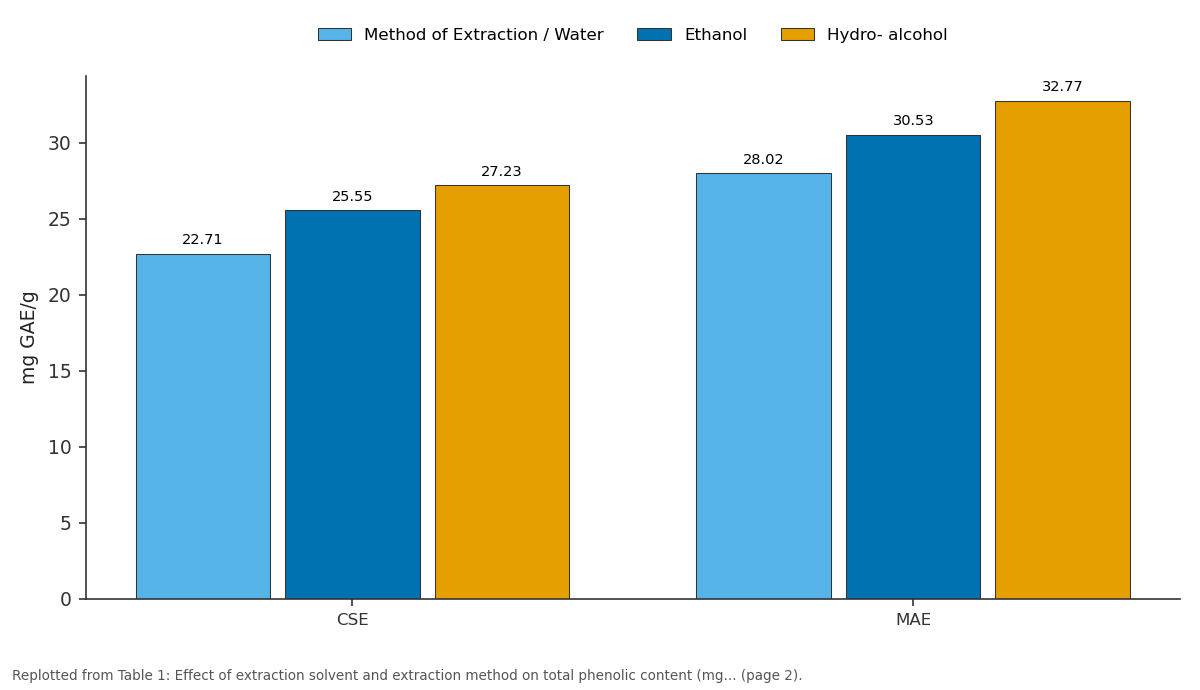
Method of Extraction / Water and Ethanol and more: CSE vs MAE
Replotted from Table 1 (page 2) of the original paper. Every bar is the paper's own table value.
View source evidence ↗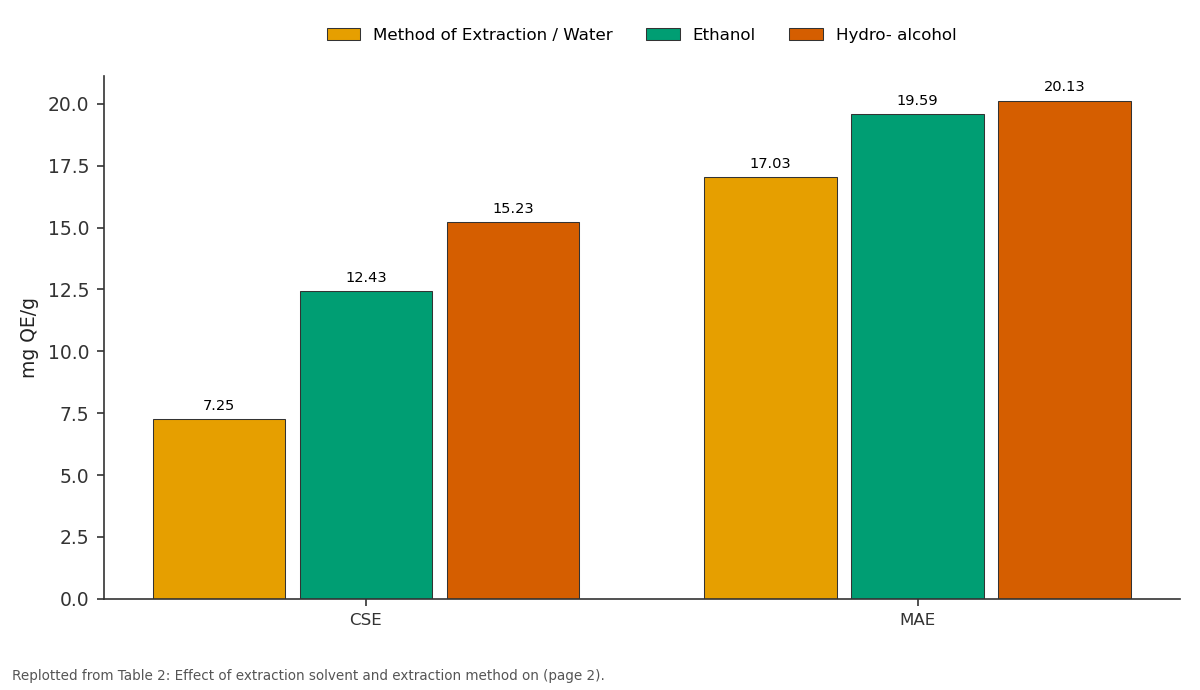
Method of Extraction / Water and Ethanol and more: CSE vs MAE
Replotted from Table 2 (page 2) of the original paper. Every bar is the paper's own table value.
View source evidence ↗Figures & tables
From the original paper Table 1
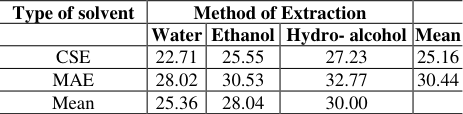 Table 1
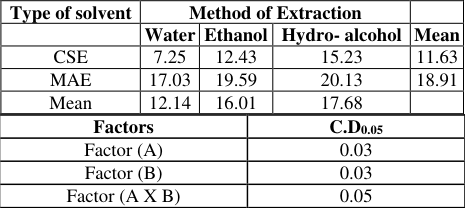 Table 2
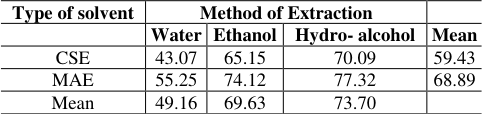 Table 4
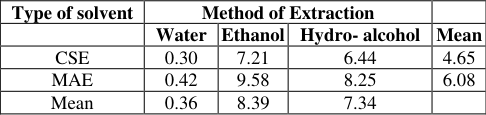 Table 3
Introduction
Mango (Mangifera indica L. Anacardiaceae) is one of the most important tropical fruits in the world and currently ranked 5 th in total world production among the major fruit crops. Mango, being a seasonal fruit, undergoes processing for various products like puree, nectar, leather, pickles, canned slices, and chutney. These items have garnered global popularity and have gained significance in both the US and European markets. Approximately 20% of the mango harvest is utilized for the production of these processed goods. In the process of mango processing, by-products like peel and kernel are generated. Currently, the peel is discarded as waste since it is not employed for any commercial purposes, leading to environmental pollution. This waste should be considered a specialized residue due to its high levels of residual phenolics, which can potentially have adverse environmental impacts, primarily by inhibiting seed germination properties of polyphenols. Consequently, the industry faces increasing costs for waste treatment. While there have been numerous studies on the composition and potential utilization of mango seed kernel, research on peels is limited. Phenolic compounds play a crucial role in determining the color and flavor of various foods and beverages, and their consistent intake is linked to positive effects on human health. Certain phenolic compounds found in mango act as antioxidants, potentially lowering the risk of cardiovascular diseases. Additionally, compounds like gallic acid and quercetin are believed to possess properties that can combat allergies, inflammation, hypertension, arthritis, and carcinogenesis. India holds the dominant position as the primary producer of mangoes, and the processing of peeled raw mangoes is undertaken to produce amchur, while ripe mangoes are processed to create mango pulp and fruit bars. Consequently, both raw and ripe peels are abundantly generated as by-products in the mango processing industry. In this current investigation, the focus is on identifying valuable bioactive compounds like polyphenols, carotenoids, antioxidant in the peels of mango. The objective is to explore the potential value of these peels.
Materials and Methods Estimation of total phenolics, flavonoids
The dried extracts underwent a thorough phytochemical analysis, including assessments of total phenols and flavonoids, following the methodology outlined by Jan et al. (2022) [10] . The determination of total phenols employed the Folin-Ciocalteu assay, and the results were expressed in milligrams of gallic acid equivalents per gram (mg GAE/g). In a concise procedure, 0.5 ml of the sample or gallic acid standard, 2.5 ml of Folin-Ciocalteu's reagent (10%), and 2.5 ml of Na2CO 3 (7.5%, w/v) were combined. The mixture was stirred and incubated at 45 °C for 30 minutes, and the absorbance was measured at 765 nm using a spectrophotometer (UV-1601, Shimadzu). The method outlined by Dewanto et al. (2002) [5] , involving aluminum chloride, was utilized to determine the total flavonoid content in the sample extract. Specifically, 2 ml of the sample extract was mixed with 1.25 ml of distilled water and 75 µl of a 5% sodium nitrite (NaNO 2 ) solution. After a 5-minute interval, 150 µl of 10% aluminum chloride (AlCl 3 .H 2 O) was introduced. The mixture underwent a 6minute incubation, followed by the addition of 500 µl of 1 M NaOH and 275 µl of distilled water. Subsequently, the solution was thoroughly mixed, and its intensity was measured at 510 nm, using water as a blank reference. The total flavonoid content was determined through a standard calibration curve of Quercetin and expressed as milligrams of Quercetin equivalents (QE) per gram of the sample.
Antioxidant studies
The antioxidant activity of the extracts was assessed through both the DPPH and reducing power methods, following the procedure outlined by Gaurav et al. (2020) [11] for the DPPH analysis. In a concise summary, a DPPH solution (0.01 mM) was prepared using methanol as the reagent. Using a 96-well plate, 20 µl of the sample or standard was combined with 180 µl of the DPPH reagent. The plate was then incubated in darkness for 30 minutes at room temperature, and the absorbance was subsequently recorded at 517 nm. The scavenging effect was calculated using equation 1.
Total carotenoid content (TCar)
The determination of carotenoid content in the persimmon extracts was conducted spectrophotometrically, employing the approach outlined by Nagata and Yamashita (1992) [12] , with the extracting solvent serving as the blank. The calculation of total carotenoid content was performed using a specific equation.
TCar (mpg β-carotene/100 ml) = 0.216A663 -1.22A645 -0.304A505 + 0.452A453 Where A663, A645, A505 and A452 represent the absorbances measured at 663 nm, 645 nm, 505 nm and 453 nm, respectively. The TCar was expressed as mg of βcarotene equivalents per 100 g of sample.
Statistical analysis
The experimental design followed a completely randomized approach with three replicates. All recorded data were presented as mean values accompanied by their respective standard deviations (SD). The comparisons between the mean values were tested using Duncan's new multiple-range test at a level of 0.05 conventional solvent extraction using three diverse solvents such as water, ethanol and hydro-ethanolic extract 70:30 resulting in the formation of aqueous extract (AE), ethanolic extract (EE) and hydro-ethanolic extract (HEE) depicted in table no: 01. The microwave assisted extraction method also followed the trend (HA> >ET>AQ)highest phenols being in hydro alcoholic solvent (32.77 mgGAE/100 gm) using microwave assisted extraction. The presence of water in solvent increase the release of phenols as it improve the swelling of plant material and cause large surface area which helps in better interaction between solvent and material. Similar results were reported by (Xia et al., 2015) [13] that mixture of water and ethanol act as better solvent as compared to pure water and pure ethanol as it extracts more phenolic contents.70% ethanol was used as best extraction solvent for total phenolic while the process decreases as the water content increases in aqueous solvent investigated by (Sharma et al., 2020) [11] , he also stated that by using 70 and 96% ethanol more phenolic compounds are extracted. [14] . Our findings coincides with Seo et al., 2014 [15] who suggested that among the three solvents used for extraction of flavonoids, water in combination with ethanol (70:30, 50:50, 30:70, and 10:90 (v/v) shows higher recovery of compounds than methanol extracts.
Results and Discussion
Results and Discussion
MAE: Microwave assisted extraction; CSE: Conventional solvent extraction
Carotenoid from mango peel was extracted via two different methods microwave assisted extraction and conventional solvent extraction using three diverse solvents such as water, hydro-ethanolic and ethanol extract resulting in the formation of aqueous extract (AE), hydro-ethanolic extract (HEE) and ethanolic extract (EE) depicted in table no:03.The microwave assisted extraction method also followed the trend (ET> >HA>AQ) the highest caretenoids being in ethanolic solvent (9.58 mg/100 gm) using ultrasonic assisted extraction. Similarly according to (Bulut et al., 2018) [16] highest carotenoids present in Scenedesmus spp were extracted from ethyl acetate then hydro alcohol and none were detected in water. Similarly by (Sun et al., 2011) [17] reported that beta carotene extracted from mandarin (Citrus succosa Hort) using ethanol as solvent shows better recovery than conventional method. Saini and Keum 2018 reported similar results that Ultrasonic assisted extraction gives highest percentage of carotenoids using ultrasonic intensity (total power 664W) with a temperature of about 30 ºC and using 75% of ethanol. (Lakshmi et al., 2021) [19] studied that the total carotenoid yield from muskmelon and watermelon was about (775.25 μg/g and 639.54 μg/g) from ultrasonic extraction as compared to microwave assisted extraction (590.85 μg/g and 474.72 μg/g). So they concluded that Ultrasonic extraction gives better results for carotenoid than microwave extraction using ethanol as solvent. [20] studied that TPC value of mango peel extract increases with increase in the microwave power and time which ultimately cause rise in DPPH content, this is because antioxidant activity of product relay on the polyphenolic concentration of the sample extracts to same limit. While increasing microwave power and liquid to solid ratio antioxidant activity increases this is mainly due to the rise in mass transfer which ultimately leads to increase in FRAP, TPC and DPPH. Rojas et al., 2015 [21] reported that yield and extraction of phenolic compounds obtained from microwave assisted extraction have major antioxidant activity in DPPH and lipid oxidation inhibition assays (70.31 and 86.46%) as compared conventional method. Song et al., 2021 [22] studied different extraction methods for evaluation of antioxidant activity from persimmon peel and revealed that microwave assisted extraction had an antioxidant activity 4 times higher than TMA extract.
Conclusion
This research has demonstrated that mango peel possesses a substantial concentration of bioactive compounds, including phenolic content, flavonoids, carotenoids, and antioxidant activity. Whether consumed as a whole fruit or in processed forms, integrating mango into one's diet can significantly contribute to the intake of these beneficial compounds. Mango peel, a by-product of the mango processing industry, emerges as a promising reservoir of bioactive compounds and enzymes such as protease, peroxidase, and polyphenol oxidase. This newfound source holds great potential as a functional food or as value-added ingredients in our dietary landscape. With proper processing, mango peel could yield valuable products that not only offset waste treatment expenses but also reduce the overall cost of the primary product.
Acknowledgement
AcknowledgmentIndian Council of Medical Research (ICMR), which provided funding for my PhD program. I sincerely thank ICMR for their support.
Figures and tables from the paper
| Type of solvent | Method of Extraction | — | — | — |
|---|---|---|---|---|
| Water | Ethanol | Hydro- alcohol | Mean | |
| CSE | 22.71 | 25.55 | 27.23 | 25.16 |
| MAE | 28.02 | 30.53 | 32.77 | 30.44 |
| Mean | 25.36 | 28.04 | 30.00 |
Table text extracted from the original PDF; superscript letters are shown inline. The original table image is below.
View original table image
| Type of solvent | Method of Extraction | — | — | — | — |
|---|---|---|---|---|---|
| Water | Ethanol | Hydro- alcohol | Mean | ||
| CSE | 7.25 | 12.43 | 15.23 | 11.63 | |
| MAE | 17.03 | 19.59 | 20.13 | 18.91 | |
| Mean | 12.14 | 16.01 | 17.68 | ||
| Factors | C.D0.05 | ||||
| Factor (A) | 0.03 | ||||
| Factor (B) | 0.03 | ||||
| Factor (A X B) | 0.05 |
Table text extracted from the original PDF; superscript letters are shown inline. The original table image is below.
View original table image
| Type of solvent | Method of Extraction | — | — | — |
|---|---|---|---|---|
| Water | Ethanol | Hydro- alcohol | Mean | |
| CSE | 43.07 | 65.15 | 70.09 | 59.43 |
| MAE | 55.25 | 74.12 | 77.32 | 68.89 |
| Mean | 49.16 | 69.63 | 73.70 |
Table text extracted from the original PDF; superscript letters are shown inline. The original table image is below.
View original table image
| Type of solvent | Method of Extraction | — | — | — |
|---|---|---|---|---|
| Water | Ethanol | Hydro- alcohol | Mean | |
| CSE | 0.30 | 7.21 | 6.44 | 4.65 |
| MAE | 0.42 | 9.58 | 8.25 | 6.08 |
| Mean | 0.36 | 8.39 | 7.34 |
Table text extracted from the original PDF; superscript letters are shown inline. The original table image is below.
View original table image
References
19 in the original paper- Ahmed ZS, Abozed SS. Functional and antioxidant properties of novel snack crackers incorporated with Hibiscus sabdariffa by-product. J Adv Res. 2015;6(1):79-87.
- Chuyen HV, Nguyen MH, Roach PD, Golding JB, Parks SE. Microwave-assisted extraction and ultrasound-assisted extraction for recovering carotenoids from Gac peel and their effects on antioxidant capacity of the extracts. Food Sci Nutr. 2018;6(1):189-196.
- Dewanto V, Wu X, Adom KK, Liu RH. Thermal processing enhances the nutritional value of tomatoes by increasing total antioxidant activity. J Agric Food Chem. 2002;50(10):3010-3014.
- Huang H, Jiang Q, Chen Y, Li X, Mao X, Chen X, Gao W. Preparation, physico-chemical characterization and biological activities of two modified starches from yam (Dioscorea opposita Thunb.). Food Hydrocolloids. 2016;55:244-253.
- Li Y, Li S, Lin SJ, Zhang JJ, Zhao CN, Li HB. Microwave-assisted extraction of natural antioxidants from the exotic Gordonia axillaris fruit: Optimization and identification of phenolic compounds. Molecules. 2017;22(9):1481.
- Madzlan K, Hasnisa H, Sabeetha S, Dayana MN. Extraction of starch and enzymatic production of high amylose starch from sweetpotato (Ipomea batatas) var. Telong. J Trop Agric Food Sci. 2012;40(2):203-210.
- Jan B, Bhat MA, Tauseef AB, Munazah Y, Aijaz N, Bhat MA, et al. Evaluation of seedling age and nutrient sources on phenology, yield and agrometeorological indices for sweet corn (Zea mays saccharata L.) Saudi J Bio. Sci. 2022;29:735-742
- Gaurav G, Sharma A, Dangayach GS, Meena ML. Assessment of jojoba as a pure and nano-fluid base oil in minimum quantity lubrication (MQL) hard-turning of Ti-6Al-4V: A step towards sustainable machining. Journal of Cleaner Production. 2020 Nov 1;272:122553.
- Nagata M, Yamashita I. Simple method for simultaneous determination of chlorophyll and carotenoids in tomato fruit. Nippon Shokuhin Kogyo Gakkaishi. 1992 Oct 15;39(10):925-928.
- Xia J, Sinelnikov IV, Han B, Wishart DS. MetaboAnalyst 3.0-making metabolomics more meaningful. Nucleic acids research. 2015 Jul 1;43(W1):W251-7.
- Kallel F, Driss D, Chaari F, Belghith L, Bouaziz F, Ghorbel R, et al. Garlic (Allium sativum L.) husk waste as a potential source of phenolic compounds: Influence of extracting solvents on its antimicrobial and antioxidant properties. Industrial Crops and Products. 2014 Dec 1;62:34-41.
- Kim S, Park M, Yeom SI, Kim YM, Lee JM, Seo E, et al. Genome sequence of the hot pepper provides insights into the evolution of pungency in Capsicum species. Nature genetics. 2014 Mar;46(3):270-278.
- Sulaiman TA, Bulut H, Yel G, Atas SS. Optical solitons to the fractional perturbed Radhakrishnan-KunduLakshmanan model. Optical and Quantum Electronics. 2018 Oct;50:1-0.
- Li Y, Wang J, Li X, Geng D, Li R, Sun X. Superior energy capacity of graphene nanosheets for a nonaqueous lithium-oxygen battery. Chemical Communications. 2011;47(33):9438-9440.
- Murhekar MV, Bhatnagar T, Thangaraj JW, Saravanakumar V, Kumar MS, Selvaraju S, et al. SARS-CoV-2 seroprevalence among the general population and healthcare workers in India, December 2020-January 2021. International Journal of Infectious Diseases. 2021 Jul 1;108:145-55.
- Wadhwa R, Paudel KR, Chin LH, Hon CM, Madheswaran T, Lakshmi T, et al. Anti-inflammatory and anticancer activities of Naringenin-loaded liquid crystalline nanoparticles in vitro. Journal of food biochemistry. 2021 Jan;45(1):e13572.
- Mouratoglou E, Malliou V, Makris DP. Novel glycerolbased natural eutectic mixtures and their efficiency in the ultrasound-assisted extraction of antioxidant polyphenols from agri-food waste biomass. Waste and Biomass Valorization. 2016 Dec;7:1377-1387.
- Ibarra-Rojas OJ, Delgado F, Giesen R, Muñoz JC. Planning, operation, and control of bus transport systems: A literature review. Transportation Research Part B: Methodological. 2015 Jul 1;77:38-75.
- Song E, Zhang C, Israelow B, Lu-Culligan A, Prado AV, Skriabine S, et al. Neuroinvasion of SARS-CoV-2 in human and mouse brain. Journal of Experimental Medicine. 2021 Jan 12;218(3):e20202135.