
Research article · 2023 · Full text
International Journal of Statistics and Applied MathematicsThe revenue generating model for radio and television stations
Volume 8(1) · Pages 26–29 · DOI: 10.22271/maths.2023.v8.i1a.923 ↗
Research areasConsumer Market Behavior and PricingSupply Chain and Inventory ManagementCustomer churn and segmentation
Abstract
Author-writtenThe primary inventory of radio/television stations is airtime. Radio/television airtimes are used for adverts, paid announcement, sponsored programme, etc. Airtime on radio/television stations is subdivided into three subunits; prime time, fixed time and normal time and the total revenue generated per day by the radio/television station is the sum of revenue from all three subunits of airtime. In this work, we derive the revenue function for each subunit of time and thereafter derive the revenue generating function for the radio/television station. A numerical example is given to demonstrate the use of the model.
Summary
Source-checkedPlain-language reading of the full paper, prepared with AI and checked against the text. Each point links to the authors' own words.
Why it matters
- Radio and television stations primarily manage airtime as their inventory, which is sold for advertisements, sponsored programs, and paid announcements. View evidence ↗
- Airtime is categorized as a non-regular fixed lifetime inventory system, meaning that airtime not used in one period is not discarded but becomes available again in the next period. View evidence ↗
- Broadcasting airtime is divided into three distinct categories: prime time, fixed time, and normal time. View evidence ↗
The question
- The objective of the study is to derive specific revenue functions for each airtime subunit and a comprehensive total revenue-generating function for the station. View evidence ↗
What they did
- The authors developed a mathematical model that classifies advertisements into prime, fixed, and normal times to calculate total daily revenue. View evidence ↗
- The total revenue function incorporates several components: the revenue from the three airtime types, setup costs, shortage costs, outdate costs, and penalty costs. View evidence ↗
- To demonstrate the model, the authors used a numerical example documenting ten advertisements from each of the three airtime categories for a single radio station. View evidence ↗
- The calculations were performed using a computer program in Mathematical 8, with a assumed fixed operating cost of 50,000,000. View evidence ↗
What they found
- In the numerical example, the total revenue generated from prime time advertisements in a day was 1,300,000. View evidence ↗
- In the numerical example, the total revenue generated from fixed time advertisements in a day was 4,672,000. View evidence ↗
- In the numerical example, the total revenue generated from normal time advertisements in a day was 894,000. View evidence ↗
What it means
- The authors conclude that they have successfully derived a total revenue function that allows station management to work toward maximizing revenue while minimizing associated costs. View evidence ↗
Visual summary
2 visualsIllustrations explain the paper; charts are replotted from the paper's own table values.
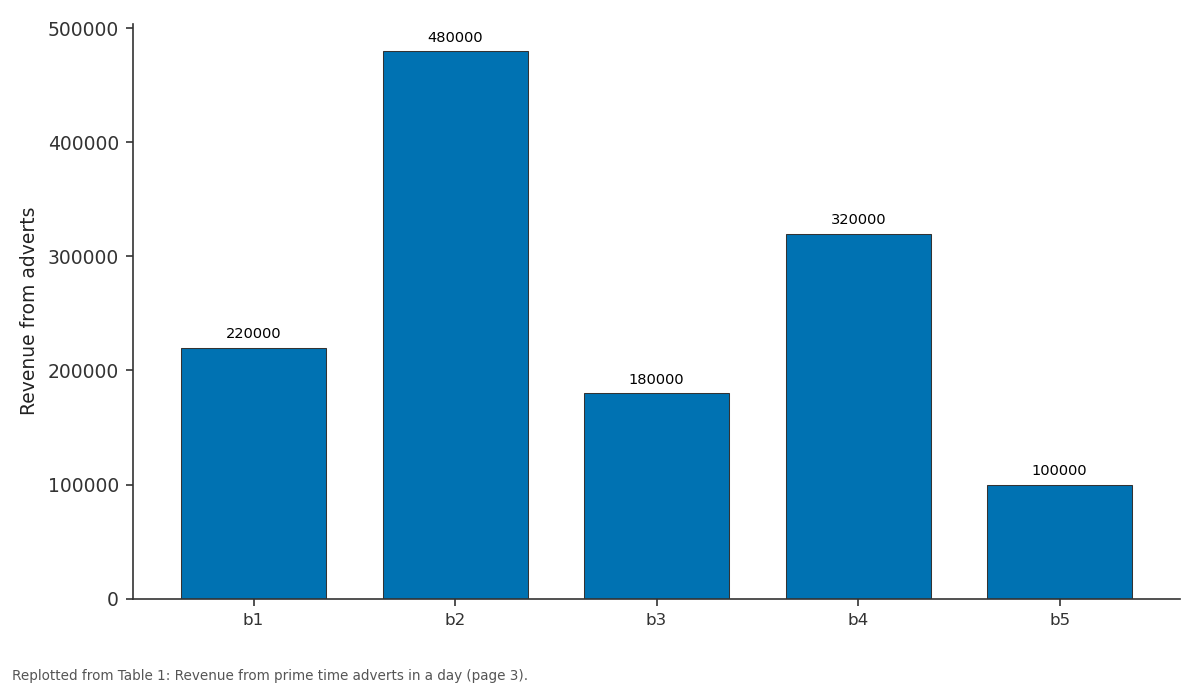
Revenue from adverts: b1 vs b2 vs b3 vs b4 vs b5
Replotted from Table 1 (page 3) of the original paper. Every bar is the paper's own table value.
View source evidence ↗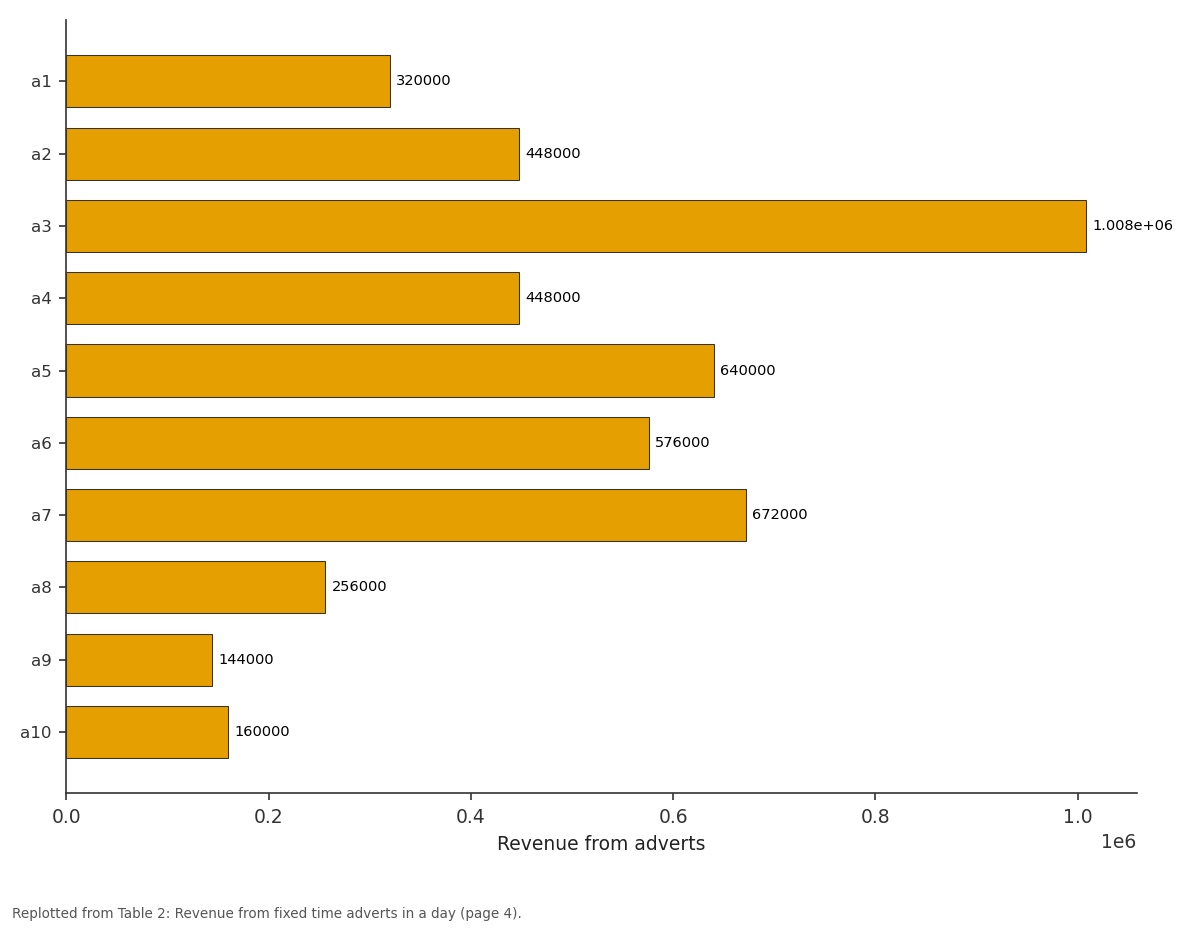
Revenue from adverts: a1 vs a2 vs a3 vs a4 vs a5
Replotted from Table 2 (page 4) of the original paper. Every bar is the paper's own table value.
View source evidence ↗Figures & tables
From the original paper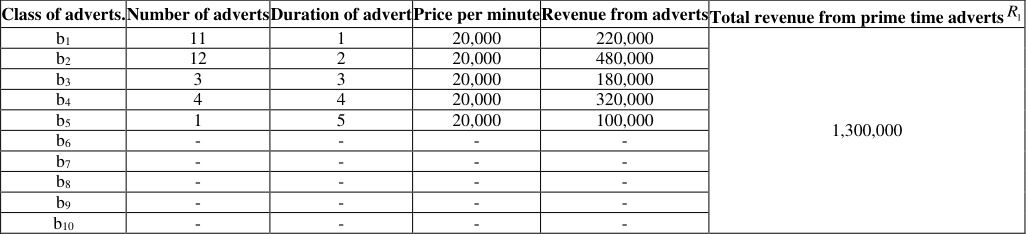 Table 1
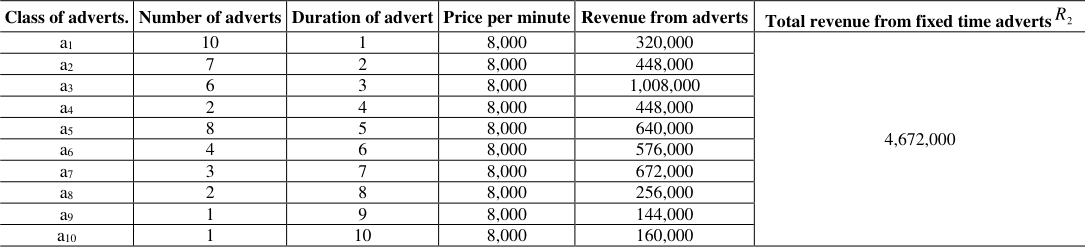 Table 2
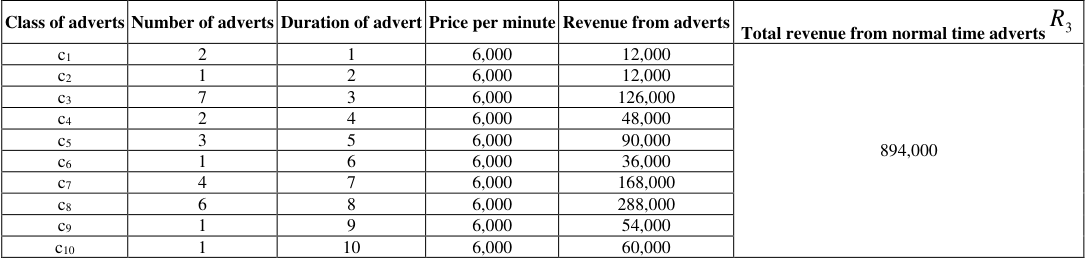 Table 3
Introduction
The airtime on radio and television stations forms a special type of non-regular fixed lifetime inventory system [1,2,3,4,5] . A non-regular fixed lifetime inventory system is one in which items outdated in one period but become useful in the next period. Simply put, outdated items are not discarded from inventory [6,7] . The usefulness or utility of the items is renewed at the start of the next period. For radio and television stations, a period is a day (1440 minutes) and any minute or multiples of minutes can be used for adverts/paid announcement/sponsored programmes. Any minute not used for adverts/ paid announcement/ sponsored programmes is considered outdate [8,9,10] and whenever there is no airtime/space for adverts/paid announcement in a day, shortage is assumed. Airtime on radio and television stations are classified into prime times, fixed times and normal times. Prime times on radio and television refers to the time of the day when the highest number of people are listening or watching. Prime times can be in the morning or evening, in Nigeria, prime times on radio/television stations are between 6 am -7:30 am in the morning or 8 pm -9 pm in the evening. Advertising rates are highest during prime times [11] because of peak viewing and listening times on television and radio. Besides the regular prime times on radio/television stations, the broadcast of major events such Africa cup of nations, World cup, Olympic games, common wealth games, Europe champions league, etc. creates more prime times for radio/television stations. Commercials can be ran at the start, half way or ending of such major events. Many big, medium and small companies take advantage of the high number of listeners and viewers to advertise their goods and services. Fixed times on radio and television refers to anytime of the day that has been paid for by a company, government agencies or individuals to advertise their goods and services. That time of the day is reserved for the company, agency or individuals. Like other radio/television adverts, fixed time adverts has a minimum duration of one minute and can be extended to any desired number of minutes by the customers. Some fixed time adverts/programmes can run for 2 days, 4 days, 1week, a quarter or even a year and can renewed by the customers if they desire to continue at the end of the period. The price for fixed time adverts is less than that of prime time adverts, since fixed time adverts may run for a long period of time. Fixed time adverts are a major source of revenue for radio and television stations in Nigeria. Normal times on radio/television stations refers to any time that is not prime nor fixed. Adverts rates are lowest during normal times.
There are no permanent normal times on radio, as customers can fix anytime by simply paying for the time, for the desire number of days or quarters. The total revenue of a radio/television station is the sum of revenues from the three subunits of time.
Description of the model
This work is aimed at deriving the total revenue function for a radio/television station. Adverts on radio and television are classified into prime time adverts, fixed time adverts and normal time adverts. The prime time adverts are the most expensive while the normal time adverts are the least expensive. The total revenue for a day is the sum of revenue from all three classes of adverts. Some adverts are only for a period while others can last for more than one period, especially the fixed time adverts. Now if Then the total minutes used for adverts in a day is
Its possible for X to be zero, which means there is no prime adverts for the day. But are hardly zero.
Assumptions and Notations Assumptions
1. The minimum time for a radio/television advert is one minute. 2. The total revenue for a period is the sum of revenues from prime times adverts, fixed times adverts and normal times adverts. 3. There is a fixed operating cost for the radio/television stations. 4. Prime times not used for adverts in a period is considered outdated, but become useful in the next periods. 5. Whenever there is no space/airtime for adverts, shortage is incurred. 6. When a radio/television station suddenly goes off air, there is a periodic penalty for every adverts already paid for until the station comes back on air. 7. The number of days an advert/paid programme can run is not fixed and determined by the customer. 8. The number of minutes for any advert/paid programmes is discrete. 9. There is a fixed number of minutes allocated daily to prime time adverts.
Derivation of total revenue function
The components of the total revenue function for a radio/television station are the revenue functions, the set up cost, the shortage cost, the outdate cost and the penalty cost.
The revenue function
The total revenue per period for radio/television station is the sum of revenues from the prime times, fixed times and normal times.
Prime time revenue
Let the prime time adverts for a day be Its important to note that some fixed time adverts can run for more than a day. If is the number of days the fixed adverts will run, then the revenue will be Therefore the revenue function by the radio/television per day is given by ( 5) Or ( 6)
Shortage cost
Shortage occur whenever there is no space/airtime for adverts that is every available space for adverts has been booked up. This particularly apply to prime time adverts since the number of minutes allocated to prime time adverts is fixed. So, if the number of minutes X available for prime time adverts is less than the number of minutes Outdate cost outdate occur when the number of minutes allocated to prime time adverts is more than the number of minutes demanded for prime time adverts, that is X X d .
Outdate cost =
Outdate cost =
Setup cost
There is a fixed set up cost for radio/television stations. Set cost = P
Penalty cost
Whenever a radio/television station is off air as a result of natural disaster or any other reason, a penalty cost is incurred for paid adverts/programmes that cannot be broadcast. Adverts and paid programmes will not be aired. If the radio/television station is off air for n days and the number of prime time adverts, fixed time adverts and normal time adverts affected are z y x q q q , , respectively, the penalty cost will be
are penalty per prime time adverts, fixed time adverts and normal time adverts respectively? The total revenue function for a radio/television station is given by the sum of equations or
Numerical Examples
We give a numerical example to demonstrate the use of the model. A total of ten adverts each, from prime time, fixed time and normal time was documented for a radio station and the total revenue generated for the day was computed with our model. Shortage and outdate were assumed to be zero. A computer programme in Mathematical 8 was designed to carry out the operations. The fixed operating cost was assumed to be 50,000,000.
Conclusion
We have derived the total revenue function for computing the daily revenue for a radio/television station. Airtime on radio/television stations is divided into prime time, fixed time and normal time and the total revenue per day is the sum of revenue from all classes. The model also include costs against radio/television stations such as outdate cost, shortage cost and penalty cost. The stations management aim to minimize the costs and maximize revenue.
Figures and tables from the paper
| Class of adverts. | Number of adverts | Duration of advert | Price per minute | Revenue from adverts | advertsR Total revenue from prime time 1 |
|---|---|---|---|---|---|
| b1 | 11 | 1 | 20,000 | 220,000 | 1,300,000 |
| b2 | 12 | 2 | 20,000 | 480,000 | |
| b3 | 3 | 3 | 20,000 | 180,000 | |
| b4 | 4 | 4 | 20,000 | 320,000 | |
| b5 | 1 | 5 | 20,000 | 100,000 | |
| b6 | - | - | - | - | |
| b7 | - | - | - | - | |
| b8 | - | - | - | - | |
| b9 | - | - | - | - | |
| b10 | - | - | - | - |
Table text extracted from the original PDF; superscript letters are shown inline. The original table image is below.
View original table image
| Class of adverts. | Number of adverts | Duration of advert | Price per minute | Revenue from adverts | R Total revenue from fixed time adverts 2 |
|---|---|---|---|---|---|
| a1 | 10 | 1 | 8,000 | 320,000 | 4,672,000 |
| a2 | 7 | 2 | 8,000 | 448,000 | |
| a3 | 6 | 3 | 8,000 | 1,008,000 | |
| a4 | 2 | 4 | 8,000 | 448,000 | |
| a5 | 8 | 5 | 8,000 | 640,000 | |
| a6 | 4 | 6 | 8,000 | 576,000 | |
| a7 | 3 | 7 | 8,000 | 672,000 | |
| a8 | 2 | 8 | 8,000 | 256,000 | |
| a9 | 1 | 9 | 8,000 | 144,000 | |
| a10 | 1 | 10 | 8,000 | 160,000 |
Table text extracted from the original PDF; superscript letters are shown inline. The original table image is below.
View original table image
| Class of adverts | Number of adverts | Duration of advert | Price per minute | Revenue from adverts | R Total revenue from normal time adverts 3 |
|---|---|---|---|---|---|
| c1 | 2 | 1 | 6,000 | 12,000 | 894,000 |
| c2 | 1 | 2 | 6,000 | 12,000 | |
| c3 | 7 | 3 | 6,000 | 126,000 | |
| c4 | 2 | 4 | 6,000 | 48,000 | |
| c5 | 3 | 5 | 6,000 | 90,000 | |
| c6 | 1 | 6 | 6,000 | 36,000 | |
| c7 | 4 | 7 | 6,000 | 168,000 | |
| c8 | 6 | 8 | 6,000 | 288,000 | |
| c9 | 1 | 9 | 6,000 | 54,000 | |
| c10 | 1 | 10 | 6,000 | 60,000 |
Table text extracted from the original PDF; superscript letters are shown inline. The original table image is below.
View original table image
References
10 in the original paper- Pan B, Wu DC, Song H. Forecasting Hotel Room Demand using Search Engine Data. Journal of Hospitality and Tourism Technology. 2012;3(3):196-210.
- Craig A, Depken II, Frank Stephenson E. Hotel Demand before, during and after Sport Events: Evidence from Charlotte, North Carolina. Economic Inquiry. 2018;56(3):1764-1776.
- Guanqun Ni, Xin Feng, Lei Chen. Hotel Room Allocation with Multiple Sales Channels: A Prospective of Mini max Regret. Journal of Control and Decision. 2020;7(4):359-378.
- Guenter S. Weekend vs Midweek Stays: Modelling Hotel Rooms Rates in a Small Market. International Journal of Hospitality Management. 2012;31(4):1113-1118.
- Izevbizua O, Apanapudor JS. Total revenue function for non-regular fixed lifetime inventory system. Africa Journal of Mathematics and Computer Sciences. 2019;12(2):24-30.
- Ling L, Dong Y, Guo X, Liang L. Availability Management of Hotel Rooms under Cooperation with Online Travel Agencies. International Journal of Hospitality Management. 2015;50(10):145-152.
- Tadj L, Djemili S. Joint optimization of the marketing and operations functions. India Journal of Operational Research. OPSEARCH. 2022;59(2):574-593.
- Radhamani B, Sivakuman B, Arivarignan G. A comparative study on replenishment policies for perishable inventory system with service facility and multiple server vacation. India Journal of Operational Research. OPSEARCH. 2022;59(1):229-265.
- Gurler U, Berk E. An exact analysis on age-based control policies for perishable inventories. IISE Transactions. 2021;53(2):221-245.
- Zhang H, Zhang J, Lu S, Cheng S. Modelling Hotel Room Price with Geographically Weighted Regression. International Journal of Hospitality Management. 2011;30(4):1036-1043.
Cited by 6
From OpenAlex, OpenCitations and reference lists read by Scinovex
- An economic evaluation of resource use efficiency of small tea growers in Assam
Mrinmoyee Sharma, Ashish S. Noel, Pranil Sunil Kale, Mukesh Kumar Maurya · International Journal of Agriculture Extension and Social Development · 2025
The tea industry in Assam, a vital component of India's agricultural landscape, has undergone a significant transformation with the growing prominence of small tea growers.The study, entitled "An Economic Evaluation of the Resource Use Efficiency of Small Tea Growers of Assam," aims to assess the efficiency of resource utilization in green tea leaf production by small-tea growers.Focusing on Tinsukia and Dibrugarh districts-two districts with major concentration of small tea grower, the study employed a multi-stage random sampling technique to select a representative sample of 197 growers.Prim
- Artificial intelligence and its applications in film and television editing ↗
Ziyad Tarek Shaker · International Journal of Humanities and Arts · 2025
The field of cinematic and television editing is witnessing rapid development due to the introduction of artificial intelligence (AI) technologies, which have brought about a real transformation in working methods and production quality. This research aims to study the various applications of AI in editing processes, such as automatic scene classification, color correction, image and sound editing, and visual effects
- Effectiveness of online advertising ↗
Karthik Srivatchan, V Dhayalan · International Journal of Research in Management · 2024
Advertising is becoming a major marketing force in the changing digital landscape, influencing consumer behaviour and company consequences worldwide. Comparing benefits over older approaches, this comparison examines the success of internet advertising in terms of reach, targeting, engagement, conversion, and return on investment. It finds the following success criteria through the analysis of digital data: engaging content, efficient ad formats,
- Active customer contribution to revenue levels at PT. Indosat ↗
Cantika Intan Sri Mawarni, Tiris Sudrartono · International Journal of Financial Management and Economics · 2024
This research aims to analyse the contribution of active customers to the level of income at PT. Indosat, the loading telecommunications service provider company in Indonesia. The research uses secondary data in the form of financial and operational reports of PT. Indosat from 2014 to 2023. The research results show that the number of active customers of PT. Indosat continues
- Features of Prime-Time Programming of Popular Satellite TV Channels in China (Hunan TV, Zhejiang TV and Jiangsu TV) ↗
Ying Zhang · Theoretical and Practical Issues of Journalism · 2024
Features of programming of the leading satellite TV channels of China, Hunan TV, Zhejiang TV and Jiangsu TV in prime time are investigated. The evening broadcast is a landmark period for television broadcasters. The study showed that most of the airtime on Hunan TV, Zhejiang TV and Jiangsu TV is occupied by entertainment content. At the same time, about 31–40…
❝ 0PDF - Revenue generating model for transportation companies
O Izevbizua, Igbinosun LI · International Journal of Statistics and Applied Mathematics · 2023
This work considers the seats on airplanes, trains, buses and cars as non-regular fixed lifetime inventories and developed a revenue generating function for each trip embarked upon by any of these means of transportation. Numerical examples on the use of the revenue generating function was also discussed.