
Research article · 2020 · Full text
International Journal of Advanced Chemistry ResearchToxicity of heavy metals in the water quality of Ganga River in Kanpur, Uttar Pradesh, India
Volume 2(1) · Pages 01–04 · DOI: 10.33545/26646781.2020.v2.i1a.14 ↗
Research areasWater Quality and Pollution Assessment
Abstract
Author-writtenA study to find the toxicity of heavy metals in the water quality of Ggana river in Kanpur, Uttar Pradesh, India area was carried out over a period of Jan. 2018 to Dec. 2018. Water samples from Kanpur (Shuklaganj New Ganges Bridge, Ordnagar, Baba Ghat, Bhairav ​​Ghat and Khayora Kati) were analyzed for heavy metals like Cu, Cr, Fe, Mn, Zn, Cd and Pb. The pH of these water samples was found in alkaline range (7.21-8.18). The concentration of PB varies between 0.44±0.32 ppm and 0.33±0.31 ppm. Cd concentration was seen to range from 0.022±0.11ppm to 0.008±0.06 ppm. The content of Cr is from 0.054±0.56 to ppm 0.38±0.33ppm. Highest concentrations of heavy metals of Cu (0.173±0.283ppm) and PB (0.44±0.32ppm) were found in Ordnance town sample, Cr (0.054±0.56) in Khyora katari water sample, Cd (0.022±0.11ppm) in Baba ghat water sample, Fe (0.366±0.98ppm) in Khyora katari water sample.
Summary
Source-checkedPlain-language reading of the full paper, prepared with AI and checked against the text. Each point links to the authors' own words.
Why it matters
- Industrial activities like mining, plating, and milling release toxic heavy metals such as chromium, copper, cadmium, manganese, lead, zinc, and iron into the environment. View evidence ↗
- Heavy metals are non-biodegradable and bioaccumulate through trophic levels, which degrades water quality and leads to toxic effects. View evidence ↗
- Contamination by heavy metals renders water non-potable and hazardous to human health. View evidence ↗
The question
- The study aimed to determine the toxicity of heavy metals in the water quality of the Ganga River in Kanpur, Uttar Pradesh, India, between January and December 2018. View evidence ↗
What they did
- Water samples were collected from five sites in Kanpur: Shuklaganj New Ganges Bridge, Ordnagar, Baba Ghat, Bhairav Ghat, and Khayora Kati, to analyze Cu, Cr, Fe, Mn, Zn, Cd, and Pb. View evidence ↗
- Heavy metals were determined by digesting 100ml samples with HNO3 and HClO4, filtering them, and analyzing them using an Atomic Absorption Spectrophotometer. View evidence ↗
- The pH of the collected water samples was measured and found to be in the alkaline range of 7.21 to 8.18. View evidence ↗
What they found
- Iron (Fe) concentrations exceeded permissible limits in all samples, with the highest concentration of 0.366 ppm found at Khyora katari. View evidence ↗
- Copper (Cu) exceeded permissible limits in five samples, peaking at 0.173 ppm in the Ordnance town sample. View evidence ↗
- The highest concentration of Chromium (Cr) was 0.054 ppm, recorded at the Khyora katari site. View evidence ↗
- Lead (Pb) reached its maximum concentration of 0.44 ppm in the Ordnance town water samples. View evidence ↗
- Cadmium (Cd) was detected in samples, with the highest concentration of 0.022 ppm found at Baba ghat. View evidence ↗
- The relative concentrations of the analyzed metals in the Ganga water followed the order: Fe > Zn > Cu > Cr > Mn > Pb > Cd. View evidence ↗
What it means
- The authors conclude that industrial effluents contain heavy metals far exceeding permissible limits, necessitating urgent treatment before discharge into water bodies. View evidence ↗
Visual summary
2 visualsIllustrations explain the paper; charts are replotted from the paper's own table values.
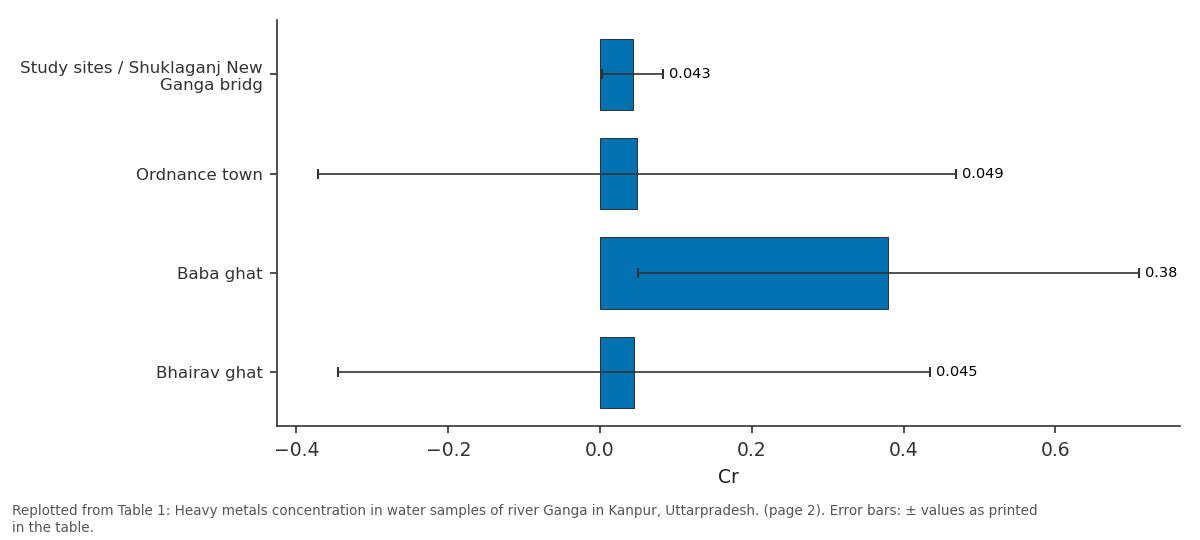
Cr: Study sites /... vs Ordnance town vs Baba ghat vs Bhairav ghat
Replotted from Table 1 (page 2) of the original paper. Every bar is the paper's own table value.
View source evidence ↗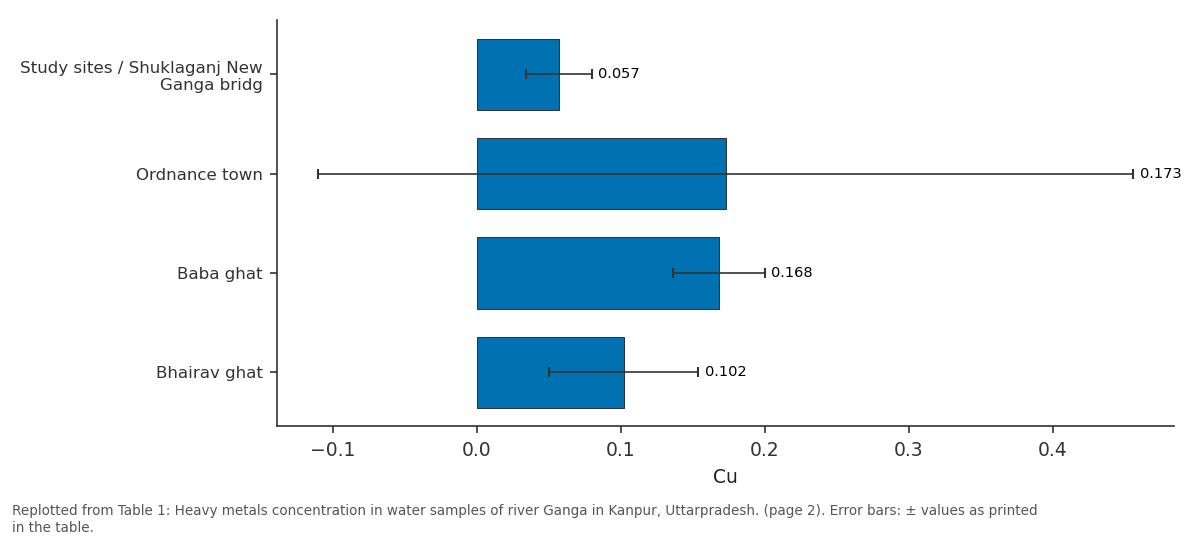
Cu: Study sites /... vs Ordnance town vs Baba ghat vs Bhairav ghat
Replotted from Table 1 (page 2) of the original paper. Every bar is the paper's own table value.
View source evidence ↗Figures & tables
From the original paper Table 1
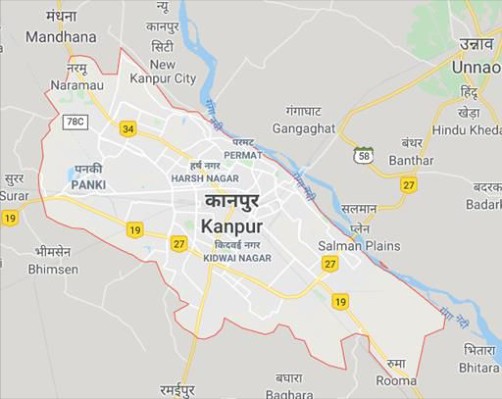 Figure 1
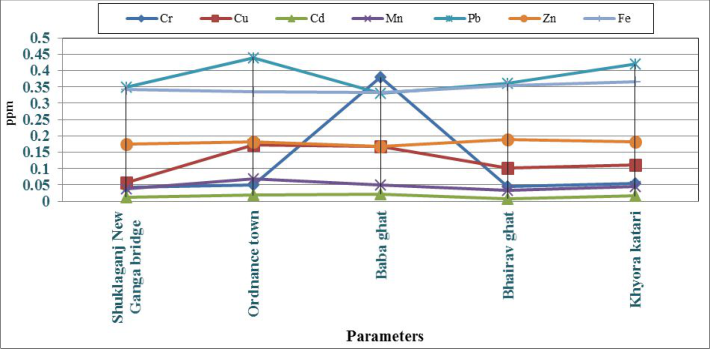 Figure 2
Introduction
Water is the most vital issue for life existence on earth. The extent and best of the world's water has been deterioting with exponential growth in human populace and its desires for industrial and agricultural activities. Metal infection in river water is an increasing number of turning into frequent in India. Toxicity caused through metals posing trouble for ecological, evolutionary, dietary and environmental areas. Presence of metals in river water in excesses may also purpose a giant hazard to human fitness and ecological systems. The essential sources of heavy steel air pollution are mining, milling, plating and surface finishing industries that discharge a variety of poisonous metals such as Cr, Cu, Cd, Mn, Pb, Zn and Fe into the environment. Over the last few decades, the attention of these heavy metals in river water and sediments has extended rapidly. Consequently, concentrations of poisonous metals in grains and veggies grown in contaminated soils have accelerated at alarming rates. This poses a serious hazard to human beings and the environment due to the fact of its toxicity, nonbiodegradability and bioaccumulation (Bahadir et al., 2007; Perez-Marin et al., 2008; Reddad et al., 2003) [1][2][3] . River Ganga is one of the biggest and longest rivers in India and originates from Gangotri in the Himalayan Mountains. After flowing about 2,525 km the river meets the Bay of Bengal near Kolkata. The vital cities positioned at its banks are Rishikesh, Haridwar, Kanpur, Allahabad, Varanasi, Patna and Kolkata. The river Ganga flows via Varanasi, a metropolis which has a prosperous cultural, religious and religious heritage. A wide variety of small industries like, metallic smelting, electroplating, fabrics dye, painting, electrical and batteries are going for walks in Kanpur. Effluent discharges of these industries contain increased stages of heavy metals like Cr, Cu, Pb, Cd, Zn and Mn etc. (Singh et al., 2009). Heavy metals enriched untreated effluents are oftentimes being dumped off in the sewage system. In India 90% of the sewage generated stays non treated and are discharged in open water bodies. Thus the discharges of untreated sewage, industrial and agricultural effluents are the important source of these heavy metallic in Ganga water. The Ganga water in Varanasi is quite affected with the aid of heavy metals like Cr, Cu, Pb, Cd, Zn and Mn etc. The monitoring stations at Kanpur, Patna, West Bengal have indicated that industrial effluents are broadly speaking accountable for the pollution (Khwaja et al., 2001, Parshuram and Singh, 2007 and Kar et al., 2008) [4][5][6] . These heavy metals in water our bodies are nondegradable in nature, accumulate from one trophic degree to the subsequent and show their toxic consequences and finally detoriate the water quality. Eventually they have an effect on the aquatic surroundings as well as human being. Heavy metals contamination makes water unfit and non-potable for human health via direct and oblique way. It would no longer be out of vicinity to mention that human beings settled along the financial institution of Ganga in this historical city of Varanasi depend closely on its water for drinking as properly as for different domestic purposes. Some of the heavy metals like Cr, Cu, Zn, Mn and Fe are useful in trace amount as a nutrient for flora and microorganisms however at higher concentration it is hazardous (Marschner, 1995, Bruins et al., 2000, Singh, and Sarma, 2005, Singh, et al. 2006, Singh, 2010) [7][8][9][10][11] . Cd and Pb are no longer required for any physiological activity. Their presence in water reasons problems associated to muscular, reproductive, behavioural, neurological and gastrointestinal systems (Abbasi et al., 1998 and Tsuji and Karatzides, 2001) [1213] . Therefore, detection of these heavy metals in Ganga water samples is integral to consider the Ganga water quality with recognize to consuming and agricultural irrigation purposes. The water of all these rivers works as a primary source for ingesting and irrigation in the place of Kanpur. Therefore, in order to restoration the nice of existence and water nice of all these rivers, appropriate water useful resource planning application be developed.
Study site
The latitude of Kanpur, Uttar Pradesh, India is 26.449923, and the longitude is 80.331871. Kanpur, Uttar Pradesh, India is located at India country in the Cities place category with the gps coordinates of 26°26' 59.7228'' N and 80° 19' 54.7356'' E. Kanpur elevation is 133 meters height, that is equal to 436 feet. Kanpur is situated on the banks of river Ganga and its area is approximately 1040 sq km and it is 126 meters above sea level. In 78 km. on the distance between Kannauj and Kanpur Barrage, there are agricultural activities at the bottom of the river, mainly Cucurbitaceous Crops are known as "plazas". There is a great decline in the quality of river water. The second distance of 7.5 km from Kanpur There is widespread floods in Shuklaganj and due to domestic and industrial waste and dumping of solid waste, there is widespread impact on the quality of river water, the most important in case of pollution load of 5.5 km from Shuklaganj to Jajmou. Kanpur has about 5500 industries with 75 medium and large industries such as compost, detergent, chemical and paint factories. Of these, 350 heterogeneous leather industries are allowed to flow in the Ganges in an area called Jajmau along the Ganges river. The river is known to move to Kanpur through time.
Materials and Methods
According to the standard quality (Rai, 2019) [14] in National Institute of Hydrology, Roorkee Laboratory (an ISO 9001-2008 certified) BIS [26] , the quality of water was analyzed. These samples were treated with 2%HNO 3 for preservation of metals in water samples and to avoid precipitation. The pH of water samples were determined with pH meter having electronic glass electrodes. For determination of heavy metals, 100ml water samples were digested with 2.5 ml HNO 3 and HClO 4 (10:1) ratio on hot water plate (Eaton et al., 1995) [15] . Later it was filtered with whatman No.42 filter paper. Samples were analyzed for the presence of heavy metals in Atomic Absorption Spectrophotometer at different wavelength. Sampling location map software of Ganga river is prepared using USED-Arc GIS 9.3 and Surfer 9.
Result and Discussions
All the five surface water samples of River Ganga had been analyzed for Cr, Cu, Cd, Mn, Pb, Zn and Fe (Table 1). The Fe content material was observed to be extra than the permissible restrict in all the water samples. Maximum Fe (0.366ppm) attention was discovered in water samples of Khyora katari. Cu used to be analysed more than permissible restriction in 5 water samples. Highest awareness of Cu (0.173ppm) was once found in water samples of Ordnance town. Highest attention of Cr (0.054ppm) used to be discovered in water samples of Khyora katari. Pb content material used to be found in maximum concentration (0.44ppm) was once discovered in water samples of Ordnance town. Cd used to be determined in fourteen water samples and most attention (0.022 ppm) used to be discovered in Baba ghat water samples. Some of the heavy metals like Fe, Cu, Zn, Cr and Mn are imperative as micronutrient for plants, microbes and humanbeings (Singh and sarma, 2005; Singh et al., 2006) [9][10] . The range of concentration of essential metals in Ganga water is as follows: Fe>Zn>Cu>Cr>Mn>Pb>Cd (Fig. 2). Lead (Pb) is the reasons of extreme health issues like convulsions, coma, and renal failure and at higher concentration demise can also occur. It creates neurotoxic consequences on growing foetuses (US Agency 1999) [16] . It has been mentioned that lead saved in the maternal bone are mobilized at excessive rate mainly throughout being pregnant and lactation (Gulson et al., 1997) [17] period. It affects foetus delivery weight, boom charge and mental improvement (Gonzalez-Cossio et al., 1997) [18] . Cadmium is a danger component for human fitness because it creates testicular degeneration (Benoff et al., 2000) [19] and prostate cancer (Ye et al., 2000) [20] . Moreover, it damages the proximal tubules of each nephron of the kidney. The affected character suffers via leakage of low molecular weight proteins and crucial ions like Ca into urine and eventually kidney failure (Satarug et al., 2000) [21] . Due to Cd exposure, the humans suffer thru vulnerable bone due to loss of Ca (Staessen et al., 1999) [22] . Use of higher heavy metals (Cr, Cd and Pb) containing Ganga water for ingesting motive has reason of carcinoma of gall bladder in the people of jap Uttar Pradesh and Western Bihar of India (Shukla et al., 1998; Strobel et al., 2001; Namasivayam and Rangnathan, 1995) [23][24][25] .
| S No. | Parameters | Study sites | — | — | — | — |
|---|---|---|---|---|---|---|
| Shuklaganj New Ganga bridge | Ordnance town | Baba ghat | Bhairav ghat | Khyora katari | ||
| 1. | Cr | 0.043±0.040 | 0.049±0.42 | 0.38±0.33 | 0.045±0.39 | 0.054±0.56 |
| 2. | Cu | 0.057±0.023 | 0.173±0.283 | 0.168±0.032 | 0.102±0.052 | 0.110±±0.090 |
| 3. | Cd | 0.012±0.010 | 0.018±0.12 | 0.022±0.11 | 0.008±0.06 | 0.016±0.12 |
| 4. | Mn | 0.039±0.028 | 0.068±0.046 | 0.049±0.033 | 0.034±0.028 | 0.044±0.036 |
| 5. | Pb | 0.35±0.22 | 0.44±0.32 | 0.33±0.31 | 0.36±0.24 | 0.42±0.38 |
| 6. | Zn | 0.175±0.088 | 0.182±0.090 | 0.167±0.66 | 0.188±0.98 | 0.182±0.84 |
Table text extracted from the original PDF; superscript letters are shown inline. The original table image is below.
View original table image
Conclusion
Stormwater runoff from urbanized areas is a significant source of metal pollution in the receiving water streams. Metal composition of urban runoff water is dependent on many factors, such as city planning, traffic, road construction, land use, and the physical characteristics and climatology of the watershed All the samples have proven Fe concentration greater than permissible limit. Cu awareness is extra than permissible limit in all the water samples except one website online (Ordnance town) where it varies between 0.173±0.283 ppm and 0.057±0.023 ppm. In general, the concentration of heavy metals in industrial effluents is much greater than their prescribed permissible limits in the aqueous solutions, so there is an urgent need to treat the metal containing effluents before they are discharged into the aquatic bodies. Metals and their concentrations in industrial waste discharges specifically depend on the profile of that particular industry.
Figures and tables from the paper
References
26 in the original paper- Bahadir T, Bakan G, Altas L, Buyukgungor H. Enzyme Microb. Technol. 2007; 41:98-102.
- Perez-Marin B, Ballester AF. Gonza´lez ML. Bla´zquez JA. Mun˜oz J Sa´ez, Zapata VM, et al. Bioresour. Technol. 2008; 99:8101-8106.
- Reddad Z, rente C, Ge ´Andre`s Y, Thibault JF, Cloirec P. Le. Water Res. 2003; 37:3983-3991.
- Khwaja AR, Singh R, Tandon SN. Monitoring of Ganga water and sediments vis-a-vis tannery pollution at Kanpur (India): A case study. Environ. Moni Assess. 2001; 68:1935.
- Parshuram, Singh AK. Studies on distribution of heavy metals in Ganga water and its bed sediments along the Patna stretch. Journal of Environmental Science and Engg. 2007; 49:211-214.
- Kar D, Sur P, Mandal SK, Saha T, Kole RK. Assessment of heavy metal pollution in surface water. Int J Environ Sci Tech. 2008; 5:119-124.
- Marschner H. Mineral nutrition of higher plants, Academic Press, London. Malik, A., Qadri, S.A., Musarrat, J. and Ahmad, M. 2006. Studies on the water quality of river Ganga at Fatehgarh and Kannauj, U.P., India. Environmental Toxicology and Water Quality. 1995; 10:91-95.
- Bruins MR, Kapil S, Oehme FW. Microbial resistance to metals in the environment. Ecotox Environ Safe. 2000; 45:198-207.
- Singh AL, Sarma PN. Removal and reuse of iron from industrial waste water using microorganisms. A chapter in Bio-technological applications in environmental management, Editor-R.K. Trivedi, 2005, 311-320.
- Singh AL, Murali Krishna P, Nageswara Rao T, Sarma PN. Uptake of Cr (VI) in the presence of sulphate by Bacillus mycoides in aerobic culture. Indian J of Biotechnology, New, Delhi. 2006; 5:506-509.
- Singh AL. Uptake of Zinc and its localization in different cell sectors of Pseudomonas japonica. World Academy of Science. Engineering and Technology, Penang, Malaysia. 2010; 62:1633-1648.
- Abbasi SA, Abbasi N, Soni R. Heavy metal in the environment, Ist Ed., Mital Publication, New Delhi, India.1998.
- Tsuji LJS, Karagatzides JD. Chronic lead exposure, body condition and testis mass in wild Mallard Ducks. B Environ Contam Tox. 2001; 67:489-495.
- Anupama Rai. Physiochemical analysis of Ganga River at Kanpur in Uttar Pradesh, India. International Journal of Advanced Science and Research. 2019; 4(4):21-26.
- Eaton AD, Clesceri LS, Greenberg AE. Standard methods for the examination of water and waste water APHA, AWWA and WEF, 1995.
- US. Agency for Toxic Substances and Disease Registry. Lead. Toxicological profiles. Atlanta: Centers for Disease Control and Prevention, 1999. PB/99/166704.
- Gulson BL, Jameson CW, Mahaffey KR, Mizon KJ, Korsch MJ, Vimpani G, et al. Pregnancy increases mobilization of lead from maternal skeleton. J Lab Clin Med. 1997; 30:5162.
- Gonzalez-Cossio T, Peterson KE, Sanin L, Fishbein, SE, Palazuelos E, Aro A, et al. Decrease in birth weight in relation to maternal bone -lead burden. Pediatrics. 1997; 100: 856-62.
- Benoff S, Jacob A, Hurley IR. Male infertility and environmental exposure to lead and cadmium. Hum Reprod Update. 2000; 6:107-21.
- Ye J, Wang S, Barger M, Castranova V, Shi X. Activation of androgen response element by cadmium: a potential mechanism for a carcinogenic effect of cadmium in the prostrate. J Environ Pathol Toxicol Oncol. 2000; 19:275-80.
- Satarug S, Haswell-Elkins MR, Moore MR. Safe level of cadmium intake to prevent renal toxicity in human subjects. Br J Nutr. 2000; 84: 791-802.
- Staessen JA, Roels HA, Emelianov D, Kuznetsova T, Thijs L, Vangronsveld J, et al. Environmental exposure to cadmium, forearm bone density and risk of fractures: Prospective population study. Public Health and Environmental Exposure to cadmium (PheeCd) Study Group. Lancet. 1999; 353:1140-4.
- Shukla VK, Prakash A, Tripathi BD, Reddy DCS, Singh S. Biliary heavy metal concentrations in carcinoma of the gall bladder: case -control study. BJM. 1998; 317:1288-1289.
- Strobe lBW, Hansen HCB, Borggaard OK, Andersen MK, Raulund-Rasmussen K. Cadmium and copper release kinetics in relation to afforestation of cultivated soil. Geochim Cosmochim Acta. 2001; 65:1233-1242.
- Namasivayam C, Ranganathan K. Removal of Cd (II) from wastewater by adsorption on "waste" Fe (III)/Cr (III) hydroxide. Water Res. 1995; 29:1737-1744.
- BIS. Bureau of Indian Standard, Drinking water specification, IS 10500: 2012 Bharti N and Katyal. D. Int J Environ Sci. 2011; 2:1.
Cited by 4
From OpenAlex, OpenCitations and reference lists read by Scinovex
- Heavy metals in water and their cascading effects on ecosystems ↗
Mirna Helena Regali Seleghim, Aiko Horikawa · International Journal of Social Science and Education Research · 2020
This paper provides a comprehensive overview of the presence of heavy metals in aquatic environments and their multifaceted impacts on ecosystems. Through a synthesis of current research, it highlights the sources, pathways, and toxicological effects of heavy metals such as lead, mercury, cadmium, and arsenic on aquatic life and terrestrial organisms. The study further explores the mechanisms of bioaccumulation and
❝ 6Found by Scinovex - An overview of the biological impacts of heavy metals. Journal of environmental biology ↗
Ivo Sell, Ira Kask · International Journal of Molecular Biology and Biochemistry · 2021
This paper provides a comprehensive overview of the biological impacts of heavy metals, including lead (Pb), mercury (Hg), cadmium (Cd), and arsenic (As), on various forms of life and ecosystems. Highlighting the mechanisms of toxicity, ecological consequences, and human health implications, the study underscores the urgency for innovative remediation strategies and stricter environmental regulations.
❝ 4Found by Scinovex - Water quality in upper and middle stretches of river Ganga, India in relation to varying anthropogenic pressures
Prerna Sharma, Ajeet Kaushik · International Journal of Geography Geology and Environment · 2022
River Ganga, one of the most important rivers of India, has been facing various types and magnitudes of anthropogenic stress along its course of run through the thickly populated river basin. The present investigation has been conducted for three seasons, for the year 2017-2018 for the upper and middle Ganga basins. The analysis has been performed to examine the variations in the concentrations of diverse water and sediment quality parameters from Devprayag to Haridwar, Bithoor to Kanpur, and Varanasi areas, respectively. The sampling locations have been chosen based on the distinct anthropoge
- Climatic fluctuation and breeding efforts to mitigate: A review
Takele Mitiku · International Journal of Research in Agronomy · 2023
Climate change is deviations from the average atmospheric state produced by both natural and anthropogenic. Deforestation and greenhouse gas such as CO2, CH4 and N2O are the main factors of causing climatic fluctuation. Climatic fluctuation has direct and indirect effects on agricultural production and productivity as well as on social healthy. Phonological changes, phenotypic changes, morphological changes, effects on plant production and landscape changes are direct while effects on soil, fertility, water quality pest and disease incidence and drought problem are indirect effects of climate