
Research article · 2023 · Full text
International Journal of Research in AgronomyClimatic fluctuation and breeding efforts to mitigate: A review
Volume 6(1) · Pages 39–43 · DOI: 10.33545/2618060x.2023.v6.i1a.166 ↗
Research areasAgricultural pest management studies
Abstract
Author-writtenClimate change is deviations from the average atmospheric state produced by both natural and anthropogenic. Deforestation and greenhouse gas such as CO2, CH4 and N2O are the main factors of causing climatic fluctuation. Climatic fluctuation has direct and indirect effects on agricultural production and productivity as well as on social healthy. Phonological changes, phenotypic changes, morphological changes, effects on plant production and landscape changes are direct while effects on soil, fertility, water quality pest and disease incidence and drought problem are indirect effects of climate changes. Different action has to be taken to tackle the difficult situation of climatic fluctuation. Rapid breeding cycles, developing drought resistant varieties, soil carbon sequestration, and rehabilitating degraded land are the main action.
Summary
Source-checkedPlain-language reading of the full paper, prepared with AI and checked against the text. Each point links to the authors' own words.
Why it matters
- Climate change is defined as deviations from the average atmospheric state, caused by both natural and human-driven factors. View evidence ↗
- The primary drivers of climatic fluctuation include deforestation and the emission of greenhouse gases like CO2, CH4, and N2O. View evidence ↗
- Changes in the global climate are a major concern for scientists because they severely impact crop productivity and threaten global food security. View evidence ↗
The question
- The objective of this review is to assess how plant breeding efforts can control climatic variability and mitigate its effects through genetic improvement. View evidence ↗
What they did
- The authors conducted a review of existing literature to evaluate plant breeding strategies for climate mitigation. View evidence ↗
What they found
- According to the IPCC, yields for maize, rice, and wheat could decrease by up to 2% per decade starting in 2030 due to climate change. View evidence ↗
- By 2080, the number of undernourished people is predicted to increase by 150% in North Africa and the Middle East, and by 300% in sub-Saharan Africa compared to 1990 levels. View evidence ↗
- In China, a 1% increase in temperature during the wheat growing season was found to reduce wheat yields by approximately 30%. View evidence ↗
- Projections for 2050 suggest that while wheat and teff production will be seriously damaged by climate change, maize yields may relatively increase. View evidence ↗
- Climate change has direct effects on plant morphology, phenotype, and production, and indirect effects on soil fertility, water quality, and pest incidence. View evidence ↗
- Global breeding efforts are currently most focused on developing heat tolerance, water-use efficiency, and drought resistance. View evidence ↗
- Core mitigation strategies include rehabilitating degraded lands, soil carbon sequestration, afforestation, rapid breeding cycles, and developing drought-resistant varieties. View evidence ↗
What it means
- The authors conclude that plant breeders have a significant responsibility to mitigate climate change by releasing drought-resistant and resource-efficient crop varieties. View evidence ↗
- The authors note that in developing countries, breeding often focuses solely on yield for food security, frequently neglecting or deprioritizing the impacts of climate change. View evidence ↗
Visual summary
1 visualsIllustrations explain the paper; they do not show study data.
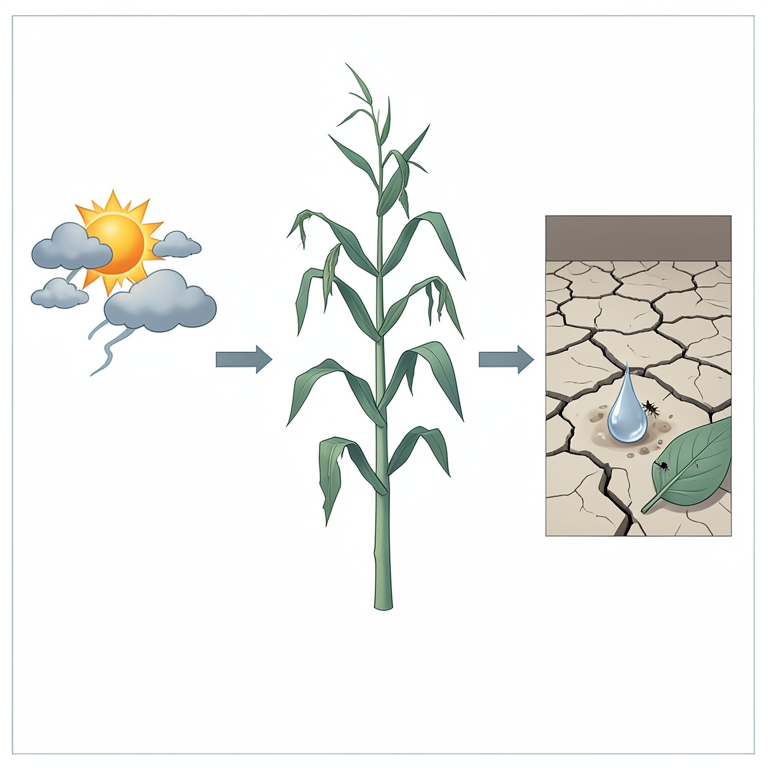
Direct vs Indirect Effects of Climate Change
AI-generated conceptual illustration (maize plants in a field). It explains the idea and does not show study data.
View source evidence ↗Figures & tables
From the original paper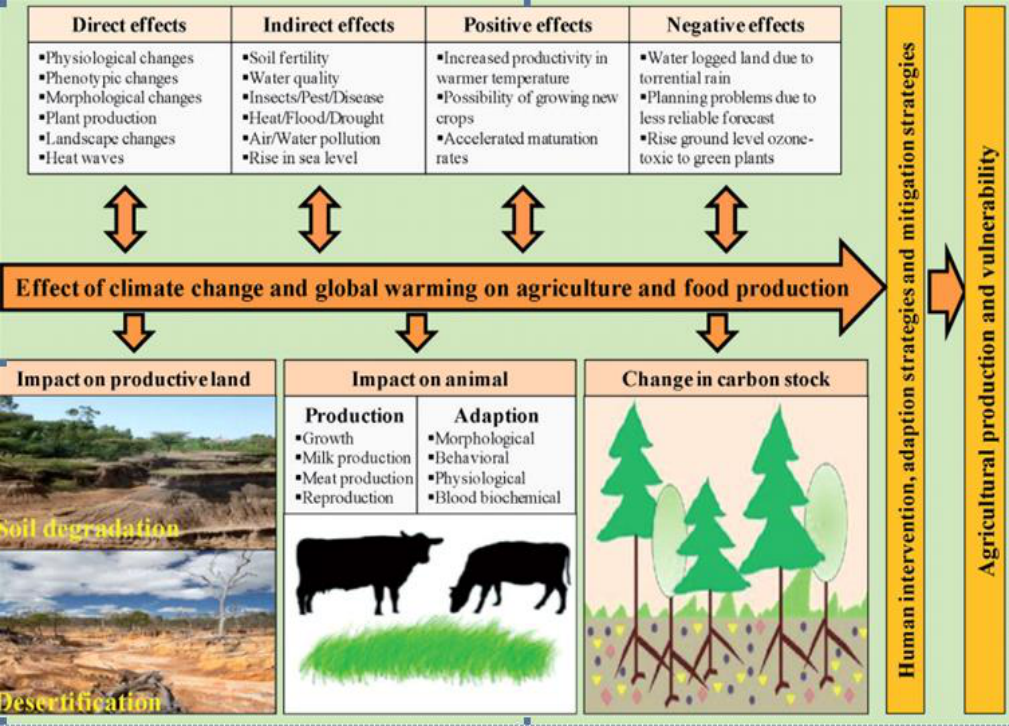 Figure 1
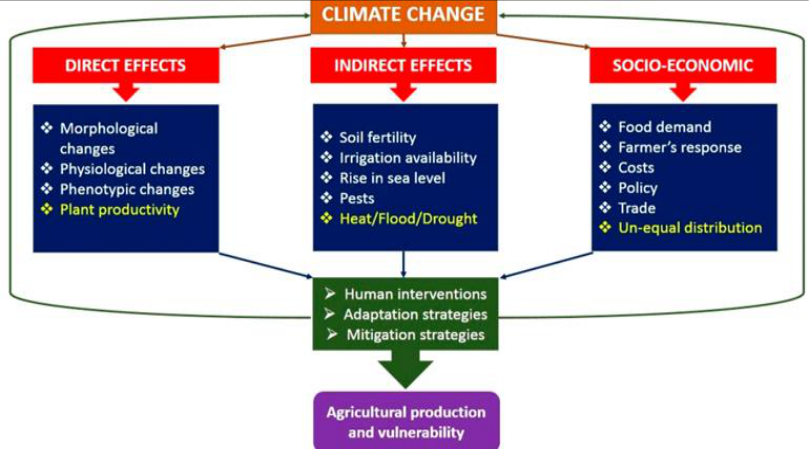 Figure 2
Introduction
Climate change is deviations from the average atmospheric state produced by both natural and anthropogenic forces such as the orbit of the earth's revolution, volcanic activity, and crustal motions. Climate change affects the land and its agriculture by yearly rainfall, average temperature, heat waves, changes in weeds, pests, or microbes, worldwide changes in atmospheric CO2 or ozone levels, and sea level oscillations. The prospect of changing global climate has piqued scientists' interest, as these changes severely influence global crop productivity and jeopardise global food security (Raza et al., 2019) [18] . Droughts and floods, which always result in acute food shortages, are illustrative of the grave consequences of extreme weather conditions for crop productivity (Mba, Ghosh and Guimaraes, 2012) [13] . According to some projections, agriculture is the most threatened activity as a result of climate change (Raza et al., 2019) [18] . It is climate-dependent and has distinct regional characteristics and is disturbed by agricultural environment altering climatic factors (Geneti, 2021) [8] . (Rosenzweig et al., 2001) [26] reported as temperature and rainfall influence the spread, growth and survival of pathogens which indirectly affect the crop. Climate fluctuation also affects human health by heat waves, floods, and fires and indirectly owing to its effects on agriculture, food supply, and diets (Springmann et al., 2016; Ceccarelli, 2019) [27,4] . Human activities, shifts in climate patterns, greenhouse gas emissions from natural systems and composition are the main factor of climate change (Temesgen, 2021). According to (Shahzad, 2019) [20] study, CO2, CH4 and N2O fluorinated greenhouse gas which lead to drastic changes in the temperature, rainfall patterns and ultimately cause undesirable effects on the land and water resources, droughts and floods. Plant breeding is the art and science of genetically improving plants for the benefit of humankind. One of the effective ways for crop production to grow under new challenges from climate change is through improving genetic makeup of varieties by plant breeding. In the past, genetics was mainly used to enhance yield and product quality but also it can equally contribute to climate change mitigation and reducing the environmental impacts of farming (Abberton, no date). Therefore, to tackle successive climate fluctuation integration of plant breeding in climate change strategies is one of the best paths to sustainable food production and a suitable ecological environment. Therefore this review is designed with the objectives of assessing plant breeding efforts in controlling climatic variability and ways of mitigation through plant genetic improvement.
Literature Review 2.1 Impact of Climate Fluctuation
Climate change is one of the processes that have already overstepped the safe planetary boundaries, together with the rate of biodiversity loss and human interference. In recent time climate variability is a high hotspot issue all over the world since all the life of living things may affect if the climate fluctuation is not properly managed. According to Glaszmann J.C. et.al.
(2013) climate change is projected to reduce yield growth rates in much of the world, especially in tropical regions. The Intergovernmental Panel on Climate Change (IPCC) reported that climate change might reduce yields per hectare of wheat, rice, and maize by up to 2 percent per decade starting 2030 compared with projected yields without climate change. Deressa and Hassan (2007) [6] showed that seasonal climate conditions (including rainfall and temperature) and agro-ecological settings had a significant impact on technical efficiency in Ethiopian agriculture. Climate fluctuation in local climates, rather than global climate trends, has an impact on agriculture. Changes in climatic factors are a major stumbling block to guaranteeing food security for the world's rising population (Leisner CP, 2020) [11] . According to the Intergovernmental Panel on Climate Shift (IPCC), global temperatures may rise by 1.7 to 4.8°C during the twenty-first century, and precipitation patterns may change as well. Furthermore, the direct and indirect effects of climate change would alter nutrient availability and bioavailability in soils (IPCC, 2014) [9] . In addition climate change's impact on biotic and abiotic pressures has already lowered worldwide agricultural production by 1% to 5% over the last three decades (Newbery F.et. al., 2016) [16] . Seed quality parameters like as reproduction, blossom, pollen viability, pollination and seed fill, set, size, dormancy, and yield can all be affected by climate change. Changes in crop/weed interactions, loss of pollinator biodiversity, and genetic diversity caused by climate change can all have an impact on seed quality. Several research have found that greater CO2 levels in the air improve plant biomass and seed production, whereas another study found that higher CO2 concentrations reduce nitrogen levels in seed. Since Agriculture is extremely vulnerable to climate change, it impedes the yield directly disturbing the agroecological environment and indirectly by discouraging growth and products. According to prediction of (Tubiello FN and Fischer G., 2007.) [28] , compared to 1990 undernourished people could be increased by 150% in the Middle East and North Africa and by 300% in sub-Saharan Africa by the year 2080. Research findings reveal that weather variability and climate change have significant impacts on global and regional food production systems and particularly have serious impacts on agriculture in Africa (UN-OHRLLS, 2009) [23] . Climatic variation affect specifically world developing country than developed country since their production entirely depends natural precipitation. Ayinde et al. (2010) [3] analyzed climate change and agricultural production in Nigeria using Granger causality approach which reported that changes in rainfall positively affected agricultural production in Nigeria. Kumar and Sharma, (2013) [10] studies on impact of climate revealed that, climate variations had a negative impact for most of the food grain crops and non-food grain crops in quantity produced per unit of land and in terms of value of production. In addition they reported an econometric estimation of the state-wise food security index which revealed that food security had been adversely affected due to climatic fluctuations. Mulwa (2015) studies the influence of climatic factors and agro-ecological zone factors on farm level efficiency in Kenya. The study reported that temperature, rainfall, standardized precipitation evapotranspiration index, altitude and adaptation strategies all influenced farming efficiency in the country negatively and positively and at different magnitudes. Deressa and Hassan (2007) [6] analyzed the economic impact of climate change on crop production in Ethiopia. They showed that seasonal climate conditions (including rainfall and temperature) and agro-ecological settings had a significant impact on technical efficiency in Ethiopian agriculture. In addition, the negative impacts of future climate change entailed serious damage to the production of teff and wheat, but relatively maize yield will increase in 2050 according to the report by Zerihun (2012) [25] . Mintewab et al. (2014) [14] assessed the impact of weather and climate change measures on agricultural productivity and result showed that contrary to expectations for rain-fed agriculture rainfall generally had a lesser important role to play than temperature. Liangzhi et al. (2005) [12] studied climate impact on Chinese wheat yields and they found that a 1% increase in the temperature in the wheat growing season reduced wheat yields by about 30%. From this study, it is possible to say that wheat prefers a highland area where the temperature is low and the trait for this climate should be selected by adaptation breeding in several locations.
Climatic Change and Plant Breeding
In the coming decades, population expansion will raise the requirement for food production, but changing climate and pest and pathogen threats may have an influence on main food crop outputs. Crop breeding, both traditional and GM-assisted, might be able to help to handle these issues if it's backed up by enough information about the future environment. Plant breeders have to work to solve the immense problems posed by climate change by developing new seed varieties and assisting producers in improving genetics from stress-tolerant germplasm. To overcome the difficulties of climate change, plant breeders must collaborate more closely with climate scientists and crop modelers. Investigation of fruitful areas to identify key target breeding traits and develop improved success criteria, identification of those conditions in which multiple stress factors are important in breeding programs, use of climate information to inform trial site selection, identification of the range of environments and locations under which crop trials should be performed, identification of appropriate trial duration, and derivation of improved success criteria (Faloon et al., 2015) [7] . It will be critical to incorporate stress-adaptive characteristics into crops that already have a solid agronomic package to ensure yield stability. Drought resistance, heat tolerance, and water use efficiency are currently the subjects of greatest interest in breeding efforts around the world. The development of superior varieties with climate change resilient crops is important for increasing productivity parallel to increasing human population. With the rapid increment in world population, agricultural productivity should be increased to overcome food security problems. Therefore, conventional crop plant improvement should be integrated with marker assisted breeding procedures to address the serious challenges of the world through enhancing crop genetic improvements (Varshney RK. et al., 2018) [24] . Source: Smart Breeding for Climate Resilient Agriculture. DOI: http://dx.doi.org/10.5772/intechopen.94847
Cause of Climatic Fluctuation
Climate refers to a long-term change in the atmospheric condition of a given place or region, whereas climate change refers to a progressive shift in the climate system caused by both natural and man-made factors. Environmental and management factors interact strongly with the plant genotype, so that higherorder Genotype*Environment*Management interactions must be considered in both breeding and agronomy (Cooper et al. 2020) [5] . Changes in each component of the climate system, such as the atmosphere, hydrosphere, biosphere, cryosphere, and lithosphere, or sophisticated interactions among those components, create climate change. The causes of climate change can be split into two categories: natural and man-made. Changes in solar activity, volcanic eruptions, seawater temperature, ice cap distribution, westerly waves, and atmospheric waves are all-natural factors. Artificial causes, on the other hand, include carbon dioxide emissions from industry and agricultural production activities, deforestation, acid rain, and Freon gas destruction of the ozone layer, with global warming as the representative (Presidential Advisory Council on Education, Science, and Technology: PACEST, 2007). The greenhouse effect generated by carbon dioxide (CO2), methane (CH4), nitrous oxide (N2O), hydro fluorocarbons (HFCs), perfluorocarbons (PFCs), and sulfur hexafluoride results in an average increase in Earth's temperature (SF6). Global warming, defined as an increase in the Earth's temperature over time owing to the greenhouse effect, began during the Industrial Revolution, coinciding with a significant increase in fossil fuel usage.
Special concerns of plant Breeders in Developing Country
Plant breeders' ultimate goal in underdeveloped countries, particularly African ones, is food security independence, while other breeding challenges such as climatic variation serve as a binary target. Breeding goals such as yield increment, disease resistance improvement, lodging resistance, yield and yield associated features, and other quality traits are primarily researchable traits in under developing countries. However, some abiotic factors that have a great impact on agricultural productivity are not a priority for research. But for the future, climatic factors research must be conducted in conjunction with other researchable traits in order to reduce climatic impact and sustain productivity.
Mitigating Climatic Fluctuation
To mitigate the impact of climatic fluctuation incorporating stress-adaptive traits into crops that already have a strong agronomic package will be vital to provide yield stability. According to (Angela Lovell, 2014) [2] study current drought, heat tolerance and water-use efficiency are subjects receiving the most focus in breeding programs around the world. Different ways of mitigating climate factors are rapid breeding cycle, afforestation, improving resistant variety to drought, soil carbon sequestration, and rehabilitating degraded lands are core. The substantial significance that crops genetic modification is playing in raising agricultural productivity. Genetic materials have been used to improve crop yield and product quality, as well as to slow global warming and lessen the environmental effects of agricultural productivity. Climate wise agriculture assists in reducing and eliminating greenhouse gas emissions wherever and whenever practicable. Avoiding deforestation due to agriculture and boosting the capacity to absorb CO2 from the atmosphere are two types of mitigation techniques (Senapati N et al., 2019) [19] .
Conclusion and recommendation
In general climatic factors are affecting the day-to-day social and economic movement of this world. If this situation continues without any interference the bio life on the planet is at great risk. To mitigate this crucial problem, plant breeders have great responsibility by releasing resistant varieties to drought and efficient user plants for society. In developing countries plant breeders concerns only about yield and yield attribute traits for food security purposes only. In these conditions the impact of climate in general is forgotten or as the binary plan which must not be. On the other hand developed countries that are with huge numbers of industries must have taken great care of the recent world climatic situation. Ozone-depleting gas released from this industry and disturb normal climatic conditions. The afforestation and resistance variety to the fluctuation must be the main issues for the world community to tackle the current climatic condition.
Figures and tables from the paper
References
18 in the original paper- Ceccarelli S. Nurturing diversity in our guts and on our farms to reduce health risks and increase food system resilience. In Agrobiodiversity Index Report 2019: Risk and Resilience, Bioversity International., ed. (Bioversity International); c2019. p. 107-113.
- Cooper M, Tang T, Gho C, Hart T, Hammer G, Messina C. Integrating genetic gain and gap analysis to predict improvements in crop productivity. Crop Science. 2020;60(2):582-604.
- Deressa T, Hassan RM. Economic Impact of Climate Change on Crop Production in Ethiopia: Evidence from Cross-section Measures, Journal of African Economies. 2007;18(4):529-554.
- Faloon P, et al. Using climate information to support crop breeding decisions and adaptation in agriculture, World Agriculture. 2015;5(1):25-43.
- Geneti D. Role of Plant Breeding in Coping with Climate Change for Food and Agriculture: A Review, Journal of Environment and Earth Science. 2021;1(1):1-7.
- Kumar A, Sharma P. Impact of Climate Variation on Agricultural Productivity and Food Security in Rural India, Economics Discussion Papers, No 2013-43, Kiel Institute for the World Economy; c2013.
- Leisner CP. Climate change impacts on food security-focus on perennial cropping systems and nutritional value. Plant Science. 2020;293:110412.
- Mba C, Ghosh K, Guimaraes EP. Re-orienting crop improvement for the changing climatic conditions of the 21 st century [electronic resource]. Agriculture and food security. 2012;1(1):1-7.
- Newbery F, Qi A, Fitt BD. Modelling impacts of climate change on arable crop diseases: progress, challenges and applications. Current Opinion in Plant Biology. 2016;32:101-109.
- Presidential Advisory Council on Education, Science and Technology (PACEST). Current Status and Prospects for Climate Change. Presidential Committee on Green Growth. 2010. Road to Our Future: Green Growth; c2007.
- Raza A, et al. Impact of climate change on crops adaptation and strategies to tackle its outcome: A review. Plants, 2019;8(2).
- Senapati N, Stratonovitch P, Paul MJ, Semenov MA. Drought tolerance during reproductive development is important for increasing wheat yield potential under climate change in Europe. Journal of Experimental Botany. 2019;70(9):2549-2560.
- Shahzad S. 'Climate Change and Mitigation: Discussion of Climate-Smart Agronomical and Breeding Tools In View of the Global Food Security Dynamics', Agronomy & Agricultural Science. 2019;2(2):1-9.
- Temesgen B. Global role of plant breeding in tackling climate change. International Journal of Agricultural Science and Food Technology. 2021;7(2):223-229.
- Dr. Rai A. Toxicity of heavy metals in the water quality of Ganga River in Kanpur, Uttar Pradesh, India. Int. J Adv. Chem. Res. 2020;2(1):01-04. DOI: 10.33545/26646781.2020.v2.i1a.14
- Varshney RK, Singh VK, Kumar A, Powell W, Sorrells ME. Can genomics deliver climate-change ready crops. Current Opinion in Plant biology. 2018;45:205-211.
- Springmann M, Godfray HC, Rayner M, Scarborough P. Analysis and valuation of the health and climate change cobenefits of dietary change. Proceedings of the National Academy of Sciences. 2016;113(15):4146-4151.
- Tubiello FN, Fischer G. Reducing climate change impacts on agriculture: Global and regional effects of mitigation, 2000-2080. Technological Forecasting and Social Change. 2007;74(7):1030-1056.
Cited by 5
From OpenAlex, OpenCitations and reference lists read by Scinovex
- Enhancing climate resilience in Sorghum production
Carl C Kirton · International Journal of Agriculture and Nutrition · 2024
Climate change poses significant challenges to global agriculture, impacting crop yields, water availability, and food security. Sorghum, a staple crop for millions in semi-arid regions, is highly valued for its resilience to drought and heat. However, escalating climate variability necessitates enhanced strategies to fortify its resilience further. This review paper aims to explore and synthesize current strategies and innovations in enhancing climate resilience in sorghum production. We examine genetic improvement, agronomic practices, and technological interventions designed to improve sorg
- Women on the frontlines: The impact of climate change on millet farming and gendered vulnerabilities ↗
Ritu Pradhan, Anupreet Kaur Sobti · International Journal of Home Science · 2025
Introduction and Aim: Millet farming, vital for sustainable agriculture and nutrition security, is particularly susceptible to the adverse impacts of climate change. In many agricultural communities, women play a crucial role in millet cultivation and household food provisioning, yet they often face unique vulnerabilities and challenges exacerbated by climate variability. This review aims to explore the intricate relationship between climate
- Chronobiology in the animal kingdom: Understanding seasonal adaptations ↗
Meruva Vijayakumar · Zoological and Entomological Letters · 2024
Chronobiology, the study of biological rhythms, plays a critical role in understanding how animals adapt to seasonal changes in their environments. These adaptations, governed by circadian (daily) and circannual (yearly) rhythms, enable species to synchronize their physiological and behavioral processes with the changing seasons, ensuring survival and reproductive success. This review explores the intricate mechanisms behind these seasonal adaptations, with
- Rainfall variability and jaguar habitat stress in tropical forests ↗
Nidhi Singh, Anju Singh · Acta Entomology and Zoology · 2024
This study examines how increasing rainfall variability intensifies ecological stress on jaguar populations in tropical rainforests. Using climate records, remote-sensing datasets, and cross-ecological comparisons, the research highlights how altered hydrological cycles disrupt forest structure, prey availability, and predator-prey dynamics. Findings show that extreme rainfall events have risen by more than twenty percent since 1980, leading to progressive habitat fragmentation and
- The impact of climate change on field crop productivity
G. Pinna, Mauro Dentali · International Journal of Geography Geology and Environment · 2023
This review paper explores the multifaceted impacts of climate change on field crop productivity, an issue of critical importance for global food security. With the ongoing shifts in temperature, precipitation patterns, carbon dioxide (CO2) levels, and the frequency of extreme weather events, agricultural systems worldwide face unprecedented challenges. This paper synthesizes current scientific understanding of these impacts, drawing on a wide range of studies to highlight the complex interactions between climate variables and crop production. Moreover, it discusses adaptation and mitigation s