
Research article · 2024 · Full text
International Journal of Agriculture and NutritionEnhancing climate resilience in Sorghum production
Volume 6(1) · Pages 88–91 · DOI: 10.33545/26646064.2024.v6.i1b.144 ↗
Research areasCrop Yield and Soil Fertility
Abstract
Author-writtenClimate change poses significant challenges to global agriculture, impacting crop yields, water availability, and food security. Sorghum, a staple crop for millions in semi-arid regions, is highly valued for its resilience to drought and heat. However, escalating climate variability necessitates enhanced strategies to fortify its resilience further. This review paper aims to explore and synthesize current strategies and innovations in enhancing climate resilience in sorghum production. We examine genetic improvement, agronomic practices, and technological interventions designed to improve sorghum's adaptability to climate stressors. The ultimate objective is to outline a comprehensive approach that integrates these strategies, ensuring sustainable sorghum production under changing climatic conditions.
Summary
Source-checkedPlain-language reading of the full paper, prepared with AI and checked against the text. Each point links to the authors' own words.
Why it matters
- Climate change is creating major difficulties for global farming by affecting food security, water availability, and the amount of crops produced. View evidence ↗
- Sorghum is a vital food source for millions of people in semi-arid areas because it naturally handles heat and drought well. View evidence ↗
- Despite its natural toughness, the increasing unpredictability of the climate means new strategies are needed to make sorghum even more resilient. View evidence ↗
The question
- The goal of this review is to examine and combine existing innovations and strategies used to improve the climate resilience of sorghum. View evidence ↗
What they did
- The authors analyzed three main areas: genetic improvements, farming (agronomic) practices, and technological tools to help sorghum adapt to climate stress. View evidence ↗
What they found
- Traditional breeding uses natural genetic variety to improve drought tolerance, disease resistance, and yields, a practice used for thousands of years. View evidence ↗
- A limitation of traditional breeding is that it is a slow process that can take many years to create a new plant variety. View evidence ↗
- Molecular breeding and genomics are more efficient than traditional methods, reducing time and resources while allowing for precise trait introduction and the combining of multiple traits. View evidence ↗
- Adding organic materials like manure, compost, and crop residues improves soil structure and water retention while boosting beneficial microbes. View evidence ↗
- Using drip or sprinkler irrigation reduces water waste by delivering water directly to the roots. View evidence ↗
- No-till and reduced-till farming help keep moisture in the soil, lower runoff, and stabilize soil structure. View evidence ↗
- Integrated Pest and Disease Management (IPDM) utilizes cultivars specifically bred to resist pests and diseases like striga, sorghum midge, and anthracnose. View evidence ↗
- IPDM uses biological controls, such as beneficial microorganisms and predators, to manage pests in an environmentally friendly way. View evidence ↗
What it means
- The authors conclude that combining genetic, agronomic, and technological strategies is essential for sustainable sorghum production and food security in vulnerable areas. View evidence ↗
- A remaining challenge is how to effectively scale and integrate these various approaches to fit the different resources and conditions of farmers globally. View evidence ↗
Visual summary
1 visualsIllustrations explain the paper; they do not show study data.
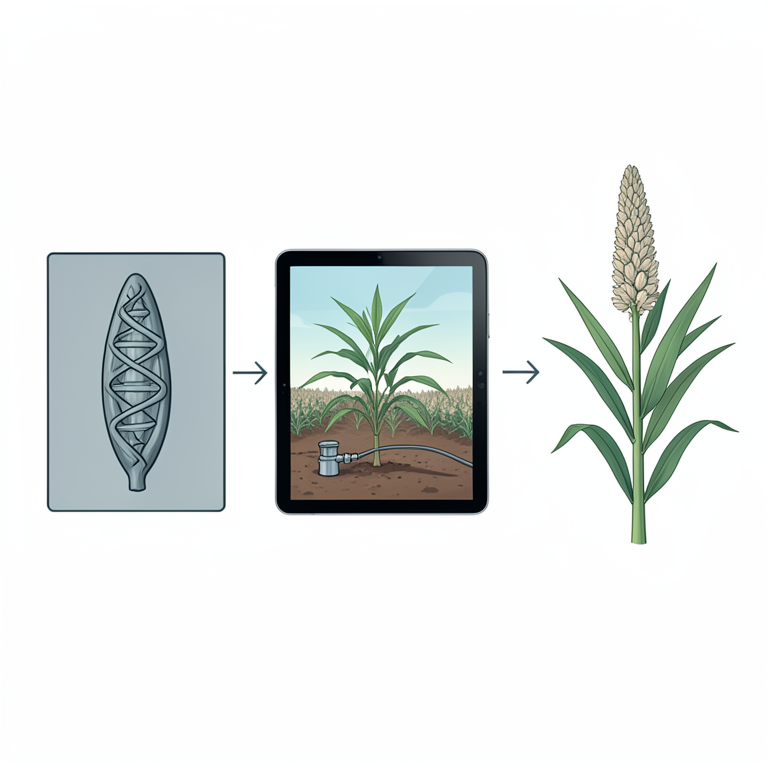
Integrated Resilience Framework
AI-generated conceptual illustration (Sorghum plants). It explains the idea and does not show study data.
View source evidence ↗Introduction
Sorghum (Sorghum bicolor) is a critical cereal crop for food security in many parts of Africa, Asia, and the Americas. Its natural tolerance to drought and heat makes it a key crop in the face of climate change. However, as climate variability increases, there is an urgent need to adopt strategies that further enhance this resilience, ensuring stable yields and food security. This review focuses on the multifaceted approach required to address this challenge, including genetic, agronomic, and technological interventions (Chadalavada K, 2021) [1] .
Main objective
The main objective of enhancing climate resilience in sorghum production is to develop and implement integrated strategies that improve sorghum's tolerance to environmental stresses caused by climate change, such as drought, heat, and pest pressures (Reddy BV, et al., 2011) [2] .
Traditional breeding
Traditional breeding, also known as conventional breeding, is the age-old practice of selecting plants with desirable traits and breeding them to produce offspring that inherit those traits. This method relies on the natural genetic variability within a plant species and has been utilized by humans for thousands of years to enhance crop yields, improve disease resistance, and increase drought tolerance, among other desirable characteristics. In the context of sorghum production, traditional breeding is a fundamental tool for enhancing climate resilience, addressing challenges such as extreme weather conditions, pests, and diseases that are exacerbated by climate change (Kothari K, et al., 2020) [3] . The traditional breeding process begins with the identification of plants that exhibit favorable traits. These traits might include enhanced yield, improved nutritional content, resistance to pests and diseases, tolerance to drought and heat, or any combination thereof. Breeders meticulously select parent plants that possess these desired characteristics, ensuring that the traits can be passed on to the next generation. Once suitable parent plants are identified, they are crosspollinated (Mwangi B, et al., 2021) [4] . This can be a labor-intensive process, especially in plants like sorghum that can self-pollinate. To ensure cross-pollination, breeders may have to manually transfer pollen from one plant to another or employ techniques to prevent selfpollination, such as removing the male parts of flowers on a plant to ensure it can only be fertilized with pollen from another plant with the desired traits.
The offspring produced from this cross, known as the F1 generation, are then grown and assessed for the presence and expression of the targeted traits (Srivastava A, et al., 2010) [5] . This evaluation process is critical and can take several growing seasons. Breeders select the bestperforming individuals and may cross them again with other selected plants or backcross them with one of the parent plants to stabilize the desired traits over several generations. As promising lines are developed, they undergo field testing in various environments to assess their performance under different climatic and soil conditions. This step ensures that the new varieties will perform well across a wide range of environmental conditions, making them more adaptable and resilient to the impacts of climate change [6] . Traditional breeding is a time-consuming process that requires patience, as it may take many years to develop a new variety. However, its advantages lie in its simplicity and the fact that it does not require sophisticated technology or equipment. It utilizes the natural genetic diversity within a species, promoting biodiversity. Furthermore, because it does not involve the insertion of foreign DNA, the varieties developed through traditional breeding are widely accepted and can be used by farmers everywhere, including those in regions with restrictions on Genetically Modified Organisms (GMOs) (Elramlawi HR, et al., 2019) [13] .
Molecular breeding and genomics
Molecular breeding and genomics are advanced techniques that have revolutionized the field of plant breeding by leveraging the knowledge of genetics and molecular biology to develop new plant varieties with desired traits more efficiently and accurately than traditional breeding methods. These approaches use information about the genetic makeup of plants, identifying specific DNA sequences associated with desirable traits, such as drought tolerance, disease resistance, or improved nutritional content. This allows plant breeders to select individuals for breeding based not just on observable characteristics but on their genetic potential, significantly speeding up the development of new crop varieties with enhanced traits. Molecular breeding involves several techniques, including Marker-Assisted Selection (MAS), where genetic markers associated with desirable traits are used to screen and select plants even before the traits can be observed. This is particularly useful for traits that are difficult to measure, appear late in plant development, or are influenced by environmental conditions, as it allows for the selection of plants with the desired genetic makeup early in the breeding process. By doing so, breeders can more rapidly accumulate desired genes in new crop varieties, improving their efficiency and effectiveness. Genomics, the study of an organism's entire genome, provides a comprehensive understanding of the genetic architecture underlying complex traits. Highthroughput sequencing technologies have made it possible to sequence whole genomes of numerous plant species, including sorghum, enabling researchers to identify genes and genetic variations responsible for specific traits. With this knowledge, plant breeders can employ genomic selection, a method that predicts the breeding value of a plant based on the sum of its genetic markers, to select individuals that are likely to produce the best offspring. Another aspect of molecular breeding and genomics is the use of genetic engineering and gene editing techniques, such as CRISPR/Cas9, to directly modify or edit the DNA of plants to introduce or enhance specific traits. While these techniques offer precise control over the introduction of desired traits, they are distinct from conventional molecular breeding methods and are subject to different regulatory and public acceptance issues. Molecular breeding and genomics have several advantages over traditional breeding methods. They can significantly reduce the time and resources required to develop new plant varieties, allow for the precise introduction of traits, and enable the stacking of multiple traits in a single variety. Furthermore, these techniques can be used to enhance the genetic diversity of crops by introducing beneficial traits from wild relatives or different species that would be difficult or impossible to achieve through traditional crossbreeding methods (Webber H, et al., 2014) [7] .
Soil and water management
In the context of sorghum production, soil and water management are crucial aspects of cultivation that significantly impact crop yield, quality, and resilience to environmental stresses. Sorghum, known for its drought tolerance, is a staple crop in many semi-arid and arid regions of the world. However, optimizing soil health and efficiently managing water resources can further enhance its productivity and sustainability, especially under the challenges posed by climate change [6] . Soil management in sorghum production involves practices that maintain or improve soil health and fertility. Given that sorghum is often grown in marginal soils with low fertility, enhancing soil organic matter is a key strategy. This can be achieved through the incorporation of organic amendments such as compost, manure, and crop residues, which improve soil structure, increase water retention, and stimulate beneficial microbial activity. The use of cover crops and green manures in rotation with sorghum can also contribute to soil health by preventing erosion, suppressing weeds, and fixing atmospheric nitrogen in the case of leguminous cover crops. Crop rotation is another vital component of soil management, helping to break cycles of pests and diseases and reduce the build-up of soil pathogens that can affect sorghum. Rotating sorghum with other crops can also help in balancing nutrient uptake and depletion, ensuring more sustainable soil fertility management. Water management is particularly critical in sorghum production due to the crop's common cultivation in waterlimited environments. Efficient water use practices, such as drip irrigation or sprinkler systems, can significantly reduce water wastage by delivering water directly to the plant root zone, where it's needed most. These systems can be more water-efficient compared to traditional flood or furrow irrigation methods and can be critical in regions facing water scarcity. Conservation tillage practices, including no-till and reduced till, play a significant role in water conservation. By minimizing soil disturbance, these practices help to preserve soil moisture, reduce runoff, and maintain a more stable soil structure. This approach not only conserves water but also reduces soil erosion and improves carbon sequestration in the soil. Mulching is another effective technique for conserving soil moisture and managing water in sorghum fields. Applying organic or inorganic mulches on the soil surface can significantly reduce evaporation, suppress weed growth, moderate soil temperature, and improve water infiltration.
In regions where water availability is unpredictable, rainwater harvesting and the construction of water catchment systems can provide supplemental water for irrigation during dry periods. These practices capture rainwater that would otherwise be lost as runoff and store it for use when water is scarce, ensuring that sorghum crops receive adequate water throughout their growth cycle. Soil and water management in sorghum production are interlinked practices that require a holistic approach to agriculture. By focusing on improving soil health and optimizing water use, farmers can enhance sorghum's natural resilience to drought and other environmental stresses, improve yields, and contribute to the sustainability of sorghum as a key crop for food security in many parts of the world (Dhankher OP, et al., 2018) [10] .
Integrated pest and disease management
Integrated Pest and Disease Management (IPDM) in sorghum production involves a holistic approach to managing pests and diseases that threaten this vital crop. Given sorghum's importance as a staple food and feed crop in many parts of the world, particularly in semi-arid regions where challenging conditions prevail, the implementation of IPDM is crucial for sustainable production. This approach combines various strategies to manage pests and diseases effectively, minimizing reliance on chemical pesticides, and promoting ecological balance and crop health (Badigannavar A, et al., 2018) [12] . In the context of sorghum production, IPDM starts with a thorough understanding of the ecosystem, including the types of pests and diseases that commonly affect sorghum, their life cycles, and how they interact with their environment. This knowledge is foundational for developing effective management strategies that are tailored to local conditions and challenges. One of the primary strategies in IPDM for sorghum is the use of resistant varieties. Plant breeders have developed sorghum cultivars that are resistant or tolerant to key pests and diseases, such as anthracnose, sorghum midge, and striga. Growing these varieties can significantly reduce the need for chemical interventions and provide a foundational layer of protection against crop losses. Cultural practices play a significant role in IPDM for sorghum. Crop rotation and intercropping with non-host plants can interrupt the life cycles of pests and diseases, reducing their prevalence and impact. Proper planting dates and densities can also minimize the risks of pest and disease outbreaks by avoiding peak periods of pest activity and reducing conditions conducive to disease development. Maintaining field hygiene by removing crop residues and weeds that can harbor pests or pathogens is another critical aspect of cultural control. Biological control is an environmentally friendly component of IPDM, utilizing natural enemies of sorghum pests, such as predators, parasitoids, and beneficial microorganisms, to keep pest populations under control. For instance, releasing beneficial insects that prey on sorghum pests or applying microbial agents that suppress disease-causing pathogens can help manage pest and disease pressures without harming nontarget organisms or the environment. When chemical controls are necessary, IPDM promotes the targeted and judicious use of pesticides. This involves selecting products that are effective against the pest or disease in question but have minimal impact on beneficial organisms and the environment. Application timing and methods are carefully considered to maximize efficacy and minimize waste and runoff. Monitoring and scouting are essential to identify when pest or disease pressures reach economic thresholds that justify the use of chemical controls, ensuring that interventions are timely and effective. IPDM in sorghum production is not a one-sizefits-all approach but requires continuous adaptation and integration of practices based on ongoing monitoring, research, and local conditions. By employing a combination of genetic, cultural, biological, and chemical strategies, farmers can manage pests and diseases in a way that is sustainable, environmentally friendly, and economically viable. This comprehensive approach supports the resilience of sorghum production systems, contributing to food security and the well-being of communities dependent on this crucial crop.
Analysis and Discussion
Enhancing climate resilience in sorghum production integrates genetic improvements, agronomic practices, and technological innovations to address the multifaceted challenges posed by climate change. Genetic advancements have enabled the development of sorghum varieties that are more tolerant to drought and heat, laying a critical foundation for resilience. These efforts are complemented by agronomic practices such as soil and water management and integrated pest and disease management, which optimize the growing environment and bolster the plant's defenses against stressors. Technological innovations, including precision agriculture and climate forecasting, offer tools for precise management and prediction of climatic impacts, enabling more informed decision-making. The synergy between these strategies is key to enhancing sorghum's resilience, ensuring sustainable production, and securing food supplies in vulnerable regions. The challenge remains in effectively integrating and scaling these approaches to meet the diverse conditions and resources of sorghum producers worldwide.
Conclusion
The enhancement of climate resilience in sorghum production is a critical endeavor that necessitates a multidimensional approach combining genetic improvements, agronomic best practices, and cutting-edge technological innovations. By developing sorghum varieties with improved tolerance to extreme weather conditions and implementing sustainable management practices, we can safeguard this vital crop against the adverse effects of climate change. The integration of precise agricultural technologies further supports these efforts by enabling more efficient resource use and better decision-making. As we move forward, the key to success will lie in the collaborative efforts of researchers, farmers, policymakers, and stakeholders across the agricultural sector. Together, they can drive the adoption of these strategies at scale, ensuring the sustainability and security of sorghum production for future generations. This holistic approach not only contributes to the resilience of sorghum but also exemplifies a sustainable path forward for global agricultural practices in the face of an increasingly unpredictable climate.
References
9 in the original paper- Chadalavada K, Kumari BR, Kumar TS. Sorghum mitigates climate variability and change on crop yield and quality. Planta. 2021;253(5):1-19.
- Kothari K, Ale S, Bordovsky JP, Porter DO, Munster CL, Hoogenboom G et al. Potential benefits of genotype-based adaptation strategies for grain sorghum production in the Texas High Plains under climate change. European Journal of Agronomy. 2020;117:126037.
- Mwangi B, Macharia I, Bett E. A multi-dimensional adoption approach for improved sorghum varieties in eastern Kenya: A climate change adaptation perspective. Climate and Development. 2021;13(4):283-292.
- Srivastava A, Kumar SN, Aggarwal PK. Assessment on vulnerability of sorghum to climate change in India. Agriculture, Ecosystems & Environment. 2010;138(34):160-169.
- Mitiku T. Climatic fluctuation and breeding efforts to mitigate: A review. Int J Res Agron. 2023;6(1):39-43.
- Haussmann BI, Fred Rattunde H, Weltzien-Rattunde E, Traoré PS, Vom Brocke K, Parzies HK et al. Breeding strategies for adaptation of pearl millet and sorghum to climate variability and change in West Africa. Journal of Agronomy and Crop Science. 2012;198(5):327-339.
- Dhankher OP, Foyer CH. Climate resilient crops for improving global food security and safety. Plant, Cell & Environment. 2018;41(5):877-884.
- Tirfi AG. Sorghum yield response to climate and other input factors in Ethiopia. International Journal of Agriculture and Food Science. 2022;4(2):88-100. DOI:10.33545/2664844X.2022.v4.i2b.100
- Badigannavar A, Teme N, DE Oliveira AC, Li G, Vaksmann M, Viana VE, et al. Physiological, genetic and molecular basis of drought resilience in sorghum [Sorghum bicolor (L.) Moench]. Indian Journal of Plant Physiology. 2018;23:670-688.
Cited by 12
From OpenAlex, OpenCitations and reference lists read by Scinovex
- Organic Approach for Sorghum Cultivation to Achieve Better Nutrition ↗
M. Hemalatha, M. Joseph, M. Aswin Ajay Raj, N Vinitha, Mahalingam Govindaraj · Sustainability Sciences in Asia and Africa · 2026
❝ 0 - Effect of temperature on progeny emergence, weight loss and grain damage caused by Sitophilus oryzae L. feeding on sorghum and split pulses
S Vijay, V. V. Radhakrishnan, M Ravi, L Allwin, A Vijayaprabhakar, V. Karunakaran · International Journal of Horticulture and Food Science · 2025
An experiment was\\r\\ncarried out at the Entomology Laboratory, Horticultural College and Research\\r\\nInstitute for Women, Trichy to estimate the comparative storage losses in split\\r\\npulses caused by Sitophilus oryzae L. under room and controlled\\r\\nconditions. A completely randomized design (CRD) was used with seven treatments\\r\\n(T1 = Sorghum, T2 = Red Gram, T3= Chick Pea, T4\\r\\n= Black Gram, T5 = Green Gram, T6 = Fried Gram and T7\\r\\n= Lentil) each replicated four times. The assessed parameters were per cent\\r\\nweight loss, number of F1 progeny and per cent grain damage. Am
- Yield gap analysis of rabi sorghum production in Buldhana district
PD Pingale, Dr. SN Ingle, S.M. SARAP, S. S. Thakare, Shri VM Gedam · International Journal of Agriculture Extension and Social Development · 2025
The present study entitled “Yield gap analysis of rabi sorghum production in Buldhana district” was conducted in the year 2023-24. Data for the selected study were collected with the aid of well-structured questionnaire. On the basis of the result obtained in the present study it can be concluded that the highest yield gap was observed in case of gap -III was 15.83 percent. The yield gap-II was 10.52 percent, while the total yield gap-I for Rabi Sorghum was 5.93 percent.
- The role of environmental factors in sorghum yield variability ↗
Vincent Ogunlela · Journal of Phytopharmacology and Phytomedicine · 2025
Sorghum (Sorghum bicolor) is a key cereal crop with significant importance in both food and biofuel production. However, its yield variability is influenced by several environmental factors, making it a subject of intense research. This paper aims to explore the role of environmental factors such as temperature, precipitation, soil type, and photoperiod in sorghum yield variability. By reviewing and synthesizing
- Soil fertility and nutrient dynamics under conservation agriculture in the semi-arid region of Burkina Faso
J. G. Mwangi, Amina Juma, Samuel Odhiambo · International Journal of Advanced Chemistry Research · 2025
This study investigates the impact of Conservation Agriculture (CA) on soil fertility and nutrient dynamics in the semi-arid region of Burkina Faso, an area plagued by soil degradation and declining agricultural productivity. The primary objective was to assess the long-term effects of CA practices, including no-tillage, crop residue retention, and crop rotation, on soil fertility and the cycling of major plant nutrients such as nitrogen (N), phosphorus (P), and potassium (K). We compared the soil fertility status and crop productivity under CA and Conventional Tillage (CT) systems in a field-
- Socio-Economic Perspectives on Climate-Resilient Sorghum Farming: Smallholder Adaptation and Rural Livelihoods ↗
Malithi Perera · International Journal of Arts Humanities and Social Studies · 2025
Sorghum, cultivated across more than 40 million hectares globally, has long been considered a “climate-smart” cereal due to its tolerance of drought and heat. Yet its socio-economic dimensions remain underexplored compared to its agronomic traits. For millions of smallholder farmers in Sub-Saharan Africa, South Asia, and parts of Latin America, sorghum is both a subsistence staple and a source of…
❝ 0PDF - Stay-green potential and interannual stability of sweet-stalk sorghum [Sorghum bicolor (L.) Moench] genotypes cultivated in Burkina Faso ↗
Salif Berthé, Wendmanegda Hermann Tondé, Pingawindé Sawadogo, Josiane Tiendrebéogo, Djakaridja Tiama, Nerbéwendé Sawadogo · Journal of Experimental Biology and Agricultural Sciences · 2025
Sweet stalk sorghum is grown in Burkina Faso primarily for its grain, forage, and sugar-rich stalks. However, its productivity is heavily reliant on rainfall, and the variability in annual precipitation significantly limits its contribution to household food security. In this context, identifying drought-tolerant genotypes with stable performance is a key breeding priority. This study evaluated the agronomic performance of sweet…
❝ 0PDF - Sorghum as a raw material ↗
Steve Carly Zangué Desobgo, Annick Chancelle Nguemogne · Elsevier eBooks · 2025
❝ 0 - Relative palatability and preference of sorghum silage, moringa or sesbania leaf meals by red Maasai sheep
BS Nyakira, JO Ondiek, PA Onjoro, MK Ambula · International Journal of Veterinary Sciences and Animal Husbandry · 2024
Intake, palatability, and preference of Sorghum silage, Moringa (Moringa oleifera) and Sesbania (Sesbania sesban) were assessed. Five (5) mature Red Maasai sheep (three females and two males) were used in a Complete Randomized Design. The sheep were kept in separate enclosures measuring 1.5 by 2.5 meters, each featuring a feeding trough separated into three portions. Using the cafeteria feeding strategy, the sheep were offered 500g of sorghum silage and 200g of Moringa or Sesbania leaf meals daily at 8:00 a.m. for a duration of sixty minutes. Feed intake differed significantly (pMoringa>Silage
- Effect of integrated nutrient management on nutrient content, uptake and economics of forage sorghum under north Gujarat agro-climatic conditions
Tejasvi V Joshi, DM Patel, Ritu Joshi, DK Patel · International Journal of Statistics and Applied Mathematics · 2024
A field experiment was conducted during the kharif seasons of 2022 and 2023 at the Agronomy Instructional Farm, C. P. College of Agriculture, S. D. Agricultural University, Sardarkrushinagar, Gujarat, to study the effects of integrated nutrient management on nutrient content, uptake and economics of forage sorghum under North Gujarat's agro-climatic conditions. The experiment consisted of 9 treatment combinations, including 3 organic manures (no manure, FYM at 10.0 t/ha, and castor cake at 1.0 t/ha) and 3 fertility levels (100% RDF, 75% RDF, and 50% RDF), arranged in a split-plot design with f
- Evaluating the impact of climate change and agronomic inputs on sorghum yield a case study from Ethiopia ↗
Sisay Belete · International Journal of Pharmacognosy and Life Science · 2024
This study evaluates the dual impacts of climate change and agronomic inputs on sorghum yield in Ethiopia, a country where agriculture forms the backbone of the economy, particularly for rural populations. Sorghum (Sorghum bicolor), a drought-tolerant cereal, is widely cultivated in Ethiopia, offering crucial food security in arid and semi-arid regions. However, climate change poses a severe threat to its
- Integrating Homoeopathic Agro-Formulations for Enhancing Sorghum Resilience to Drought and Climatic Stress ↗
A. Mahamane · International Journal of Homoeopathic Sciences · 2024
Sorghum (Sorghum bicolor L. Moench) is a climate-resilient cereal of global importance, cultivated extensively in semi-arid regions of Africa, Asia, and the Americas. Its tolerance to drought and heat is superior to most cereals, yet the increasing intensity of climatic variability threatens yield stability. While conventional adaptation strategies emphasize breeding, conservation agriculture, and microbial inoculants, emerging alternative approaches include the…
❝ 0PDF