
Research article · 2022 · Full text
International Journal of Agriculture and Food ScienceContamination in meat: A review
Volume 4(2) · Pages 136–140 · DOI: 10.33545/2664844x.2022.v4.i2b.106 ↗
Research areasIdentification and Quantification in FoodMeat and Animal Product Quality
Abstract
Author-writtenMeat is an flesh of animal that’s eaten as a food. Meat has an unprecedented source of energy. Human eat meat of different animals like camels, goats, cow, chicken, fish etc. Meat has some major parts including water, carbohydrates, proteins fats and minor components like vitamins. (Vitamin A and B) and minerals (Iron, Zinc, selenium). Selenium is a mineral that’s play a vital role in metabolism and thyroid function of the body. All of these things are required for human body growth. Due to increases in population of this world, requirement of meat increases day by day. Many factors involve in the contamination of meat. So, contamination of the meat is also increasing, and this factor may be intentionally or unintentionally. Chemical contamination like aflatoxin, pesticides (transfer through forage) and heavy metals (transfer through water, environment, and forage) etc. These types of contamination may can unfit the meat for human body and will cause serious infection. Microbial activity is also a major issue in meat. This activity may can deteriorate the meat. Physical contamination is also a major problem and that may have done during slaughtering, transportation, and storage etc. All these factors have adverse effect on the meat quality. And when these material transfer in human body through meat then they can cause constipation, diarrhea, and many other diseases. This article will help people to getting info about different ways through meat can contaminate.
Summary
Source-checkedPlain-language reading of the full paper, prepared with AI and checked against the text. Each point links to the authors' own words.
Why it matters
- Meat serves as a significant source of energy and is consumed as food from various animals, including cows, goats, camels, fish, and chickens. View evidence ↗
- Meat is a nutritious protein source, but it is highly perishable and has a short shelf-life unless preservation methods are used. View evidence ↗
- The global increase in population has led to a higher demand for meat, which in turn increases the risks and factors associated with meat contamination. View evidence ↗
The question
- The aim of this review is to provide information on the various ways in which meat can become contaminated. View evidence ↗
What they did
- The review categorizes meat contamination into three main types: chemical (e.g., aflatoxins, pesticides, heavy metals), microbial, and physical (occurring during slaughter, transport, or storage). View evidence ↗
What they found
- The typical composition of meat consists of approximately 75% water, 19% protein, 3.5% soluble non-protein substances, and 2.5% fat. View evidence ↗
- A daily intake of 100g of meat and liver can provide up to 50% of the daily requirement for iron, zinc, selenium, and vitamins B1, B2, B6, and B12, and 100% of vitamin A. View evidence ↗
- Aflatoxin B1, the most toxic mycotoxin, and its metabolites can be found in poultry tissues and eggs when the animals consume tainted diets. View evidence ↗
- Heavy metals including lead, mercury, thallium, and cadmium accumulate in animal organs due to their slow rate of elimination. View evidence ↗
- Heavy metal deposition in the liver and kidneys can lead to organ failure. View evidence ↗
- The presence of antibiotic residues in meat contributes to the development of antibiotic resistance. View evidence ↗
- Over 100 types of pesticides exist, with the majority (68%) used in agriculture, which can lead to residues entering the animal body via feed. View evidence ↗
- Contaminants transferred to humans through meat consumption can cause diseases such as diarrhea and constipation. View evidence ↗
What it means
- The authors conclude that human-influenced contamination factors must be avoided to improve food safety. View evidence ↗
Visual summary
1 visualsIllustrations explain the paper; they do not show study data.
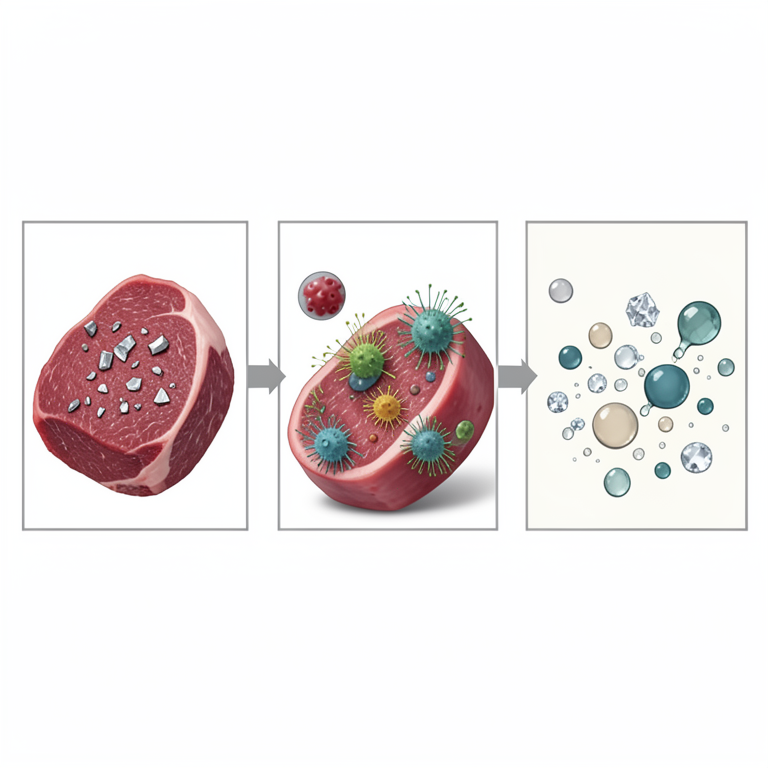
Types of Meat Contamination
AI-generated conceptual illustration (Raw beef and pork cuts). It explains the idea and does not show study data.
View source evidence ↗Introduction
Meat is the edible skeletal muscle of an animal which is used as a food after the slaughtering (CFDAR, 1990) [8] . Meat consists of four primary ingredients, including antioxidants, carbohydrates, pigments and flavorings, including water, protein, lipid, starch and many other minor components (Lambert et al., 1991) [21] . Meat is nutritious, highly perishable protein food with minimal shelf-life without using preservative processes. Holding and preservation of meat quality are influenced by a variety of interrelated factors, including conservation of temperatures which may contribute to dangerous changes in the quality of meat. (Olaoye and Onilude, 2010) [29] . All of these contributions have a special structure, shape, flavor, colour and nutritious benefit for meat in their proportions. However, meat is rapidly rotting from the moment of slaughter to consumption because of its unique biological and chemical nature (Lambert et al., 1991) The importance of meat as a main source for certain micronutrients is either due to its sole source or to the fact that it is more bioavailable. Vitamin A and B12 are mostly found in foods. Plant-derived provitamins can hardly be substituted (Biesalski, 2005) [3] . Fe is more bioavailable for meat than plants as its folic acid, particularly for liver or eggs, is almost 10 times higher compared to vegetables (Biesalski, 2005) [3] . For the growth and development of various cells and tissues, vitamin A, one of the micronutrients in the meat, is essential. The Retinoic Acid's active type controls natural differentiation as a ligand for RA receptors and helps integrate cell structure, i.e. gap junction. (Kurokawa et al., 1994). Moderate vitamin A deficiency increases the incidence of lung diseases, and regular breathing disorders can be managed with mild vitamin A supplementation. (Biesalski, 2005) [3] . Vitamin A is also responsible for the growth and maturation of the lungs and the development of other tissues, and regulation of these processes appears to depend on the expression of RA receptors. While the liver is the best available source of vitamin A, it has a 'poor reputation' due to other possible constituents of the body, such as heavy metals, hormones or xenobiotics (Biesalski, 2005) [3] . In order to obtain the recommended 1 mg of retinol per day from vegetables, 500 mg of mixed and β-carotene rich vegetables must be consumed daily, whereas 100 g of liver twice a month is adequate and is neither toxic nor teratogenic (Biesalski, 2005 [3] ; Nohr and Biesalski, 2007). In a significant number of human diets meat, including meat products, is one of the main food grades. Its frequent/regular usage means a high protein consumption, a broad range of essential micronutrients (Fe, Zn, B12, etc.) and a large energy intake. However, the comparatively large amounts of meat currently eaten by some population groups in many countries have been blamed for leading to a rise in the prevalence of some chronic diseases, including cancer (De Smet and Vossen, 2016; Hammerling et al., 2016) [14] . This increased occurrence, and in particular that of certain cancers (colorectal cancer, CRC), is more linked to red meat than to white meat. Specifically on cancer, the International Agency for Cancer Research (IARC, 2015) [15] released a press release on the latest assessment of the carcinogenicity of red and processed meat consumption on 26 October 2015. Until that decision of the IARC, it was believed that eating moderate quantities of lean red meat as part of a healthy diet would make a valuable contribution to the intake of essential nutrients and probably also to the intake of long chain PUFAs and conjugated linoleic acid would not raise the risk of cardiovascular disease and CRC.
Contamination in meat
As the recipient population rises, the need for cheap, abundant, nutritious and safe food goods has never been louder or more urgent. (Tilman et al. 2002; OECD-FAO 2009). Exposure to chemical compounds, such as organic toxins, pesticides and antibiotics, in farming ecosystems and their possible existence as residues in food products are one concern that has drawn the public's interest in particular. (Bruhn 1999 [5] ; NRC 1999; Resurreccion and Galvez 1999 [37] ; Willis 2000 [44] ; Verbeke et al. 2007). This concern has led consumers to consider (erroneously) that exposure to chemicals in foods is one of the top ten causes of death (Nicholls et al. 1994) [28] . Similarly, in the fall of 2005, the Eurobarometer survey showed that European consumers rank the presence of chemicals, pesticides and toxic substances in food second after food poisoning as an issue that consumers worry about when assessing risks associated with food in general (European Commission 2006) [11] and particularly with animal food products (Becker 2000). Poultry products represent approximately one-third of the protein food consumed in the world (Johnson 2010) [17] . Yet, health associated risks from consuming these products are a growing concern for consumers (Yeung and Morris 2001) [45] , followed closely by concerns regarding animal welfare in this production system (Van Horne and Achterbosch 2008) [43] .
Chemical Contamination
Even though most consumers are mainly concerned about the presence of residues of pesticides and veterinary drugs in their food, in reality there are many more potential sources of contaminants normally present in the environment. Many of these unintentional sources of contaminants can be just as harmful for consumers, including mycotoxins, heavy metals, pesticides and environmental contaminants (e.g. dioxins; Botsoglou and Fletouris 2000; Peshin et al. 2002) [47] . Contamination by aflatoxin B1 (the most toxic of all mycotoxins) and its metabolites has been found in eggs and poultry tissues after the consumption of diets tainted with aflatoxins (Pandey and Chauhan 2007 [32] ; Denli et al. 2009) [10] . These metabolites may cause significant direct toxic effects on the birds (e.g. decreased feed intake and growth rate, reduced egg production, impaired immunity, and mortality). Elements such as cadmium, lead, mercury and thallium can be stored in several different organs in the animal. They are generally characterized by a slow rate of elimination, accumulating in tissues and even being able to undergo transformations that increase their toxicity (Montoro and Velez 2004) [26] . They have the potential, at high enough concentrations, to have harmful effects on consumers, such as disruption of several metabolic processes and disorders in the gastrointestinal, urinary and nervous systems (e.g. cadmium, lead, arsenic; Tollefson and Cordle 1986 [41] ; Gochfeld 1997 [13] ; NRC 1999).
Antibiotics
A wide variety of veterinary antimicrobial chemicals, natural synthetic or semi-synthetic, are used to control pathogens (Phillips et al., 2004) [35] or as feed additives (SGP) for different sectors such as poultry, agriculture or agricultural activity as synthetic growth promoters (SGPs). (Aust et al., 2008 [23] ; Gao, et al., 2012; Zuccato, Castiglioni, Bagnati, Melis, & Fanelli, 2010) [46] . (Cunha and Burnside (1949) [9] , has found that adding chlortetracycline residues into pig feed increased its development by adding dry mycelia in aerobic cultures of Streptomyces-auerofaciens (previously referred to as Aureomycin), (Castilian, 2007). The use of antibiotics in the 1940's and 1930s as growth promoters was part of an original solution to animal feed supplementation called "animal protein factor". The antibiotics which is used as pharmaceutical are not absorbed properly (Thiele-Bruhn, 2003) their higher concentration is usually excreted out via feces urine (Ostermanna et al., 2013) [30] , or sweating, eggs (Idowu et al., 2010) [16] and milk (Arikan, Mulbry, & Rice, 2009;
HallingSorensen, Jensen, Tjornelund, & Montforts, 2001) its non-excretable residues remains deposited in tissues (Kim & Schrenk, 2012; Kwon et al., 2011). The addition of these antibiotics in meat causes the resistance against antibiotics. (Butaye, Devriese, & Haesebrouck, 2003) and usually regarded as major contributor of allergies. Not only are antibiotics applied by cattle producers to animal feed. Excessive use of these antibiotics caused the resistance and ed towards the failure in applied therapy which results to use more adverse and costly drugs due to resistance (McEwen, 2006) problem increases when the duration and infection,s severity persist. (Barza, 2002). In industrial meat processing, anabolic steroids and bagonists have been commonly used to enhance the integration of available nutrients and animal efficiency in sheep (Mondragon et al. 2010) [25] beef cattle (Vasconcelos et al., 2008) via endocrine system it will meet the standard meat which is recommended.
Heavy metals
Domestic and industrial discharge from their source imparts the most adverse effect on the human health (Gulf Research Center). These residual discharge from factories contains the high level of heavy metals and further these contaminates become part of food chains. (Alloway and Ayres, 1997) [1] . As far as the environmental pollution the accumulation of the heavy metals in the meat products is a big concern for food safety. These heavy metals are deposited in liver and kidney and cause failure of organ's. One of the most dangerous metals is known to be cadmium. Moreover, elevated blood pressure (Perry et al., 1979) [33] , Prostate cancer, abnormalities, showing and fetal (embryonic) death (Pitot and Dragan, 1996) [36] were involved. In certain enzymes, some elements, such as copper, zinc, manganese and iron, are co-factors and play an important role in many human and animal physiological functions. Absence of these essential metals results the malfunction (Koh and Judson, 1986 [19] ; Schuhmacher et al., 1991) but their excessive concentration caused toxicity.
Veterinary drugs
Most of vestiary drugs which is administrated for treatment of animals or for the enhancement of milk. The most of the compounds present in the drugs given to animals in feed. Both drugs and feed also contain contaminants (McEvoy, 2002) [24] .
Mycotoxins
The most dangerous contaminant which is present in the feed is fungi/mycotoxin's and result in by causing mycotoxicosis is usually present in the plant based feed such as cereals and oil seed crops used as forage. The severity of these mycotoxins leads towards the production of carcinogenic compounds but animals usually detoxify these toxins (Stoloff, 1979) [40] . But these residues become part of meat/tissues. Aflatoxins are the highest potential as carcinogenic with the properties of heat resistance and stability.
Pesticides
There are more than hundred types of pesticides but it might not be possible to find in a single stuff. It varies from food to food. Major contribution of these pesticides are used in agriculture sector and comprises about 67.5% and about 16.5% in industrial and commercial and 9% in domestic level and about 6-8/% in govt application. (Cantoni and Comi, 1997) [6] . More than 100 pesticides are known, but it is unlikely to find all of them in one foodstuff. They are mainly used in agriculture (68%), commercial and industrial activities (17%), domestic settings (8%) and in governmental applications (7%), (Khadim et al. 2016). Pesticides are used in crops in order to make pest free crop but these residues and pesticides became part of animals body via feed. (MacLachlan and Bhula, 2008) [23] . Mostly the animal become victim of pesticide residue due to grazing and feeding. Animals which bears less exposure to residues may due to improper disposal of waste and grazing or locomotion in the affected areas or accidental spills (Robertson et al., 1990) [38] .
Conclusion
Meat is considered as the most superior meal. It contains the number of the Carbohydrates, proteins, mineral's, vitamins and all essential components required for metabolism. The environment is suffering from pollution which have the various factors, some factors are natural and some factors are induced by Human activities. The Contaminants are the most hazardous factors which is involved in the deterioration of meat. Pesticide residues are the mostly adversely effects the quality of meat. These contaminants becomes the part of the meat when animals grazed in the pesticide infected land. These contaminants became the part of meat. Same case with Fungus which is engulfed with the food and further contaminates such as Aflatoxin becomes the part of meat. Anti-biotics are used as the purpose of treatment but these resides become part of the meat. Veterinary drugs are given usually to the milch animals in order to meet the requirements of the milk and other characteristics necessary for the animal contaminants from these drugs cause the hormonal imbalance and health issues. So that these contaminants factors which is in the approach of human beings are avoided to reduce the concern of food safety.
References
33 in the original paper- Beckar T. 'Consumer perception of fresh meat quality: a framework for analysis', Brit Food J. 2000;10:158176.
- Biesalski HK. Meat as a component of a healthy diet - are there any risks or benefits if meat is avoided in the diet?. Meat Science. 2005;70:509-524.
- Bruhn CM. 'Consumer perceptions and concerns about food contaminants', Adv Exp Med Biol. 1999;459:1-7.
- Cantoni C, Comi G. Changes in the concentrations of pesticide residues in foods and in human tissues between 1960 and 1996. Outlook on Agriculture. 1997;26:47-52.
- Castanon JIR. History of the use of antibiotic as growth promoters in European poultry feeds. Poultry Science. 2007;86(11):2466-2471.
- CFDAR. Canadian Food and Drugs Act and Regulations with amendments to Chapman and Hall, London; c May 3, 1990.
- Cunha TJ, Burnside JE. Effect of vitamin B12, animal protein factor and soil for pig growth. Archives of Biochemistry. 1949;23(2):324.
- Denli M, Blandon JC, Guynot ME, Salado S, Perez J. F. Effects of dietary Afla Detox on performance, serum biochemistry, histopathologically changes, and aflatoxin residues in broilers exposed to aflatoxin B1. Poultry Science. 2009;88(7):1444-1451.
- Gill CO. Meat Spoilage and Evaluation of the Potential Storage Life of Fresh Meat. Journal of Food Protection. 1983;46(5):444-452. DOI: 10.4315/0362-028x-46.5.444
- Gochfeld M. 'Factors influencing susceptibility to metals', Environ Health Perspect. 1997;105(Suppl 4):817-822.
- Hammerling U, Bergman Laurila J, Grafstro€m R, Ilb€ack NG. Consumption of red/processed meat and colorectal carcinoma: possible mechanisms underlying the significant association. Crit. Rev. Food Sci. Nutr. 2016;56:614e634.
- Idowu F, Junaid K, Paul A, Gabriel O, Paul A, Sati N, et al. Antimicrobial screening of commercial eggs and determination of tetracycline residue using two microbiological methods. International Journal of Poultry Science. 2010;9(10):959e962.
- Johnson RJ. Livestock, dairy and poultry outlook. A report from the Economic Research Service (USDA); c2010. http://www.ers.usda.gov/publications/idp/2010/08Aug/ ldpm194.pdf
- Koh TS, Judson GJ. Trace-elements in sheep grazing near a lead-zinc smelting complex at Port Pirie, South Australia. Bulletin of Environmental Contamination and Toxicology. 1986;37(1):87-95.
- Kurokawa R, DiRenzo J, Boehm M, Sugarman J, Gloss B, Rosenfeld MG, et al. 'Regulation of retinoid signalling by receptor polarity and allosteric control of ligand binding'. Nature. 1994;371:528-531.
- Lambert AD, Smith JP, Dodds KL. Shelf life extension and microbiological safety of fresh meat -A review. Food Microbiology. 1991;8:267-297.
- MacLachlan DJ, Bhula R. Estimating the residue transfer of pesticides in animal feedstuffs to livestock tissues, milk and eggs: A review. Australian Journal of Expermental Agriculture. 2008;48:589-598.
- Mondragon J, Dominguez Vara IA, Pinos Rodriguez JM, Gonzalez M, Borquez JL, Dominguez A, et al. Effects of feed supplementation of zilpaterol hydrochloride on growth performance and carcass traits of finishing lambs. Acta Agriculturae Scandinavica, Section Ae Animal Science. 2010;60(1):47e52.
- Nicholls TJ, McLean GD, Blackman NL, Stephens IB. Food safety and residues in Australian agricultural produce. Australian Veterinary Journal. 1994;71(12):393-396.
- Olaoye OA, Onilude AA. Investigation on the potential use of biological agents in the extension of fresh beef in Nigeria. World Journal of Microbiology and Biotechnology. 2010;26:1445-1454. DOI: 10.1007/ s11274-010-0319-5.
- Ostermanna A, Siemensa J, Welpa G, Xueb Q, Linb X, Liuc X, et al. Leaching of veterinary antibiotics in calcareous Chinese croplands. Chemosphere. 2013;91(7):928-934.
- Pandey I, Chauhan SS. Studies on production performance and toxin residues in tissues and eggs of layer chickens fed on diets with various concentrations of aflatoxin AFB1. British Poultry Science. 2007;48(6):713-723..
- Perry HM, Erlanger M, Perry EF. Increase in the systolic pressure of rats chronically fed cadmium. Environmental Health Perspectives. 1979;28:251-260.
- Langeroudi NVP, Mollataghi A. Synthesis of nonenzymatic biosensor based on selenium dioxide nanoparticles in order to detection of glucose under electrochemical method. Int. J Adv. Chem. Res. 2021;3(2):12-16. DOI: 10.33545/26646781.2021.v3.i2a.36
- Phillips I, Casewell M, Cox T, De Groot B, Friis C, Jones R, et al. Does the use of antibiotics in food animals pose a risk to human health? A critical review of published data. Journal of Antimicrobial Chemotherapy. 2004;53(1):28-52.
- Pitot HC, Dragan YP, Teeguarden J, Hsia S, Campbell H. Quantitation of multistage carcinogenesis in rat liver. Toxicologic Pathology. 1996;24(1):119-128.
- Resurreccion AV, Galvez FC. 'Will consumers buy irradiated beef?', Food Technol. 1999;53:52-55.
- Robertson ID, Naprasnik A, Morrow D. The sources of pesticide contamination in Queensland livestock. Australian Veterinary Journal. 1990;67:152-153.
- Tollefson L, Cordle F. Methylmercury in fish: a review of residue levels, fish consumption and regulatory action in the United States. Environmental Health Perspectives. 1986;68:203-208.
- Van Horne PLM, Achterbosch TJ. Animal welfare in poultry production systems: impact of EU standards on world trade. World's Poultry Science Journal. 2008;64(1):40-52.
- Willis C. Antibiotics in the food chain: their impact on the consumer. Reviews in Medical Microbiology. 2000;11(3):153-160.
- Zuccato E, Castiglioni S, Bagnati R, Melis M, Fanelli R. Source, occurrence and fate of antibiotics in the Italian aquatic environment. Journal of Hazardous Materials. 2010;179(1-3):1042-1048.
- Peshin SS, Lall SB, Gupta SK. Potential food contaminants and associated health risks. Acta Pharmacologica Sinica. 2002;23(3):193-202.