
Research article · 2023 · Full text
International Journal of Veterinary Sciences and Animal HusbandryMicrobial quality assessment of dried anchovy fish sold in Puducherry, India
Volume 8(2) · Pages 81–83 · DOI: 10.22271/veterinary.2023.v8.i2b.494 ↗
Research areasFood Safety and HygieneIdentification and Quantification in Food
Abstract
Author-writtenDried anchovy fish is a popular and widely consumed seafood product in Puducherry, India. However, its microbial quality and safety are of concern due to the potential risks of foodborne illnesses. Microbial deterioration of fish can lead to foodborne illnesses, which may cause multi-drug resistance in the long run. This study aims to evaluate the microbiological quality of dried anchovy fish sold in Puducherry, India. Three microbiological parameters were considered: Total Coliform Count (TCC), Total Plate Count (TPC), and Yeast and Mold Count. The average TPC value of the study was around 2.11±0.51x10⁸, which indicates that all of the tested samples have poor microbial quality. The coliform count ranges from 512 to 28,489 and the Yeast and Mold count ranges from 1.78×10⁴ to 2.89×10⁴. Moreover, all the tested dried fish samples are heavily loaded with bacteria. The study concludes that dried anchovy fish samples were prone to microbial contamination, which can be reduced by improving hygiene practices during harvesting and processing. The findings of the study can be useful for policymakers and stakeholders to implement appropriate measures to ensure food safety and security.
Summary
Source-checkedPlain-language reading of the full paper, prepared with AI and checked against the text. Each point links to the authors' own words.
Why it matters
- Fisheries play a critical role in reducing food and nutritional insecurity in many developing countries. View evidence ↗
- Dried anchovy is widely eaten in Puducherry, India, but there are concerns regarding its safety and the risk of foodborne illness. View evidence ↗
- The microbial spoilage of fish can cause foodborne illnesses and potentially lead to long-term multi-drug resistance. View evidence ↗
The question
- The study aimed to assess the microbiological quality of dried anchovy fish sold in the Puducherry region of India. View evidence ↗
What they did
- The quality assessment focused on three parameters: Total Plate Count (TPC), Total Coliform Count (TCC), and Yeast and Mold Count. View evidence ↗
- Samples were prepared by crushing 1 gram of fish with 9 mL of sterile saline and further homogenizing to create a 1:10 dilution. View evidence ↗
- Total Plate Count was determined using Plate Count Agar (PCA) with incubation at 37 °C for 24 hours. View evidence ↗
What they found
- The average Total Plate Count (TPC) was 2.11±0.51×10⁸, with values ranging from 1.01×10⁸ to 2.89×10⁸. View evidence ↗
- The bacterial load in all tested samples exceeded the ICMSF microbiological standards. View evidence ↗
- Total Coliform Counts (TCC) in the samples ranged from 512 to 28,489. View evidence ↗
- The observed coliform counts significantly exceeded the IAMS quality standard, which limits coliforms to 100. View evidence ↗
- The mean Yeast and Mold Count was 2.2±0.33×10⁴, with a range between 1.78×10⁴ and 2.89×10⁴. View evidence ↗
What it means
- The authors concluded that dried anchovy fish samples from all collection sites were severely contaminated with bacteria. View evidence ↗
- The authors recommend using traditional sun-drying equipment to reduce environmental contamination compared to open-air drying. View evidence ↗
- The authors state a need for further research to standardize drying times and ingredients for different species and environments to ensure safety. View evidence ↗
Visual summary
1 visualsIllustrations explain the paper; they do not show study data.
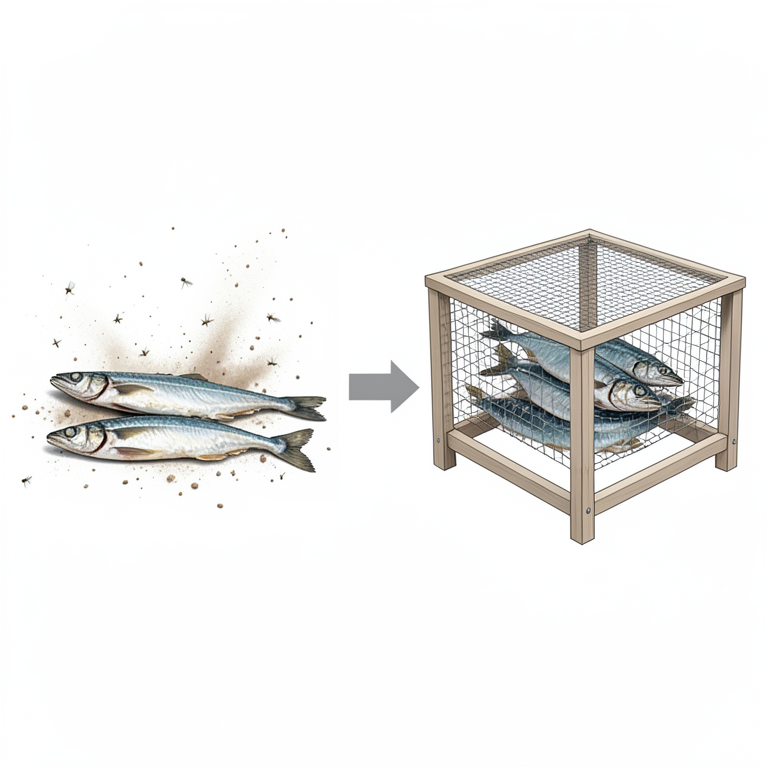
Contamination Pathway
AI-generated conceptual illustration (dried anchovy fish). It explains the idea and does not show study data.
View source evidence ↗Introduction
In most developing nations, fisheries have a big impact on lowering food and nutrition insecurity. Due to its extraordinary nutritional content, fish's contribution to a balanced diet and good health is widely known. Essential fatty acids, essential amino acids, calcium, zinc, iron, and vitamins A and B12 are all highly bioavailable in fish [1] . The Indian economy depends heavily on the fisheries industry, which accounts for around 1.24% of the country's GDP. It promotes exports, employment growth, food security, and national income. A significant number of the economically underprivileged people of the country, particularly in rural regions, rely on this industry as a primary source of income. India has moved from being a 'Local to a Global' brand by becoming the fourth-largest distributor of fish and fishery products globally and the third in world fish production [2] . The average monthly fish intake in urban and rural areas of India is 0.27 kg and 0.25 kg, respectively, based on a study conducted by National Sample Survey Organization (NSSO) [3] . The World Bank predicts that in 2030, per capita fish intake would be 6.6 kg, falling short of the ICMR's recommended 12 kg per year, which India has yet to reach [4] . Globally, behind cereals and milk, fish is recognized as the most significant source of dietary protein with 3.1 billion people getting 20% of their protein from animal sources and fish. Anchovies are small pelagic fish that belong to the Engraulidae family and are found throughout the Indo-Pacific region. They are consumed by humans and used as feed for larger fish. Protein, carbohydrates, fat, and amino acids are among the macronutrients and micronutrients found in anchovies. Furthermore, anchovy contains well-balanced amino acid compositions that include eight essential amino acids and eight non-essential amino acids. The nutritional value of anchovies has led to numerous food applications [5] . Preservation and storage of fish present a significant challenge for the fishing industry. Factors such as autolysis, rancidity, mechanical damage during handling, and the presence of spoilage organisms can cause fish to deteriorate in storage [6] . The biggest issue globally is the unhygienic processing conditions that fish are exposed to before they are consumed [7] . Conventional ways of preservation include smoking, sundrying, freezing, and salting. For example, anchovies are traditionally sun-dried by the side of the road or by the sea, occasionally using firewood smoke as a preservation method [8, 9] . The anti-suicidal activity of limonene (LMN), which can devitalize Anisakis larva found in the marinated anchovy fillets was reported in a study done by Nalbone 2022 [10] . After dried anchovies were ingested in Singapore, Ling et al. (2002) [11] documented the disease caused by multi-drug resistance S. Typhimurium DT104L.
Materials and Methods
In the Puducherry region, East coast of India anchovy fishes are available throughout the year in local markets and are used for consumption in both dried and fresh forms.
Collection of Samples
Thirty Dried anchovy samples were collected randomly from three different retail markets in a sterile aseptic container and transferred to the lab immediately for further processing. In the present study, three microbiological parameters were considered: Total Coliform Count (TCC), Total Plate Count (TPC), and Yeast and Mold Count.
Preparation of Sample
To prepare the fish samples for testing, a sterile mortar was used to crush one gram of each sample with 9 mL of sterile normal saline. A clean, sterile beaker containing 9 mL of distilled water was then used to homogenize 1 mL of the crushed sample, resulting in a 1:10 dilution. A similar procedure is used for all of the fish samples [12] .
Total Plate Count (TPC)/ Total Bacterial Load/ Total Viable Count (TVC)
The microbial load of fish was determined using Plate Count Agar (PCA) [HIMEDIA]. For testing, the sample homogenate was diluted into decimal dilutions ranging from 10 -1 to 10 -8 using separate sterile pipettes. 1 mL of the previous dilution was added to 9 mL of sterile saline water. A vortex mixer was used to mix the dilutions, and 1 mL of each dilution was poured onto separate sterile Petri plates. Once cooled to 45 °C, 10-25 mL of medium was poured onto each plate, and the sample and agar were uniformly mixed by rotating and moving the plates back and forth. After solidification of the agar, the plates were inverted and incubated at 37 °C for 24 hours. After 24 hours, the total colony-forming units per gram of sample were calculated by counting the colonies and multiplying them by the dilution factor [1] .
Total Coliform Count (TCC)
Eosin Methylene Blue (EMB) agar [HIMEDIA] is used for determining the Total Coliform Count [13] . The technique, temperature, and duration used for the Total Bacterial Count were similarly used to determine the Total Coliform Count.
Yeast and Mold count
Potato Dextrose Agar [HIMEDIA] was used for the determination of the Yeast and Mold Count [14] . The procedure was similar to that of the Total Bacterial Count.
Microbial Count
Colony Forming Unit (cfu/g) is the unit of measurement used to represent the number of colonies counted from cultured Petri plates. These were counted using a colony counter.
Results and Discussion
From samples of dried fish, the mean and standard deviation (Mean ± SD) of microbiological quality indices were estimated.
Total Plate Count (TPC)/ Total Bacterial Load/ Total Viable Count (TVC)
The values of the TPC obtained in this study varied from 1.01×10 8 to 2.89×10 8 . The average TPC value of the study was around 2.11±0.51×10 8 . Similar studies conducted revealed that the TPC varied from 10 5 to 10 9 [15] . In general, the Total Plate Count implies that all of the analyzed samples have low microbiological quality. In comparison to the generally used microbiological standards, the bacterial load of all examined samples in this investigation was greater than the ICMSF standard [16] .
Total Coliform Count (TCC)
Coliforms were found in almost all the tested dried fish samples. The samples that have been tested had coliform counts varying from 512 to 28,489. Similar findings have been found in the studies conducted previously [17] . As per IAMS standards [18] , Coliforms in a quality dried fish product should not exceed 100. Water could be the primary source of coliform contamination. Furthermore, coliforms may have been present in such high concentrations as a result of poor hygiene practices throughout the drying process, which may have included using unclean processing equipment and handling the fish improperly.
Mold and yeast count
The Mold and Yeast Counts were recorded ranging from 1.78×10 4 to 2.89×10 4 . The mean Mold and Yeast Count was 2.2±0.33×10 4 . Similar studies conducted revealed that the Mold and Yeast Counts varied from 10 3 to 10 5 [1] . But compared to harmful bacteria, which cannot thrive at water activity levels below 0.86, yeasts and molds have a stronger tolerance for low water activity levels, which explains their existence in such dry food products [19] .
Conclusion
The quality of the dried anchovy fish was investigated, and the samples, regardless of where they were collected, were severely contaminated with bacteria. This might be due to polluted water, dirty utensils, and/or inadequate hygienic handling throughout the drying process. However dried fish can be a very healthy part of a diet, the microbiological quality of these dried fish is very low, and preparation and processing practices need to be improved. In the area of the study, the process of drying was carried out in open-air conditions exposing them to various kinds of contaminants like dust, sand, and insects. Therefore, using traditional sundrying equipment could considerably decrease environmental contamination. Additionally, it is crucial to standardize the drying process by conducting research on drying time, required ingredients, and their quantities for each species and environmental conditions to meet safety criteria. Ensuring good bacteriological quality of the fish is pivotal for export purposes.
References
15 in the original paper- Gutema B, Hailemichael F. Microbial quality of traditionally dried fish products from selected parts of Ethiopia. Frontiers in Environmental Microbiology. 2021;7(1):1-5.
- Action SI. World Fisheries and Aquaculture. Food and Agriculture Organization. 2020;2020:1-244.
- Department of Fisheries Ministry of Fisheries, Animal Husbandry & Dairying Government of India, New Delhi. Handbook on Fishery Statistics; c2020. dof.gov.in/sites/default/files/2021-02/Final_Book.pdf. Accessed 10 Jan. 2023.
- Msangi S, Kobayashi M, Batka M, Vannuccini S, Dey MM, Anderson JL, et al. Fish to 2030: prospects for fisheries and aquaculture. World Bank Report. 2013;83177(1):102.
- Kari NM, Ahmad F, Ayub MN. Proximate composition, amino acid composition and food product application of anchovy: a review. Food Research. 2022;6(4):16-29.
- Debrah JS, Obodai EA, Aheto DW, Ameworwor DH, Sarpong-Baidoo M. Coliform and Escherichia coli levels in the Yellowfin tuna (Thunnus albacares) landed at the Dixcove beach in Ghana. Journal of Microbiology and Biotechnology Research. 2011;1(4):198-205.
- RM D, OA D. Traditional and improved fish processing technologies in Bayelsa State, Nigeria. European Journal of Scientific Research. 2009;26(4):539-548.
- Uwagbai EC, Abolagba OJ. A Comparative Analysis of Microbial Load of Smoke-Dried Fishes (Ethmalosa fimbriata and Pseudotolithus elongatus) Sold in Oba and Koko Markets in Edo and Delta States, Nigeria at Different Seasons. Australian Journal of Basic and Applied Sciences. 2011;5(5):544-550.
- Nalbone L, Panebianco F, Cammilleri G, Ferrantelli V, Giarratana F. Anisakicidal Effects of R (+) Limonene: An Alternative to Freezing Treatment in the Industrial Anchovy Marinating Process. Foods. 2022;11(8):1121.
- Ling ML, Goh KT, Wang GC, Neo KS, Chua T. An outbreak of multidrug-resistant Salmonella enterica subsp. enterica serotype Typhimurium, DT104L linked to dried anchovy in Singapore. Epidemiology & Infection. 2002;128(1):1-5.
- Geetha S, Sri Lakshmi B, Karuna Y, Rao VG, Krishna NM, Reddy NR, et al. Microbiological Examination of Three types of Common Edible Marine Fishes from Visakhapatnam Fishing Harbour, East Coast of India. World Journal of Fish and Marine Sciences. 2014;6(5):471-474.
- Mhango M, Mpuchane SF, Mpuchane BA. Incidence of indicator organisms, opportunistic and pathogenic bacteria in fish. African Journal of Food, Agriculture, Nutrition and Development. 2010;10(10):4202-4218.
- Gassem MA. Microbiological and chemical quality of a traditional salted-fermented fish (Hout-Kasef) product of Jazan Region, Saudi Arabia. Saudi Journal of Biological Sciences. 2019;26(1):137-140.
- Immaculate K, Sinduja P, Velammal A, Patterson J. Quality and shelf life status of salted and sun dried fishes of Tuticorin fishing villages in different seasons. International Food Research Journal. 2013;20(4):18551859.
- Fish SD; et al. Comparative Study on Organoleptic, Microbiological and Biochemical Qualities of Commercially and Experimentally Prepared Salted and Sun Dried Talang Queen Fish. Asian Journal of Animal and Veterinary Advances. 2012;7(12):1279-1289.