
Research article · 2022 · Full text
International Journal of Advanced Chemistry ResearchGroundwater pollution, its causes and enhancement by surface water pollution and prevention techniques
Volume 4(2) · Pages 346–350 · DOI: 10.33545/26646781.2022.v4.i2e.132 ↗
Research areasHealthcare and Environmental Waste ManagementWater Quality Monitoring Technologies
Abstract
Author-writtenGroundwater is considered to be the most important component of life but day by day, the quality of water becomes degraded. Several factors are responsible for the deterioration of water bodies, such as increased human population, industrialization, use of excess fertilizers in agriculture and other man-made activities, etc. There are several diseases have been identified among human beings, which are caused by using contaminated water. Water-born disease infections occur during washing, bathing, and consuming polluted water during food preparations. Therefore the quality of water must be checked at a regular time of intervals because the financial losses due to water-born diseases harm the nation. Nowadays, this is a significant problem for developing countries throughout the world. The main aim of the present study was to give an idea about the pollution level of groundwater and the impact of domestic sewage on the freshwater body.
Summary
Source-checkedPlain-language reading of the full paper, prepared with AI and checked against the text. Each point links to the authors' own words.
Why it matters
- Groundwater is a critical component for life, but its quality is increasingly degrading over time. View evidence ↗
- The use of contaminated water is linked to various human diseases, making water quality monitoring essential to prevent financial and health losses. View evidence ↗
- Water body deterioration is driven by human-led factors including population growth, industrialization, and excessive agricultural fertilizer use. View evidence ↗
The question
- The study aims to provide an overview of groundwater pollution levels and specifically examine how domestic sewage impacts freshwater bodies. View evidence ↗
What they did
- Groundwater quality is assessed through the analysis of chemical, organic, and radiological parameters. View evidence ↗
What they found
- Municipal sewage is a primary pollutant source, with leakages caused by poor workmanship, defective pipes, tree root damage, heavy vehicle loads, and soil slippage. View evidence ↗
- Industrial wastewater introduces various heavy metals into the environment, including arsenic, cadmium, chromium, cobalt, copper, iron, lead, manganese, and mercury. View evidence ↗
- In arid and semi-arid regions, irrigation is the main cause of groundwater pollution, with 1/2 to 2/3 of water used for crops being lost to evapotranspiration. View evidence ↗
- Animal waste contributes significantly to pollution; for example, a red meat animal in a feedlot for 120 to 150 days produces over a half-ton of dry-weight manure, with nitrate nitrogen being a key persistent pollutant. View evidence ↗
- Uncontrolled discharge of waste from the soft drink industry can migrate downward and contaminate groundwater. View evidence ↗
- Filtration is an effective attenuation mechanism for removing iron and manganese particulates and chemical precipitates from groundwater. View evidence ↗
- Field research indicates that harmful pathogens can be significantly reduced by passing through as little as one meter of silt and clay soil. View evidence ↗
- Dilution increases the area affected by pollutants but results in a marginal decrease in contaminant concentration as the particles travel further. View evidence ↗
What it means
- Effective water resource management is essential for a nation's economic growth and overall development. View evidence ↗
- Due to widespread pollution in Indian rivers, the National River Conservation Directorate (NRCD) has implemented action plans for several of them. View evidence ↗
Visual summary
1 visualsIllustrations explain the paper; they do not show study data.
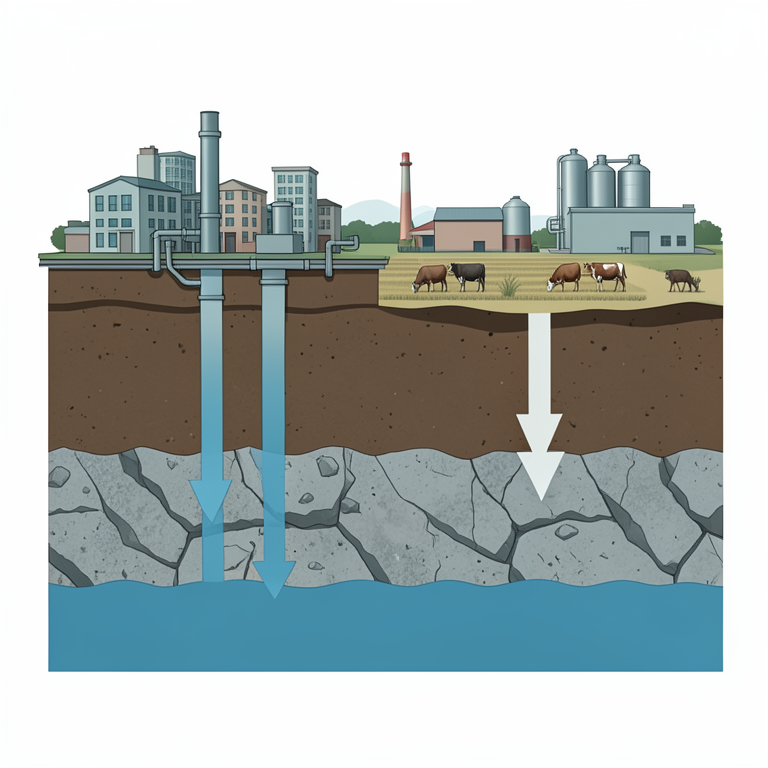
Sources of Groundwater Pollution
AI-generated conceptual illustration (A cross-section of soil and a groundwater aquifer beneath a mixed landscape of urban, industrial, and agricultural land.). It explains the idea and does not show study data.
View source evidence ↗Introduction
It's far generally identified that the quantity of groundwater is not lie in satisfactory condition due to its critical amount. The movements of particles of groundwater behave likes solutions due to the presence of many salts in it, which are derived from the pollution. The great delivery of groundwater is based on its purpose. Therefore, the desires for various types of water, such as ingesting, business and irrigation water, varied broadly. The establishment of good standards of quality of water there requires measuring the specified chemical and radiological ingredients of liquid. Besides this, many specific methods are given for reporting and evaluating outcomes of water evaluation. All results of the assessment indicate that the unrecognized level of dissolved gases in groundwater can pose a risk to the survival of living beings. The main advantage for water delivery and industrial functions is the uniform situation of groundwater-related temperature. Since in floor water, inorganic salts remain dissolved, it possesses the qualitative supply of ingesting water. When such dissolved inorganic salts containing lead and arsenic minerals seep into the water, they it becomes additionally toxic. In recent years, a few regions of the world have included an expanded amount of pollutants, which caused significantly threatened drinking water quality. There are many sources of groundwater pollutants like wastewater leakage from human sports and pipes for wastewater storage where these are lives by forming a colony. Besides that, pond lagoons and industrial and municipal wastewater are also suitable for the growth of these pollutants. Leakage also takes place from underground petrol tanks. These pollutant sources allow for oxidation by using air to decontaminate it without any remedy or doubt. A definite line is drawn for these pollutants, so the solid particles beneath the line are permeable while the above quantity is unlined. Hence, the polluted water seeps down and reaches the bottom of the floor water table. The same problem is often related to that solid particles saved in landfills. The contaminants that leak into the groundwater concern the growth of bio-resistant insecticides that are closely implemented for dealing with extensive infestations of bugs percolated into the groundwater. The tailing process of mines is complicated because they produce several poisonous minerals through incorporation. The extracted poisonous minerals are exposed to the outfield of the atmosphere. Some parts of these exposed waste minerals are dissolved into the rainwater and delivered to an aquifer. The pollutant released into the groundwater through various human assets creates severe problems critical for floor water in the lakes or streams.
The principal motives for this distinction are the following as 1. A pretty movement was found in the maximum quantity of floor water. In this movement, any blend was not found at any stage of activities through porous rocks.
There is no easy dilution of floor water contaminants delivered into groundwater. 2. No more extended air entry into the groundwater is available as floor water. The location of floor water can't be possible by self-purification in deep aquifers.
Since most groundwater lies in a secure region, reviews on pollutants produced by pesticides and chemical fertilizers are found to be pretty but familiar in areas with high quantities of fertilizer. The parts with high business interest contain significant values of compounds that have poisonous chemicals.
Groundwater pollution & its causes
Groundwater pollution can be defined based on the artificial degradation rate of herbal pollutants present in groundwater.
Pollutants affect water usage through their toxicity and may create unfold of sickness and hazards to public health. The origin of maximum pollution occurs via wastewater disposal into that water used for any vast purpose. The deviation in water quality assets causes an exception in groundwater ranging from septic tanks to irrigated agriculture. The contrast between surface and subsurface water pollution represents a more excellent complex manipulation of subsurface pollution, which can persist for many years. The growing popularity of quality assessment related to underground water indicates the need to reduce and eliminate floor water pollution to save human life. The leading causes of groundwater pollution are the following:
Sewerage
The municipal resources of pollution are sewage which causes sewer leakage. It may be supposed that sanitary sewers are to be watertight. But in truth, the sewer leakage into the ground surface is caused due to the oldness of the tailor, which is not unusual. Many factors cause leakage in sewer lines. These factors are the following:-
Terrible artistry
The neutrality of the workers who work on seethe wage pipeline caused sewer leakage.
Defective sewer pipe
The presence of some defect in the structure of pipes creates leakage.
Breakage by tree roots
Sometimes the plant roots inject into the pipe and damage it.
Ruptures from heavy loads
The presence of a loaded vehicle on the pipe ruptured it and caused leakage.
Soil slippage
The leakage of pipes can be possible via the slippage process of soil on sewer pipes.
Besides the above, some other factors, such as fractures from seismic interest, loss of basis assists, shearing, etc., are responsible for sewer leakage. Due to the differential agreement related to the infiltration process, the inflicting sewage flows into the deserted sewer laterals. For the clogging of sewer cracks, solid particles suspended in sewage are used. We know that there is a tendency for surrounding soil to be clogged the minor leakage of sewer pipes because of anaerobic situations. The extensive awareness of physical-chemical parameters like biological oxygen demand, chemical oxygen demand, nitrate, and other compounds of chemical nature present in the environment and all types of bacteria in groundwater can be produced by sewer leakage. While in sewers of various business areas, a lot of heavy metals, like arsenic, cadmium, chromium, cobalt, etc., are present. Besides this, the wastewater of the industrial area also contains copper, iron, lead, manganese, and mercury metals.
Liquid wastes
The origin of wastewater in an urban area occurs from domestic, industrial, or typhoon runoff. The maximum undesired particles mixed into the waters are received from some degree of remedy and then released into surface water bodies. The discharged wastewater into the groundwater can be treated in an increasing fashion where it is merged into the naturally obtained groundwater, which can be used for reuse for any purpose.
As we know, irrigation, infiltration-percolation and overland waft are the three essential techniques used to accomplish land software municipal effluent. By using one of the three methods given at the online website, we can govern the drain potential of the soil; based on these assets, we can determine the loading price of allowable liquid. The irrigation process is similar to a wastewater machine, which acts as spraying, ridging, furrowing, and flooding. The method of evapotranspiration is misplaced with water.
To implement basins effluent, the way of spreading is used in infiltration-percolation approach. Almost all of the water which was spreading reached the floor water. The spraying of wastewater in an overland waft approach is carried out over the upper reaches of sloped terraces. The waft is allowed to pass through a vegetated surface of runoff which causes collection ditches. Because surface runoff percolation is a minor groundwater right, evapotranspiration accounts for implementation concerning maximum water quantity.
Many microorganisms, such as bacteria, viruses, and inorganic chemical compounds, are introduced into groundwater by municipal wastewater. So the water is recharged first and then extracted for potable use so that the viruses, trace factors, heavy metals, and stable organic compounds can be removed. Thus the reclaimed water only concerns fitness components. Furthermore, when we used bleaching powder for the chlorination of wastewater effluents than it caused to increase in the extra amount of pollutants that made the water useless.
Stable Wastes
The pollutant which was supplied into the groundwater is created by the solid waste that was disposed of by the landmark. The water action was proceeding through the scraps dipped into the earth. As we know, the water resources are found in the form of feasible consisting of precipitation, infiltration related to the surface, percolating related to adjoining land, and groundwater in contact with the fill. The water content is present in the mixed refuse as the form of moisture is usually less than that of discipline ability; therefore, lactates form of landfill may be minimized if the supplied water may be stored into the fill fabric. The sanitary landfill, which was appropriately built, is used to manage leachate generation and avert polluted water from the ground surface.
Industrial resources
The water is used in the flowering business for production, cooling, sanitation, and processing. The floor water pollutants can act as commercial wastewater discharged into the pits, ponds, or lagoons. These wastewater pollutants are enabled to emigrate down to the water table.
Tank and pipeline leakage
Since fuels and chemical substances are commonly used for business and commercial installations, these substances are transmitted into underground storage in extensive form. For this purpose, tanks and pipelines are stabilized on the ground surface. There are some structural defects subjected in tanks and pipelines. So there are great possibilities of subsequent leakage. This leakage will become a source of groundwater pollution since petroleum products are valuable hydrocarbons producing carbon particles as liable pollutants. The central frequency of leakage arises from the fuel station and domestic fuel oil tanks. An immiscible liquid released from leaking underground tanks and pipelines moves downward to reach the water table via permeable soils. After that, it forms a layer on the pinnacle of the water table by spreading and then migrates laterally with groundwater waft.
Agricultural sources and irrigation process
Nearly 1/2 to 2/3 of the water was taken away for irrigation of crops and is fed on through evapotranspiration. The irrigation is used for floating and draining to ground channels or joints of the underlying groundwater. When we add the salts of chemical substances into the water, there is a degradation effect caused by the process of dissolution at the time of the irrigation process. The concentration of salts delivered as fertilizers or soil alteration can be estimated through evapotranspiration. The fertilizers and water pollutants contain essential cations such as calcium, magnesium, and sodium, while anions consist of bicarbonate, sulfate, chloride, and nitrate ions. The irrigation process denotes the primary use of water in arid and semiarid areas. The irrigation process is the primary cause of groundwater pollution in arid and semiarid regions.
Animal wastes
Thus, for the 120 to 150 days that a red meat animal remains in a feedlot, it will produce over a half-ton of manure on a dry-weight basis. With hundreds of animals in an unmarried feedlot, the herbal assimilative ability of the soil can grow to be overtaxed. Animal wastes may also ship salts, organic hundreds, and microorganisms into the ground. Nitrate nitrogen is the most crucial persistent pollutant to attain the water desk.
Fertilizers and soil amendments
Most of the fertilizers were made of compounds of essential elements: nitrogen, phosphorus, and potassium. These fertilizers are commonly used in agriculture due to their effective adsorption by soil particles and infrequently representation of pollutants problem. When the solution containing nitrogen is supplied to the soil, it is partially utilized by flowers or adsorbed by soil particles. The pollutant particles in fertilizers are considered used and will surely boom in the destiny.
Insecticides
The maximum amounts of insecticides remain insoluble in water but are effortlessly adsorbed by soil debris or undergo microbial degradation.
Surface discharges
The waste product of cold drinks industries is discharged on the earth's ground surface in an uncontrolled manner. This cold drink waste should migrate downward to groundwater and undergoes degradation by the microbial process. There is an additional increment in the quantities of pollutants in water by any incident with ground pipelines, storage tanks, etc. Besides the railroad, automobiles and vehicles also launched vast amounts of contaminants on a specific web page. The frequently flushed water from highways includes unsafe and flammable beverages. The often-washed drinks are a helpful resource for transporting the pollutant in the water table.
Septic tanks and cesspools
Septic tanks and cesspools are the most valuable factor which plays a vital role in groundwater pollution. A septic tank acts as a watertight basin that splits the floating solid particles and settles them down from the liquid discharged from home sewage. For the separation of settle-down particles present in sewage effluents soil mantle process of the biological environment is used. The soil mantle process includes a subsurface percolation system. The tile subject seepage mattress and sand-blanket filters are central to this percolation system. At the same time, a cesspool is used for receiving and percolating uncooked sewage. The cesspool is a big buried chamber with porous walls. The mineral pollutants are also added to groundwater by domestic sewage.
Role of floor water in groundwater pollution
There are additional contributions to groundwater by polluted water bodies lying on the earth's surface. Their discharged particles come to be assets of groundwater pollutants. Precise recharge occurs by losing circulation or pumping nicely, which is a different result. Most of the water delivery wells under municipal authority are positioned adjacent to rivers that are good enough flow. The vital treatment mechanism for groundwater pollution can be served through the above. This mechanism is also used in sewage water treatment. The explosion of floor water into the atmosphere takes place without any delay. The explosion process is related to several little inlets. These inlets are rivulets, seasonal streams, and floor drains. The concentration of dissolved and atmospheric gases and waste materials continuously changed through water conveyances.
It is an additional factor of floor water pollution. The primary sources of floor water pollution are the following:-1. Pollutants containing gases present in the atmosphere. 2. Floor water runoff 3. The mechanism of decomposition of that substance which animal and plant released as a waste product. 4. The waste effluents which released by businesses and municipal bodies. Using chemical and biological evaluation, we can specify groundwater's high-quality characteristics when the groundwater samples undergo a complete analysis of chemical parameters, including the will pow will organic ingredients concentration and organic and radiological parameters. Studying these parameters is generally complex due to human-induced pollutants' effects. The salinity of groundwater arises from dissociated ions of dissolved salts. Some other additional materials and elements that are present in water also affect the purity of water.
Attenuation of floor water pollutants
The attenuation of floor water pollutants and their charge depends on the local hydrogeological situation and management. The tendency for localization of groundwater pollutants was correlated with the attenuation mechanism. It is an additional mechanism for water reclamation technique that is labile for the interest in groundwater recharge.
Filtration
The suspended materials are obtained by filtration motion technique. This technique of filtration in which the polluted water is available for infiltrating into the floor of the surface is used consequently at the ground surface. By using the filtration process of groundwater, we can eliminate the varieties of iron and manganese particulate and the precipitates which fashioned with the aid of chemical reactions.
Sorption
For attenuating groundwater pollution, the sorption technique plays a significant role in treating it-the materials used in the above mechanism are known as sorptive materials. The substances like hydroxides, Clays, metallic oxides, and other organic compounds are used as sportive materials. The overall exception of chloride and the lesser quantity of nitrate and sulfate may be sorbed under favorable pollution situations. The critical issue of the water desk is that the sorption process depends on each pollutant's chemical and physical properties. The additional problem of the water desk is the subsurface substances and massive clay content in the study material. The maximum inorganic materials have infinite ite sportive capacity of geologic implication,s but the sportive capability can be renewed indefinitely for biodegradable materials, including microorganisms and ammonia.
Microbiological decomposition
Many microorganisms are present in the soils, which are pathogenic in nature. Since these microorganisms are subjected to the last destruction hence do not flourish within the ground. The above microorganisms are released at good timing of environmental conditions as unique species. A good indication was provided by field research that these harmful pathogens can be eliminated in large numbers by using reasonable quantities of slit and clay passage through as little as one meter of soil.
Dilution
The longitudinal and lateral spreading of a pollutant presenpresentse groundwater was produced by the blending mechanism of dilution. When we dilute the solution, the extent affected by pollutants will increase. At the same time, a marginal decrement was observed in the attention of contaminants with the distance traveled by pollutants particles. Pollutants follow the dilution technique to reach the water table because it is the contaminants' most critical attenuation mechanism. Since the pathogens live in water, they are transmitted in our body via water and cause intestinal infections due to their labile nature. Intestinal infections cause many typhoid and paratyphoid fevers, dysentery, cholera, etc. In addition, these pollutants are accountable for hepatitis and polio infections.
Conclusion
When the rainwater reaches the ground gets percolated in soil and becomes underground water. Generally, underground water is clear and colorless but mixed with inorganic salts when water seeps down the floor.
References
8 in the original paper- Anukul Srivastava. Study of Gomati river in Uttar Pradesh in India, E-Journals of Chemistry. 2011;2:521525.
- Khanna DR. assessment of water property of Ganga at foothills of Garhwal Himalayas, J Environ. Educ. Inc. 2011;13(1):56-98.
- Sen Sujata. Correlation study of ponds and river water Quality John Wiley And Sons, Inc. Chichester. 2011, 211-215.
- Shradha Sharma. Evolution of water quality of Narmada River at Hoshangabad. J Pollut. Res. 2011;2(1):131-134.
- Ortyom YG. Water pollution: A menace to aquatic ecodiversity and human health: A review. Int. J Agric. Food Sci. 2021;3(2):47-53. DOI: 10.33545/2664844X.2021.v3.i2a.74
- BIS, Indian Standard: Drinking water-Specification W.H.O. Report 2013; c2012.
- Bhadja P. Effect of excess salt on Saurashtra river of Gujrat. E. Journals of Chemistry; c2013. 685-692. 2010.
- Rim-Rukh A, Fikrat M Hassan, Jasin M. Salman (2013).study of Niger delta of Nigeria. American Public Health Association (APHA); c1998.
Cited by 6
From OpenAlex, OpenCitations and reference lists read by Scinovex
- CRISPR-Cas based nano-sensors in water pathogen detection ↗
Shrestha Mukherjee, Subhasis Sarkar, Suranjana Sarkar, Semanti Ghosh, Bidisha Ghosh · International Journal of Research in Advanced Electronics Engineering · 2024
Waterborne diseases are primarily caused by various indiscriminate anthropological activities as a result of fast pace in industrialization coupled with the infestation of microorganisms borne as a result of the same. Water pollution thus is a major concern for public health in economically unprivileged nations. Assessing the water pathogens and monitoring quality is crucial for decision-making in water distribution systems,
- Study on the extraction and characterization of polymer obtained from scales of Channa striatus, exoskeleton of Barytelphusa guerini, Macrobrachium rosenbergii and fresh water mussel from fresh water bodies of Bhopal, Madhya Pradesh ↗
Shazia Tabassum Shah, Tehleel Ahmed, Susan Manohar, Rajendra Chauhan · International Journal of Molecular Biology and Biochemistry · 2023
A research was accomplished to examine the extraction and characterization of chitosan (polymer) from four different organism of fresh water i.e. fish scales, bivalve, prawn and crab shells. Extracted chitosan has been produced by using various parameters i.e. demineralization Deproteinization and DE acetylation as chemical methods. Results showed that chitosan was found at maximum in the crab (Bareytelphusa guerini) 87.29%
- Effect of soil fertilizer amendment on the physicochemical properties of two studied land surfaces (Upland and lowland) after rice harvest in Ishiagu, Ivo L.G.A., of Ebonyi state ↗
Udeozo PI, Okeke MU, Okeke HC, Aniobi CC, Okeke OR, Offor EN · International Journal of Chemical and Biological Sciences · 2023
Studies were carried out to evaluate the effect of soil fertilizer amendment on the physicochemical properties of two land surfaces (upland and lowland) after rice harvest in Ishiagu, Ivo local government area of Ebonyi State, using standard analytical procedures. For each of the land surfaces, samples D1, D2, D3 and D4 denoted 0, 50, 100 and 150 kg NPK amendments
- Availability and extraction of ground water resources in the Western Haryana, India ↗
Himanshu Grover, Apperdeep Kaur · International Journal of Arts Humanities and Social Studies · 2024
Groundwater is a very vital natural resource that provides relatively clean, cheap drinking water for domestic use, industrial processes, drinking water supply, and agriculture throughout urban and rural areas. Use of groundwater has increased significantly in Western Haryana over the last few decades with widespread tubewell irrigation. The paper highlights a critical issue as the annual groundwater abstraction in the
- A study of improvement in the field of agriculture in Punjab, using Israeli technology
Urmila Urmila · International Journal of Agriculture Extension and Social Development · 2023
Israel, the Biblical holy land, known for its rich culture and infrastructure, was established on May 14, 1948. Jews from all over the world converged on Israel and developed the country with a missionary zeal. Despite having geographical conditions that do not favour farming, Israel has managed to script a success story in the field of agriculture. India, an ancient land with centuries of knowledge, expertise and experience in various fields coupled with its rich natural resources is a force to reckon with. It was with the intent of sharing the best practices and technical knowledge that in 2
- Impact of solid waste dumping yard on ground water
R. Das, Arvind K Dwivedi · International Journal of Biology Sciences · 2023
Municipal and industrial trash is frequently disposed of in solid waste dumps or landfills. However, these dump sites have a substantial impact on the quality and availability of groundwater, which is essential for supporting ecosystems and providing for human requirements in terms of water. In this article, the effect of solid waste disposal yards on groundwater is examined, along with any possible repercussions. Leachate, a fluid that introduces contaminants into the groundwater, can occur as a result of poor trash compaction, inadequate liners or barriers, or incorrect management of dumping