
Research article · 2020 · Full text
International Journal of Geography Geology and EnvironmentStudy of developments in marketing geography in India
Volume 2(2) · Pages 45–47
Research areasInnovation and Socioeconomic DevelopmentMarketing and Advertising StrategiesConsumer Behavior in Brand Consumption and Identification
Abstract
Author-writtenIn this paper the rural markets have been the focus of the study for social scientists, especially the economic geographers since a long time. A bulk of literature is available about the different spatio-temporal and socio-economic aspects of rural markets. Rural markets have been studied by the scholars of different disciplines from different point of view. In order to understand the various studies related to rural markets and associated aspects, a review based on available literature is presented in this chapter. The studies have been broadly undertaken in international and Indian perspectives.
Summary
Source-checkedPlain-language reading of the full paper, prepared with AI and checked against the text. Each point links to the authors' own words.
Why it matters
- Marketing strategies and policies are expressed spatially through the distribution of demand and supply, which forms the basis for marketing geography. View evidence ↗
- The significant portion of the workforce in marketing and the extensive urban infrastructure dedicated to trade justify the need for a specialized study of marketing geography. View evidence ↗
- Marketing geography analyzes market locations, infrastructure, commodity movement, and consumer behavior to aid in regional and socioeconomic development planning. View evidence ↗
The question
- The authors aim to review existing literature on rural markets and associated aspects from both international and Indian perspectives. View evidence ↗
What they did
- The study is conducted as a literature review of available research. View evidence ↗
What they found
- Post-1970, Indian geographers in various cities (including Udaipur, Madras, and Varanasi) began conducting regional marketing studies, marking the start of commercial activity geography in India. View evidence ↗
- The National Council of Applied Economic Research (NCAER) promoted the study of market centers to accelerate India's spatial development. View evidence ↗
- Marketing geography utilizes the concept of hierarchy to determine the status of market centers and emphasizes the delimitation of trade areas for planning. View evidence ↗
- While agricultural marketing was traditionally the domain of economists and agriculturalists, geographers have recently adopted it to improve the spatial planning of market yards. View evidence ↗
What it means
- The authors conclude that philosophical and methodological research in marketing geography remains insufficient in India. View evidence ↗
- The authors recommend that marketing geographers integrate geographic techniques with knowledge of economics, statistics, accounting, and marketing research for better results. View evidence ↗
- The authors conclude that marketing geography models are effective tools for planning rural, urban, and agricultural development. View evidence ↗
- The authors state that current research is tentative and highlight a significant need for further study on the origin of markets in different geo-historical regions. View evidence ↗
Visual summary
1 visualsIllustrations explain the paper; they do not show study data.
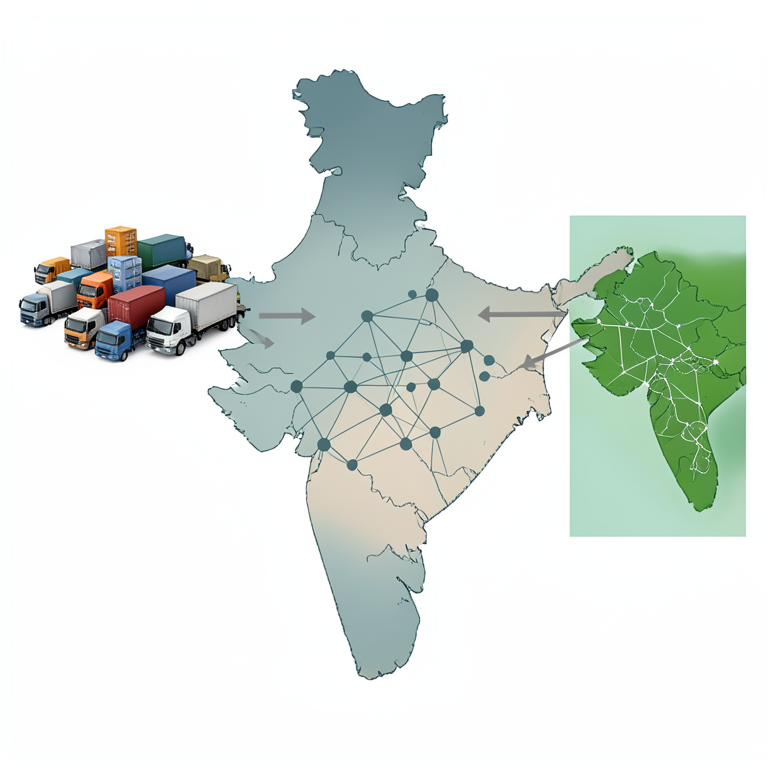
Conceptual Framework of Marketing Geography
AI-generated conceptual illustration (A map of India with urban market centers and rural trade networks). It explains the idea and does not show study data.
View source evidence ↗Figures & tables
From the original paper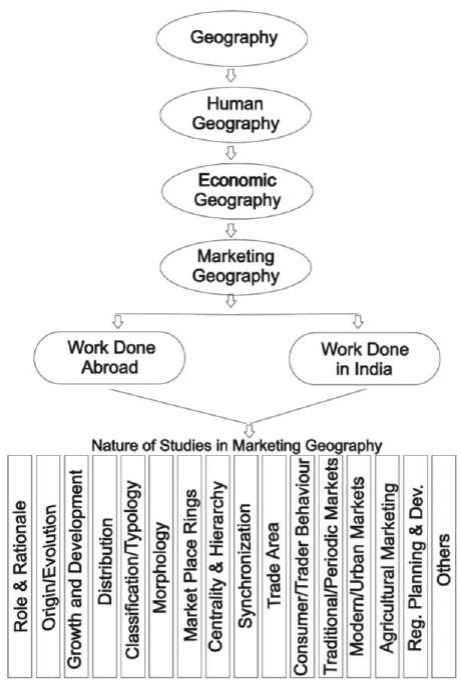 Fig. 1
Introduction
The "marketing", in general business term, is concerned with distribution of the demand of various goods and services and with the arrangements of supply of the same through an efficient distribution network. It is essentially that function of management oversees the buying and selling of a firm's commodities. The strategies and policies involved in marketing are inevitably manifested in some spatial form. It is the areal expression which is given to the source of demand and areal structure of system of supply that provide the foundation for a geographical study of marketing. However, if one consider the large section of the working population that is engaged exclusively in marketing functions, the large part of the urban landscape that is devoted to the structures of wholesale and retail trade, and the complex channels of distribution that lead from producing to consuming areas, it becomes even clearer that there is place and need for special attention to marketing geography. Such a development would not only greatly increase understanding in the other fields of economic geography, but would also help the geographer working in the field of marketing to contribute significantly to solutions of problems in the actual business of marketing (Applebaum, 1947) [1,3] . Thus, the marketing geography may be described as the application of geographical methods and techniques to study market places as units of space and various kinds of activities associated with the spatial distribution of goods required. The root of marketing geography is the "marketplace". The word "market" is derived from the Latin word "mercatus" which refers to a place where buyers and sellers meet. Markets are spatial units; thus their location, site, situation, physical extent, morphology and areal combination, etc. are of spatial significance to geographers (Saxena, 2004) [2] . In brief, marketing geography is concerned with the location and distribution of markets, their infrastructural pattern, measure and extent of marketing activity, movement of commodities, consumer behaviour, perception and the determination of hierarchy in order to prepare a systematic plan for regional development, and their role and rationale in socioeconomic development.
Fig. 1: Marketing Geography-A Review
Marketing geography has now emerged as a subject of its own and has emerged as the foremost and integrative topic for the study of economic geography. Marketing is not only an indispensable feature of modern life but also an indicator of regional economic development (Saxena, 2004) [2] . A need for the study of marketing in economic geography is evident, not only to strengthen various aspects of economic geography, but also to help the geographer in the field of marketing to find significant solutions to problems in the actual business of marketing. Marketing geography is associated with the channels of distribution through which goods move from producer to consumer (Applebaum, 1954) [1, 3] .
Studies in International perspectives
Though economic geographers have bestowed considerable attention on the study of resources and factors of production until recently, they had neglected study of the associated market-places and marketing. Man's economic activity covers a broad spectrum and can be described in a generalized form, while its associated phenomena like agriculture, industry, transportation and marketing require special attention and techniques of study not only to understand their present status but also for development and planning. No doubt, some sporadic discussion and surveys has been made on marketing activities, both in rural and urban centres in the world but these studies were considered as a part of either urban geography, industrial geography or agricultural geography till the middle of last century. However, the fifth decade of the twentieth century witnessed the introduction of new discipline of marketing geography. William Applebaum (1954) [1,3] laid the foundation of this discipline by defining the field and scope of marketing geography. He defined the marketing geography as being "concerned with the delimitation and measurement of market and with the channels of distribution through which goods moves from producers to consumers". During the 1960's and 70's marketing geography became very popular in western world especially for planning the location of different commercial firms in U.S.A. and Britain. Various aspects of marketing geography and periodic markets have been studied by different geographers in different phases of time. The practical importance of marketing geography in its initial stage has been pointed out by geographers like Berry, Bohannan, Bromley, Hodder, Goods, Mintz, Skinner, Smith, Symanski and others. The market centres were considered as functions of centrality which provide various types of function and services to their tributary areas. With the introduction of Central Place the study of service centres including wholesaling and retailing became very common. The studies on marketing geography were undertaken at African, Latin American and Asian countries. The origin of periodic markets as an economic phenomenon. The change in marketing system from traditional exchange to modern markets in various parts of the world. The distance factor in determining the demand of goods in the market centres. The limit of market area is the maximum range of threshold value of goods distributed from market centres. He concluded that although the goods are distributed in all the markets but high order goods dealing markets have started in this decade. Identified three-tier system of exchange, which was temporarily interlocking. He recognized rural markets as the smallest unit associated with intermediate and central markets at national level for exchange system. The geographical importance of market was emphasized after the publication of Berry's book entitled "Geography of Market Centres and Retail Distribution" A substantial part of this book is devoted to the markets in peasant societies particularly considering market location and their periodicity. Many studies on the cognitive and behavioural approach to market.
Studies in Indian perspectives
The early phase of geo-economic study of marketing and market-place started in thirties of the last century in the form of research papers appearing in the various Indian journals on market fairs, periodic markets and market centres. This phase continues till 1960 with the introduction of new themes of study such as agricultural marketing, market-place trade etc. All these studies have given a base for further research in this field. After 1970, several studies were conducted by geographers at Udaipur, Madras, Madurai, Mysore, Gorakhpur, Nagpur, Allahabad, Jabalpur, Kanpur and Varanasi, which were related to marketing in their regional setting. In fact, this was the real beginning of the geography of commercial activities in India. The NCAER (National Council of Applied Economic Research) has also helped in promoting the study of market centres with a view that market towns could accelerate the process of spatial development of India (Saxena, 2004) [2] . The most recent work entitled "Sustainability of Vegetable Cultivation and Marketing: Exploring the State of Indian Farmers" (Khan, M. M. and Khan, N., 2014) [4] are also a notable contribution by these marketing geographers. In addition to these above-mentioned contributions a number of doctoral dissertations were completed at various Indian universities during these periods. Among commercial activities, marketing is considered to be the dominant activity worldwide; therefore, geographers have taken more interest in studying various facets of marketing geography. Geographers have done considerable work in the field of commercial activities in general and marketing geography in particular. Their main emphasis is on regional study as well as on the study of individual market town. The research work in the field of marketing geography is very tentative and there is a vast scope of research, especially in the field of origin of markets in various geo-historical regions. The study of retail marketing in urban areas is a potential field of study because it will help in urban commercial planning. The concept of hierarchy has been used in marketing geography to obtain the status of market centres in a region. The delimitation of market area or trade area is also an important aspect, which not only helps in understanding the present status of a market town but also provides a base for future planning. The studies related to the role of market towns in regional development and planning provides a base for spatial planning. Agricultural marketing which is an interdisciplinary subject dealt by economists and agriculturalists. Geographers have recently given attention to this subject, but their studies are important for spatial planning of markets and market yards. Many of the phenomena that the geographers map in various kinds of studies, such as terrain, soil, vegetation, climate, land use, mineral resources, industries, settlements, types of farming, traffic and transportation or communication systems, bear upon marketing in various ways. The marketing geographer should consider all these significant factors in their future studies. In India, like other branches of geography, attention towards philosophical and methodological research in marketing geography is quite low. Since, different countries of the world have different geo-economics situations and are culturally highly diversified, therefore, there is a need to study the markets and marketing pattern of each geo-cultural region. It is a fact that skill in geographic techniques is not acquired without a solid background in geography, so it is necessary for the marketing geographer to obtain relevant knowledge of the principles and methods of economics, marketing research, statistics, and the theory and practice of accounting. Thereafter they should blend these techniques with those of geography. Better research and more valuable results can be derived from such cross-fertilization of ideas and research methods. There is a vast scope of research in the field and it can be stated that it is a rapidly growing field of study, having a short history and a long future.
Conclusion
In developing countries, the change of globalization of trade, commercialization process and emergence of market oriented agriculture, required immediate knowledge of geographical insights for selecting better and optimum localization of market centres, shopping centres as well as crops land use planning. Hence, marketing geography with its different models would be effective tools for rural, urban as well as agricultural development and planning. This subbranch of geography has very bright future prospects in agriculture, rural marketing, consumer behaviour, retailing, and corporate sector as well as in the comparative analysis of rural and urban trade and marketing. So, the marketing geography, as being the subject dealing with spatial dimension of markets and marketing activities and related features, has a wide range of relevance and significance in modern world.
Figures and tables from the paper
References
4 in the original paper- Applebaum W. The Geographer in Business and his Requisite Training, The Professional Geographer, April issue 1947.
- Saxena HM. Marketing Geography, Rawat Publications, New Delhi 2004.
- Applebaum W. "Marketing Geography" in James, PE and Jones, CF (eds.), American Geography: Inventory & Prospects, Syracuse University Press, Syracuse 1954.
- Khan MM, Khan N. Sustainability of Vegetable Cultivation and Marketing: Exploring the State of Indian Farmers, The International Journal of Sustainability Policy and Practice, Common Ground Publishing USA 2014;9(3).
Cited by 1
From OpenAlex, OpenCitations and reference lists read by Scinovex
- برنامج مقترح فى التسويق الجغرافى لتنمية أبعاد الاستهداف الجغرافى والاتجاه نحو التسويق الأخضر وبقاء أثر التعلم لدى الطلاب المعلمين شعبة الجغرافيا ↗
رضى السيد شعبان إسماعيل · Maǧallaẗ Kulliyyaẗ Al-Tarbiyyaẗ Ǧāmiʻaẗ Al-Minufiyyaẗ /Maǧallaẗ Kulliyyaẗ Al-Tarbiyyaẗ Ǧāmiʻaẗ Al-Minufiyyaẗ · 2023
هدف البحث الحالى إلى الكشف عن أثر برنامج مقترح فى التسويق الجغرافى لتنمية أبعاد الاستهداف الجغرافى والاتجاه نحو التسويق الأخضر وبقاء أثر التعلم لدى الطلاب المعلمين شعبة الجغرافيا بكلية التربية – جامعة الفيوم ولتحقيق هدف البحث والتصدى لمشكلته تم إعداد البرنامج المقترح فى التسويق الجغرافى وضبطه علميا، وإعداد أدوات القياس ( الاختبار التحصيلى، واختبار مواقف أبعاد الاستهداف الجغرافى، ومقياس الاتجاه…
❝ 1PDF