
Research article · 2020 · Full text
International Journal of Geography Geology and EnvironmentSocioeconomic factors that favour forest conservation reducing forest dependency of local communities in developing countries: Lesson learnt from the Rangamati hill district in Bangladesh
Volume 2(1) · Pages 28–33
Research areasConservation, Biodiversity, and Resource ManagementForest Management and PolicyEconomic and Environmental Valuation
Abstract
Author-writtenForests provide direct and indirect economic benefits to forest dependent communities in the world, especially in the developing countries contributing to the national economy. Present study was conducted to explore the socioeconomic status and factors favoring forest conservation and influencing people’s dependency on forest resources in the Rangamati hill district of Bangladesh. The study was based on Focus Group Discussion (FGD) and socioeconomic survey through semi-structured questionnaire. Using generalized logistic regressions (GLR), this study has investigated the socioeconomic factors that favour forest conservation and influence people’s dependency on forest resources. The study revealed that peoples’ income from forest and forest-related occupations were positively aligned with their forest dependency. However, their education level significantly reduced their dependency on forest resources. Thus, educating the forest-dependent people, empowering the local and co-management communities and supporting alternative income generation activities may be an option for effective forest management and conservation. This study represents an important pioneer step in taking a holistic view of the peoples’ dependency on forest resources which might be helpful for policy makers in future to ensure sustainable forest management and conservation in developing countries like Bangladesh.
Summary
Source-checkedPlain-language reading of the full paper, prepared with AI and checked against the text. Each point links to the authors' own words.
Why it matters
- Forests are vital to the national economies of developing countries by providing direct and indirect economic benefits to the communities that depend on them. View evidence ↗
- Managing and conserving forests in developing nations is difficult because local communities rely heavily on forest products for food, medicine, energy, agriculture, and income. View evidence ↗
- Forest lands in the study region are degrading and becoming barren due to factors such as over-exploitation, faulty management, jhum cultivation, and land tenure conflicts. View evidence ↗
The question
- The study aimed to investigate the socioeconomic status of people in the Rangamati hill district of Bangladesh and identify factors that influence their dependency on forest resources and favor conservation. View evidence ↗
What they did
- The researchers assessed socioeconomic conditions using Focus Group Discussions (FGD) and interviews with marginal dwellers. View evidence ↗
- Data on forest resource extraction and income were collected from 60 respondents, split equally between two villages. View evidence ↗
- The study employed generalized logistic regressions (GLR) to analyze the socioeconomic factors affecting forest dependency. View evidence ↗
- Forest dependency was defined as a binary variable, where a household was considered dependent if 20% or more of its total income came from forest resources. View evidence ↗
What they found
- The average age of the respondents was 34.66 ± 2.58 years, with an illiteracy rate of approximately 16.7%. View evidence ↗
- The average monthly income for respondents in the study area was BDT 15,722.22 ± 2847.70. View evidence ↗
- Half of the respondents (50.0%) were engaged in jhum and crop cultivation. View evidence ↗
- Non-forestry occupations were inversely related to forest dependency, with a parameter estimate of -1.2568 (significant at the 10% level). View evidence ↗
What it means
- The authors suggest that effective forest conservation can be achieved by educating dependent populations, empowering local co-management communities, and supporting alternative income sources. View evidence ↗
- The authors conclude that future policies for sustainable forest management in developing countries like Bangladesh must consider the socioeconomic factors of local communities living near forests. View evidence ↗
Visual summary
1 visualsIllustrations explain the paper; charts are replotted from the paper's own table values.
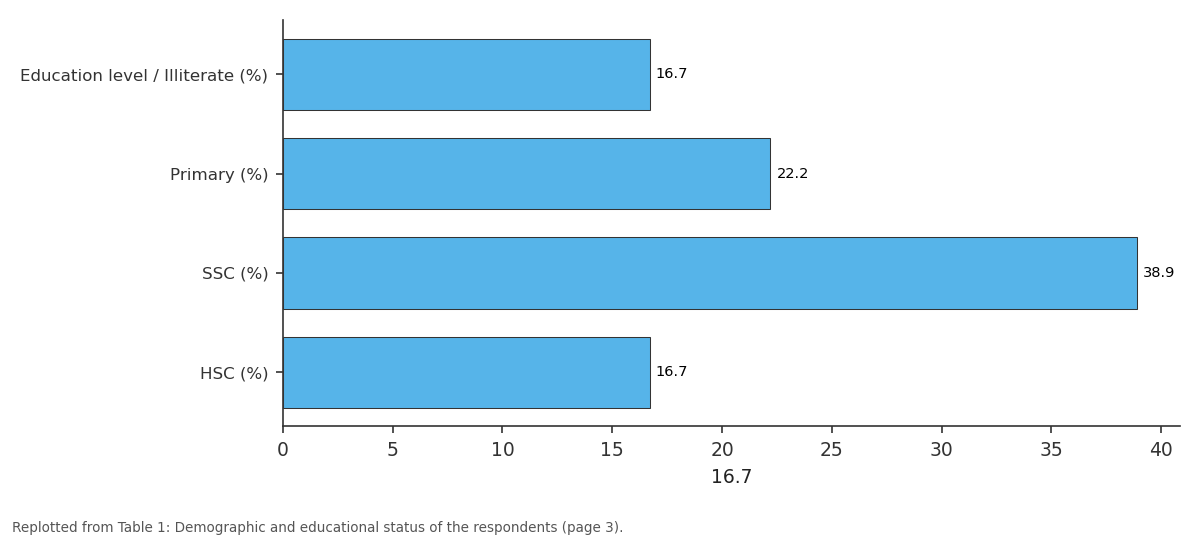
16.7: Education level /... vs Primary (%) vs SSC (%) vs HSC (%)
Replotted from Table 1 (page 3) of the original paper. Every bar is the paper's own table value.
View source evidence ↗Figures & tables
From the original paper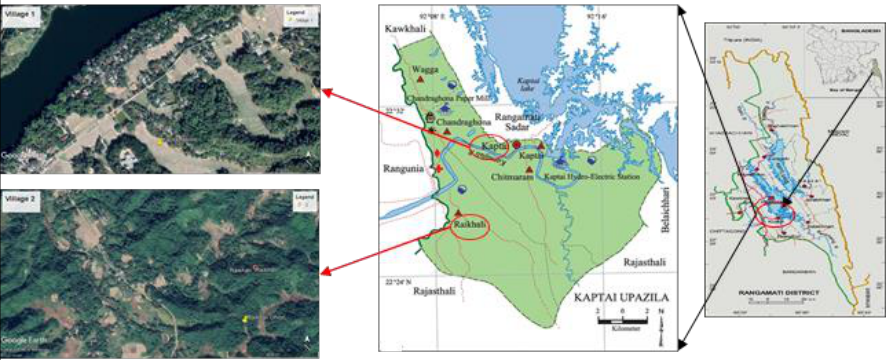 Figure 1
 Table 1
 Table 2
 Table 3
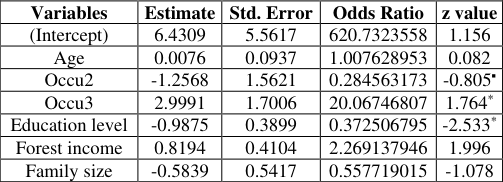 Table 4
Introduction
People's dependency on forest resources is a multi-dimensional phenomenon due to the evidence that forests give a diversified benefits to humans being (Beckley, 1998) [9] . People rely on forests direct and indirect services such as for timber, non-timber products, recreational facilities, water water regime regulation, protection of soil erosion, conservation of biodiversity, sequestering carbon, ecological and environmental services. Conservation and management of forest areas in developing countries has been very complex and challenging due to higher level of dependency of local communities on forest products for agricultural, energy, nutritional, medicinal, and income related events (Adam and El Tayeb, 2014 [3] ; Masozera and Alavalapati, 2004) [29] . Bangladesh being the developing country consisting the area of 147,000 km 2 , with approximately 17% of its forest areas faces many management and conservation challenges related to forests whether it is natural or planted forests (Hossain, 2016) [22] . The total forest area of Bangladesh is about 2.53 million hectares (Hossain, 2016; Hossain, 2015) [22,21] of which 84% has been classified as natural forest and 16% as plantation forest (Hossain and Hoque, 2013; Rahman et al., 2010) [23,37] . Bangladesh occupies diversified forest types (FMP, 2016) [17] ranging from wetlands, evergreen, semi evergreen, moist deciduous and mangrove forests comprising with diverse plants in each forest types (Bhuiyan et al., 2014) [10] . Among these forest types, the evergreen and deciduous forests are mostly distributed in the hilly districts of Bangladesh. Combining three hilly districts namely Rangamati, Khagrachari and Bandarban Chittagong Hill Tracts covers about 13,294 km 2 of which more than 75% is considered suitable for forest resources (Hossain, 2016; Hossain, 2016a; Khisa et al., 2006) [22,28] and the forests of CHT are ecologically classified as Tropical wet-evergreen, Tropical semi-evergreen, Tropical moist-deciduous, Tropical open deciduous and Savannah forests (Hossain, 2016; Chowdhury, 2006) [22,11] . The Chittagong Hill Tracts (CHT) in Bangladesh supports almost 80% of the country's total biodiversity (Hossain, 2016; Jashimuddin and Inoue, 2012; Nishat and Biswas, 2005) [22,25,35] , and is inhibited by people from 12 ethnic groups (UNDP, 2009; Rasul, 2007; Rasul and Thapa, 2006; Miah and Chowdhury, 2004; Chowdhury and Miah, 2003) [38, 40-41, 32, 14] who depend largely on forest resources to fulfill their livelihoods (Misbahuzzaman, 2015; Miah et al., 2012; Rasul and Karki, 2006; Rasul, 2007; Miah and Chowdhury, 2004) [38,[40][41]32] . Forests contribute a significant portion of the economy (46%) at local and national levels, followed by crop/fruit production in the region (Rasul and Tripura, 2016; Ahammad and Stacey, 2016) [5,39] . From the beginning of forest management, Rangamati hill district of Bangladesh was designated for forest resources, particularly as a source of timber both from the natural forests and also from the plantations (Ahammad and Stacey, 2016; Hossain, 2016) [5,22] . But in course of time, most of the forestlands are becoming barren, covered with grass or with scattered trees, bamboos and weeds due to destruction of natural habitat of plants, over exploitation of natural green cover, conversion of large areas into non-forestlands, faulty management, jhum cultivation, invasion by exotics, land tenure ownership conflicts and so on (Akhtaruzzaman et al., 2016; Hossain, 2016; Chowdhury, 2014) [22,32,12] . Traditionally, people have access to government forests in some cases yet their secure tenure rights have not yet been properly addressed (Khan et al., 2012; Barkat et al., 2010) [27,8] . There have been many studies that have demonstrated the role of forest resources in strengthening the economic condition of forest dependent communities in both developed and developing countries of the of the world (Fernandes et al., 1988; Shackleton et al., 2008; Asfaw et al., 2013; Adam et al., 2013) [44,4,16,2] . However, very few studies were conducted to evaluate the socioeconomic factors that favour forest conservation along with influencing the livelihoods of forest dependent communities (Gutanilake, 1998). Therefore, we conduct the present study to explore the socio-economic factors that favour forest conservation and affect people's dependency on forest resources and livelihood in Rangamati hill district of Bangladesh.
Methodology
Socio-economic condition of the people of Rangamati hill district was assessed through interview of the marginal dweller and Focused Group Discussion (FGD). Preliminary information about location, accessibility, communication means, and demography was collected from Conservator of Forest (CF) office of Bangladesh Forest Department (BFD), CHT Regional Council, different NGO's, literature and reconnaissance survey to the study area.
Description of the study area
The Chittagong Hill Tracts (CHTs) of Bangladesh is situated at the southeast region of the country (21°25 N to 23°45 N latitude and 91°54 E to 92°50 E longitude) and comprises three districts: Rangamati, Bandarban, and Khagrachari (Figure 1). This hilly forest region is traditionally resided by 12 ethnic groups, all with distinct cultures, languages, and traditions. We have selected two villages from the two separate union -Kaptai and Raikhali of Kaptai Upazila under Rangamati district.
Focus Group Discussion
Before starting for data collection from local people, a focused group discussion was conducted involving with the concerned NGO and Karbari. Karbari is the village head in each para who usually collects the tax from villagers and adjudicate disputes at village level and considered as the most powerful person in the village social structure. Both male and female members participated actively in the FGD. We conduct 2 FGD from two villages (1 FGD for each village) to collect necessary information related to the forests and the dependency of local communities on forests from the view of several socio-economic factors.
Interview of marginal stakeholder
A semi-structured questionnaire was used for interview of the local stakeholders in order to conduct socioeconomic survey. The questionnaire was designed to explore socioeconomic status of the local people. Detail data on forest resource extraction and corresponding monetary income was collected from 60 respondents (30 respondents from each village) to assess their forest dependency.
Quantitative framework
Logistic regression model: Generalized linear model (GLM), popularly known as logistic regression model was used in the present study to evaluate how people socioeconomic conditions affected their dependency on forest resources of CHT. GLM has been used in many socioeconomic studies. Mehta and Kellert (1998) [31] , Sah and Heinen (2001) [42] and Holmes (2003) [20] have used GLM to determine impacts of demographic and economic variables. Holmes (2003) [20] has used logit model to identify the factors that determined people's forest dependency. Logistic regression has also been used by Ellis and Porter-Bolland (2008) [15] to associate the socio economic reasons to deforestation in Mexico. However, generalized linear model (GLM) are made up of three components: Random, Systematic and Link Function. The random component identifies the dependent variable (Y=0 or 1) and its probability distribution, the systematic component identifies the set of explanatory variables (Xi), and link function identifies a linear relationship between the explanatory variables and their probability function. That is,
Where, Xi is the vector of socioeconomic attributes of the respondents, Pi (Xi) indicates the probability of respondents' dependency on forest resources of CHT for their livelihoods (yes = 1, otherwise = 0) for a given value of Xi and βi is the vector of parameters to be estimated.
In generalized linear model, a logit link function can be defined as follows:
Combination of equations ( 1 The ratio of the two is called the odd ratio which represents the Odds that an outcome will occur (the probability of people's dependence on forest resources) given a particular exposure (Xi = 1) compared to the odds of the outcome occurring in the absence (Xi = 0) of that exposure. Thus, Equation ( 6) can be obtained by combining equations ( 4) and ( 5). Βi = log (Odd ratio) So, Odds ratio = e βi Similar relationship can also be established if Xi is continuous.
Identification and definitions of variables
Identification and definitions of variables
Results and discussions 3.1 Socio economic conditions of the respondents Demographic and educational status:
The study revealed that on an average age of the respondents was (34.66 ± 2.58) years and illiteracy rate is about 16.7%. Education of most of the respondents is up to secondary level (Table 1). Family size and income: The demography showed that on an average more than 5 people live in each family (calculated value 5.56 ± 0.36 individual)
| Name (District) | Age (Years) | Education level | — | — | — | — |
|---|---|---|---|---|---|---|
| Illiterate (%) | Primary (%) | SSC (%) | HSC (%) | B.Sc. (%) | ||
| Rangamati | 34.66± 2.58 | 16.7 | 22.2 | 38.9 | 16.7 | 5.6 |
Table text extracted from the original PDF; superscript letters are shown inline. The original table image is below.
View original table image
and monthly average income of the respondent is about (BDT 15,722.22 ± 2847.70) in the study area (Table 2). Occupation of the respondents: Jhum or shifting cultivation in the nearby hills is the major occupation of the respondents in CHT. Jhum or shifting cultivation (Jhum cultivation is also known as the slash and burn agriculture, is the process of growing crops by first clearing the land of trees and vegetation and burning them thereafter) and mixed fruit gardening were the main occupations of the respondents of Rangamati. About 50.0% of the respondents are associated with jhum and crop cultivation of that area. They cultivate various crops in the nearby occupied hills. The lands are kept fallow for one or two years after harvesting of the cultivated crops. Mixed fruit gardening appeared as a prominent sector for income generation since 17.0% people mentioned it as primary occupation (Table 3). About one third of the respondents (33.0%) in this district is associated with non-forestry professions such as labor, teaching, engineer, business and service holder which is quite higher compared to other two districts of CHT (Table 3). Forests are the source of livelihoods for hundreds of millions of people worldwide especially in developing countries (Jashimuddin and Inoue, 2012; FRA, 2010) [25,18] . [13,38,32,14] . Household fuelwood, food, medicines, shelter building materials and agricultural implements are common uses of forest resources in Bangladesh (Jannat et al., 2018) [24] . Shackleton et al. (2007) [43] mentioned that millions of South Africans derived direct benefits from forests and the contribution is approximately 20% of their livelihood. They also noted that forest resources are not a means of alleviating poverty for millions of people, but rather that they provide resilience in their livelihoods, thus preventing intensification of poverty. Bahuguna (2000) [7] found the differences in rural communities' forest dependency in the Madhya Pradesh, Orissa, and Gujarat states of India which has similarities with the present study. Kamanga et al.
(2009) [26] stated that the poorest segment depends more on forest than the least poor group. Miah et al. (2012) [33] reported that degradation of forest resources are constantly associated with deepening poverty and livelihood vulnerability. Miah et al. (2012) [33] found that dependence on the forest resources was influenced by easier forest access, the number of foragers from a household and family size.
Socioeconomic factors affecting people's forest dependency and livelihoods
For the management and conservation of forest resources i.e. timber, fuel wood, Bamboo, Broom stick, medicinal plants, fish and other NTFPs (Non-Timber Forest Products) of Rangamati hill district, it is important to address the needs of the people whose livelihoods are heavily dependent on the forest resources. Thus, one of the major aims of this study was to identify the major socioeconomic factors that governed people's degree of dependency on forest resources. Table 4 shows how the socioeconomic forces determined the local people's degree of dependency on forest resources. Of the six factors under consideration, Occupation and Education_level were found significantly contributing to a respondent's dependency on forest resources.
| Variables | Estimate | Std. Error | Odds Ratio | z value |
|---|---|---|---|---|
| (Intercept) | 6.4309 | 5.5617 | 620.7323558 | 1.156 |
| Age | 0.0076 | 0.0937 | 1.007628953 | 0.082 |
| Occu2 | -1.2568 | 1.5621 | 0.284563173 | -0.805▪ |
| Occu3 | 2.9991 | 1.7006 | 20.06746807 | 1.764* |
| Education level | -0.9875 | 0.3899 | 0.372506795 | -2.533* |
| Forest income | 0.8194 | 0.4104 | 2.269137946 | 1.996 |
| Family size | -0.5839 | 0.5417 | 0.557719015 | -1.078 |
Table text extracted from the original PDF; superscript letters are shown inline. The original table image is below.
View original table image
The parameter estimate of Occu2 was -1.2568, which was significant at 10% level (Table 4). The result indicates that respondent's non-forestry occupation was inversely related to their degree of dependency on the forest resources of Rangamati district. Again, the parameter estimate of Occu3 was 2.9991, which was significant at 5% level (Table 4). As expected this finding indicates that, the log (Odds) of forest dependency of a respondent with a forest related occupation (Gardening / Horticulture / plantations in the hills) was greater than that of a respondent with a non-forestry occupation by 2.9991. Thus, we conclude that people were more likely to depend on forest resources if they worked in professions that required forest resources as inputs. Forest conservation is almost impossible without the support from the local community. Macura et al. (2011) [30] reported that local people who had better access to forests, the forests were more aware of forest protection. Respondent's education level was inversely related to their degree of dependency on the forest resources. The parameter estimate of Education level was -0.9875, which was significant at 5% level. An increased year of schooling of a respondent decreased his log (Odds) by 0.9875 (Table 4). The reasons might be twofirstly, an educated respondent might have better understanding about the importance of nature conservation and secondly, he might have managed to have a better and alternative income source elsewhere. This is an important finding in the sense that forest resources could be better managed if the forest dependent people could be educated. Similar findings were reported by Jannat et al. (2018) [24] and Rahman et al.
(2017) [36] and Adhikari (2004) [1] who mentioned that educated people are less dependent on forest resources.
Conclusion
Forests provide a wide range of environmental services including biodiversity conservation, watershed protection, soil protection, and climate change mitigation. In addition to providing environmental services, forests are critical in meeting numerous human needs for water, food, shelter, medicine, fuel wood, fodder and timber. Land tenure ownership conflicts, lack of effective management, inter sectorial policy conflicts, people's extensive dependency on forest resources coupled with their ignorance about the environmental importance of these resources have caused severe depletion and degradation of forest resources in Rangamati in the last couple of decades. The diminishing and depleting natural resources in the developing countries like Bangladesh is not uncommon. The situation demands bridging the gap between the indigenous communities and the ruling power including Forest Department. Forest protection efforts without the cooperation of the local people failed in most cases when their traditional rights on forest, which they enjoyed for generations, were ignored. For this, it is important to evaluate identification of the driving factors that affect their livelihoods is also equally important. People's income, education and forest dependency are the major factors significantly affecting their perception and attitude towards forest conservation. People should be motivated, focusing on the socio-environmental benefits from forest, to divert their negative attitudes towards forest conservation. Conclusively, people from developing countries like Bangladesh are directly or indirectly depend on forest resources for their daily needs. From this study, we conclude that consideration of socio-economic factors of the local communities who are living around the forests is important for future policy formulation and decision making process towards sustainable management and conservation of forests in developing countries like Bangladesh.
Acknowledgement
AcknowledgementWe are thankful to the Institute of Forestry and Environmental Sciences, University of Chittagong, Bangladesh for providing us in-kinds support during data collection from the fields during July 2016 to June 2017. We are also thankful to different government (Bangladesh Forest Department and CHT Regional Council) and nongovernment bodies who extended their hands to collect necessary secondary information for preparing this manuscript. Finally we would like to show our gratitude to the two anonymous reviewers for their valuable comments to make this manuscript publishable.
References
45 in the original paper- Adhikari B, Di Falco S, Lovett JC. Household characteristics and forest dependency: evidence from common property forest management in Nepal. Ecological economics. 2004; 48(2):245-257.
- Adam YO, Pretzsch J, Pettenella D. Contribution of non-timber forest products livelihood strategies to rural development in drylands of Sudan: Potentials and failures. Agricultural Systems. 2013; 177:90-97.
- Adam YO, El Tayeb AM. Forest dependency and its effect on conservation in Sudan: A case of Sarf-Saaid Reserved Forest in Gadarif state. Poljoprivreda i Sumarstvo. 2014; 60(3):107.
- Asfaw A, Lemenih M, Kassa H, Ewnetu Z. Importance, determinants and gender dimensions of forest income in eastern highlands of Ethiopia: The case of communities around Jelo Afromontane forest. Forest Policy and Economics. 2013; 28:1-7.
- Ahammad R, Stacey N. "Forest and agrarian change in the Chittagong Hill Tracts region of Bangladesh." In E. L. Deakin, M. Ksatriya and T. C. H. Sunderland (Eds.) Agrarian Change in Tropical Landscape. Bogo: Center for International Forests Research (CIFOR), 2016, 190233.
- Akhtaruzzaman M, Osman KT, Haque SMS. DTPA Some Extractable Micronutrients in Different Hill Forests of Chittagong Region, Bangladesh, JFES. 2016; 32(1):20-26.
- Bahuguna VK. Forests in the economy of the rural poor: an estimation of the dependency level. Ambio. 2000; 29:126-129.
- Barkat A, Halim S, Osman A, Hossain MI, Ahsan M. Status and Dynamics of Land Rights, Land Use and Population in Chittagong Hill Tracts of Bangladesh, Human Development Research Centre, Dhaka, 2010, 1300.
- Beckley TM. The nestedness of forest dependence: A conceptual framework and empirical exploration. Society and Natural resources. 1998; 11(2):101-121.
- Bhuiyan MK, Hossain MK, Alam MS. Banspata (Podocarpus nerifolia, D. Don.)-A critically endangered tree species of Bangladesh, Institute of Forestry and Environmental Sciences, Chittagong, 2014, 72.
- Chowdhury JA. Towards Better Forest Management, Oitijjhya, Dhaka, Bangladesh, 2006.
- Chowdhury K. The making of political forests in the Chittagong Hill Tracts, Bangladesh: The state, development and integrity, PhD thesis, Graduate Program in Social Anthropology, York University, Toronto, Ontario, 2014.
- Chowdhury MSH, Halim MA, Miah MD, Muhammed N, Koike M. Biodiversity use through harvesting faunal resources from forests by the Mro tribe in the Chittagong Hill Tracts, Bangladesh. Int. J Biodivers Sci. Manag. 2007; 30:56-62.
- Chowdhury MSH, Miah MD. Housing pattern and food habit of the Mro-tribe community in Bangladesh: A forest dependence perspective. Journal of Forestry Research. 2003; 14:253-258. doi:10.1007/BF02856841.
- Ellis EA, Porter-Bolland L. Is community-based forest management more effective than protected areas? A comparison of land use/land cover change in two neighboring study areas of the Central Yucatan Peninsula, Mexico. For Ecol Manage. 2008; 256:19711983.
- Fernandes W, Menon G, Viegas P. Forests, environment and tribal economy -deforestation, impoverishment and marginalisation of Orissa. New Delhi: Indian Social Institute, 1988.
- Forestry Master Plan (FMP), Forest Department, Bangladesh, 2016.
- FRA. Global forest resources assessment 2010: Main report. FAO Forestry Paper 163. Rome: Food and Agriculture Organization of the United Nations, 2010.
- Halim S, Roy RD. Lessons learned from the application of human rights-based approaches in the indigenous forestry sector in the Chittagong Hill Tracts, Bangladesh: A case study of the village common forest project implemented by Taungya. URL, 2006. http://hrbaportal.org/wp-content/files/ 1233223431_8_1_1_resfile.pdf.
- Holmes CM. The influence of protected area outreach on conservation attitudes and resource use patterns: a case study from western Tanzania. Oryx. 2003; 37:305315.
- Hossain MK. Silviculture of Plantation Tree Species of Bangladesh. Arannayk Foundation. Dhaka, Bangladesh, 2015, 361.
- Hossain MK. Re-greening the Degraded Hill Forests through Recovery and Restoration of Native Tree Species, National Tree Fair, Forest Department, Bangladesh, 2016.
- Hossain MK, Hoque ATRM. Eucalyptus Dilemma in Bangladesh, Institute of Forestry and Environmental Sciences, Chittagong, 2013, 148.
- Jannat M, Hossain MK, Uddin MM, Hossain MA, Kamruzzaman M. People's dependency on forest resources and contributions of forests to the livelihoods: a case study in Chittagong Hill Tracts (CHT) of Bangladesh. International Journal of Sustainable Development & World Ecology. 2018; 25(6):554-561.
- Jashimuddin M, Inoue M. Management of Village Common Forests in the Chittagong Hill Tracts of Bangladesh: Historical Background and Current Issues in Terms of Sustainability, Open Journal of Forestry. 2012; 2(3):121-137.
- Kamanga P, Vedeld P, Sjaastad E. Forest incomes and rural livelihoods in Chiradzulu District, Malawi. Ecol Econ. 2009; 68:613-624.
- Khan MH, Aziz MA, Uddin M, Sharif S, Chowdhury SU, Chakma S. Community conserved areas in Chittagong Hill Tracts of Bangladesh. In Islam, MA, ed. Wildlife Trust of Bangladesh, Dhaka, Bangladesh, 2012.
- Khisa SK, Shoaib JU, Khan NA. Selected Natural Resource Conservation Approaches and Technologies in the Chittagong Hill Tracts, BANCAT, CHTDB, Khagrachari, 2006.
- Masozera MK, Alavalapati JR. Forest dependency and its implications for protected areas management: a case study from the Nyungwe Forest Reserve, Rwanda. Scandinavian Journal of Forest Research. 2004; 19(S4):85-92.
- Macura B, Zorondo RA, Grau FS, Demps M, Laval K, Garcia-Reyes CAV. Local community attitudes toward forests outside protected areas in India. Impact of legal awareness, trust, and participation, Ecol Soc. 2011; 16:10.
- Mehta JN, Kellert SR. Local attitudes toward community-based conservation policy and programmes in Nepal: a case study in the Makalu-Barun Conservation Area. Environ Conserv. 1998; 25:320333.
- Miah MD, Chowdhury MSH. Traditional forest utilization practice by the Mro tribe in the Bandarban region, Bangladesh, Schweiz. Z.Forstwes. 2004; 155(34):65-70.
- Miah MD, Chakma S, Koike M, Muhammed N. Contribution of forests to the livelihood of the Chakma community in the Chittagong Hill Tracts of Bangladesh. Journal of Forest Research. 2012; 17(6):449-57.
- Misbahuzzaman K, Smith-Hall C. Role of forest income in rural household livelihoods: The case of village common forest communities in the Chittagong Hill Tracts, Bangladesh. Small-Scale Forestry. 2015; 14(3):315-30. Doi: 10.1007/s11842-015-9290-1.
- Nishat A, Biswas SR. Community-Based Restoration of Degraded Tropical Hill Forests: Experiences from Krykhong Para, Chittagong Hill Tracts, Bangladesh. Bulletin of the National Institute of Ecology. 2005; 16:1-11.
- Rahman MM, Mahmud MAA, Shahidullah M. Socioeconomics of biodiversity conservation in the protected areas: a case study in Bangladesh. International Journal of Sustainable Development & World Ecology. 2017; 24(1):65-72.
- Rahman MM, Guogang Z, Islam KS. A Review of the Present Threats to Tropical Moist Deciduous Sal (Shorea robust) Forest Ecosystem of Central Bangladesh. Conservation letter. Tropical Conservation Science. 2010; 3(1):90-102.
- Rasul G. Political ecology of the degradation of forest commons in the Chittagong Hill Tracts of Bangladesh. Environmental Conservation. 2007; 34:153-163. doi:10.1017/S0376892907003888.
- Rasul G, Tripura NBK. Achieving the sustainable development in the Chittagong Hill Tracts -Challenges and opportunities. ICIMOD Working Paper 2016/12. Kathmandu: ICIMOD, 2016.
- Rasul G, Karki M. Political ecology of degradation of forest common in the Chittagong Hill Tracts of Bangladesh. The Eleventh Biennial Conference of the International Association for the Study of Common Property, Bali, 2006, 19-23.
- Rasul G, Thapa GB. Financial and economic suitability of agroforestry as an alternative to shifting cultivation: The case of the Chittagong Hill Tracts, Bangladesh. Agricultural Systems. 2006; 91:29-50. doi:10.1016/j.agsy.2006.01.006.
- Sah JP, Heinen JT. Wetland resource use and conservation attitudes among indigenous and migrant peoples in Ghodaghodi Lake area, Nepal. Environ Conserv. 2001; 28:345-356.
- Shackleton CM, Shackleton SE, Buiten E, Bird N. The importance of dry woodlands and forests in rural livelihoods and poverty alleviation in South Africa. For Policy Econ. 2007; 9:558-577.
- Shackleton SE, Campbell B, Lotz-Sisitka H, Shackleton CM. Links between the local trade in natural products, livelihoods and poverty alleviation in a semiarid region of South Africa. World Development. 2008; 36:505526.
- Gunatilake HM. The role of rural development in protecting tropical rainforests: evidence from Sri Lanka. Journal of Environmental management. 1998; 53:273-292.
Cited by 6
From OpenAlex, OpenCitations and reference lists read by Scinovex
- Potential of non-timber forest products in contribution on rural livelihood ↗
Jit Narayan Sah, Uday Kumar Singh, Rajan Kumar Sah · Journal of Medicinal Plants Studies · 2021
Introduction: Non-Timber Forest Products (NTFPs) are rich sources of forest and contribute of rural livelihoods in fulfilling their subsistence needs and household level income. This research explores the present status of potential NTFPs, influential factor for their collection with contribution for upliftment of rural livelihood. Methods: The inventory method for bio-physical data and social data for livelihood was used using
- Assessment on backyard chicken feeding practices and health management in Fogera district Amhara region, Ethiopia ↗
Demelash Kefale, Tsegaye Mitiku · Acta Entomology and Zoology · 2023
The study was conducted in Fogera District of South Gonder Zone of Amhara Region of Ethiopia, with the study objective of generating baseline information and assessment on backyard chicken feeding practices and health management system of chicken in Fogera District. Two Kebeles (Quar Abo and Quar Michel) were selected purposively and a total of 15 households were randomly selected per…
- Banana farming: source of enhancing income and sustaining livelihoods in Meloor Panchayath
Sreeni Kr · International Journal of Horticulture and Food Science · 2021
Banana is a widely perennial fruit crop grown in Meloor Panchayat due to high economical gain for small and marginal farmers throughout the year. Meloor is one of the largest producers of Banana in Thrissur District with an average of 2812 tons from an area of 75 hectares with average productivity of 30 to 35 tons per hectare. Moreover, 25 hectares were added to banana cultivation in Meloor Panchayat during Post Covid Period. 70 percentage farmers sell their bananas in Chalakudy Market, 20 percentage in VFPCK and 10 percentage in Horticrop. The overall objective of the study is to examine econ
- The relationship of community livelihoods in and around forest reserve areas to forest resources in Humbanghasundutan District of North Sumatra Province ↗
Taufik Taufik, Sulistyowati Diah Kusumawardhani · Sriwijaya Journal of Environment · 2024
Forest resource management needs to pay attention to the relationship between the community and forest resources. The conversion of forest land into non-forest areas affects the livelihoods of communities around the forest itself; therefore, knowledge of the socio-economic and cultural interrelatedness of communities in and around forest areas is needed so that the sustainability of forest resources and community livelihoods…
❝ 0PDF - Assessment of barriers to livelihood diversification among commercial motor drivers in Ekiti State, Nigeria
RS Owoeye, J. O. Ijigbade, OJO Olaniyi Oluwatosin · International Journal of Agriculture and Food Science · 2023
The research investigated the evaluation of obstacles to expanding sources of income among commercial motor drivers in Ekiti State, Nigeria. A total of 120 commercial motor drivers were selected for the study using a multistage sampling method. The data was collected through pre-tested questionnaires administered to the respondents. Subsequently, the collected data was subjected to analysis, employing both descriptive statistics and Tobit regression analysis. The findings of the study revealed that 65.7 percent of the commercial drivers were male, and approximately 46.7 percent fell within the
- Youtubers from rural bengal are winning hearts of millions of netizens: A study on transforming rural livelihood ↗
Dr. Mahendra Kumar Jena, Purabi Das, Dipika Mondal · International Journal of Advanced Mass Communication and Journalism · 2023
Bengal being agro-based economy, agriculture is the major source of income among the rural folks. Those with hectares/acres of land, employ other landless villagers to work in their field on payment of minimum wages. Thus, landless villagers (youth) with no other major source of income, face a hardship to sustain in villages as there is rarely other scope of work…