
Research article · 2021 · Full text
International Journal of Horticulture and Food ScienceBanana farming: source of enhancing income and sustaining livelihoods in Meloor Panchayath
Volume 3(2) · Pages 49–53 · DOI: 10.33545/26631067.2021.v3.i2a.76 ↗
Research areasAgricultural Economics and Practices
Abstract
Author-writtenBanana is a widely perennial fruit crop grown in Meloor Panchayat due to high economical gain for small and marginal farmers throughout the year. Meloor is one of the largest producers of Banana in Thrissur District with an average of 2812 tons from an area of 75 hectares with average productivity of 30 to 35 tons per hectare. Moreover, 25 hectares were added to banana cultivation in Meloor Panchayat during Post Covid Period. 70 percentage farmers sell their bananas in Chalakudy Market, 20 percentage in VFPCK and 10 percentage in Horticrop. The overall objective of the study is to examine economically feasibility of banana production and the sustainability of by-products. It also examines the major role played by cooperatives banks, insurance schemes and agriculture departments which helps to enhance farmer’s income and also create job opportunities. Agriculture and allied activities provide the main source of livelihood and income to 80 percentages of people in Panchayath. The government should take all necessary measures and support the panchayat to start micronutrients, nutraceuticals (baby food), livestock feed, natural fibres, and bio-fertilizers units. As Cochin International Airport is 18 Km away panchayat has huge potential for export. The unemployment can be sorted out by supporting small and cottage industries sector for byproducts such as Chips, figs, flour, powder, banana pulp, food and infants, clarified banana juice.
Summary
Source-checkedPlain-language reading of the full paper, prepared with AI and checked against the text. Each point links to the authors' own words.
Why it matters
- Banana farming is a significant perennial crop in Meloor Panchayat because it provides high economic gains for small and marginal farmers year-round. View evidence ↗
- Agriculture and related activities are the primary source of income and livelihood for 80% of the population in the Panchayat. View evidence ↗
- The region's fertile land and lateritic river valley soils make Meloor Panchayat ideal for high-yield banana cultivation. View evidence ↗
The question
- The study aims to examine the economic feasibility of producing bananas and the sustainability of their by-products. View evidence ↗
- The research also investigates how agricultural departments, insurance schemes, and cooperative banks help increase farmer income and create jobs. View evidence ↗
What they did
- The study utilized primary data from interviews with banana cultivators and sellers, and secondary data from the Agriculture office, VFPCK, and the Panchayat. View evidence ↗
- The study notes that farmers typically plant 1,600 bananas per hectare, with an average yield of 75 fruits per plant. View evidence ↗
What they found
- Meloor is a leading producer in Thrissur District, producing an average of 2,812 tons from 75 hectares, with productivity ranging from 30 to 35 tons per hectare. View evidence ↗
- The majority of farmers (70%) sell their produce in the Chalakudy Market, while 20% use VFPCK and 10% use Horticrop. View evidence ↗
- The total cost of banana cultivation per hectare is 593,000 Rs, with the imputed value of household labour accounting for the largest share at 50.59% (300,000 Rs). View evidence ↗
- The VFPCK crop insurance premium is 5.70 Rs per plant, with the farmer paying 3.0 Rs and VFPCK paying 2.7 Rs, which is described as a burden on the farmers. View evidence ↗
- Over the last three years, snail attacks have emerged as a problem causing damage to banana fruits in Meloor. View evidence ↗
- Despite the production volume, there are currently no local units in the area to process bananas into by-products such as chips, flour, or juice. View evidence ↗
What it means
- The author concludes that with government prioritization of productivity and sustainability over the next 5 to 10 years, Meloor could regain its status as a leading global banana producer. View evidence ↗
- The author recommends supporting small and cottage industries for banana by-products to address unemployment in the region. View evidence ↗
- The study identifies high shipping rates, the need for cooled containers, and limited sea transport as major constraints for accessing overseas markets. View evidence ↗
Visual summary
3 visualsIllustrations explain the paper; charts are replotted from the paper's own table values.
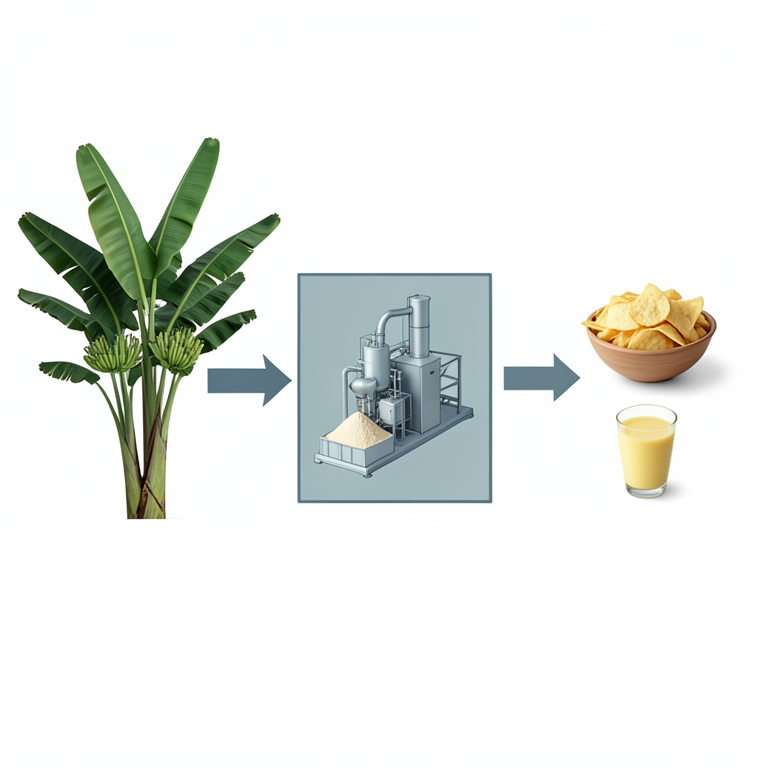
Banana Value Chain Expansion
AI-generated conceptual illustration (Banana plants and processed banana products). It explains the idea and does not show study data.
View source evidence ↗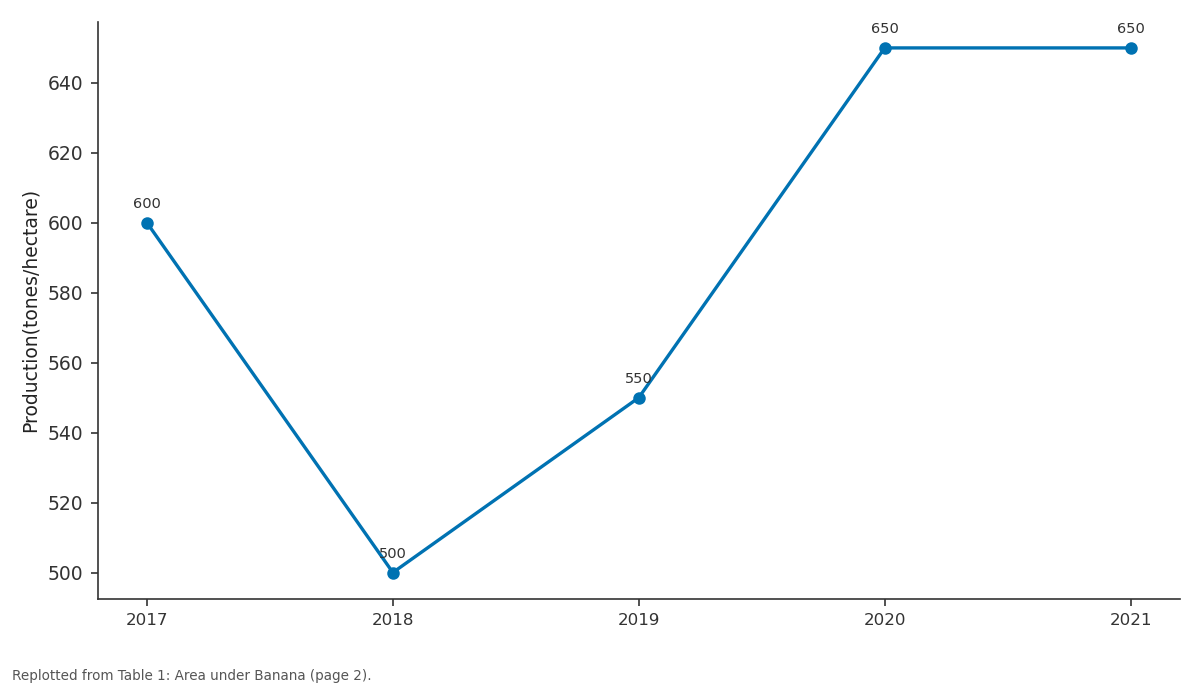
Production(tones/hectare): 2017 vs 2018 vs 2019 vs 2020 vs 2021
Replotted from Table 1 (page 2) of the original paper. Every bar is the paper's own table value.
View source evidence ↗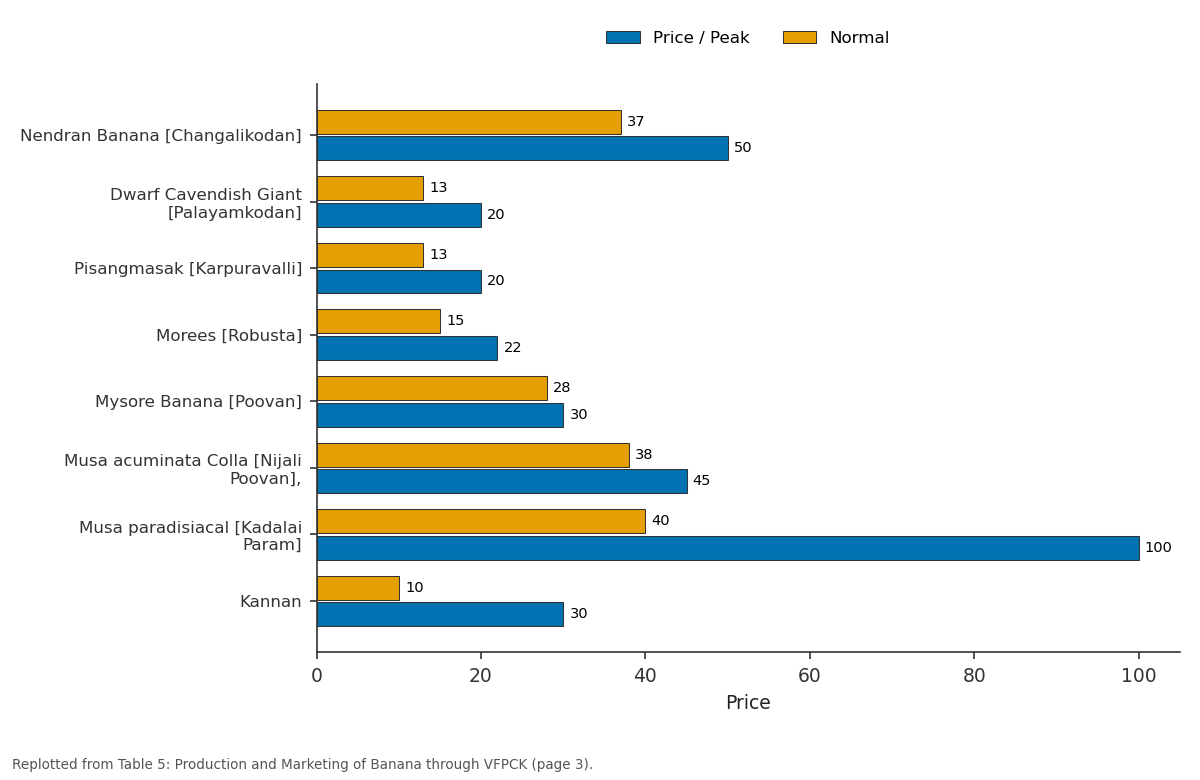
Price / Peak and Normal: Nendran Banana... vs Dwarf Cavendish Giant... vs Pisangmasak... vs Morees [Robusta] vs Mysore Banana [Poovan]
Replotted from Table 5 (page 3) of the original paper. Every bar is the paper's own table value.
View source evidence ↗Figures & tables
From the original paper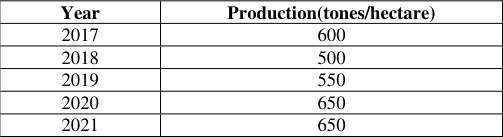 Table 1
 Table 2
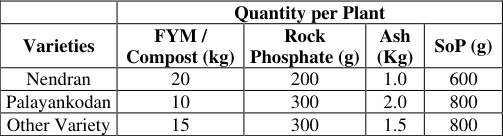 Table 3
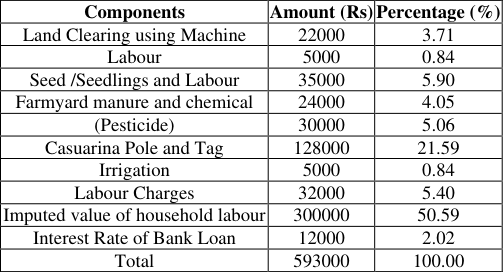 Table 4
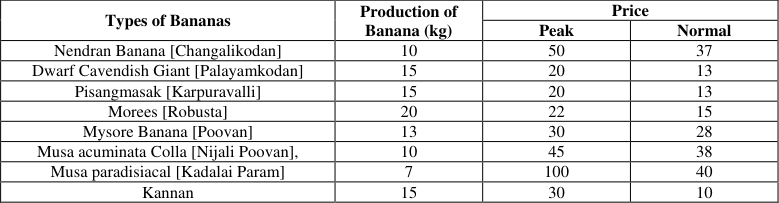 Table 5
Introduction
Meloor Gram Panchayath is an agrarian village on the banks of Chalakudy river sharing 17km borders with the river is in, Thrissur District of Kerala State. It has an area of 1987 hectares, which is famous for its natural beauty and plantations. The richness of Meloor panchayat is its fertile land and lateritic soil of river valleys which are ideal for banana growing and is known for high yield banana. The four boundaries of Meloor Panchayat are Chalakudy River in the north, Karukutty panchayat in the east, Kadukutty panchayat in the west and Koratty panchayat in the south. The total population of the panchayat (1991 census) is 27698.
Methodology of the study
The present study is based on primary data and secondary data. Primary data are collected directly from the banana cultivators, banana sellers and a well-structured interview schedule were used for data collection from the farmers. Secondary data are collected from Panchayath, Agriculture office, VFPCK etc.
Objectives of the study To study the varieties of bananas in terms of commercial values
To identify the problems faced by the banana cultivators in the production and marketing of their products. To study the role of VFPCK (Vegetable and Fruit Promotion Council Keralam) and Horticrop, banks, insurance schemes and agriculture department in the support of Banana Farmers.
Scope of the study
The scope of the study is to bring into the notice of government about the commercial value of banana and employment the opportunity of Meloor village. The study was primarily intended to analyse the production and marketing of bananas.
The outcome of the study is more beneficial to the farmers and government prioritising key areas that the banana industry might address to improve its productivity and sustainability.
Selection of seed
From the healthy clump's farmers select 3-4 months old disease-free suckers. In the case of Nendran variety, the pseudo-stem is cut up to the length of 15-18 cm from the corm and remove from its old roots. Then the rhizomes are treated with beejamrutha to control rhizomes weevil and kept for 3 -4 days in sunlight and stored in shade for 15 days before planting.
Preparation of land
The field was prepared by digging pits for planting. Usually, the size of the pit is taken as 30 cmX10cm still depends upon soil type, water table and variety of banana. Recommended manures FYM (Farm Yard Manures) or compost of leaves @10 kg per plant at the time of planting + 10 g Azospirillum (Gramnegative, microaerophilic, non-fermentative and nitrogenfixing bacterial genus). 500 gram of lime in the pit and allow to weather Vermicompost @2kg per pit and Groundnut cake/neem cake @ 1 kg /pit at the time of planting. Mix PGPR (Plant Growth Promoting Rhizobacteria), bio NPK fertilizer@ 500-100 gm/pit mixed with 5 kg of FYM should be applied at the time of planting. Recommended at the time when there is enough moisture in the soil. Pancagavya 3% as foliar spray 3 times at 3rd, 6th and 9th month after planting. Sow 50 kg /ha of cowpea seeds before planting banana (20 gram/plant). Incorporate the crop into the soil after 40 days. After 3 months Elephant Foot Yam or Colocasia was planted in between keeping the space of 6 m each. It's an additional income to farmers It's preferable to apply organic manures in two equal doses at 2 nd and 4 th a month after planting.
Harvesting and yield
According to market preference banana is harvested when the fruits are slightly or fully matured. Harvesting is done at 75 -85% maturity for long-distance transportation.
The planted crop gets ready for harvest within 10-12 months of planting and the main harvesting season of banana is from September to April. Bunches attain maturity from 75-90 days after flowering depending upon variety, soil, weather condition and elevation.
The dwarf varieties are ready for harvesting within 10-11 months after planting while the tall varieties take about 11to 12 months. After harvesting of the bunch, only leaves are to be cut and the plant system is retained for ratoon crop development. This improves the food supply and about 15% can be saved on irrigation. For getting good quality banana, only 3 to 4 berries are to be retained in a bunch.
Cost structure and analysis of banana
Production generally the production and management cost include: land rent, primary tillage, irrigation system seeds, tools, bagging, support poles (Casuarina Pole or bamboo), fertilizer, pesticides, energy cost, wages, temporary worker's wages, transportation and other incidental expenses etc. Comparative costs are listed in the following.
Marketing of banana
The banana cultivated in Meloor Panchayath is marketed through VFPCK. The market is open twice a week (Tuesday and Friday). Farmers brought bananas to the market where farmers are able to sell their product directly to end customers or wholesalers as well as retailers. Vegetable and Fruit Promotion Council Keralam (VFPCK) avoid middlemen and helps farmers to get a better price for the products. A bunch of bananas were sold at an average rate of Rs 35-40 Rs/kg and each bunch contain an average of 8 to 10 kg and farmers get between Rs300 to Rs 450. The average cost for one banana cultivation is Rs 370 -400 Rs.
From 2018 -19 after the flood, the farmers are in bad debt due to low price. Major set backs Government has not tried to open Meloor as the largest plantation to worldwide markets even though Nedumbassery airport is 18 km away from Meloor, the panchayat. Not able to address the farmers problem of finance in the production of bananas during good seasons. The Panchayat has unnoticed to develop an as largest commercial unit of India and provide employments in areas from growing the fruit, may also package, process, and ship their product directly from the plantation to worldwide markets. VFPCK is only the institute that can extend its support to local farmers but failed to visualize things in a boarder sense. (Failed to add commercial values to the product).
Crop insurance package
VFPCK has designed a crop insurance package for its participating farmers for protecting farmer as well as the banker from uncertainties that arises during the cultivation period. Premium: Banana -Rs. 5.70/ plant (VFPCK Rs 2.7/plant and Farmer Rs 3.0/plant). Again, it's a burden on farmers. In VFPCK Payment from retail traders normally takes four to five days to reach farmers. The crop Insurance upto 300 Rs/Plant given by Krishi Bhavan is the scheme for safe guarding the farmers from unexpected damage to agricultural crops due to various reasons including Natural Calamities and the subsequent loss caused by that. Meloor should be brought back to the world map as the largest producer of banana, if the government prioritising key areas that the Banana Industry might address to improve its productivity and sustainability over the next 5 to 10 years.
Problems in production and marketing of banana
Problems in production and marketing of banana
Figures and tables from the paper
| Year | Production(tones/hectare) |
|---|---|
| 2017 | 600 |
| 2018 | 500 |
| 2019 | 550 |
| 2020 | 650 |
| 2021 | 650 |
Table text extracted from the original PDF; superscript letters are shown inline. The original table image is below.
View original table image
| Varieties | Spacing (m) | Suckers/ Ha (Numbers) | Duration (No of days) |
|---|---|---|---|
| Nendran Banana [Attunendran] | 2.0X2.0 | 2500 | 365 |
| Dwarf Cavendish Giant [Palayamkodan] | 2.4X1.8 | 2310 | 300 |
| Pisangmasak [Karpuravalli] | 2.4X2.4 | 1730 | 300 |
| Morees [Robusta] | 2.4X1.8 | 2310 | 300 |
| Mysore Banana [Poovan] | 2.1X2.1 | 2260 | 300 |
| Musa acuminata Colla [Nijali Poovan], | 2.1X2.1 | 2267 | 300 |
| Musa paradisiacal [Kadalai Param] | 2.1X2.1 | 2260 | 300 |
| Kannan | 2.1X2.1 | 2267 | 300 |
Table text extracted from the original PDF; superscript letters are shown inline. The original table image is below.
View original table image
| — | Quantity per Plant | — | — | — |
|---|---|---|---|---|
| Varieties | FYM / Compost (kg) | Rock Phosphate (g) | Ash (Kg) | SoP (g) |
| Nendran | 20 | 200 | 1.0 | 600 |
| Palayankodan | 10 | 300 | 2.0 | 800 |
| Other Variety | 15 | 300 | 1.5 | 800 |
Table text extracted from the original PDF; superscript letters are shown inline. The original table image is below.
View original table image
| Components | Amount (Rs) | Percentage (%) |
|---|---|---|
| Land Clearing using Machine | 22000 | 3.71 |
| Labour | 5000 | 0.84 |
| Seed /Seedlings and Labour | 35000 | 5.90 |
| Farmyard manure and chemical | 24000 | 4.05 |
| (Pesticide) | 30000 | 5.06 |
| Casuarina Pole and Tag | 128000 | 21.59 |
| Irrigation | 5000 | 0.84 |
| Labour Charges | 32000 | 5.40 |
| Imputed value of household labour | 300000 | 50.59 |
| Interest Rate of Bank Loan | 12000 | 2.02 |
| Total | 593000 | 100.00 |
Table text extracted from the original PDF; superscript letters are shown inline. The original table image is below.
View original table image
| Types of Bananas | Production of Banana (kg) | Price | — |
|---|---|---|---|
| Peak | Normal | ||
| Nendran Banana [Changalikodan] | 10 | 50 | 37 |
| Dwarf Cavendish Giant [Palayamkodan] | 15 | 20 | 13 |
| Pisangmasak [Karpuravalli] | 15 | 20 | 13 |
| Morees [Robusta] | 20 | 22 | 15 |
| Mysore Banana [Poovan] | 13 | 30 | 28 |
| Musa acuminata Colla [Nijali Poovan], | 10 | 45 | 38 |
| Musa paradisiacal [Kadalai Param] | 7 | 100 | 40 |
| Kannan | 15 | 30 | 10 |
Table text extracted from the original PDF; superscript letters are shown inline. The original table image is below.
View original table image
References
5 in the original paper- Balaganesh G, Gautam Y, Anoop M, Singh HP. Economics and rate of adoption of precision farming in Banana in Theni district, Tamil Nadu, International Journal of Agriculture Sciences 2016;8(52):2553-2556.
- More SS, Shelke RD, Kalyankar S. Labour utilization and input use pattern in banana cultivation, Agricultural Marketing 2006;48(1):21-23.
- Jannat M, Hossain MK, Uddin MM. Socioeconomic factors that favour forest conservation reducing forest dependency of local communities in developing countries: Lesson learnt from the Rangamati hill district in Bangladesh. Int. J Geogr. Geol. Environ. 2020;2(1):28-33.
- Molina AB. Banana Fusarium Wilt Management: Towards Sustainable Cultivation, The International Network for the Improvement of Banana and Plantain, Mon-terpeller 1999, 7-8.
- FAOSTAT 2011. http://faostat.fao.org/site/567/default.aspx#an-cor ohttp://soeagra.com/iaast/iaastsept2019/4.pdf http://nhb.gov.in/report_files/banana/BANANA.htm
Cited by 1
From OpenAlex, OpenCitations and reference lists read by Scinovex
- Agricultural Productivity and Multidimensional Poverty Reduction in Colombia: An Analysis of Coffee, Plantain, and Corn Crops ↗
Jaime Andrés Betancourt, Gloria Yaneth Flórez Yépes, Yeison Alberto Garcés-Gómez · Earth · 2024
This article presents the correlation between the Multidimensional Poverty Index (MPI) and the area planted, production in tons, and productive yield for various crops in Colombia from 2018 to 2021. The aim of this study is to determine the relationship between agricultural productivity and multidimensional poverty in Colombia, focusing on the cultivation of coffee, plantain, and corn. The methodology employed…
❝ 5PDF