
Research article · 2026 · Full text
International Journal of Horticulture and Food ScienceGrowth of dragon fruit as influenced by inorganic (NPK) fertilization under arid- irrigated conditions
Volume 8(9) · Pages 112–115 · DOI: 10.33545/26631067.2026.v8.i9b.862 ↗
Research areasAgricultural Science and FertilizationBotanical Research and ApplicationsGrowth and nutrition in plants
Abstract
Author-writtenBalanced fertilization with appropriate levels of nitrogen, phosphorus and potassium (NPK) is essential for maximizing nutrient use efficiency, improving plant growth and ensuring sustainable productivity in dragon fruit cultivation. The present investigation was conducted during the year 2025 at R.K. Goyal Dragon Fruit Farm, Ganeshgarh, Sri Ganganagar, Rajasthan, with the objective of evaluating the effect of different levels of inorganic fertilizers on the growth of dragon fruit. The experiment was laid out in a Randomized Block Design (RBD) comprising eight treatments with three replications using four-year-old plants. A uniform dose of 20 kg FYM per pole was applied to all treatments except the absolute control. Among the different fertilizer levels, T4 (450 g N + 350 g P + 300 g K per pole) proved to be the most effective treatment. It recorded the maximum vine length (3.36 m), number of cladodes (68.42), cladode length (67.61 cm) and cladode girth (24.92 cm). Areoles diameter was not significantly influenced by the treatments. while the maximum distance between areoles (37.44 mm) was observed under T5. Therefore, application of 450 g N + 350 g P + 300 g K per pole along with 20 kg FYM per pole is recommended for obtaining better growth attributes of dragon fruit under the agro-climatic conditions of Sri Ganganagar, Rajasthan.
Summary
Source-checkedPlain-language reading of the full paper, prepared with AI and checked against the text. Each point links to the authors' own words.
Why it matters
- Dragon fruit is well-suited for arid and semi-arid regions because its specialized photosynthetic pathway (CAM) improves water-use efficiency. View evidence ↗
- There is a lack of standardized information regarding the optimal NPK fertilizer doses for dragon fruit across different agro-climatic zones. View evidence ↗
What they did
- The research was conducted in 2025 at the R K Goyal Dragon Fruit Farm in the Sriganganagar district of Rajasthan. View evidence ↗
- The study used a Randomized Block Design with eight treatments and three replications, totaling 96 experimental poles. View evidence ↗
What they found
- Treatment T4 resulted in the longest vine length (3.36 m), which was 38.84% higher than the absolute control (T8, 2.42 m), though this difference was not statistically significant. View evidence ↗
- T4 produced the highest number of cladodes (68.42), representing a 36.27% increase over the absolute control (T8, 50.21). View evidence ↗
- T4 achieved the maximum cladode girth (24.92 cm), an 81.24% increase compared to the absolute control (T8, 13.75 cm). View evidence ↗
What it means
- The authors recommend applying 450 g N, 350 g P, and 300 g K per pole combined with 20 kg of FYM per pole for optimal growth in the Sriganganagar region. View evidence ↗
- Because the experiment was not factorial, the results cannot be used to prove statistical synergism between nitrogen, phosphorus, and potassium. View evidence ↗
Figures & tables
From the original paper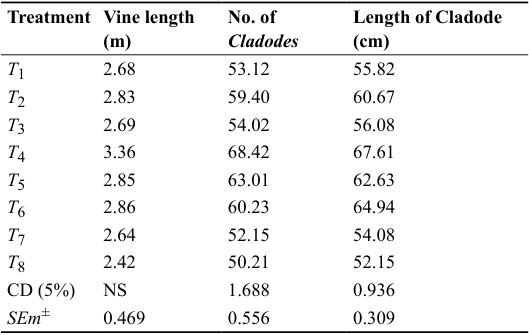 Table 1
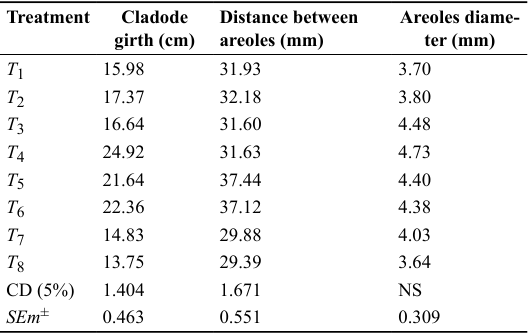 Table 2
Introduction
Dragon fruit is a perennial climbing cactus characterized by succulent triangular stems and large nocturnal flowers. The crop exhibits Crassulacean Acid Metabolism (CAM), a specialized photosynthetic pathway that enhances water-use efficiency and enables successful cultivation under arid and semi-arid conditions. This unique characteristic makes dragon fruit a promising crop for regions facing water scarcity and climate variability (Balaji et al., 2025). The fruit is highly valued for its nutritional and medicinal properties. Dragon fruit plants generally begin bearing fruits within two to three years after planting and continue productive fruiting for many years. The fruits are consumed fresh and are also processed into juice, squash, jam, jelly, wine, ice cream and other value-added products. Its increasing popularity in domestic and international markets has enhanced its commercial significance and created new opportunities for growers and entrepreneurs (Balaji et al., 2025). The growth and productivity of dragon fruit are influenced by several factors including climatic conditions, planting density, training system, irrigation management and nutrient availability. Among these factors, nutrient management plays a pivotal role because nutrient availability directly affects vegetative growth, flowering behaviour, fruit development and overall crop performance. Nutrients are essential components of plant metabolic processes and their adequate supply ensures proper physiological functioning throughout the growth cycle. Deficiency or imbalance of nutrients may adversely affect growth and reproductive development, ultimately reducing yield and fruit quality. Nitrogen is considered one of the most important macronutrients required by plants. It forms an integral part of amino acids, proteins, nucleic acids and chlorophyll molecules. Adequate nitrogen supply promotes vigorous vegetative growth, stem development, chlorophyll synthesis and photosynthetic activity. Phosphorus plays a critical role in ATP synthesis and various biochemical reactions associated with plant growth and development. Adequate phosphorus availability promotes strong root systems, enhances flowering and improves fruit set. In fruit crops, phosphorus has been reported to influence reproductive efficiency and overall crop productivity. Potassium is often referred to as the "quality nutrient" because of its significant influence on fruit development and quality attributes. It regulates osmotic balance, enzyme activation, carbohydrate metabolism and translocation of assimilates from source to sink tissues. Nutrient requirements vary with soil type, climatic conditions, plant age and management practices, making location-specific fertilizer recommendations essential. With the rapid expansion of dragon fruit cultivation in India, there is an increasing need to develop region-specific nutrient management practices for achieving higher productivity, superior fruit quality and greater profitability. Since information on optimum NPK requirements under different agro-climatic conditions is still limited, further research is necessary to standardize fertilizer doses for commercial cultivation. Therefore, considering the growing economic importance of dragon fruit and the need for scientific nutrient management, the present investigation entitled "Growth, Yield and Quality of Dragon Fruit as Influenced by Inorganic (NPK) Fertilization" was undertaken to evaluate the effect of different NPK levels on the growth, yield and quality of dragon fruit under agro-climatic conditions of Sriganganagar district, Rajasthan.
Materials and Methods
Materials and Methods
Experimental site
The experiment was conducted during 2025 at R K Goyal Dragon Fruit Farm located at Manfool Singh Road, Ganeshgarh, 26 LNP, Sri Ganganagar district of Rajasthan. The experimental site represents the arid-irrigated agro-climatic conditions of north-western Rajasthan.
Experimental design and layout
The experiment was laid out in a Randomized Block Design (RBD) comprising eight treatments and three replications, resulting in a total of 96 experimental poles. Each experimental pole has 4 vines of dragon fruit, spacing of poles 4.6 × 3.0 m. Three representative vines were randomly selected and tagged in each pole for recording observations throughout the experimental period.
Planting and crop management
The experiment was carried out during the period from June to September, 2025 on an already established dragon fruit orchard. All recommended cultural and plant protection practices were followed uniformly throughout the experimental period to ensure healthy growth and development of the crop.
Treatments and their application
Eight treatments were evaluated in the experiment as follows: Absolute control (Native fertility) (Note -20 kg FYM per pole was common to all treatments except treatment T 8 .)
Nitrogen, phosphorus and potassium were supplied through urea, single super phosphate (SSP) and muriate of potash (MOP), respectively. Phosphorus and potassium were applied as a full basal dose at the beginning of the experiment along with the first split of nitrogen. Nitrogen was applied in two equal splits, wherein the first half was applied during early June to promote vegetative growth and the remaining half was applied during late July to early august at the peak flowering and fruit development stage. The treatments were applied uniformly according to the prescribed concentrations and experimental protocol.
Observations recorded
Observations were recorded on the following six growth attributes: The observations were recorded from the tagged representative plants of each experimental plot, and treatment-wise values were used for statistical analysis.
Statistical analysis
The experimental data were statistically analyzed using the analysis of variance (ANOVA) appropriate for a Randomized Block Design. The significance of treatment effects was tested using the F-test.
Treatment means were compared using the Critical Difference (CD) at the 5% level of significance. The statistical analysis was carried out separately for each growth and yield parameter.
Results
Results
Effect on growth parameters of dragon fruit
The growth of dragon fruit was influenced by different levels of inorganic fertilizers applied during the course of investigation ( The treatments showed noticeable variation in the growth characters of dragon fruit, with T 4 recording the highest vine length, number of cladodes, cladode length and cladode girth. The maximum distance between areoles was recorded under T 5 , while T 4 recorded the highest areoles diameter. Overall, T 4 showed better performance for most of the vegetative growth parameters, whereas T 8 recorded the lowest values for most of the characters. The effect on vine length and areoles diameter was non-significant, while the remaining growth parameters showed significant differences among treatments.
Discussion
The present study revealed substantial variation in the growth performance of dragon fruit in response to inorganic fertilization (NPK) treatments.
The better growth under T 4 may be due to the balanced supply of nitrogen, phosphorus and potassium. Nitrogen plays an important role in vegetative growth and helps in formation of chlorophyll and plant tissues. Phosphorus is associated with root development, energy transfer and better utilization of nutrients, whereas potassium helps in movement of food materials, enzyme activity and overall plant vigour. Due to the combined effect of these nutrients, the plants under T 4 with better length and girth as compared to the control treatments. However, since the present experiment was not factorial in design, the observed response should not be interpreted as statistical synergism among N, P and K. Rather, T 4 performed favorably among the treatments evaluated under the specific experimental conditions of the study. Further investigations involving factorial combinations, different nutrient concentrations and application schedules would help to clarify individual nutrient contributions and nutrient interactions.Top of FormBottom of Form
Practical implications
The findings indicate that inorganic fertilization management can be considered as a potential component of nutrient management for dragon fruit under arid-irrigated conditions. The treatment combination evaluated as T 4 showed favourable growth responses in the present experiment. However, its broader commercial recommendation requires validation across seasons, locations and contrasting soil and production conditions. Optimization of basal doses of inorganic fertilizers and application time is also necessary to ensure adequate nutrient supply without causing injury.
Conclusion
The findings of the present investigation revealed that inorganic NPK fertilization had a noticeable effect on the vegetative growth characteristics of dragon fruit under the agro-climatic conditions of Sri Ganganagar, Rajasthan. Among the treatments evaluated, T 4 comprising 450 g N + 350 g P + 300 g K per pole recorded the most favourable overall response, with higher vine length, number of cladodes, cladode length and cladode girth, while the maximum distance between areoles was observed under T 5 . The improved vegetative growth may be attributed to the complementary roles of nitrogen, phosphorus and potassium in plant growth, nutrient uptake, photosynthetic activity and translocation of assimilates, although the present experimental design does not permit their individual effects to be separated. Therefore, the tested NPK treatment showed potential for improving the vegetative growth of dragon fruit under the conditions of the present study. Further multi-season and multi-location studies are required to validate the consistency of these responses and to determine the most suitable NPK fertilization schedule for dragon fruit production.
Figures and tables from the paper
References
10 in the original paper- Abirami K, Swain S, Baskaran V. Distinguishing three Dragon fruit (Hylocereus spp.) Species grown in Andaman and Nicobar Islands of India using morphological, biochemical and molecular traits. Sci Rep. 2021;11:2894.
- Ali A, Zahid N, Manickam S, Siddiqui Y, Alderson PG. Double Layer Coatings: A New Technique for Maintaining Physicochemical Characteristics and Antioxidant Properties of Dragon Fruit during Storage. Food Bioprocess Technol. 2014;7(8):23662374.
- Bajrang Nodal, Prerak Bhatnagar, Jitendra Singh, Prahlad VC, Arya CK, Chopra R. Integrated Nutrient Management Strategies Optimize Productivity and Fruit Quality in a Sustainable Guava (Psidium guajava L.) Production System. Applied fruit science. 2025;68:14.
- Barbeau G. Red pitaya, a new exotic fruit. Fruits. 1990;45:14174.
- Bellec FL, Vaillant F, Imbert E. Pitahaya (Hylocereus spp.): a new fruit crop, a market with a future. Fruits. 2006;61(4):237-50.
- Moshfeghi N, Mahdavi FO, Shahhosseini S, Malekifar S, Taghizadeh. Introducing a New Natural Product from Dragon Fruit. Int. J. Res. Rev. Appl. Sci. 2013;15:269-72.
- Muchjajib S, Muchjajib U. Application of Fertilizer for Pitaya (Hylocereus Undatus) Under Clay Soil Condition. Acta Horticulture. 2012;928:151-154.
- Pacharne DP, Tumbare AD. Effect of nutrient management on growth, yield and quality of Kharif groundnut. International Journal of Agricultural Sciences. 2016;12(2):163-166.
- International Journal of Horticulture and Food Science https://www.hortijournal.com 26631075, 2026, 8(9), Downloaded from https://www.doi.org/10.33545/26631067.2026.v8.i9b.862 by International Journal of Horticulture and Food Science on [28/09/2026]. See the Terms and Conditions (https://www.hortijournal.com) for rules of use; OA articles are governed by the applicable Creative Commons License 10. Package of practices for Horticultural crops of Assam. Assam Agricultural University, Jorhat & Department of Agriculture, Govt. of Assam; 2021. p. 47-48.
- How to cite this article: Sai D, Sharma N, Kumar M, Satdev. Growth of dragon fruit as influenced by inorganic (NPK) fertilization under arid-irrigated conditions. International Journal of Horticulture and Food Science. 2026;8(9):112-115. doi: https://w ww.doi.org/10.33545/26631067.2026.v8.i9b.862 International Journal of Horticulture and Food Science https://www.hortijournal.com 26631075, 2026, 8(9), Downloaded from https://www.doi.org/10.33545/26631067.2026.v8.i9b.862 by International Journal of Horticulture and Food Science on [28/09/2026]. See the Terms and Conditions (https://www.hortijournal.com) for rules of use; OA articles are governed by the applicable Creative Commons License