
Research article · 2026 · Full text
International Journal of Horticulture and Food ScienceInfluence of degree days on grape phenology, yield and quality of Manjari Naveen grapes grown under semi-arid conditions
Volume 8(8) · Pages 53–58 · DOI: 10.33545/26631067.2026.v8.i8a.838 ↗
Research areasHorticultural and Viticultural ResearchPlant Physiology and Cultivation StudiesBerry genetics and cultivation research
Abstract
Author-writtenGrape (Vitis vinifera L.) is one of the most economically important fruit crops in India, with Maharashtra being a significant contributor to the country's grape production. Phenological studies play an important role in understanding grapevine growth and development and the time requirements to plan activities during the season to harvest quality grapes. The main purpose of this research was to evaluate the productivity and phenology of the Manjari Naveen grape variety in a semi-arid region using a double pruning and single cropping system. The study was conducted at ICAR-National Research Centre for Grapes over three years (2020-21, 2021-22 and 2022-23). The Manjari Naveen scions were grafted onto 'Dogridge' rootstocks and trained in the Y trellis system, with a spacing of 9×5 feet. The harvesting was done in 113 days during the 2020-21 fruiting season and the yield was 15.41 ton/ha. In the season 2021-22, the harvesting was done in 119 days and the yield was 17.98 tons/ha. While, during the fruiting season of 2022-23, it took 122 days to mature the grape berries and the yield was 13.28 tons/ha.
Summary
Source-checkedPlain-language reading of the full paper, prepared with AI and checked against the text. Each point links to the authors' own words.
Why it matters
- Grapes are a major economic fruit crop in India, with the state of Maharashtra contributing significantly to national production. View evidence ↗
- Studying phenology is essential for understanding how grapevines grow and for planning seasonal activities to ensure high-quality harvests. View evidence ↗
- Climate change, leading to warmer and drier conditions, significantly impacts grapevine growth, the composition of the fruit, and the timing of harvests. View evidence ↗
The question
- The study aimed to evaluate the phenology and productivity of the Manjari Naveen grape variety grown in a semi-arid region using a single cropping and double pruning system. View evidence ↗
- The researchers specifically sought to understand how weather conditions relate to the phenological stages of Manjari Naveen grapes. View evidence ↗
What they did
- The study used a five-year-old vineyard of Manjari Naveen grapes grafted onto Dogridge rootstock at the ICAR-National Research Centre for Grapes in Pune from 2020 to 2023. View evidence ↗
- The grapevines were trained using an extended Y-Trellis system with a spacing of 9 by 5 feet. View evidence ↗
- Phenological and productive behavior were evaluated using 10 representative grapevines between October 2020 and February 2023. View evidence ↗
- Thermal demands were measured by calculating Degree Days (DD) using the average of maximum and minimum temperatures minus 10. View evidence ↗
What they found
- Manjari Naveen grapes reached maturity between 113 and 122 days after fruit pruning. View evidence ↗
- The 2021-22 season produced the best physical results, including a berry weight of 3.55 g, berry diameter of 17.86 mm, berry length of 22.66 mm, bunch weight of 418.20 g, and a yield of 18.57 kg per vine. View evidence ↗
- The 2020-21 season was characterized by the highest Total Soluble Solids (TSS) at 17.84 0Brix and the lowest acidity at 0.54%. View evidence ↗
- In the 2022-23 season, the time required to reach growth stages was longer, resulting in a delayed harvest. View evidence ↗
What it means
- The authors concluded that temperature variations affect growth stages, with higher temperatures accelerating critical stages such as flowering and bud break, which helps ensure optimal fruit set. View evidence ↗
- The authors state that understanding these phenological and productive patterns is useful for optimizing the distribution of labor for pruning, harvesting, and other management practices. View evidence ↗
Visual summary
2 visualsIllustrations explain the paper; charts are replotted from the paper's own table values.
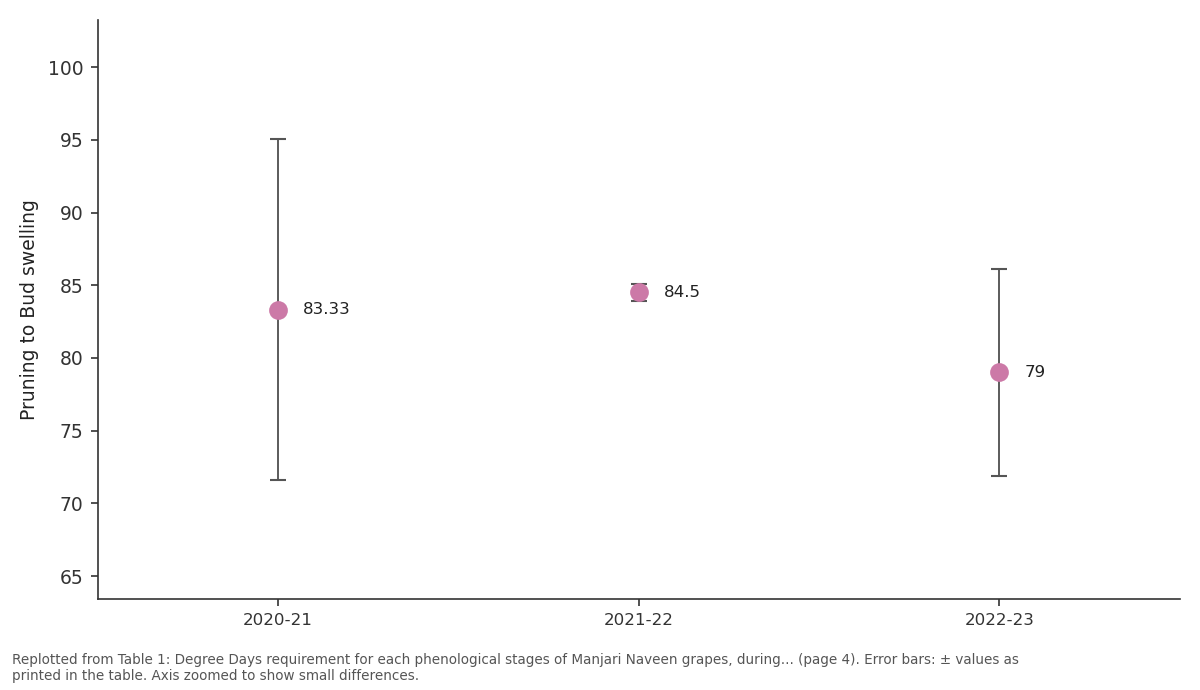
Pruning to Bud swelling: 2020-21 vs 2021-22 vs 2022-23
Replotted from Table 1 (page 4) of the original paper. Every bar is the paper's own table value.
View source evidence ↗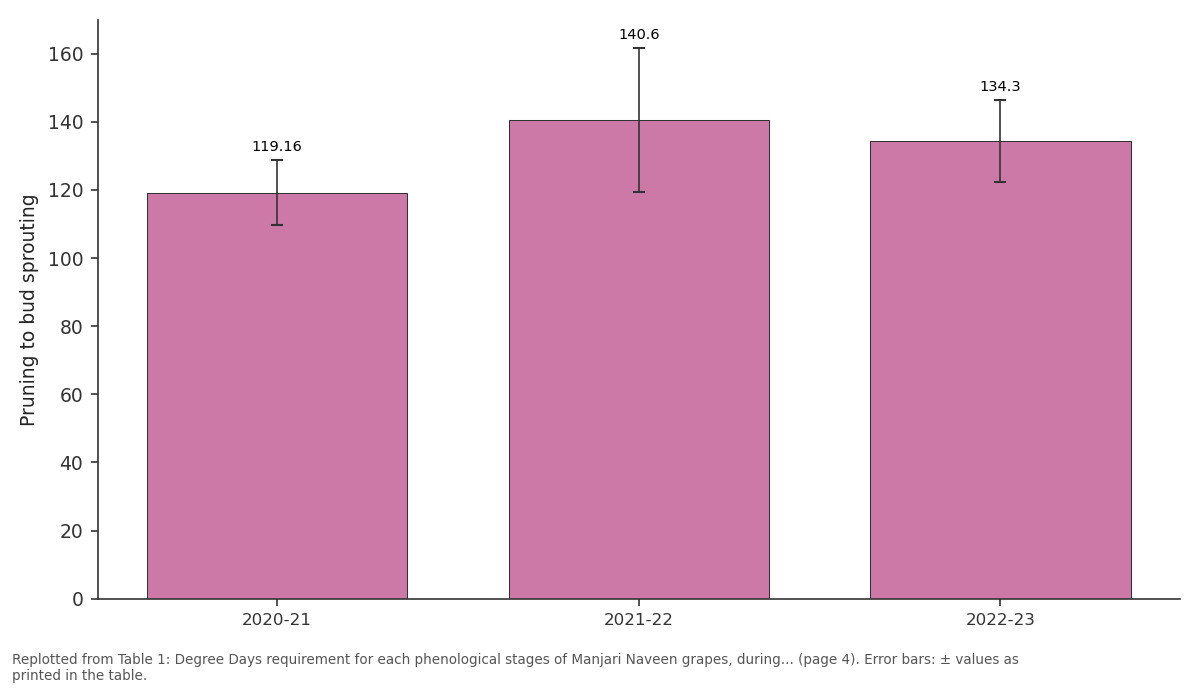
Pruning to bud sprouting: 2020-21 vs 2021-22 vs 2022-23
Replotted from Table 1 (page 4) of the original paper. Every bar is the paper's own table value.
View source evidence ↗Figures & tables
From the original paper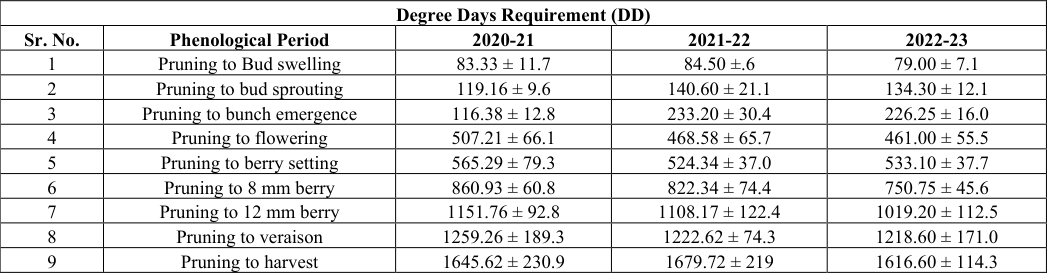 Table 1
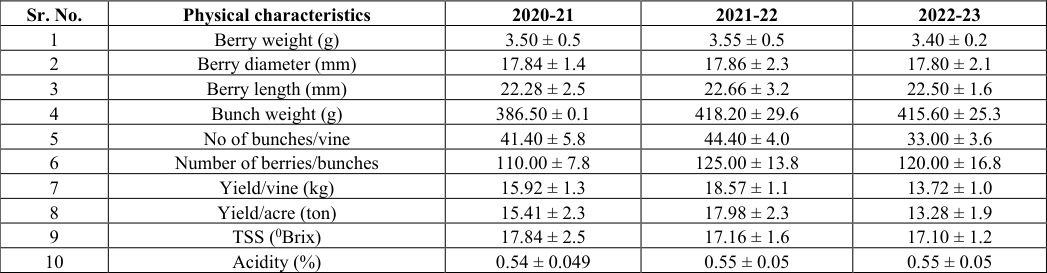 Table 2
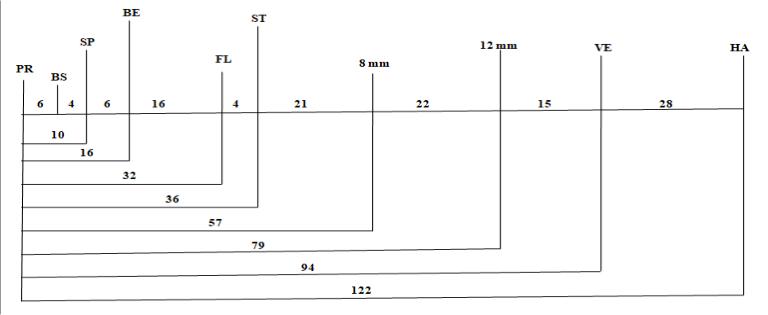 Figure 1
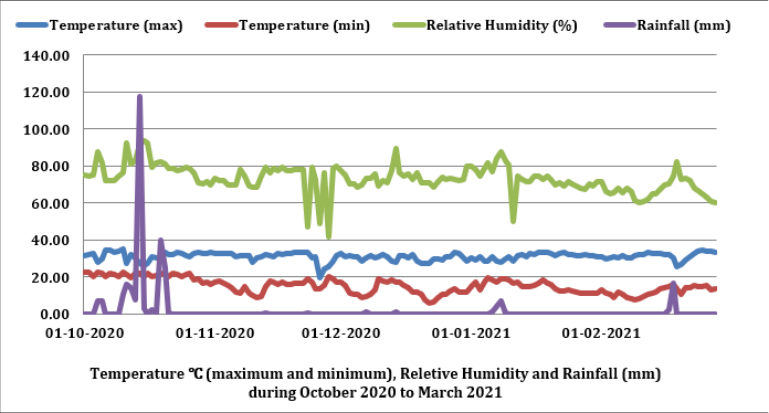 Figure 1
Introduction
Manjari Naveen is one of the white seedless table grape varieties with mild muscat flavor grown for table purposes. The fruit ripens in 110 to 115 days after forward pruning, which is about 25 to 30 days earlier than present Thompson Seedless. The variety does not require gibberellic acid for bunch elongation and produces uniform berries and clusters and requires minimal thinning. The fruit can be harvested at 16 0 Brix; hence, quick packing for precooling and cold storage is recommended to maintain its quality. Climate plays a crucial role in grape production (De Orduna et al., 2010) [5] . As climate change continues to cause warmer and drier weather, it is having a significant impact on the growth, fruit composition, and early harvest. Grapevine yield and quality are heavily influenced by climate conditions and depend on complex interactions between temperatures, water availability, plant material and viticultural practices. Many growers have been able to improve yield and quality by using plant material and viticultural practices suited to their local climate. To adapt to higher temperatures, growers may need to change their plant material and modify their viticultural practices, such as adjusting their harvest dates (Van Leeuwen et al., 2019) [18] . The phenology of grapevines tends to occur earlier, impacting sugar and acid levels and ultimately affecting grape quality (Bock et al., 2011) [3] . Heat units, which are also linked to climate change, have been found to delay ripening in berries and to cause a significant reduction in berry quality (Greer and Weedon, 2013) [7] . The total soluble solids, pH, and titratable acidity of berry juice at harvest are affected by the variety and thermal level. The claim that temperature reduces titratable acidity and increases pH is an oversimplification that highlights the risk of generalizations based on indirect evidence, where temperature is confounded with other factors (Sadras et al., 2013) [15] . These changes in grapevine phenology may result in alterations in grape composition, such as early maturity, separation between anthocyanins and sugars, and lower acidity due to increased temperatures (Ramos and de Toda, 2020) [13] .
To adapt to changing climates, grape growers can use the phenological diversity of grape varieties as a tool (Wolkovich et al., 2017) [20] . Different grapevine cultivars exhibit different temperature requirements to reach key phenological stages. By understanding the temperature requirements of different grapevine varieties using temperature-based phenological modelling, growers can select varieties that are more suited to future warmer conditions. This knowledge can help vine growers adapt to climate change by using grapevine cultivars that are better adapted to changing climates (Parker et al., 2020; Fraga et al., 2016) [12][6] . Manjari Naveen is a seedless table grape variety with naturally bold berries, loose bunches, and a short-duration variety (Somkuwar et al., 2020) [17] being grown in different grape-growing regions in Maharashtra. To understand degree days requirement for table grapes in relation to planning for cultural practices becomes important under semi-arid conditions. The study was therefore planned to know the phenological stages in relation to weather conditions in Manjari Naveen grapes.
Materials and methods
The experiment was conducted at ICAR-National Research Centre for Grapes, Pune during 2020 to 2023. A five-yearold vineyard of Manjari Naveen grafted on Dogridge rootstock was selected for study. The vines were trained to extended Y-Trellis spaced at a 9 x 5 feet distance. The region experiences a tropical wet and dry climate, where double pruning and single cropping are being practiced. The foundation pruning was carried out in April, while fruit pruning was done in October. Pune (18.32°N and 73.51°E) experiences an average temperature ranging from 20 to 28 C, with an annual precipitation of 700 to 750 mm from June to September. The phenological and productive behaviour of Manjari Naveen grapes was evaluated using representative grapevines (n=10) of the experimental area during the period from October 2020 to February 2023. The duration of the main phenological stages and thermal requirement (degree days) from pruning to harvest were determined during the experiment. The vine was consistently adjusted to have 25 to 30 canes per vine during the fruit pruning. Forward pruning was done, leaving a single bud after the knot on the sub-cane, followed by application of hydrogen cyanamide for uniform budburst. To determine the duration of the phenological stages of Manjari Naveen, five canes per vine were recorded and evaluated through visual observations from the pruning stage (PR) onwards. The stages were considered to have reached 50% bud swell (BS): when the scales were broken and green tissue was visible; sprouting (SP): when the first leaf of the sprout was fully expanded; bunch emergence (BE): when 50% of the shoots presented the inflorescence, with clusters visible. Flowering (FL): when 50% of the flowers were open, with visible flowers; veraison (VE): when 50% of the berries had changed colour and started softening and Harvest (HA): when 100% of the grapes showed intense colour with a proper TSS level. Meteorological data were collected from the weather station, ICAR-National Research Centre for Grapes, Pune (Appendix A, B and C). To characterize the thermal demands of Manjari Naveen grape, the degree day (DD) from pruning to harvest was calculated using the following formula.
Degree Days= (Maximum Temperature + Minimum Temperature)/2-10 Ten vines were selected to record the observations on number of bunches/vine and average bunch weight was calculated on five bunches on each vine. Berry diameter, berry length and berry weight were measured on 5 bunches and 10 berries of each bunch. Yield/vine and yield/acre were determined on ten vines. The number of berries/bunches was calculated on five bunches of each vine. TSS and acidity were measured by extracting juice from 10 berries from each vine. TSS was measured using a refractometer and acidity was determined by the titration method. Based on the average number of bunches per vine, average weight of bunches, and the number of vines per acre, estimates yield were obtained as per Roberto et al. (2012) [14] . The physicochemical and productive characteristics of the 'Manjari Naveen' grape are presented as mean values and standard deviations for each variable during the fruit pruning seasons 2020-2021, 2021-2022 and 2022-2023.
Results and discussion
The data recorded on various phenological stages are presented in Fig. 1. The fruits of grape variety Manjari Naveen matured in 113-122 days from fruit pruning. The harvesting stage was passed through different stages called as sub periods e.g. from pruning to bud swelling (PR-BS), pruning to sprouting (PR-SP), pruning to bunch emergence (PR-BE), pruning to flowering (PR-FL), pruning to berry setting (PR-ST), pruning to 8mm (PR-8mm), pruning to 12mm (PR-12mm), pruning to veraison (PR-VA) and pruning to harvest (PR-HA) recorded 8, 10, 13, 35, 39, 59, 79, 87, and 113 days respectively, during the fruit pruning season of 2020-21 (Fig 1a). In the 2021-22 fruit pruning season, the same variety was harvested in 119 days with the durations of the sub-periods from pruning to different stages was 6, 9, 15, 30, 33, 55, 75, 86 and 119 days for PR-BS, PR-SP, PR-BE, PR-FL, PR-ST, PR-8mm, PR-12mm, PR-Veraison and PR-HA, respectively (Fig 1b). During the 2022-23 fruit pruning season, durations of the sub-periods from pruning to different stages were 6, 10, 16, 32, 36, 57, 79, 94 and 122 days for PR-BS, PR-SP, PR-BE, PR-FL, PR-ST, PR-8mm, PR-12mm, PR-Veraison and PR-HA, respectively (Fig 1c). In viticulture, different grape varieties behave differently in achieving the major growth and developmental stages. Thus, the knowledge of phenological stages in viticulture helps in cultivar selection, manpower and cultural practice scheduling. After the fruit pruning, the increase in temperature results in a higher rate of vegetative growth. Photoperiod and temperature can alter hormone levels, inducing or inhibiting the expression of genes, and leading to the endogenous synthesis of gibberellins, which promote budburst. Extended periods of daylight can stimulate the internal production of gibberellins, which counteract the effects of abscisic acid (ABA) and facilitate budburst. During off-season cropping, grapevines maintain photosynthetically active leaves throughout their growth cycle (Kishino et al., 2019) [10] . Consequently, it can be concluded that the shortening of the growth cycle during this period is associated with the timing of vine pruning. The seasons of 2020-21 and 2021-22 experienced the highest rainfall from the pruning to sprouting stage. During the 2022-23 season, there was significantly less rainfall recorded during berry development stages, which occur from flowering to veraison, and a dry period of about 112 days. Grapevines require the maximum amount of water during the phenological phase from flowering to fruit set (Winkler, 1974) [19] , while prolonged droughts can cause delays in the formation of bunches and the harvest of crops. During the fruit pruning season of 2022-23, the variety reported a longer period to attain growth stages and the harvest period was also delayed. During the period of bud sprouting to shoot development, buildup of high humidity can lead to the development of downy mildew, while after the berry setting stage, powdery mildew becomes a major problem in the vineyard. Similarly, during the berry development stages, humidity can impact berry size, sugar development and flavour in the grape berries. Therefore, maintaining a balanced humidity level is crucial to obtain both yield and quality. Temperature plays a critical role in berry development stages, affecting sugar content, flavour, and ripening. Cool temperatures can slow down the process, potentially leading to a delay in sugar development, while excessive heat may accelerate ripening, leading to over ripeness thereby reducing grape quality. Optimal temperature management is essential for grape quality. The levels of hormones in plants can be influenced by photoperiod and temperature. This is because they can affect the expression of genes that encode enzymes involved in the biosynthesis of plant growth hormones (Kerbauy, 2012) [9] . Longer days can trigger the synthesis of gibberellins, which can counter the effects of abscisic acid and promote budburst. The harvest duration of any grape variety changes with location, soil and weather conditions in that area, canopy management practices followed and rootstock used. The duration of the productive cycle of grapevines depends on factors such as canopy/rootstock combination, plant vigour in the given edaphoclimatic condition and yield (Kishino et al., 2019) [10] . The grape variety BRS Clara Seedless grown in a subtropical region has a production cycle of 120 days for the off-season crop (Colombo et al., 2011) [4] , while the cycle duration could be reduced to 97 days in semi-arid regions due to variations in temperature and climate (Santos et al., 2015) [16] . The total degree days requirement from pruning to harvest (PR-HA) during the 2020-21 season was 1645.62. The subperiods, PR-BS, PR-SP, PR-BE, PR-FL, PR-ST, PR-8mm, PR-12mm and PR-Veraison, had degree days requirements of 83.33, 119. 16 1). The temperature in different regions, from temperate to sub-tropical and tropical regions, varies significantly. Subtropical regions have temperatures that are cooler than tropical climates but warmer than temperate zones and winters are generally slightly cool with unpredictable temperatures. Winter conditions can be unstable and may cause a variation in the accumulation of degree days over several years in the same location. This variation may accelerate or delay the onset of plant development (Hussain et al., 2016) [8] . The periods with the highest thermal demand were FL-VE and VE-HA in Manjari Naveen grapes during 2020-2023. Koyama et al. (2020) [11] also reported degree days requirement of 1744 and 1845 in summer and off-seasonal crop of "BRS Melodia" grape. The data presented in Table 2 for the season of 2021-22 showed better results in terms of berry weight (3.55 g), berry diameter (17.86 mm), berry length (22.66 mm), bunch weight (418.20 g), yield/vine (18.57 kg) and yield/acre (17.98 ton). In contrast, the 2020-21 season had good TSS (17.84 0 Brix) and the lowest acidity (0.54%). The present results indicated the impact of degree days on yield and quality in grapes. During the cropping season of 2020-21, there was a decrease in the bunch weight, number of bunches/vines, berry length, berry diameter, yield and TSS. This difference was caused by the fact that the vines had to pass through different phases for growth and bear fruit under different weather conditions compared to other crop seasons. According to Anzanello and Souza (2015) [2] shoots from off-season crops of table grape cultivars can change the leaf area index, which affects the synthesis and dynamics of carbohydrate reserve storage and consumption in the canes. These changes have a significant impact on the overall mass of the grape bunches. Understanding the phenological and productive behaviour of the vines can be useful in optimizing labour distribution for various management practices such as pruning, harvesting, cultural treatments and the application of phytosanitary products. Considering the improvement in colour of grapes, vineyards can use defoliation and crop load adjustment techniques (Kishino et al., 2019) [10] . The colour of 'BRSI sis' seedless grapes is greatly influenced by the climate, specifically the air temperature. The annual yield of 'BRS Isis' is high, producing 47.7 tons per hectare, which is more than other seedless grape varieties like 'Superior Seedless', 'Thompson Seedless', and 'Crimson Seedless' grown in semi-arid or subtropical regions under annual double cropping systems (Ahmed et al., 2019) [1] .
| Sr. No. | Physical characteristics | 2020-21 | 2021-22 | 2022-23 |
|---|---|---|---|---|
| 1 | Berry weight (g) | 3.50 ± 0.5 | 3.55 ± 0.5 | 3.40 ± 0.2 |
| 2 | Berry diameter (mm) | 17.84 ± 1.4 | 17.86 ± 2.3 | 17.80 ± 2.1 |
| 3 | Berry length (mm) | 22.28 ± 2.5 | 22.66 ± 3.2 | 22.50 ± 1.6 |
| 4 | Bunch weight (g) | 386.50 ± 0.1 | 418.20 ± 29.6 | 415.60 ± 25.3 |
| 5 | No of bunches/vine | 41.40 ± 5.8 | 44.40 ± 4.0 | 33.00 ± 3.6 |
| 6 | Number of berries/bunches | 110.00 ± 7.8 | 125.00 ± 13.8 | 120.00 ± 16.8 |
| 7 | Yield/vine (kg) | 15.92 ± 1.3 | 18.57 ± 1.1 | 13.72 ± 1.0 |
| 8 | Yield/acre (ton) | 15.41 ± 2.3 | 17.98 ± 2.3 | 13.28 ± 1.9 |
| 9 | TSS (0Brix) | 17.84 ± 2.5 | 17.16 ± 1.6 | 17.10 ± 1.2 |
| 10 | Acidity (%) | 0.54 ± 0.049 | 0.55 ± 0.05 | 0.55 ± 0.05 |
Table text extracted from the original PDF; superscript letters are shown inline. The original table image is below.
View original table image
Conclusion
The present study examined the growth stages of grapevines and how temperature, humidity and rainfall affected their phenological stages. The variation in temperature could affect the growth stages after fruit pruning in Manjari Naveen grapes. Higher temperatures advanced critical stages like bud break and flowering, ensuring uniformity and optimal fruit set. Adequate rainfall can either boost or slow down grape growth, impacting phenological stages and quality. Manjari Naveen seedless grape recorded a yield of 15.41 ton/ha in 113 days in 2020-21 and 17.98 tons/ha in 119 days in 2021-22. The 2021-22 season showed better results in terms of berry weight (3.55 g), berry diameter (17.86 mm), berry length (22.66 mm), bunch weight (418.20 g), number of bunches/vine (44), number of berries/bunch (125), yield/vine (18.57 kg) and yield/acre (17.98 tons). In contrast, the 2020-21 season had good TSS (17.84 0 Brix) and the lowest acidity (0.54%). C, y PR-BS: pruning to bud swelling, PR-SP: pruning to sprouting, PR-BE: pruning to bunch emergence, PR-FL: pruning to flowering, PR-ST: pruning to berry setting, PR-8mm: pruning to 8mm, PR-12mm: pruning to 12mm, PR-VA: pruning to veraison, and PR-HA: pruning to harvest.
Acknowledgement
AcknowledgmentsThe authors highly acknowledge the National Research Centre for Grapes, Pune for the support and contributions.
Figures and tables from the paper
| Degree Days Requirement (DD) | — | — | — | — |
|---|---|---|---|---|
| Sr. No. | Phenological Period | 2020-21 | 2021-22 | 2022-23 |
| 1 | Pruning to Bud swelling | 83.33 ± 11.7 | 84.50 ±.6 | 79.00 ± 7.1 |
| 2 | Pruning to bud sprouting | 119.16 ± 9.6 | 140.60 ± 21.1 | 134.30 ± 12.1 |
| 3 | Pruning to bunch emergence | 116.38 ± 12.8 | 233.20 ± 30.4 | 226.25 ± 16.0 |
| 4 | Pruning to flowering | 507.21 ± 66.1 | 468.58 ± 65.7 | 461.00 ± 55.5 |
| 5 | Pruning to berry setting | 565.29 ± 79.3 | 524.34 ± 37.0 | 533.10 ± 37.7 |
| 6 | Pruning to 8 mm berry | 860.93 ± 60.8 | 822.34 ± 74.4 | 750.75 ± 45.6 |
| 7 | Pruning to 12 mm berry | 1151.76 ± 92.8 | 1108.17 ± 122.4 | 1019.20 ± 112.5 |
| 8 | Pruning to veraison | 1259.26 ± 189.3 | 1222.62 ± 74.3 | 1218.60 ± 171.0 |
| 9 | Pruning to harvest | 1645.62 ± 230.9 | 1679.72 ± 219 | 1616.60 ± 114.3 |
Table text extracted from the original PDF; superscript letters are shown inline. The original table image is below.
View original table image
References
20 in the original paper- Ahmed S, Roberto SR, Shahab M, Colombo RC, Silvestre JP, Koyama R, et al. Proposal of doublecropping system for 'BRS Isis' seedless grape grown in subtropical area. Sci Hortic. 2019;251:118-126.
- Anzanello R, Souza PVD. Content of reserves, vegetative vigour and yield of grapevines submitted to two harvests per vegetative cycle. Semina Cienc Agrar. 2015;36:719-730.
- Bock A, Sparks T, Estrella N, Menzel A. Changes in the phenology and composition of wine from Franconia, Germany. Clim Res. 2011;50:69-81.
- Colombo LA, Roberto SR, Tessmann DJ, Genta W, Sato AJ, Assis AM. Physical-chemical and productive characteristics of 'BRS Clara' under protected cultivation. Rev Bras Frutic. 2011;33:798-808.
- De Orduna RM. Climate change associated effects on grape and wine quality and production. Food Res Int. 2010;43:1844-1855.
- Fraga H, García de Cortázar-Atauri I, Malheiro AC, Santos JA. Modelling climate change impacts on viticultural yield, phenology and stress conditions in Europe. Glob Chang Biol. 2016;22:3774-3788.
- Greer DH, Weedon MM. The impact of high temperatures on Vitis vinifera cv. Semillon grapevine performance and berry ripening. Front Plant Sci. 2013;4:491.
- Hussain I, Roberto SR, Fonseca ICB, Assis AM, Koyama R, Antunes LEC. Phenology of 'Tupy' and 'Xavante' blackberries grown in a subtropical area. Sci Hortic. 2016;201:78-83.
- Kerbauy GB. Fisiologia vegetal. 2nd ed. Rio de Janeiro: Guanabara Koogan; 2012.
- Kishino AY, Carvalho SLC, Roberto SR. Viticultura tropical: o sistema de produção de uvas de mesa. Londrina: IAPAR; 2019.
- Koyama R, Borges WFS, Colombo RC, Hussain I, Souza RT, Roberto SR. Phenology and yield of the hybrid seedless grape 'BRS Melodia' grown in an annual double cropping system in a subtropical area. Horticulturae. 2020;6(1):3.
- Parker A, García de Cortázar-Atauri I, Trought MC, Destrac A, Agnew R, Sturman A, et al. Adaptation to climate change by determining grapevine cultivar differences using temperature-based phenology models. OENO One. 2020;54(4):955-974.
- Ramos MC, de Toda FM. Variability in the potential effects of climate change on phenology and on grape composition of Tempranillo in three zones of the Rioja DOCa (Spain). Eur J Agron. 2020;115:126014.
- Roberto SR, Assis AM, Yamamoto LY, Miotto LCV, Sato AJ, Koyama R, et al. Application timing and concentration of abscisic acid improve color of 'Benitaka' table grape. Sci Hortic. 2012;142:44-48.
- Sadras VO, Petrie PR, Moran MA. Effects of elevated temperature in grapevine. II. Juice pH, titratable acidity, and wine sensory attributes. Aust J Grape Wine Res. 2013;19:107-115.
- Santos SDL, Ribeiro VG, Lima MAC, Souza ER, Shishido WK. Influence of gibberellic acid on physiology and quality of grapevine cv. Sweet Celebration in the Submedium of São Francisco. Rev Bras Frutic. 2015;37:827-834.
- Somkuwar RG, Samarth RR, Ghule VS, Sharma AK. Crop load regulation to improve yield and quality of Manjari Naveen grape. Indian J Hortic. 2020;77(2):381383.
- Van Leeuwen C, Destrac-Irvine A, Dubernet M, Duchêne E, Gowdy M, Marguerit E, et al. An update on the impact of climate change in viticulture and potential adaptations. Agronomy. 2019;9:514.
- Winkler AJ, Cook JA, Kliewer WM, Lider LA. General viticulture. Berkeley (CA): University of California Press; 1974.
- Wolkovich EM, Burge DO, Walker MA, Nicholas KA. Phenological diversity provides opportunities for climate change adaptation in winegrapes. J Ecol. 2017;105:905-912.