
Research article · 2026 · Full text
International Journal of Agriculture and NutritionTechniques for encapsulating slow-release fertilizers using smart polymers: Towards controlled and sustainable release of plant nutrients: A review
Volume 8(8) · Pages 07–11 · DOI: 10.33545/26646064.2026.v8.i8a.729 ↗
Research areasPolymer-Based Agricultural EnhancementsMicroencapsulation and Drying ProcessesAdvanced Drug Delivery Systems
Abstract
Author-writtenThis paper reviews recent advances in the encapsulation of slow- and controlled-release fertilizers with smart polymer technologies as an innovative approach towards enhancing nutrient use efficiency and sustainable agriculture. Conventional fertilizers suffer huge losses of nutrients by leaching, volatilization, and fixation which ultimately reduce the efficiency of the fertilizer and have serious environmental consequences like contamination of groundwater and eutrophication. The smart polymer coating can best cope with this problem by regulating the release of nutrients according to environmental stimuli such as temperature, soil moisture, and pH, thus synchronizing nutrient availability with plant physiological requirements. The paper covers classification and functional mechanisms of stimulus-responsive polymers, encapsulation and coating technologies, nutrient release kinetics, the influence of interactions between polymeric coatings and soil physicochemical properties, and the influence of soil microbiota on polymer degradation. It also discusses the present problems related to synthetic polymer residues and microplastic accumulation and stresses the switch to biodegradable biopolymers like carboxymethyl cellulose, alginate, and nano-chitosan. It further reviews the economic feasibility, future research directions, and recommendations for enhancing the application of smart fertilizer technologies. In general, smart polymer-based controlled-release fertilizers are a key element of climate-smart agriculture and a sustainable approach to enhancing agricultural productivity while reducing environmental impacts.
Summary
Source-checkedPlain-language reading of the full paper, prepared with AI and checked against the text. Each point links to the authors' own words.
Why it matters
- Traditional fertilizers are inefficient because they lose significant amounts of nutrients to leaching, volatilization, and fixation, which pollutes groundwater and causes eutrophication. View evidence ↗
- In traditional fertilization methods, plants lose between 40-70% of added nitrogen and approximately 80% of added phosphorus. View evidence ↗
- The absorption efficiency of traditional fertilizers is low, with plants utilizing only 30-50% of nitrogen and 50-60% of both phosphorus and potassium. View evidence ↗
The question
- The paper aims to review recent advancements in using smart polymer technologies to encapsulate fertilizers to improve nutrient use efficiency and support sustainable agriculture. View evidence ↗
What they did
- Controlled-release fertilizers (CRFs) are created by applying a smart polymer film coating to highly soluble fertilizers like urea, ammonium nitrate, or NPK compounds. View evidence ↗
- Industrial production of coated fertilizers primarily uses spray coating or fluidized-bed coating, with the latter being superior for creating uniform nanocoatings. View evidence ↗
- Smart polymers are classified by their response to environmental stimuli: thermo-responsive polymers react to temperature, pH-responsive polymers react to hydrogen ion concentration, and hydro-responsive polymers react to water absorption. View evidence ↗
What they found
- Smart polymer-coated fertilizers increase nutrient uptake efficiency to 75-90%, compared to only 30-50% for conventional fertilizers. View evidence ↗
- Using smart fertilizers allows for a single application at planting instead of 3-5 times per season, reducing labor and fuel costs by up to 70%. View evidence ↗
- In greenhouse and soilless cultivation, polymer capsules can reduce nutrient loss through drainage water by more than 60%. View evidence ↗
- Polymeric membranes protect sensitive seedlings, such as peppers and tomatoes, from 'root scorching' by preventing sharp increases in soil osmotic pressure. View evidence ↗
- First-generation petrochemical-derived polymers leave behind empty casings that disintegrate into microplastics, which can enter the food chain via plant roots. View evidence ↗
- The production cost of smart polymer-coated fertilizers is 200% to 400% higher than that of conventional fertilizers, hindering widespread adoption for low-margin crops. View evidence ↗
What it means
- The authors conclude that smart polymer encapsulation of fertilizers is a fundamental component for transitioning to global climate-smart agriculture. View evidence ↗
- A current limitation is the instability of nutrient release during extreme weather events like floods or severe droughts, which disrupts the polymer's response. View evidence ↗
Visual summary
1 visualsIllustrations explain the paper; they do not show study data.
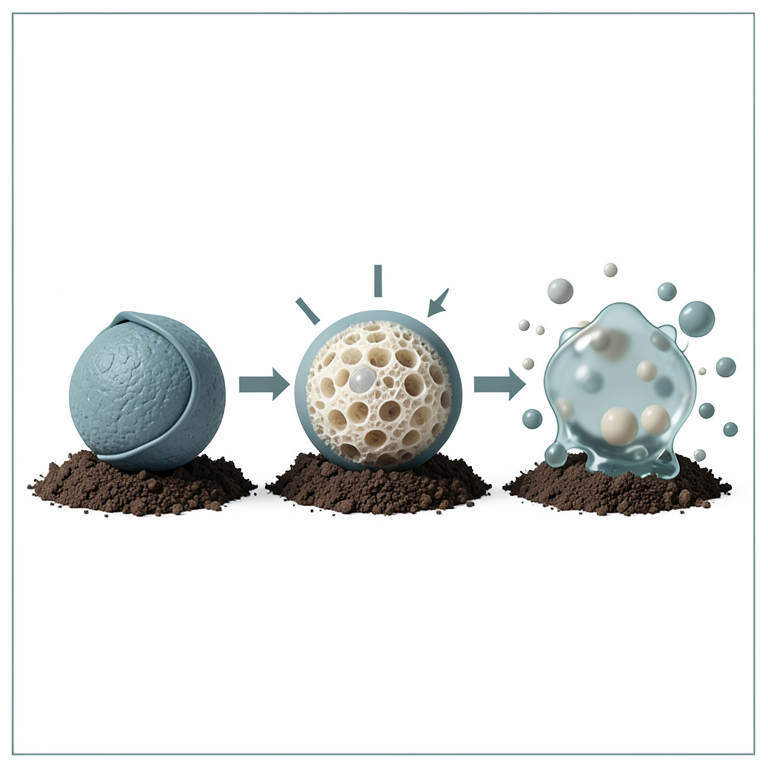
Stimulus-Responsive Polymer Mechanisms
AI-generated conceptual illustration (polymer-encapsulated fertilizer granules in soil). It explains the idea and does not show study data.
View source evidence ↗Figures & tables
From the original paper Table 1
Introduction
Synthetic chemical fertilizers are the major types of fertilizers applied in agriculture. They are manufactured from macro-primary soil nutrients, which are highly potent and efficient. Ammonium sulfate, urea, and ammonia plus some fillers are the common constituents [1,2] . Different types of crops and soil conditions where they are to be applied also determine other filler materials. In effect, they are therefore instrumental in increasing agricultural production to meet the world's food demand. The problem is with the traditional method of fertilization; the plants lose 40-70% of nitrogen and about 80% of phosphorus added to the soil. This loss is mainly due to leaching; volatilization and chemical fixation within the soil are also responsible for it. This harm goes beyond huge financial losses to the farmers; it also leads to environmental calamities like water bodies' eutrophication and groundwater getting contaminated with nitrates. [1][2][3] This has led to rapid population growth and, hence, massive pressure on the agriculture sector, forcing the farmers to use more chemical fertilizers, especially to meet the demand for food across the globe. This, in turn, raises the cost of food production and contributes to environmental pollution through the release of emissions and contamination of water sources. A good example of a substance that is quickly lost through evaporation and leaching when applied in fields is urea; also, modern methods of fertilization lack the required efficiency to meet the nitrogen needs of plants [3][4][5] Increased crop productivity in modern agriculture is linked to a growing reliance on fertilisers as a cornerstone of the agricultural system, owing to their pivotal role in boosting the yield of food crops. Statistics indicate that global consumption of nutrients exceeded 186 million tonnes in 2016.
This was distributed among nitrogen, phosphorus and potassium as 111 million tonnes, 42 million tonnes and 33 million tonnes respectively. With demand continuing to rise at an estimated annual rate of 1.6 per cent, total consumption is expected to reach 201 million tonnes by 2021. However, the problem lies in the low efficiency with which plants absorb these fertilisers; plants utilise only a limited proportion of the traditional fertilisers applied, ranging from 30 -50 per cent for nitrogen, 50-60 per cent for phosphorus and 50-60 per cent for potassium. This loss results in these elements ending up as waste in the surrounding environment, causing environmental pollution and posing a threat to public health. [4,5] It is therefore of the utmost importance to modernise systems that enhance production efficiency and reduce environmental problems. Slow-release fertilisers may be one such solution, offering an effective alternative and a promising strategic option, as they are believed to improve crop yield and quality whilst reducing environmental pollution caused by hazardous emissions compared to conventional fertilisers [4][5][6] Consequently, fertiliser delivery technologies have emerged as innovative solutions and are among the most prominent practices of sustainable smart agriculture, owing to their ability to modulate the rate at which nutrients are released into the soil to match the physiological requirements of plants throughout the growing season.
Slow-release and controlled-release fertilizers
There is a common confusion in agricultural and chemical literature between the terms 'slow-release fertilizers' (SRFs)" and "controlled-release fertilizers' (CRFs). a. Slow-release fertilisers: The release of nutrients from these fertilisers depends on the chemical or microbial decomposition of compounds that are inherently poorly soluble in water (such as urea-formaldehyde or isobutylidene diurea). This release is randomly influenced by soil environmental conditions, such as bacterial activity and soil moisture, making it impossible to predict accurately or programme in advance [8] . b. Controlled-release fertilisers: these are conventional, highly soluble fertilisers (such as pure urea, ammonium nitrate or NPK compound fertilisers) that are physically coated with an advanced, smart' polymer film. The rate and pattern of nutrient release in this technology are strictly and programmably controlled via the properties of the laboratory-designed polymeric film, allowing the flow of nutrients to be precisely adjusted to match the plant's physiological demand curve throughout its growth stages, from germination to harvest [7] .
Materials engineering and structural properties of smart polymers 1. Classification of smart polymers and their mechanisms of response to environmental stimuli
Smart polymers, or stimulus-responsive polymers, are characterised by their high capacity to exhibit significant physical or chemical changes in their network structure when exposed to subtle environmental stimuli in the rhizosphere [8][9][10][11][12] . These materials are classified according to the type of physical or chemical stimulus as follows: a. Thermo-responsive polymers: These polymers possess a lower critical solution temperature (LCST).
Their spatial structure and porosity change with soil temperature; when the temperature rises during periods of active growth (spring and summer), the polymer pores expand to allow the passage of dissolved nutrients, and contract during colder periods (winter) to prevent fertiliser wastage in the absence of plant activity [9] . b. pH-responsive polymers: these contain ionisable functional groups (such as carboxyl or amine groups) that respond to changes in the soil's hydrogen ion concentration. This is crucial because plant roots secrete organic acids (such as citric and malic acids) that alter the pH of the surrounding soil when they need to absorb nutrients, thereby triggering the breakdown or permeability of the polymer membrane to meet this biological demand [13] . c. Hydro-responsive polymers: These absorb water and transform into a self-hardening hydrogel, whereby the internal hydraulic pressure regulates nutrient diffusion based on the moisture potential of the surrounding soil [14] .
Interlocking structural relationships within the polymer network
The efficiency of a polymeric membrane depends on the degree of chemical cross-linking. High cross-linking reduces interstitial spaces and pore volume, leading to a significant slowing of the compost decomposition rate. Conversely, low cross-linking allows rapid permeability, which may cause the compost to lose its 'controlled release' property. Therefore, the chemical engineering of these bonds constitutes the most significant challenge in materials science laboratories to ensure the stability of the membrane under mechanical soil stresses [9,15] .
Encapsulation and coating technology and industrial product engineering 1. Industrial systems and reactors to produce coated fertilizer's
The engineering of these fertilisers requires advanced manufacturing techniques to ensure the uniformity of the polymer film and the absence of mechanical defects or pinholes that could lead to sudden and catastrophic fertiliser leaching. The main industrial methods used include:a. Spray Coating Technology: The polymer is liquefied using volatile solvents, and the spray is then applied to the fertiliser granules as they roll through heated rotating drums. The immediate evaporation of the solvent leaves a solid, uniform polymeric layer around the granule [7] . b. Fluidised-bed coating technology: The fertiliser granules are suspended in a warm, speed-controlled ascending air stream, and the polymer spray is atomised from above or below so that it is distributed extremely uniformly and finely around each suspended granule. This technique is considered the best for producing nanocoatings of uniform thickness [8] .
Mechanical quality control criteria for the capsule
During transport, storage and mechanical handling in the fields, coated fertiliser granules are subjected to mechanical stress and severe friction. If the polymer film is brittle, it will crack before application. Therefore, plasticizers are chemically incorporated into the polymer composition to increase the film's flexibility and its ability to withstand mechanical impacts without compromising its permeability properties [15] .
The kinetics of mass transfer and release within the soil.
The three kinetic stages of nutrient transport across the membrane
The release process of smart polymer-encapsulated fertiliser is subject to a sequential physical and chemical mechanism governed by the laws of diffusion and mass transfer, and can be summarised in three dynamic stages [7] :
1. Induction and penetration stage: When the fertiliser is applied to the soil, soil moisture penetrates through the semi-selective polymer membrane into the capsule in the form of water vapour. This condensed vapour dissolves part of the solid fertiliser granule, forming a saturated aqueous solution inside the capsule without the fertiliser yet being released into the soil [8] . 2. Zero-order release phase: As a result of the huge concentration gradient between the inside and outside of the capsule, a high internal osmotic pressure is generated, which drives the fertiliser solution to exit slowly and steadily through the nanopores of the membrane. This stage continues at a constant rate as long as there is a solid portion of the fertiliser that has not yet dissolved inside the capsule; it is the ideal stage for continuous plant nutrition [7] .
Once the solid core of the fertilizer has completely
dissolved, this osmotic pressure and internal concentration gradually decrease. The nutrient flow rate begins to decline until the contents are completely depleted, leaving the polymeric shell empty. [8] .
Mathematical modelling of release kinetics
The diffusion process is largely governed by Fick's first law of diffusion. These mathematical equations help manufacturers determine the required membrane thickness based on the target release time [9] .
Interaction of the polymeric capsule with the complex soil environment and the microbiome 1. The effect of soil physicochemical properties on membrane permeability
Polymeric capsules do not work in isolation but rather are influenced by the soil complex around them. In heavy clay soils, the movement of water is slow, which delays the onset of the first phase as compared to light, well-drained sandy soils [10] . Further, soil salinity (the concentration of dissolved salts in the soil solution) has an inverse effect; high salinity outside the capsule would reduce the osmotic pressure difference between the interior and exterior, which may retard the release rate that is expected to be fast. This would need the polymer to be modified with hydrophilic groups to compensate for this shortcoming [9] .
The interaction between the polymeric membrane and the soil microbiome
Soil is a community of living microorganisms consisting of millions of bacteria, fungi, and actinomycetes. Smart polymers, especially those that are biobased, when introduced may form a potential source of carbon for these microbes. The bacteria secrete exoenzymes which break the covalent bonds of the polymer and hence contribute to the gradual degradation of the membrane. Such microbial degradation should be carefully monitored and assessed so that it does not lead to the film breaking down before the plant has fully taken up the nutrients but rather at about the same time as the end of the crop's life cycle [15] .
Field yields, diverse agricultural applications and plant physiology 1. Physiological and morphological response of crops
Large-scale field trials have demonstrated that the use of slow-release fertilisers coated with smart polymers achieves a genuine physiological breakthrough for plants by avoiding the alternating phenomena of 'over-fertilisation' and 'underfertilisation' associated with conventional fertilisation [8] . The most notable documented effects include: a. Improved photosynthetic efficiency: Continuous release provides a steady flow of nitrate and ammonium ions, preventing 'nitrogen starvation' between fertilisation applications, and is reflected in a stable increase in the crop's chlorophyll content and effective green leaf area [5,7] . b. Protection of roots and seedlings: The polymeric membrane prevents sudden and sharp increases in the osmotic pressure of the soil solution, thereby protecting sensitive seedlings (such as vegetable crops like tomatoes and peppers) from localised salinity shock, also known as 'root scorching' [14] .
Specialised applications in protected agriculture and horticulture
Smart fertilizer capsules are ideally suited for use in greenhouses and soilless cultivation, where the volumes of growing media (such as peat moss and perlite) are extremely limited and drain rapidly. The use of polymer capsules in these systems helps to reduce nutrient loss via drainage water by more than 60 per cent, and ensures consistent growth of cut flowers, ornamental plants and high-value export crops [7,15] .
The microplastics dilemma and the strategic shift towards sustainable biopolymers 1. The cumulative environmental risks of chemically synthesised polymers
Despite the remarkable technical success of the first generation of controlled-release fertilisers, which utilised petrochemical-derived polymers (such as polyethylene, polyurethane and epoxy resins), their environmental downside has recently begun to emerge. Once the water and fertiliser content has been depleted from the capsule, the empty polymer casings remain as solid residues in the soil. Under the influence of solar heat and mechanical processes in the field, these casings disintegrate physically without undergoing chemical degradation, transforming into accumulating microplastics, which contaminate the soil and are transported via the roots into plant tissues, and from there into the animal and human food chains [11][12][13] .
The new generation: fully biodegradable nanobiopolymers
To address the microplastics crisis, contemporary research is focused on developing smart coatings derived entirely from renewable natural polymers that are fully biodegradable without leaving any toxic residues [11] . Among the most notable of these sustainable polymers are:
a. Carboxymethylcellulose (CMC): a cellulose derivative characterised by its abundance, low cost and exceptional ability to form thin, uniform films around fertiliser granules [13] . b. Alginate: a polymer extracted from brown seaweed, characterised by its very high sensitivity to ionic bonds and its ability to form cohesive hydrogel networks when cross-linked with calcium ions [15] . c. Nano-chitosan: Extracted from the chitin in the shells of marine crustaceans. Its role is not limited to acting as a biodegradable film; it also possesses natural antifungal properties and acts as a plant immune elicitor, thereby providing dual protection (nutritional support and disease control simultaneously) [14] .
Overall economic assessment, future challenges and recommendations 1. Overall economic feasibility analysis
The high price of smart polymer-coated fertilisers remains the main obstacle to their widespread adoption in lowmargin open-field crops, as their production cost ranges from 200 per cent to 400 per cent that of conventional fertilisers [7,10] . However, when calculating long-term economic viability, it becomes apparent that the product delivers genuine financial savings through the following [8,13] .
Current challenges and future prospects for scientific research
Despite scientific advances, there remain challenges requiring an engineering solution; these include the instability of the release behaviour during extreme climatic events (such as sudden severe droughts or floods), which disrupts the smart polymer's response. This necessitates the development of hybrid polymers with nano-scale chemical 'safety valves capable of completely sealing their pores in the absence of critical soil moisture [9,11] .
Recommendations
The technology of encapsulating slow-release fertilisers using smart polymers is considered a cornerstone of the global transition towards 'climate-smart agriculture'. To maximise its benefits in the Arab region, the following is recommended [9,15] : 1. Supporting joint research between faculties of science (chemistry departments) and faculties of agriculture to develop locally sourced biopolymers derived from agricultural waste (such as rice straw and sugarcane bagasse). 2. Provide economic incentives and tax exemptions to local factories producing environmentally friendly controlled-release fertilisers. 3. Establish demonstration fields to raise farmers' awareness of the long-term economic viability of these 'smart' fertilisers and train them in the correct method of applying them once beneath the seeds [15] .
Figures and tables from the paper
References
15 in the original paper- Maluin FN, Hussein MZ. Chitosan-based agronanochemicals as a sustainable alternative in crop protection. *Molecules* (2020);25(7):1611
- Kumar R, Kumar R, Prakash O. The impact of chemical fertilisers on our environment and ecosystem. Chief Ed. Chapter (2019)5;35-69.
- Al-Rubaie AK. Super absorbent polymers (SAPs): Chemical structures and agricultural applications (Undergraduate Project). University of Babylon (2024).
- Majied ZA, Zainab AJ, Hasoon SN. Synthesis, characterization and application of new cross-linked and modified potassium polyacrylate as soil amendments. Iraqi Journal of Agricultural Sciences, (2026);57(4). https://doi.org/10.36103/p50rm831
- Azeem B, KuShaari K, Man ZB, Basit A, Thanh TH. Review on materials & methods to produce controlledrelease coated urea fertiliser. Journal of Controlled Release (2014);181(1): doi: 10.1016/j.jconrel.2014.02.020.
- ME Trenkel, Slow-and Controlled-Release and Stabilised Fertilisers: An Option for Enhancing Nutrient Use Efficiency in Agriculture, Paris, 2010.
- GP Shetty, Dasgupta R, Shetty MG, Meghana A, Meghana GB. A review of minimising fertiliser losses through controlled-release technology, with a focus on urea and leaching prevention. Int. J. Adv. Biochem. Res. 2024;8(8S):37-41. doi: 10.33545/26174693. 2024.v8.i8Sa1729.
- Jabarah ZA, Tawfiq MT, Al-Kadi, I. Design, synthesis, characterization and modification of novel aromatic compounds with poly vinyl alcohol. Journal of the Chemical Society of Pakistan, (2024);46(6):262-270. https://doi.org/10.52568/001467/JCSP/46.03.2024
- ME Trenkel, Slow and Controlled-Release and Stabilised Fertilisers: An Option for Enhancing Nutrient Use Efficiency in Agriculture, Paris, 2010.
- Azeem B, KuShaari K, Man ZB, Basit A. Review on materials and methods for producing controlled-release coated urea fertiliser. Journal of Controlled Release, (2014);181:11-21
- Timilsina SP, Acidri R, Chikte P. Enhanced-efficiency fertilisers: a review of formulation and nutrient release mechanisms. Science of Food and Agriculture, (2015);95(1):1-13.
- Jabarah ZA, Al-Kadi I, Fayad AA. Synthesis, characterization and biological activity evaluation of bis-methylene-di-(2-amino benzoic acid) derivatives grafting with polyethanol. Journal of the Chemical Society of Pakistan, (2024);46(6):550-559.
- Calabi-Flores M, et al. Smart polymers for controlled release of nutrients: A review of recent advancements in climate-smart agriculture. Polymer Testing, (2020);89:106-622.
- Fertahi, S, Ilsouk M, El Gharous M, Oukarroum A. Recent trends in the preparation and application of biobased smart polymer coatings for controlled--release and slow-release fertilisers: A review. Industrial Crops and Products, (2021);164:113-357.
- Vejan P, Abdullah R, Khadiran T, Ismail S. Controlled and slow-release fertilisers using naturally derived biopolymers as a coating material: A review on sustainable agriculture. Environmental Science and Pollution Research, (2022);29:38811-38831