
Research article · 2026 · Full text
International Journal of Horticulture and Food ScienceDevelopment and quality evaluation of functional apple jam fortified with wheatgrass (Triticum aestivum L.) powder
Volume 8(7) · Pages 157–161 · DOI: 10.33545/26631067.2026.v8.i7b.822 ↗
Research areasFood Science and Nutritional StudiesFood and Agricultural SciencesPhytochemicals and Antioxidant Activities
Abstract
Author-writtenThis study aimed to develop a functional apple jam fortified with wheatgrass powder (WGP) and evaluate its physicochemical, nutritional, antioxidant, and sensory properties. Apple jam was prepared by incorporating WGP at 1%, 3%, and 5% (w/w), with an unfortified jam serving as the control. WGP fortification significantly (p<0.05) reduced moisture and total sugars while increasing ash content, titratable acidity, vitamin C, total phenolic content, and antioxidant activity. Total soluble solids remained within the desirable range (68.05-68.61 °Brix), ensuring appropriate gel formation and product stability. Total phenolic content increased from 52.4 to 122.3 mg GAE/100 g, while DPPH radical scavenging activity increased from 26.3% to 74.9%. Sensory evaluation indicated that jam fortified with 3% WGP achieved the highest overall acceptability. Therefore, 3% WGP can be recommended for developing nutritionally enriched functional apple jam with improved antioxidant properties and consumer acceptance.
Summary
Source-checkedPlain-language reading of the full paper, prepared with AI and checked against the text. Each point links to the authors' own words.
Why it matters
- There is a growing consumer demand for functional foods due to an increased awareness of how diet affects health. View evidence ↗
- Standard jams are typically high in sugar and low in health-promoting phytochemicals, providing an opportunity to create functional versions using nutrient-dense plant materials. View evidence ↗
- Wheatgrass, harvested at the early vegetative stage, is considered a promising functional ingredient due to its high nutritional value. View evidence ↗
The question
- The study aimed to create an apple jam fortified with wheatgrass powder (WGP) and assess its nutritional, antioxidant, sensory, and physicochemical properties. View evidence ↗
What they did
- The researchers prepared four jam samples: a control without wheatgrass and three fortified with 1%, 3%, and 5% (w/w) wheatgrass powder. View evidence ↗
- A panel of 10 trained judges used a nine-point hedonic scale to evaluate the jam's taste, texture, color, and overall acceptability. View evidence ↗
What they found
- Adding wheatgrass powder significantly reduced moisture content, dropping from 31.82% in the control to 29.74% in the 5% WGP sample. View evidence ↗
- Ash content, which indicates mineral levels, increased significantly from 0.41% in the control to 0.81% in the fortified jam. View evidence ↗
- Total soluble solids (TSS) remained stable across all treatments, ranging from 68.05 to 68.61 °Brix. View evidence ↗
- Total sugar content decreased as wheatgrass levels increased, falling from 64.82% in the control to 62.65% in the 5% WGP treatment. View evidence ↗
- Vitamin C levels significantly improved with fortification, increasing from 8.82 mg/100 g in the control to 18.46 mg/100 g in the 5% WGP sample. View evidence ↗
- Antioxidant potential increased with WGP levels, with total phenolic content rising from 52.4 to 122.3 mg GAE/100 g and DPPH radical scavenging activity increasing from 26.3% to 74.9%. View evidence ↗
- Sensory scores improved up to a 3% WGP concentration, which achieved the highest overall acceptability score of 8.48. View evidence ↗
What it means
- The authors recommend incorporating 3% wheatgrass powder as it provides the optimal balance between improved nutritional value and consumer acceptance. View evidence ↗
- The authors state that further research is needed on consumer acceptance, the retention of bioactive compounds, and storage stability to support commercial use. View evidence ↗
Visual summary
3 visualsIllustrations explain the paper; charts are replotted from the paper's own table values.

Sensory Acceptability Curve
AI-generated conceptual illustration (apple jam fortified with wheatgrass powder). It explains the idea and does not show study data.
View source evidence ↗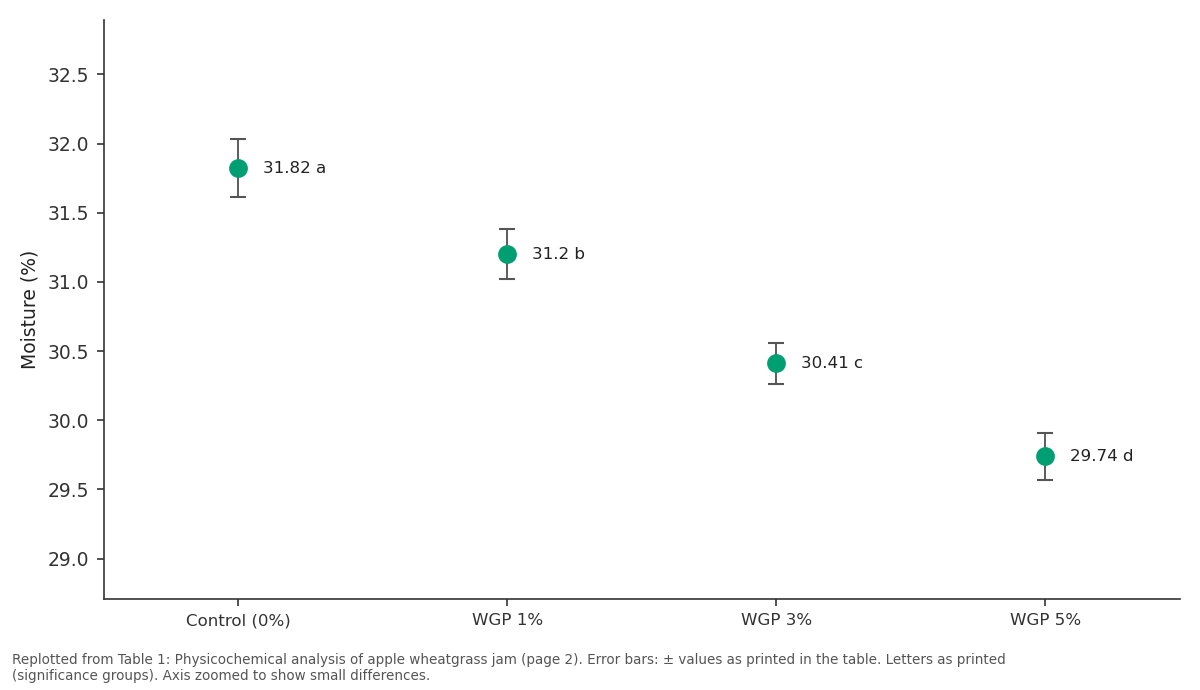
Moisture (%): Control (0%) vs WGP 1% vs WGP 3% vs WGP 5%
Replotted from Table 1 (page 2) of the original paper. Every bar is the paper's own table value.
View source evidence ↗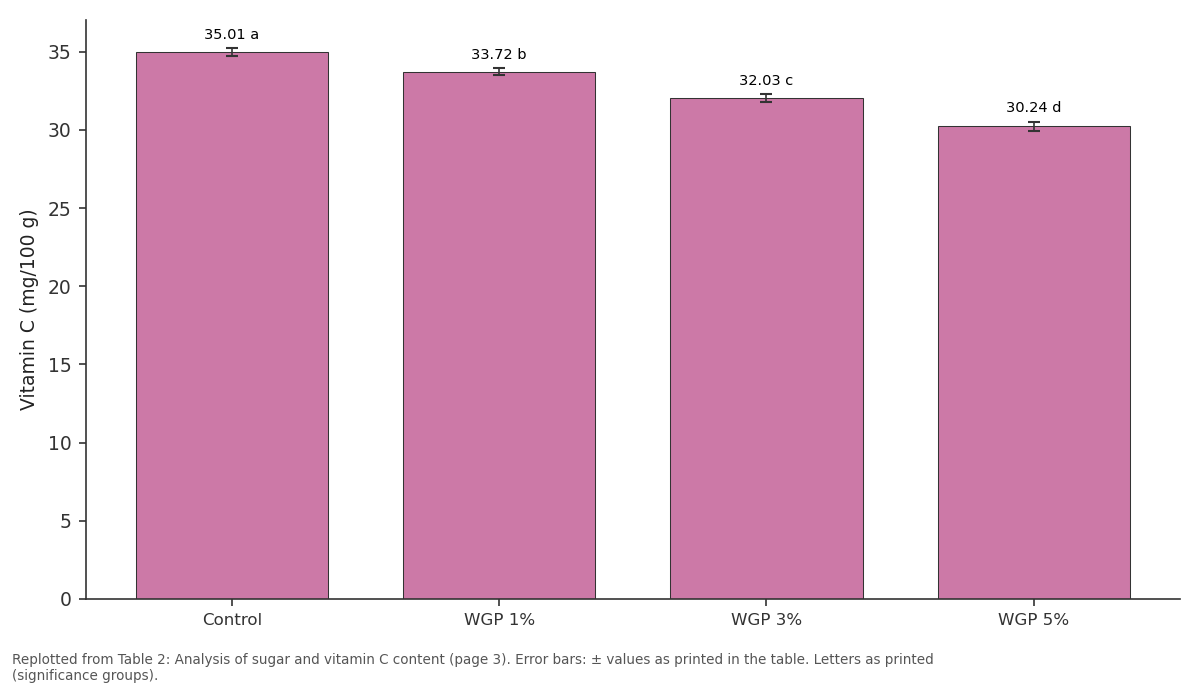
Non-reducing sugars (%): Control vs WGP 1% vs WGP 3% vs WGP 5%
Replotted from Table 2 (page 3) of the original paper. Every bar is the paper's own table value.
View source evidence ↗Figures & tables
From the original paper Table 1
 Table 2
 Table 3
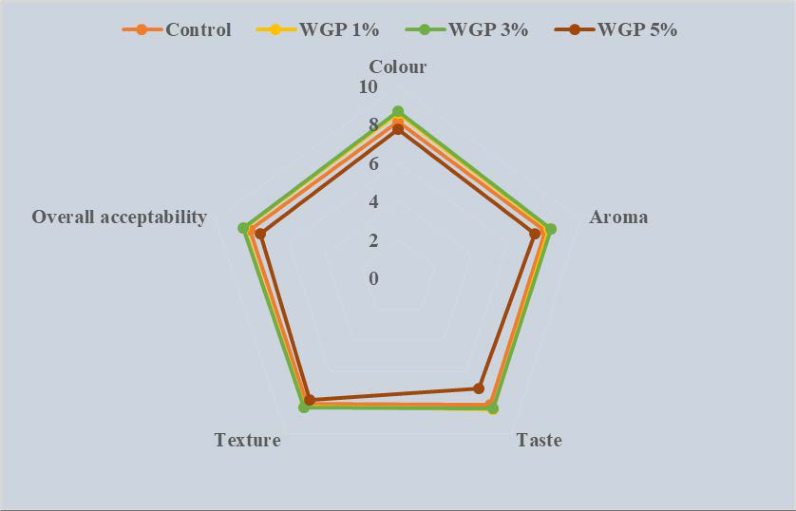 Figure 1
Introduction
Consumer demand for functional foods has increased substantially in recent years, driven by growing awareness of the link between diet and health. Fruit-based products enriched with bioactive plant ingredients have gained considerable attention because they combine consumer acceptability with enhanced nutritional and functional properties [1] . Among these products, jam remains one of the most widely consumed fruit preserves owing to its pleasant taste, convenience, long shelf life, and versatility. However, conventional jams are generally rich in sugars and provide limited amounts of health-promoting phytochemicals, creating opportunities to develop value-added functional jams by incorporating nutrient-dense plant materials. Apple (Malus domestica Borkh.) is one of the most popular fruits used for jam production because of its desirable flavor, natural pectin content, and balanced acidity. Apples are rich in dietary fiber, vitamin C, potassium, and various phenolic compounds, including chlorogenic acid, quercetin, catechin, and phloridzin, which exhibit antioxidant, antiinflammatory, and cardioprotective properties [2] . Furthermore, the naturally occurring pectin in apples contributes to desirable gel formation, texture, and stability during jam manufacture. Wheatgrass (Triticum aestivum L.), the young shoots of common wheat harvested at the early vegetative stage, has emerged as a promising functional ingredient because of its exceptional nutritional profile. Wheatgrass contains chlorophyll, vitamins A, C, and E, essential amino acids, minerals such as iron, calcium, magnesium, and potassium, dietary fiber, flavonoids, phenolic acids, carotenoids, and antioxidant enzymes. Numerous studies have demonstrated that wheatgrass exhibits antioxidant, anti-inflammatory, antimicrobial, immunomodulatory, hepatoprotective, and detoxifying properties owing to its rich phytochemical composition [3] . Incorporating wheatgrass into fruit-based products, such as jam, offers an effective strategy to improve nutritional quality while maintaining consumer acceptability. Wheatgrass fortification has been reported to enhance total phenolic content, chlorophyll concentration, Antioxidant activity, and mineral composition of food products.
However, its characteristic green color and grassy flavor may influence sensory acceptance, making it essential to optimize the fortification level [3] . Although several researchers have successfully enriched jams and fruit products with natural plant ingredients to improve their functional and antioxidant properties [4] , information regarding the development of wheatgrass-fortified apple jam remains limited. Therefore, the present study aimed to develop a functional apple jam fortified with wheatgrass and evaluate its physicochemical, nutritional, antioxidant, textural, microbiological, and sensory characteristics.
Material and methods
Fresh apples (Malus domestica Borkh.) were purchased from a local market in Greater Noida, Uttar Pradesh, India. Wheatgrass (Triticum aestivum L.) powder was prepared in the laboratory of the Department of Food Science and Technology, School of Engineering and Technology, Sharda University, Greater Noida, Uttar Pradesh, India. All chemicals and reagents used for physicochemical and analytical analyses were of analytical reagent (AR) grade and were procured from standard commercial suppliers.
Preparation of Apple Jam
Apple jam was prepared using fresh apple pulp fortified with wheatgrass (Triticum aestivum L.) powder at different concentrations. A control sample (without wheatgrass powder) and three fortified samples containing 1%, 3%, and 5% (w/w) wheatgrass powder were prepared. For jam preparation, 100 g of fresh apple pulp was heated over a low flame, continuously stirred. Granulated sugar was added gradually during cooking to ensure complete dissolution. Appropriate quantities of pectin and citric acid were incorporated to facilitate gel formation and maintain the desired acidity. Wheatgrass powder was added at the respective concentrations (1%, 3%, and 5%, w/w) and mixed thoroughly to obtain a homogeneous mixture. The mixture was cooked with continuous stirring, and total Soluble solids (TSS) were monitored periodically using an Abbe handheld refractometer until a final TSS of 68 °Brix was reached. The cooking process was then terminated, and the jam was allowed to cool to room temperature. The cooled jam was filled into clean, sterilized glass jars, sealed immediately, and stored under refrigerated conditions until further physicochemical, antioxidant, microbiological, and sensory analyses.
Physico-chemical analysis
Moisture and ash content were quantified using AAOC 2000 standards [5] . Titratable acidity, pH, total soluble solids, reducing sugars, non-reducing sugars, and ascorbic acid were quantified according to the standard analytical methods prescribed by the Association of Official Analytical Chemists (AOAC, 2019) [6] .
Sensory Analysis
The sensory attributes of the jam samples, including color, texture, taste, and overall acceptability, were evaluated by a panel of 10 trained judges using a nine-point hedonic scale. Sensory evaluation was conducted at 15-day intervals over a 3-month storage period. The panelists assigned scores ranging from 1 (dislike extremely) to 9 (like extremely) for each sensory attribute.
Result and discussion
Result and discussion
Physicochemical analysis Moisture and ash
The incorporation of wheatgrass powder (WGP) significantly affected the physicochemical properties of apple jam. Moisture content decreased (p<0.05) from 31.82% in the control to 29.74% in the 5% WGP treatment, likely due to the high dietary fiber content of wheatgrass, which binds water and reduces free moisture [7] . Conversely, ash content increased significantly from 0.41% to 0.81%, reflecting the mineral-rich nature of wheatgrass (Table 1). Similar trends have been reported in wheatgrass-fortified and other fiber-enriched food products [8] . The results are represented as the means ± standard deviation. Superscripts with different letters in the same column indicate significant differences (p≤0.05).
| Treatment | Moisture (%) | Ash (%) | TSS (°Brix) | pH | Titratable acidity (%) |
|---|---|---|---|---|---|
| Control (0%) | 31.82 ± 0.21ᵃ | 0.41 ± 0.01ᵈ | 68.05 ± 0.14ᵃ | 3.46 ± 0.02ᵃ | 0.69 ± 0.01ᶜ |
| WGP 1% | 31.20 ± 0.18ᵇ | 0.52 ± 0.02ᶜ | 68.18 ± 0.16ᵃ | 3.41 ± 0.03ᵇ | 0.73 ± 0.01ᵇ |
| WGP 3% | 30.41 ± 0.15ᶜ | 0.66 ± 0.02ᵇ | 68.43 ± 0.12ᵃ | 3.36 ± 0.02ᶜ | 0.77 ± 0.02ᵃ |
| WGP 5% | 29.74 ± 0.17ᵈ | 0.81 ± 0.03ᵃ | 68.61 ± 0.15ᵃ | 3.31 ± 0.03ᵈ | 0.81 ± 0.02ᵃ |
Table text extracted from the original PDF; superscript letters are shown inline. The original table image is below.
View original table image
TSS and pH
The TSS remained unchanged (68.05-68.61 °Brix) across treatments, indicating that WGP had minimal effect on soluble solids due to standardized sugar concentration (Table 1). The values were within the recommended range for proper gel formation and jam preservation [9] . In contrast, increasing WGP levels significantly decreased pH (3.46-3.31) and increased titratable acidity (0.69-0.81%), likely due to the presence of organic acids and phenolic compounds in wheatgrass. This enhanced acidity may improve pectin gel formation, microbial stability, and shelf life, consistent with previous reports on plant-enriched fruit products [10] .
Total sugar and Vitamin C content
The incorporation of WGP significantly (p<0.05) influenced the sugar profile and vitamin C content of apple jam. Total sugars and non-reducing sugars decreased progressively with increasing WGP levels, whereas reducing sugars and vitamin C content increased significantly, indicating an improvement in the jam's nutritional quality. Total sugars decreased from 64.82% in the control to 62.65% in the 5% WGP treatment, which may be attributed to the partial replacement of apple pulp with wheatgrass powder. As wheatgrass is rich in dietary fiber, minerals, and bioactive compounds but comparatively lower in soluble sugars, its incorporation reduced the overall sugar content of the jam. Similar findings have been reported in functional fruit products enriched with fiber-rich plant ingredients [11] .
Reducing sugars increased significantly from 29.81% to 32.41%, while non-reducing sugars decreased from 35.01% to 30.24% (Table 2). This shift is mainly due to acidcatalyzed hydrolysis (inversion) of sucrose into glucose and fructose during jam processing at high temperatures and under acidic conditions. The higher acidity observed in WGP-fortified formulations may have further promoted sucrose inversion, resulting in increased reducing sugars and decreased non-reducing sugars. Similar observations have been reported during jam manufacture, where sucrose inversion improves texture, prevents sugar crystallization, and enhances product stability [12] . The results are represented as the means ± standard deviation. Superscripts with different letters in the same column indicate significant differences (p≤0.05). Vitamin C content increased significantly from 8.82 mg/100 g in the control to 18.46 mg/100 g in the 5% WGP treatment. This increase is attributed to the naturally high vitamin C content of young wheatgrass, which is also rich in chlorophyll, phenolic compounds, flavonoids, and other antioxidant phytochemicals. Although some ascorbic acid is lost during thermal processing, WGP supplementation significantly enhanced the nutritional and antioxidant value of the jam. Similar improvements have been reported in other wheatgrass-fortified food products [13] .
| Treatment | Total sugars (%) | Reducing sugars (%) | Non-reducing sugars (%) | Vitamin C (mg/100 g) |
|---|---|---|---|---|
| Control | 64.82 ±0.31ᵃ | 29.81 ±0.22ᵈ | 35.01 ±0.25ᵃ | 8.82 ±0.31ᵈ |
| WGP 1% | 64.14 ±0.27ᵇ | 30.42 ±0.25ᶜ | 33.72 ±0.23ᵇ | 11.84 ±0.42ᶜ |
| WGP 3% | 63.36 ±0.24ᶜ | 31.33 ±0.28ᵇ | 32.03 ±0.26ᶜ | 15.71 ±0.38ᵇ |
| WGP 5% | 62.65 ±0.30ᵈ | 32.41 ±0.31ᵃ | 30.24 ±0.30ᵈ | 18.46 ±0.40ᵃ |
Table text extracted from the original PDF; superscript letters are shown inline. The original table image is below.
View original table image
Total phenolic content and antioxidant activity": The incorporation of WGP significantly (p<0.05) increased the total phenolic content and antioxidant activity of apple jam.
Total phenolic content increased from 52.4 to 122.3 mg GAE/100 g, while DPPH radical scavenging activity increased from 26.3% to 74.9% with increasing WGP levels, demonstrating a marked improvement in the antioxidant potential of the jam (Table 3). The enhanced phenolic content and DPPH inhibition are attributed to the rich presence of phenolic compounds, flavonoids, chlorophyll, and other antioxidant phytochemicals in wheatgrass. Despite thermal processing, WGP retained sufficient bioactive compounds, thereby significantly improving the jam's functional quality. Similar findings have been reported in wheatgrass-fortified and other plantbased functional foods [7] . The results are represented as the means ± standard deviation. Superscripts with different letters in the same column indicate significant differences (p≤0.05).
| Treatment | Total phenolics (mg GAE/100 g) | DPPH inhibition (%) |
|---|---|---|
| Control | 52.4 ±1.1ᵈ | 26.3 ±0.9ᵈ |
| WGP 1% | 71.8 ±1.5ᶜ | 39.8 ±1.1ᶜ |
| WGP 3% | 96.4 ±2.0ᵇ | 58.7 ±1.4ᵇ |
| WGP 5% | 122.3 ±2.4ᵃ | 74.9 ±1.8ᵃ |
Table text extracted from the original PDF; superscript letters are shown inline. The original table image is below.
View original table image
Sensory analysis
The incorporation of WGP significantly (p<0.05) affected the sensory attributes of apple jam. Colour, aroma, taste, texture, and overall acceptability improved with WGP addition up to 3%, with the highest overall acceptability recorded for the 3% WGP treatment (8.48), followed closely by 1% WGP (8.43). However, further increasing WGP to 5% significantly reduced all sensory scores, with overall acceptability declining to 7.51. The improved sensory quality at lower WGP levels may be attributed to the pleasant green hue and the contribution of bioactive compounds without adversely affecting flavor or texture. In contrast, higher incorporation (5%) imparted a stronger grassy flavor, a darker color, and slight textural changes, resulting in lower consumer acceptability. Similar trends have been reported in wheatgrass-fortified functional foods, where moderate supplementation improved sensory quality, whereas excessive addition negatively affected consumer preference due to the characteristic taste and aroma of wheatgrass [7,13] .
Fig 1: Radar diagram of sensory analysis of apple wheatgrass jam
Fig 1: Radar diagram of sensory analysis of apple wheatgrass jam
Conclusion
The present study demonstrated that wheatgrass powder is a promising functional ingredient for the development of nutritionally enriched apple jam. Wheatgrass fortification significantly improved the mineral content, vitamin C, total phenolic content, and antioxidant activity while maintaining desirable physicochemical characteristics. Although higher levels of wheatgrass (5%) further enhanced the nutritional and antioxidant properties, they adversely affected sensory quality due to the characteristic grassy flavor and darker color. Among the formulations, 3% wheatgrass powder provided the best balance between nutritional enhancement and consumer acceptability, achieving the highest overall sensory score and markedly improved antioxidant potential. Therefore, incorporating 3% wheatgrass powder is recommended for producing functional apple jam with improved health-promoting properties and acceptable sensory quality. Further studies on storage stability, bioactive compound retention, and consumer acceptance are recommended to support its commercial application.
Figures and tables from the paper
References
13 in the original paper- Rababah, T. M., Al-u'datt, M., Almajwal, A., Brewer, S., Feng, H., Al-Mahasneh, M., & Yang, W. (2012). Evaluation of the nutraceutical, physiochemical and sensory properties of raisin jam. Journal of Food Science, 77(6), C609-C613.
- Boyer, J., & Liu, R. H. (2004). Apple phytochemicals and their health benefits. Nutrition Journal, 3(1), 5.
- Grubišić, S., Kristić, M., Lisjak, M., Mišković Špoljarić, K., Petrović, S., Vila, S., & Rebekić, A. (2022). Effect of wheatgrass juice on nutritional quality of apple, carrot, beet, orange and lemon juice. Foods, 11(3), 445.
- Li, C. X., Zhao, X. H., Zuo, W. F., Zhang, T. L., Zhang, Z. Y., & Chen, X. S. (2020). Phytochemical profiles, antioxidant, and antiproliferative activities of redfleshed apple as affected by in vitro digestion. Journal of Food Science, 85(9), 2952-2959.
- AACC International. (2000). Approved methods of analysis (10th ed.). American Association of Cereal Chemists.
- AOAC International. (2019). Official methods of analysis of AOAC International (21st ed.). AOAC International.
- Bilal, M., Du, Y., Li, D., Yang, R., Xie, C., & Wang, P. (2025). Assessing wheatgrass powder as a functional ingredient in steamed bread from the nutritional and techno-functional perspective. Grain & Oil Science and Technology.
- Saini, A., Sinha, S., & Singh, J. (2017). Comparison of polyphenols, flavonoids, antioxidant and free radical scavenging content of freeze-dried wheatgrass extract from three different wheat species. International Journal of Applied Biology and Pharmaceutical Technology, 8(1), 98-106.
- Uribe-Wandurraga, Z. N., Bravo-Villar, M., Igual, M., Savall, C., García-Segovia, P., & Martínez-Monzó, J. (2021). Sugar and no sugar added fruit microalgaeenriched jams: A study about their physicochemical, rheological, and textural properties. European Food Research and Technology, 247(10), 2565-2578.
- Ali, S. A., Alqahtani, N. K., Alnemr, T. M., & Saleh, S. M. (2025). Pomegranate peel powder for the sustainable development of a novel date jam: Texture profile, color parameters, microstructure features, antioxidant activity, and sensory properties. LWT, 217, 117403.
- Elleuch, M., Bedigian, D., Roiseux, O., Besbes, S., Blecker, C., & Attia, H. (2011). Dietary fibre and fibrerich by-products of food processing: Characterisation, technological functionality and commercial applications: A review. Food Chemistry, 124(2), 411421.
- Baker, R. A., Berry, N., Hui, Y. H., Barrett, D. M., Somogyi, L., & Ramaswamy, H. S. (2005). Processing fruits: Science and technology (2nd ed.). CRC Press.
- Kulkarni, S. D., Tilak, J. C., Acharya, R., Rajurkar, N. S., Devasagayam, T. P. A., & Reddy, A. V. R. (2006). Evaluation of the antioxidant activity of wheatgrass (Triticum aestivum L.) as a function of growth under different conditions. Phytotherapy Research, 20(3), 218-227.