
Research article · 2026 · Full text
International Journal of Advanced Chemistry ResearchA sustainable nutritional approach for improving growth performance and feed efficiency in broiler chickens
Volume 8(7) · Pages 52–55 · DOI: 10.33545/26646781.2026.v8.i7a.715 ↗
Research areasAnimal Nutrition and PhysiologyAgricultural safety and regulationsPhytase and its Applications
Abstract
Author-writtenThe present study was conducted to evaluate the effect of dietary supplementation of a phytobiotic feed additive on the growth performance and economic efficiency of broiler chickens under farmers' field conditions. The phytobiotic feed additive was supplemented at the recommended inclusion level of 250 g/ton of feed. The study comprised two experimental groups, viz., control (T1) and phytobiotic-supplemented treatment (T2). Productive performance parameters including average initial body weight, average daily gain (ADG), average total body weight gain, mortality rate, feed conversion ratio (FCR) and benefit-cost (B:C) ratio were evaluated. The results revealed that the average initial body weight did not differ significantly (p > 0.05) between the experimental groups. Dietary supplementation of the phytobiotic feed additive significantly (p < 0.05) improved average daily gain (55.14±0.52 g) and average total body weight gain (2315.88±21.84 g) in the treatment group as compared to the control group (53.04±0.22 g and 2227.68±9.28 g, respectively). The treatment group exhibited a 3.96% increase in body weight gain over the control group. Mortality percentage, feed conversion ratio and benefit-cost ratio showed numerical improvements in the phytobiotic supplemented group; however, the differences were statistically non-significant (p > 0.05). The feed conversion ratio improved from 1.59±0.02 in the control group to 1.55±0.01 in the treatment group, while the benefit-cost ratio increased from 1.23±0.02 to 1.26±0.03. It can be concluded that dietary supplementation of phytobiotic feed additive has the potential to improve growth performance and production efficiency in broiler chickens. The findings suggest that phytobiotic feed additives may have the potential to reduce dependence on antibiotic growth promoters in poultry production systems.
Summary
Source-checkedPlain-language reading of the full paper, prepared with AI and checked against the text. Each point links to the authors' own words.
Why it matters
- The poultry industry is a rapidly growing sector essential for providing affordable, high-quality animal protein to a growing global population. View evidence ↗
- While antibiotic growth promoters (AGPs) improve production, their overuse has led to antimicrobial-resistant bacteria and residues in food, creating public health risks. View evidence ↗
- Phytobiotics are natural, plant-derived additives containing bioactive compounds like phenolics and flavonoids that can serve as alternatives to antibiotics. View evidence ↗
The question
- The study aimed to evaluate how a phytobiotic feed additive affects the growth, feed efficiency, mortality, and economic returns of broiler chickens in real-world farm conditions. View evidence ↗
What they did
- The trial involved 1,000 day-old broiler chicks divided into two groups of 500, conducted across five commercial farms with similar management. View evidence ↗
- The treatment group received a commercial phytobiotic additive at 250 g per metric ton of feed, while the control group received a standard diet without additives. View evidence ↗
- The experimental feeding trial lasted for 42 days, encompassing both the starter and finisher growth phases. View evidence ↗
- Data were analyzed using an independent samples t-test, with statistical significance set at p < 0.05. View evidence ↗
What they found
- There was no significant difference in initial body weight between the control group (42.00±0.84g) and the treatment group (44.00±0.54g). View evidence ↗
- Phytobiotic supplementation significantly improved the average daily gain (ADG) to 55.14±0.52 g, compared to 53.04±0.22 g in the control group. View evidence ↗
- The treatment group showed a significantly higher average total body weight gain (2315.88±21.84g) than the control group (2227.68±9.28 g), representing a 3.96% increase. View evidence ↗
- Mortality was numerically lower in the treatment group (3.20±0.37%) compared to the control group (3.80±0.37%), though this was not statistically significant. View evidence ↗
- The feed conversion ratio (FCR) improved numerically from 1.59±0.02 in the control group to 1.55±0.01 in the treatment group, but the result was not statistically significant. View evidence ↗
- The benefit-cost ratio was numerically higher in the treatment group (1.26±0.03) than in the control group (1.23±0.02). View evidence ↗
What it means
- The authors conclude that phytobiotic feed additives are a safe and sustainable strategy to improve growth and can serve as a suitable alternative to antibiotic growth promoters. View evidence ↗
- The authors recommend future research with larger flock sizes and evaluations of gut health, immune response, and carcass traits to understand long-term benefits. View evidence ↗
Visual summary
1 visualsIllustrations explain the paper; they do not show study data.
Experimental Group Comparison
AI-generated conceptual illustration (broiler chickens). It explains the idea and does not show study data.
View source evidence ↗Figures & tables
From the original paper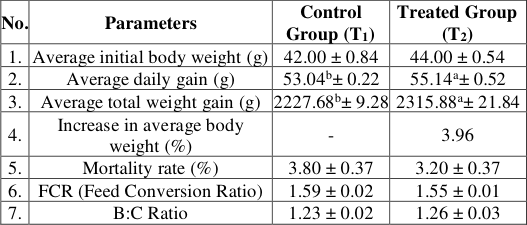 Table 1
Text
digestibility, ultimately leading to improved feed efficiency and productive performance (Brenes and Roura, 2010; Yang et al., 2015) [4,5] . Several studies have demonstrated that dietary supplementation of phytogenic feed additives positively influences broiler performance by improving body weight gain, feed conversion ratio, immune response, intestinal morphology, and antioxidant status. Furthermore, phytobiotics suppress the proliferation of pathogenic microorganisms while promoting beneficial intestinal microflora, thereby enhancing nutrient absorption and reducing production losses (Murugesan et al., 2015) [6] . Herbal feed additives such as garlic, ginger, turmeric, Aloe vera, and tulsi have also been reported to improve growth performance and economic returns in broiler chickens, supporting their potential as natural substitutes for antibiotic growth promoters (Karangiya et [1,[7][8][9] . Phytobiotic feed additives have gained considerable attention in poultry nutrition owing to antimicrobial, antioxidant, digestive stimulant and immunomodulatory properties. Their use in broiler diets has been associated with improved growth performance, feed efficiency and overall production efficiency, making them promising and sustainable alternatives to antibiotic growth promoters in poultry production systems (Hashemi and Davoodi, 2010; Murugesan et al., 2015) [3,6] . Although numerous experimental studies have demonstrated the beneficial effects of phytobiotics, relatively limited information is available regarding their performance under farmers' field conditions. Scientific validation of phytobiotic feed additives through on-farm trials is essential before recommending their large-scale adoption by poultry producers. Therefore, the present study was undertaken to evaluate the effect of dietary supplementation of a phytobiotic feed additive on the growth performance, feed conversion ratio, mortality, and economic returns of broiler chickens under farmers' field conditions, considering their potential as sustainable alternatives to antibiotic growth promoters in poultry production..
Materials and Methods
The present on-farm trial was conducted under the supervision of Krishi Vigyan Kendra, Chandauli, Uttar Pradesh, India, to evaluate the effect of dietary supplementation of a phytobiotic feed additive on the productive performance of broiler chickens under farmers' field conditions. Five poultry farmers practicing commercial broiler farming with similar management conditions were selected for the study. A total of 1000 day-old commercial broiler chicks were randomly allocated into two experimental groups comprising 500 birds each. Birds in the control group (T₁) were fed a standard commercial broiler diet without any feed additive, whereas birds in the treatment group (T₂) received the same basal diet supplemented with a commercially available phytobiotic feed additive at the rate of 250 g per metric ton of feed. The feeding trial was conducted for 42 days covering both starter and finisher phases. Throughout the experimental period, birds were reared under deep-litter housing system following standard commercial management practices. Feed and fresh drinking water were offered ad libitum, while brooding, vaccination schedule, lighting programme, litter management, ventilation and biosecurity measures were maintained uniformly in both treatment groups. No antibiotic growth promoter was included in the diets of either group during the study period.
Body weight of the birds was recorded at the beginning and at the end of the experimental period using a digital weighing balance. Average daily gain (ADG) was calculated from the body weight records. Feed consumption was recorded on a flock basis, and feed conversion ratio (FCR) was calculated as the amount of feed consumed per unit body weight gain. Mortality was monitored daily, and cumulative mortality percentage was calculated for each treatment. Economic performance was assessed by estimating the cost of production, gross return, net return per bird and benefit:cost (B:C) ratio using prevailing market prices. The data generated during the study were expressed as mean ± standard error (SE) and analysed using IBM SPSS Statistics. The significance of differences between the control and phytobiotic-supplemented groups was determined using an independent samples t-test, and differences were considered statistically significant at p < 0.05
Results and Discussion-
The present study was undertaken to evaluate the effect of dietary supplementation of a phytobiotic feed additive on the growth performance and economic efficiency of broiler chickens under farmers' field conditions. The phytobiotic feed additive was supplemented at the rate of 250 g/ton of feed. The productive performance parameters indicated that phytobiotic supplementation positively influenced body weight gain and production efficiency without adversely affecting the health and survivability of broiler birds. The average initial body weight of broiler chicks did not differ significantly (p > 0.05) between the control (42.00±0.84g) and treatment groups (44.00±0.54g) , indicating proper randomization and uniformity of experimental birds at the commencement of the trial. Similar findings were reported by Hasan et al. (2016) [8] , who observed comparable initial body weights among tulsi supplemented and control broiler groups, suggesting that subsequent improvements in growth performance can be attributed primarily to dietary interventions rather than inherent differences in chick weight. Dietary supplementation of the phytobiotic feed additive significantly (p < 0.05) improved average daily gain (ADG) in broiler chickens. Birds receiving phytobiotic supplementation recorded an ADG of 55.14±0.52 g compared to 53.04±0.22g in the control group. Consequently, the average total body weight gain was significantly (p < 0.05) higher in the treated group (2315.88±21.84g) than in the control group (2227.68±9.28 g). The treatment group exhibited 3.96% greater body weight gain than the control group. The improved growth performance may be attributed to the bioactive phytogenic compounds present in phytobiotic feed additives, which are known to possess antimicrobial, antioxidant, anti-inflammatory and digestive stimulant properties. These compounds improve intestinal microbial balance, stimulate digestive enzyme secretion and enhance nutrient digestibility and absorption. The findings of the present study are in agreement with those of Karangiya et al. (2016) [1] , who reported significant improvements in body weight gain following dietary supplementation of garlic and ginger in broiler chickens. Similarly, Sethy et al. (2016) [7] demonstrated that turmeric supplementation significantly increased body weight gain in broilers. Hasan et al. (2016) [8] also reported significantly higher live body weights in tulsi supplemented broilers compared with controls. Previous studies have established that phytobiotics improve growth performance by promoting gastrointestinal health and reducing microbial competition for nutrients within the digestive tract. Phytogenic feed additives have gained considerable attention as potential alternatives to antibiotic growth promoters due to their beneficial effects on nutrient utilization and bird health. Hashemi and Davoodi (2010) [3] reported that phytobiotics act as natural growth promoters by enhancing digestive enzyme activity, improving feed palatability and modulating intestinal microflora. Likewise, Windisch et al. (2008) [2] suggested that phytogenic compounds improve nutrient digestibility and support intestinal eubiosis, thereby improving productive performance in poultry. Mortality percentage was numerically lower in phytobiotic supplemented birds (3.20±0.37%) than in the control group (3.80±0.37%), although the difference was statistically nonsignificant (P>0.05). Lower mortality in treated birds may be associated with the immunomodulatory, antimicrobial and antioxidant properties of phytogenic compounds that improve disease resistance and physiological well-being. Similar trends have been reported by Hasan et al. (2016) [8] and Yadav et al. (2017) [9] , who observed improved livability and lower mortality in broilers supplemented with herbal feed additives. Reduced mortality contributes positively to production economics, particularly under commercial farming conditions. Feed conversion ratio (FCR) is an important indicator of feed utilization efficiency in broiler production. In the present study, phytobiotic supplementation numerically improved FCR from 1.59±0.02 in the control group to 1.55±0.01 in the treatment group, although the difference was statistically non-significant (P>0.05). Improved FCR indicates more efficient conversion of feed into body mass and suggests enhanced nutrient utilization in phytobiotic supplemented birds. The numerical improvement observed in the present study corroborates earlier findings by Ürüşan and Bölükbaşı (2017) [10] , who reported improved FCR following turmeric supplementation in broiler diets. Similarly, Karangiya et al. (2016) [1] observed better feed efficiency in broilers supplemented with garlic and ginger. Gautam et al. (2021) [11] also reported significantly lower FCR in broilers supplemented with phytobiotic mixtures and organic acids. Although the improvement was not statistically significant in the present study, the observed trend clearly indicates the beneficial influence of phytobiotics on feed utilization. The economic analysis revealed that the benefit-cost ratio was numerically higher in the treatment group (1.26±0.03) compared to the control group (1.23±0.02), suggesting better economic returns from phytobiotic supplementation. Improved profitability may be attributed to enhanced body weight gain, better feed efficiency and reduced mortality. Similar economic benefits associated with herbal supplementation have been documented by Hasan et al. (2016) [8] and Yadav et al. (2017) [9] , who reported higher net profits in phytobiotic supplemented broilers. Improved economic efficiency is particularly important for poultry farmers, where even modest improvements in production parameters can substantially influence farm profitability. The observed improvements in growth performance may also be explained by the bioactive phytogenic compounds present in phytobiotic feed additives. These compounds are known to improve gut health, stimulate digestive enzyme secretion, enhance nutrient digestibility and suppress pathogenic microorganisms in the gastrointestinal tract. Several researchers, including Platel and Srinivasan (2004) [12] , Giannenas et al. (2005) [13] , Kirkpinar et al. (2010) [14] and Gregacevic et al. (2014) [15] , have reported that phytobiotics enhance intestinal health and productive performance in poultry birds through improved nutrient utilization and modulation of gut microflora. Overall, the results of the present investigation demonstrate that dietary supplementation of a phytobiotic feed additive significantly enhanced average daily gain and total body weight gain of broiler chickens while numerically improving feed conversion ratio, mortality percentage and economic returns. The present findings support the growing body of evidence suggesting that phytobiotic feed additives have the potential to serve as safe, residue-free and sustainable alternatives to antibiotic growth promoters in commercial broiler production systems.
Conclusions
The present study demonstrated that dietary supplementation of a phytobiotic feed additive positively influenced the productive performance of broiler chickens under farmers' field conditions. Supplementation significantly improved average daily gain and total body weight gain, indicating indicating improved growth performance in broiler chickens.. Although feed conversion ratio (FCR), mortality percentage and benefit-cost (B:C) ratio were not statistically different between the control and treatment groups, numerical improvements were observed in the phytobiotic supplemented birds, suggesting improved feed utilization efficiency, survivability and economic returns. These findings indicate that phytobiotic feed additives can enhance broiler productivity without adversely affecting bird performance. The beneficial effects observed in the present study are likely attributable to the bioactive phytogenic compounds present in phytobiotic feed additives, which may improve digestive function, gut health and nutrient absorption. Therefore, supplementation of phytobiotic feed additives may be considered a safe, practical and sustainable nutritional strategy for improving growth performance in commercial broiler production and may serve as a suitable alternative to antibiotic growth promoters. Further investigations involving larger flock sizes and evaluation of carcass traits, immune response and gut health parameters are recommended to better understand the long-term benefits of phytobiotic supplementation in poultry nutrition.
Figures and tables from the paper
| No. | Parameters | Control Group (T1) | Treated Group (T2) |
|---|---|---|---|
| 1. | Average initial body weight (g) | 42.00 ± 0.84 | 44.00 ± 0.54 |
| 2. | Average daily gain (g) | 53.04b± 0.22 | 55.14a± 0.52 |
| 3. | Average total weight gain (g) | 2227.68b± 9.28 | 2315.88a± 21.84 |
| 4. | Increase in average body weight (%) | - | 3.96 |
| 5. | Mortality rate (%) | 3.80 ± 0.37 | 3.20 ± 0.37 |
| 6. | FCR (Feed Conversion Ratio) | 1.59 ± 0.02 | 1.55 ± 0.01 |
| 7. | B:C Ratio | 1.23 ± 0.02 | 1.26 ± 0.03 |
Table text extracted from the original PDF; superscript letters are shown inline. The original table image is below.
View original table image
References
15 in the original paper- Karangiya VK, Savsani HH, Patil SS, Garg DD, Murthy KS, Ribadiya NK, et al. Effect of dietary supplementation of garlic, ginger and their combination on feed intake, growth performance and economics in commercial broilers. Veterinary World. 2016;9(3):245-250.
- Windisch W, Schedle K, Plitzner C, Kroismayr A. Use of phytogenic products as feed additives for swine and poultry. Journal of Animal Science. 2008;86(Suppl. 14):E140-E148.
- Hashemi SR, Davoodi H. Phytogenics as new class of feed additive in poultry industry. Journal of Animal and Veterinary Advances. 2010;9(17):2295-2304.
- Brenes A, Roura E. Essential oils in poultry nutrition: Main effects and modes of action. Animal Feed Science and Technology. 2010;158(1-2):1-14.
- Yang C, Chowdhury MAK, Huo Y, Gong J. Phytogenic compounds as alternatives to in-feed antibiotics: Potentials and challenges in application. Pathogens. 2015;4(1):137156.
- Murugesan GR, Syed B, Haldar S, Pender C. Phytogenic feed additives as an alternative to antibiotic growth promoters in broiler chickens. Frontiers in Veterinary Science. 2015;2:21.
- Sethy K, Swain P, Behera K, Nayak SM, Barik SR, Patro P, et al. Effect of turmeric (Curcuma longa) supplementation on growth and blood chemistry of broilers. Exploratory Animal and Medical Research. 2016;6(1):7579.
- Hasan MN, Mostofa M, Sorwar MG, Hasan MT, Das K, Hossain DMN. Effects of Tulsi leaf extract on body weight gain in broiler production. Bangladesh Journal of Veterinary Medicine. 2016;14(1):21-25.
- Yadav DC, Bidhan DS, Sharma V, Sahu S. Effect of Aloe vera (Aloe barbadensis) supplementation on production indices, mortality and cost of production of broiler chicken. Journal of Animal Research. 2017;7(1):107-113.
- Ürüsan H, Bölükbaşi ŞC. Effects of dietary supplementation levels of turmeric powder (Curcuma longa) on performance, carcass characteristics and gut microflora in broiler chickens. Journal of Animal and Plant Sciences. 2017;27(3):732-736.
- Gautam S, Yadav A, Singh VK. Effect of phytobiotic mixture and organic acid supplementation on growth performance, haemato-biochemical profile and carcass traits of broiler chickens. Indian Journal of Veterinary Sciences and Biotechnology. 2021;17(3):46-50.
- Platel K, Srinivasan K. Digestive stimulant action of spices and their influence on digestive enzymes. Food Research International. 2004;37:667-675.
- Giannenas I, Florou-Paneri P, Papazahariadou M, Christaki E, Botsoglou NA, Spais AB. Effect of dietary supplementation with oregano essential oil on performance of broilers. Poultry Science. 2005.
- Kirkpinar F, Ünlü HB, Özdemir G. Effects of oregano and garlic essential oils on performance of broiler chickens. South African Journal of Animal Science. 2010;40(5):198204.
- Gregacevic M, et al. Phytobiotics as alternatives to antibiotic growth promoters in poultry nutrition. 2014.