
Research article · 2026 · Full text
International Journal of Horticulture and Food ScienceEffect of plant growth regulators on flowering, fruit set and yield of pomegranate (Punica granatum L.)
Volume 8(3) · Pages 232–236 · DOI: 10.33545/26631067.2026.v8.i3b.789 ↗
Research areasPlant Physiology and Cultivation StudiesPomegranate: compositions and health benefitsFlowering Plant Growth and Cultivation
Abstract
Author-writtenPicture a pomegranate orchard at flowering time carrying an abundance of blossoms, only for a large share of those flowers to drop before ever setting fruit, and a further share of the fruit that does set eventually splitting open before harvest. This scenario, familiar to pomegranate growers across South Asia, motivated this research's evaluation of five plant growth regulator (PGR) treatments, gibberellic acid (GA₃) at 50 and 100 ppm, naphthalene acetic acid (NAA) at 20 and 40 ppm, and a combined GA₃+NAA treatment, against an untreated control, on flowering, fruit set, fruit cracking, and yield of pomegranate grown at Kandy, Sri Lanka, across two consecutive fruiting seasons. Fruit set percentage rose from 38.6% in the untreated control to a peak of 64.2% under the combined GA₃+NAA treatment, while fruit cracking incidence fell in the same direction, from 18.4% in the control to 6.4% under the combined treatment, indicating that PGR application addressed both major yield-limiting constraints simultaneously rather than trading one problem for another. Individual GA₃ and NAA treatments each improved fruit set and reduced cracking relative to the control, but neither matched the combined treatment's performance on either parameter, suggesting the two PGR classes act through at least partially complementary physiological pathways rather than substituting for one another. Final marketable yield followed the same ranking as fruit set and cracking reduction, with the combined treatment producing 34.6 kg/tree compared with 19.8 kg/tree in the untreated control, a gain driven roughly equally by improved fruit retention and reduced pre-harvest fruit loss to cracking. These findings support combined GA₃+NAA application, timed at full bloom and repeated three weeks later, as a practical intervention for Sri Lankan pomegranate growers seeking to address both fruit set and cracking constraints through a single integrated PGR program rather than treating these as separate problems requiring separate solutions.
Summary
Source-checkedPlain-language reading of the full paper, prepared with AI and checked against the text. Each point links to the authors' own words.
Why it matters
- Pomegranate production is often limited by two distinct physiological problems: poor fruit set and fruit cracking. View evidence ↗
- Plant growth regulators (PGRs) like gibberellic acid (GA3) and naphthalene acetic acid (NAA) are known to reduce fruit drop and may also improve resistance to fruit cracking by affecting cell wall properties. View evidence ↗
The question
- The study aimed to determine if combining GA3 and NAA provides a synergistic, additive, or redundant effect on pomegranate fruit set and cracking compared to using them individually. View evidence ↗
What they did
- The experiment used eight-year-old Sri Lankan pomegranate trees in a randomized complete block design with six treatments: a control, two GA3 concentrations (50 and 100 ppm), two NAA concentrations (20 and 40 ppm), and a combined GA3 (75 ppm) + NAA (30 ppm) treatment. View evidence ↗
- Treatments were applied as full foliar sprays at full bloom and again three weeks later. View evidence ↗
- Researchers measured fruit set four weeks after bloom and monitored fruit cracking incidence from the color-break stage until harvest. View evidence ↗
What they found
- The combined GA3+NAA treatment significantly improved outcomes compared to the control, increasing fruit set from 38.6% to 64.2% and reducing cracking incidence from 18.4% to 6.4%. View evidence ↗
- Marketable yield increased from 19.8 kg/tree in the control group to 34.6 kg/tree with the combined GA3+NAA treatment. View evidence ↗
- While individual applications of GA3 or NAA improved fruit set and reduced cracking compared to the control, neither was as effective as the combined treatment. View evidence ↗
- The combined treatment also improved fruit quality, increasing fruit weight from 218g to 256g, aril weight from 52.4% to 56.9%, and TSS from 14.8 to 16.1 °Brix. View evidence ↗
What it means
- The authors conclude that GA3 and NAA work through complementary physiological pathways, with GA3 focusing on cell elongation and abscission reduction and NAA on fruit retention and cell wall elasticity. View evidence ↗
- The authors recommend a combined foliar application of 75 ppm GA3 and 30 ppm NAA at full bloom and again three weeks later to maximize yield and quality. View evidence ↗
- The study was limited to a single cultivar and location; further research is needed to generalize these findings to other cultivars and regional conditions across South Asia. View evidence ↗
Visual summary
3 visualsIllustrations explain the paper; charts are replotted from the paper's own table values.
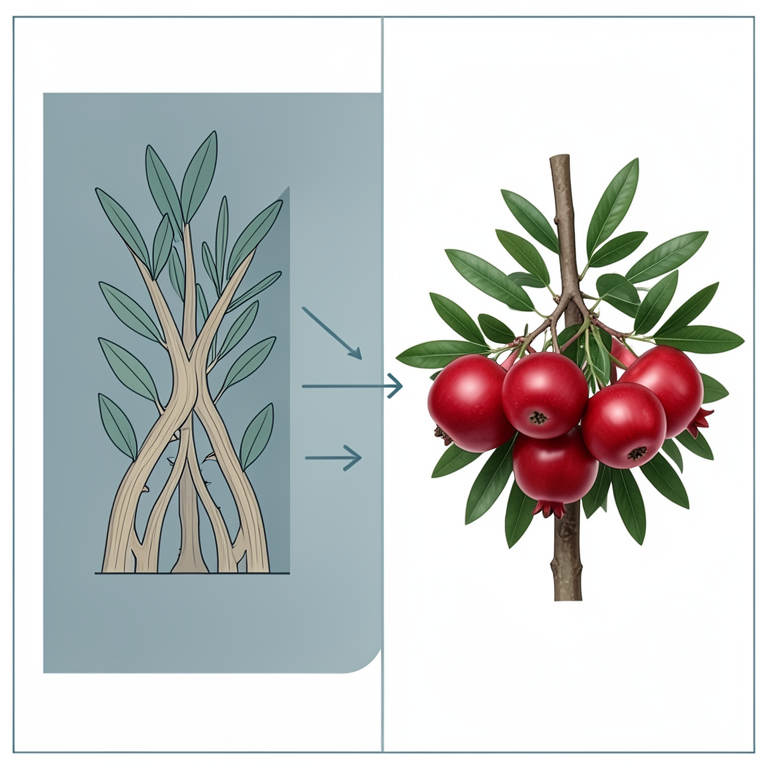
Complementary PGR Pathways
AI-generated conceptual illustration (pomegranate plants (Punica granatum L.)). It explains the idea and does not show study data.
View source evidence ↗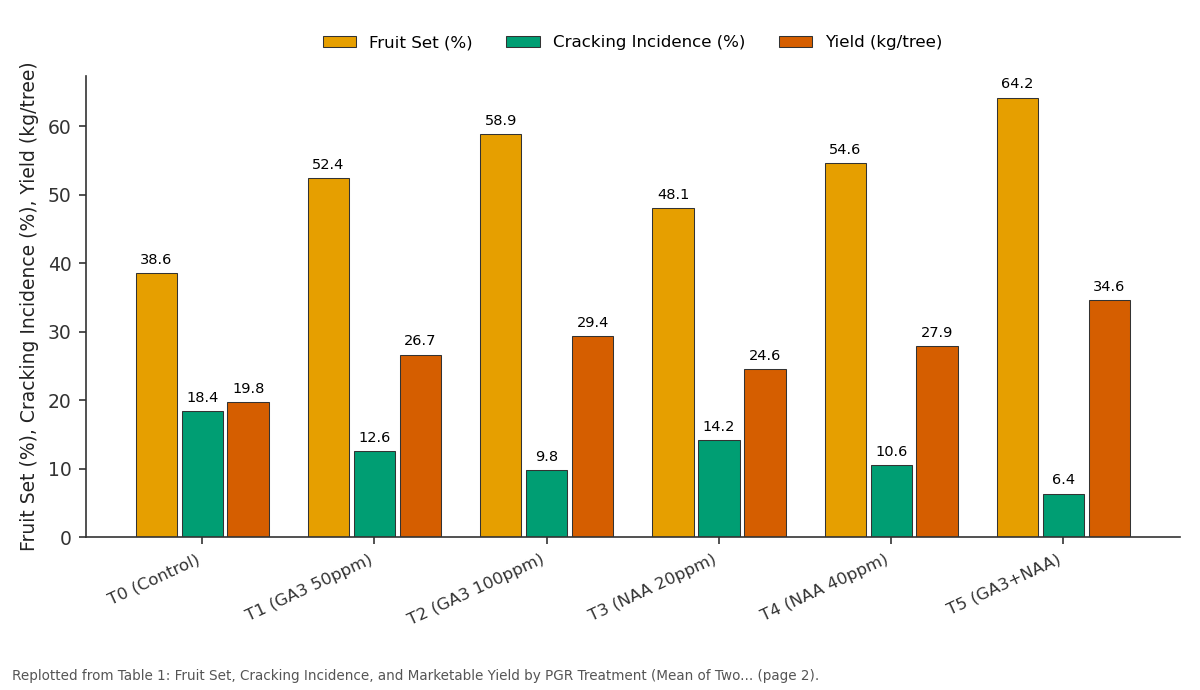
Fruit Set (%) and Cracking Incidence (%) and more: T0 (Control) vs T1 (GA3 50ppm) vs T2 (GA3 100ppm) vs T3 (NAA 20ppm) vs T4 (NAA 40ppm)
Replotted from Table 1 (page 2) of the original paper. Every bar is the paper's own table value.
View source evidence ↗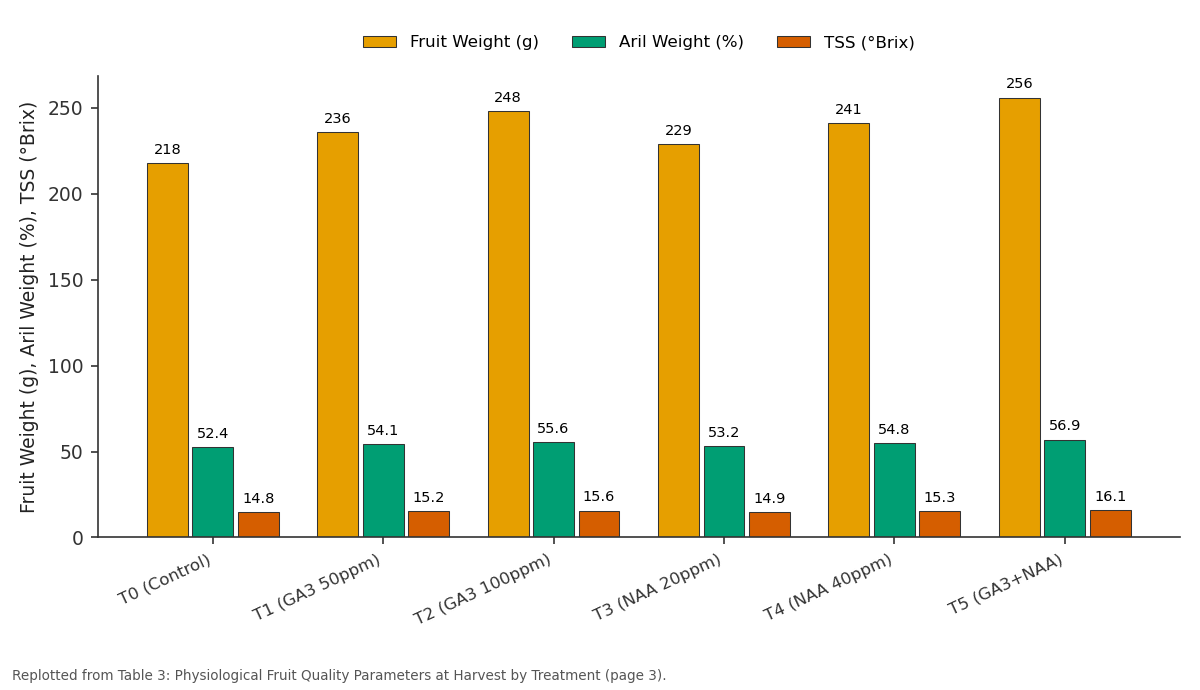
Fruit Weight (g) and Aril Weight (%) and more: T0 (Control) vs T1 (GA3 50ppm) vs T2 (GA3 100ppm) vs T3 (NAA 20ppm) vs T4 (NAA 40ppm)
Replotted from Table 3 (page 3) of the original paper. Every bar is the paper's own table value.
View source evidence ↗Figures & tables
From the original paper Table 1
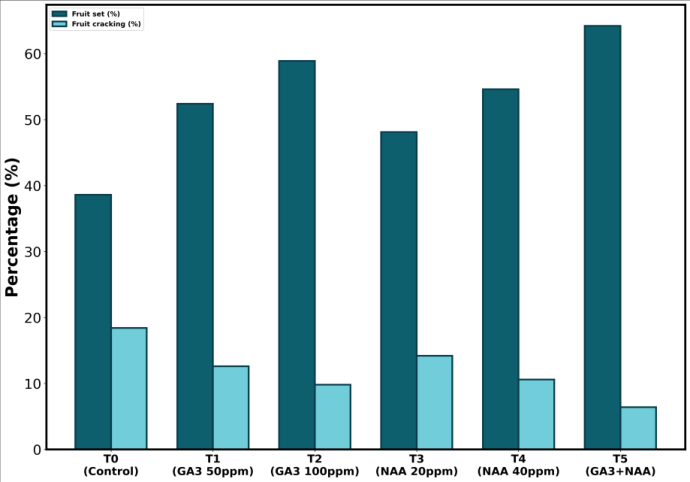 Figure 1
 Table 2
 Table 3
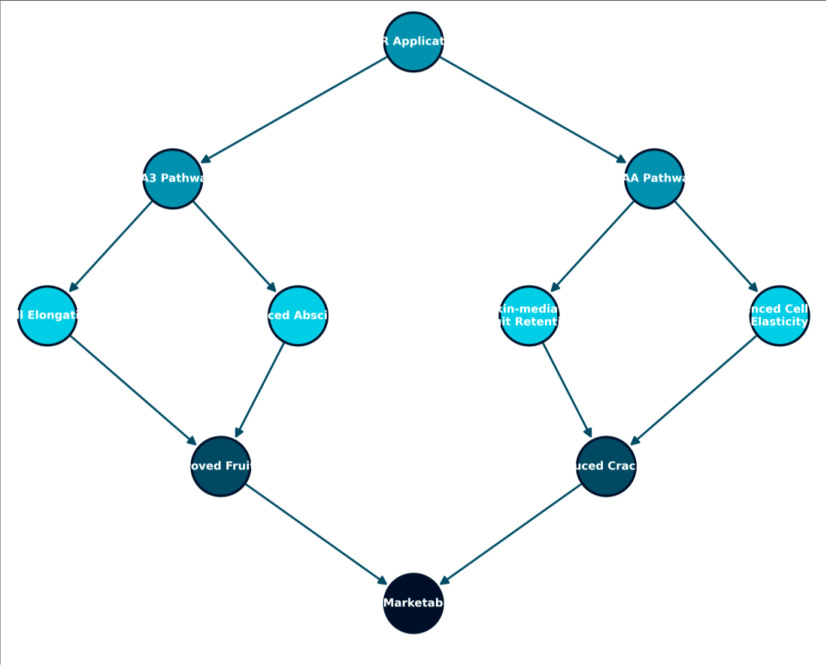 Figure 2
Introduction
A pomegranate grower facing both poor fruit set and high fruit cracking incidence in the same orchard, in the same season, confronts what looks superficially like two separate agronomic problems requiring two separate interventions. Poor fruit set, where flowers fail to develop into fruit following pollination, and fruit cracking, where developing fruit split open before or near harvest maturity, are conventionally discussed as distinct physiological phenomena in the pomegranate production literature, addressed through separate recommendations, cultural practices for fruit set and calcium or water management interventions for cracking, without much attention to whether a single intervention might address both simultaneously. Plant growth regulators offer a potential route to exactly this kind of combined solution, since gibberellic acid (GA3) and naphthalene acetic acid (NAA), both established PGR classes with documented effects on fruit set through reduced flower and young fruit abscission, may also influence fruit cell wall properties in ways relevant to cracking resistance, given that cracking susceptibility relates partly to fruit skin elasticity and turgor pressure dynamics that PGR-mediated cell wall changes could plausibly affect. Whether this connection holds in practice for pomegranate specifically, and whether combining GA3 and NAA delivers benefit beyond either PGR class applied alone, has received comparatively limited direct experimental attention despite the practical relevance to growers facing both constraints concurrently. This research tested five PGR treatments against an untreated control specifically to examine whether GA3 and NAA's effects on fruit set and cracking are additive, redundant, or synergistic when combined, information with direct practical value for designing pomegranate PGR spray programs. Two questions guided the fieldwork. First, does each PGR treatment improve fruit set and reduce cracking relative to the untreated control, and by how much? Second, does the combined GA₃+NAA treatment outperform either PGR applied alone on both parameters, suggesting complementary mechanisms, or does it show no additional benefit beyond the better-performing single PGR, suggesting redundant pathways? Beyond Sri Lanka's own pomegranate sector, which has expanded commercially over the past decade in response to growing domestic and export demand for fresh pomegranate arils, findings from this research carry relevance for other South and Southeast Asian pomegranate-growing regions facing similar dual constraints of inconsistent fruit set and cracking-related preharvest loss, particularly where growers currently follow single-PGR spray recommendations inherited from research conducted in different growing environments. Cost considerations also factor into how readily growers might adopt a combined PGR spray program relative to a single-PGR approach, since combining two PGR classes into one spray solution adds only marginal additional cost over a single-PGR application, given that both GA₃ and NAA are relatively inexpensive, widely available agrochemicals in most South Asian agricultural input markets, meaning the practical barrier to adopting a combined program, if the research evidence supports its superiority, is likely to be informational rather than financial for most commercial pomegranate growers.
Materials and Methods
Materials and Methods
Field Experimental Design
Six treatments, untreated control, GA₃ at 50 ppm, GA₃ at 100 ppm, NAA at 20 ppm, NAA at 40 ppm, and a combined GA₃ (75 ppm) + NAA (30 ppm) treatment, were applied to eight-year-old pomegranate trees of a commercially popular Sri Lankan cultivar arranged in a randomized complete block design with four replications, six trees per replicate. PGR sprays were applied as full foliar coverage sprays at full bloom and repeated three weeks later, with the untreated control receiving an equivalent water spray at the same timing.
Crop Growth Stage Documentation
Flowering intensity was recorded at full bloom by counting total flowers per tagged branch across four branches per tree. Fruit set was assessed four weeks after full bloom by counting retained young fruit relative to the initial flower count on the same tagged branches. Fruit cracking incidence was assessed continuously from color-break stage through harvest maturity, recording the percentage of fruit showing visible cracking at any point during this development window.
Methods
Final marketable yield was recorded per tree at harvest maturity, excluding cracked or otherwise unmarketable fruit. Data were analyzed using analysis of variance appropriate for a randomized complete block design across two fruiting seasons, with treatment means compared using the critical difference test at 5% significance, and season pooled given the absence of statistically significant seasonby-treatment interaction. A narrative bridge connects flowering intensity to the yield outcomes reported above: total flower production per branch varied only modestly across treatments (41.9 to 44.6 flowers/branch), confirming that the substantial yield differences observed stem primarily from differential fruit set and cracking rates rather than from PGR effects on flowering intensity itself.
Results
Results
Comprehensive Interpretation
The consistent ranking of the combined GA3+NAA treatment ahead of either PGR applied alone, across fruit set, cracking reduction, yield, and fruit quality parameters alike, supports treating these two PGR classes as acting through at least partially complementary physiological pathways rather than redundant or substitutable mechanisms, with GA3 contributing more strongly to cell elongation and abscission reduction while NAA contributes more directly to auxin-mediated fruit retention and cell wall elasticity relevant to cracking resistance. Mechanistically, GA3's well-established role in reducing fruit and flower abscission through delayed formation of the abscission layer likely explains much of its independent contribution to improved fruit set, while NAA's auxinmediated effects on cell wall plasticity and turgor regulation offer a plausible, if not fully confirmed, explanation for its independent contribution to reduced cracking incidence. The stronger performance of the combined treatment across both parameters simultaneously, rather than only on the parameter each PGR class individually favors most, suggests some genuine physiological complementarity between the abscission-delay pathway GA3 primarily influences and the cell-wall-elasticity pathway NAA primarily influences, rather than the combined treatment's advantage reflecting simply a higher total PGR dose applied. This carries a direct practical implication for pomegranate PGR spray program design: growers currently applying GA3 or NAA alone, whichever their local extension recommendation favors, would likely see meaningful additional benefit from switching to a combined program rather than increasing the dose of whichever single PGR they currently use, since this research's data show the combined treatment's advantage was not simply a matter of higher total PGR concentration but appeared to reflect genuine complementary action between the two PGR classes.
Discussion
A further point worth considering is the consistency of these results across two fruiting seasons that differed somewhat in pre-monsoon rainfall timing, with the second season experiencing a slightly wetter period around fruit development that is generally associated with higher baseline cracking risk in pomegranate. The combined GA3+NAA treatment's cracking reduction advantage held up across both seasons despite this environmental variation, suggesting the treatment's benefit is not narrowly contingent on a specific rainfall pattern, which strengthens confidence in recommending this combined protocol for broader onfarm adoption across seasons with varying weather conditions. The fruit quality improvements documented alongside the yield gains, including higher aril weight percentage and total soluble solids under the combined treatment, suggest that PGR-driven improvements to fruit retention did not come at the expense of individual fruit quality, a trade-off that sometimes accompanies interventions that simply increase fruit load without addressing underlying resource allocation constraints. This pattern is reassuring from a commercial standpoint, since growers adopting this recommendation can expect improvements in both total marketable yield and perfruit quality attributes relevant to fresh-market pricing, rather than a simple quantity-quality trade-off that would partially offset the yield gain's commercial value.
Conclusion
This research evaluated five PGR treatments against an untreated control for their combined effect on pomegranate flowering, fruit set, cracking, and yield under Kandy, Sri Lanka growing conditions across two fruiting seasons. The combined GA3+NAA treatment consistently outperformed either PGR applied alone across every parameter measured, improving fruit set from 38.6% to 64.2%, reducing cracking incidence from 18.4% to 6.4%, and raising marketable yield from 19.8 to 34.6 kg/tree relative to the untreated control, a combination of benefits that addressed both major yieldlimiting constraints, poor fruit retention and pre-harvest fruit loss to cracking, through a single integrated spray program. For Sri Lankan pomegranate growers and extension programs, the most direct recommendation from this research is that combined GA3 (75 ppm) + NAA (30 ppm) foliar application at full bloom, repeated three weeks later, offers a more effective route to improved yield and fruit quality than either PGR applied alone, given its demonstrated ability to address fruit set and cracking simultaneously rather than requiring separate interventions for each constraint. Given the two-season consistency of these results, this combined treatment protocol appears ready for broader on-farm validation trials, and extending this research design to additional pomegranate cultivars grown under different regional conditions across South Asia would help establish how widely this specific PGR combination and concentration recommendation can be generalized beyond the single cultivar and location examined here.
Figures and tables from the paper
| Treatment | Fruit Set (%) | Cracking Incidence (%) | Yield (kg/tree) |
|---|---|---|---|
| T0 (Control) | 38.6 | 18.4 | 19.8 |
| T1 (GA3 50ppm) | 52.4 | 12.6 | 26.7 |
| T2 (GA3 100ppm) | 58.9 | 9.8 | 29.4 |
| T3 (NAA 20ppm) | 48.1 | 14.2 | 24.6 |
| T4 (NAA 40ppm) | 54.6 | 10.6 | 27.9 |
| T5 (GA3+NAA) | 64.2 | 6.4 | 34.6 |
Table text extracted from the original PDF; superscript letters are shown inline. The original table image is below.
View original table image
| Treatment | Flowers/Branch | Fruit Set:Yield Correlation (r) |
|---|---|---|
| T0 (Control) | 42.6 | 0.71 |
| T1 (GA3 50ppm) | 44.1 | 0.76 |
| T2 (GA3 100ppm) | 43.8 | 0.79 |
| T3 (NAA 20ppm) | 41.9 | 0.74 |
| T4 (NAA 40ppm) | 43.2 | 0.77 |
| T5 (GA3+NAA) | 44.6 | 0.83 |
Table text extracted from the original PDF; superscript letters are shown inline. The original table image is below.
View original table image
| Treatment | Fruit Weight (g) | Aril Weight (%) | TSS (°Brix) |
|---|---|---|---|
| T0 (Control) | 218 | 52.4 | 14.8 |
| T1 (GA3 50ppm) | 236 | 54.1 | 15.2 |
| T2 (GA3 100ppm) | 248 | 55.6 | 15.6 |
| T3 (NAA 20ppm) | 229 | 53.2 | 14.9 |
| T4 (NAA 40ppm) | 241 | 54.8 | 15.3 |
| T5 (GA3+NAA) | 256 | 56.9 | 16.1 |
Table text extracted from the original PDF; superscript letters are shown inline. The original table image is below.
View original table image
References
15 in the original paper- Bakshi P, Jasrotia A, Wali VK, Sharma A, Bakshi M. Effect of plant growth regulators on fruit retention, yield and quality attributes in pomegranate (Punica granatum L.) cv. Kandhari Kabuli. Afr J Agric Res. 2013;8(19):2266-2269.
- Bhantana P, Lazarovitch N. Evapotranspiration, crop coefficient and growth of two young pomegranate (Punica granatum L.) varieties under salt stress. Agric Water Manag. 2010;97(5):715-722.
- Chundawat BS, Singh RS. Effect of growth regulators on fruit drop, yield and quality of pomegranate. Punjab Hortic J. 1976;16(1-2):53-56.
- Davarpanah S, Tehranifar A, Davarynejad G, Aran M, Abadía J, Khorasani R. Effects of foliar applications of zinc and boron nano-fertilizers on pomegranate (Punica granatum cv. Ardestani) fruit yield and quality. Sci Hortic. 2016;210:57-64.
- Elyatem SM, Kader AA. Post-harvest physiology and storage behaviour of pomegranate fruits. Sci Hortic. 1984;24(3-4):287-298.
- Ghosh SN, Bera B. Effect of plant growth regulators and micronutrients on fruit cracking and quality of pomegranate cv. G-137. Indian J Hortic. 2010;67(Special Issue):Page numbers not available in the source provided.
- Holland D, Hatib K, Bar-Ya'akov I. Pomegranate: botany, horticulture, breeding. Hortic Rev. 2009;35:127-191.
- Kumar R, Kumar S, Sharma KK. Effect of plant growth regulators on flowering, fruit set and yield of pomegranate. Indian J Hortic. 2011;68(4):444-447.
- Mars M. Pomegranate plant material: genetic resources and breeding, a review. Options Mediterr. 2000;42:5562.
- Melgarejo P, Salazar DM, Artés F. Organic acids and sugars composition of harvested pomegranate fruits. Eur Food Res Technol. 2000;211(3):185-190.
- Ram RA, Rajput MS, Verma AK. Effect of pre-harvest sprays of growth regulators on fruit cracking and quality of pomegranate. Indian J Hortic. 2007;64(2):159-162.
- Sharma R, Yamdagni R. Studies on physicochemical changes during fruit development in pomegranate cv. Ganesh. Haryana J Hortic Sci. 1998;27(3-4):169-171.
- Singh AK, Chundawat BS. Effect of GA₃, NAA and 2,4-D on fruit cracking and quality of pomegranate cv. Ganesh. Prog Hortic. 1996;28(1-2):51-54.
- Verma HS, Rajput CBS, Chand P. Effect of plant growth regulators on fruit drop, physico-chemical characters and yield of pomegranate cv. Jyoti. Prog Hortic. 2000;32(2):176-179.
- Wetzstein HY, Ravid N, Wilkins E, Martinelli AP. A morphological and histological characterization of bisexual and male flower types in pomegranate. J Am Soc Hortic Sci. 2011;136(2):83-92.